CPJ calls on Bahrain to end harassment of critical journalists
CPJ calls on Bahrain to end harassment of critical journalists
by: Committee to Protect Journalists
New York, July 19, 2011–The Committee to Protect Journalists calls on Bahrain to end harassment and contrived legal proceedings against critical journalists. Since February, critical journalists have been intimidated, interrogated, smeared in government-owned and -aligned publications, and harassed and sued by government supporters.
Reem Khalifa, a journalist for the much-harassed Arabic-language daily Al-Wasat and a contributor to other local and international media, has been the target of harassment, intimidation, and a coordinated smear campaign; ,most recently she was also charged with verbally abusing and physically assaulting a government supporter, according to local news reports.
“Bahrain’s government has a responsibility to protect journalists from those who resort to threats of violence, intimidation, or fabricated criminal charges to influence coverage,” said CPJ Middle East and North Africa Program Coordinator Mohamed Abdel Dayem. “The government should halt the smear campaign in pro-government publications against critical journalists.”
Khalifa was at a press conference held by an Irish delegation of medical, political, and human rights practitioners at a Manama hotel on Thursday evening. The press conference ended prematurely after government supporters and journalists with state media outlets bullied delegation members, as well as independent and critical journalists, according to CNN. When Khalifa tried to interview a member of the delegation she was repeatedly interrupted by a small group of pro-government medical practitioners, who followed and taunted her, according to Khalifa and corroborating testimony by other journalists who were present.
An argument ensued and Khalifa reached to take a camera away from a woman who was haranguing and filming her. Described by various news outlets as a physician or a nurse, Hind al-Fayez claimed that Khalifa had hit her. CPJ’s review of the video footage and still shots from it indicate that Khalifa did not strike al-Fayez. On Sunday, Khalifa was summoned by the public prosecutor for questioning and was released pending an investigation, according to local news reports. Khalifa denied all accusations and filed a counterclaim for insult and invasion of privacy.
Meanwhile, state media have engaged in a smear campaign against Khalifa, reporting on the incident as if she had committed a crime and had been found guilty of it. Al-Watan, Al-Ayyam, Akhbar al-Khaleej, Al-Bilad¸and the official Bahrain News Agency all described her as an assailant and most attached misleading still shots from the video that insinuate that Khalifa had struck al-Fayez. …more
July 20, 2011 Add Comments
Bahrain: Washington and London Endorse Dialogue With Tyrants, War Criminals and Torturers
Bahrain: Washington and London Endorse Dialogue With Tyrants, War Criminals and Torturers
by Finian Cunningham – Global Research, July 20, 2011
Efforts by the US and British-backed Bahraini regime to repair its international image over human rights violations are in tatters with the revelation that senior members of the oil kingdom’s royal family have been personally involved in torturing hundreds of civilian detainees, including doctors and nurses.
One of the torturers-in-chief is Captain Nasser Al Khalifa, son of the king. He graduated this year “with honours” from the US Marine Corps University at Qantico, Washington.
This criminal rule by inner-circle members of the House of Al Khalifa also exposes Washington and London’s efforts to positively talk up reforms and dialogue by their Persian Gulf ally as a cynical sham. In Libya and Syria, war and sanctions are declared against alleged human rights abusers. But in Bahrain, Washington and London say pro-democracy protesters must embrace the rulers’ so-called initiative for national dialogue.
Revelations of royal family brutality in Bahrain also make a mockery of King Hamad’s announcement last month of an “independent” human rights probe into violations that took place during the Western-backed Saudi-led military invasion of the oil-rich kingdom earlier this year.
Yet again Washington and London had trumpeted this move as a positive step to reform in the Gulf kingdom, where a minority unelected Sunni elite has ruled over a majority Shia population for 40 years since nominal independence from Britain in 1971.
But how can such a regime be taken seriously for investigating crimes against humanity when the perpetrators of those crimes are senior members of the regime? Since the popular and peaceful uprising against the US and British-backed monarchy began in mid-February, nearly 40 unarmed civilians have been killed by state forces. The head of the armed services is Supreme Commander King Hamad. …more
July 20, 2011 Add Comments
People trampled upon by tyranical leaders will rise up and have their justice, it’s the natural course of revolution
July 19, 2011 Add Comments
Full-tilt repression and a punishing tyrant King pushing Bahrain into the abyss with the US and UK his cheering section
“On June 29, Reuters reported that Bahrain University is requiring its students to sign the loyalty pledge or give up their right to higher education. I’ve received messages from students saying they were corralled into signing, and did so, fearing reprisals if they didn’t. Among the demands: students must pledge to avoid “harming Bahrain’s domestic or international reputation.”
But it is the ruling Al Khalifas who have grievously harmed Bahrain’s reputation. Bahrain’s rulers should consider another approach. How about just pledging allegiance to the rights of citizens of Bahrain to free speech, peaceful assembly and justice?”
Pledging Allegiance in Bahrain
by Dan Williams
Published in: The Huffington Post – July 19, 2011
Since mid-April, the government of Bahrain has urged its citizens to sign pledges of allegiance to the country’s “wise leadership,” saying the signatures would be inscribed on a golden sword whose existence would then be entered in the Guinness Book of World Records, in the category of… well, “sword bearing the largest number of signatures,” according to the official Bahrain News Agency.
Allegiance “events” have been held all over the island kingdom — in stadiums, schools and, in June, at businesses where citizens lined up dutifully to sign the pledge.
No reports yet on whether the campaign includes prisons, where hundreds of political protestors and dissidents are held.
Bahrain’s serial assault on the country’s pro-democracy protest movement has been eclipsed by the violent upheavals in Syria, Libya, and Yemen. Yet, Bahrain is geostrategically important and should not be ignored. The US Fifth Fleet is based in Bahrain. Bahrain’s ruling family and its main regional backer, Saudi Arabia, have positioned the small kingdom at the epicenter of a tense rivalry with Iran.
That would argue for resolving Bahrain’s crisis as a high priority both for the government and its international backers. So far, the strategy is full-tilt repression.
On July 5, Human Rights Watch issued a briefing paper detailing the systematic crackdown on critics of the government since mid-March, when government police and army troops violently brought an end to a month of mostly peaceful protests. Hundreds of prisoners remain in incommunicado detention; credible charges of torture have gone unaddressed.
At first glance, the 30 deaths at the hands of Bahrain’s security forces don’t match the scale of hundreds of civilian deaths in Libya or Syria. But the native population of Bahrain is just 525,000 and official violence has been visited almost exclusively on Shiite Muslim citizens, who make up about 60 percent of Bahrainis. Moreover, the range of repression is breathtaking: besides torture, televised confessions, midnight home raids by masked men with guns, beatings, mass firings from jobs in the private sector, withdrawal of scholarships at home and abroad from students who demonstrated.
You might not hear much about all this, and not only because media attention is elsewhere. On May 24, the government ordered Frederik Richter, a Reuters correspondent and the only resident international journalist based in Bahrain in recent years, to leave. Human Rights Watch has not been allowed in since the authorities, on April 20, gave me 24 hours to leave after I asked to extend my visa.
The government sometimes tries to put out its own version of events, sometimes quite clumsily. In early April, photos circulated on the Internet of the body of Ali Ibrahim Isa Saqer, who died in jail and whose corpse was bruised and slashed. The government threatened to jail a human rights activist, Nabeel Rajab, for “circulating fabricated photos” of Saqer’s body, but the photos I saw matched the state of Saqer’s body, which I viewed when I observed the body prior to burial at its ceremonial cleansing. …more
July 19, 2011 Add Comments
After months of continued Saudi occupation, Bahrain Security Forces attack Almaameer village protesters 19July, 2011
July 19, 2011 Add Comments
Where are Independent International Investigators – none appointed by King Hamad. Who prosecute the crimes of torture – not King Hamad
Bahrain security forces ‘tortured patients’
By Patrick Cockburn – Friday, 22 April 2011
Bahrain’s security forces stole ambulances and posed as medics to round up injured protesters during a ferocious crackdown on unarmed demonstrators calling for reform of the monarchy, an investigation by a rights group reveals today.
The first major report on repression of the medical profession during the country’s crisis details how a doctor was abducted during an operation and injured patients lying in hospital were tortured and threatened with rape.
The investigation by Physicians for Human Rights (PHR) followed a report by The Independent yesterday detailing threats faced by medical staff who treated victims of the repression. More than 30 medics have been taken away by security forces and have had little or no contact with their families.
The report said it found that security forces targeted Shia doctors in particular. The crackdown has created such a climate of fear that wounded people were too frightened to go to hospital to seek treatment.
The Bahraini monarchy responded to calls for reform by massed demonstrations starting on 14 February by calling in 2,000 troops from Saudi Arabia and other Gulf states. Over the next two days, Bahraini security forces, backed by the Saudis, drove protesters from the streets, made arbitrary arrests of at least 500 people, systematically tortured detainees and sacked anybody who had shown sympathy for protests.
The group’s investigators said they received witness evidence that security forces stole at least six ambulances. “Police forcibly removed ambulance medics from the vehicles, made them remove their uniforms at gunpoint, and then posed as medics, reportedly to get closer to injured protesters to detain them,” the report said. It also related how “armed security forces abducted Dr Ali El-Ekri from the operating room while he was performing surgery at Salmaniya Hospital on 17 March.”
Patients and detainees have been targeted according to the report which says that methods used against them include “torture, beating, verbal abuse, humiliation, and threats of rape and killing.”
In one case a Bahraini called Ali was shot in the face with bird shot and was taken while unconscious to Salmaniya hospital in the capital Manama where he remained for five days. On his second day there “three armed security forces handcuffed Ali and a dozen other wounded men behind their backs with plastic wrist ties and began to beat them.”
Ali and the other patients were thrown from their beds onto the floor where they lay face first and were then dragged, leaving trails of blood, into a hallway of the hospital. An Indian nurse told the security men: “Don’t hurt them. They are our patients.” …more
July 19, 2011 Add Comments
Israeli Navy takes Dignite/Al Karama in international waters – CALL TO ACTION
Israeli Navy takes Dignite/Al Karama in international waters – CALL TO ACTION
by US Boat to Gaza
Tuesday Jul 19th, 2011 11:20 AM
Earlier today, the Israeli navy took control of the one boat from Freedom Flotilla II that had made it into international waters on their way to Gaza. The French-flagged boat – Dignite/Al Karama – carried 16 people from France, Canada, Greece, Sweden and Tunisia. They were stopped about 40 miles away from Gaza [in international waters] and after several hours the Israelis took control of the boat, bringing it to the Israeli port of Ashdod.
There are no reports of any injuries and we have heard the passengers were being arrested. We do not yet know how long they will be detained or what will happen to the boat.
We urge you to contact the Israeli Embassy in Washington, DC to call for the immediate release of these people. And – most importantly – we must call on the Israeli government to end the siege and blockade of Gaza, and to treat the people of Palestine in compliance with international law!
Israeli Embassy in Washington, DC
telephone: 202-364-5500
fax: 202-364-5423
A list of the Israeli consulate offices around the U.S. will be posted our website later today. Please call any of those numbers as well. …source
July 19, 2011 Add Comments
Picket of Israeli owned-ship at Deltaport
Picket of Israeli owned-ship at Deltaport in response to blocking of aid flotilla to Gaza
By Canadian Boat to Gaza | July 19, 2011
Activists from throughout the Lower Mainland will gather early Tuesday morning at Deltaport for an information picket targeting a major Israeli shipping company, Zim. The action is in solidarity with the aid flotilla to Gaza, which included a Canadian Boat and which has been prevented from sailing to the occupied and blockaded Palestinian territory.
The protest will take place Tuesday, July 19, 7:00 a.m. – 8:00 a.m., Deltaport. Returning delegates from the Canadian Boat to Gaza, the Tahrir, will be among the participants in the picket Tuesday morning. The Tahrir was stopped from sailing to Gaza by the Greek coast guard.
“The Israeli government attacked our humanitarian flotilla with sabotage, threats of violence, and a great deal of political and economic pressure — that’s ultimately why the Greek government shamefully agreed to enforce the Israeli blockade,” said Irene MacInnes, a Vancouver member of the Canadian Boat to Gaza (CBG) who was among more than 30 Canadians on board the Tahrir.
“Our Canadian Boat and the Freedom Flotilla aimed to highlight the impact of the blockade of Gaza,” added MacInnes. “While Gazans cannot travel or ship exports by sea, massive Israeli companies like ZIM are able to freely do business around the world despite their connection to the unjust policies that bring so much suffering to Palestinians.”
Zim is by far the biggest Israeli shipping company, and one of the 10 largest in the world, with 60 weekly services to 180 ports worldwide, including Deltaport. This year’s Freedom Flotilla was a follow up to a similar effort in May 2010, when Israeli armed forces raided a Turkish ship, the Mavi Marmara, killing nine activists. …more
July 19, 2011 Add Comments
Israeli navy intercepts and boards Gaza-bound French boat
Israeli navy intercepts and boards Gaza-bound French boat
Published today (updated) 19/07/2011 15:34
BETHLEHEM (Ma’an) — The Israeli navy intercepted and boarded the French-flagged Dignite Al-Karame boat on Tuesday as it approached the Gaza Strip.
At least three Israeli military ships had surrounded the yacht as it neared Gaza, seeking to breach Israel’s blockade on the territory, an organizer told AFP on Tuesday.
The Israeli navy said it had “exhausted” all diplomatic channels but the vessel had ignored the calls. The navy then took control of the ship and are taking it to the port of Ashdod.
Following the seizure, the passengers’ health was examined and they were offered food and beverages, an army statement said.
The passengers will face questioning upon arrival at the Israeli port and will be referred to immigration authorities.
The Israeli army had released a statement earlier saying that ‘contact’ had been made with the boat.
“The boat is surrounded by at least three Israeli ships and since 9:06 am all the communications have been jammed. We can’t get in touch with them by phone or by Internet,” one of the organizers Julien Rivoire said by phone from Paris.
“We call on the French government to take its responsibilities and to protect the passengers, and to call on Israel not resort to violence.”
The boat set sail for Gaza after a night anchored at sea, despite Israeli warnings that it would intercept the vessel — the only boat remaining from a flotilla of 10 ships that had planned to breach Israel’s blockade this summer.
The Israel navy earlier warned the Dignite Al-Karame that it is on route to “an area under a maritime security blockade” and told them that any supplies they carry can be transferred through land crossings and the Ashdod port.
Organizers of the ship had said they expected it to arrive in Gaza on Tuesday.
“This ‘little’ boat symbolizes the determination of the international solidarity movement to break the blockade on Gaza and express its support for the 1.6 million Palestinians imprisoned there since 2007,” a statement from the boat said Monday.
“The fact that the Dignite Al Karama is at sea is a setback for the Israeli government which by force or by pressure is trying to perpetuate an illegal and criminal blockade and to silence civil society movements around the world,” it said.
The French-flagged vessel had managed to escape the clutches of the Greek coastguard on July 5, but two days later, it was blocked by the authorities in Crete when it stopped to refuel.
A 10 ship Freedom Flotilla had been due to sail from Greece at the end of June but was hit by a wave of red tape and technical faults which organizers blamed on Israel.
Israel has vowed to prevent any attempt to reach Gaza by sea in defiance of its naval blockade which was first imposed in 2006 after militants there captured an Israeli soldier.
Rights groups have the condemned the blockade as a form of collective punishment of the 1.6 million Gaza residents.
AFP contributed to this report …source
July 19, 2011 Add Comments
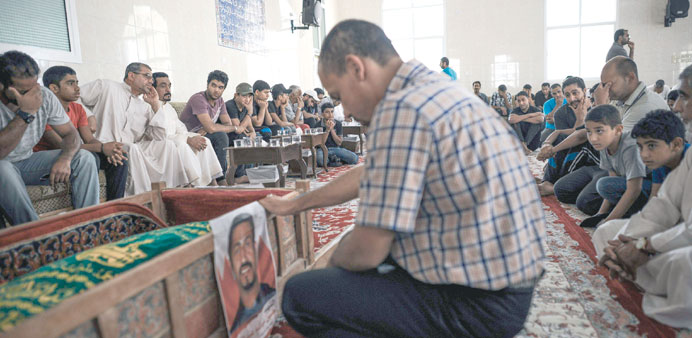
Religious freedom during prayers at Mosque in Sitra
July 19, 2011 Add Comments
Bahrain: Stop Systematic Attacks on Medical Providers
Bahrain: Systematic Attacks on Medical Providers
Stop Targeting Medics, Patients, Health Facilities
July 18, 2011
(Beirut) – The Bahraini government should immediately end its campaign of arrests of medical professionals and attacks on injured patients linked to recent anti-government protests, Human Rights Watch said in a report released today. Human Rights Watch called on authorities to investigate the violations against medical personnel and patients who exercised their rights to freedom of expression and assembly, hold those responsible to account, and allow unhindered access to medical treatment for all.
The 54-page report, “Targets of Retribution: Attacks against Medics, Injured Protesters, and Health Facilities,” documents serious government abuses, starting in mid-February 2011. These include attacks on health care providers; denial of medical access to protesters injured by security forces; the siege of hospitals and health centers; and the detention, ill-treatment, torture, and prosecution of medics and patients with protest-related injuries.
“The attacks on medics and wounded protesters have been part of an official policy of retribution against Bahrainis who supported pro-democracy protests,” said Joe Stork, deputy Middle East director at Human Rights Watch. “Medical personnel who criticized the severe repression were singled out and jailed, among the more than 1,600 Bahrainis facing solitary confinement and ill-treatment in detention and unfair trials before a special military court.”
The government violations were part of the violent response by authorities to largely peaceful pro-democracy and anti-government demonstrations that began in February and continued months after military and security forces began a massive crackdown in mid-March, which led to the armed occupation of Bahrain’s main public hospital, the Salmaniya Medical Complex, on March 16.
Beginning on February 17, Human Rights Watch documented attacks by security forces on paramedics, doctors, and nurses who were providing urgent offsite medical care to wounded protesters and bystanders. Sadiq Alekry, a 44-year-old doctor, volunteered his services at the Pearl Roundabout on the evening of February 16, prior to the attack by security forces after midnight that resulted in the deaths of four protesters. Shortly after 3 a.m. Dr. Alekry said, riot police confronted him with sticks and guns, handcuffed him and began punching, kicking, and beating him with sticks. …more
July 19, 2011 Add Comments
US needs to become visible and meaning part of “Bahrain Solution” and check al Khalifa regime’s abuses
After Opposition’s Withdrawal, U.S. Urged to Declare its Position on National Dialogue in Bahrain
For Immediate Release: July 19, 2011
Washington, D.C.—The U.S. government should immediately and publicly declare whether it still supports the Bahraini government’s National Dialogue after the country’s main opposition party, Al Wefaq, has officially withdrawn, said Human Rights First today.
“A wide range of human rights defenders in Bahrain told us last week the dialogue is cosmetic, and the U.S. government is losing credibility by being associated with it,” said Human Rights First’s Brian Dooley, who just returned from a fact finding mission in Bahrain. “Even as the dialogue sessions meet, the Bahraini government continues to shoot at civilians, detain opposition members, torture human rights defenders and intimidate all those who speak out.”
Last week, Human Rights First released a new report on the continuing human rights crackdown in Bahrain. The report is based on eye-witness testimonies and in-country interviews with human rights defenders, and includes recommendations for the U.S. and Bahraini governments.
The complete report and recommendations can be found here.
“Human rights defenders told us the Bahraini government must rebuild community trust before any dialogue can be real,” added Dooley. “They argue that the U.S. government has influence it can use in persuading the Bahraini government to take necessary confidence-building steps. These steps include: stopping all violence against peaceful protesters, ending the abuse and torture of all detainees –and giving them medical attention and visits from their families–and releasing all political detainees and members of the opposition. It’s time the U.S. government uses that influence.” …more
July 19, 2011 Add Comments
Remembering the CIA’s Chile 1973 – the daunting task of holding torturers accountable
Remember 1973. Hold Torturers Accountable.
Americas, Amnesty Members, Torture, USA | Posted by: The Editors, July 19, 2011 at 10:06 AM
By Kalaya’an Mendoza, Field Organizer for Amnesty Western Region
On July 15th a group of activists from Amnesty International USA and Survivors of Torture International held a protest on board the Chilean vessel “La Esmeralda” as it docked in San Diego Harbor.
Activist Hannah Bogen in front of La Esmeralda in San Diego Harbor.
In 1973, after former Chilean General Augusto Pinochet seized power in a military coup, the ship served as an interrogation center for political prisoners. Survivors described torture that included beatings, electric shocks and sexual assault.
Currently, the Esmeralda is traveling around the Americas acting as a roving ambassador for Chile on a mission of “goodwill.” The crew invited happy families, wide-eyed tourists and, unbeknownst to them, a small group of human rights activists ready to unfurl signs on board that read: “Remember 1973. Hold Torturers Accountable.”
This protest follows the recent decision by a Chilean judge to drop charges against most of those implicated in the historic case of a priest believed to have died aboard the Esmeralda in 1973. Father Michael Woodward was arrested in September of that year, and taken to the Esmeralda, where he was interrogated and tortured. He was pronounced dead in a naval hospital six days after his arrest, but his body has never been recovered.
Twenty-nine former naval and police officials were initially indicted in the case. Last week, charges were dropped against nineteen of them. The remaining former low-ranking officials facing charges are now being prosecuted only for Father Woodward’s abduction, rather than for his torture and disappearance, which are crimes under international law. Guadalupe Marengo, Amnesty International’s Deputy For the Americas, sums it up:
“It is bitterly ironic that the Esmeralda is still going from international port to international port as a so-called ambassador for Chile, even as those involved in this infamous case of torture below its decks seem to be getting away with murder.”
Amnesty activists boarded the ship on behalf of the survivors and victims of the torture that was committed beneath its decks over 30 years ago. We wanted to remind the Chilean government of their responsibility to ensure that all those responsible for these heinous crimes, including those who gave the orders, are brought to justice. You can watch video footage of our protest here.
No matter where “La Esmeralda” goes, we shall follow. …source
July 19, 2011 Add Comments
Bahrain says talks to continue despite opposition walkout – talking to the mirror
Bahrain says talks to continue despite opposition walkout
Isabel Coles, Reuters July 18, 2011, 11:47 pm
DUBAI (Reuters) – Bahrain’s government expressed regret Monday that the country’s largest Shi’ite opposition group Wefaq planned to pull out of a national dialogue, but said political talks would continue with or without the influential group.
The Gulf kingdom’s Sunni rulers launched a national dialogue on July 2 to discuss reforms and address grievances, after a four-month crackdown that began in March and crushed weeks of pro-democracy protests led by the Shi’ite majority.
A walkout by the largest opposition group could damage the dialogue’s chances of reaching national consensus as sectarian tensions continue to simmer in kingdom.
Protests have erupted almost daily in Shi’ite villages ringing the capital Manama since Bahrain lifted emergency law in June, and tension had been rising as demonstrators increasingly demanded that the opposition quit the talks.
The National Dialogue’s spokesman, Isa Abdul Rahman, said Wefaq could rejoin the talks if it changed its mind.
“Should any participant choose to exclude themselves from the process, the door will remain open for them to return to the talks. Regardless of any participant’s decision to leave the Dialogue will continue,” he said.
Wefaq said Sunday it would withdraw because its views were not being taken seriously in talks it accused of being dominated by pro-government representatives. That decision still has to be ratified by the movement’s higher council.
Wefaq and six other political opposition groups, which were invited to take part in talks, have complained their proposed political reforms would never be put into effect because the opposition received only 35 out of 300 seats at the talks.
Wefaq, which held over 40 percent of seats in the country’s elected lower council before it resigned in protest in February, was given five seats at the talks.
The government has defended its apportioning of representatives, saying it wants the dialogue to include all Bahrainis, whether they are involved in politics or not.
Bahrain is seen as a fault line for tensions between Iran and Sunni Gulf Arab countries that are wary of protests spreading to their own Shi’ite minorities. The government has accused the opposition of pursuing a sectarian agenda with backing from nearby Shi’ite power Iran, charges the groups deny.
Mainstream opposition groups such as Wefaq have called for a more representative parliamentary system and greater powers for the elected lower council, whose powers are neutered by the upper Shura council, appointed by the king.
But hard liners calling for the abolition of the monarchy have gained popularity since the crackdown.
Dialogue spokesman Abdul Rahman said he was disappointed Wefaq had not stuck with the talks.
“It is sometimes harder to stay and help shape the solution than to walk away. Now is the moment to heal divides and unite behind a shared vision of Bahrain’s future,” said spokesman Isa Abdul Rahman. “We consider al-Wefaq’s contribution to the dialogue as central to its success thus far.” …source
July 19, 2011 Add Comments
Al Wefaq trying to find leadership footing and a voice of relevance after the opposition moved beyond al Khalifa’s “dialogue”
[cb editor: after finding nothing of value at the table with al Khalifa, Al Wefaq seems a bit lost as it tries to reestablish it’s self amongst the opposition. Real questions remain what opportunism drew them to al Khalifa’s table to begin with. Al Khalifa with Western endorsement went back to the vomit of the pretense of reform that has plagued Bahrain for more than the last decade with Al Wefaq joining them as a seemingly willing partner. Since the national dialogue seemed not to include them, was “stacked against them”, they have now moved on but one can only be suspicious of what they have moved on to? Maybe an even more theatric rejoining of talks after they “walk out” on the “rest of the opposition”. A curious thought, perhaps they were “sent out” to bring something of value back to the table they left behind – an abandonment of a revolutionary movement they been all to reluctant to embrace from the beginning? This dangerous middle road seems all so attractive and easily played by Hamad and those who would see him King. It is with great hope they get on with the business of revolution and help insist on the disposal of the al Khalifa’s regime of terror and pain. ]
Bahrain’s opposition quits talks
irishtimes.com – Last Updated: Sunday, July 17, 2011, 16:23
Bahrain’s largest Shia opposition group Wefaq said today it planned to pull out of a national dialogue, which was aimed at reforms after mass pro-democracy protests rocked the Gulf island kingdom earlier this year.
Opposition groups like Wefaq had complained since talks began on July 2nd that they would never be able to get their proposed political reforms put into effect, as the opposition received only 35 of 300 seats at the talks.
The government has defended its apportioning of seats, saying it wanted the talks to include all Bahrainis, whether they were involved in politics or not.
“The Wefaq board decided to pull out of the so-called National Consensus Dialogue and submitted its decision to the Wefaq Shura council (upper council) for ratification,” Khalil al-Marzouq, spokesman for Wefaq, said.
“Wefaq tried with all seriousness to offer political solutions and it was always responded to with rejections, or it was ignored,” he said.
Mainstream opposition groups such as Wefaq have called for a more representative parliamentary system and greater powers to the elected lower council, whose powers are neutered by the upper Shura council, appointed by the king.
But hardliners calling for the abolition of the monarchy have gained popularity since the crackdown by Bahrain’s Sunni rulers. Security forces crushed weeks of protests in March led by the country’s majority Shia population, who were demanding a greater say in government.
The government accused the opposition of a sectarian agenda with backing from nearby Shia power Iran, charges the groups deny. Bahrain is seen as a fault line for tensions between Iran and Sunni Gulf Arab countries that are wary of protests spreading to their own Shia minorities. …more
July 18, 2011 Add Comments
HRW says Bahrain targeting medical workers
[cb editor: Joe Stork and his team at Human Rights Watch continue to do an exceedingly excellent job regarding Bahrain. HRW has been a voice of objective reason in the midst of the insane brutality that has poured out from the al Khalifa regime on the people of Bahrain who seek dignity, protection of their human rights and to live in a fair and justly governed society. Congratulations to you Mr. Stork and to your team. Your contributions toward helping the people of Bahrain in this desperate hour are huge and immeasurable Mr. Stork. Thank you. ]
Special Reports
HRW says Bahrain targeting medical workers
Published: July 18, 2011 at 1:33 PM
BEIRUT, Lebanon, July 18 (UPI) — Targeting members of the medical community is part of an effort by the monarchy in Bahrain to silence critics, Human Rights Watch said from Beirut.
Physicians for Human Rights in April said it had forensic evidence to suggest Bahraini security forces attacked medical staff and patients with bullets and chemical agents.
At least 47 healthcare workers were charged with various crimes since protests broke out early this year.
In March U.N. High Commissioner for Human Rights Navi Pillay described the March 16 seizure by security forces of a hospital in Bahrain as “shocking and illegal conduct.”
Human Rights Watch in a 54-page report said it had documented “serious government abuses” against medics and patients wounded during opposition protests.
The United Nations in early July praised Bahrain for launching a national dialogue secession following early criticism that the minority Sunni-led monarchy was using a heavy hand against a Shiite uprising early this year.
But Joe Stork, deputy Middle East director at Human Rights Watch, said targeting the medical community was part of an official policy against pro-democracy forces in Bahrain.
“Officials justify the government’s crackdown and the arrests of the medics by alleging that they violated the principle of medical neutrality and committed heinous crimes,” he said in a statement. “Yet they have failed to provide any convincing evidence that their actions are anything but a campaign of retribution aimed at silencing government critics.” …source
July 18, 2011 Add Comments
The Interview with Bahrain Revolution’s Poet, “Ayat Al-Gormezi”
The Interview with Bahrain Revolution’s Poet, “Ayat Al-Gormezi”
shiapost | July 18, 2011
“When I stood in the roundabout I wasn’t intending to offend the regime, but to expose the people’s sufferings,” Ayat told Al-Manar Website, reassuring her belief that “the core of the conflict in Bahrain is not in the regime figures, but in the policy that this regime adopts.”
“We are living a crisis of trust and dignity… especially as detainees, we were exposed to the worst kinds of abuses,” Ayat said.
Nine Days under Torture, Inquiry Absurd
The revolution’s poet told Al-Manar Website about the level of torture and brutal beating that she faced in detention, indicating that “they started torturing me the moment i laid foot in the security vehicle…the security men started beating me blindly on the face. As soon as I arrived to the interrogation department, a group of men there started kicking and beating me.
“They kept me in a small room that smelled very bad… it was filthy and full of insects… and they were continuously beating me and cursing me without any interrogation,” Ayat said.
She continued: “I spent nine days of torture in the interrogation center, even though interrogations usually take only two to three days. The inquiry was absurd… the interrogator focused on reminding me that the state was paying my education fees, and that it had paid for my father’s education too. He was also pointing out that my father works in a ministry and that our house is property of the State, while barely mentioning the poem I read on the roundabout.”
“After the interrogation center, I was moved to the remand center. It was a prison for detainees that were not sentenced yet. They kept me in an isolated room for several days, due to the apparent torture marks on my face. They locked me up until the marks were gone, and then they allowed me to call my parents… I didn’t speak to my parents except after 16 days of detention,” Ayat further explained. …more
July 18, 2011 Add Comments
Cairo, patience boiling-over
Five Months of Waiting
What happens when a revolution stalls out?
BY SHARIF ABDEL KOUDDOUS | JULY 15, 2011
CAIRO — Five months after the fall of Hosni Mubarak, Tahrir Square has, once again, been transformed into a mass protest encampment and the epicenter of the struggle for change in Egypt. Thousands of protesters are entering the second week of a sit-in reminiscent of the one that captured the world’s attention during the 18-day uprising that began on Jan. 25.
At the heart of the matter is the feeling of many that the basic demands of the revolution have gone unfulfilled, with little indication that a path for real change lies ahead; that the calls for justice and accountability for members of the former regime and security forces accused of killing protesters have gone unanswered; and that the revolutionary demands of “bread, freedom, social justice” have all but been abandoned.
“I’m here because most of our demands have not been met,” says Lobna Darwish, a 24-year-old protester who is taking part in the sit-in. Many activists are fed up with the Supreme Council of the Armed Forces and their handling of Egypt’s transitional period following after the ouster of Mubarak.
In Tahrir, protesters have dug in for the long haul. The middle of the square has been converted into a tent city, complete with winding pathways, food stocking centers, and a hairdresser. Electricity has been routed from street lamps to power fans and recharge cell phones. Wi-Fi Internet connections and satellite TV have been set up. Protesters have organized popular committees to protect the entrances, sweep the streets, and make collective decisions about living in the square. To counter the oppressive summer heat, a massive white canopy has been stitched together and strung across the middle garden using scaffolding and rope to provide much-needed shade. Numerous stages have been constructed where speakers lead protest chants and musicians perform. A nightly “Tahrir Cinema” has been organized to screen raw footage, experimental documentaries, and finished films about the revolution. In the evenings, when the weather cools, the crowds swell dramatically, and thousands more gather to join those camping in the square, hold political discussions, and demonstrate. …more
July 18, 2011 Add Comments
Industrial tyranny, structural violence and death of the planet
You Can’t Kill a Planet and Live on It, Too
By Frank Joseph Smecker and Derrick Jensen
Truthout -Sunday, Jul 17, 2011
Let’s expose the structure of violence that keeps the world economy running.
With an entire planet being slaughtered before our eyes, it’s terrifying to watch the very culture responsible for this – the culture of industrial civilization, fueled by a finite source of fossil fuels, primarily a dwindling supply of oil – thrust forward wantonly to fuel its insatiable appetite for “growth.”
Deluded by myths of progress and suffering from the psychosis of technomania complicated by addiction to depleting oil reserves, industrial society leaves a crescendo of atrocities in its wake.
A very partial list would include the Bhopal chemical disaster, numerous oil spills, the illegal depleted uranium-spewing occupations of Iraq, Afghanistan, mountaintop removal, the nuclear meltdown of Fukushima, the permanent removal of 95 percent of the large fish from the oceans (not to mention full-on systemic collapse of those oceans), indigenous communities replacement by oil wells, the mining of coltan for cell phones and Playstations along the Democratic Republic of the Congo/Rwanda border – resulting in tribal warfare and the near-extinction of the Eastern Lowland gorilla.
As though 200 species going extinct each day were not enough, climate change, a direct result of burning fossil fuels, has proved not only to be as unpredictable as it is real, but as destructive as it is unpredictable. The erratic and lethal characteristics of a changing planet and its shifting atmosphere are becoming the norm of the 21st century, their impact accelerating at an alarming pace, bringing this planet closer, sooner than later, to a point of uninhabitable ghastliness. And yet, collective apathy, ignorance and self-imposed denial in the face of all this sadistic exploitation and violence marches this culture closer to self-annihilation. …more
July 18, 2011 Add Comments
Tunisian riots claim first victim – time running out on reformist show-boating and hype
Tunisian riots claim first victim
Posted on July 18, 2011 by mat
TUNIS (Reuters) – One man was killed in a demonstration in Tunisia on Sunday when soldiers fired into the air to bring the crowd under control.
It was the first reported death in a wave of violent protests that have hit Tunis and other cities.
“One civilian was killed yesterday evening in Sidi Bouzid when soldiers fired into the air to disperse rioters who had attacked the soldiers,” a Defence Ministry official, Colonel Marouan Bouguerra, told journalists in Tunis on Monday.
Sidi Bouzid is the town in central Tunisia where a young man killed himself by setting himself on fire last December, providing the spark that set off the Arab Spring revolutions now convulsing much of the region.
The rioting is the starkest sign to date of the friction between Tunisia’s secular establishment and Islamists who have been growing more assertive since the country’s autocratic leader was ousted in a revolution six months ago.
The government has said the rioting was orchestrated by extremist groups trying to undermine stability. …source
July 18, 2011 Add Comments
Arms Trade Treaty May Bypass Anti-Riot Weapons
Arms Trade Treaty May Bypass Anti-Riot Weapons
By Thalif Deen
UNITED NATIONS, Jul 18, 2011 (IPS) – When weeklong negotiations on the control and regulation of the global arms trade were concluded last week, there was one missing link in the proposed treaty: riot control equipment used recently against peaceful demonstrators in the streets of Egypt, Libya, Bahrain, Syria, Yemen and Jordan.
The Arms Trade Treaty, which is expected to be finalised and signed next year, is either ambiguous or excludes “weapons of repression”, including rubber bullets, water cannons, tear gas canisters, and high voltage electric-shock stun guns.
Described as combat protective equipment, these weapons are used not only by national armed forces but also by law enforcement agencies, including the police and prison services.
The London-based Amnesty International (AI) warned that if certain types of security and police equipment such as non-military firearms, including riot guns, crowd control vehicles, shotgun ammunition and tear gas, are not clearly covered by the ATT, “many governments will not prevent such arms being supplied and used for serious violations of human rights”.
Jeff Abramson, coordinator of the Control Arms Secretariat, a global civil society coalition, told IPS the last draft of the chairman’s text will need to be transformed into treaty language, but the precise process as to how that will happen is still unclear.
“There could be both improvements and backsliding as that happens,” he said.
Members of the Control Arms coalition will be working hard to see that improvements occur on what is generally a positive paper now, he added.
“Those areas for improvement include inclusion of police and crowd control equipment, the same items that are often used to commit the abuses for which a robust Arms Trade Treaty would work to stop,” noted Abramson.
Currently, there are no comprehensive or binding international rules or treaties governing the international trade in conventional weapons. Gaps and loopholes in national controls allow weapons and armaments to end up in the hands of serious human rights abusers.
In a statement released Friday, AI pointed out the recent repression in the Middle East and North Africa demonstrates that a wide range of arms used by military, security and police forces must be covered under the scope of the ATT. …more
July 18, 2011 Add Comments
Bahrain Security Forces using tear gas under guise of crowd control as murder weapon
POMED Wire: More Deaths in Bahrain
16 July 2011
Bahraini security forces have been increasing their use of tear gas against protesters, which have resulted in numerous deaths including the death of Zainab Hassan, 47 year old mother of two girls. In addition, riot police attacked people’s homes in Sitra on Friday and chased people out of the village.
An Irish group began a fact finding mission in Bahrain to determine the condition of detained medical workers and doctors that have been detained in Bahrain. The delegation arrived in unofficial capacity despite hesitation from Bahraini authorities to allow entry into the country. The group met with family members of detained medics and with some who have been released. Authorities did not allow the group to meet with detained medics. Currently, 47 medics have been arrested and detained, and the fact finding mission plans to remain in Bahrain till the conflict is resolved.
Human Rights First released it’s second fact-finding mission report that took place on July 6 to July 12 outlining the torture protesters and civilians have to endure from the security forces.
The National Journal met with Maryam Al-Khawaja, the 24-year-old director of foreign relations for the Bahrain Center for Human Rights on Capitol Hill to discuss reasons for her encouragement toward the U.S. to step up efforts to convince Bahrain to stop human rights violations. In response to Bahrain’s attempt of a national dialogue, Al-Khawaja, said that this is the government’s attempt to buy time and “get some positive media attention for what they are doing.” …source
July 17, 2011 Add Comments
Mike Hancock MP, takes al Khalifa and conservative party line – either grossly misinformed or sell-out deal over his recent sorted womanizing past?
Talks ‘only way to peace in Bahrain’
BAHRAIN’S sectarian divide can only be solved by talking through each problem with all members of the community, says a European political delegation.
Non-participation of groups in National Dialogue will only lead to further divisions, it added.
The statement was made during a meeting held by editor-in-chief of our sister paper Akhbar Al Khaleej, Anwar Abdulrahman, and deputy editor Sayed Zahra with British MP Mike Hancock and Polish MP Professor Tadeusz Iwinski.
The Council of Europe members are part of a delegation which has been meeting politicians, ministers, the youth and expatriates to gauge an understanding of what happened during February and March.
The one-week visit also aims to discuss what can be done to avoid further unrest.
“We are here to listen, learn and tell a story about Bahrain to the outside world which perhaps has not been told before,” said Mr Hancock.
“There is a huge degree of ignorance at how the situation has been portrayed in the international media.
“What happened here started out as an internal issue between the two sects but continued and gathered momentum as external influences played their part.
“The strongest influences were undoubtedly from Iran and the US, and Iran can win a number of wars without firing a shot due to its sheer level of influence within society.
“Now people have to know what will happen to this country if a solution is not reached and the only way of raising this awareness is by talking.”
The delegation assured Mr Zahra and Mr Abdulrahman that the purpose of their visit was not to defend the position of Bahrain, but to present a balanced and non-biased report of the country to their respective parliaments.
“I ask you not to come here to defend us or our position, but leave with a balanced and clear view of Bahrain,” said Mr Zahra.
“This country is suffering from a sectarian division and issues in society.
“However, there is widespread ignorance in Europe, not only within the media but also among officials and what people forget is that Bahrain was a pioneer of democracy in this region.”
The delegation advocated that the Dialogue talks should be extended beyond its allocated month timeframe. …more
July 17, 2011 Add Comments
Journalist harassed after press briefing in Bahrain – al Khalifa’s acts of desperation and fear of impending loss of power
Journalist harassed after press briefing in Bahrain
Posted on 2011/07/17
Following a press briefing organised by the Irish delegation of medical, political and human rights figures at the end of their visit to Bahrain on 14 July 2011 the journalist Ms Reem Khalifa was surrounded by pro-Government protesters and abused and harassed. The protesters then called the police and claimed one of their number had been struck on the jaw. Eye witnesses to the encounter have testified that no person was struck and that it was Ms Reem Khalifa who was the victim of harassment and that she then walked away from the confrontation in the hotel lobby.
The Irish delegation press briefing had been disrupted by a small group of women who shouted repeatedly. Delegation members were interviewed by a number of journalists including Reem Khalifa at the end of the briefing. When Reem Khalifa went to exit through the lobby of the Ramada Palace Hotel she was surrounded by a small group of women who shouted abuse at her, seemingly because she had been undertaking her legitimate journalistic activity and interviewing members of the delegation. …more
July 17, 2011 Add Comments
Egypt Military Moves to Cement a Muscular Role in Government
Egypt Military Moves to Cement a Muscular Role in Government
By DAVID D. KIRKPATRICK
Published: July 16, 2011
CAIRO — The military council governing Egypt is moving to lay down ground rules for a new constitution that would protect and potentially expand its own authority indefinitely, possibly circumscribing the power of future elected officials.
Protesters unhappy with the military council have returned to Tahrir Square with increasing frequency to voice their demands.
The military announced Tuesday that it planned to adopt a “declaration of basic principles” to govern the drafting of a constitution, and liberals here initially welcomed the move as a concession to their demand for a Bill of Rights-style guarantee of civil liberties that would limit the potential repercussions of an Islamist victory at the polls.
But legal experts enlisted by the military to write the declaration say that it will spell out the armed forces’ role in the civilian government, potentially shielding the defense budget from public or parliamentary scrutiny and protecting the military’s vast economic interests. Proposals under consideration would give the military a broad mandate to intercede in Egyptian politics to protect national unity or the secular character of the state. A top general publicly suggested such a role, according to a report last month in the Egyptian newspaper Al- Masry Al- Youm. The military plans to adopt the document on its own, before any election, referendum or constitution sets up a civilian authority, said Mohamed Nour Farahat, a law professor working on the declaration. That would represent an about-face for a force that, after helping to oust President Hosni Mubarak five months ago, consistently pledged to turn over power to elected officials who would draft a constitution. Though the proposed declaration might protect liberals from an Islamist-dominated constitution, it could also limit democracy by shielding the military from full civilian control.
The military is long accustomed to virtual autonomy. Its budget has never been disclosed to Parliament, and its operations extend into commercial businesses like hotels, consumer electronics, bottled water and car manufacturing. …more
July 16, 2011 Add Comments