Of course Fifth Fleet won’t be moved – Bahrain positioning vital to Israeli, US, Saudi military strategy against Iran
US denies any plan to move Fifth Fleet from Bahrain
Omar Karmi – Jul 22, 2011
WASHINGTON // The US Department of Defence yesterday denied reports that it was considering moving its Fifth Fleet from Bahrain.
A spokesman, via e-mail, said there are no intentions to move the fleet and that reports suggesting otherwise “do not reflect the views of the Defence Department.”
A report in The Times newspaper in London yesterday said the US administration was mulling relocating the fleet in part because its continued presence in Manama could be seen as condoning the government crackdown on opposition parties.
The move, according to an unnamed source quoted by the newspaper, was first raised in February, when demonstrations gathered force. The idea has gained ground in recent months. The US military is reported to be against a move allegedly promoted by the US State Department.
However, a State Department official yesterday also denied the report, saying the US has “no intention to relocate the Fifth Fleet”.
There is no obvious alternative to Bahrain as the fleet’s host in the short term. In The Times’s report, the United Arab Emirates and Qatar were touted as the most likely alternatives, though it would take years before either had ports equipped to host a fleet of the size currently based in Manama.
The fleet comprises some 30 vessels and 16,000 US Navy personnel. It operates in the Arabian Gulf, the Red Sea, the Arabian Sea, parts of the Indian Ocean and the east coast of Africa. …more
July 21, 2011 Add Comments
Netanyahu gives public “hand job” to America’s “Christian Taliban” – no shame amongst the delussional fanatics
US, Israel one and the same: Netanyahu
shiapost | July 21, 2011
Israel’s prime minister has addressed the pro-Israeli Christians’ annual gathering in Washington, calling the United States and Israel one and the same.
Benjamin Netanyahu spoke via video link to Christians United For Israel (CUFI), which gathered in their thousands to reassert allegiance to Tel Aviv, Israeli newspaper Ha’aretz reported on Wednesday.
“When you support Israel, you don’t have to choose between your interests and your values; you get both,” he told the mostly-evangelical Christians in the gathering.
“Our enemies think that we are you, and that you are us. And you know something? They are absolutely right,” he said.
The US and Israel have each considered the other as its most strategic ally.
Washington has invariably stonewalled the United Nations’ actions against Tel Aviv. It also provides Tel Aviv with USD 3 billion in military aid each year.
Israel’s Ambassador to the US Michael Oren also addressed the attendees and admired the CUFI’s backing of Israel.
He compared the US support of Israel with British military officer Orde Wingate’s training of Jewish paramilitary units before Israel’s 1948 occupation of the Palestinian land.
The military action, after which Israel proclaimed existence, forced 711,000 Palestinians to leave their homeland. The number of Palestinian refugees is put at over 4.6 million, according to 2008 estimates.
In 1967 and during what became to be known as the Six-Day War, Tel Aviv went on to occupy and later annex the Palestinian territories of the West Bank, East al-Quds and Gaza Strip in a move not recognized by international laws.
Israel carried out a so-called withdrawal from Gaza in 2005, but has been keeping the coastal sliver under recurrent attacks. An all-scale Israeli offensive on Gaza at the turn of 2009 killed more than 1,400 Palestinians. …source
July 21, 2011 Add Comments
NO to the Treachery Act – NO to the Release of Perpetrators: Towards an independent judicial committee to establish transitional justice in Egypt
“No” to the Treachery Act… “No” to the Release of Perpetrators: Towards an independent judicial committee to establish transitional justice in Egypt | 19/07/2011
The Cairo Institute for Human Rights Studies (CIHRS) welcomes the decision by Judge Mohammed al-Gharyani, the president of the Supreme Judicial Council, to appoint a committee to discuss a new law to ensure financial and administrative independence of the judiciary in accordance with international standards. This decision is considered a step forward in preparation for the second National Conference on Justice—which has not been convened since the first conference was held in 1986—with the goal of adopting a comprehensive strategy to advance the judiciary and the Egyptian legal system and to establish the pillars for the rule of law in the post-revolution society.
CIHRS believes that securing judicial independence and immunizing it against interventions from the executive is vital to dispel growing doubts about the possibility of fair and expeditious trials for former regime officials accused of involvement in the killing of demonstrators, grave human rights violations, and corruption. At the same time, however, CIHRS fears that the current course of legal accountability for criminal, economic, and political crimes committed by former regime figures puts the justice system itself at risk and threatens Egyptians’ aspirations for deterrent, fair punishment of perpetrators of these crimes as well as for justice for the victims. The delays and lax measures taken against those responsible for most of these crimes raise serious doubts about the potential for tampering with evidence, manipulating witnesses, and more.
CIHRS believes that both trying former regime figures as well as protecting the credibility of the judiciary require correcting the course of these trials and reshaping the justice system to meet the legitimate aspirations of the Egyptian people.
If the political will exists to hold the Mubarak regime accountable, those responsible for administering the affairs of the country must create an integrated system to receive complaints and criminal claims and establish a fund for compensation or reparation for damages as an attempt to correct the current course of affairs. They must also establish a cohesive system for legal and political investigations into decades of abuses – not just into what occurred in a few days between January 25 and February 2 – and issue credible reports about these investigations, including judicial recommendations to address these abuses and to prevent their recurrence.
CIHRS believes that accountability should not be limited to the killing of demonstrators during the Egyptian revolution but rather that it should extend to the systematic crimes of torture and enforced disappearance seen over at least the last 30 years as well as to the crime of referring civilians to exceptional or military courts, particularly considering that some of these civilians were sentenced to death and executed. The violations of Egyptians’ rights over the past decades ultimately required a popular revolution to confront them, but now an institutional revolution is needed to end such policies and practices and to guarantee that they will not be repeated. The problems and abuses of the past are too complex to be resolved through one traditional mode of action given the multiplicity of perpetrators, crimes, and victims. …more
July 21, 2011 Add Comments
al Khalifa rearranges deck chairs on “sinking ship of human rights abuse” – more deception and misdirection to appease Western pressure and growing contempt for al Khalifa
Bahrain embarks on political sea change
Published: July 21, 2011 at 11:32 AM
MANAMA, Bahrain, July 21 (UPI) — The prime minister of Bahrain is granted more power over the state’s affairs, something a spokesman said represented “a radical shift” in the kingdom.
Bahrain in early July started a dialogue process meant to examine possible improvements in the political structure. The government earlier received praise for transferring some trials from a military tribunal to civilian courts.
The Sunni-led kingdom was condemned for its violent response to a Shiite uprising early this year,
Isa Abdul Rahman, a spokesman for the dialogue committee, said the elected Parliament was granted more authority in the government.
Rahman said the prime minister now has the right to choose members of his government. That government would then be vetted by members of Parliament who have the right to reject or approve the prime minister’s decisions.
“This decision represents a radical shift in the balance of power — between our democratically elected Parliament and our executive branch — further demonstrating Bahrain’s commitment to concrete reforms,” he said in a statement.
Bahrain is home to the U.S. Navy’s 5th Fleet. U.S. and regional sources suggested to The Times of London that Navy officials were reviewing their presence there.
The source said U.S. lawmakers are concerned the military presence is seen as tacit support for Bahrain’s response to the Shiite uprising. …source
July 21, 2011 Add Comments
fascist architecture – Interpol’s Red Notices used by some to pursue political dissenters, opponents
Interpol’s Red Notices used by some to pursue political dissenters, opponents
By Libby Lewis July 18, 2011
When Iranian political activist Rasoul Mazrae sought shelter from his own government, he fled, headed for Norway via Syria.
He was followed by a petition from Iranian officials that Interpol, the international police agency, list him as a fugitive. Despite the United Nations recognizing him as a political refugee , the same Syrian government that today is cracking down on its own dissidents used that Interpol alert to deport Mazrae to Iran in 2006.
Mazrae was jailed for two years. His family told a UN rapporteur he was tortured to the point of paralysis, had blood in his urine and lost all of his teeth.
Mazrae was sentenced to death, and human rights observers lost track of him. “We are not aware that his death penalty has been carried out, but we cannot be absolutely sure,” said James Lynch of Amnesty International.
What Syria and Iran used to go after Mazrae was an Interpol “Red Notice.” This system of notices, little known outside legal circles, is being exploited for political purposes by some of the 188 member nations that belong to the 88-year-old international police cooperation agency.
Interpol’s primary purpose is to help police hunt down murderers and war criminals, child sex offenders and wildlife poachers. But a five-month investigation by the International Consortium of Investigative Journalists shows a little-known side to Interpol’s work: In cases from countries such as Iran, Russia, Venezuela and Tunisia, Interpol Red Notices are not only being used for legitimate law enforcement purposes, but to round up political opponents of notorious regimes.
For countries that want to abuse Interpol, “it’s a way to extend their arm to harass opponents – political or economic,” said Kyle Parker , policy director of the U.S. Helsinki Commission, a human rights body of the U.S. Congress.
ICIJ analyzed a snapshot of Interpol’s Red Notices, published on December 10, 2010. It includes 7,622 Red Notices issued at the request of 145 countries. About a quarter of those were from countries with severe restrictions on political rights and civil liberties. About half were from nations deemed corrupt by international transparency observers.
July 21, 2011 Add Comments
Saudi-backed Bahraini regime attack protesters
‘Bahraini forces attack protesters’
shiapost | July 21, 2011
Bahrainis attend a demonstration in Diraz, west of Manama, on July 1, 2011.
Saudi-backed Bahraini regime forces have once again attacked peaceful protesters as the five-month-old revolution continues in the Persian Gulf state.
Riot police fired tear gas on the protesters in Nuwaidrat, Sanabis, Eker, and Sitra on Wednesday.
The protesters were fired at when they were shouting slogans of death to the ruling Al Khalifa family.
Meanwhile, an international rights group has urged Bahrain to stop harassing and intimidating reporters critical of the Saudi-backed regime.
The Committee to Protect Journalists (CPJ) said in a statement it had documented cases of two journalists who died while in police custody and many others being detained or tortured in Bahrain since the beginning of protests in mid-February.
“Bahrain’s government has a responsibility to protect journalists from those who resort to threats of violence, intimidation, or fabricated criminal charges to influence coverage,” said CPJ Middle East and North Africa Program Coordinator Mohamed Abdel Dayem.
Anti-regime protesters have been holding demonstrations across the country since mid-February, calling on the Al Khalifa ruling family to relinquish power. …source
July 21, 2011 Add Comments
Bahrain Royal Family engaged in direct torture of detainees
Ayat al-Qurmezi: Bahrain Royal Family Tortures Detainees
shiapost | July 21, 2011
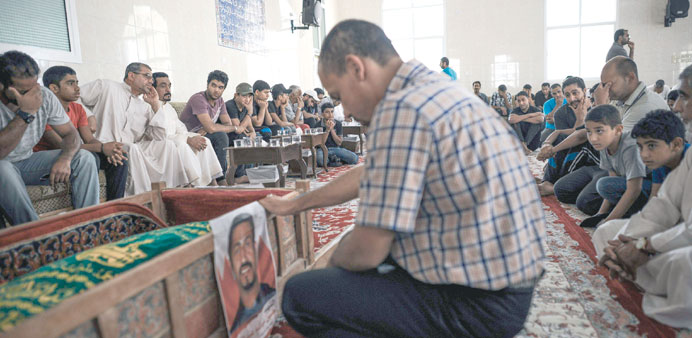
Ayat al-Qurmezi, Revolutionary Poetess of Bahrain
She said in an interview with Al-Alam news channel on Wednesday: “There is no doubt about the government’s official supervision over the torture, even some members of the ruling family personally take part in torturing detainees.”
Al-Qurmezi noted that some detainees have been killed under torture.
She was arrested on March 30 after being caught on film reading poems critical of Bahrain’s ruling regime to a group of protesters at Pearl Square in the capital Manama.
In June, a military court sentenced the young activist to 12 months in jail, reportedly without any legal argument or her lawyer being allowed to speak.
The 20-year-old poetess was released on July 13, but her sentence has not been revoked. She is currently under house arrest.
She said that beating and electronic shocks are the most common ways of torturing in Bahrain’s prisoners.
In the latest development on Wednesday, Bahraini forces once again attacked peaceful protesters in several villages and towns surrounding the capital including Nuwaidrat, Sanabis, Eker, and Sitra.
Anti-regime protesters have been holding demonstrations across the country since mid-February, calling on the Al Khalifa ruling family to relinquish power. …source
July 21, 2011 Add Comments
The unreality of Bahrain’s relative calm – Bahrain can heal, after it removes the festering wound of al Khalifa’s brutal tyranny
Bitter Divides Persist Below Bahrain’s Relatively Calm Surface
By Barbara Slavin
WASHINGTON, Jul 20, 2011 (IPS) – When Bahraini ambassador Houda Ezra Nonoo arrived in Washington three years ago, she was greeted as the representative of a close U.S. ally with a reputation for more openness and tolerance than most Gulf nations.
Nonoo was also a novelty as a woman representing an Arab country, and even more unusually, a Jew – one of only 37 in Bahrain.
These days, however, her job is considerably more complicated. Demonstrations followed by a bloody crackdown have tarnished Bahrain’s image and shaken its social cohesion. Al-Wefaq, the largest opposition party, pulled out Sunday from a national dialogue convened by the government only two weeks ago to try to bridge a sectarian divide between the ruling Sunni minority and the Shiite majority that has widened into a chasm since the spring.
Welcoming an audience comprised largely of business people and Congressional staffers to the embassy Tuesday night, Nonoo appealed for patience. “My request to you as Americans is …try to understand what it means to be such a small country with powerful neighbours and wounds to heal,” she said.
The ambassador spoke after guests watched a glitzy video about Bahrain that even she conceded was jarringly out of date.
The video touted Bahrain’s “political stability” and called the island nation “the only real democracy in the Gulf region”. It showed scenes from Formula One racing, which cancelled its scheduled Grand Prix event in Bahrain this spring because of the political unrest. Bahrain is “a country undergoing dynamic changes”, the video said, a land of business opportunities, five star hotels and luxury homes built on land reclaimed from the sea.
The video, Nonoo noted, had been made in 2006, long before the current turmoil. However, she underlined its pitch for foreign investment and tourism, insisting that “Bahrain is open for business” and that its lifestyle is more relaxed and comfortable for foreigners than that of straight-laced Saudi Arabia across a 16-mile causeway to the west. What’s more, she added, Bahrain has no taxes of any kind. …more
July 21, 2011 Add Comments
Where are King Hamad’s Investigators now President Obama – busy somewhere trying to find “independent” evidence of abuse? 16 July, 2011
July 20, 2011 Add Comments
Bani Jamrah 20 July, 2011 – Bahrain Security Forces working on youth development – or – how to ensure a revolution stays lit
July 20, 2011 Add Comments
Aali July 20, 2011 – Bahrain Security Forces encouraging stability
July 20, 2011 Add Comments
Chillin with the homies in Bani Jamrah Jul 20, 2011
July 20, 2011 Add Comments
EFF Campaign Defending Democracy on the Internet
EFF Campaign Increases the Number of Tor Relays by 13.4%
Announcement by Rainey Reitman
Watching the revolutions unfolding in the Arab world this springtime – and learning details first-hand from our friends on the ground – we at EFF struggled to find meaningful ways to support democratic activists and promote online freedom of expression. But we didn’t just want to lend a helping hand –we wanted to create a pathway so that anyone, anywhere in the world, could contribute to making the Internet more private and more resistant to censorship. From these discussions came our idea of launching the Tor Challenge.
We started the Tor Challenge with a simple goal: to launch 100 new Tor relays. Tor is software that individuals –including online activists in authoritarian regimes– can use to mask their IP addresses and proxy out to uncensored networks, helping them dodge network surveillance and elude online censorship. But Tor isn’t merely software – it’s also a network of volunteer computers, each donating bandwidth and acting as a router so that people can bounce their requests through the network, thereby obscuring their digital tracks.
We launched our campaign on May 31, 2011 –and within days surpassed our goal of 100 new relays. Today, we are closing the challenge after adding 549 new relays to the network. This includes:
Exit relays: 123
Middle relays: 299
Bridges: 127
Current bandwidth: 326,084 kb/s
Percentage of Tor network bandwidth: 5.77%
While some of the new relays were later taken offline, the majority of them stayed operational. The total number of public relays in the Tor network has increased by 13.4% during the course of our campaign.
There is an acute need for circumvention technologies in authoritarian regimes – and even activists in many would-be progressive societies may feel safer if they can avoid the electronic gaze of authorities. Jacob Appelbaum, a security researcher and advocate for the Tor Project, recently wrote:
The Tor Challenge is a phenomenal show of support for the Tor network and the network graphs show the results. The efforts expended by EFF supporters around the world have helped to continue the Tor network’s growth in a positive direction. Additionally, the educational efforts made by the EFF have similarly impacted the world; people everywhere understand the need for anonymity as well as how to use Tor to meet their needs in a practical manner.
While EFF’s Tor Challenge may have ended, individuals and organizations that want to create a more private Internet can still run Tor relays. And those who want to support Tor but aren’t tech-savvy can find an ally in TorServers.net, an organization based in Germany that provides technical assistance and support in running Tor relays.
Our gratitude goes out to the hundreds of individuals who set up relays and donated bandwidth to help strengthen the network. They are true defenders of online freedoms. …source build your own TOR network HERE The torproject.org here
July 20, 2011 Add Comments
Jalila al-Salman Teacher in Bahraini Prison
Female Teacher Forgotten in Bahraini Prison
20 July, 2011 – By Stephanie El Rayess
Human Rights Defenders
Jalila al-Salman was arrested in March for her alleged role in coordinating a teachers’ strike following the February and March protests that called for government reform.
In addition to opposition members, human rights defenders, peaceful protesters, students and athletes, the Bahraini government is cracking down on its teachers. Teachers like Jalila al-Salman who was arrested in March for her alleged role in coordinating a teachers’ strike following the February and March protests that called for government reform. Over 40 security officers raided Jalila’s home in late March and arrested her in front of her three children. Jalila is still locked up, and her family claims she has been tortured. She may get her day in court, though no exact word on when.
The Bahrain Center for Human Rights raised alarm of the government’s violent crackdown on the Bahraini Teacher’s Association (BTA) and the country’s teachers in a recently released report. According to their findings, many have been subjected to arbitrary arrests, military prosecution, torture, suspensions, salary cuts, and investigations due to their support of the peaceful demonstrations. Education International, a global federation of teacher unions, also condemned the Bahrain’s Ministry of Social Development’s decision to dissolve the BTA and to prosecute its leaders in military courts, calling it a “serious assault on teachers’ rights.”
Jalila has devoted her life to education. Her colleagues describe her sincerity, work ethic, and passion for teaching students and helping faculty over her 25 year career as an educator. Because of her years’ long struggle to improve teaching conditions in Bahrain, she faced numerous threats and was passed over for promotion. In addition to her work at Saba Secondary School, Jalila was the Vice-President of the BTA, which was formed as a substitute to the teachers’ union after the government’s 2003 ban on all unions in the public sector. …more
July 20, 2011 Add Comments
Russia with fresh ideas on resolving problems with Iran’s Nuclear ambitions – US hyprocracy to frustrate effort
US rebuffs Russian ingenuity on Iran
By Kaveh L Afrasiabi
Amid ongoing speculation that Israel is preparing to attack Iran’s nuclear facilities this autumn, Russia has stepped in by proposing a “step-by-step” approach to resolve the standoff over Tehran’s nuclear program.
Moscow’s solution is worthy of attention by the United States and other “Iran Six” nations (France, China, Russia, Britain and Germany), as well as Iran’s policymakers. Yet the US appears to be dead set on its dual diplomacy-coercion strategy that has escalated tensions with Iran.
At last week’s meeting between US Secretary of State Hillary Clinton and Sergei Lavrov, her Russian counterpart, Lavrov
revealed Russia’s intention to distance itself from the US’s coercive diplomacy against Iran that in the recent months has yielded new unilateral sanctions, deemed as covering both nuclear and human-rights violations.
This move makes it doubly difficult to pursue Russia’s proposal for suspension of sanctions in return for Iran’s compliance with International Atomic Energy Agency (IAEA) demands, simply because it ignores the fact that the US has imposed sanctions on such Iranian institutions as the Islamic Revolutionary Guards Corps for its alleged suppression of pro-democracy activists.
The Russian focus is on inquires put to Iran by the IAEA and seeks to reinvigorate dialogue to address US and European concerns that Iran’s nuclear program is aimed at weapons development – a charge Iran denies.
Rebuffing Lavrov, who is understandably worried that Iran could be weakened as a result of the tough sanctions that invite instability in both Iran and the surrounding Caspian Sea/Central Asia regions, Clinton insisted on maintaining a present course of action vis-a-vis Iran that is deemed excessive by Russia and, to a lesser extent, China. …more
July 20, 2011 Add Comments
Storm of rebuke and retribution coming as West feels real pressure to act against al Khalifa’s brutality and deceptions become clear
Bahrain warned over detentions
shiapost | July 20, 2011
One of the founders of al-Wasat daily, Karim Fakhrawi, died in police detention in April.
An international rights group criticizes Bahrain for suppressing journalists critical of the ruling Al Khalifa dynasty, urging Manama to end the harassment and legal proceedings against them.
The Committee to Protect Journalists (CPJ) said in a statement released late on Tuesday that it had documented cases of two journalists who died while in police custody and many others being detained or tortured in Bahrain since the beginning of anti-government protests in mid-February.
“Bahrain’s government has a responsibility to protect journalists from those who resort to threats of violence, intimidation, or fabricated criminal charges to influence coverage,” said CPJ Middle East and North Africa Program Coordinator Mohamed Abdel Dayem.
“The government should halt the smear campaign in pro-government publications against critical journalists,” he added.
CPJ said in its statement that it “has documented dozens of cases of journalist detentions in Bahrain the death in custody of two journalists … and a large number of physical assaults against reporters.”
The statement added that in the most recent move against journalists critical of the government, Bahrain’s public prosecutors summoned local journalist Reem Khalifa over accusations that she has hit a woman among pro-government supporters during a news conference held by an Irish delegation investigating rights abuses against Bahraini medics. …more
July 20, 2011 Add Comments
Obama considers “cut and run” option in Bahrain rather than a engage in serious diplomatic efforts to avoid a face-off with al Khalifa and Saud
‘US might redeploy Bahrain fleet’
shiapost – July 20, 2011
The US is reportedly considering redeploying its Navy Fifth Fleet outside Bahrain, due to its alarm at the popular revolution against the country’s Washington-backed regime.
Citing sources in Washington, The Times wrote that there was a groundswell of opinion in favor of the relocation of the fleet, which has been stationed in Bahrain since the 1970s.
Tens of thousands of Bahraini protesters have been holding peaceful anti-government rallies throughout the country since February, demanding an end to the rule of the Al Khalifa family.
“There was talk on Capitol Hill about moving the fleet within days of the protests breaking out, and that increased in March and April as people realized that what was happening in Bahrain ran counter to our interests,” one source said.
The paper described the fleet as “a key component of US military power” in the Persian Gulf.
Al Khalifa, which has been ruling Bahrain for over 40 years, came into power with the direct support of the British royal family.
The Bahraini government is being constantly backed by the United States despite its record of human rights abuse and the numerous complaints lodged against it with the International Court of Justice at The Hague.
Scores of people have been killed and many more have been arrested and tortured in prisons since the beginning of protests in Bahrain. …source
July 20, 2011 Add Comments
Evolving Models of Prosecution of Human Rights violations during Abar Uprisings
FIDH Mission in Cairo Discussing its Report “The Price of Hope: Human Rights Violations during the Egyptian Revolution”
18 July 2011
This mission was following the release of FIDH report on human rights abuses committed during the Egyptian Revolution and aimed at discussing the recommendations contained in the report with the authorities, in particular with regard to the prosecution of police officers allegedly responsible for serious human rights violations during the uprising.
In a very cooperative meeting, the Office of the Prosecutor made it very clear that the prosecution of those responsible for serious human rights violations remains a top priority regardless of the personality of the accused. The Office of the Prosecutor stated its focus on prosecuting those accused of corruption and embezzlement of public funds, in addition to the police officers and their superiors who are allegedly accused of the attempted killing and injury of the peaceful protestors during the 18-day revolution. They stressed the importance of accuracy and holistic approach to the investigations to ensure that justice is served properly. …more
July 20, 2011 Add Comments
Partners for Democratic Change – “An Update from Bahrain”
POMED Notes: Maryam al-Khawaja – An Update on Bahrain
Notes on the event are located below the break, or can be accessed in PDF form here
On Monday Partners for Democratic Change hosted the Society for International Development, Washington’s Middle East Workgroup for a monthly brown bag lunch entitled “An Update from Bahrain with Bahraini Human Rights Activist, Maryam al-Khawaja.” Monalisa Salib, Senior Manager, Partners for Democratic Change opened the event. Cole Bockenfeld, Advocacy Director for the Project on Middle East Democracy provided background information on events in Bahrain and introduced Maryam al-Khawaja.
Al-Khawaja is the Director of External Relations for the Bahrain Center for Human Rights and a former Fulbright Scholar at Brown University. Al-Khawaja was present during the beginning of the February 14th uprising, as protesters demanded democratic reforms, and witnessed a government response that included excessive use of force, widespread arrest, discrimination, and scare tactics to suppress dissent and quell voices for reform. She is also the daughter of Abdulhadi al-Khawaja, the founder of the Bahrain Center for Human Rights, who was among a group of high-profile human rights activists and opposition leaders recently sentenced to life imprisonment. Although she left Bahrain in early March and has not been able to go back in order to avoid arrest and/or imprisonment, she remains very connected to events on the ground as an advocate and has emerged as a leading voice for human rights. She has been influential in shaping official responses to the atrocities in Bahrain around the world by engaging with prominent European and American policymakers in her advocacy efforts.
Maryam al-Khawaja began her remarks discussing the deep roots of the protests that are currently taking place. There have been anti-government protests in Bahrain occurring nearly every 10 years, for the past century. The current protests began on February 14 and eventually included 250,000 – 300,000 protesters out of a nation of 500,000 citizens. These protests were started by youth, which is different than any other previous protests usually started by political or religious leaders, yet the government’s response has been the same every time. On March 15, after days of the Bahraini security forces violently repressing the protests, the regime invited Saudi Arabian/Gulf Cooperation Council (GCC) forces into Bahrain. Al-Khawaja described systematic mass human rights violations including torture, imprisonment, attacks on homes while people are sleeping, and teargas being shot into homes. …more
July 20, 2011 Add Comments
Tunisia’s latest Martyr and lack of Government Accountability
Tunisia: Joint Statement on Latest Events
Wednesday, July 20,2011 15:23 – IkhwanWeb
Six months after the beginning of the revolution for freedom and dignity on 17 December 2010 in the city of Sidibouzid, a new martyr fell yesterday, 17 July, in the same city, in a protest at conditions in the country. This gives protests in the capital and other regions over the last few days a political character expressing the fears of vast sectors of Tunisians, particularly the youth of the revolution, over the fate of the revolution, the delay in achieving its aims, and attempts to circumvent it.
In response to the above events, interim Prime Minister Mr Beji Kaid-Essebsi addressed Tunisians in a speech on Monday 18 July in which he presented the government’s version of events, its conclusions and its proposed response to them.
The speech was characterised by a tone justifying what has happened and accusing unspecified political parties without presenting any evidence. Furthermore, it was void of any call for dialogue, nor any apology for the attacks on journalists and other citizens, violating their personal safety as well as the sanctity of places of worship, to the extent of using live ammunition and causing death. It also ignored the demands of the protesters and their expressions of dissatisfaction. The government has thus, through the Prime Minister’s speech, abandoned its position of neutrality and its temporary nature as a caretaker government, through its bias towards certain political parties and moving towards a political clash with others.
The undersigned parties wish to clarify the following to Tunisian and international public opinion:
1. Their rejection of the government’s stance and their call upon it to review it and to engage positively with public expressions and the demands of the political elite, and their warning against pushing the country towards an orchestrated state of polarisation that replays scenarios from which the country had suffered immensely and paid dearly, They further call for the adoption of dialogue and consensus-building as the mechanism for resolving disputes in this sensitive phase of our country’s history.
2. Their defense of the right to freedom of expression, protest and sit-ins, considering any violation of that right a contravention of the aims of the revolution, and their condemnation of all acts of violence and attacks on public or private property, such as the events of Menzel Bourguiba. They further express solidarity with all victims, civilian and security personnel, and call for the release of all detainees and those forced to undergo military service.
3. Their commitment to the date of October 23rd as the definitive date for the constituent assembly elections, and their appeal to all parties and political actors to assume their responsibility in protecting the gains of the revolution and enabling a peaceful democratic transition based on open and transparent electoral legitimacy.
Party for Reform and Development
People’s Progressive Unionist Movement
Congress for the Republic Party
Movement of Socialist Democrats
Popular Union Movement
an-Nahdha Movement
July 20, 2011 Add Comments
Israeli Navy Encircles “Dignity” At Sea
Israeli Navy Encircles “Dignity” At Sea
frm: Ikhwanweb
GAZA, — Three Israeli navy ships are encircling the French boat “Dignity” and blocking it from continuing its sail to the Gaza Strip on a humanitarian mission, press reports said on Tuesday.
Al-Jazeera TV channel correspondent Ayash Daraji, on board the boat, said that the Israeli navy was besieging the boat only 70 kilometers away from Gaza, claiming that it carried weapons, a matter which was categorically denied by the solidarity activists on board.
The Israeli officers are contacting the boat’s crewmembers and telling them they should go back from where they came from, yet Daraji said that all on board were determined to go ahead in the voyage to Gaza.
Organizers of the humanitarian mission said on Monday that the boat was approaching Gaza and would dock there within the coming 24 hours. …source
July 20, 2011 Add Comments
It’s a good gesture – EU Parliament calls for release of “innocent” doctors and nurses – EU problematically leaves “innocent” up to al Khaifa to define and other “innocents”, non-medicals, remain in detention?
EU Parliament calls for Bahraini medics release
July 20, 2011 By Aoife Connors
The European Parliament has issued a call for innocent prisoners in Bahrain to be released and for parties to engage in productive dialogue, with a view to conflict resolution.
Ireland South MEP Seán Kelly tabled a motion for resolution at the Parliament on July 7 as concerns increased about Irish-trained doctors awaiting a military trial in Bahrain.
During the debate, the Parliament stated that it strongly condemned the disproportionate use of force by the regime against peaceful demonstrators and deplored the large number of persons killed and wounded.
The Parliament heard that 47 Bahraini doctors and nurses have been accused of “incitement to overthrow the regime by force” and are facing trial by a Bahraini military court, whereas the medical professionals treated all injured people equally, in keeping with the ethical code of their profession.
“The aggressive actions taken by the Bahraini regime against its own people is a clear breach of human rights. The detention of 47 medical professionals, including some Irish-trained doctors, is also extremely worrying,” said Kelly.
“Medics around the world need to be assured of their safety as they try to help the sick or injured during times of conflict. The Parliament has condemned the decision to imprison those doctors and is calling for their release.” …more
July 20, 2011 Add Comments
Bahrain direct benefactor of Saudi existential spending on “internal security”
Saudi Arabia Internal Security Market $10 billion by 2015 – 2011-2011
(March 2011)
Saudi Arabia internal security market. The recent turmoil in the Arab world forced the Saudi Arabian royal family into critical internal security decision junctures. Financed annually by hundreds of billions petro dollars, Saudi Arabia decided to spend $60B for their air force and an additional $30B for their navy upgrade. Now, the Saudis are preparing to pour as much as $40B during 2011-2015 on procurement of equipment and services for their Internal Security. This creates lucrative business opportunities for the international defense and security players.
HSRC’s latest report, presents in 130 pages, including 81 tables and figures, analysis and forecasts of 14 Saudi internal security sub-markets. The report presents SWOT and competitive analysis of the market, companies that are active in Saudi internal security market, and specific business opportunities in the Saudi security sector. …source
July 20, 2011 Add Comments
Identification of US made munitions deployed in conflicts – includes “riot” control
Appendix F
Ammunition Identification
Ammunition is identified by markings and color-coding on the items themselves, the containers, and the packing boxes. The markings and standard nomenclature of each item, together with the lot number, FSC, NSN, DODIC, and DODAC, completely identify each item and are used to maintain accountable records. This appendix gives a basic explanation of markings and color-coding. Because color-coding is a more ready means of identification, it is given greater emphasis here.
MARKINGS
F-1. Markings stenciled or stamped on munitions items include all information needed for complete identification. Components in which all explosive, incendiary, or toxic materials have been simulated by substitution of inert material are identified by impressed INERT markings. Components in which all explosive, incendiary, or toxic materials have been omitted are identified by stamped EMPTY markings.
AMMUNITION LOT NUMBER
F-2. Each item of ammunition is assigned a complete round or item lot number when it is manufactured or is at the LAP plant. See MIL-STD 1168-A for a description of the current system. See MIL-STD 1168 for a discussion of the old lot numbering system. Figure F-1 breaks down a typical ammunition lot number showing both the new and old systems.
See more for identification of munitions and markings here
July 20, 2011 Add Comments
Know munitions of Oppression – correctly Identify the weapons deployed against you
Grenade, Hand, Riot, CS, ABC-M7A2
Grenade, Hand, Riot, CS, ABC-M7A3

FM 23-30: ABC-M7A2/A3
The ABC-M7A2 and ABC-M7A3 riot-control hand grenades contain only CS as a filler. They differ only in the amount of filler and the form of the CS they contain. The ABC-M7A2 grenade has 5.5 ounces of burning mixture and 3.5 ounces of CS in gelatin capsules. The ABC-M7A3 has 7.5 ounces of burning mixture and 4.5 ounces of CS pellets.
The bodies of both grenades are sheet metal with four emission holes at the top and one at the bottom. Both grenades have gray bodies with red bands and markings. These grenades do not have safety clips.
ABC-M7A3 Unit cost: $175 (Fiscal Year 2005).
Grenade, Hand, Riot, CN1, ABC-M25A1
FM 23-30: M25A1
Obsolete. [Still in Use] The ABC-M25A1 riot control hand grenade is a bursting munition with an integral fuze.
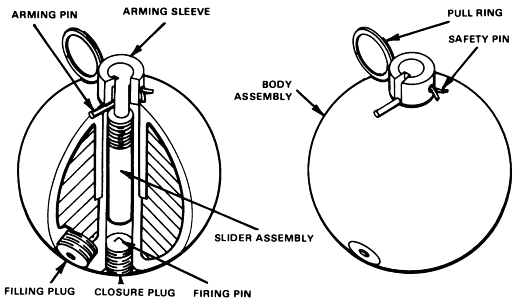
All fillers are mixed with silica aerogel for increased dissemination efficiency.
The M25 series of riot-control hand grenades have a radius burst (visible cloud grenade) of about 16 feet (5 m), but fragments of the grenade are occasionally projected up to 82 feet (25 m).
The grenade has a gray body with red band and red markings. Grenade, Hand, Riot, CN1, ABC-M25A2
Grenade, Hand, Riot, CS1, ABC-M25A2
FM 23-30: M25A2 TACTICAL AND MATERIEL INNOVATIONS: ABC-M25A2 CS1
ABC-M25A2 CS1
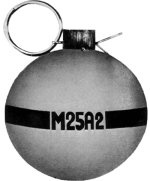
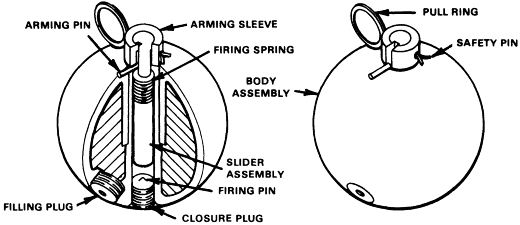
Obsolete. [Still in Use] The ABC-M25A2 riot control hand grenade is a bursting munition with an integral fuze. The M25A2 grenade is an improved version of the M25A1 grenade. The two grenades differ primarily in body construction.
All fillers are mixed with silica aerogel for increased dissemination efficiency.
The M25 series of riot-control hand grenades have a radius burst (visible cloud grenade) of about 16 feet (5 m), but fragments of the grenade are occasionally projected up to 82 feet (25 m).
July 20, 2011 Add Comments