Abdulhadi Alkhawaja’s, “freedom or death” hunger strike of 21 days, reaches dangerous phase
URGENT ACTION: As he enters 20th day of Hungerstrike:Lawyer warns that Alkhawaja’s health is entering a dangerous Phase
29 February, 2012 – Bahrain Youth Society for Human Rights
The Bahrain Youth Society for Human Rights (BYSHR) calls on international human rights organizations to urgently intervene to secure the release of human rights defender Mr.Abdulhadi Alkhawaja (Previous President and acting director of the BCHR) who is to enter his 21st day of hungerstrike tomorrow. Mr.Abdulhadi Alkhawaja had began the hungerstrike demanding “Freedom or Death” on the 8th of February which followed a 1 week hungerstrike just 2 days before which aimed at highlighting the continued human rights violations taking place in Bahrain.
According to Mr.Alkhawaja’s wife, the activist can no longer tolerate sitting for longer than 10-15 minutes in the sun due to fatigue and spends most of his day lying down. Mr.Alkhawaja’s wife also states that the activist needs a hot water bottle to keep his body warm.
The activists lawyer, Mr. Mohammed Aljishi had previously stated that the hospital clinic can no longer administer IV fluids as the activists veins are too weak.
Mr. Abdulhadi Alkhawaja’s daughter, Human Rights Defender Ms.Maryam Alkhawaja, Head of Foreign Relations of the Bahrain Centre for Human Rights(BCHR)as well as the Gulf Centre for Human Rights (GCHR) , had previously stated that Mr.Alkhawaja was exhibiting symptoms of a person on his 60th day of hungerstrike as his Kidney had already started to get affected. He also shows signs of increasing fatigue and lack of concentration in addition to having difficulty in moving.
The activist, even in accordance to the Bahrain Independent Commission of Inquiry (BICI) that was commissioned by the King , was subject to severe torture. Numerous international human rights organizations have called for Mr.Abdulhadi Alkhawaja’s release such as Amnesty International, Human Rights Watch, Human Rights First as well as Frontline Defenders and questioned the trial procedures through which he was sentenced to life imprisonment.
The BYSHR once again calls for the immediate and unconditional release of human rights defender Mr.Abdulhadi Alkhawaja and places full responsibility for his well being on the Bahraini authorities. …more
February 29, 2012 Add Comments
Systematic Abuse and Regime Brutality
February 29, 2012 Add Comments
Understanding Peak Oil and Capitalism
February 29, 2012 Add Comments
WikiLeaks: Stratfor Predicts Huge Oil Profits From Attack on Iran
WikiLeaks: Stratfor Predicts Huge Oil Profits From Attack on Iran
By Anissa Haddadi – International Business Times – 28 February 2012
WikiLeaks has started publishing more than five million emails hacked by Anonymous from the servers of Stratfor, a US intelligence gathering company.
An email sent by Chris Farnham, senior officer for Stratfor, to an internal unnamed source inside the company titled “Israel/Iran Barak Hails Munitions Blast in Iran” provides details about who would benefit from an Israeli attack on Iran, and say such a plan would be motivated by economic factors.
According to the email, sent on November 13, 2011, supporters of an Israeli-led attack are Russia, India and Saudi Arabia, while the EU and China stand against such plans, mainly for economic reasons.
“Not many people know that Russia is one of Israel’s largest military partners and India is Israel’s largest client. If a direct conflict between Iran and Israel erupts, Russia and Saudi Arabia will gain the advantages on oil increasing prices. On the other hand, China and Europe are expected to lose from an oil crisis as a result of a conflict,” the email says
Farnham said that an attack on the Iranian nuclear facilities would last only 48 hours and be so devastating it would lead to regime change.
“Based on Israeli plans, the attack on Iran will last only 48 hours but will be so destructive that Iran will be unable to retaliate or recover and the government will fall. It is hard to believe that Hamas or Hezbollah will try to get involved in this conflict,” Farham wrote.
The Stratfor analyst then reveals that despite claims propagated in the media, an attack on Iran is unlikely since Israeli commandos have already targeted major parts of Iran’s nuclear programme.
“In the open media many are pushing and expecting Israel to launch a massive attack on Iran. Even if the Israelis have the capabilities and are ready to attack by air, sea and land, there is no need to attack the nuclear programme at this point after the commandos destroyed a significant part of it.”
Farnham said an attack would be motivated by economic factors rather than Iran’s nuclear programme.
“If a massive attack on Iran happens soon, then the attack will have political and oil reasons and not nuclear. It is also very hard to believe that the Israelis will initiate an attack unless they act as a contractor for other nations or if Iran or its proxies attack first,” the email concludes. …more
February 29, 2012 Add Comments
Bahrain Press reforms hailed – wins coveted Crooked Bough Horseshit Award
Bahrain Press reforms hailed
By Sandeep Singh Grewal – 29 February, 2012
BAHRAIN’S commitment to Press freedom is a stepping stone towards creating a hub for regional and international media. It follows Manama being named Capital of Arab Press for 2012 and the country hosting the fourth Arab Youth Media Forum for the first time.
The two-day pan-Arab eventwas attended by top Arab media figures, officials and diplomats, at the Sofitel Bahrain Zallaq Thalassa Sea and Spa.
It is being held under the patronage of His Majesty King Hamad and was opened yesterday in the presence of Supreme Council for Youth and Sport chairman and Bahrain Olympic Committee president Shaikh Nasser bin Hamad Al Khalifa, ministers and media figures from the Arab world.
Shaikh Nasser expressed His Majesty’s dedication to making Bahrain a hub for the media and providing the right atmosphere for all creative professionals.
The forum has placed Bahrain on the world media map and the recognition is a “source of pride”, said Information Affairs Authority president Shaikh Fawaz bin Mohammed Al Khalifa during the opening ceremony.
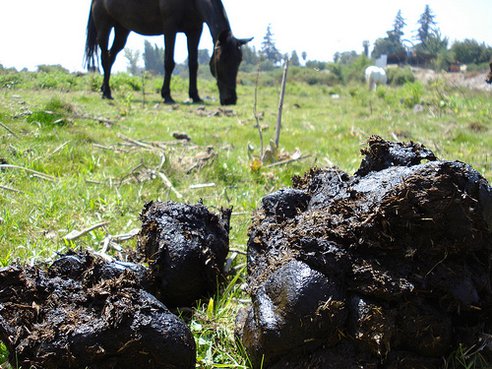
Coveted Crooked Bough Horseshit Award
“Bahrain seeks to upgrade standards, organise and expand the horizons of freedoms of the media and attract leading media corporations to its Media City,” added Shaikh Fawaz.
The forum discussed issues in connection with media in the Arab world and its evolution, and it ends today.
Meanwhile, Al Jazeera news anchor Tunisian Mohammed Krichen said it was the perfect time for Bahrain’s media to reflect arguments made by all sides of the community.
“This is a great honour for Bahrain to be the Arab Press Capital but the government and people should now be committed to Press freedom,” he told the GDN.

“It’s time the Bahrain Press reflected plurality of opinions that will boost its credibility and at the same time build trust and confidence.”
Mr Krichen was presented with the Best Arab TV Presenter award and he was among many figures who were honoured during the opening ceremony. …source
February 29, 2012 Add Comments
Barbar – Freedom not Systemic Oppression
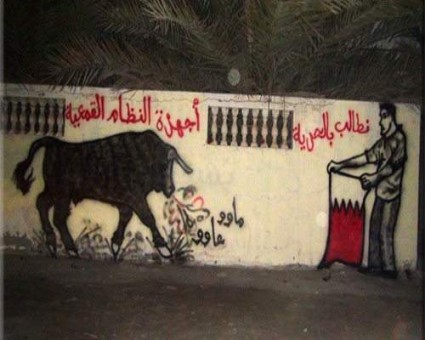
February 29, 2012 Add Comments
Sitra Resistance Art Collaboration
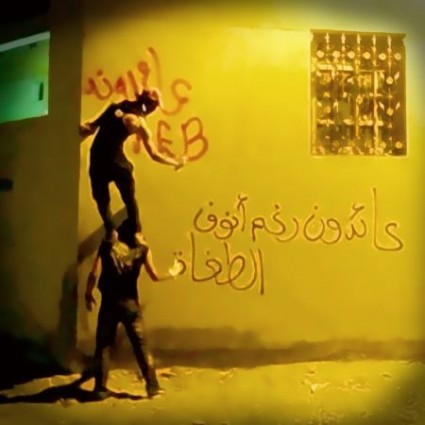
February 29, 2012 Add Comments
Siemens a Grand Prix Sponor with long history of support for Worlds most Notorious despots and tyrants
Siemens became involved in Formula 1 in 1998 as a partner of the McLaren F1 team and as a partner of Formula One Management.
Siemens. Siemens took slave laborers during the Holocaust and had them help construct the gas chambers that would kill them and their families. Good people over there.
Siemens also has the single biggest post-Holocaust moment of insensitivity of any of the companies on this list. In 2001, they tried to trademark the word “Zyklon” (which means “cyclone” in German) to become the name a new line of products… including a line of gas ovens.
Zyklon, of course, being the name of the poison gas used in their gas chambers during the Holocaust.
A week later, after several watchdog groups appropriately freaked out, Siemens withdrew the application. They said they never drew the connection between the Zyklon B gas used during the Holocaust and their proposed Zyklon line of products. (Source: BBC)
Nokia-Siemens Spy Tools Aid Police Torture in Bahrain
06 September, 2011
Spy tools sold and maintained by German communications and engineering giants Siemens and Nokia Siemens Networks are being used by authorities in Bahrain to aid in their interrogation and torture of human rights activists, according to Bloomberg Markets magazine.
The equipment is used by authorities there, and in other repressive regimes, to track the location of activists through their mobile phones and record their conversations and text messages, according to activists as well as workers at NSN and Trovicor (a divested unit of NSN) who installed the systems in several Middle East countries.
Abdul Ghani Al Khanjar, a 39-year-old school administrator and activist, was shown transcripts of his text messages by jailers who beat him with rubber hoses and used other torture methods during his detention between August 2010 and February 2011.
The systems are currently sold and installed by Trovicor, a business whose activities initially began in 1993 as a unit of Siemens’ voice- and data-recording division. In 2007, the unit became part of Nokia Siemens Networks, a joint venture between Siemens and Finland’s Nokia Oyj. In March 2009, NSN sold the unit, then known as Intelligence Solutions, to Perusa Partners Fund — in part to distance NSN from the controversial surveillance business and the potential it posed for human rights abuses. Perusa renamed the company Trovicor, though the equipment and most of the workers remained the same as prior to the sale.
Trovicor’s monitoring centers, which can be installed at telecommunications companies or at ISPs, have been sold to Egypt, Syria and Yemen, in addition to Bahrain. In all, the equipment plays a surveillance role in at least 12 Middle Eastern and North African nations, Bloomberg Markets reports. …more
February 29, 2012 Add Comments
Daily cycle of murderous gassing, protest and imprisonment in Bahrain
Bahraini dies from inhaling toxic gas fired by regime forces
By shiapost – 29 February, 2012
Another Bahraini citizen has lost his life after inhaling toxic tear gas fired by the Saudi-backed regime forces on protesters, Press TV reports.
Fresh protests have erupted against the Saudi-backed Al Khalifa dynasty in Bahrain after the demonstrators blocked roads and set tires on fire in Sar, near the capital, Manama.
The protesters condemned the imprisonment of the rights activist Abdul Hadi Khawaja and demanded the immediate release of the top campaigner.
Khawaja, the co-founder and former president of the Bahrain Center for Human Right, was sentenced to life in prison by a military court last year. He is currently on a hunger strike to protest against his detention and Al Khalifa regime’s brutal crackdown on protests.
The protest dubbed the “cry of conscience” was organized by the February 14th Youth Coalition.
Despite the ongoing crackdown, anti-regime protests continue in the Persian Gulf kingdom and there is no sign of the ruling Al Khalifa dynasty’s inclination to step down.
Bahrain has been witnessing a wave of anti-regime protests since February 2011.
Dozens of people have been killed and hundreds more arrested or fired from their jobs since the beginning of the popular uprising in Bahrain in February 2011.
On January 26, Amnesty International called on Bahraini authorities to “investigate and account for the reports of more than a dozen deaths following tear gas use.”
Amnesty also called on the US government to “suspend transfers of tear gas and other riot control equipment to the Bahraini authorities.”
In a 94-page report issued on February 28, Human Rights Watch (HRW) criticized the Bahraini regime’s trial of anti-government demonstrators, protest leaders, and the medical doctors, who treated the injuries caused in government crackdown on the protesters.
The HRW also called on Bahrain’s Saudi-backed Al Khalifa regime to release detained protesters. …more
February 29, 2012 Add Comments
Respect Existance or Expect Resistance
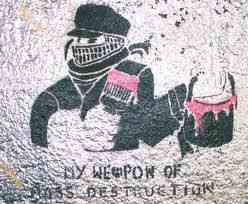
February 28, 2012 Add Comments
KPFA interviews Lateefah Simon, Zainab al-Khawaja, and Saria Idana
KPFA Women’s Magazine interviews Lateefah Simon, Zainab al Khawaja, and Saria Idana about their work, interests and impact on today’s women and the world
February 27, 2012 – Womens Magazine
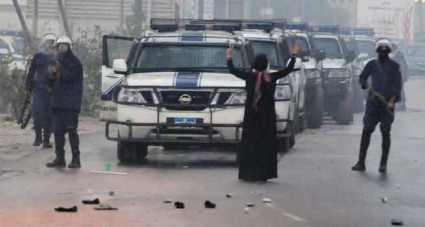
Zainab al Khawaja (@AngryArabiya) talks about the Arab Spring, the goals of the democracy movement in Bahrain, and her father’s hunger strike for freedom. She also talks about how she became one of Bahrain’s leading tweeps. 15:11 min.
February 28, 2012 Add Comments
US Prisons filled with nearly 2.5m and Counting – record numbers imprisoned for being too poor to pay
Debtor’s Prison
The United States Supreme Court in Bearden v. Georgia, 461 U.S. 660 (1983), made it clear that courts cannot imprison an indigent person for failure to pay a criminal fine unless the failure to pay was “willful.” Too often, however, this constitutional rule is ignored. Courts across the South routinely impose substantial costs on already poor people who are struggling to get by, then incarcerate them for being too poor to pay.
February 28, 2012 Add Comments
Russia to Modernize Popular Weapon of Mass Destruction
Russia To Modernize Iconic Kalashnikov Assault Rifle
28 February, 2012 – Radio Free Europe
Russia has announced plans to modernize the Kalashnikov AK-47 assault rifle, the mainstay of the Russian Army and weapon of choice for paramilitaries and gangsters around the world.
Deputy Prime Minister Dmitry Rogozin told parliament that the “modernized” weapon will have “detachable equipment, such as an optical sight and a lamp.”
Rogozin said the army would also receive a new pistol by the end of the year to replace the semi-automatic Makarov, another weapon from the 1940s and now a Cold War relic.
Rogozin said that a planned $690 billion modernization of Russia’s armed forces includes the addition of new submarines and aircraft by 2020. …source
February 28, 2012 Add Comments
King Hamad, Release the Hostages for Democracy!
HRW demands Bahrain release activists
SkyNews.au – 29 February, 2012
Human Rights Watch (HRW) has called for the release of hundreds of Bahraini pro-democracy activists arrested after last year’s uprising and for all charges against them to be dropped.
‘Grossly unfair military and civilian trials have been a core element in Bahrain’s crackdown on pro-democracy protests,’ HRW said. Cases ‘against everyone convicted on politically motivated charges’ should be dropped.
The New York-based group also called for the release of at least four Shi’ite protest leaders who remain in prison for expressing anti-government sentiments and demanding political reform.
According to HRW, hundreds of Bahraini activists have been tried in special military courts set up after King Hamad declared a quasi state of emergency last March as his security forces crushed a month-long uprising in Manama.
The rights group said that by October, all the special military court cases had been transferred to civilian courts.
But ‘egregious violations of fair trial rights in political cases’ continued in Bahrain’s criminal justice system ‘with serious systemic problems,’ despite government pledges to reform, HRW said.
‘Serious abuses included denying defendants the right to counsel and to present a defence, and failure to investigate credible allegations of torture and ill-treatment,’ it said, citing a 94-page report on judicial violations.
The report is based on 50 interviews with defendants, lawyers and observers as well as examination of court documents.
Earlier this month, Amnesty International said Bahrain’s government had failed to implement human rights reforms demanded by an independent commission which investigated the crackdown.
They said the government was still ‘far from delivering the human rights changes’ recommended by the Bahrain Independent Commission of Inquiry (BICI).
The BICI report was commissioned by the king last June after the violence left 35 people dead and triggered international pressure on the ruling Sunni dynasty.
Near daily protests have continued in Shi’ite neighbourhoods of the kingdom, with the main opposition formation, Al-Wefaq, charging that ‘violations’ by the authorities have been on the rise.
…more
February 28, 2012 Add Comments
UK, US, France, Russia, China and Germany agree in principle to accept Iranian offer to resume negotiations
Diplomats from UK, US, France, Russia, China and Germany agree in principle to accept Iranian offer to resume negotiations
Iran nuclear talks with six-nation group of powers set to be agreed
Julian Borger – guardian.co.uk – 28 February, 2012
A new round of nuclear negotiations with Iran is likely to be agreed in the next few days when diplomats from six major powers hammer out a common response to Tehran’s offer to resume contacts, official sources said on Tuesday.
The diplomats from the UK, US, France, Russia, China and Germany have agreed in principle to accept the Iranian offer, spelt out in a letter from Tehran’s chief negotiator, Saeed Jalili, on 14 February. Sources said that although there are no high expectations of a breakthrough, there was a growing consensus that every peaceful avenue should be explored in the hope of avoiding a new conflict in the Middle East.
“We have to use every opportunity to test Iran’s willingness to talk,” a European diplomat said.
After talks between the political directors of the six powers, it is hoped an official response, probably offering to meet in Turkey in March, will be ready this week. It will be issued by Catherine Ashton, the EU foreign policy chief who acts as the group’s coordinator. Ashton has said she is cautiously optimistic about the resumption of talks.
“And then all the things that come from that: where we’re going to talk, what the talks will consist of … and what we need to do, what steps we need to take to move forward. So that is being discussed now, the political directors will meet me very shortly in order to tell me the results of those discussions and then we’ll move forward from there,” Ashton said on Monday. “I’ll be in touch then with Iran.”
The stakes and pressures at any new round of talks will be extremely high, as they will take place against a backdrop of worsening tensions, a military build-up in the Gulf and constant speculation that Israel may be planning air strikes against Iran’s nuclear sites, which the west believes are designed to give Iran the capacity to make weapons.
Tehran says its programme is entirely peaceful, and has defied repeated demands from the UN security council to suspend the most controversial element, the enrichment or uranium. Unless new negotiations can break the deadlock, Iran will face an EU oil embargo in July and US financial sanctions against its oil trade at about the same time.
Diplomats said there was significant western scepticism over Iranian intentions, particularly from Paris. The last set of talks, in Istanbul in January 2011, were widely seen as a fiasco. Jalili refused to discuss uranium enrichment or negotiate confidence-building measures, including the exchange of Iranian enriched uranium for foreign-made fuel rods. Since then, Iran has said it would only resume talks if all sanctions were lifted and enrichment was taken off the agenda.
Furthermore, two visits to Tehran in the past month by UN weapons inspectors from the International Atomic Energy Agency (IAEA) failed to win Iranian cooperation on unanswered questions over past Iranian research work which the agency says could be related to the development of nuclear weapons. The inspectors also found that Iran had tripled its production of 20% enriched uranium, which is of particularly concern because it would be relatively easy to turn into weapons-grade material.
European diplomats said the six-nation group of powers was discouraged by the outcome of the IAEA mission but decided not to allow it to prevent broader negotiations.
Ashton’s office has spoken to Jalili’s deputy, Ali Bagheri, in an effort to clarify some of the outstanding questions about the Iranian letter, and a consensus is emerging in western capitals that the mention of the nuclear programme in the document does reflect a significant advance, signalling the dropping of Iran’s preconditions for talks.
“If that turns out not to be the case, then the next talks will be over pretty quickly,” a diplomat said. …more
February 28, 2012 Add Comments
The American Spin Masters
Bahraini ‘Reformers’ in Washington, Courtesy of American Spinmeisters
by Justin Elliott – ProPublica – 28 February, 2012
A protester gestures to police as they shoot tear gas during a standoff after a mourning procession in the village of Mameer, Bahrain, on Jan. 24, 2012. (Caren Firouz/Reuters)
Earlier this month, a group of three young Bahrainis arrived in Washington to talk about reform in the small Persian Gulf nation, which has been rocked by Arab Spring protests for the last year. The delegation, including an NGO worker and a tech entrepreneur, both Western-educated, represented “the leading voice for change and reform” in Bahrain, as an email message from one of the group’s representatives put it.
But these weren’t leaders of the protest movement that has challenged the country’s ruling Sunni monarchy. They were members of a “youth delegation” put together by a top American public relations firm, Qorvis, which has been working with Bahrain to shore up the country’s image in the United States.
The youth delegation’s modestly pro-reform message was mixed with sharp criticism of the opposition in Bahrain and complaints about negative media coverage in the U.S.
Last year, in the early weeks of Bahrain’s violent crackdown on the largely Shia opposition protests, the minister of foreign affairs inked a contract with Qorvis to provide public-relations services for $40,000 per month, plus expenses. One of the largest PR and lobbying firms in Washington, Qorvis employs a number of former top Capitol Hill staffers and also works for Bahrain’s close ally, Saudi Arabia. The firm’s work for Bahrain came under scrutiny last year when it defended the government’s raid last year on a Doctors Without Borders office in Bahrain. Also in 2011, a Qorvis official wrote pro-regime columns in The Huffington Post without revealing his affiliation with Qorvis.
Bahrain is an important American ally in the gulf, and its capital Manama is home to the U.S. Navy’s 5th Fleet. An independent commission found late last year that the government had systematically tortured detainees and used excessive force to put down the protests. While the unrest has fallen from the headlines, Bahrain continues to suppress protests, sometimes violently. And while Bahrain has promised reforms, Human Rights Watch today released a report finding “egregious violations of fair trial rights” in cases brought against opposition activists.
The Obama administration has largely stood by Bahrain, offering muted criticism while continuing to sell arms to the government, though one weapons package remains on hold.
To counter negative press, Bahrain has made a major public-relations push in the U.S., employing Qorvis and several other firms. The youth delegation dispatched to Washington, on the anniversary of the start of the protests, is the latest part of that effort.
In meetings and public appearances, the three-member Qorvis delegation has criticized opposition protesters as violent agitators. …more
February 28, 2012 Add Comments
US, Britain gear up for war on Iran
US, Britain gear up for war on Iran
By Bill Van Auken – 28 February 2012 – World Socialist Web Site
The military commands in both the US and Britain have sought increased funding and stepped up deployments of arms and personnel to the Persian Gulf in preparation for an anticipated war against Iran.
According to the Wall Street Journal, the Pentagon, acting on the request of the Central Command, which oversees US military operations in the region, has requested the re-allocation of some $100 million in military spending to ratchet up war preparations.
The Journal cast these preparations as defensive measures aimed at countering an Iranian threat to close the Strait of Hormuz, the waterway through which some 20 percent of the world’s exported oil flows. Iran’s threat came in response to trade sanctions and embargoes imposed by the US and Western Europe that amount to a blockade, an act of war, as well as open Israeli threats to bomb the country.
“The US military has notified Congress of plans to preposition new mine-detection and clearing equipment and expand surveillance capabilities in and around the strait, according to defense officials briefed on the requests,” the Journal reports. “The military also wants to quickly modify weapons systems on ships so they could be used against Iranian fast-attack boats, as well as shore-launched cruise missiles, the defense officials said.”
Under the Pentagon’s plans, US warships would be equipped with anti-tank weapons, rapid-fire machine guns and light weapons for use against the Iranian navy’s small speedboats. They would be backed by increased numbers of unmanned drones.
The Journal adds that “US special-operations teams stationed in the United Arab Emirates would take part in any military action in the strait should Iran attempt to close it.”
The US has already doubled the number of aircraft carrier battle groups it has stationed in the Persian Gulf area, deploying both the USS Abraham Lincoln and the USS Carl Vinson. It also has substantial numbers of warplanes operating out of the Arabian Peninsula and tens of thousands of troops near Iran’s borders in Afghanistan and Kuwait.
The new war preparations, the Journal states, show “the extent to which war planners are taking tangible steps to prepare for a possible conflict with Iran, even as top White House and defense leaders try to tamp down talk of war and emphasize other options.”
The report in the Journal indicates that the Pentagon wants the military buildup in the Gulf in place by autumn, when Pentagon planners anticipate that Israel will launch an unprovoked military strike on Iran.
High-level discussions on Iran between Washington and the Israeli state are scheduled over the next several days, with Defense Minister Ehud Barak having left Israel Monday for two days of talks with US officials, and Israeli Prime Minister Benjamin Netanyahu set to hold talks with Obama on March 5. …more
February 28, 2012 Add Comments
Hanaa al-Shalabi Palestinian inprisoned by Israel on Hunger Strike Since 16 February
Hezbollah praises Palestinian prisoner hunger strike
28 February, 2012 – Lebanon Now
Hezbollah issued a statement on Tuesday commending Hanaa al-Shalabi, a Palestinian imprisoned in Israel, who has been on hunger strike since her arrest on February 16.
“The [hunger strike is a] battle led by Palestinian prisoners in Israeli jails against the brutality of [their detainment] and its unfairness,” the statement said.
It also added that that Shalabi’s step “proves the failure of the enemy to [subdue] the Palestinian prisoners.”
Hanaa al-Shalabi was freed in a prisoner swap with Israel but later re-arrested.
Shalabi is demanding the end of her administrative detention and for the soldiers who beat her up and undressed her to be put on trial.
…more
February 28, 2012 Add Comments
Free Abdulhadi Alkhawaja Now!
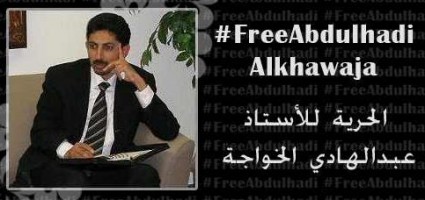
Abdulhadi Alkhawaja is a leading Bahraini human rights activist and was the former president of the Bahrain Center for Human Rights. He was imprisoned following and unjustified and unlawful arrest by Bahraini authorities on April, 9th, 2011. He is currently in a “freedom or death” hunger strike. We demand his immediate release.
February 28, 2012 Add Comments
Free Alkhawaja!
February 28, 2012 Add Comments
Free Alkhawaja Now!
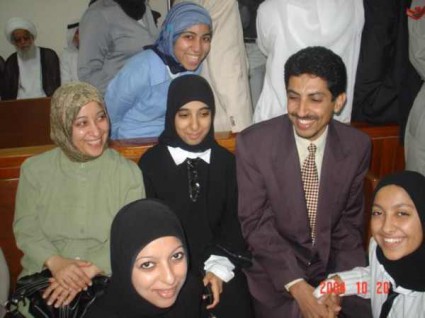
Alkhawaja (handcuffed) with his daughters & wife during 2004 trial after criticizing Bahrain’s ruling regime.
February 28, 2012 Add Comments
Staggeringly corrupt and repressed, Saudi Arabia is ripe for revolution, conducts self with impunity on world stage
Arabia awaits its spring
27 February, 2012 – Guardian – Saad al-Faqih
Staggeringly corrupt and repressed, Saudi Arabia is ripe for revolution. But fear deters reformers from declaring their views
A falcon flies from the glove of its trainer in the desert near Tabuk, Saudi Arabia. The Saudi regime holds tens of thousands of political prisoners, most without charge. Photograph: Reuters
‘Let us strangle the last king with the guts of the last priest,” the French 18th century philosopher Denis Diderot said. The same phrase is now widely repeated across Arabia – or Saudi Arabia, as it is currently named under the dynastic autocracy. It is only a matter of time before the revolutions that have swept the Arab world in the past year reach the Saudi kingdom.
Most of the factors that led to the Arab uprisings are present in Arabia. The Saudi regime holds tens of thousands of political prisoners, most without charge – just one example of the oppression people suffer. The scale of corruption is staggering. In the most recent budget alone, $100bn is unaccounted for. In this country with its huge oil revenue, unemployment rates are soaring (currently more than 30%), the average salary is less than $1,300 (£820) a month, with a huge discrepancy between classes, and 22% of the population live in poverty. As a result of corruption, the oil wealth has had little impact on the quality of life of the average citizen, as is the case in neighbouring Gulf countries.
What is worse is that the royal family continues to treat the country and its people as its private property. Instead of attempting to provide the citizens with the strong identity people long for, they have reinforced the subjugation to the royal family of Al-Saud.
Furthermore, as elsewhere in the Arab world, the expansion in communication tools has broken down barriers and deprived the Saudi regime of the secrecy and deception on which its legitimacy relied. Opposition-run satellite stations now voice an alternative message, while the internet and mobiles allow easy interaction, making virtual debates more effective than real ones.
In the past couple of months, one anonymous twitter account, @mujtahidd, has attracted more than 220,000 followers thanks to its ability to expose corruption in a detailed, accurate manner. @mujtahidd has already published thousands of remarkably well informed tweets about several royal family members, including the king. The popularity of @mujtahidd has gone beyond Twitter; it has become the talk of the nation. So much so that blocking his account inside the kingdom did nothing to stop the number of followers escalating. This readiness to embrace the campaign of leaks by an anonymous individual is a demonstration of how little people trust the country’s official media.
Reformists from many different backgrounds are increasingly audible in society. Most are from the religious ranks – as has been the case in other Arab countries where upheavals occurred. It is these religious reformers themselves, not the liberals, who repeat Diderot’s call for a settling of accounts with both princes and their tame religious hierarchy.
It is this kind of apparent contradiction – along with the complexity of Arabia’s geopolitical map – which makes many observers incapable of forecasting the kingdom’s political future.
The western media, where they notice the ferment in Arabia at all, focus on the Shia revolt and the position of women. It is true that the Shia are very active in protest – their demonstrations are massive. However, they are a minority and the regime links them with Iran, so their protests remain isolated and self-contained. The regime has so far successfully used these protests in its favour, by persuading the Sunni majority of a threat of a Shia “takeover” of the Eastern province.
And within Arabia, where both sexes are deprived of their basic rights, the west’s focus on women’s rights has backfired, as it has become twinned with unpopular “western” values.
Paying attention exclusively to these two questions suits the Saudi regime because it gives the impression that it is not facing other distracts from more far-reaching challenges that threaten itsvery existence. The regime is more concerned with its portrayal in the west as a stable and resilient regime than being seen as serving minority rights or encouraging western values. Any major internal challenge to its stability would result in western powers losing confidence in its ability to serve their interest.
So why hasn’t revolution yet reached Arabia? The traditional inhibitions are still there. Despite the widespread conviction that a comprehensive change of regime is necessary, reformers remain hesitant about declaring their views, let alone taking .
The official religious establishment, whose members are directly appointed by the king, continue to appease the regime in a country where religion is the main player in politics. People are bombarded with scaremongering in the media which associates change with chaos and bloodshed as in Yemen, Syria and Libya.
More significant still is the level of distrust between activists, making any collective act of protest difficult. Political activism in Arabia has been almost nonexistent, while terms such as freedom of expression, power sharing, transparency and accountability are seen as alien. …more
February 28, 2012 Add Comments
Calls on Denmark to secure release of Danish Citizen Albdulhadi Al-Khawaja from Bahrain Prison
Jailed activist calls on Denmark to secure release
Peter Stanners – 23 February, 2012 – The Copenhagen Post
A Danish human rights activist has appealed to Danish and European politicians to do more to secure his release from a Bahraini jail where his serving a life sentence.
Albdulhadi Al-Khawaja is currently on a hunger strike and wrote an open letter last week to Danish foreign minister Villy Søvndal urging an investigation into the legal basis of his detention.
“I am entitled to protection by EU member states in accordance with the EU guidelines on the protection of human rights defenders around the world,” Al-Khawaja wrote. “I would suggest that the Danish authorities kindly put more efforts, in coordination with other EU-state members, to take whatever possible actions […] to address my case and the cases of other detained activists.”
Al-Khawaja was arrested on April 8 of last year for his role in protests against the Bahraini government, which were launched as part of the wider Arab Spring movement in the region.
He said he was severely beaten following his arrest, held in solitary confinement and tortured for two months before being tried on charges of instigating hatred toward, and attempting to overthrow, the regime. His sentence was life in prison.
Al-Khawaja was granted asylum in Denmark after fleeing Bahrain in 1989. While living in Copenhagen with his wife and daughters, Al-Khawaja took on Danish citizenship and established the Bahrain Human Rights Organisation, which he states helped improve human rights conditions in Bahrain.
He returned to Bahrain in 2001, and maintains that he was repeatedly arrested, beaten during peaceful protests, subjectted to travel bans and the victim of character assassination in the media.
Despite the troubles he has faced promoting human rights, Al-Khawaja wrote in his open letter that he has no regrets.
“It is a serious business to address issues such as corruption, inequality, and discrimination in order to promote the interests of members of the ruling family, and documenting arbitrary detention and torture by the brutal national security apparatus,” he wrote. …more
February 28, 2012 Add Comments
Bahrain: Hundreds Railroaded in Unjust Trials – Politically Motivated Prosecutions Flagrantly Disregard Rights
Bahrain: Hundreds Railroaded in Unjust Trials
28 February, 2012 – Human Rights Watch
Grossly unfair military and civilian trials have been a core element in Bahrain’s crackdown on pro-democracy protests. The government should remedy the hundreds of unfair convictions of the past year by dropping the cases against everyone convicted on politically motivated charges and by adopting effective measures to end torture in detention.
Joe Stork, deputy Middle East director at Human Rights Watch
(Beirut) – Bahrain has routinely convicted hundreds of opposition activists and others of politically motivated charges in unfair trials, Human Rights Watch said in a report released today. The government should void the convictions in trials before Bahrain’s military and civilian courts that fell far short of international fair trial standards, Human Rights Watch said.
The 94-page report, “No Justice in Bahrain: Unfair Trials in Military and Civilian Courts,”documents serious due process violations in high-profile trials before Bahrain’s special military courts in 2011 – including one trial of 21 prominent political activists and another of 20 doctors and other medical personnel – and in politically motivated trials before ordinary criminal courts since 2010. Serious abuses included denying defendants the right to counsel and to present a defense, and failure to investigate credible allegations of torture and ill-treatment during interrogation.
“Grossly unfair military and civilian trials have been a core element in Bahrain’s crackdown on pro-democracy protests,” said Joe Stork, deputy Middle East director at Human Rights Watch. “The government should remedy the hundreds of unfair convictions of the past year by dropping the cases against everyone convicted on politically motivated charges and by adopting effective measures to end torture in detention.”
The egregious violations of fair trial rights in political cases do not just reflect the poor practices of individual prosecutors and judges, but serious, systemic problems with Bahrain’s criminal justice system, Human Rights Watch said.
In a February 13, 2012 interview, King Hamad bin Isa Al Khalifa told Der Spiegel magazine that: “There are no political prisoners as such in Bahrain. People are not arrested because they express their views, we only have criminals.”
The Human Rights Watch report is based on more than 50 interviews with defendants, defense lawyers, and trial observers, and a comprehensive examination of available trial verdicts and other court documents. Human Rights Watch wrote to Bahrain’s attorney general in November 2010 and to the justice minister in December 2011 concerning the trials, but received no response.
At least five people died as a result of torture while in custody following the government crackdown on mostly peaceful protests that began in mid-March 2011, according to the November reportof the Bahrain Independent Commission of Inquiry, a body of five international jurists and human rights experts set up by King Hamad. Human Rights Watch has documentedthe persistent practice of torture and ill-treatment by Bahraini security officers over the past several years. …more
February 28, 2012 Add Comments
al Khalifa Regime forces Assault Village of Dair
Saudi-backed Bahrain forces injure anti-regime protesters
hassan – 28 February, 2012 – Shia News
Several Bahraini protesters have been injured in an attack by security forces on a demonstration against the Al Khalifa regime in the village of Dair, Press TV reports.
Witnesses said on Sunday that regime forces fired tear gas and sound grenades to disperse the protesters in Dair, located on the northern coast of the Muharraq Island.
The demonstrators chanted slogans against the Manama regime and demanded the release of political prisoners.
Saudi-backed regime forces continue their violent crackdown on the demonstrations across the country.
The main Bahraini opposition group, al-Wefaq, has called on the protesters to press ahead with their demands through public demonstrations.
Bahraini protesters hold King Hamad bin Isa Al Khalifa responsible for the death of scores of people during the popular uprising in the country that began in February 2011. …source
February 28, 2012 Add Comments