Attacks on funerals well documented – al Khalifa regime and it’s thugs must learn decency, before they can even utter the pretense of reform
Bahrain unrest continues after king’s reform promises
25 November 2011 – By Bill Law – BBC News
Reports from Bahrain suggest continuing violence this week, despite a promise from King Hamad to prevent further abuses from security forces.
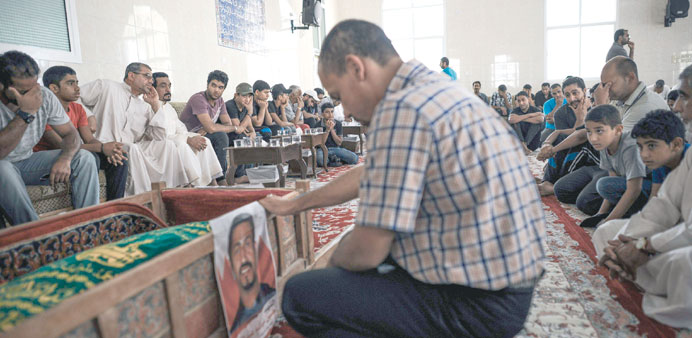
An activist said police had fired tear gas and rubber bullets on Thursday at a funeral for a man allegedly targeted by authorities a day earlier.
Police said the man was the victim of a road accident and that an “illegal rally” was held after his funeral.
A report has said security forces used “excessive force” earlier this year.
The independent report covered unrest in February and March, and prompted King Hamad to promise reforms to prevent future abuses by security forces.
It detailed excessive use of force and abuse of unarmed protesters. Bahrain’s mainly Shia protesters have been calling for democratic reforms and more rights for the country’s Shia majority in the Sunni-ruled kingdom.
Bahraini security forces, aided by the Saudi military, cracked down this year on mainly Shia demonstrators demanding a greater say in government and an end to what Shia said was systematic discrimination against them.
‘Not a protest’
The activist, who said he was in hiding and requested anonymity to avoid reprisals, said he was one of several thousand to attend the funeral for Abdul Nabi Khadhem on Thursday in the Shia town of A’Ali.
“We were lowering his body into the ground and the security forces opened fired with tear gas, rubber bullets and stun grenades,” he said.
But in a statement to the BBC, the interior ministry said: “Around 500 persons participated in an illegal rally after a funeral procession in A’Ali. Roads were blocked and Molotov cocktails and stones were hurled by the demonstrators which led to police forces interfering.”
Mr Khadhem died in a car crash on Wednesday. Police say he was simply the victim of a road accident when his car hit another on the outskirts of the capital Manama.
The interior ministry statement described him “driving at a high speed on a branch road, where he lost control of the vehicle due to a curve on the road”.
But the activist told the BBC that the 43-year-old died when his car was deliberately struck by a security vehicle and swerved into the path of an oncoming car.
He said that people had shouted at the police that it was they who were responsible for Mr Khadhem’s death. But he denied claims that the crowd was violent.
“There were no banners, we were not in a protest march, we were in the cemetery, burying him, and they opened fire.”
The reports of continuing unrest bodes ill for the government’s attempt to draw a line on the violence and upheaval that has wracked this island kingdom for months.
Bahrain’s international image has been seriously damaged and its economy slowed to a near standstill as confrontations between police and predominantly Shia protesters continue. …source
November 25, 2011 Add Comments
The narrative should be about “Structural Abuse” of Human Rights not simply “systematic abuse”. And it’s something that is happening, not something that happened a few months ago. The construct of the BICI has created a false narrative that omits calls for Democracy almost entirely.
November 24, 2011 Add Comments
Martyred by Saudi Security Forces, one of four young people murdered reveals King Abdullah’s “Freudian Projection” toward Syria
November 24, 2011 Add Comments
Bahrain Tortured Activists in Deadly Crackdown – No mention they are now caged
November 23, 2011 Add Comments
US and Western Allies must recognize and cease the role as enablers of al Khalifa regime of oppression
U.S. urges Bahrain to address ‘disturbing’ abuses
23 November, 2011 – By Arshad Mohammed and Caren Bohan
WASHINGTON (Reuters) – The United States urged its ally Bahrain, home to the U.S. Fifth Fleet, to quickly address abuses laid out in a report Wednesday that said Bahraini security forces used torture to obtain confessions.
A Bahraini government-commissioned panel charged with investigating abuses found that Bahrain’s security forces used excessive force to suppress pro-democracy protests this year, saying five people were tortured to death.
The United States, which has been faulted by rights activists for not criticizing the island kingdom more sharply for the crackdown, appeared to carefully balance its demand for the abuses to be addressed with praise for its Gulf ally.
“We are deeply concerned about the abuses identified in the report and urge the Government and all elements of Bahraini society to address them in a prompt and systematic manner,” Secretary of State Hillary Clinton said in a statement.
“We believe the … report offers a historic opportunity for all Bahrainis to participate in a healing process that will address long-standing grievances and move the nation onto a path of genuine, sustained reform,” Clinton added.
Neither Clinton’s statement, nor one from the White House, hinted at any distance between the Obama administration and the royal family that rules Bahrain, although Washington has said it will weigh human rights in decisions about military sales.
Clinton made a point of stressing the “strategic interests” that the two countries share, a likely reference to containing Bahrain’s neighbor Iran, which the United States suspects of pursuing nuclear weapons and accuses of supporting terrorism. …more
November 23, 2011 Add Comments
Obama and Western analysts fail to acknowledge structural – “apartheid” – nature of conflict, argument for vain remedies of judicial accounting and punishments for underlings are not a solution to structural oppression
Obama Praises Report as Groups Urge Arms Delay
By Jim Lobe – IPS – 23 November, 2011
WASHINGTON, Nov 23, 2011 (IPS) – The administration of President Barack Obama has praised a damning report issued Wednesday in Manama on Bahrain’s crackdown on the democracy movement earlier this year, as human rights groups called on Washington to further delay delivery of a pending 53-million-dollar arms package to the kingdom.
“We welcome today’s report by the Bahrain Independent Commission of Inquiry (BICI), which provides a thorough and independent assessment of events in Bahrain since protests first erupted in February,” the White House said in a statement.
“The report identifies a number of disturbing human rights abuses that took place during this period, and it is now incumbent upon the Government of Bahrain to hold accountable those responsible for human rights violations and put in place institutional changes to ensure that such abuses do not happen again,” according to the statement.
It also said Washington “will closely follow” the implementation of King Hamad bin Isa al-Khalifa’s commitment to carry out the report’s recommendations.
At the same time, several major human rights groups here called on the administration to further delay the transfer of a pending 53- million-dollar arms deal for Bahrain in light of the findings by the Commission, which was headed by the Egyptian-American jurist, Cherif Bassiouni.
“The U.S. shouldn’t sell the arms until there’s clear evidence that the Bahraini ruling family is addressing these very serious issues that the commission found and has taken action on the recommendations,” said Joe Stork, the Middle East analyst for Human Rights Watch (HRW) here.
“The Bahraini security forces have demonstrated over the past few months a willingness to use everything from weapons up to tanks in cracking down against domestic protestors,” said Sanjeev Bery, Middle East/North Africa advocacy director for the U.S. section of Amnesty International (AIUSA).
“Until its government has demonstrated complete follow-through on the recommendations, including the investigation and prosecution of anyone who may have been involved in the abuses, including those who gave the orders, there should be no arms transfers from the United States or any other country to Bahrain,” he told IPS.
Based on more than 5,000 interviews with Bahraini officials, protestors and witnesses, the long-awaited report found numerous serious and systematic violations, including the excessive use of force by the security forces; arbitrary arrests; and the abuse of detainees during the February-March government crackdown. More than 40 people – most of them Shi’a demonstrators – were killed in the violence. …more
November 23, 2011 Add Comments
Unrest grows in Qatif as Saudi goverment held to account in the streets for murders of young people
November 23, 2011 Add Comments
Still waiting for the “turning point”
November 23, 2011 Add Comments
Bahrain: Critical report should spur human rights ‘turning point’
[cb editor: While I would like to share in the optimism from Amnesty and others, I find it difficult to grasp why there “should be a turning point” ahead. The need and opportunity for a “turning point” by the al Khalifa regime has presented itself time and again and it could have been pursued at any point along the way. Even today, as the BICI report was released, another protester was killed during Security Force attacks on demonstrators. It seems, incrementalism, couched in Pollyanna “carrot on a stick” approaches to reform, while maybe well intentioned by some, are what have brought Bahrain to the brink of revolution. ]
Bahrain: Critical report should spur human rights ‘turning point’
23 November 2011
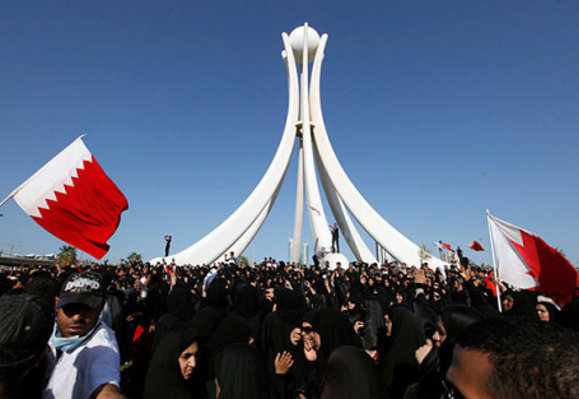
Mass protests in Manama earlier this year called for wide-ranging reforms
Amnesty International today urged Bahrain’s government to usher in much-needed human rights reforms after a comprehensive independent report by international experts criticized the use of torture and “excessive force” during protests earlier this year.
The Bahrain Independent Commission of Inquiry (BICI) report, released today amid fresh protests in Manama, was deeply critical of the authorities’ handling of demonstrations in February and March and other abuses in the following months.
It covered hundreds of cases of abuse and included strong recommendations for protecting human rights and delivering justice and reparations to victims.
“We hope Bahrain’s government will view this landmark report as a turning point in how it responds to human rights violations, and will use its recommendations to lay the foundations for far-reaching reform,” said Philip Luther, Amnesty International’s Acting Middle East and North Africa Director.
“The pattern of abuse documented by the BICI – including mass arrests of peaceful demonstrators, widespread torture in detention and dozens of flawed military trials of activists and professionals – must be relegated to the past and Bahraini authorities must fully establish the rule of law and deliver justice to the victims.”
Established by a royal decree on 29 June, the BICI gathered around 9,000 testimonies and interviewed some 5,000 people about abuses during and after pro-reform protests in February and March.
Hundreds of cases were covered, including beatings of protesters by security forces, mass arbitrary arrests of mainly Shi’a opposition activists and widespread torture, with five deaths resulting from torture in custody. In all, at least 35 people have died in connection with the protests, including five security personnel.
The report urged the Bahraini government to immediately establish an independent body made up of representatives of civil society, the opposition and the government; to oversee the implementation of the BICI’s recommendations; to usher in legislative reforms to ensure laws are in line with international human rights standards; and to bring to account those responsible for abuses.
Bahrain’s King Hamad bin Isa Al Khalifa responded to the report by vowing not to repeat the events following the protests in February and March.
In a statement on Monday, Bahrain’s cabinet admitted that security forces had been responsible for “instances of excessive force and mistreatment of detainees”.
It announced new initiatives, including the criminalization of torture – bringing Bahrain’s penal code in line with international standards – and the establishment of an independent national human rights body.
The government also said that it was prosecuting 20 cases against security officers, without giving any further details, and would set up a special fund to compensate victims of the clashes between security forces and protesters.
“The King’s appointment of the BICI was a landmark development, as the commission’s findings and recommendations testify,” said Philip Luther.
“The true test now will be the speed, extent and seriousness with which the government follows through on the BICI’s recommendations.
“In particular, the government must now deliver justice, ensure national laws are adequate to protect rights and work with civil society and opposition leaders to establish a truly independent and effective national body to monitor human rights according to a clear timetable.”
A coalition of Bahraini civil society organizations published their own highly critical report on the protest aftermath yesterday.
The civil society report also called on Bahrain’s international supporters to do more to promote human rights in the Gulf nation. …source
November 23, 2011 Add Comments
Bahrain’s human rights report: The Cliff’s Notes version
Bahrain’s human rights report: The Cliff’s Notes version
By David Kenner – November 23, 2011 – Foreign Policy
Rarely has a human rights report been accompanied by as much hoopla as the Bahrain Independent Commission of Inquiry’s (BICI) investigation. The report, which examines the government’s crackdown during domestic unrest in February and March, was published on Nov. 23. Its release was accompanied by a televised speech by the BICI’s head, Cherif Bassiouni, accusing King Hamad bin Isa al-Khalifa’s security forces of operating with a sense of impunity, and using torture and excessive force to quell the protests.
The 501-page tome (warning: large .pdf file ahead) is a tough read. It neglects to name the officials responsible for human rights violations, and often falls back on a “he said-she said” account of events that leaves readers none the wiser about what took place. But there are a few sections of the report that shed new light on the abortive revolution that occurred on the island kingdom in February and March.
The first protester’s death: The first casualty in Bahrain’s crackdown occurred on Feb. 14, when police killed Ali Abdulhadi Almeshaima in the village of Daih. As the report makes clear, Almeshaima’s death galvanized the protest movement, as demonstrators took to the street for his funeral and to express outrage over the killing. The government’s story is that Almeshaima was participating in a demonstration and was killed after the protesters attacked a nearby police unit, while his family claims that he was shot by a police unit in cold blood, “for no apparent reason.”
On page 224, the commission comes down on the side of Almeshaima’s family:
“The death of Mr Almeshaima can be attributed to the use of excessive force by police officers. At the time of the shooting, there were no reports of any disturbances in the Daih area. Furthermore, the fact that Mr Almeshaima was shot in the back at close range indicates that there was no justification for the use of lethal force.”
The death toll: The casualties from Bahrain’s uprising is a matter of some dispute — the Bahrain Center for Human Rights has listed 46 people that it says were killed by excessive force from the country’s security forces. The BICI, however, finds that 35 people will killed during the revolt.
On page 214, it breaks down its death toll: 13 civilians were reportedly killed by security forces, five people died from torture, eight civilians died from unattributed causes, four expatriate workers were killed by both civilians and security forces, and five policy and army officers died during the unrest.
Fake blood: One of the narratives pushed by pro-government supporters is that protesters smeared fake blood over themselves to exaggerate, for media consumption, the brutality of the security forces’ crackdown. Among the government’s charges against 20 imprisoned medical workers, which it accuses of colluding with the protesters, is that they provided demonstrators with donor blood for just this purpose, and also gave atropine to some individuals to imitate nerve gas injuries — again for media consumption.
The BICI report, on page 74 and 75, appears to confirm the rumors that protesters used fake blood in at least one Feb. 18 protest:
“The protesters approached the BDF barricade at approximately 17:00 and demanded access to the roundabout. According to subsequent BDF investigations, the protesters began to verbally abuse the military personnel deployed in the area and to shout anti-government slogans. Reports also indicated that certain individuals among the demonstrators smeared their bodies with red liquid to feign injuries that could be recorded and subsequently aired on the internet and on satellite news channels.”
Torture: The most explosive segment of the report relates to the torture and death of protesters at the hands of Bahrain’s security forces. Strangely, in the case of two of the five protesters who died in police custody from torture, officers tried to cover up their crimes on multiple occasions by listing the cause of death as related to sickle cell anemia.
On pages 238 and 239, the report recounts a witness’s statement about the events that led to the death of Zakariya Rashid Hassan al-Asheri on April 9:
“The witness stated that all the detainees in the same cell were blindfolded and handcuffed, and forced to lie on their stomachs. On one of the mornings, the deceased began to experience hallucinations or confusion, whereby he began banging on the door shouting his name. The prison guards shouted at him to be quiet and when he did not comply, they entered his cell. The witness heard the deceased being beaten and he heard him scream after each beating. The witness then heard a shuffling noise after which the deceased‘s shouts became muffled. The witness then heard a Pakistani say in Urdu, ‘He is dead.'” …source
November 23, 2011 Add Comments
Wyden, McGovern Statement on Release of Bahraini Human Rights Report
Press Release of Senator Wyden
Wyden, McGovern Statement on Release of Bahraini Human Rights Report
Wednesday, November 23, 2011
Washington, D.C. – Reaffirming their opposition to the sale of arms to the Kingdom of Bahrain until sustaining human rights improvements are made, U.S. Senator Ron Wyden (D-Ore.) and U.S. Representative Jim McGovern (D-Mass) released the following statement on the Bahrain Independent Commission’s report on human rights:
“The Bahrain Independent Commission of Inquiry’s (BICI) report confirms accounts from human rights groups and Bahrainis who have spoken out against the abuses of this year. It is clear that the regime fostered a culture of terror and violently suppressed peaceful political protestors.
We are heartened to hear that the King has agreed to make changes in response to the report. However, these changes must be lasting and significant.
We certainly hope that the King and his government will immediately accept the BICI’s recommendations. We also hope that the regime makes more general changes to give all the people of Bahrain an equal voice in government.
The people of Bahrain are unlikely to stop pushing for freedom, equal opportunity, and representative government. This may require a gradual transition, but that transition must begin or the country of Bahrain, and potentially the entire region, could continue to be rocked by instability.
As we’ve stated before, rewarding regimes that violently suppress peaceful civil dissent and violate human rights with multi-million dollar arms sale is inconsistent with American values and interests. Therefore, we believe it would be inappropriate for the U.S. to finalize the arms sale until we see significant and tangible progress in Bahrain.” …source
November 23, 2011 Add Comments
King Hamad’s Grand Sham
cb editor: Quick Analysis – Of course King Hamad’s response is tailored for the politicians that are ready to sell him weapons and give him dispensation for crimes committed in the name of National Safety. On first pass, the report seems little more than a compilation of “alleged” crimes, incidents and other events. Clearly it is incomplete and is limited to a few weeks of events that occurred while King Hamad was “ruling by decree”. Bassiouni emphasizes the “rule by decree” often, which basically grants the King and his Security Forces exemption from accountability for atrocities. King Hamad’s action plan is already underway with the arrest of 20 “Security Forces” as fall guys. King Hamad’s action plan will remedy all that is necessary to return to “business as usual”. It will include a few expulsions of foreign security workers, maybe something more dramatic, a death sentence would add contrast to those he has handed down to the Opposition and it might make him appear even handed.
All the making of a Grand Sham as Bassiouni and crew collect their blood money. On first pass there is nothing in the 501 page document that seems it will facilitate any “real reform” or any other kind of remediation. There will surely be some money to go around to any takers who have been “unjustly” injured or otherwise offended, possibly a pardon or two for some of the detainees. A familiar phase for countries headed for a revolution.
See the Bassioni Report HERE
See King Hamad’s response HERE
November 23, 2011 Add Comments
King Hamad, “All those who called for the downfall of the regime will have a wall fall on their heads. Bahrain is a small island – there is no escape.”
Stalinesque Military Tribunals for Civilians – Since July 2011, at least six people have been killed by birdshots or excessive tear gas during the daily protests that have persisted despite regime brutality. To date, around five hundred detainees are languishing in Bahrain’s prisons, most of them sentenced in military tribunals specifically established to deliver summary justice. In Bahrain’s corrupt judicial system, even if cases are appealed in regular civilian courts, the possibility of a fair trial or access to legal counsel is severely diminished. Most detainees have no idea what the nature of charges against them are until they are brought to trial. Punishments are then inconsistently applied. Again, in my husband’s case, he was sentenced to three years on two counts of participating in an illegal assembly consisting of more than five persons and spreading false information that incites hate against the Bahraini regime.
Bahrain’s Independent Commission of Inquiry: A Path to Justice or Political Shield
by Alaa Shehabi – Jadaliyya – 22 November, 2011 – BCHR
Tomorrow, 23 November 2011, the Bahrain Independent Commission of Inquiry (BICI), comprised of an international panel of law experts, is due to submit its report following a four-month investigation of the violence that broke out since the February 14 Uprising in Bahrain. Aside from questions of partiality raised by ongoing statements made by its Chairperson, Professor Bassiouni, the more serious question centers on the political purpose that this report will serve. Will it offer justice for victims of the most brutal crackdown in Bahrain’s history? Or will it whitewash the findings by avoiding high-level accountability and offering a political shield for the regime against its critics?
The February 14 Uprising and the Saudi Crackdown
“All those who called for the downfall of the regime [isqat al-nizam] will have a wall fall on their heads. Bahrain is a small island – there is no escape.”
These were the ominous words of the son of the King of Bahrain, uttered on state television in his newly appointed role as Head of the Royal Guard in March 2011. It was a stark warning: no one who participated in Bahrain’s revolt would be spared the regime’s wrath. Many, like myself, felt like a ton of bricks had fallen on our heads. There really was no escape. My own husband, Ghazi Farhan, an apolitical businessman who did not participate in the protest movement, was ambushed in his office parking lot on 12 April by masked armed men and held incommunicado for fifty days before being dragged to a military tribunal and sentenced to three years of imprisonment. He was the liberal and consumer-orientated face of the young generation of Bahrainis who cared little for politics. But that is no longer the case. Much of this has changed. Not just in him, but in many of the youth who have witnessed or experienced such repression.
Ghazi is one of the hundreds of forgotten prisoners languishing in an overcrowded jail that was emptied of common criminals over Ramadan in late Summer 2011 to make room for more prisoners of conscience. In October alone, 208 people were sentenced to a combined total of 2500 years in prison through military tribunals. Since February 2011, forty-three people have been killed, almost 1500 arrested and tortured, and nearly 3000 fired from their jobs. Hundreds of Bahrainis have gone into exile.
The mass persecution of thousands of activists and their families began as punishment for daring to participate in mass protests in which people demanded the end of absolute rule. Those protests brought the regime to the brink of collapse. Some demanded a constitutional monarchy. Others wanted an end to the monarchy altogether. One by one, masked men raided the homes of youths, doctors, lawyers, teachers, and engineers. People were blindfolded and whisked off to undisclosed locations with little or no information given to their distressed families. Fuelled by a public campaign of naming and shaming on state television, thousands were dismissed from their jobs, labeled as “traitors,” and denied the ability to question the accusations made against them. Bahrain’s prisons, infamous for the torture that took place in them during the 1990s, were once again transformed into terror chambers. During his first four days of interrogation at the Riffa West police station, my husband was sleep deprived, whipped on the back and feet, and verbally abused. Four men, including a renowned book publisher, Karim Fakhrawi emerged with battered bodies after a few days of their arrest. The government’s forensic doctors attributed the bruises and marks to “sickle cell anemia” or “kidney failure.” “We will kill you like we killed Karim Fakhrawi, if you do not confess,” my husband was told by his interrogator.
Choosing the route of brutal repression, backed by neighboring Saudi Arabia’s military intervention, may have secured the regime its survival for the time being. Yet the human cost will prove too heavy for such a small island to bear. The regime and its state institutions has been implicated in serious and systematic crimes, which blatantly flouted internationally recognized principles and laws. A regime that has so keenly nurtured its international image as “business-friendly” and rarely made headlines over the last decade—except to announce its role as host of the prestigious Formula One races—now finds itself being referred to as “tyrannical” on the front pages of Western newspapers.
In the aftermath of the crackdown, the government needed a major damage control strategy. One that would allow it to regain some kind of legitimacy in the eyes of the international community, if not amongst its own people. So a regime accused of grave violations of human rights—ones that could very well amount to crimes against humanity—has initiated an investigation to be supervised by panel of renowned international law experts. On 20 July, the commission, comprised of five members headed by Professor Bassiouni, commenced its work. …more
November 23, 2011 Add Comments
“Kingdom of Bahrain, innocent young Democracy being taken advantage of by Armed Factions”, Bahrain Ambassador to US tells Congress
Bahrain’s Ambassador to the United States Responds to Congressional Joint Resolution on Arms Sales, Outlines the Need for Military Readiness in the Gulf
WASHINGTON, Nov. 22, 2011 /PRNewswire-USNewswire/ — The Kingdom of Bahrain responded to a proposed resolution that attaches conditions to future arms sales between the United States and Bahrain. In a letter to Congressional leadership on the Foreign Affairs, Appropriations committees, and the bill’s sponsors, Houda Nonoo, Bahrain’s Ambassador to the United States, outlined the need for military readiness in the Gulf against external threats for both Bahrain and the United States. The full text of the letter reads:
“I would like to address the concerns raised by members of Congress in the joint resolution that recommended attaching conditions to a proposed sale of critical military hardware to the Kingdom of Bahrain. The arms and technology in question would be dedicated to safeguarding Bahrain from external threats. This arms sale, like others before, will go to maintain security in the Arabian Gulf for the U.S. and its regional allies.
“While we recognize the concerns of our friends in Congress, this resolution is based on fundamental misconceptions about the unrest in Bahrain. Earlier this year, the Kingdom of Bahrain faced unrest unprecedented in our history. While many Bahrainis took to the streets to express legitimate demands, radical factions hijacked these protests and resorted to violence. These stories are well documented: the houses of government officials were marked for attack by armed mobs; hundreds of expatriate workers were attacked and several were killed; and, of course, several unarmed police officers were attacked and killed. Evidence suggests that these radical elements were inflamed by foreign actors seeking to undermine Bahrain’s sovereignty. As evidenced by the recent plot against the Saudi Ambassador to Washington, this foreign threat is very credible for the United States and its regional allies.
[Read more →]
November 23, 2011 Add Comments
BCHR President Speaks about Systematic Abuse and Bahrain’s Human Rights Crisis
November 23, 2011 Add Comments
Clashes in Bahrain ahead of crackdown report
Clashes in Bahrain ahead of crackdown report
By Nathalie Gillet (AFP) – 23 November, 2011
MANAMA — Bahraini police clashed with protesters in at least two Shiite villages as tensions escalated ahead of Wednesday’s release of a report on alleged rights abuses during a protest crackdown, activists said.
Protests erupted early morning in Aali village on the outskirts of the capital Manama, where rights activists and an AFP correspondent said police used tear gas and rubber bullets to disperse demonstrators.
A Bahraini man was killed when his car crashed into a wall as police confronted the protesters, according to the activists.
“I saw the police attack. There were a few dozen protesters shouting and chanting. The police attacked them with tear gas, rubber bullets, and sound bombs,” said Mohammed Maskati, head of the Bahraini Youth Society for Human Rights.
Nabil Rajab, a Shiite rights and opposition activist said the victim, Abdelnabi Kadhim, was “apparently not protesting. He was in his car when then police chased after him.”
In an online tweet, the interior ministry said a man died in a traffic accident in Aali, adding an investigation was underway. The tweet made no mention of police involvement.
An AFP correspondent in Aali said dozens of men and women chanted “Hamad must fall,” referring to the Sunni king whose family has ruled the Shiite-majority kingdom for some 250 years.
The smell of tear gas wafted through the air and the streets were littered with empty tear gas canisters and sandals, abandoned by protesters as they fled the police.
Clashes also erupted in the Shiite island of Sitra where mourners protested the November 19 death of a 16-year-old boy killed after being struck by a police car, witnesses said.
The police at the time said the boy’s death was an accident after a police car lost control and struck him.
The clashes occurred just hours before the much-anticipated release of a report by the Independent Commission of Inquiry, which was commissioned by the king to investigate allegations of human rights abuses in the bloody crackdown in February and March on anti-government protesters. …more
November 23, 2011 Add Comments
Protesters Respond to Bassiouni Commission Report and Royal Order No. 28
November 22, 2011 Add Comments
Maloney Signs Bahrain Arms Deal House Resolution
Maloney Signs Bahrain Arms Deal House Resolution
22 November, 2011 – POMED
An additional cosponsor has been added to H.J. Res. 80, which calls for “limiting the issuance of a letter of offer with respect to a certain proposed sale of defense articles and defense services to the Kingdom of Bahrain,” originally introduced by Rep. James McGovern (D-MA). Rep. Carolyn Maloney (D-NY) joined thirteen other cosponsors in signing the resolution.
The resolution limits the proposed arms sale, requiring the Secretary of State to “certify to the Committee on Foreign Relations of the Senate and the Committee on Foreign Affairs of the House of Representatives” that the Government of Bahrain “is conducting good faith investigations and prosecutions of alleged perpetrators responsible for the killing, torture, arbitrary detention, and other human rights violations committed since February 2011,” among other measures ensuring the Government of Bahrain’s compliance with international human rights standards. …source
November 22, 2011 Add Comments
Bahrain government under fire in advance of report on abuses
LEAD: Bahrain government under fire in advance of report on abuses
Nov 22, 2011, Deutsche Presse-Argentur
Cairo/Manama – Bahrain’s largest Shiite opposition group on Tuesday accused the government of having planned the use of ‘excessive force’ on protesters calling for greater freedoms and reforms earlier this year.
In a statement posted on its website Al-Wefaq said the government, by admitting to abuses, was trying ‘to escape its responsibility for violations leading to numerous fatalities and hundreds of injuries.’
On Monday, the government admitted to ‘instances of excessive force and mistreatment of detainees,’ during countrywide unrest earlier this year. It said that some 20 officers are being prosecuted as a result.
But according to Al-Wefaq, the ‘abuses were systematic and linked to planned government policies.’
‘Abuses could not have taken place without prior knowledge and consent of influential officials … and the ultimate responsibility falls on top decisionsmakers rather than junior officials and soldiers.’
More than 30 people were reported to have been killed when protesters clashed with security forces between February and March.
The opposition statement came a day before the planned release of a report by an independent commission of inquiry into the crackdown.
Separately Tuesday, three Bahraini human rights groups issued a shadow report criticizing the handling of dissidents, calling for reforms, and urging Western countries to halt military aid to the regime.
The 84-page report was compiled by the Bahrain Center for Human Rights (BCHR), the Bahrain Human Rights Society (BHRS), and the Bahrain Youth Society for Human Rights (BYSHR).
It detailed serious human rights violations, including extra-judicial killings, torture in custody and targeting of medics, and educational, media, and sports professionals.
The report claimed that torture was widespread and systematic, and predated the crackdown on pro-reform protesters who hit the streets on February 14th, demanding more political rights as the Arab Spring protests spread through the region.
It called on the Bahraini government to: immediately end ongoing human rights violations; unconditionally release political prisoners; end torture, arbitrary detention, and incommunicado detention; and to reduce the security presence on the streets.
It also called on the authorities to put on trial all those accused of killing, wounding and torturing protesters and detainees, as well as those who ordered and authorized such acts.
It also recommended the introduction of a new independent justice system and the reinstatement of all workers who were dismissed from their workplace for taking part in the protests. …source
November 22, 2011 Add Comments
Bahrain: Human Price of Freedom and Justice
[cb editor: It is of great importance to change the narrative that most elected officials follow regarding Bahrain. For many of them it is purely out of ignorance and they simply parrot the webpage rhetoric from the CIA fact-book and State Department country profiles. I urge you to print copies of the report HERE and linked below, add a cover letter to your Senators, Congressional Representatives, University Middle East Studies Groups and local Mosques and mail it to them.
It would be huge if you find the courage and conviction to organize a study group and discuss the document. Iinvite your Congressional Representatives or someone from their office, they will likely attend your meeting and gladly. Show the Bahrain Videos listed in the sidebar on, The Crooked Bough or find other videos that are meaningful to you. It is probably no accident the BICI report is being released so it will be eclipsed by the renewed demonstration in Egypt’s ongoing Revolution. Bahrain’s future hangs in the balance and all you do to Break the Silence regarding Bahrain, helps advance the cause for Human Rights and Democracy. ]
Bahrain: Human Price of Freedom and Justice
Bahrain Center for Human Rights (BCHR), Bahrain Youth Society for Human Rights (BYSHR), Bahrain Human Rights Society (BHRS)
Manama, London – 22nd November 2011
As Bahrain awaits the outcome of the Bahrain Independent Commission of Inquiry report, Bahraini human rights groups have released their own report documenting the brutal crushing of the Arab Spring protests in Bahrain.
This report documents the violations in Bahrain since February 14th, although crucial to note that due to lack of funding and manpower it was difficult to document all the cases that have occurred. This 87 page report gives background to the situation, then identifies and document all the types of violations that took place, with the aim of putting out recommendations to the Bahraini government, as well as the EU, US, UN OHCHR and the ICC. These recommendations are crucial to start a process of reconciliation and to stop the ongoing violence, including loss of civilian lives, taking place.
(For the entire report, kindly find PDF document attached HERE)
Findings:
This Joint Report represents a concerted effort on the part of every human rights organization operating in Bahrain, various opposition parties, and those citizens in which this report gives a voice. The collection of personal testimonies, governmental orders and documentation, and video and hardcopy evidence, amongst others, has been an ongoing project since before the February 2011 protests erupted. Nevertheless, while the work of this Joint Report is representative of almost a yearlong research study, much more needs to be done, largely because the conflict continues to rage and violations of international human rights law are reported everyday.
The evidence contained in this report is accurate considering the reliability of the sources used and the length of time spent in collecting and addressing various data. It is therefore the opinion of this joint report that the violations of international human rights law that are addressed herein are credible and sufficient in quality and quantity to illicit immediate action by the international community and the government of Bahrain. Prior to and after the February 2011 protests, the international media has produced several reports pertaining to the events. Moreover, videos and still pictures have been given to members of the Bahrain human rights community by various individuals fearful of coming forward to the Government supported BICI Report. This video and photographic evidence has been surmised in relation to their validity and proven credible.
The current state of affairs must be appraised in regard to the regime’s reign since the 18th century, and specifically, Hamad bin Isa Al-Khalifa succession in 1999, as noted in Section II. (Background). The 2002 Constitution reinforced the absolute powers of the king, and diminished the powers of the appointed legislature. This Constitutional Crisis also negated the actions of the National Action Charter, enabling the King to increase the number of security agencies, with the creation of the National Security Agency, to control the judiciary, and to enforce a process of naturalization. The NSA is known to be behind numerous human rights violations and largely uses non-Bahraini mercenaries. In 2010, BCHR reported that “the NSA has become a security institute that is completely independent of the Public Security and Defense; however, it benefits from double jurisdictions that combine the domains of the Public Security Forces and the Judicial Authority.”# This is a development which has severely negative effects in the observance of justice and further encourages impunity for torturers. These political maneuvers by the King provided the framework for the February 2011 protests, but more importantly, not only allowed the government to perpetrate human rights abuses but suffer the consequences of them as well under national and international law.
[Read more →]
November 22, 2011 Add Comments
Egypt’s military rulers agree to speed up handover of power
Egypt’s military rulers agree to speed up handover of power
By Jeffrey Fleishman – Los Angeles Times – November 22, 2011
Egypt’s military rulers agreed Tuesday to speed up the timetable for a transfer of power to a civilian government, but it was not immediately clear whether the gesture would appease tens of thousands of protesters or calm the unrest that has left at least 29 people dead.
In another concession to protesters, according to state media, the Supreme Council of the Armed Forces accepted the resignation of the widely unpopular military-backed interim government. The generals said a new “national salvation” government would be put in place until July, when the military would step aside.
“Presidential elections to be held by the end of June and the final preparations for handing over power by July 1,” Emad Abdel Ghafour, leader of the ultraconservative Islamist Nour party, told Reuters news service.
The military had previously indicated it would not relinquish control of the country until after presidential elections in 2013. Its latest moves were announced after emergency talks with political parties.
Demonstrators, who surged into the square as darkness fell, had promised not to leave until ruling generals themselves relinquished power. Egyptian TV reported that Field Marshal Mohamed Hussein Tantawi, who was chanted against and vilified by protesters, would address the nation Tuesday night. Dozens were injured in downtown Cairo as police fired tear gas to keep protesters from reaching the nearby Interior Ministry, a long reviled symbol of state repression. Demonstrators were angry not only at the military but also at political parties, including the dominant Muslim Brotherhood, for not strongly supporting a wave of nationwide protests that began Friday. …more
November 22, 2011 Add Comments
Egypt: Fighting for a “stolen” revolution
Egypt: Fighting for a “stolen” revolution
22 Nov 2011 – Index on Censorship
Despite the lethal crackdown, Egyptians are converging on Tahrir Square for the fourth day demanding change. Shahira Amin reports
The death toll from three days of unrest in Cairo’s downtown Tahrir Square has risen to 33, with more than 1700 injured. More casualties and fatalities are expected as riot police and security forces continue their crackdown on the tens of thousands of protesters demanding the ousting of Field Marshal Hussein Tantawy who heads the Supreme Council of the Armed Forces (SCAF).
Following the outbreak of unrest, Prime Minister Essam Sharaf’s government resigned. At the same time, the Youth Revolutionary Coalition called on Egyptians to participate in what they hoped would be a million-strong National Rescue protest on Tuesday, calling for the formation of a new government with complete authority to run the country during the transitional period.
“The people feel their revolution has been stolen by the military. So we are back in Tahrir to ask the military rulers to leave. They are all members of Mubarak’s regime. The autocracy has only been replaced by another military dictatorship.”
-22-year-old activist Sahar Mohamed Zaki, who works for an airline company, explaining why protesters had returned to Tahrir
Most of the deaths in Tahrir were the result of gunshot wounds sustained in clashes with security forces as protesters attempted to storm the nearby Interior Ministry, headquarters of the detested police force. Demonstrators — suffering head injuries after being beaten with batons and choking as a result of excessive tear gas inhalation — were being ferried on makeshift stretchers to an area in the square where volunteer medics offered emergency aid. Wailing sirens could be heard as ambulances transported the more serious cases to nearby hospitals for treatment. Bahaa el Razi, a volunteer medic at the scene, told me that most of the casualties suffered from gas inhalation, while a few had been hit by rubber bullets and bird shots. Protesters claimed live ammunition was also being fired in attempts to disperse them.
In one instance, the body of a dead man was thrown by his attackers onto a rubbish heap . The incident enraged eyewitnesses, who insisted that “nothing has changed” and that their lives counted for nothing to those in a position of authority.
“Tantawy, leave!” The chants of the indignant protesters reverberated across the square. The scene was reminiscent of the January uprising that ousted Mubarak. Demonstrations erupted in Tahrir last Friday, with people demanding the ruling military council immediately hand over power to a civilian government. The protesters also called for an end to military trials for civilians and for parliamentary elections to be held on the scheduled date of 28 November. They also called for those responsible for the recent deaths to be punished for their crimes. …more
November 22, 2011 Add Comments
Three Saudi Shi’ites killed by Stray Bullets
Three Saudi Shi’ites killed by stray bullets
by Goran Tomasevic – Nov 22, 2011
DUBAI – (REUTERS) Three Shi’ite Muslims have been killed in eastern Saudi Arabia by what was reported as stray bullets fired by police, a Saudi activist said on Tuesday, raising tensions ahead of the Ashura holiday which has prompted clashes in the past.
Tawfiq al-Saif, an activist, told Reuters that the government was sending a team of investigators to the town of al-Qatif to investigate the deaths, which have angered Shi’ites in the oil-producing Eastern Province. An Interior Ministry spokesman was not immediately available to comment on the report.
Saudi Arabia has escaped the popular protests that have swept three Arab heads of state from power this year, after the world’s largest oil exporter offered a major package of incentives to its citizens. But small-scale protests have taken place in the Eastern Province, where most of the kingdom’s Shi’ite Muslims live. Activists said authorities responded by deploying armed riot police who had set up checkpoints.
The Eastern Province is the center of Saudi Arabia’s oil production facilities and is connected by a 16-mile causeway to Bahrain, where Riyadh sent troops earlier this year to help the Sunni government end a Shi’ite uprising. Saudi Shi’ites complain of systematic discrimination, which is denied by the authorities. King Abdullah has appointed members of the sect to advisory government bodies.
Saif said that a 19-year-old technical college student died on Sunday by what police had told his family was a stray bullet fired during a clash between security forces and unknown assailants. On Monday, a girl was shot and killed and another young man, believed to be aged 24, was also shot dead during a march in al-Qatif. The activist said they were hit by stray bullets.
“Opening fire is a big mistake, especially as we approaching Ashura,” Saif said, referring to the holiday when Shi’ite Muslims mark the anniversary of the slaying of Prophet Mohammad’s grandson, Imam Hussein, in 680. This year Ashura falls in early December.
Saif said that unlike provincial police, who had always held back from opening fire even during protest marches, shooting into the air had increased since riot police were deployed earlier this year in the province. He said he hoped that an investigative team being sent by the Saudi government to look into the incidents would calm tensions . “We expect this committee to work in a neutral way, to calm tensions. I hope it will calm spirits,” he added. …more
November 22, 2011 Add Comments
A Quite Day in Bani Jamra
Adam Shapiro reports from Bahrain on Day 1 of mission “Perhaps even the torture chambers are on hold this week”.
Frontline Defenders – Jim Loughran’s blog
Walking around in Manama, Bahrain, things seem to be normal. I had been here before and I don’t know that I would necessarily be able to tell the difference, except that in general things seemed quiet. There is a breeze from the Gulf and the boats in the marina bob up and down on the waves. But the quiet is deceptive in Bahrain.
Towards evening I head to the outskirts of the city, to Bidaya Road, which is the main road linking villages on the outskirts of the city. Behind are the bright lights and the shopping malls and the boats. Pulling down the narrower streets, which get narrower the further into the village we drive, I start noticing the graffiti on the walls. Having been born and raised in New York City at the rise of the graffiti era, I find I can easily overlook interesting wall art, or become intensely absorbed in understanding images, words and meanings. However, the writing on these walls, caught my attention not for artistic value or for interesting messaging – I was noticing because the writing was covered up. Literally every word, every image, every number spray painted on a wall had white paint laid over it. Sometimes you could still make out a few letters, or even a word and decipher what was underneath, but it was clear: someone had come to cover up the populist scribbles.
We were in Bani Jamra, a poor village that supported the popular protests calling for reform and democracy in Bahrain. Months after the main protest at the Pearl Roundabout was violently broken up, this village (and dozens of others) face continued collective punishment as almost every night riot police patrolling up and down Bidaya Road respond to popular protest (honking horns, shouting from rooftops, chanting, etc.) with firing rounds of tear gas, rubber bullets and sound grenades into the villages, into homes and into people. The riot police then go after the protesters, entering homes full of women and children and beat and detain young men.
Talking to a human rights defender who had previously attended the 2009 Front Line Dublin Platform, I learned how he was filming one such encounter in his village from his rooftop when one of the tear gas canisters started a fire nearby. He ran over to put out the fire and found himself being shot at and hit in the back by a sound grenade and a rubber bullet. He fell two stories and landed in a heap. Perhaps it was only because he had fallen and must have been seriously injured that the riot police didn’t come to arrest him – they would have to explain this to too many superiors. But Naji could not go to the hospital either, for he knew that it was extremely likely that he would be detained at the hospital as so many others were. So like increasing numbers of Bahrainis he chose to forego the necessary medical care for his broken foot and messed up back which was already problematic due to torture he had experienced during a previous stint in jail on charges stemming from his human rights work. Instead one of a network of underground doctors treated him as best he could at home.
As we drove out of the village we passed 6 Ministry of Interior police SUVs with about 15 riot policemen hanging out at the edge of the village, waiting. Inside the village things were quiet, and our local hosts explained that this was the first time in a long time that the police had not taken action. Perhaps, he joked, it was us – international human rights NGO personnel – who were providing security. Perhaps tonight will be quiet in Bahrain for everyone; perhaps even the torture chambers are on hold this week.
First day in Bahrain, tomorrow a chance to speak to the government. …source
November 22, 2011 Add Comments
Two Slices and the Spooks To Go
CIA agents spying on Hezbollah and Iran nabbed at Pizza Hut
Voltaire Network – 22 November 2011
Several dozen spies working for the CIA in Iran and Lebanon have been caught, ABC News said, citing U.S. officials with connections to the intelligence community.
The CIA has basically lost its spy network in Lebanon and suffered a major setback in its efforts to infiltrate Iran, all because “of a lack of professionalism in the U.S. intelligence community.” When the agency decided to cryptically refer to its secret meet-up spot as “PIZZA,” Hezbollah double-agents logically inferred that the location may have been a pizza restaurant. And it was!
Hezbollah kept an eye on a Beirut Pizza Hut, a tactic that – ABC News said – allowed “Hezbollah’s internal security arm [to identify] at least a dozen informants, and the identities of several CIA case officers.”
Almost at the same time, Iranian counter-intelligence “cracked” a secret internet communication method used by CIA-paid assets in Iran, leading to alleged arrests of at least 30 U.S. and Israeli spies.
The officials, cited by ABC, admitted that the loss of the two U.S. spy rings in the Middle East represents “a setback of significant proportions in efforts to track the activities of the Iranian nuclear program and the intentions of Hezbollah against Israel.”
There have been no official comments by the U.S. authorities on the exposure of CIA spy networks in the Middle East …source
November 22, 2011 Add Comments