Protests meet political detentions of Saudi Arabia ‘s genocidal policies toward Shia
Protest Rallies in Saudia for the release of Shia Political Prisoners
August 13, 2011 – by jafrianews
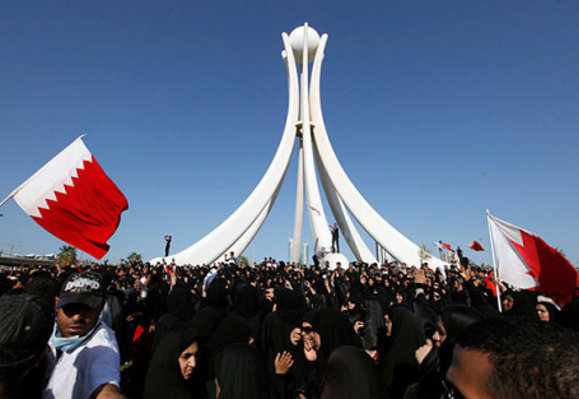
JNN 13 Aug 2011 : Hundreds of Saudi anti-government protesters have poured into the streets in the eastern city of al-Qatif, demanding the release of thousands political prisoners.
The demonstrators also shouted slogans against the ruling regime.
A similar anti-government protest rally was held in the city of al-Awamiyah on Thursday night in which demonstrators condemned the detention of cleric Tawfiq al-Ammer and called for his immediate release.
Al-Ammer, who is known by his followers as the most prominent advocate of civil rights and freedom in the eastern region of the Arab kingdom, was recently arrested after he called for reforms during a speech at a local mosque.
His arrest has triggered protests in the oil-rich east.
Saudis in the eastern province plan to take to the streets again later on Friday. Reports say Saudi security forces have surrounded a mosque and several areas in al-Qatif.
Saudi Arabia’s east has been the scene of anti-government protests over the past months.
Human Rights Watch says more than 160 dissidents have been arrested since February as part of the Saudi government’s crackdown on anti-government protesters.
According to the Saudi-based Human Rights First Society (HRFS), the detainees were subject to both physical and mental torture. …source
August 21, 2011 Add Comments
al Khalifa regime systematic assault on Shia community from job dismissals, detentions of leadership and killings is genocide
The Convention on the Prevention and Punishment of the Crime of Genocide was adopted by the United Nations General Assembly on 9 December 1948 as General Assembly Resolution 260: Article 2 of the Convention defines genocide as …any of the following acts committed with intent to destroy, in whole or in part, a national, ethnical, racial or religious group, as such: (a) Killing members of the group; (b) Causing serious bodily or mental harm to members of the group; (c) Deliberately inflicting on the group conditions of life calculated to bring about its physical destruction in whole or in part; (d) Imposing measures intended to prevent births within the group; (e) Forcibly transferring children of the group to another group.
Bahrain government fires hundreds of employees for political views
By Kristen Chick, Correspondent – August 19, 2011 – Cairo
More than 100 government employees have been dismissed in recent weeks, joining 2,500 workers – nearly all Shiites – who have been fired since Bahrain’s pro-democracy uprising.
They join 600 workers who have already been forced to leave government ministries and universities and about 1,900 workers sacked by private businesses this spring. While the Ministry of Labor has reinstated about a fifth of those fired, the most recent dismissals challenge official portrayals of the kingdom as going back to normal following the government’s brutal crackdown, in which at least 30 people were killed and hundreds detained.
RELATED: Amid unrest, Bahrain companies fire hundreds of Shiites
An independent commission appointed by King Hamad bin Isa Al Khalifa to investigate the crackdown could lead to more workers regaining their jobs. But some are losing confidence in the Bahrain Commission of Inquiry (BICI), which has become a focal point for angry protests.
Sayed Salman, head of the General Federation of Bahrain Trade Unions (GFBT), says he appreciates the efforts of the Labor ministry so far to reinstate employees who were unfairly fired, but says the proportion of workers reinstated is too small and has taken too long. He also rejects government arguments that dismissals, such as those taking place at government ministries currently, are disciplinary measures carried out according to law.
“When you talk about the dismissal of 10 or 15 people, that is one thing,” says Mr. Salman. “When you talk about the collective dismissal of hundreds of people from different ministries, it is a systematic dismissal to get rid of anyone who is suspected of having supported the political unrest.”
19 Shiite academics fired last week
Last week, 19 academics and 40 staff members were fired from the University of Bahrain, including Abdulla Al Derazi, who has been an English language professor at the university for 20 years and is also head of the Bahrain Human Rights Society. He says the university accused the academics of participating in protests, expressing political opinions critical of the government, and talking to the media. The university also accused Prof. Derazi of civil disobedience for being absent from work during protests – which he denies.
“There’s no grounds for what they did because it’s all unconstitutional,” says Derazi. “The decision was based on political and sectarian reasons.”
All 19 academics are Shiite, as are most of the more than 2,500 workers who have so far been dismissed, according to the count of the General Federation of Bahrain Trade Unions. Bahrain’s population is about 60 percent Shiite.
Though Shiites made up the majority of the protesters demanding democratic reform from Bahrain’s Sunni monarchy, the movement’s aims were democratic rather than sectarian. But the government has largely targeted Shiites in its efforts to quell the uprising, which began in February inspired by the revolutions in Tunisia and Egypt. The government called in Saudi and other Gulf forces to participate in a violent crackdown in March.
‘Is sending an e-mail a crime?’
In recent months, the government has sought to portray the crisis as over. It held a national dialogue billed as a gathering to address political problems, and released some of the hundreds it had detained during the crackdown, including two former members of parliament from the largest opposition bloc, Al Wefaq.
But activists and opposition members say the national dialogue didn’t address Bahrain’s real problems, and point out that those who have been released still face politically motivated charges.
The private sector firings largely took place in April, targeting Shiites and employees who had participated in protests. Many companies attempted to justify the dismissals by saying employees were absent. But some of the government institutions seem to be more open about the political reasons for the dismissals. …more
August 21, 2011 Add Comments
Remembering how the Medical Staff became victims to al Khalifa and Saud coverup of heinous crimes against humanity
BYSHR: Bahrain: Injured testimonies confirm that the hospital turned into prison
August 16th, 2011
Bahrain Youth Society for Human Rights-BYSHR has documented testimonies of some injured of the protests that started on 14 February 2011. BYSHR representatives met with the injured after they had been released from jail. They were arrested from Salmaniya Hospital, the main governmental hospital, and were detained for more than three and a half months.
BYSHR sought the assistance of an independent physician, to examine the patients and report the injuries they suffered.
On 16 March 2011 the army and the National Guard took over of Salmaniya Hospital and arrested the protesters whom gathered in the hospital building. Later a number of doctors were arrested on charges of hospital occupation and the confiscation of Medical equipment.
Salmaniya Hospital is considered one of the witnesses to the human rights violations that took place against protesters since the 14th of February uprising, as thousands of the injured got medical treatment in Salmaniya Hospital due to the suppression of riot police using rubber bullets, tear gas, sound grenades and shot guns. Also, the military used live ammunition to disperse protesters on the 16th of March 2011 – the BYSHR have documented cases where live ammunitions were used.
An injured told the BYSHR: ” I was on the 4th floor in Salmaniya Hospital where I was being treated from a shotgun injury in the head and face – left side – when they transferred me to the 6th floor, and there I was mistreated, insulted, tied to the bed, eye folded and they used offensive words against the Shia and asked us to curse and insult the political opposition leaders”. (1)
And he continues: “I was taken later from the hospital to Noaim Police Station and then to Isa Town Police Station where I was tortured there too.”
Another protestor told (BYSHR)’s representative: “my right eye is injured because of a shotgun explosion besides me; I was taken to the hospital after the army and police took over, I tried to escape but I was arrested in a checkpoint near the hospital gate and I was tortured in an external room – the room of ambulance care assistants and ambulance drivers (attached Picture) – other injured were with me too.” (2)
A wounded by birds gunshots informed BYSHR: “I was injured on 15 March in my back by the ant-riot police. I was transported to Salmaniya Hospital. I was on the fourth floor, afterwards I was transferred to the sixth floor where I was mistreated, tied to the bed, and blindfolded. The doctors avoided talking to us about our cases for fear of the security forces. I was removed in a police car to Isa Town Police Station and was forced to sing the National Anthem and insult the opposition political leaders.”. (3)
The injured refused to mention their names because the charges against them are still valid even after their release.
BYSHR expresses its concern about those allegations and it demands urgent investigation in subjecting the injured to the allegations of mistreatment and torture at Salmaniya Hospital. BYSHR demands the Special Rapporteur on torture the urgent action and investigation of those accusations against the anti-riot police.
(1) Medical examination: Multiple bird shot to the left side of the scalp and face.Cartilaginous damage to the left pinna.Missing segment of upper pinna and scarring and possible retained shot within the ear.Normal ear drum.Unable to fully open jaw due to pain.TMJ appears to be moving in a normal fashion but without full range of movement.
(2) Medical examination:Patient has a bird shot within the upper lid of the left eye on the nasal aspect.Bird shot on the temporal aspect of the upper lid of the right eye.Healing laceration to the right cornea on the lateral border of the iris.Acuity to finger counting only.Fundoscopy looks normal.
(3) Medical examination: Multiple bird shot entry wounds on the back from upper shoulder area to the feet.More evident on the left side of the body.Laparotomy scar.Tenderness on the left mid axilla chest area . …source
August 21, 2011 Add Comments
Bahrain: Independence Day remembered as royal commission nears collapse
Bahrain: Independence Day remembered as royal commission nears collapse
Bahrain Freedom Movement – 19/08/2011 – 12:22 p | Hits: 187
Tension is rising in the country on the eve of Imam Ali’s martyrdom. The regime’s armed militias (Death Squads) have threatened to attack the religious procession in Muharraq tonight and tomorrow night. These squads are responsible for the abduction, torture and killing hundreds of Bahrainis in the past twelve months.
They are run by the royal court and are immune from prosecution. There are hundreds of images of these squads wreaking havoc on the citizens. They often roam the streets wielding axes, swords, wooden sticks or guns. They were deployed last summer after the crackdown on the opposition figures to instill fear in the hearts of the people. Their actions have only solidified the will of the people to oppose the Al Khalifa hereditary dictatorship. When the 14th February youth declared the revolution these Death Squads were granted extra weapons and powers to attack humans and properties. Bahrainis have appealed to the international community to intervene to stop these thugs before the situation gets out of control. Bahrainis will not allow themselves to be intimidated.
Last night demonstrations erupted in most areas amid massive attacks by the regime’s forces. Bahrainis have celebrated 40 years of independence from the British rule in their own ways. They wanted to tell the world that the struggle of the people had contributed to the independence and that the 150 years British rule was abruptly ended. The message is that regardless of the duration of the occupation, it has to end one day. The Al Khalifa rule is also bound by this fact; it has to end one day. It is not eternal; it is a temporary arrangement that is now doomed due to the excesses of the regime. The people of Dair took to the streets, breaking the siege by the regime’s forces. They marched bare-chested near the main entrance to the town until they were mercilessly attacked by the aggressors who used tear and chemical gases, rubber bullets and shotguns. The Al Khalifa forces also attacked people’s properties and cars.
The people of Sitra marched on 17th August near the main road before they were attacked by the regime’s forces. Moving images show clearly the intensity of the confrontations that had taken place near the police station and the National Bank building. Similar scenes were reported at Mhazza, wadyan, Sfala, El Ekr and Ma’amir. On the same day another demonstration in Dair was attacked near Martyr Zakaria Al Ashiri’s Square. All kinds of repressive measures were used against the demonstrations that have continued in most areas of Bahrain to mark the Independence Day which the regime has refused to recognize. Many casualties were reported and the images of these indicate intentional attacks to suppress the voice of dissent and revenge from those who defy the Al Khalifa hereditary dictatorship.
Meanwhile it has been reported that Jalila Al Salman, the teacher who began a hunger strike last week has been transferred to hospital after her health deteriorated on Wednesday. She was joined by Dr Rola Al Saffar who is also behind bars for treating the injured in March. Medics have remained in detention ever since as the international community failed to force the regime to release them.
In a separate development the discredited royal commission, headed by Charif Bissiouni to whitewash the dictator and his sons from any wrong doing has shown signs of serious cracks in its membership. The head of the local committee supervising the investigation, Kamran Chaudry, has resigned for “personal reasons” and left the country. The resignation came after it became clear that Bissiouni has sold out to the dictators and betrayed the trust of some of his victims.
Bahrain Freedom Movement
19th August 2011
…source
August 21, 2011 Add Comments
al Khalifa plays cat and mouse game with opposition over detainee release, trials and bogus charges
Bahrain: The Medical staff before a military court again
August 21st, 2011 – BYSHR
Mr. Mohisn Al-Alawi – Lawyer – informed the BYSHR that the medical staff will be presented before a military court on 28th Aug, 2011.
Bahrain Youth Society for Human Rights (BYSHR) is deeply concerned about the trial of the Medical staff before a military court. ...source
Attached : The list of Medical Staff undergoing trial and bogus charges (click Here)
August 21, 2011 Add Comments
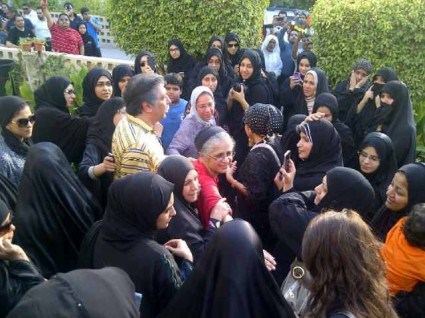
Rola al-Safar Free!
August 21, 2011 Add Comments
Wrongfully detained Bahrain Nursing Official Released after five months, used as political capital to “legitimize” al Khalifa’s BICI
Bahrain Nursing Official Freed From Custody
By THE ASSOCIATED PRESS – August 21, 2011
MANAMA, Bahrain (AP) — Bahraini authorities have released the country’s top nursing official after five months in custody .
Rola al-Safar was detained during crackdowns on Shiite-led protesters demanding greater rights.
Rights groups say the release of al-Safar and another detainee, teachers’ union official Jalila al-Salman, came after jailhouse meetings with the head of an international panel investigating alleged abuses in the Gulf nation’s six-month-old unrest.
Al-Safar is among more than two dozen doctors and nurses facing charges linked to the demonstrations by Bahrain’s majority Shiites, who claim widespread discrimination by Sunni rulers. At least 19 medical personnel remain in custody.
Hundreds of well-wishers streamed toward al-Safar’s house after her release Sunday. …source
August 21, 2011 Add Comments
al Khalifa hiring former failed performers and criminals from Pakistani military and police to cover security plans and jobs Bahraini’s refuse
Pakistani Veterans Beef Up Bahrain Security Forces
by Gary Thomas – VOA – August 18, 2011
Pakistan’s president, Asif Ali Zardari, made a one-day visit to the Middle East kingdom of Bahrain this week. Substantive details of his meetings with King Hamad bin Isa al-Khalifa were not made public. But Bahrain has been gripped by anti-government protests, part of the “Arab Spring” sweeping across the region. The Bahraini government has been soliciting help from Pakistan to put down demonstrations.
According to analysts and Bahraini human rights activists, Bahrain’s government has been recruiting former soldiers and policemen from Pakistan at a steady rate to bolster the security forces.
Former CIA officer Bruce Riedel, who has extensive experience in South Asia, says Bahrain has been recruiting Pakistani veterans for decades. But he says the eruption of the pro-democracy demonstrations in the Gulf state in March has sparked a sharp increase in the recruiting.
“This winter, when the very serious demonstrations began and it looked like the regime might even be toppled at a certain point, their hiring of mercenaries went up substantially,” said Riedel. “And they began sending out basically want ads in major Pakistani newspapers advertising well-paying jobs in the Bahraini police and the Bahraini National Guard for any experienced soldier or policeman in Pakistan.”
The ads placed in Pakistani newspapers call for ex-riot police and riot control instructors, military police, non-commissioned officers, and other military and security specialists – as well as cooks and mess hall waiters – for the Bahrain National Guard. The ads were placed by the Fauji Foundation, an organization set up to help veterans and their families. Calls to the foundation seeking comment were not returned. …more
August 20, 2011 Add Comments
BICI continues to reclaim legitimacy after Mr. Bassiouni’s reckless media statements – charade over, time to resign and close up shop Mr. Bassiouni you have no credibility
BICI Reiterates Position on Recent Events
The Bahrain Independent Commission of Inquiry (BICI) has been following the information being circulated about its work and the statements attributed to its Chairperson Professor M. Cherif Bassiouni in the local Bahraini and international press. Because this information is either inaccurate or baseless, the BICI is compelled to issue the following statement.
The BICI denies the report being circulated on some electronic social media platforms that its Chairperson or any of its members have resigned their positions. All the members of the Commission continue to discharge their duties. The Commissioners are studying and analyzing the increasingly large amounts of evidence being gathered by its investigators for the preparation of BICI’s final report due on October 30th 2011. …more bullshit
August 20, 2011 Add Comments
Bahrain Ministy of the Interior, Joseph al Khalifa Goebbels, outlaws speaking truth, expressing opinion
Article 19 of the Universal Declaration of Human Rights – “Everyone has the right to freedom of opinion and expression; this right includes freedom to hold opinions without interference and to seek, receive and impart information and ideas through any media and regardless of frontiers”.
Police summon Nabeel Rajab for publishing wrong information
August 19, 2011
MOI: The Director-General of the Northern Governorate Police announced on Friday that it had summoned Nabeel Rajab under a warrant at 8:30pm on that day for publishing and disseminating incorrect news and information through his social media website. He said Rajab had done so in an inciting manner that was likely to disturb public security, promote fear, affect general interests and humiliate public authorities.
The Director-General said that Rajab was instructed to remain committed to facts while exercising his freedom of expression, which was a right protected under the Constitution. He said Rajab was also instructed to follow legal regulations, while a report of procedures taken was prepared.
The Director-General said that the use of social media networks should be within the legal framework and for general interest, as violations could pose a threat to civil peace. …source
Statement of the Bahrain Ministry of Interior on the Questioning of Nabeel Rajab
MANAMA, Bahrain, Aug. 20, 2011 /PRNewswire-USNewswire/ — On the evening of August 19, 2011, the General Director of the Northern Governorate Police in Bahrain announced that Mr. Nabeel Rajab had been summoned for routine questioning about false and potentially incendiary information being conveyed through his website in social media. Mr. Rajab was summoned openly and in full accordance with Bahraini law. He was not arrested or detained, and he left the police offices within one hour.
The government of Bahrain has become increasingly concerned that unconfirmed and potentially incendiary information could incite fear and anger that might lead to public disturbances and even violence.
The government of Bahrain supports the freedom of its citizens to express their political opinions and acknowledges that opinions from many different individuals and groups can play a positive role in the national reconciliation process. The government, however, is deeply concerned that unconfirmed rumors or incendiary information issued by any well-known organization or individual could create a dangerous situation in which lives and property are placed at risk.
SOURCE Bahrain Ministry of Interior
German Empire (1871-1918)
With the outbreak of World War I, the military took over the censorship office with the aim of mobilizing German support for the war. A police official was instated in every city for this purpose. Restrictions on materials became much harsher. Materials could be banned because of association with a particular person or country, or simply because the censor felt that the piece was distracting or a waste of time.
Censorship in Nazi Germany
Censorship in Nazi Germany was implemented by the Minister of Propaganda, Joseph Goebbels. All media — literature, music, newspapers, and public events—were censored. Attempts were also made to censor private communications, such as mail and even private conversation, with mixed results.
The aim of censorship under the Nazi regime was simple: to reinforce Nazi power and to suppress opposing viewpoints and information. Punishments ranged from banning of presentation and publishing of works to deportation, imprisonment, or even execution in a concentration camp. …source
August 20, 2011 Add Comments
I played with marbles not rubber bullets when I was a kid
artifacts of hatred from al Khalifa security forces

August 19, 2011 Add Comments
does truth have a tongue?
August 19, 2011 Add Comments
al Kalifa woes continue along with brutal crackdown, Credit Agricole Bahrain headquarters set to shut
Credit Agricole will not be last bank to shut shop in Bahrain
Reuters/Bloomberg/Dubai 15 August, 2011
Credit Agricole Bahrain headquarters which is set to shut down. The French lender’s move is a blow for the one-time regional financial hub of the Arabian Gulf
The consequences of Bahrain’s turbulent spring are mounting.
First, the Formula 1 Grand Prix was cancelled, now Credit Agricole has decided to shift its regional headquarters to Dubai.
The French lender’s move is a blow for the one-time regional financial hub of the Arabian Gulf region. But the Shia led protests earlier this year and subsequent crackdown by Bahrain’s Sunni-ruling minority – with the help of troops from its Arab neighbours – is only one reason why financial institutions are saying bye-bye to Bahrain.
International banks are rushing to cut costs as revenue falls and risk grows. That makes it harder for them to maintain their previous practice of keeping multiple bases in the Middle East – a region that still generates relatively little revenue.
The political instability, combined with a growing presence in Dubai, will have made Credit Agricole’s decision easier. …more
August 19, 2011 Add Comments
As al Khalifa continues reckless course of Human Rights abuse US plans exit strategy
U.S. Base In Bahrain In Danger
by James Dunnigan – August 5, 2011
The United States is quietly looking for another country, on the west coast of the Persian Gulf, to host an American naval base. This is because months of political unrest in Bahrain has put the American base there in danger. So the U.S. Navy is looking at the possibility, and cost, of moving the Bahrain base to Dubai or Qatar. The navy is not happy about making the move, as it would be expensive and disruptive. But if the unrest in Bahrain continues, and escalates, there may be no choice.
Over the last few years, the U.S. has been expanding its naval base in Bahrain. The navy has taken over the Mina Salman port, which transferred all commercial operations to the new Khalifa bin Salman port. The navy has leased 28 hectares (70 acres) of waterfront space at Mina Salman. At the capital, the navy has an .4 hectare (one acre) area at the port there, and 17 hectares (42 acres) at a nearby base. The new port is large enough to berth the largest U.S. ships (the Nimitz class carriers.) The port currently supports over a dozen American warships operating in the area.
Thus the U.S. Navy has turned a minor naval station in the Persian Gulf, into one of its most crucial bases for the war on terrorism. The U.S. moved into Bahrain in 1973, when the British gave it up. The Bahrainis, like most of their Arab neighbors, like to have some friendly Western power in residence. This provides some insurance against Saudi Arabia to the west, and Iran to the east.
Before 1918, the British presence helped keep the Ottoman (Turkish) Empire off their backs as well. All the Bahrainis ask is that the foreign troops be quiet, and discreet. Until 2002, the Bahraini base was just a place where U.S. warships could tie up for repairs, or recreation for the crews. About 3,600 American military personnel were stationed there. There was an airbase for navy and air force transports and warplanes. The Bahrainis denied much of this activity, so as to avoid getting pilloried by other Arab states. But Bahrain is a small place (a 655 square kilometer island about 20 kilometers off the Saudi coast, with a population of about 1.1 million), and it’s difficult for things like warships and warplanes to go unnoticed.
In the last eight years, several hundred million dollars has gone into building more permanent facilities. The trailers and other “temporary structures” were replaced by more permanent buildings and facilities. This included a new pier, just for military ships. There is a shopping center just for the military, and a lot of recreational facilities for the troops. Until 2004, some troops could bring their families. But now it’s all military, and the brass try to keep everyone happy on base. It’s a one year tour for most, but Bahrain is pretty popular. Living conditions are good, and the local Bahrainis are pretty mellow and friendly by Middle Eastern standards, at least most of the time. …source
August 19, 2011 Add Comments
Conclusions and recommendations of the Committee against Torture : Bahrain. 06/21/2005.
Conclusions and recommendations of the Committee against Torture : Bahrain. 06/21/2005.
CAT/C/CR/34/BHR. (Concluding Observations/Comments)
Convention Abbreviation: CAT
COMMITTEE AGAINST TORTURE
Thirty-fourth session
2-20 May 2005
CONSIDERATION OF REPORTS SUBMITTED BY STATES PARTIES
UNDER ARTICLE 19 OF THE CONVENTION
Conclusions and recommendations of the Committee against Torture
BAHRAIN
1. The Committee considered the initial report of Bahrain (CAT/C/47/Add.4) at its 653rd and 656th meetings (CAT/C/SR.653 and 656), held on 12 and 13 May 2005, and adopted, at its 663rd meeting (CAT/C/SR.633), the following conclusions and recommendations.
A. Introduction
2. The Committee welcomes the initial report of Bahrain although it regrets that the report, due in April 1999, was submitted with a five-year delay.
3. The Committee notes that the report does not fully conform to the Committee’s guidelines for the preparation of initial reports and lacks information on practical aspects of implementation of the Convention’s provisions.
4. The Committee welcomes the opportunity to discuss the report with a large delegation knowledgeable about diverse matters addressed in the Convention, and the full and constructive dialogue that resulted.
B. Positive aspects
5. The Committee notes the following positive developments:
(a) The extensive political, legal and social reforms on which the State party has embarked, including:
(i) The adoption of the National Action Charter in 2001 which outlines reforms aimed at enhancing non-discrimination, due process of law and the prohibition of torture and arbitrary arrest and stating, inter alia, that any evidence obtained through torture is inadmissible;
(ii) The promulgation of the amended Constitution;
(iii) The creation of the Constitutional Court in 2002;
(iv) The establishment of a new bicameral parliament with an elected chamber of deputies;
(v) Decree No. 19 of 2000 giving effect to the new constitutional provision establishing the Higher Judicial Council, drawing a clear dividing line between the executive branch and the judiciary and thereby reinforcing a separation of powers stipulated in the Constitution;
(vi) Decree No. 4 of 2001 abolishing the State Security Court which had jurisdiction over offences against the internal and external security of the State and emergency legislation, which are now heard by the ordinary criminal courts;
[Read more →]
August 19, 2011 Add Comments
Subject to continued harrassment by al Khalifa regime in Bahrain, Human Rights activist Nabeel Rajab honoured with Ion Ratiu Democracy Award
August 19, 2011 – NABEEL RAJAB is released now after summon to police station for alleged “publishing wrong news & Info through social media”
Bahraini rights activist Nabeel Rajab honoured with Ion Ratiu Democracy Award
by Kristina Stockwood – IFEX – 17 August 2011
As president of the Bahrain Centre for Human Rights (BCHR) and one of the country’s leading rights activists, Nabeel Rajab has been closely monitored by the government, barred from leaving the country, beaten and harassed. His family home has been attacked with tear gas and armed invasions. One night, while he slept, dozens of masked gunmen stormed his house and abducted him, then drove him around in a vehicle all night and assaulted him – before returning him home. The Woodrow Wilson International Center in Washington is honouring Rajab with this year’s Ion Ratiu Democracy Award (IRDA) to give international recognition to his courageous fight for democracy in Bahrain.
Rajab is one of the few rights defenders who has not been imprisoned or gone into hiding. In June, he was being investigated for posting photos on Twitter of alleged torture that resulted in the death of a prisoner.
According to the Wilson Center, “As one of the founders of the human rights movement in Bahrain… [Nabeel has] worked tirelessly and at considerable personal peril to advance the cause of democratic freedoms and civil rights of Bahraini citizens.”
The Ion Ratiu Democracy Award was established in 2005 in order to recognise the ideas, ideals and accomplishments of democracy activists around the world. Rajab has been invited to Washington, D.C., for one month to have an opportunity to engage with representatives of Washington’s policy, NGO and academic communities. He will also participate in a symposium given in his honour at the Wilson Center at the end of the year. …more
August 19, 2011 Add Comments
Citizens, Not Subjects: Debunking the Sectarian Narrative of Bahrain’s Pro-Democracy Movement
Citizens, Not Subjects: Debunking the Sectarian Narrative of Bahrain’s Pro-Democracy Movement
ISPU by Sahar Aziz 1 and Abdullah Musalem2
Against the Winds of Political Change
The origins of Bahrain’s pro-democracy movement are not sectarian. For the past three decades, Bahrainis have been dissatisfied with a weakening economy that does not fairly distribute the national wealth, a shortage of jobs for its growing number of youth, and the lack of any rule of law that grants equal rights to all of its citizens. In the past, these deep-seated grievances would occasionally erupt into protests and acts of defiance that were often met with violence. As with other Arab states, the Bahraini ruling family did all it could to suppress the growing demand for political reforms and a more equitable distribution of wealth.
The few occasions when it appeared that Manama was serious about reform ended in retrenchment as soon as the citizens exercised their increased freedoms. Hence much of the official rhetoric or negligible steps taken to support democracy were merely political posturing designed to create an image of liberalism for the international community in the hopes of increasing foreign investment.
An Ethnically and Religiously Diverse Arab State
Being a center of international trade has endowed Bahrain with a very diverse population. Throughout history, its ports have hosted Arab, Persian, South Asian, African, and European traders and invaders, many of whom settled down and assimilated. The majority of Bahrainis are Shi’a Muslims.7 At the end of the nineteenth century, the European colonial powers sought to create colonies or protectorates in their own image; the French established republics and the British established monarchies. The fall of the largely Sunni Ottoman empire and its competition with the Shi’a Persian empire found Arab and non-Arab members of both sects caught in a web of emerging nation states devised to serve colonial interests.
The current borders of Arab countries were determined in London and Paris. Elites who cooperated with them were rewarded economically and politically. Power was thus concentrated in the hands of a few. Bahrain was no exception. The ruling Al-Khalifa family does not consider itself indigenous; rather, it traces its ancestry to the Sunni tribes inhabiting the western coast of the Gulf with familial ties strengthened by decades of intertribal marriage and alliances.8 …more
August 19, 2011 Add Comments
Bahrain: Union Leaders On Hunger Strike
Bahrain: Union Leaders On Hunger Strike
By William Fisher – The Public Record – Aug 19th, 2011
Jaleela Al Salman, Vice President of the Bahrain Society for teachers, and Rula AlSafar, President of Bahrain Nursing Society, are into the 12th day of a hunger strike to protest what they claim is their “illegitimate detention” in a Bahraini prison along with hundreds of teachers, doctors, and nurses who insisted on doing their jobs in the face of attacks and abuse from the government’s security forces.
The Bahrain Center for Human Rights charges that since the Sunni government’s crackdown on the Shia majority of Bahrain in mid- March 2011, many activists, professionals and unionists have been targeted by being subject to arbitrary arrest, physical and psychological abuse, torture, dismissal from their jobs, and prosecuted at military and later at civilian courts.
The Society says the two female unionists have reportedly been ill-treated in detention and are expected to be sentenced with false accusations. They were arrested on March 29 and their hunger strike started August 2. Their families reported that the two women plan to continue the strike until they are released.
Today, one of the hunger-strikers, Ms. Jaleela AlSalman, was taken to a hospital due to pains in the chest and deteriorating health, according to Maryam Al-Khawaja, head of the Foreign Relations Office of the Bahrain Center for Human Rights.
Ms. AlSalman, the Vice President of the Bahrain Society for Teachers, is a 46 year-old mother of three. She was a deputy manager in Saba Secondary School. Her school, which has won significant awards a distinctive school with many projects and initiatives, independent from the Ministry of Education, to achieve excellence of the educational process where she was been either leading those projects or amongst the active members of the projects teams. …more
August 19, 2011 Add Comments
Annual foreign policy conference in Bahrain called off
Annual foreign policy conference in Bahrain called off
Posted By Josh Rogin Friday, August 19, 2011 – Foreign Policy
The Bahraini government and the International Institute for Strategic Studies (IISS) will not hold what would have been the 8th annual Manama Security Dialogue this year because of the social upheaval and subsequent government crackdown in the country.
“We have decided not to convene the Manama Dialogue in December 2011,” IISS CEO and President John Chipman told The Cable. “Instead, we have decided to hold two ‘Sherpa Meetings’, one in January 2012, one in May 2012, involving high level officials from all the states that normally participate in the Manama Dialogue, to prepare for the intended resumption of the Manama Dialogue summit in December 2012.”
The Manama Dialogue is the region’s largest annual meeting of influential national security officials and experts. Chipman said that the Sherpa meetings are meant “to sustain the momentum” of the dialogue, as well as to build support for high-level government participation for the event in December 2012.
IISS notified government officials about the change in an information note last month.
“These Sherpa meetings will involve senior government officials from those states who normally participate in the Manama Dialogue,” reads a note on the Sherpa meetings provided to The Cable by IISS. There will be about 65 officials from 20 countries at each meeting, which will be off the record and held at IISS’s Manama office.
The most recent Manama Dialogue featured attendance by Secretary of State Hillary Clinton, then Iranian Foreign Minister Manouchehr Mottaki, and your humble Cable guy. It’s the Middle East counterpart to IISS’s annual Shangri-La Dialogue in Singapore, which we also attended.
The Manama Dialogue is not the only international event in Bahrain that has been delayed this year for political reasons. The Bahrain Grand Prix Formula 1 racing event was postponed from March 2011 to October and then cancelled outright. The next F1 racing event in Bahrain is scheduled for November 2012. …source
August 19, 2011 Add Comments
BYSHR: Bahrain: Injured testimonies confirm that the hospital turned into prison
BYSHR: Bahrain: Injured testimonies confirm that the hospital turned into prison
August 16th, 2011
Bahrain Youth Society for Human Rights-BYSHR has documented testimonies of some injured of the protests that started on 14 February 2011. BYSHR representatives met with the injured after they had been released from jail. They were arrested from Salmaniya Hospital, the main governmental hospital, and were detained for more than three and a half months.
BYSHR sought the assistance of an independent physician, to examine the patients and report the injuries they suffered.
On 16 March 2011 the army and the National Guard took over of Salmaniya Hospital and arrested the protesters whom gathered in the hospital building. Later a number of doctors were arrested on charges of hospital occupation and the confiscation of Medical equipment.
Salmaniya Hospital is considered one of the witnesses to the human rights violations that took place against protesters since the 14th of February uprising, as thousands of the injured got medical treatment in Salmaniya Hospital due to the suppression of riot police using rubber bullets, tear gas, sound grenades and shot guns. Also, the military used live ammunition to disperse protesters on the 16th of March 2011 – the BYSHR have documented cases where live ammunitions were used.
An injured told the BYSHR: ” I was on the 4th floor in Salmaniya Hospital where I was being treated from a shotgun injury in the head and face – left side – when they transferred me to the 6th floor, and there I was mistreated, insulted, tied to the bed, eye folded and they used offensive words against the Shia and asked us to curse and insult the political opposition leaders”. (1)
And he continues: “I was taken later from the hospital to Noaim Police Station and then to Isa Town Police Station where I was tortured there too.”
Another protestor told (BYSHR)’s representative: “my right eye is injured because of a shotgun explosion besides me; I was taken to the hospital after the army and police took over, I tried to escape but I was arrested in a checkpoint near the hospital gate and I was tortured in an external room – the room of ambulance care assistants and ambulance drivers (attached Picture) – other injured were with me too.” (2)
A wounded by birds gunshots informed BYSHR: “I was injured on 15 March in my back by the ant-riot police. I was transported to Salmaniya Hospital. I was on the fourth floor, afterwards I was transferred to the sixth floor where I was mistreated, tied to the bed, and blindfolded. The doctors avoided talking to us about our cases for fear of the security forces. I was removed in a police car to Isa Town Police Station and was forced to sing the National Anthem and insult the opposition political leaders.”. (3)
The injured refused to mention their names because the charges against them are still valid even after their release.
BYSHR expresses its concern about those allegations and it demands urgent investigation in subjecting the injured to the allegations of mistreatment and torture at Salmaniya Hospital. BYSHR demands the Special Rapporteur on torture the urgent action and investigation of those accusations against the anti-riot police. …more
August 19, 2011 Add Comments
Bahraini Anti-Royal Graffiti Speaks of Unhealed Rift With al Khalifa regime
Bahraini Shiites’ Anti-Royal Graffiti Speaks of Unhealed Rift With Sunnis
By Donna Abu-Nasr – Aug 17, 2011 3:00 PM MT
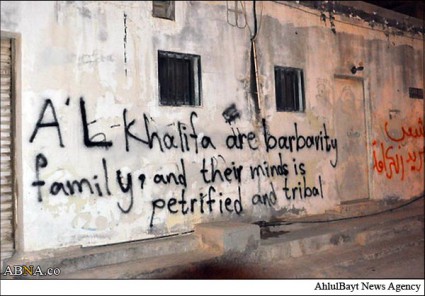
The defaced walls of the Bahraini village of Burhama reflect the mounting tension between Muslims from the Shiite community and the Sunni-led royal family.
Every day, the village’s Shiites spray anti-monarchy graffiti on the facades of its buildings. And every day, the offensive language is concealed by police under a strip of white paint, until it reappears atop another white layer the next day.
The graffiti is just one indication that steps taken by the Sunni-led government have yet to heal rifts stemming from a crackdown this year on mostly Shiite pro-democracy protesters. Shiite villages have held rallies almost every night since the Muslim fasting month of Ramadan began Aug. 1, while al-Wefaq, the Shiites’ largest party, has announced it won’t participate in next month’s special elections to fill the parliamentary seats of its members who resigned to protest the crackdown.
“Those in power should be in harmony with the will of the people,” said Hadi al-Mousawi, one of 18 al-Wefaq members who quit the parliament. “But they just turn their backs to what the opposition wants.”
The grievances that sparked the demonstrations in February and March have intensified because the government has ignored core Shiite demands for higher living standards and equal representation, Mousawi said in a telephone interview Aug. 14.
Government measures to try to calm the situation weren’t enough, he said. The steps included releasing political detainees, reinstating many employees suspended from work on suspicion of participation in the protests, and hosting reconciliation talks. …more
August 19, 2011 Add Comments
Insight – how to defeat a dictator
Interview Thor Halvorssen – President, Human Rights Foundation
George Ayittey – How to Defeat a Dictator – 06/24/11
Ghanaian economist George Ayittey attended the Oslo Freedom Forum in May. There, he sat down with me to talk about defeating dictators.
Thor Halvorssen: How pervasive is dictatorship in Africa today?
George Ayittey: Africa has more dictators per capita than any other continent. In 1990, only four out of the 54 African countries were democratic; today, 21 years later, it is only 15. Fewer than ten can be deemed economic success stories and a free media exists in only ten African countries. Some people call this progress… that’s not what I would call it.
2011-06-23-Ayittey.jpg
George Ayittey presents at the Oslo Freedom Forum. In the Africa graphic behind him dictatorships are shown in red, democracies in white.
TH: That means at least 39 countries in Africa are still ruled by dictators.
GA: And we are fed up. Fed up! Angry Africans are fed up and are taking the heat to them. Dictators cause the world’s worst problems: all the collapsed states, and all the devastated economies. All the vapid cases of corruption, grand theft, and naked plunder of the treasury are caused by dictators, leaving in their wake trails of wanton destruction, horrendous carnage and human debris.
But guess who’s always cleaning up their mess?
For decades, the West has spent trillions of dollars trying to persuade, cajole, and even bribe them to reform their abominable political and economic systems. The West has even tried appeasement in their rapprochement. Enough!
TH: But shouldn’t the West pressure dictators with other measures like cutting off IMF loans and international aid packages and threaten to stop recognizing them diplomatically?
GA: The West has to understand that dictators never have and never will be interested in reform. They are stone deaf and impervious to reason. Period.
Dictators are allergic to reform, and they are cunning survivors. They will do whatever it takes to preserve their power and wealth, no matter how much blood ends up on their hands. They are master deceivers and talented manipulators who cannot be trusted to change.
TH: What kind of resources do they need in order to maintain their survival? Surely the loss of Western funding would hinder them?
GA: After a mere four-and-a-half years in office, the late dictator of Nigeria, Sani Abacha, managed to accumulate a personal fortune of 5 billion dollars. Omar Al-Bashir has siphoned 7 billion out of Sudan. And Hosni Mubarak of Egypt managed to accumulate a personal fortune of 40 billion dollars! All stolen from their own people.
Let me put that into perspective. The net worth of all U.S. presidents, 43 of them, from Washington to Obama, amounted to 2.7 billion. That means that Africa’s kamikaze bandits each stole more than the net worth of all U.S. presidents and then more.
TH: How does a human rights activist fight against 40 billion dollars of bribe money?
GA: This is exactly what happened in Egypt and Tunisia. Fed up with their corrupt antics, angry street demonstrators started pushing dictators out: Ben Ali fled, Mubarak was shoved aside, and more coconuts will tumble
But caution: Noisy rah-rah street demonstrations alone are not enough.
Three cardinal principles must be followed for a popular revolution to succeed. First, a united coalition of opposition forces is essential. Second, the dictator’s modus operandi — strengths and weakness — must be studied in detail. Lastly, getting the sequence of reform right is crucial; there are several steps that must be followed precisely in order.
TH: The sequence you just described should perhaps be named Ayittey’s law. By a “coalition” do you mean a political alliance? Wouldn’t that be difficult in most of these countries suffering under dictatorships or one-party rule?
GA: A small group of pro-democracy activists — call it an elders council — is imperative to serve as the nerve center, plan strategically, and coordinate the activities of the various opposition groups, civil society groups and youth movements. For example, The Gathering in Sudan in 1985, The Danube Circle in Hungary in 1988, Charter 77 in Czechoslovakia in 1989 and the Alliance for Change in Ghana in 1995, in which I participated. If the dictator schedules an election, the council must rope all political parties into an electoral alliance. In 2010, dictators “won” elections because of a divided opposition field. For funding, the council should rely on its own diaspora community, not on Western donors.
TH: Why should reformers depend on their community as opposed to Western donors?
GA: Reform must start with intellectual freedom and freedom of the press. Reform must come from within — made by the people themselves, not by Western governments or financial institutions. Internally-initiated reform is far more sustainable and enduring. The self-immolation of Mohammed Bouazizi started the Arab Spring. His was the ultimate and extreme form of freedom of expression.
2011-06-23-Ayittey2.jpg
TH: Ok, so first a coalition, second we find the dictator’s weaknesses…
GA: The modus operandi of all dictators is essentially the same: Besides parliament, if there is one, they seize control of six key state institutions (the security forces, the media, the civil service, the judiciary, the electoral commission, and the central bank), pack them with their supporters, and debauch them to serve their interests. To succeed, a popular revolution must wrestle control of at least one or more of these institutions out of the dictator’s clutches. The game was over for Ben Ali and Hosni Mubarak when the military refused to fire on civilians. Ditto in the Philippines in 1986 and Georgia in November 2003, where the security forces were charmed with roses (hence, the “Rose Revolution.”) Ukraine’s Orange revolution of November 2004 won the Supreme Court to its side and Pakistan’s Black Revolution of March 2007 had the full support of the judiciary. Let me give you 3 more ways of toppling a dictator’s stronghold:
First, get the media out of their hands: create pirate radios, use social media. That’s what will unleash the reforms we all cherish so dearly, not Western sermons, sanctions, or appeasement.
Second, hit them with their own constitution. For example, Article 35 of China’s Constitution guarantees freedom of speech, press, assembly, and association. In Ghana, we used the Constitution and the courts to free the airwaves, leading to a proliferation of FM Radio stations, which were instrumental in ousting the regime in 2000.
Third, a dictator’s weakness is exploited by s-t-r-e-t-c-h-i-n-g its military geographically. Shut down the civil service and any military regime will collapse. It will not have enough soldiers to replace civil servants across the country; we saw this in Ghana in 1978 and Benin in 1989. We also saw the same thing this year, as street protests in Tunisia and Egypt erupted simultaneously in several cities and towns, straining security forces. …more
August 19, 2011 Add Comments
Fascist echos of Pearl Square
The Pain in Spain
By V. Noah Gimbel, August 17, 2011 – FPIP
As the sun rose on August 2, Spanish authorities destroyed the tent-village that had come to symbolize what some participants have called the Spanish Revolution. The ruling Socialist Party, via the Ministry of the Interior and in conjunction with the right-wing Popular Party that controls the local government, ordered Madrid’s Puerta del Sol cleared of all remnants of the 15-M (May 15) movement as its participants, the indignados (the outraged) watched helplessly. Police boots, chainsaws, and fire hoses erased months of makeshift architecture, street art, and community – once inhabited by some 28,000 campers – from the Spanish capital’s central square.
The conglomeration of organizations that make up the 15-M movement vowed to march on the square at 7:30 that evening to protest what they called an illegal eviction. The government responded with nothing short of a call to arms, halting all metro and commuter rail access to the station at Puerta del Sol. Meanwhile, dozens of national police vans turned the square into a parking lot, and helmeted policemen set up barricades at every entrance to the square. Helicopters flew overhead as the combined forces of municipal police in riot gear and national police – hands on pistols – reinforced the barricades and patrolled the surrounding areas on foot.
Nevertheless, a fairly large showing gathered at the barricades that evening, gaining momentum as their non-violent outrage met with no response from the police. “We’ll stay until there are no more people from 15-M,” said one officer. That was around 8:30 when crowds were still rather light. …more
August 18, 2011 Add Comments
Shadow policy and powers in the darkness, US war of clandestine operations
Shadow Warriors: Movin’ On Up
By Conn Hallinan, August 18, 2011 – FPIP
For decades the U.S. military has waged clandestine war on virtually every continent on the globe, but for the first time, high-ranking Special Operations Forces (SOF) officers are moving out of the shadows and into the command mainstream. Their emergence suggests the U.S. is embarking on a military sea change that will replace massive deployments, like Iraq and Afghanistan, with stealthy night raids, secret assassinations, and death-dealing drones. Its implications for civilian control of foreign policy promises to be profound.
Early this month, Vice Adm. Robert Harward—a former commander of the SEALs, the Navy’s elite SOF that recently killed al-Qaeda leader Osama bin Laden—was appointed deputy commander of Central Command, the military region that embraces the Middle East and Central Asia. Another SEAL commander, Vice Adm. Joseph Kernan, took over the number two spot in Southern Command, which covers Latin America and the Caribbean.
The Obama administration has been particularly enamored of SOFs, and according to reporters Karen DeYoung and Greg Jaffe of the Washington Post, is in the process of doubling the number of countries where such units are active from 60 to 120. U.S. Special Operations Command spokesman Col. Tim Nye told Nick Turse of Salon that SOFs would soon be deployed in 60 percent of the world’s nations: “We do a lot of traveling.”
Indeed they do. U.S. Special Operations Command (SOC) admits to having forces in virtually every country in the Middle East, Central Asia, as well as many in Africa, Southeast Asia, and Latin America. But true to its penchant for secrecy, SOC is reluctant to disclose every country to which its forces are deployed. “We’re obviously going to have some places where it’s not advantageous for us to list where we’re at,” Nye told Turse.
SOF forces have almost doubled in the past two decades, from some 37,000 to close to 60,000, and major increases are planned in the future. Their budget has jumped from $2.3 billion to $9.8 billion over the last 10 years. …more
August 18, 2011 Add Comments
al khalifa charades, misdirection, misinformation and blaming the victims, against a backdrop of daily torture, detentions and collective punishments
Bahrain steps up crackdown on demos
shiapost – August 18, 2011
The Saudi-backed Bahraini forces have intensified their brutal crackdown on peaceful anti-government protesters across the Persian Gulf sheikhdom.
The Bahraini regime forces clashed with protesters in several areas late on Wednesday.
According to local sources, scores of people have been killed and hundreds arrested during the harsh government clampdown on peaceful demonstrations since mid-February.
On Tuesday, Vice President of the Bahrain Teachers Association (BTA) Jalila al-Salman was hospitalized with chest pains following a 10-day hunger strike to protest her continuing torture and ill treatment while in custody.
The Bahraini regime fired some 14 university teachers for taking part in demonstrations against the ruling Al Khalifa family on Saturday.
Since the beginning of the revolution in Bahrain, large numbers of anti-government protesters have poured into streets across the nation to demand more rights, freedom and wide-ranging political reforms. …more
August 18, 2011 Add Comments