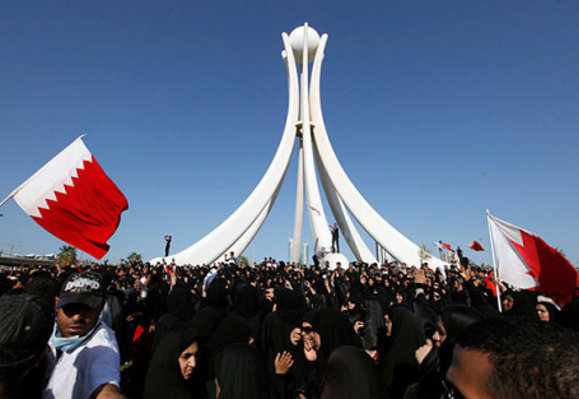
Bahrain’s Democracy seeking Patriots treated as enemies of the State, dying in clouds of gas administered by brutal al Khalifa regime
Bahrain top Shiite cleric says authorities treat protesters as ‘enemies of state’
By Associated Press, Updated: Friday, September 16, 5:50 AM
MANAMA, Bahrain — Bahrain’s Sunni rulers have treated Shiite anti-government protesters seeking greater rights in the Gulf kingdom as “enemies of state,” a senior cleric said Friday, as tensions deepen between the strategic island’s minority Sunnis and majority Shiites.
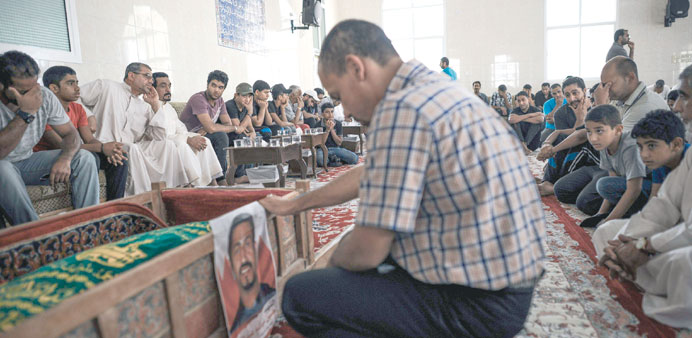
The comments by Sheik Isa Qassim came as mourners were gathering for the funeral of a 35-year-old man who relatives say died after inhaling tear gas fired at protesters on Tuesday night. Sayyed Jawad Ahmed is to be buried later Friday in Bahrain’s oil hub of Sitra.
Anti-government protesters stand amid makeshift barricades in the headlights of riot police vehicles, unseen, during clashes in the Shiite Muslim area of Sitra, Bahrain, Wednesday, Sept. 14, 2011. Clashes erupted after word of a Sitra man’s death. Relatives said the man died in hospital after being repeatedly exposed to heavy tear gas used by riot police to quell anti-government protests. The official Bahrain News Agency reported, however, that Sayed Jawad Ahmad, 35, was a sickle cell patient who died after suffering Acute Respiratory Syndrome Distress.
Clouds of tear gas waft through the streets of Sitra, Bahrain, on Wednesday night, Sept. 14, 2011. Clashes erupted after word of a Sitra man’s death. Relatives said the man died in hospital after being repeatedly exposed to heavy tear gas used by riot police to quell anti-government protests. The official Bahrain News Agency reported, however, that Sayed Jawad Ahmad, 35, was a sickle cell patient who died after suffering Acute Respiratory Syndrome Distress.
Clashes erupted after word of a Sitra man’s death. Relatives said the man died in hospital after being repeatedly exposed to heavy tear gas used by riot police to quell anti-government protests. The official Bahrain News Agency reported, however, that Sayed Jawad Ahmad, 35, was a sickle cell patient who died after suffering Acute Respiratory Syndrome Distress.
The kingdom’s health ministry confirmed the death in a statement Thursday, saying Ahmed died from “acute respiratory syndrome distress.”
Shiites make up a majority of Bahrain’s people, but they have long complained of discrimination at the hands of the country’s ruling Sunni dynasty and a lack of economic opportunities.
More than 30 people have died since February when protests started in Bahrain, inspired by other Arab uprisings.
Hundreds of activists have been detained and brought to trial on anti-state charges in a special security court set up after authorities imposed marital law and invited a Saudi-led Gulf military force in the country to help deal with dissent in the tiny island nation.
Bahrain is a strategically important nation in the Persian Gulf and is the home of the U.S. Navy’s 5th Fleet.
The United States has urged Bahrain’s ruling dynasty, a close Washington ally, to listen to the protesters’ demands for more political freedoms. However, a government-led national dialogue produced no compromise with the Shiite opposition, which only had token representation at the talks.
“The regime has designated the section of society asking for rights as enemies of state,” Sheik Isa said during Friday’s sermon at a mosque in the opposition stronghold of Diraz, northwest of the capital Manama.
Bahrain lifted emergency rule in June. Since then, government opponents have clashed with police almost every night. …source
September 16, 2011 Add Comments
Gassing the Masses, It’s dangerous and It’s deadly
[cb editor: since the writing of this story several others have been killed by the use of CS Gas. The nonlethal is a lie.]
Lethal Non-Lethal Weapons: The Deadly Effects of Tear Gas in Bahrain
By marcowenjones On July 22, 2011
Tear gas, or CS gas, has become part of the daily diet of many Bahrainis who continue to take to the streets in pursuit of their democratic struggle. The use of this so-called ‘non-lethal’ crowd control weapon has become increasingly controversial, not least because it has potentially resulted in the death of 6 Bahrainis, including 6-year-old Mohammed Farhan. More recently, however, it is believed by many to have been responsible for the death of 47-year-old mother-of-two Zainab Juma, who died last Friday following demonstrations in Sitra. If we include the death of Ahmed Farhan, who was apparently killed when a stun grenade exploded right next to his head, then about one in six people have so far died in Bahrain as a result of these ‘non-lethal’ weapons. It makes sense then to explore the nature of these weapons, who sells them, who is affected by them, and how ‘ non-lethal’ they really are.
Who has died?
Of the approximately 40 people who have died so far, the following are thought to have died from tear gas inhalation; Zainab Hassan al-Juma (47) , Sayad Adnan Sayed Hassan (44), Zainab al-Tajer, Mohammed Farhan (6), Isa Mohammed Ali Abdulla (71) & Khadija Mirza Al-Abdulhai (50). Here we can see that those killed by tear gas are not just the very young or the very old. Indeed, tear gas seems to be responsible for the death of people of all ages and both sexes. I’ll stop short of saying it affects all demographics, since I think it is safe to say that most of the dead are neither the rich nor the privileged. So why is a supposedly ‘non-lethal’ technology so deadly. Well there are a number of reasons – including the misuse of tear gas, the fact that tear gas manufacturers have a poor quality control system, the variable concentrations used by different companies and also the fact that CS (2-chlorobenzalmalononitrile) is a potentially lethal chemical.
[Read more →]
September 16, 2011 Add Comments
President Obama they are your friends, tell them the Gassing Must Stop! Urgent Appeal from the Citizens of Bahrain
Stop the Sales of “nonlethal gas”, It Isn’t , It’s Killing our loved ones!
Say “No More Gas” to: NonLethal Technologies, PA USA
Ph: 724-479-5100 sales@nonlethaltechnologies.com
Urgent Appeal – from Anonymous Bahraini Source – 15 September, 2011
Dear Friends,
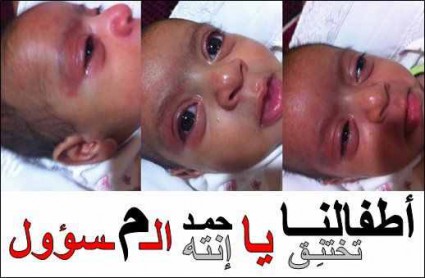
As we have been witnessing every night, several villages were attacked with excessive teargas tonight. For the first time in a while a family decided to take their three daughters (one is a baby) whose conditions were worsening due to the teargas to the hospital. This family was inside their home and were subjected to the teargas because it was shot next to their home. At the hospital they were told to go to the central police station.
The father, Mansoor Ali Alkhawaja, and uncle, Salah Ali Alkhawaja, are now being held by the police, and the two girls and their mother are being held by female police (girls are Aqdas Mansoor alkhawaja, shez a baby, Noor Mansoor Alkhawaja and fatima Mansoor Alkhawaja).
This is an urgent call for an intervention to ensure they are released and to receive proper medical attention.
This unfortunately will only further convince people not to seek medical help despite the countless injuries, some very serious, we are seeing on a nightly basis.
Infant gassed at home during heavy attack on his village:
Direct Attacks on homes, obvious targets from “hit lists”:
Direct Attack on Mother and Child seeking safety:
September 15, 2011 Add Comments
A Case for Hacktivsm – unscrupulous Western technology corporations sell their wares enabling human rights abuse
cb editor: The underlying issue at hand is, the US has set the precedence of immoral conduct for the entire Western “Misery Industrial Complex” it built in the launching of it’s pretentious “war on terror” over a decade ago.
An entire new breed or class of “merchants of misery” have emerged from the shadows of war profiteering. They have aligned themselves as whorish participants in support of tyrants engaged in immoral practices of torture, murder and despotism who in recent times would have been deemed untouchable by public relations firms, arms dealers and technology peddlers.
This phenomena is a direct consequence of occupation of the highest levels of the USG by the Corporatist’s and their subsequent privatization of the US Military, using it not in the common defense of the people as it was intended, but as a “force gratis” to advance the aims of private commercial interests and to advance corporate multinationalism – their private army.
Such was the nature of the “privateers” of the 1700s who looted the wealth of nations in an existential bid to create their own nation, the United Sates. In the worst of economic times the whorish nature of the Corporatist, modern day privateers, is amplified when they “scrape bottom” in “existential desperation” that transforms them into profiteers of misery and torture as they service the lowest and most despicable of Kings and Tyrants who have wealth to squander.
Main Article
Companies that cooperate with dictatorships must be sanctioned
Published on Friday 2 September 2011.
Reporters Without Borders condemns the criminal cooperation that exists between many western companies, especially those operating in the new technology area, and authoritarian regimes.
“These companies no longer have any reservations about collaborating with criminal governments,” Reporters Without Borders secretary-general Jean-François Julliard said. “Providing dictatorships with communication equipment or confidential data is irresponsible. A total of 122 bloggers and netizens are currently detained worldwide. The companies that work with these governments are complicit and responsible for the fate of these detainees. Financial sanctions should be imposed on companies collaborating with governments that jail bloggers or censor the Internet.
“Without financial sanctions, these practices will not stop. Companies are not above the law. There are courts that try illicit practices by companies. Why shouldn’t they try the criminal responsibility of companies that collaborate with regimes that are guilty of crimes? Provision should be made at the national level for penalizing such collaboration, and referral to the International Criminal Court should be considered when companies become the accomplices to war crime by dictators. After being concerned about impunity for dictators, the world should now be worrying about impunity for companies.
“Human lives are at stake. Must they be sacrificed for the sake of profits? The leaders of international companies operating in the new technology domain, especially telecommunications surveillance, in Libya, Syria, Burma, China, Turkmenistan and other authoritarian counties should think about their responsibility. Their tools, their equipment and their know-how are being used for criminal purposes.”
These technologies are at the heart of a new war. Emails can now be intercepted, Skype calls can be recorded, webcams can be turned on remotely and Internet content can be modified without the users knowing. Reporters Without Borders urges Internet users to be much more careful.
Reporters Without Borders reiterates the need for legislation banning cooperation between companies and dictatorships on the lines of the proposed Global Online Freedom Act (GOFA) in the United States and its European equivalent. Like the EU regulations on trade in products that could be used for “capital punishment, torture or other cruel treatment,” there is now a need to introduce international regulations on the provision of technology that threaten cyber-citizens, to control the export of certain technologies, to create a monitoring body that is independent of governments and to have dissuasive sanctions ready. Companies should also have legal and official recourse against measures in countries like China or Iran that force them to obstruct the free flow of information.
The GOFA, a bill submitted to the US Congress in 2006 and still awaiting adoption, aims to prevent US companies from “cooperating with repressive governments in transforming the Internet into a tool of censorship and surveillance.” The European equivalent, submitted to the European Parliament on 17 July 2008 by Dutch MEP Jules Maaten of the Alliance of Liberals and Democrats for Europe (ALDE), aims to forestall online censorship possibilities and to regulate the potentially repressive activities of European Internet companies. It would create an Office of Global Internet Freedom with the job of combating online censorship by the most repressive governments and protecting the personal data of Internet users.
These measures are now urgent and necessary. Examples of companies cooperating with such governments are on the increase. Referring in May to Microsoft’s acquisition of the Internet telephony company Skype, Microsoft Russia president Nikolay Pryanishnikov said he was ready to provide its source code to the Russian security services. Microsoft is nonetheless a leading member of the Global Network Initiative, an alliance that brings private-sector companies and investment funds together with organizations that defend freedoms.
Many other companies that have shown no interest in the GNI’s principles seem ready to stop at nothing to conquer new markets. Bull, Nokia, BlueCoat, Netfirms and Cisco have all yielded to the lure of profits. Reporters Without Borders has compiled the following summary of their repressive practices.
Libya: Bull (France) and Boeing (Unites States)
Amesys, a subsidiary of the French computer company Bull, reportedly provided Col. Muammar Gaddafi with Internet surveillance equipment, including a system called Eagle that can intercept email sent via Hotmail, Gmail and Yahoo! and monitor MSN and AIM instant messaging. According to the Wall Street Journal, several files containing transcripts of phone and chat conversations between government opponents were found in Libyan intelligence agency computers.
Boeing and its offshoot Narus, which specializes in software that protects against Internet attacks, are also suspected of cooperating with the Gaddafi regime. They have denied this.
Syria and BlueCoat (United States)
According to a study of Syria’s censorship infrastructure last month by Telecomix, Fhim and Reflets.info, the Syrian government’s phishing and website blocking is assisted by the US company BlueCoat. The passwords and “private” communications of Yahoo! Messenger, MSN and Facebook users are being recorded with the help of technology provided by BlueCoat, the survey said. BlueCoat has allegedly provided Syria with at least two different technologies, including Deep Packet Inspection (DPI), which can be used to intercept all sorts of communication including emails and phone calls as well as photos and messages posted on online social networks such and Facebook and Twitter, and proxy filters.
Bahrain and Nokia Siemens Network (Finland)
Nokia Siemens Network (NSN) has been accused of providing the monitoring technology that the Bahraini authorities have been using to spy on the emails, mobile phone conversations and text message of dozens of human rights activists. Abdul Al-Khanjar, an activist who was detained from August 2010 to February 2011, said the security officials who interrogated him revealed that they had the records of the messages he had sent from his phone. Speaking on condition of anonymity, several Nokia employees confirmed that this technology had been provided to Bahrain. Ahmed Al-Doseri, director of information and communications at Bahrain’s Telecommunications Regulatory Authority, confirmed that Bahrain was using this kind of sophisticated monitoring technology. There may be a European Union investigation into these allegations.
Nokia spokesman Ben Roome said: “We are very aware that communications technology can be used for good and ill.” Reporters Without Borders regrets that this awareness is not reflected in the company’s commercial decisions. Nokia and Siemens already provided Iran with software necessary for telecommunications surveillance in 2009. Nokia confirmed that it had sold DPI-based technology to Iran.
Thailand and Netfirms (Canada)
Netfirms Inc, a Canadian web hosting company that is also based in the United States, provided the Thai government with information that enabled it to identify Anthony Chai, a US citizen of Thai origin, as the person who was anonymously conducting a pro-democracy blog in the Thai language, Manusaya.com. As a result, the Thai authorities were able to arrest and interrogate Chai at Bangkok airport, when he visited Thailand, and even got him to meet with a Thai official after he had returned to California. They also warned him that he would be arrested for lèse-majesté if he went back to Thailand. Chai filed a complaint against Netfirms on 24 August for providing his email and IP addresses to the Thai authorities without his knowledge, and for closing down his blog at their request.
China and Cisco (United States)
The US computer technology company Cisco Systems has been accused not only of providing China since 2007 with the technology for a censorship system called Golden Shield, used for identifying political dissidents, but also of helping to set up and develop the system. Two complaints have been recently filed against Cisco in the United States: one on 19 May in a court in San Jose, California, by the Falun Gong, a religious movement banned in China, and one in June in a Maryland court by three Chinese netizens – Liu Xianbin, Du Daobin and Zhou Yuanzhi – and 10 other people.
Both lawsuits stress the Chinese government’s use of Cisco’s technology to identify online dissidents and the fact that this enabled the authorities to detain and torture them. Cisco has denied any role in Chinese repression in a message posted on the company’s blog by vice-president Mark Chandler. “We have never customized our equipment to help the Chinese government – or any government – censor content, track Internet use by individuals or intercept Internet communications,” Chandler wrote.
Nonetheless, Cisco cannot deny providing the Chinese government with security technology including Deep Packet Inspection, which can be used to track down cyber-dissidents. …source
September 15, 2011 Add Comments
FBI Teaches Agents: ‘Mainstream’ Muslims Are ‘Violent, Radical’
FBI Teaches Agents: ‘Mainstream’ Muslims Are ‘Violent, Radical’
By Spencer Ackerman – September 14, 2011 – Danger Room
The FBI is teaching its counterterrorism agents that “main stream” [sic] American Muslims are likely to be terrorist sympathizers; that the Prophet Mohammed was a “cult leader”; and that the Islamic practice of giving charity is no more than a “funding mechanism for combat.”
At the Bureau’s training ground in Quantico, Virginia, agents are shown a chart contending that the more “devout” a Muslim, the more likely he is to be “violent.” Those destructive tendencies cannot be reversed, an FBI instructional presentation adds: “Any war against non-believers is justified” under Muslim law; a “moderating process cannot happen if the Koran continues to be regarded as the unalterable word of Allah.”
These are excerpts from dozens of pages of recent FBI training material on Islam that Danger Room has acquired. In them, the Constitutionally protected religious faith of millions of Americans is portrayed as an indicator of terrorist activity.
“There may not be a ‘radical’ threat as much as it is simply a normal assertion of the orthodox ideology,” one FBI presentation notes. “The strategic themes animating these Islamic values are not fringe; they are main stream.”
The FBI isn’t just treading on thin legal ice by portraying ordinary, observant Americans as terrorists-in-waiting, former counterterrorism agents say. It’s also playing into al-Qaida’s hands.
Focusing on the religious behavior of American citizens instead of proven indicators of criminal activity like stockpiling guns or using shady financing makes it more likely that the FBI will miss the real warning signs of terrorism. And depicting Islam as inseparable from political violence is exactly the narrative al-Qaida spins — as is the related idea that America and Islam are necessarily in conflict. That’s why FBI whistleblowers provided Danger Room with these materials.
Over the past few years, American Muslim civil rights groups have raised alarm about increased FBI and police presence in Islamic community centers and mosques, fearing that their lawful behavior is being targeted under the broad brush of counterterrorism. The documents may help explain the heavy scrutiny.
They certainly aren’t the first time the FBI has portrayed Muslims in a negative light during Bureau training sessions. As Danger Room reported in July, the FBI’s Training Division has included anti-Islam books, and materials that claim Islam “transforms [a] country’s culture into 7th-century Arabian ways.” When Danger Room confronted the FBI with that material, an official statement issued to us claimed, “The presentation in question was a rudimentary version used for a limited time that has since been replaced.”
But these documents aren’t relics from an earlier era. One of these briefings, titled “Strategic Themes and Drivers in Islamic Law,” took place on March 21.
The Islam briefings are elective, not mandatory. “A disclaimer accompanied the presentation stating that the views expressed are those of the author and do not necessarily reflect the views of the U.S. government,” FBI spokesman Christopher Allen tells Danger Room.
“The training materials in question were delivered as Stage Two training to counterterrorism-designated agents,” Allen adds. “This training was largely derived from a variety of open source publications and includes the opinion of the analyst that developed the lesson block.”
Not all counterterrorism veterans consider the briefings so benign. “Teaching counterterrorism operatives about obscure aspects of Islam,” says Robert McFadden, who recently retired as one of the Navy Criminal Investigative Service’s al-Qaida-hunters, “without context, without objectivity, and without covering other non-religious drivers of dangerous behavior is no way to stop actual terrorists.”
Still, at Quantico, the alleged connection between Islam and violence isn’t just stipulated. It’s literally graphed. …more
September 14, 2011 Add Comments
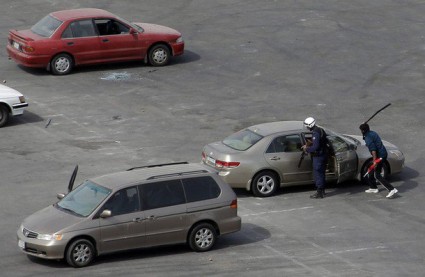
Bahrain Security Forces practice torture techniques on pro-democracy automobil
September 14, 2011 Add Comments
Blow-back Libya – new sources of weapons with US backed Al Qaeda as “black market” distributor and deal maker
cb editor note: Please read the article by Voltaire’s, Thierry Meyssan, HERE regarding the resurrection of Al Qaeda as a supported US operative in Libya. This is an important article that clearly identifies a failing and misdirected US foreign policy in North Africa and the Middle East regarding the “Arab Democracy Movement”. It sets up a rerun of the scenario of felling trade towers, bombing embassies and sinking naval vessels that the resurrected US ally in Libya, Al Qaeda, once mastered, blow-back squared. Thierry Meyssan’s article is cross-posted on this blog HERE
The article below highlights the Weapons Brokering for Democracy movement that the USG and NATO have created in MENA while the largely peaceful and nonviolent movements for democracy remain under the repression of the Western supported regimes. It seems the Western leaders with their broken economies have reduced their foreign policy ambitions to ensuring success of black markets and increasing tradition weapon sales in the name of “democracy armed”. The lesson to be learned here is; if you don’t buy weapons from the West then you will not know “democracy”.
Phlipn Pagee
Main Article
U.S. helps create potential market to terrorists for WMDs
By D. Lindley Young – Knoxville Journal
Some question whether U.S. involvement in Libya was really thought out. There are a couple of big problems that the United States has in the war in Libya. First, we don’t really know who the “rebels” are and in all likelihood would count in their numbers members of al-Qaeda attempting to take advantage of the unrest and instability as there is a transition of power from Gaddafi to the rebels or representatives of the rebels.
Second, while some want war with Iran because they could potentially make a nuclear bomb and put it in the hands of terrorists, the Obama administration opens Pandora’s weapons box without control of it creating maybe the greatest opportunity ever for terrorists to get a large supply of Gaddafi’s stock pile of dangerous weapons. Gaddafi controlled chemical weapons, mustard gas, shoulder-held rockets, materials to make road side explosive devices and processed uranium which was left from his nuclear weapons program, which the U.S. does not want to get in the hands of al-Qaeda or other terrorist organizations.
The concern is real. Peter Bouckaert, emergencies director at Human Rights Watch says that “weapon proliferation out of Libya is potentially one of the largest we have ever documented — 2003 Iraq pales in comparison — and so the risks are equally much more significant.”
As put by Adam Rawnsley in his article titled Gaddafi’s Loose Weapons Could Number a ‘Thousand Times’ Saddam’s: “Libya’s Moammar Gaddafi spent decades piling up a huge stash of weapons like a crazy old lady hoarding cats. Ironically, rebel forces looted his arms depots to turn Gaddafi’s missiles and guns on their old master. But the ease with which the rebels were able to arm themselves points to their next massive problem: securing those weapons before they fuel a lethal insurgency or flood the global arms bazaar.”
Although the U.S. may have special ops trying to secure the weapons our intelligence is weak and the rebels are not malleable to U.S. demands. Will the “rebels” who put their lives on the line in months of fighting and dying just turn them over to the U.S. if they have or get them?
The rebels got at least some of the weapons and used them against Gaddafi. So, can the U.S. count on the rebels since we helped them take down Gaddafi. Probably not.
Despite our help the rebels outright rejected U.S. demands to turn over the master mind behind the bombing of Pan Am flight 103 in 1988 in Lackerbie, Scotland. The bombing killed over 270 people – mainly Americans. The bomber has been living in Libya as a hero under Gaddafi for the past two years after being released from prison in Scotland for humanitarian reasons. He was supposed to die within months of release from cancer. …source
September 14, 2011 Add Comments
In Obama’s Middle East, North Africa Strategy, Democracy is born at the Barrel of a Gun
U.S. Asks Saudi Arabia to Arm Libya Rebels
March 9, 2011 – Leak Source
[cb editor: This article is a bit dated but no less to the point that in President Obama’s Middle East and North Africa “democracy grows at the barrel of a gun”. With the Saudi’s as the only weapons broker for Obama’s “Armed Democracy Movement” in MENA it seems nonviolent protest, reform and opposition to tyrants, such as Bahrain’s King Hamad, will be a hard slog. Lacking the respect and value from the governments of the US and UK for nonviolent democracy movements, there comes a call to action to all nonviolent and peace living people to engage their countries to demand support and respect for these movements. ]
Desperate to avoid US military involvement in Libya in the event of a prolonged struggle between the Gaddafi regime and its opponents, the Americans have asked Saudi Arabia if it can supply weapons to the rebels in Benghazi. The Saudi Kingdom, already facing a “day of rage” from its 10 per cent Shia Muslim community on Friday, with a ban on all demonstrations, has so far failed to respond to Washington’s highly classified request, although King Abdullah personally loathes the Libyan leader, who tried to assassinate him just over a year ago.
Washington’s request is in line with other US military co-operation with the Saudis. The royal family in Jeddah, which was deeply involved in the Contra scandal during the Reagan administration, gave immediate support to American efforts to arm guerrillas fighting the Soviet army in Afghanistan in 1980 and later – to America’s chagrin – also funded and armed the Taliban.
But the Saudis remain the only US Arab ally strategically placed and capable of furnishing weapons to the guerrillas of Libya. Their assistance would allow Washington to disclaim any military involvement in the supply chain – even though the arms would be American and paid for by the Saudis.
The Saudis have been told that opponents of Gaddafi need anti-tank rockets and mortars as a first priority to hold off attacks by Gaddafi’s armour, and ground-to-air missiles to shoot down his fighter-bombers.
Supplies could reach Benghazi within 48 hours but they would need to be delivered to air bases in Libya or to Benghazi airport. If the guerrillas can then go on to the offensive and assault Gaddafi’s strongholds in western Libya, the political pressure on America and Nato – not least from Republican members of Congress – to establish a no-fly zone would be reduced.
US military planners have already made it clear that a zone of this kind would necessitate US air attacks on Libya’s functioning, if seriously depleted, anti-aircraft missile bases, thus bringing Washington directly into the war on the side of Gaddafi’s opponents.
For several days now, US Awacs surveillance aircraft have been flying around Libya, making constant contact with Malta air traffic control and requesting details of Libyan flight patterns, including journeys made in the past 48 hours by Gaddafi’s private jet which flew to Jordan and back to Libya just before the weekend.
Officially, Nato will only describe the presence of American Awacs planes as part of its post-9/11 Operation Active Endeavour, which has broad reach to undertake aerial counter-terrorism measures in the Middle East region.
The data from the Awacs is streamed to all Nato countries under the mission’s existing mandate. Now that Gaddafi has been reinstated as a super-terrorist in the West’s lexicon, however, the Nato mission can easily be used to search for targets of opportunity in Libya if active military operations are undertaken.
Al Jazeera English television channel last night broadcast recordings made by American aircraft to Maltese air traffic control, requesting information about Libyan flights, especially that of Gaddafi’s jet.
An American Awacs aircraft, tail number LX-N90442 could be heard contacting the Malta control tower on Saturday for information about a Libyan Dassault-Falcon 900 jet 5A-DCN on its way from Amman to Mitiga, Gaddafi’s own VIP airport.
Nato Awacs 07 is heard to say: “Do you have information on an aircraft with the Squawk 2017 position about 85 miles east of our [sic]?”
Malta air traffic control replies: “Seven, that sounds to be Falcon 900- at flight level 340, with a destination Mitiga, according to flight plan.”
But Saudi Arabia is already facing dangers from a co-ordinated day of protest by its own Shia Muslim citizens who, emboldened by the Shia uprising in the neighbouring island of Bahrain, have called for street protests against the ruling family of al-Saud on Friday.
After pouring troops and security police into the province of Qatif last week, the Saudis announced a nationwide ban on all public demonstrations.
Shia organisers claim that up to 20,000 protesters plan to demonstrate with women in the front rows to prevent the Saudi army from opening fire.
If the Saudi government accedes to America’s request to send guns and missiles to Libyan rebels, however, it would be almost impossible for President Barack Obama to condemn the kingdom for any violence against the Shias of the north-east provinces.
Thus has the Arab awakening, the demand for democracy in North Africa, the Shia revolt and the rising against Gaddafi become entangled in the space of just a few hours with US military priorities in the region. …source
September 14, 2011 Add Comments
‘Bahrain regime does unforgivable acts’
The Bahraini regime is carrying out outrageously reprehensible actions by torturing and imprisoning doctors and nurses, a political observer tells Press TV.
In an interview with Press TV, Colin Cavell, former assistant professor at University of Bahrain, commented on the crackdown by the Bahraini regime on peaceful anti-government protesters in the country.
The following is a transcript of the interview:
Press TV: The international community say they are urging the US and Saudi Arabia to pressure the Bahraini authorities to cease violating their citizen rights. But reality on the ground is that the opposite is taking place. Why is there such inconsistency?
Cavell: Everyone knows the US has a large military base in Bahrain and because of this reason of state, they are keeping quiet. Even though the US is funding and supporting the rebellions in Libya, Egypt, Tunisia and Syria, when it comes to the (Persian) Gulf kingdoms and sheikhdoms and Saudi Arabia, [there is] absolute silence, [which is] hypocritical, inconsistent.
Press TV: Let us look at this international human rights panel headed by law professor and former human rights expert Bassiouni. His findings were prejudiced. The Bahraini government has been accused by the UN High Commissioner of Human Rights Navi Pillay for having her words distorted. How can human rights then be upheld in Bahrain?
Cavell: Nothing will come of substance from this commission, because it is being paid for by the monarchy. What is going be, there is another whitewash just as the national dialog was a whitewash. So, do not expect any lasting criticism or substantive criticism of the regime from this commission. He is accepting his pay from King Hamad and he is not going to swap the hand that feeds him.
Press TV: What is the role of Saudi Arabia and the United States in Bahrain? What is plan B if the Bahrainis move ahead with their demands?
Cavell: My name is Colin Cavell and it would be associated with my great grandmother Edith Cavell. She was a nurse who was shot by the Germans for giving aid to both German soldiers and Allied soldiers, exactly what the Bahraini doctors and nurses were doing, and what the Bahraini government is doing by torturing and imprisoning these doctors and nurses is an outrage, it is reprehensible and unforgivable. The regime should be held to account for this outrageous behavior against medical personnel.
With regard to the United States and Saudi Arabia, the Saudis have an economic hold on the United States. The United States, given its financial difficulties right now, is reluctant to speak out against the Saudi regime. It is a sclerotic and rotten regime that needs to fall … The regime, if not for oil, would have been overthrown 50 years ago. The regime needs to go. …source
September 14, 2011 Add Comments
…is anybody listening?
September 14, 2011 Add Comments
Appreciating Bahrain, The Pearl of the Middle East
Bahrain at the heart of Middle East tensions
September 13th, 2011 – By Rabah Ghezali – Special to CNN
Editor’s Note: Rabah Ghezali is a member of the Transatlantic Network 2020.
Bahrain’s uprising did not receive the same attention as other revolts in the Arab awakening, but it was perhaps the most strategically significant. The protests against the Bahraini government began on February 14, 2011. In response, Bahraini King Hamad bin Isa al-Khalifa declared a state of emergency and called on his allies in the Gulf Cooperation Council (GCC) to suppress the uprising.
Saudi Arabia, the United Arab Emirates and Qatar intervened to curb the spread of the so-called “Arab Spring.” These other monarchies wanted to staunch the spread of uprisings because they threatened their regimes too. But even more was at stake for them. Bahrain is where the tension between the Gulf monarchies and Teheran, between Riyadh and Washington and between the traditionalists and the reformists played out.
Bahrain’s geopolitical significance
Bahrain is of real strategic significance for Riyadh in its power struggle against Iran. The Bahraini population is predominantly Shia and maintains a close relationship with Iran. Bahrain is ruled by a Sunni regime and Saudi Arabiawants to ensure the continuation of this regime.
Since the Iranian revolution of 1979, Saudi Arabia has been living with the threat of Shia revolutions in regional countries that would upset the balance of power. Riyadh sees Shia revolts as attempts by Tehran to increase regional influence. This happened before in 1981 when the Iranian regime orchestrated an attempted uprising in Bahrain to overthrow the ruling ( Teheran still officially claims Bahrain as part of its historic territory emphasising the Iranian identity of 75% of the Bahraini Shias).
It’s important to note, however, that Bahrain confronted Iran with its own contradictions: how to support the uprising there while keeping silent on the bloody repression in Syria and of its internal opposition.
Saudi Arabia, which witnessed the political rise of the Shia communities in Lebanon and Iraq, would like to avoid having to face a similar scenario with Bahrain. Despite what Riyadh says, however, religion is not driving the revolts in Bahrain. Protesters in the capital city of Manama call for social equality, the end of discrimination and the democratization. Unemployment is close to 20% and affects mainly the Shias, which are barred from part of the public services such as the police and the army. This feeling of discrimination has been reinforced by the naturalization of Sunni immigrants. The disillusionment of the Shia has been magnified by the security crackdown, which has been perceived as a collective punishment.
However, playing the religious card allows the Saudis to “ideologize” the conflict. What would happen if Iran were to invoke a “responsibility to protect” to intervene militarily in Bahrain? Saudi Arabia and its allies are engaged in a dangerous game and that could lead to a military escalation between Riyadh and Tehran and to the crystallization of the tensions between Sunnis and Shias in the region.
Saudi Arabia counted on the restraint of its Western allies when it led the “counter-revolution”. Indeed, the measured critics of the United States before the Saudi-led operation contrasted with the firmness displayed against Libya. The tense relationship between Riyadh and Washington has been reinforced by the Obama administration turning on Hosni Mubarak. Washington was confronted with a tricky decision, scrambling to strike a balance between its support for allies in Manama and Riyadh and its pledge to back the Arab people in their pursuit of freedom. If Washington seemed in favour of political and social reforms in Bahrain, however, it did not necessarily want the fall of the regime. Bahrain is a traditional ally of Washington and home of the U.S. FifthFleet, which responsible for ensuring the security of the Strait of Hormuz through which 40% of the world’s oil passes.
Inside Bahrain
Inside the regime, the gap has widened between reformists led by Crown Prince Salman and hardliners grouped around the Prime Minister, Sheikh Khalifa bin Salman al-Khalifa. The conservatives gained the upper hand after attempted negotiations in March between the Prince and the opposition were derailed by radicals of both sides. Since then, the Prime Minister is Bahrain’s strongman to the dissatisfaction of the reformist and the Shias.
The King of Bahrain recently called for a national dialogue and lifted the state of martial law. Al-Wefaq, Bahrain’s main Shia opposition party, welcomed King Hamad’s call but the changes al-Wefaq is seeking such as a constituent assembly to write a new constitution designing a parliamentarian monarchy would certainly not be accepted by the King. However, the negotiation could perhaps focus on giving more powers to the Parliament and on a redrawing of the constituencies, which today are designed to ensure that the Shia party remains permanently in opposition. Any changes to the King’s power or the removal of the Prime Minister are red lines.
On both sides of the divide, the next months are critical as the results of the negotiations and the findings of the human rights commission emerge and the trials of activists, politicians and doctors resume, all of which could lead to a deepening of internal tensions. Having little hope of change, the youth may soon assume that only street pressure will make the regime listen, recalling the promise of reforms made a decade ago in the National Action Charter of Bahrain, which ended the 1990’s popular uprising. To avoid such a deadlock and help move this divided society away from recriminations towards a constructive dialogue, the underlying causes of February’s protests – unemployment and discrimination – must be solved. Failing that, a new outpouring of protest may overwhelm the region. …source
September 14, 2011 Add Comments
Arming Peace – can a peaceful, unarmed people seeking to nonviolently overcome tyrany and build a Democracy or must they first buy arms from the Western black marketeers?
Democracy for Dollars
04/01/2011 – By Benjamin Bidder and Clemens Höges – Spiegel International
[excerpt]
Yesterday’s Friends
Indeed, Europeans have been fostering such business ties in a number of the Arab countries whose governments are now faltering. Great Britain’s Prince Andrew, for example, visited Yemeni President Ali Abdullah Saleh in San’a in late 2009. Over lunch at the royal palace, the prince-turned-government-trade-rep praised Yemen’s “unity, stability and development.”
Prince Andrew arrived in the country with investment money — and then suggested that Saleh could take care of his weapons needs in the British isles. Which the Yemeni president then did. Shortly after the prince’s trip, the British government authorized the sale of ammunition and bulletproof vests worth €183,000 to Yemen. These days, of course, Saleh’s security forces are busy firing at demonstrators. Two weeks ago, 52 protesters were killed in a single day.
Germany, for its part, has had well-established ties to Egypt for several years. In 2009, Germany provided equipment worth nearly €80 million; most of it was tank components and military electronics, but it also includes submachine guns. It’s unclear whether these ended up in the hands of the army, which sided with the people, or whether they became the property of the detested police. When unrest broke out there, Germany temporarily revoked arms export licenses to Egypt.
Fear, Jobs and Profits
Meanwhile, the United States thinks on a very different scale, especially when it comes to Saudi Arabia. The House of Saud has money to spend, and Washington wants to arm Saudi Arabia against Iran. But on Monday, March 14, Saudi troops marched into Bahrain to help put down the rebels there.
Last year, Washington announced the largest arms export deal in history: Saudi Arabia plans to buy aircraft worth $60 billion over the course of the next five to 10 years. Money is no object, and the Saudi air force is to receive F-15 fighter-bombers, Apache attack helicopters, missiles, radar equipment and bombs. All together, according to the Wall Street Journal, the order is large enough to guarantee 77,000 jobs at Boeing.
For an additional $30 billion, the Saudi royal family also plans to modernize its navy. To calm Israeli fears, the country will receive cutting-edge F-35 jets (also known as “Joint Strike Fighters”) that, if necessary, will be able to shoot the older Saudi F-15s out of the sky.
Eager Customers, Happy Investors
The United Arab Emirates (UAE) are similarly lavish in their spending — and equally afraid of their overly powerful neighbor Iran. According to a confidential diplomatic cable from the US Embassy in Abu Dhabi released by Wikileaks, the UAE’s sheiks have spent billion — but without clear planning or an “obvious master plan for an integrated defense network.” The emirates want to buy only the best, the cable continued, and “the shinier the better.”
The UAE’s militaries reportedly even ask — impatiently and often — for weapons that are still in the development phase, the cable added, only to discover that the weapons system they’re looking for “had not yet been invented.” The downside, the dispatch continues, is that the sheiks prefer not to put “all eggs in one basket,” so they also buy from France, Britain and even China.
Even so, in 2010, the UAE ordered $40 billion worth of weapons from the United States. To be able to shoot down Iranian missiles, they also want to buy America’s most modern air defense system. The Americans would be happy to set up similar systems in the entire region.
Give the situation, one can’t really blame investors for viewing the conflicts and revolutions in the Middle East primarily as a signal to buy. When the United Nations declared a no-fly zone over Libya, the armaments index on the New York Stock Exchange shot up by 5 percent.
Translated from the German by Ella Ornstein …Article
September 13, 2011 Add Comments
Lowkey: Terrorist?
September 13, 2011 Add Comments
Daily life in Bahrain: Arrests, Trials and Hunger Strikes
Three important dates to watch: 23rd of September: parliament bi-elections (two people have already secured seats due to not having opponents, or opponents withdrawing) and it is also the date being discussed on social networks as the date of “going back to the pearl square”. 28th of September: verdict in the appeal of the 21 political and human rights leaders. 29th of September: verdict in the case of the doctors and medics.
Bahrain: Update on arrests, trials, hunger strikes
13-09-2011 – Muslim News UK
Mahdi AbuDeeb, Head of the Bahrain Teacher’s Society, announced Sunday his hunger strike demanding charges against him be dropped and that he be released. He was arrested on April 6 and is now undergoing a military trial. Two sixteen-year-old boys were arrested 5 days ago, Kumail Mohammed AlGhadhban and Mohamed Ali Abbas AlAbbas. Both boys were allegedly subjected to torture and are currently in the prison hospital.
Ali AlMajed, 32 years old and a US citizen was arrested in Aali 5 days ago and is now in the hospital; we are concerned that he may have been beaten/tortured. Ali has been on hunger strike since his arrest demanding to meet with representatives of the US embassy. Fatima AlBaloushi announced that those hired temporarily to replace employees who had been sacked or arrested during the past few months, will be given permanent jobs. 37 of those hired have a degree no higher than intermediate (9th grade) or high school diplomas.
Mahdi Sahwan was re arrested Sunday after being released a month ago. In a protest today demanding the release of Mahdi Sahwan, 16 year old Ali Ebrahim AlHaiki was arrested. Mahdi Sahwan’s arrest comes amongst several other arrests which are starting to take place in a similar fashion of what we saw in mid-March until June; raids on homes at night. We estimate the current number of detainees to be around 400, with nightly arrests and releases.
Jaffar Abbas fell in court today during his hearing due to hunger strike. There are approximately 100 detainees still on hunger strike.
Five students who were expelled from the Bahrain Polytechnic have been summoned to go to the police station Monday morning.
Dr. Jahromi along with a few other professors and Drs, including Maitham AlSalman went on trial Monday. ….source
September 13, 2011 Add Comments
Bankrupt, greedy, broken governments show no shame dealing their wares to despots, tyrants and human rights abusers
Bahrain despots top arms fair’s roll call of shame
Tuesday 13 September 2011 – by Paddy McGuffin
Repressive regimes including Bahrain were welcomed with open arms today at the massive Defence Security and Equipment International (DSEi) weapons fair in London’s Docklands.
Bahrain, Saudi Arabia, Egypt, Qatar, the United Arab Emirates and Algeria were all invited to the event.
All have faced condemnation for their human rights records yet remain major clients for the British weapons industry.
There are strong suspicions that British-sold arms including firearms, “riot-control equipment” and tear gas were used by the Bahraini regime in the bloody crackdown on demonstrators earlier this year.
British-made armoured vehicles are also thought to have been used by the Saudi army to help crush protests in its neighbour.
Campaign Against Arms Trade spokeswoman Kaye Stearman told the Morning Star: “All the usual suspects are at DSEi, minus Libya which is in the doghouse at the moment – but who knows for how long?
“It is of serious concern that the government is continuing to sell arms to repressive regimes in the Middle East who may have used them to suppress recent protests.”
Amnesty International accused the government of a “serious error in judgement” in inviting the Bahraini regime.
The charity’s arms programme director Oliver Sprague said: “No government which is known to maim, kill and torture its own people should ever be allowed to attend a fair to shop for weapons.
“This decision also appears to be at odds with Britain’s previous censure of the violence carried out by Bahrain’s state security forces, which left scores of the country’s people dead or injured.”
Britain revoked numerous arms export licences to Bahrain in the wake of the brutal suppression of pro-democracy protesters in March.
Mr Sprague said it was “ludicrous that they would enable the same government to window shop for weapons on British soil.
“They will be here perusing the wares on offer and will undoubtedly arrange future arms sales when far out of the reach of the British arms licensing regime. The invitation makes a mockery of any claim that Bahrain’s access to arms is being moderated.” …more
September 13, 2011 Add Comments
‘Bahrain regime has zero legitimacy’
‘Bahrain regime has zero legitimacy’
Tue Sep 13, 2011 6:13PM GMT – PressTV
A prominent political analyst says the ruling Al Khalifa regime has lost any type of legitimacy within the public in the Persian Gulf sheikhdom of Bahrain, Press TV reports.
“Their legitimacy within the population has basically been zero. The people have cleared their mind and realized that the only way to progress in Bahrain is to remove the Al Khalifa,” said Ali al-Ahmed, the director of the Institute for (Persian) Gulf Affairs (IGA), in an interview with Press TV on Monday.
“Of course, they have support within segments of the population but that support is dwindling itself,” Ahmed added.
The political observer went on to say that the Al Khalifa “right now are using much of their power and influence because Bahrain is becoming like a Saudi territory.”
“The power is not anymore in the hand of Al Khalifa. They have very little power,” he further explained.
Ahmed pointed out that the only support the ruling Bahraini dynasty has now “is from countries like Saudi Arabia and the United States and of course the UK and other Western countries and that is going to change in the next few months, because when the West realizes that the Al Khalifa is sinking, they will push them away and I anticipate that will happen this year or early next year.”
“The US and Western countries do not support the people of Bahrain and their revolution. It is very simple that they are not in favor of this revolution,” Ahmed concluded.
Demonstrations broke out in Bahrain in February, with people taking to the streets and calling for a constitutional monarchy — a demand that later turned into calls for the ouster of the monarchy.
In mid-March, Saudi Arabia and the United Arab Emirates deployed military forces to Bahrain to assist the Bahraini government in its crackdown on the popular protests.
Saudi-backed Bahraini regime forces once again attacked peaceful anti-government protesters in the cities of Sitra and Diraz and the village of Musalla on Sunday.
Scores of protesters have been killed — many under torture — and numerous others have been detained and transferred to unknown locations during the regime’s crackdown. …more See Video Report HERE
September 13, 2011 Add Comments
al Khalifa regime maintains near ceaseless assault on students and teachers
Bahrain regime continues targeting students and teachers
13 Sep 2011 – BCHR
Bahrain Center for Human Rights expresses its deepest concern over the deterioration of the educational system in Bahrain caused by unwarranted decisions taken by the government of Bahrain targeting teachers and university students. Recently: expelled university students have been summoned for investigation, students are on hunger strike in solidarity with their detained friends, and teachers are being transferred to schools in different areas also being dismissed and replaced by unqualified teachers.http://www.crookedbough.com/wp-admin/post-new.php
Dozens of students on hunger strike in solidarity with their detained friends from University of Bahrain
Last June BCHR has reported the arrest of 78 students, most of them were students of University of Bahrain. They were either arrested by having their homes raided and vandalized, and their families terrorized, some got arrested from their universities while other from their villages or at checkpoints. Being involved in politics is not the reason for being arrested as many students who had no involvement in any political activities were arrested for the mere reason of being from a certain sect which indicated for authorities that they are from opposition. Today 6 of University of Bahrain students remain in detention after 5 months from their arrest.
More than 30 students have started a hunger strike in solidarity with their 6 detained friends:
1. Jawad Al Mahary – arrested 29 March
2. Shawqi Radhi – arrested 26 April, House raid
3. Jassim Al Hulaini – arrested 27 March, House raid
4. Jassim AlMukhodher – arrested 26 April, House raid
5. Ali AlMoolani – arrested 16 March, at check point
6. Yousif Ahmed – arrested 26 April, House raid
Click to view the information of the detained students
Ali AlMowlani, one of the detained students, 21 years, electrical engineering student at UOB and a player at the Bahrain Hand Ball National Team and AlAhli Club. He was arrested at a checkpoint on 16 March and sentenced to 3 years imprisonment in a military court on 12 May for participating in “illegal assembly”.
The other students have been falsely accused of being involved in the March 13 incident where government-sponsored thugs supported by security forces attacked university students[1] in the UOB campus. The attack resulted in four serious cases of injury and about 80-100 students were transferred to the hospital due to suffocation caused by tear gas[2].
The detained students have been through severe torture in their early days of detention and were denied access to their families and lawyers for at least a month as reported by families of the majority of detained students. On 21 June, they were presented to the military court, Shawqi Radhi, was unable to stand because of torture. …more
September 13, 2011 Add Comments
The good people of Ireland Speak up and the good people of Bahrain Speak back
September 13, 2011 Add Comments
Silencing the Vision and Witness of Children
Tell MOCHA to show “A Child’s View From Gaza”
Middle East Children’s Alliance
Succumbing to enormous pressure from the Jewish Federation and the Jewish Community Relations Council of the East bay, the Museum of Children’s Art (MOCHA) in Oakland cancelled an exhibit of Palestinian children’s art called “A Child’s View From Gaza.” MOCHA and the Middle East Children’s Alliance (MECA) had been working together for several months to bring this exhibit to the Bay Area community.
On September 8, 2011, MOCHA’s Board President Hilmon Sorey informed MECA that the museum would not show the children’s artwork. The exhibit was due to open on September 24, 2011.
Over the last 23 years, pro-Israel groups determined to silence the Palestinian perspective have repeatedly targeted MECA. Enough is enough. Please stand up for the right of all children to express the reality of their lives and share their dreams for the future. …more
September 12, 2011 Add Comments
In desperation Western governments turn to Weapons Sales and War making to prop up failing economies
Leading article: A regime we should not do business with
Tuesday, 13 September 2011 – The Independent
The sale of arms to unpalatable regimes is turning into an ugly stain on the record of the Coalition Government – an unacceptable practice that, disturbingly, seems to cause neither the UK authorities nor our arms industry the slightest qualm.
In February, as Arab Spring uprisings were being brutally suppressed, David Cameron saw nothing wrong in attending an arms fair in Abu Dhabi, blithely dismissing the objection that his actions were wholly inconsistent with his avowed support for democracy in the region. Seven months on, another arms fair is taking place – it opens today in London’s Docklands – and among the Government’s invitees is a delegation from Bahrain, a dictatorship whose crackdown on pro-democracy protesters this year have left at least 30 people dead.
Related articles
An invitation for Bahrain – despite human rights violations
Come and buy our weapons, UK arms fair tells Bahrain
Search the news archive for more stories
Britain was forced to revoke a number of export licenses against Bahrain after it emerged that in 2010 the Department of Business approved the export of a host of crowd-control weapons. That we are still in the business of trying to sell arms to a regime with so much of its own citizens’ blood on its hands is nothing less than shameful.
What is happening can’t be defended on the grounds that our arms industry employs thousands and makes an estimated £9bn a year in exports. Britain and Bahrain’s long-standing close diplomatic ties are also irrelevant. Considerations of morality must come first. …source
September 12, 2011 Add Comments
#your highness #can you hear me now??? #this is the revolution royal brutality has built
No Unplugging This Revolution
By Portia Crowev- IPS
MONTREAL, Canada, Sep 12, 2011 (IPS) – Nabeel Rajab believes in the power of social media, and he wants his government to know it. Speaking at the CIVICUS World Assembly in Montreal, the Bahraini activist embraced such communication and specifically requested that all live- Tweeters “hashtag” his name, or include it in their posts.
“That way my government will see I am here speaking out,” he told audience members at Saturday’s plenary session.
Rajab is the president of the Bahrain Centre for Human Rights, and an outspoken critic of that country’s regime. He is also critical of mainstream media – both local and international – and its coverage of Bahraini citizen uprisings.
“Social media is leading the revolution in the Arab Spring – not any local media or regional or international media,” he told IPS. Most media sources, including the well-known Arabic news source Al- Jazeera, are “ignoring and silencing Bahrain”, he said.
According to Perihan Abou-Zeid of Egypt’s Qabila TV, the role of social media in developing countries has most commonly been to unite people around a particular cause.
“A cause is more of a historical thing, and you can rally people around [it] and get them attracted, through a story,” said Abou-Zeid, who spoke Monday with civil society representatives about the role of social media in elections.
She said such storytelling, via social media, tends to attract people in a more emotional way than traditional forms of political communication do.
“That’s basically how social media played a role in the revolution,” she told IPS, noting for example the images of Khaled Mohamed Saeed, allegedly beaten to death by Egyptian security forces, which circulated on Facebook and helped spark the country’s Jan. 25 revolution.
Once such emotional barriers were breached, said Abou-Zeid, the next step was to mobilise action. Social media proved useful here, too.
“They asked the right question: what do you want to do? Do you want to go down to the streets?” Abou-Zeid explained.
In Egypt, this was enough to initiate protests in Tahrir Square. The Internet was then blocked, but since its return after Mubarak’s ousting, social media has taken on an entirely new purpose in the country’s democratisation.
“Its role after the rallies was that it was the ‘right’ source of information,” Abou-Zeid told IPS.
“You had people basically reflecting the reality, telling the truth,” she said.
Egypt has experienced an explosion of citizen journalism. Aaccording to Abou-Zeid, in the 10 days after Internet access resumed, the country gained one million new Facebook users and 65 percent more Twitter users, and organisations like Abou-Zeid’s Qabila TV have emerged to create a new “platform of political awareness”.
Through its YouTube channel, Qabila aims to make politics more accessible by helping regular citizens understand political terms used by elites. Qabila staff also work on the ground, training citizen journalists to conduct surveys, analyse their communities’ priorities, and ask tough questions of electoral candidates.
“We’re basically working in a decentralised fashion in the local communities,” Abou-Zeid explained.
The road ahead
Despite the progress made in the last seven months, social media are only beginning to have a real impact on Egyptian political life. Of the country’s 85 million residents, only 23 million are Internet users, Abou-Zeid said, and of these, only five million use Facebook and fewer than 50,000 use Twitter.
“We’re not expecting social media to play a great role in promoting a candidate or political party,” she explained. But she described the educated community who use social media as “trendsetters when it comes to political activism”.
At Monday’s workshop, some civil society actors expressed concern at the prospect of social media being used in harmful ways. One member noted the possibilities for slander, misinformation, and the breaking of electoral campaign rules.
Abou-Zeid, however, noted that in many cases, citizens have already proved capable of recognising such unreliable sources. She gave the example of Youm7.com, an Egyptian newspaper known for tweeting false information, which is no longer considered a trusted source by the Egyptian people.
The full impacts of social media in post-Mubarak Egypt are not clear, but its role in sparking that country’s revolution has inspired those like Nabeel Rajab in Bahrain, where human rights abuses are ripe and citizens continue to oppose the regime.
“Bahrain is very much educated in social media, and now every level of age group and every level of society are very aware,” he told IPS. “Thank God it’s not yet been blocked.”
He estimated that his own Twitter and Facebook followers alone make up 18 percent of the country’s population.
“I want my government to hear that,” he said. …source
September 12, 2011 Add Comments
Shame and guns and greed
An invitation for Bahrain – despite human rights violations
By Jerome Taylor – Tuesday, 13 September 2011 – The Independent
A host of authoritarian regimes will be entertained in London today at one of the world’s largest arms fairs, despite concerns over how readily unpopular dictatorships turned to live ammunition to suppress popular revolutions during this year’s Arab Spring.
Invitations to the Defence and Security Equipment International (DSEi) exhibition – an enormous arms fair which opens its doors today at the ExCeL Centre – have been extended to 65 countries.
At least 14 delegations hail from countries that are defined as “authoritarian regimes” by human rights groups who have expressed fears that the British arms industry is returning to a “business as usual” approach towards weapons sales in the Middle East despite the political turmoil sweeping the region.
Arms campaigners have expressed dismay that Bahrain, which has killed scores of mainly Shia citizens since protests broke out in February, has been invited. Earlier this year the British Government was forced to cancel a host of export licences that had allowed the Gulf kingdom to import crowd-control weapons.
Other countries that have been sent invitations include Egypt, Iraq, Pakistan, Saudi Arabia, Oman, Qatar, the UAE and Kazakhstan.
Arms campaigners had tried for months to discover which national delegations were being invited to the arms fair through freedom of information requests but they were rebuffed. The government finally published the list yesterday once national newspapers, including The Independent, began to make enquiries last week.
The exhibition,held every two years, features more than 1,300 companies, around half of which are British. The government defends the arms industry as a vibrant and lucrative part of the UK economy. But campaigners say Britain’s determination to sell arms abroad is ethically unacceptable.
“The Government appears so embarrassed by the countries it has invited that it has only issued a complete list the day before the exhibition opens,” said Kaye Stearman, from the Campaign Against the Arms Trade. “Does the UK public really feel happy about selling arms to undemocratic and abusive countries like these?”
Last night the Foreign Office defended the invitation adding that export licences are under review following the Arab Spring.
“An invitation does not mean that licences will be automatically issued for the goods exhibited,” a spokesman said. “We will not issue licences where we judge there is a clear risk that the proposed export might provoke or prolong regional or internal conflicts, or which might be used to facilitate internal repression.”
But Oliver Sprague, Amnesty International’s arms programme director, countered: “The invitation makes a mockery of any claim that Bahrain’s access to arms is being moderated.” …source
September 12, 2011 Add Comments
Bahrain’s unceasing Protest and King Hamad’s unrelenting crackdown
September 12, 2011 Add Comments
A Decade Later: An Assessment of US Policy Since 9/11
A Decade Later: An Assessment of US Policy Since 9/11
JURIST Guest Columnist Leonard Cutler of Siena College says that President Obama did not keep his promise to make the country’s counterterrorism policy more consistent with constitutional principles and international law, and that it remains to be seen whether his approach to counterterrorism can avoid the serious political damage manifested by his predecessor…
After al-Qaeda’s unprecedented acts against the US on September 11, 2001, President George W. Bush indicated that the country was facing a different type of enemy in the twenty-first century. The nameless, faceless and borderless enemy was terrorism and for the first time the front was in America. The attack on the World Trade Center, the symbol of global finance and capitalism, and the Pentagon, the heart of the US national security command, caused a catastrophic loss of life and an unprecedented threat to the national sense of well being. President Bush’s objective was to eradicate the evils of terrorism, which meant that the conflict did not end with al-Qaeda or the Taliban. It also included other terrorist militant organizations in Iraq, Palestine, Indonesia, Pakistan, Iran and North Korea.
The Bush administration’s record in the aftermath of September 11, 2001, included the overthrow of the Taliban regime in Afghanistan, the disruption of al-Qaeda’s power infrastructure and the capture or killing of some of the terrorist organization’s worst Islamist militants. It also included a violation of international human rights standards. Due to this, the Bush administration failed to reduce anti-American sentiment across the globe. With the historic election of Barack Obama in 2008, came the perception that Americans would witness a significant departure from the Bush administration’s national security and counterterrorism policies. During the campaign, Obama pledged to make the country’s counterterrorism policy more consistent with constitutional principles and international law.
For all of the Obama administration’s rhetoric claiming that it has chartered an entirely new approach to counterterrorism policy, the record to date clearly indicates the contrary. It may be a case of message over substance as it relates to the following:
– The Guantanamo Bay prison facility remains open as a symbol of torture and repression, and some detainees will continue to be held there indefinitely without trial;
– Water boarding and enhanced interrogation techniques have stopped, but they had already ceased under Bush in 2006;
– An expanded program for detaining alleged terrorists is underway in Bagram, Afghanistan;
– Central Intelligence Agency (CIA) renditions continue to help provide alleged foreign terrorists to friendly foreign governments, who may have their own interrogation standards;
– Obama’s expanded program of targeted killings via drone aircraft is clearly evidenced in Afghanistan;
– Broad electronic surveillance of terrorist suspects continues under Obama with legislative authorization; and
-The longstanding practice of invoking the state secrets doctrine continues to be utilized to quash litigation against the government’s actions.
There is far more consistency with respect to Bush administration policies than was anticipated, particularly in the war against al-Qaeda. Under Obama, Afghanistan has become the military’s top priority in the war against al-Qaeda and the Taliban. More than 100,000 troops and support personnel have been committed in the past two years. Obama initially maintained that the US is not in Afghanistan to control that country. However, his war strategies are strikingly similar to those employed by Bush in Iraq. The number of troops has surged and counterinsurgency and nation-building have become the core strategies. Obama’s principal goal is to promote good governance and legitimacy in the eyes of the local population.
[Read more →]
September 11, 2011 Add Comments
How much does Freedom cost?
September 11, 2011 Add Comments