Obama’s doctrine – friends sell guns to friends who buy them – democracy comes from the barrel of a gun and nonviolence has no voice
Obama preaching Democracy and Aiding Dictators like Al Khalifa , Ale Saud, Saleh
JNN 19 Sept 2011 : The United Sates gave 90 million dollars in military aid to Bahrain regime, since President Barak Obama’s tenure started, Press TV reported.
“The Obama administration’s support for the al-Khalifa dictatorship (Bahrain’s ruling dynasty) has been continuous. Over 92 million dollars of aid were directed by Obama since his inauguration and another 26.2 million dollars slated for next year,” Press TV quoted Ralph Schoenman author of Hidden History of Zionism.
Formerly, two nations signed 10- year military pact on October 28, 1999, and renewed it again in October 2001 for another 10-year. Washington Post reported the secret extension of the pact for another five years. Former President of the United States Gorge W Bush extended the accord. United States helped Bahrain regime to repress Bahraini’s peaceful protests by such military pacts.
“The Pentagon has cut specific deals with Bahrain sending American tanks, armored personnel carriers, helicopter gunships, thousands of 38-caliber pistols, millions of rounds of ammunition, 50-caliber rounds used in sniper rifles and machine guns, bullets for hand guns and specifically, gas,” Schoenman said.
It seems contradictory that on the one hand countries like US claim for supporting freedom and democracy, and on the other hand they endorse such contracts to assist dictator regimes. Many Bahraini people have been arrested by the Saudi-backed regime since revolution started in February.
The clear difference in the US Preaching and Practice they adopt shows their , evil designs of working against the Human Rights Not Only around the world , but also in their Homeland , as the Number of People living under the Poverty line is increasing every day , while the Tax Cuts and Rebates are being paid by the US Government to the already Filthy Rich Cooperate Giants , which are in one way or the other connected to the government , and are the Major Players in changing and Keeping the government intact. …source
September 19, 2011 Add Comments
Al Saud regime rise to new found prominence remenicent of the rise of Hitlers fascist Third Reich
Saudis to U.S.: You’re Sleeping on the Couch Tonight
By Paul Mutter, September 16, 2011 – FPIP
Prominent Saudi officials have been wagging their fingers at the U.S. since 9/11, trying to convince Washington that Riyadh is as indispensable to the U.S.’s Middle East status quo as Tel Aviv is. One such prominent Saudi official, Prince Bandar, has gone so far as to compare the arrangement between Saudi Arabia as a “Catholic marriage,” i.e., periods of separation are allowed but divorce is not. He is, by U.S. standards, an exasperating partner because of his proclivity to make statements along the lines of “the U.S. shouldn’t be counted on to restore stability across the Middle East” and to go around the U.S.’s back in conversations with Pakistani, Emirates and Malaysian officials.
Prince Turki al-Faisal, a former Saudi ambassador and intelligence chief (one of the main silent partners in the U.S.-led campaign to arm the Afghan mujahideen in the 1980s) is suggesting the stubborn U.S. will soon be seeing some unwelcome papers from his lawyer. He warns the U.S. that its recalcitrance over the Palestinian Authority’s effort at the UN will force the Kingdom of Saudi Arabia to reconsider its ties with Washington. From the New York Times:
The United States must support the Palestinian bid for statehood at the United Nations this month or risk losing the little credibility it has in the Arab world. If it does not, American influence will decline further, Israeli security will be undermined and Iran will be empowered, increasing the chances of another war in the region.
Moreover, Saudi Arabia would no longer be able to cooperate with America in the same way it historically has. With most of the Arab world in upheaval, the “special relationship” between Saudi Arabia and the United States would increasingly be seen as toxic by the vast majority of Arabs and Muslims, who demand justice for the Palestinian people.
Saudi leaders would be forced by domestic and regional pressures to adopt a far more independent and assertive foreign policy. Like our recent military support for Bahrain’s monarchy, which America opposed, Saudi Arabia would pursue other policies at odds with those of the United States, including opposing the government of Prime Minister Nuri al-Maliki in Iraq and refusing to open an embassy there despite American pressure to do so. The Saudi government might part ways with Washington in Afghanistan and Yemen as well.
Considering that the Saudis have long been our partners in making Afghanistan, Yemen and Bahrain what they are today, their newfound “unhelpfulness” would certainly undermine U.S. interests in those countries — if it actually comes to pass.
Saudi statements about Israel today essentially amount to (hypocritical) bluster. Saudi Arabia is no sudden human rights champion, however much the royal family goes on about Palestinian refugees and self-determination. And in foreign policy, there is far too much at stake for both Riyadh and Washington to have a falling out.
Nor can the Saudis realistically expect to get a better deal in Iraq than the one they currently have in the form of the U.S.-backed al-Maliki, since a different government might be more willing to work with Iran, the Saudis’ archenemy and “populist” theocratic rival (though Tehran today is about as authentically populist as Rick Perry).
In Yemen and Bahrain, the U.S. and Saudi Arabia basically have the same interests: marginalize Iran and suppress popular dissent under the banner of counterterrorism. The Saudis also cannot expect to easily switch out military suppliers and consultants when it comes to their armed forces, as U.S. intel and equipment dominates the Saudi defense apparatus.
Most likely, there will be a flurry of diplomatic snubs (“Emirates, please tell the U.S. to pass the salt.”), but little more than that — you cannot say the Saudis are going to undermine aspects of U.S. policy in retaliation because, well, Saudi officials have done that on a regular basis in both good times and bad, in sickness and in health, for rich or for … rich.
It’s a turbulent marriage, to be sure, but remember, divorce is not permitted! And while you can annul a Catholic marriage, neither the U.S. government nor the Saudi royal family will be annulling theirs, whatever happens in Israel and the Occupied Territories from here on out.
Paul Mutter is a graduate student at the Arthur L. Carter Journalism Institute at NYU and a contributor to Foreign Policy In Focus. …source
September 19, 2011 Add Comments
Under US and Saudi bribes, pressure and cohersion Egypt Returns to it’s wicked ways of oppression
Egypt Returns to Bad Old Days of Repression
Posted by: Geoffrey Mock, September 19, 2011 at 12:00 PM
It’s a return to the bad old days of repression for Egypt.
Last week, the military regime took a significant step back – severely threatening free speech, free association and assembly, and the right to strike – by expanding the government’s “emergency powers.”
These “State of Emergency” powers are the same ones the Mubarak regime used in its assault on human rights. The military authorities have essentially taken Egypt’s laws back to the bad old days of repression.
And with the coming parliamentary election, the timing couldn’t be worst. The Egyptian people have waited so long for free elections, but even the most devoted of Egyptian democracy activists knew that a lot of difficult work had to be done in little time to build the foundations of free press, independent judiciary and other pillars needed for free elections.
Fair elections cannot be held in 2011 if the military regime is using “emergency powers” to arrest people without charge. Instead of expanding these powers the military council needs to fulfill the promise they made at the fall of the Mubarak regime in February to end the State of Emergency.
At several critical moments over these past months, the military council has set back that work, through harassment of journalists and bloggers, arrests of political activists, curtailment of public protests, and resuming unfair trials of civilians in military court.
The US government appears to be in a weak position to do anything about this, although officials have raised their usual objections. They will not be heard in Cairo.
No, the challenge to the regime, as it did back in January, will come from inside of Egypt. As this blog is being written, mass protests are again being formed in Tahrir Square. Time and time again this summer, Egyptians have returned to where the uprising began and told the military rulers that they haven’t forgotten the dream of Jan. 25. This time, many are vowing to remain until the three-decade old State of Emergency is lifted.
Amnesty International is urging the Egyptian authorities to respect the rights of demonstrators to protest peacefully tomorrow. We fear that the security forces will interpret these amendments as a sign that they have been ‘let off the leash’. …source
September 19, 2011 Add Comments
Detained President of Bahrain teacher Association, Mahdi Abu Deeb Life is at Risk
Urgent Appeal: Teacher Mahdi Abu Deeb and President of Bahrain teacher Association Life is at Risk in Bahraini Prison
19 Sep 2011 – BCHR
Arrest and detention: violence and torture
On March 20th, the house of the President of BTA, Mahdi Abu Deeb, was raided by security forces in the middle of the night. They did not find him home but his wife and children were interrogated for two hours.
On April 6th, security forces raided his uncle’s house, he was thrown from the second floor then taken by the security forces, held incommunicado for more than a month with no access to family or lawyer. He was in solitary confinement for the whole period until his first military court hearing on 7 June and he was subjected to severe torture and ill-treatment.
Accusations and dissolving the teachers society
On April 7th, the Ministry of Social Development dissolved the Bahrain Teachers’ Association, falsely accusing the union of “issuing statements and speeches inciting teachers and students” and “calling for a strike at schools, disrupting educational establishments, in addition to manipulation school students”. The statement also blamed BTS President, Mahdi Abu Deeb (49 years), of having “delivered speeches haranguing and instigated protestors and inciting them against the political regime, flouting the real voluntary and lofty goals of the association” for protecting both teachers and students by calling for strike after violence committed by regime’s forces and thugs escalated against schools and students.
Hunger Strike and Military Trial: Deteriorating health
On Sunday, 11 September, Mahdi Abu Deeb started a hunger strike demanding his release and for all false charges to be dropped. Today, his health is deteriorating not only for not eating but also for not taking his medicine which puts him at a great risk, especially that he suffers from health disease, diabetes and blood pressure. Mr. Mahdi is awaiting a trial at military court on Sunday, 25 September.
We appeal to you to demand the immediate release of Mr. Mahdi Abu Deeb’s to save his life and put an end to his unfair arrest. …source
September 19, 2011 Add Comments
Trials, appeals and hopes for freedom continue September 25th – Free al-Khawaja! Free the wrongfully detained and prisoners of conscience!
Testimonies from Bahrain: Jailed Activist’s Wife Speaks Out
Trials in Bahrain will continue on September 25. Please take action now!
Abdulhadi al-Khawaja and his wife Khadija
By Khadija al-Mousawi, wife of imprisoned human rights defender ‘Abdulhadi al-Khawaja.
It was on a Friday when we gathered in my daughter Fatima’s flat as a family – eating together, talking about politics and human rights or joking and laughing.
Suddenly we heard a very loud noise. In a matter of seconds the flat door was broken in and burly, masked men burst into the room. I cannot explain how I felt at that moment, because no word in the dictionary, or in any language, can explain it.
My husband had always said “whenever they come to take me, please do not interfere and I will just go with them”. But he was not allowed to go peacefully. One of them grabbed him by the neck and then pulled him down the stairs by his legs. He was brutally beaten – punched and kicked in front of me and my daughters. When my eldest daughter interfered, they responded with insults and tried to arrest her too. I was torn between begging them not to take her and looking at my husband on the stairs where they were still kicking him and praying that he was ok. As if that was not enough, I suddenly noticed three masked men holding my three sons-in-law by their necks and taking them downstairs. At that point I was furious, sad and helpless.
My husband was gone, but I could not show how sad I felt because my daughters were suffering after watching the arrest of their husbands and father.
From that night on, our lifestyle changed. We would stay up all night, just in case the masked men decided to come back, and sleep after sunrise. We always slept fully clothed, just in case. Every sound made me jump and check the apartment was safe.
Days went by and we were waiting for news – any news. We asked a lawyer to try to get any information about their condition or whereabouts. He told us that that would be fruitless since lawyers weren’t being told anything about detainees. I was praying to God, “Please just keep them alive!” – because after seeing how ‘Abdulhadi was beaten, I was not sure that he had survived. My daughter decided to go on hunger strike. She was getting weaker and weaker every day. …more
September 19, 2011 Add Comments
Bahrain regime winning over US support with weapons bid to defend against threat that doesn’t exist
Bahrain Requests Humvee Mounted TOW-2A and TOW-2B Missiles
By US Defense Security Cooperation Agency on Monday, September 19th, 2011
The Defense Security Cooperation Agency notified Congress today of a possible Foreign Military Sale to the Government of Bahrain for Armored High Mobility Multi-Purpose Wheeled Vehicles, TOW Missiles and associated equipment, parts, training and logistical support worth an estimated $53 million.
The Government of Bahrain has requested a possible sale of 44 M1152A1B2 Armored High Mobility Multi-Purpose Wheeled Vehicles (HMMWVs), 200 BGM-71E-4B-RF Radio Frequency (RF) Tube-Launched Optically-Tracked Wire-Guided Missiles (TOW-2A), 7 Fly-to-Buy RF TOW-2A Missiles, 40 BGM-71F-3-RF TOW-2B Aero Missiles, 7 Fly-to-Buy RF TOW-2B Aero Missiles, 50 BGM-71H-1RF Bunker Buster Missiles (TOW-2A), 7 Fly-to-Buy RF Bunker Buster Missiles (TOW-2A), 48 TOW-2 Launchers, AN/UAS-12A Night Sight Sets, spare and repair parts, support and test equipment, publications and technical documentation, personnel training and training equipment, U.S. Government and contractor engineering, technical and logistics support services, and other related elements of logistical and program support. The estimated cost is $53 million.
This proposed sale will contribute to the foreign policy and national security of the United States by helping to improve the security of a major non-NATO ally that has been, and continues to be, an important force for political stability and economic progress in the Middle East.
The proposed sale will improve Bahrain’s capability to meet current and future armored threats. Bahrain will use the enhanced capability as a deterrent to regional threats and to strengthen its homeland defense.
The proposed sale of this equipment and support will not alter the basic military balance in the region.
The prime contractors will be AM General in South Bend, Indiana, and Raytheon Missile Systems Corporation in Tucson, Arizona. There are no known offset agreements proposed in connection with this potential sale.
Implementation of this proposed sale will not require the assignment of any additional U.S. Government or contractor representatives to Bahrain.
There will be no adverse impact on U.S. defense readiness as a result of this proposed sale. This notice of a potential sale is required by law and does not mean the sale has been concluded. …source
September 19, 2011 Add Comments
US economy in shambles, Obama pimps guns to bloody Bahrain regime
US, Bahrain in talks on $53mn arms deal
Fri Sep 16, 2011 11:18PM GMT
The United States and Bahrain are currently discussing a deal, which, if it goes through, would see the US sell the Persian Gulf kingdom $53 million of military equipment, according to a recent report.
The Defense Security Cooperation Agency (DSCA), which is part of the US Department of Defense, has notified the Congress of a possible Foreign Military Sale (FMS) to the government of Bahrain, the German defense news website defpro.com reported on Thursday.
DSCA provides financial and technical assistance, transfer of defense materials, training, and services to US allies, and promotes military-to-military contracts.
Bahrain is seeking to purchase armored high mobility multi-purpose wheeled vehicles, TOW missiles and associated equipment, and training and logistical support from the US military.
Reports estimate the total cost of the deal, which still needs to get congressional approval, to be over $53 million.
In February, Manama began a harsh crackdown on Bahraini citizens calling for an end to the absolute monarchy at anti-government demonstrations.
Human rights groups say the United States, Britain, and other Western countries are supplying arms to the Bahraini regime.
The US is selling arms to Bahrain despite the fact that scores of people have been killed and many more arrested and tortured in prisons in the Saudi-backed crackdown on protests in Bahrain — a longtime ally of the US and home to a huge military base of the US Navy’s Fifth Fleet.
Bahraini forces have abducted many people, including opposition activists, journalists, teachers, students, doctors, and nurses, and have also destroyed dozens of mosques.
Human rights groups and the families of protesters arrested during the crackdown say that most detainees have been physically and psychologically abused. …source
September 19, 2011 Add Comments
World Medical Association seeks release and charges dropped against detained Bahraini Medicals
WMA appeals to King of Bahrain over Trial of Health Professionals
(16.09.2011) The World Medical Association has appealed directly to the King of Bahrain to intervene in the case of the 20 health professionals facing trial in the country after they treated injured protesters during the recent political unrest.
In a letter to King Shaikh Hamad bin ‘Issa Al Khalifa, the WMA urges him to carry out an immediate and independent investigation into the allegations of torture and other ill-treatment against some of the health professionals, as well as against other detainees in Bahrain, to make the results public, and to bring to justice any officials responsible for the torture or other ill-treatment of detainees.
The WMA adds that the confessions obtained under torture must not be submitted or used as evidence in the trial of the 20 health professionals or any other trials in Bahrain.
The health professionals, including a number of physicians, are due to appear before a military court on September 26 charged with participating in efforts to overthrow the Bahraini monarchy and taking part in illegal rallies.
The WMA says it believes that if the health workers are found guilty, they could be possible prisoners of conscience.
In its letter, which was also sent to Bahrain’s Minister of Social Development and the Minister of Justice and Islamic Affairs, the WMA says the trial, according to Amnesty International, does not appear to have met international standards for fair trial.
‘We are deeply concerned that, despite the serious charges brought against them, these health professionals appear to have been brought to trial solely because of their peaceful efforts to provide medical assistance to people injured by government security forces during popular protests in February and March, in which case those held in custody would be prisoners of conscience and should be immediately and unconditionally released.
‘All healthcare personnel must be protected and supported in their moral, ethical and professional responsibilities to provide care for the sick and injured. We call on you to be fair and just in this matter.’ …source
September 19, 2011 Add Comments
Another Regime Murder and Another Attack on Funeral
Jaffar Hassan dies after serious injuries and security forces attack mourners
19 Sep 2011 – BCHR
Jaffar Hasan, 28 years-old, married with two kids, one boy n one girl is from Demistan. Back in March 2011, the security forces stormed his house in search of his wanted brother, as his brother was not there, they beat him up severely. And for the second time in the same month, security forces once again stormed his flat in Buri, in search of his brother, and again he was severely beaten, particularly on his stomach and chest. His health deteriorated due to the kicking on his chest, and he was taken to Salmaniya Medical Complex for treatment for three days, then to Jordan, where he was diagnosed with Hepatitis and bowel perforation.
Jaffar was brought back from Jordan late July, when his health further deteriorated, so he was admitted to Salmaniyah hospital again on 8th August and remained in the ICU until he passed away on 18th August 2011. According to his family, Jaffar Hasan was fit and healthy and did not suffer from any kind of diseases, and his health deteriorated due to the outrageous beatings by the security forces.
Jaffar and his injuries
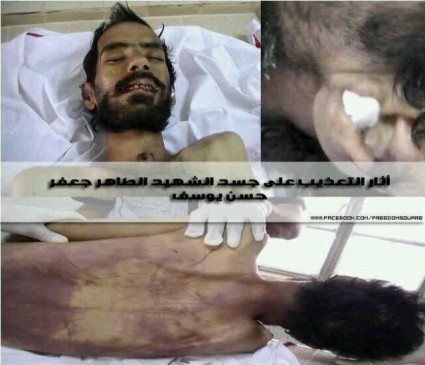
As the funeral procession was finishing, mourners were heavily attacked by security forces. There were reports of attempts by security forces to run people over with their jeeps. …source
September 19, 2011 Add Comments
Bahrain Suffering and Violence
Anthony Shadid on Bahrain suffering
16 September, 2011
“In the revolts that have roiled the Middle East this year, toppling or endangering a half-dozen leaders, Bahrain, an island kingdom once best known for its pearls and banks, has emerged as the cornerstone of a counterrevolution to stanch demands for democracy. While the turmoil elsewhere has proved unpredictable — the ascent of Islamists in Egypt, the threat of civil war in Syria and the prospect of anarchy in Yemen — Bahrain suggests that the alternative, a failed uprising cauterized by searing repression, may prove no less dangerous.
“The situation is a tinderbox, and anything could ignite it at any moment,” said Ali Salman, the general secretary of Al Wefaq, Bahrain’s largest legal opposition group. “If we can’t succeed in bringing democracy to this country, then our country is headed toward violence. Is it in a year or two years? I don’t know. But that’s the reality.”The toll of the ensuing repression was grim: in a country of about 525,000 citizens, human rights groups say 34 people were killed, more than 1,400 people were arrested, as many as 3,600 people were fired from their jobs and four people died in custody after torture in what Human Rights Watch called “a systematic and comprehensive crackdown to punish and intimidate government critics and to end dissent root and branch.”For decades, Bahrain’s relative openness and entrenched inequality have made it one of the Arab world’s most restive countries, as a Shiite majority numbering as much as 70 percent of the population seeks more rights from a Sunni monarchy that conquered the island in the 18th century.
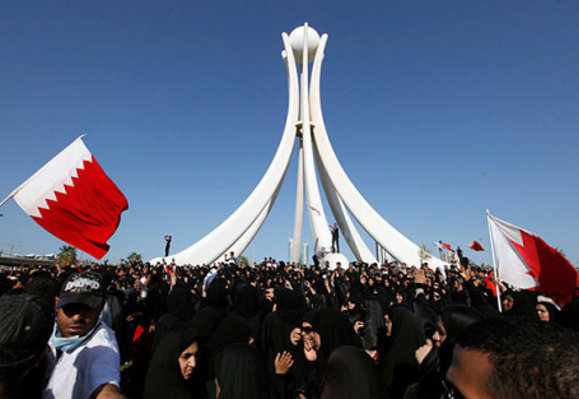
But February was a new chapter in the struggle, when the reverberations of Egypt and Tunisia reached Bahrain and, after bloody clashes, protesters seized a landmark known as Pearl Square, where they stayed for weeks. Activists trade stories of colleagues forced to eat feces in prison and high-ranking Shiite bureaucrats compelled to crawl in their offices like infants. Human rights groups say 43 Shiite mosques and religious structures were destroyed or damaged by a government that contended that it faced an Iranian-inspired plot, without offering any evidence that Tehran played a role.
Backed by the armed intervention of Saudi Arabia, King Hamad bin Isa al-Khalifa declared martial law in March, and though it was repealed June 1, the reverberations of the repression still echo across the island.“They told me, ‘There are two ways we can deal with you — as a human or as an animal,’ ” Matar Matar, 45, recalled being told after he was arrested by men in civilian clothes in May and jailed for three months.”
The crackdown here has won a tactical and perhaps ephemeral victory through torture, arrests, job dismissals and the blunt tool of already institutionalized discrimination against the island’s Shiite Muslim majority. In its wake, sectarian tension has exploded, economic woes have deepened, American willingness to look the other way has cast Washington as hypocritical and a society that prides itself on its cosmopolitanism is colliding with its most primordial instincts. Taken together, the repression and warnings of radicalization may underline an emerging dictum of the Arab uprisings: violence begets violence.” ...source
September 18, 2011 Add Comments
Bahrain Feature: Repression Tears Apart a Country
Bahrain Feature: Repression Tears Apart a Country (Shadid)
Friday, September 16, 2011 – Scott Lucas – EA WorldView
Demolition of a Shia Mosque in BahrainAn interesting parallel to James Miller’s coverage on EA of the situation in Bahrain — Anthony Shadid, who in my opinion is one of the best reporters for first-hand observation, reports for The New York Times:
The battle began soon after sundown. And for the next six hours, in air heavy with heat and tear gas, phalanxes of police officers in helmets battled scores of youths in ski masks, as customers at a Costa Coffee not far away sat like spectators.
No one won in the clashes, which erupt almost every night in this Persian Gulf state. Five months after the start of a ferocious crackdown against a popular uprising — so sweeping it smacks of apartheid-like repression of Bahrain’s religious majority — many fear that no one can win.
“This is all cutting so deep,” said Abdulnabi Alekry, an activist whose car was stopped at one of the checkpoints of trash bins, wood and bricks the youth had fashioned during the clash in August. “The fabric here was never that strong, and now it is torn.”
In the revolts that have roiled the Middle East this year, toppling or endangering a half-dozen leaders, Bahrain, an island kingdom once best known for its pearls and banks, has emerged as the cornerstone of a counterrevolution to stanch demands for democracy. While the turmoil elsewhere has proved unpredictable — the ascent of Islamists in Egypt, the threat of civil war in Syria and the prospect of anarchy in Yemen — Bahrain suggests that the alternative, a failed uprising cauterized by searing repression, may prove no less dangerous.
See also Bahrain Special: New Martyrs, New Protests, New Crackdown
The crackdown here has won a tactical and perhaps ephemeral victory through torture, arrests, job dismissals and the blunt tool of already institutionalized discrimination against the island’s Shiite Muslim majority. In its wake, sectarian tension has exploded, economic woes have deepened, American willingness to look the other way has cast Washington as hypocritical and a society that prides itself on its cosmopolitanism is colliding with its most primordial instincts. Taken together, the repression and warnings of radicalization may underline an emerging dictum of the Arab uprisings: violence begets violence.
“The situation is a tinderbox, and anything could ignite it at any moment,” said Ali Salman, the general secretary of Al Wefaq, Bahrain’s largest legal opposition group. “If we can’t succeed in bringing democracy to this country, then our country is headed toward violence. Is it in a year or two years? I don’t know. But that’s the reality.”
For decades, Bahrain’s relative openness and entrenched inequality have made it one of the Arab world’s most restive countries, as a Shiite majority numbering as much as 70 percent of the population seeks more rights from a Sunni monarchy that conquered the island in the 18th century. But February was a new chapter in the struggle, when the reverberations of Egypt and Tunisia reached Bahrain and, after bloody clashes, protesters seized a landmark known as Pearl Square, where they stayed for weeks. …more
September 18, 2011 Add Comments
US Corporatist Greed Trumps Human Rights – Obama’s Moral Death
Is There A U.S. Human Rights Policy?
Posted on Sunday, September 18, 2011 – by Elliott Abrams
Now in its third year in office, the Obama Administration has never championed the cause of human rights. Its slow reaction in June 2009 to the stealing of the election in Iran and the birth of the “Green Movement” there, and its delay in backing the rebellions in Egypt, Libya, and Syria, are evidence of this problem. But two recent news items show just how bad the situation has become.
In Bahrain, American silence and inaction in the face of human rights abuses has produced resentment toward the United States. Here is what The New York Times reported last week:
As the status quo endures — some believe that the king may introduce reforms this month, while others remain skeptical — anger among many Shiites toward American policy has deepened. Though some appreciated President Obama’s criticism of the crackdown in May, many lament what they see as a double standard. In contrast to the treatment of Syria and Libya, they point out, no administration official is calling for sanctions against Bahrain, a country where the United States has its largest regional naval base, for the Fifth Fleet. “Democracy isn’t only for those countries the United States has a problem with,” said Nabeel Rajab, president of the Bahrain Center for Human Rights.
Last week as well, the Obama Administration made an astonishing kow-tow to China and intervened in free elections in Taiwan. The Financial Times of London reported this:
The Obama administration has warned that a victory by Tsai Ing-wen, the Taiwanese opposition leader, in the island’s January presidential election could raise tensions with China. A senior US official said Ms Tsai, the Democratic Progressive party leader who is visiting Washington, had sparked concerns about stability in the Taiwan Strait, which is “critically important” to the US. “She left us with distinct doubts about whether she is both willing and able to continue the stability in cross-Strait relations the region has enjoyed in recent years,” the official told the Financial Times after Ms Tsai met with administration officials.
What a picture! We intervene in Taiwan where there are free elections, and remain far too quiet on Bahrain where there are manifold abuses. When Bahraini human rights activists see a double standard, they are close to the truth: the Obama Administration appears to have no coherent human rights policy at all. If human rights NGOs were not mostly on the Left they would be protesting far more vociferously against this abandonment of principle.
The resentment felt in Bahrain can be dangerous to U.S. interests; indeed in the future it can endanger the presence of the Fifth Fleet there. I recall well the Nixon Administration’s support for the Greek coup in 1967, an act for which the people of Greece have still not forgiven us. One lesson of the Arab Spring must surely be that our relations with rulers cannot be allowed to displace our concern for the fate of the peoples they rule—who will remember whether we were with them or against them as they sought to end oppression and direct their own destinies.
…source
September 18, 2011 Add Comments
What a hypocritical world we live in
What a hypocritical world we live in
by Pamela Hansen – Article published on 18 September 2011
How can countries that market arms to tyrannical regimes pretend that they do not support human rights violations? What is even more two-faced is that they then get on their high horse and interfere militarily, or subtly, in other countries because of atrocities caused by weapons supplied by themselves?
I am so nauseated by politicians supporting and selling arms to dictators then turning all shocked and appalled when those weapons are used to ensure the tyrants retain their power.
UK anti arms campaigners have expressed dismay that Bahrain, which has killed scores of mainly Shias (who are treated as second-class citizens) since protests broke out in February, has been invited to one of the world’s largest arms fairs being hosted in London’s docklands.
When, in the early hours of 17 February, Bahrain security police stormed the roundabout where a protest was being held, doctors, nurses and paramedics went to the aid of people who had been shot, beaten and tear-gassed.
The security forces were not well pleased and, according to reports, at least one doctor was attacked by baton-wielding officers while tending to an injured demonstrator.
Doctors staged a protest after word spread that security forces were preventing the wounded from being taken to hospital. They blocked the entrance to the hospital, demanding the resignation of the health minister.
Other hospital workers, including nurses, joined in the protests. This led to 47 medics held under arrest in March. In early June, those doctors and nurses who had treated injured protesters in Bahrain appeared in a special military court in Manama charged with attempting to topple the monarchy.
The list of invitees to the Defence and Security Equipment International (DSEI) exhibition, which also included Egypt, Iraq, Pakistan, Saudi Arabia, Oman, Qatar, the UAE and Kazakhstan, had been held back from the campaigners until the press started asking for it last week.
More than 1,300 companies, around half of which are British, are participating in the exhibition. Sixty-five countries have been invited.
In February, we saw the embarrassment of the US government in the early days of the revolution in Egypt, when the media was ever so careful not to call it that. Tear gas used against the regime protestors, obviously supplied by the US, flashed on our TV screens and we discovered that countries, notably the US, had subsidised Mubarak’s military to the tune of $1.3 billion a year.
Although President Barak Obama applied pressure on the Egyptian military for it not to attack the protestors, had the Egyptian people not been so resolute to overthrow Mubarak, the so-called democratic countries would still be propping him up.
He would no doubt have been invited to the current UK arms fair as well as Gaddafi.
And all is not over in Egypt. Last week, the ruling Supreme Council of the Armed Forces (SCAF), (whose representatives have no doubt visited the arms fair) widened the scope of the emergency law – restricted in 2010 by Mr Mubarak to narcotics and terrorism – to include strikes, traffic disruption and the spreading of rumours.
Hundreds are again gathering in Cairo’s Tahrir Square to protest against the recent expansion of the emergency law. The Egyptians are now protesting at the military’s handling of transition from autocratic rule.
[Read more →]
September 18, 2011 Add Comments
Washington Preparing For ‘Regime Change’ in PR Disaster Kingdom – it’s worse than that…
[cb editor note: The work that goes on over at Global Research is excellent and no less praise from here for Mr. Cunningham. However, in the article that follows I respectfully disagree with Mr. Cunningham’s premise; Washington Preparing For ‘Regime Change’ in PR Disaster Kingdom. I expect the reality lies else where, in a broken down, over stretched and arrogant State Department and US Intelligence gathering Agencies. Their best briefings on Bahrain are little more that uninformed, uncritical from lazy analysts who reach no further than the BNA and feed Clinton and Obama the feel good, Pollyanna crap that they have cowed their staffs down to provide, as Obama tries to improve his election prospects, so we can all enjoy four more years of greedy democrats instead of greedy republicans. Tyrannical party leaders seem to enjoy the company and flattery of tyrannical kings.
The “partners” that occupy the White House aren’t interested in Bahrain aside from their personal and political profit motives. If democrats and “friends can make a few bucks” pimping the DNC leadership out as PR people to repackage al Khalifa’s sales image to the West and maybe increase national sales of a few extra tons of CS gas, they will, because that’s what interests them about the situation in Bahrain. They aren’t worried about loosing their base for the 5th fleet, they can just park the tanks and anti-riot gear there that the West has been selling the GCC and the Saudi’s. In Bahrain they sell CS gas and PR people but this Method of Operation was originally championed by former Secretary Albright in Kosov by snatching the Cell Phone concession as “spoils of war” after President Clinton and Cheney crushed Kosov and installed KBR and Haliburton as economic victors there. Same shit different theater.
The folks in DC have transformed themselves from the morally bankrupt to the morally dead. Their is no grand strategy, no ideal of a higher good other than amassing wealth, there is no real plan, just a world power dominated by egos and profit motives and a nation that has the guns and bombs to support their desires – here unto now anyway. This point of view would do the left some good, it might wake up and realize there is no grand plan or conspiracy other than profit motive and that the Western political system is neither sophisticated nor is it intelligent, it’s just fucking greedy. Sorry Mr. Cunningham maybe I’ll cheer up a little this week when (if) Greece defaults and Capitalism takes a shot to the nuts – one can only hope.
Peace,
Philipn ]
Bahrain: Is Washington Preparing For ‘Regime Change’ in PR Disaster Kingdom?
by Finian Cunningham – Global Research, September 18, 2011
The persistence of pro-democracy protests in Bahrain in the face of brutal repression may be giving Washington second thoughts about its unwavering support for the royal rulers of the strategically important Persian Gulf kingdom. Are we about to witness a cosmetic ‘regime change’ – not so much for the genuine sake of democratic rights in Bahrain, but more to save Washington’s vital interests across the region?
The tiny island situated between Saudi Arabia and Qatar serves as the base for the US Navy’s Fifth Fleet. The Fifth Fleet, comprising 16,000 personnel and 30 vessels, is a staging ground for US military projection across the Middle East and Central Asia. It also monitors the sealanes of the Persian Gulf through which some 30 per cent of the world’s total supply of traded oil passes every day.
Since the mainly Shia population of Bahrain took to the streets on 14 February in protest against the unelected Sunni monarchy of the Al Khalifa dynasty, Washington has given unrelenting support to the regime – invariably describing Bahrain as “an important ally”.
Apart from the US Fifth Fleet, the US has a free trade agreement with Bahrain, it sells some $20 million in weapons every year to the kingdom, and Bahrain is a financial hub for American and global capital.
Bahrain returned all these favours by lending Washington and its NATO allies diplomatic cover for the military intervention in Libya to oust Muammar Gaddafi. Bahrain, along with the other Gulf monarchies of Saudi Arabia, Qatar and the United Arab Emirates, lined up dutifully behind the US/NATO intervention to give it a veneer of Arab approval, and thus head off charges that the aerial bombardment of Libya is a Western imperialist war of aggression. The Gulf Arab monarchies have also performed the same political function of providing diplomatic cover for the US/NATO sanctions and threats of intervention against Syria.
Bahrain and the other Gulf dictatorships (despite the irony of that) have thus played an important propaganda function. They have helped underpin the premise that the US and NATO involvement in Libya and Syria is guided by defence of human rights and democratic freedoms.
But now here’s the rub. Bahrain stands out as a glaring contradiction to stated US government claims regarding its interventions in Libya and Syria.
The fact that some 40 people have been killed in Bahrain for peacefully demanding democratic freedoms and basic human rights is an unmitigated damning indictment of the US-backed regime. Thousands have been injured – many horribly mutilated – from regime forces firing at unarmed peaceful demonstrators.
The apparent glaring contradiction between US foreign policy towards Bahrain and its espoused concerns for the people of Libya and Syria makes Bahrain under the Al Khalifa regime a serious liability to Washington’s “humanitarian” credibility.
Given the ongoing persecution against Shia workers (over 3,500 sacked); the preposterous use of military show trials to prosecute dozens of doctors, nurses, teachers, lawyers and athletes; the widespread condemnation by human rights groups of illegal mass detention and torture; the targeting of independent journalists and bloggers; the expulsion of hundreds of students and academics – the liability of the Al Khalifa regime to Washington’s foreign policy credibility grows ever more unwieldy by the day. …more
September 18, 2011 Add Comments
Cynical assualt – Bahrani Security Forces open fire with CS Gas and rubber bullet on mourners at funeral of man killed by CS Gas attack
Bahrain forces fire tear gas at funeral
Security forces use tear gas and rubber bullets on procession of a man who died after he himself was tear-gassed.
Last Modified: 17 Sep 2011 00:10
Governement says Jawad Marhun was killed by sickle cell disease, but his advocates say otherwise [Reuters]
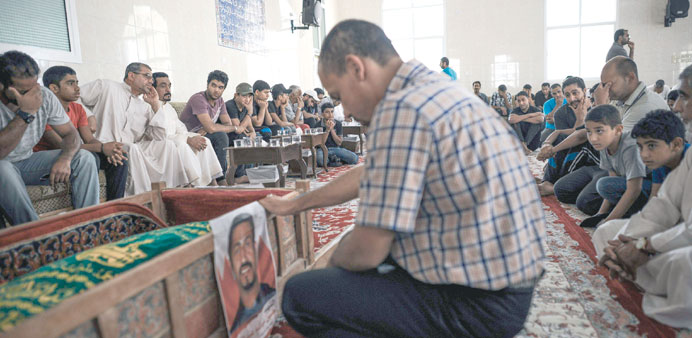
Bahraini security forces have fired tear gas, rubber bullets and stun grenades to disperse thousands of mourners at the funeral of a man who died after he himself was tear-gassed, a Shia politician said.
“Security forces used tear gas, rubber bullets and stun grenades to disperse the demonstrators while the majority of them were trying to leave at the end of the funeral,” said Matar Matar, a senior member of Al-Wefaq, Bahrain’s largest Shia opposition formation, on Friday.
Tens of thousands of Bahrainis, he said, were at the funeral of Jawad Marhun, a 36-year-old who died late on Wednesday from what Al-Wefaq said was “excessive exposure to tear gas from a canister tossed into his parents home on September 10”.
The government of Bahrain, which crushed a month of protests in mid-March, said Marhun had died from “acute respiratory” problems as a result of sickle cell disease. His family denies that he had the disease, according to the Bahrain Centre for Human Rights (BCHR).
In April, the government said two other activists died from the blood disorder while in custody.
“Sooner or later, the people will achieve victory,” the mourners chanted in the village of Sitra, according to Matar.
“He is the second victim within about two weeks in Sitra,” said the former member of parliament.
“In general, the tension in Bahrain is increasing and the government is still using excessive force against the demonstrators and ignoring the demand for real dialogue that would lead to major political reforms.”
The BCHR says that the government has intensified its use of tear gas in a campaign to stop unrest.
“We are receiving many complaints that the teargas being used now produces a black smoke rather than white, and is a lot stronger than the one security forces used to use,” the BCHR said in a statement.
“The burning feeling in the chest is sharper, and the skin feels like it is burning (as described by protesters).”
On August 31, Ali Jawad Ahmed al-Sheikh, 14, died in the village of Sitra during a protest after prayers commemorating the beginning of the Muslim holiday of Eid al-Fitr.
The opposition said al-Sheikh was fatally wounded when he was struck in the face by a tear gas canister fired by security forces.
“According to those who took him to the hospital, those working at the hospital refused to treat the boy,” said the BCHR.
The government said the teenager died of trauma after suffering a blow from a blunt object to the back of the neck that could not have been caused by a rubber bullet or tear gas.
The deaths come ahead of parliamentary elections scheduled for September 24.
The opposition has already boycotted the polls and wants democratic reforms in the Gulf kingdom where a Sunni monarchy has ruled over a majority Shia population for decades.
“I believe that the shortest path for stability can be reached if the king takes a brave decision to drive the kingdom (towards) tolerance and real political reform,” Matar said.
Security forces were aided in the March crackdown on protesters after being backed by troops with tanks from neighbouring monarchies.
Authorities said 24 people were killed in the unrest, including four police officers. The opposition put the toll at 30. …source
September 18, 2011 Add Comments
HRW response to delusional letter to editor at WP from Bahrain’s Ambassador in Washington – Ambassador is disconnected from reality or it’s he is a pretentious, cynical apologist for the al Khalifa regime
Tad Stahnk Response to Bahrain’s Ambassador to Washington, letter to Washington Post editor – original letter follows
The Post’s Sept. 9 editorial on Bahrain wisely warned that “the administration should use its influence now — before the crisis resumes.” In fact, the crisis hasn’t ever gone away for Bahrainis, even though the U.S. government has conveniently forgotten it.
Bahraini doctors and other civilians are still tried in military courts, protesters have been shot and killed, and accounts of torture continue to emerge from released detainees. Despite this, the United States has said nothing about the situation for months. On the flip side, the Bahrain government has hired D.C.-based public relations and law firms to try to shift attention from its appalling human rights record.
At the end of September, verdicts are expected in the trial of Bahraini medics and in the appeal of 21 prominent dissidents already sentenced in a sham trial. The U.S. government should rouse itself from its paralysis on Bahrain and take a stand for democracy and human rights.
Tad Stahnke, Washington
The writer is director of policy and programs at Human Rights First.
Letter to the Editor
Bahrain’s progress — or not
Published: September 16 – Washington Post
Regarding the Sept. 9 editorial “Bahrain’s brewing crisis”:
We agree that thoughtful dialogue on events in Bahrain is crucial. But this editorial wrongly criticized our peaceful reconciliation process and failed to provide a comprehensive picture of what we have accomplished for all Bahrainis.
Moreover, the editorial asserted that the United States has played a passive role as we work to unify our nation. Bahrain’s government has appreciated support from our ally the United States as we strive to peaceably overcome challenges. We are proud to be home to the Navy’s 5th Fleet, and we stand with the United States in its fight against terrorism.
The decision of opposition groups to remove themselves from our peaceful dialogue reinforces an active trend of trying to hinder Bahrain’s democratic process. Bahrain’s 300 National Dialogue participants represented all political parties, including opposition groups. We cannot force a rational, measured process on those who would rather settle disputes in the streets.
The Bahrain Independent Commission of Inquiry will detail the actions of the government and protest movement. The U.N. High Commissioner for Human Rights welcomed the creation of the group, which has already demonstrated an impartial approach to investigating events in Bahrain. We are prepared to live with whatever hard truths are revealed.
Houda Nonoo, Washington
The writer is Bahrain’s ambassador to the United States.
September 18, 2011 Add Comments
Bahrain Mourners say goodbye to Martyr Sayed Jawad
September 17, 2011 Add Comments
Bahrain – Martyr Jawad Funeral Gains Intensity
September 17, 2011 Add Comments
Martyr Jawad Funeral Attacked by Security Forces
September 17, 2011 Add Comments
Funeral of martyr S.Jawad breaks up after the attack
September 17, 2011 Add Comments
More spontaneous street protests as Security Force victims reach boiling point
September 17, 2011 Add Comments
Bahrain Security Forces Retreat in realization of overwhelming numbers of “pissed-off” protesters
September 17, 2011 Add Comments
Protests Sounding Louder
September 17, 2011 Add Comments
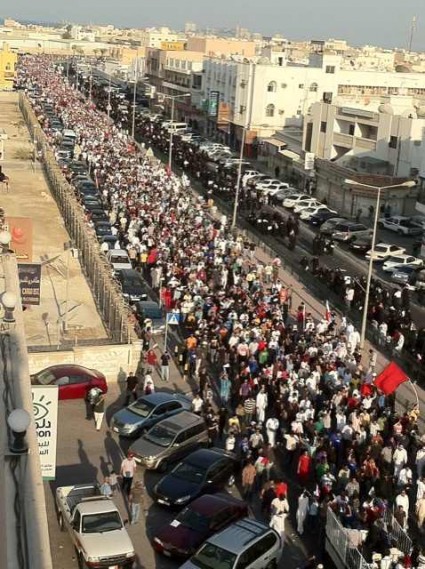
Protests flare after funeral procession of Seyyed Jawad Ahmed Hashim Marhoon
Bahraini protesters, police clash after man’s funeral
By the CNN Wire Staff -September 17, 2011
Manama, Bahrain (CNN) — Clashes between protesters and police extended into a second day in Bahrain on Saturday, following the burial of a man who died in questionable circumstances this week.
Tens of thousands marched chanting anti-regime slogans in the funeral procession of Seyyed Jawad Ahmed Hashim Marhoon in Sitra, southwest of the capital, Manama.
Shortly after the burial, scores of mourners clashed with police.
The Bahrain Ministry of Interior said it dealt with a group of vandals who blocked streets following the funeral march.
Clashes broke out late Thursday and early Friday, ahead of Marhoon’s funeral. Many of the same areas saw renewed clashes following the funeral.
Violence was reported in most Shiite villages across the small Gulf island, including some on the outskirts of Manama, where anti-riot police moved in.
Thick clouds of tear gas, rubber pellets and stones covered many of the streets as police clashed with angry protesters.
Parts of the capital also saw limited clashes, but the heaviest were in Sitra.
Marhoon died in a hospital after being admitted to the intensive care upon arrival.
Relatives say he developed difficulty in breathing after tear gas was fired at his father’s home on September 10, but the family fearing arrest and reprisal opted not to seek medical care until later.
In May, a report by Doctors Without Borders entitled “From hospitals to prisons” said medical staff in Bahrain had been unfairly targeted by government forces.
Injured protesters have been arrested at hospitals, according to the report.
[Read more →]
September 17, 2011 Add Comments
VOA implies Bahrain unrest just a bunch of angry kids on twitter?
Youth groups have utilized social media to attract support for a number of demonstrations in the lead up to next week’s elections, including a protest at the Pearl Roundabout site in Manama that has become symbolic with Bahrain’s opposition movement.
Tensions Rise Ahead of Bahrain Elections
September 17, 2011
Phillip Walter Wellman – Manama, Bahrain
Tensions are mounting in Bahrain ahead of planned parliamentary elections next week, with opposition supporters vowing to hold a mass demonstration in the capital, Manama.
Next Saturday’s poll will fill 18 seats abandoned by the main opposition al-Wefaq party, who quit in February over the government’s bloody crackdown on pro-democracy demonstrators.
Mattar Mattar, one of the legislators who resigned, says the decision to replace all of the opposition parliamentarians is proof that the nation’s leaders are neglecting the grievances of the people. “They are trying to ignore us, but this plan will not succeed. They are going on the wrong track. Without opening a real dialogue and without going for real political reform it’s difficult to reach stability here,” he said.
Bahrain’s political opposition comprises, in large part, the nation’s majority Shi’ite Muslims, who say they are treated like second-class citizens by the ruling Sunni minority. They have been calling for more rights and for the introduction of a constitutional monarchy.
Some hardliners in the opposition have been demanding the abolition of the monarchy, and as unrest continues, their numbers are growing.
Clashes between security forces and anti-government protesters take place nearly every night in Shi’ite neighborhoods.
According to rights groups, about 40 people have been killed and more than a thousand detained since February. The government has defended the crackdown, saying it is needed to reinstate stability.
On Friday, tear gas, rubber bullets and stun grenades were used to disperse tens of thousands of mourners at a funeral in Sitra, south of Manama.
[Read more →]
September 17, 2011 Add Comments