Saudi forces fire on Peaceful Shia protesters in Qatif
Saudi forces fire on Peaceful Shia protesters in Qatif
25 January, 2012 – JafriaNews
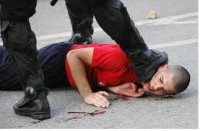
JNN 24 Jan 2012 Qatif : Several Saudi protesters have been injured in an attack by security forces on a demonstration in the Qatif region of the Eastern Province, Press TV reports.
On Tuesday, Saudi security forces opened fire on demonstrators in Qatif that protested against the ruling Al Saud regime.
Some of the wounded are reportedly in critical condition.
Nine protesters were also arrested during the attack on Tuesday for involvement in anti-regime demonstrations in the region.
Saudi officials accuse the detainees of “shooting members of security forces” in Eastern Province.
On Monday, Saudi security forces detained Zaher al-Zaher, a social activist, in the town of Awamiyah in the Eastern Province.
Regime forces also killed 22-year-old protester Essam Mohamed Abu Abdellah and wounded three others in Awamiyah on January 12.
Since February 2011, Saudi protesters have held demonstrations on an almost regular basis in the oil-rich Eastern Province, mainly in Qatif and Awamiyah, calling for the release of all political prisoners, freedom of expression and assembly, and an end to widespread discrimination.
However, the demonstrations have turned into protest rallies against the Al Saud regime, especially since November 2011, when Saudi security forces killed five protesters and injured many others in Eastern Province.
Sheikh Nimr al-Nimr, a prominent Shia cleric in Saudi Arabia, has warned the kingdom against the brutal crackdown on protesters in Eastern Province and called on the Al Saud regime to stop bloodshed.
Saudi Arabia is a state party to the Arab Charter on Human Rights. Article 24 of the charter states that “every citizen has the right… to freely pursue a political activity [and] to freedom of association and peaceful assembly.” …source
January 25, 2012 Add Comments
Ceaseless State Violence tries patience of youthful protests and they Retaliate against murdeous regime
Some Protesters Retaliate Against Police Violence
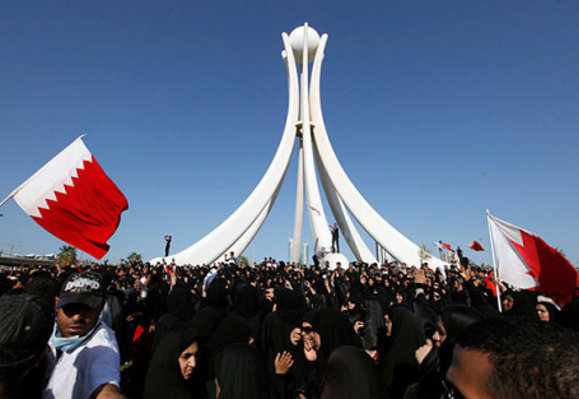
Several people were wounded as “violence flared up in Bahrain in the wake of a leading Shia cleric’s call to ‘crush’ police.’” In his sermon Sheikh Isa Qassim said, “whoever you see abusing a woman, crush him,” which spurred some youth activists to engage in violence. “How do those who do this to people expect the people to remain silent and not defend their rights and honor?” he asked, referencing the violence that security forces have used against opposition groups. The video (above) shows Shia activists throwing stones and petrol bombs in response to recent attacks on protesters and women. Some sources also said that two policemen kidnapped and assaulted before being released. Public Security chief Major-General Tariq Al Hassan said, “a number of vandals were arrested after they blocked roads in various villages.” Some peaceful protesters expressed concern over the attacks, saying, “no one should come down to that level. It is not right what (the protesters) are doing.”
Meanwhile, security forces fired tear gas and stun grenades when protesters marched into the capital city of Manama. Police set up checkpoints and many shops were closed after the clashes. …source
January 25, 2012 Add Comments
Al Khalifa Regime Murders two more Protesters in violent gas assaults
Bahrain protesters Martyred by toxic gas assaults
25 January, 2012 – Shia Post
Two more anti-government Bahraini protesters have martyred from inhaling toxic tear gas and the other by sound grenade fired by al-Khalifa regime forces.
According to informed sources, Bahraini forces attacked houses in A’ali and al Diyah village by fiering tear gas and severely suppressed innocent civilians.
Today victims namely ’Haj ali al Sakri’ martyred from inhaling toxic tear gas in A’ali village and the other one ’Abbas Ja’afar Sheikh’, 22, by sound grenade from al-Khalifa regime forces, in al-Diyah village.
The number of Bahrain martyrs reached to 63.
Local sources said the demonstrations were held mainly in the village of Ma’ameer, about 15 kilometers (9.5 miles) south of the capital Manama, and the village of Dair, located on the northern coast of the Muharraq Island.
Many were also injured during the attacks, the sources said.
Regime forces also used toxic gas against a protest in the town of Sitra, A’alia and al-Dirah.
Saudi-backed Bahraini forces continue their violent crackdown on peaceful demonstrations in the country. …source
January 25, 2012 Add Comments
Make your voice heard in the US – get face time with your Senators and Representatives – How? Just ask they are paid to meet with you!
Human Rights in the Middle East: Why US Voices Matter
by: Sanjeev Bery – 25 January, 2012 – Human RIghts now Amnesty
Five months ago, I joined the team at Amnesty International USA to advocate for human rights across the Middle East and North Africa. Together with my colleagues in our Washington DC office, I work daily to push governments to stand up for core freedoms — or at least, to stop violating them.
From my perch in DC, I’m especially concerned about US foreign policy and how it impacts the lives of those across the Middle East and North Africa. In a number of countries where protestors have been in the streets, the governments that have attacked them received guns, ammunition, and equipment from US sources.
Egypt’s military leadership is one example. Bahrain’s monarchy is another. What this means is that US-based human rights advocates and activists have a very important role to play. What happens in Washington DC and in congressional districts across the country has a significant impact on human rights around the world.
That’s because the people responsible for putting US weapons in the hands of human rights violators pay close attention to what US voters have to say. Where there is silence, the status quo remains. But when concerned US citizens and residents speak up, elected officials notice.
One good example was the US State Department’s decision late last year to delay a proposed $53 million weapons sale to the Bahraini government. Since February of 2011, the Bahraini security forces have shown a willingness to use violence and torture to control and penalize Bahraini protestors.
Bahrain is a tiny island nation that has been ruled by the al Khalifa monarchy for some 200 years. As with so many governments across the Middle East and North Africa, Bahrain’s leaders are now facing increasing scrutiny and protest from the society they have ruled over. And as in so many other countries, the Bahraini government has responded to such protests with violence.
That’s why there was significant protest inside the United States when the Obama Administration proposed selling $53 million in US arms to the Bahrain government in September of 2011. Amnesty International, human rights activists, and even Members of Congress criticized the proposed sale. The Bahraini government had already used tanks to surround a hospital where wounded protestors had been treated. Why was the US government now proposing the sale of additional armored Humvees and tow missiles?
Following public criticism and threats of legislative action, the weapons sale has now been put on hold. That’s why Bahrain’s monarchy invests time in Twitter and pays for US lobbyists like Joe Trippi – the one-time strategist behind Howard Dean’s presidential campaign. They want to do their best to prevent such an outcome from happening again in the future. As human rights violations in Bahrain continue, the Bahraini government wants to limit the resulting political damage in the US.
All of this, however, shows how important domestic US opinion is for securing global human rights. As protestors take to the streets in country after country in the Middle East and North Africa, let’s make sure we in the US are doing our part to stand up for their core human rights. That doesn’t necessarily mean endorsing their every specific demand or political platforms. But it does mean preventing the shipment of US weapons that could be used to kill them.
In the global struggle for human rights, our own policymakers need to hear from us.
January 25, 2012 Add Comments
International Mission to Bahrain Report says promises for reform unfulfilled, while situation deteriorates
International Mission to Bahrain Report says promises for reform unfulfilled, while situation deteriorates
24 January 2012- BCHR
(ANHRI/Index on Censorship/WiPC/IFEX) – 24 January 2012 – Tunis/London – A report from a six-member mission of international organisations to Bahrain last November called out Bahraini authorities for failing to deliver on promises of reform, despite a highly-touted commission of inquiry which made numerous recommendations. Rights violations continue on a daily basis, and people are still jailed on long sentences, including prominent human rights activists jailed for life. Yet the world has not been paying attention to this forgotten country during a year of turmoil in the region.
The report, “Justice Denied in Bahrain: Freedom of Expression and Assembly Curtailed”, outlines violations of human rights related to the authorities’ handling of protests and demonstrations in the country since February 2011. The report details meetings with human rights defenders, lawyers, writers, artists, journalists, government officials and foreign diplomats and provides insight into how the government continues to punish and prosecute individuals for expressing their opinions and protesting ongoing repression.
“In the middle of the successive events that occur in the region we must not lose sight of the Bahraini people’s plight. We should deal with what’s happening in Bahrain as a peaceful uprising asking for dignity and human rights, not in the framework of sectarian conflict,” said Mina Mamdouh, Researcher at the Arabic Network for Human Rights Information.
With the publication of the Bahrain Independent Commission of Inquiry (BICI) report at the end of November (witnessed by the mission) and the deadline of February 2012 for a national commission to make recommendations for reform, expectations have been raised that there will be change in Bahrain. However, as the report indicates and as the mission members witnessed – and continue to monitor –the reality on the ground in Bahrain remains unchanged. Human rights activists, doctors, teachers, union members, political figures, journalists, bloggers and others continue to face harassment, prosecution and imprisonment despite the use of torture and unfair trials against them. Protests continue on an almost daily basis, and the security forces response is virtually unchanged since before the publication of the BICI report.
“It seems that despite the BICI report’s extensive catalogue of abuses against Bahraini citizens including torture, and a clear condemnation of the culture of impunity, the government of Bahrain is intent on maintaining the status quo. We are not seeing the immediate release of prisoners. Instead there is an interminable succession of postponed trials,” said Marian Botsford Fraser, Chair of the Writers in Prison Committee, PEN International.
The 11 recommendations made in the report, “Justice Denied in Bahrain: Freedom of Expression and Assembly Curtailed”, include calls to end the harassment, imprisonment and prosecution of Bahraini citizens for what essentially amount to persecution of free expression and legitimate human rights work. In line with the BICI report, which was accepted by the government of Bahrain, the international mission report also insists on accountability for those responsible for violating international human rights norms, in particular those responsible for torture and killing.
The full mission report is online in English at:
bahrainmissionreportjanuary2012final.pdf (634 KB)
The mission team was composed of the Arabic Network for Human Rights Information (ANHRI), Front Line Defenders, the Gulf Centre for Human Rights (GCHR), Index on Censorship, International Media Support (IMS) and the Writers in Prison Committee (WiPC) of PEN International, and was supported by the International Freedom of Expression Exchange (IFEX). …source
January 25, 2012 Add Comments
King Hamad launches Systematic Violations Against Human Rights Activists in Bahrain
New Year in Bahrain Different: Systematic Violations Against Human Rights Activists
17 January, 2012
On January 1, 2012, Mr. Hani Alqmich was injured in the head by teargas canister were fired by the riot police during the assault on a peaceful protest.
Mr.Hani had surgery in the head, but he is still in hospital suffering from injury.
Mr.Hani activist in defending the rights of the unemployed.
On January 1, 2012, Bahraini authorities arrested Mr. Ahmed Abbas (a member of the Bahrain Youth Society for Human Rights-BYSHR) and he has been subjected to ill-treatment.
In October and November 2011, the authorities attempted to arrest Mr. Ahmed Abbas, a member of the BYSHR, in relation to the monitoring and documentation of human rights violations in the village of Nuwaidrat. Mr. Ahmed Abbas has since then been forced to remain in hiding to continue his human rights work.
In the evening of January 6, 2012, Mr. Nabeel Rajab, President of the Bahrain Center for Human Rights was beaten severely by the security forces in Manama while he was participating in a peaceful demonstration to call for the release of political prisoners and human rights activists. According to testimonies, policemen attacked the demonstrators and a group of police officers gathered suddenly around Mr. Rajab and started beating him. He was kicked, punched and beaten all over his body and especially on the face and back, while lying on the ground.
In the evening of January 12, 2012, Mr. Nader Abdulemam, Human Rights Activist was injured in the face by teargas canister were fired by the riot police during the assault on a peaceful protest.
The Bahrain Youth Society for Human Rights (BYSHR) demands to punish the perpetrators and the protection of human rights defenders in Bahrain. ..source
January 25, 2012 Add Comments
Arab-American Organization for Democracy and Human Rights Awards Bahraini Human Rights Defenders
Three Prominent Bahraini Human Rights Defenders Recieve International Human Rights Personality of the Year 2011
29 December, 2011 – BYSHR
The Arab-American Organization for Democracy and Human Rights has awarded three prominent Bahraini Human Rights Defenders the International Human Rights Defenders Personality of the year 2011 along with other prominent Arab activist from the region.
The three defenders are:
1. Mr. Abdulhadi Alkhawaja, currently serving a life sentence for his human rights work in Bahrain. Was previously the Middle East and North Africa Coordinator with Frontline Defenders and the previous President of the Bahrain Centre for Human Rights (BCHR)
2. Mr. Nabeel Rajab, An Ion Ratiu Democracy Award Winner 2011, President of Bahrain Center for Human Rights (BCHR), Deputy Secretary General of FIDH, and MENA Advisory member of Human Rights Watch.
3. Mr. Mohammed Al-Maskati, President of the Bahrain Youth Society for Human Rights (BYSHR)
The award identifies these 3 activists as brave leaders of the Arab spring along with other prominent activists such as Nobel award winner Tawakul Karman, Eqyptian blogger Alaa Abdulfatah and Egyptian activist Wael Ghunaim. …source
January 25, 2012 Add Comments
Preparations Underway for more intensive Crackdown?
Brace for the worst in Bahrain
by Hussein Ibish, 24 January, 2012 – LebanonNow
The stage seems to be set for February and March to be the scene of a significant intensification of tensions in Bahrain. The period will mark the one-year anniversaries of the protest movement, the government crackdown, and the “Peninsula Shield” intervention by Saudi-led Gulf Cooperation Council forces. More importantly, recent developments have pushed almost entirely away from substantive moves toward national accommodation or reconciliation.
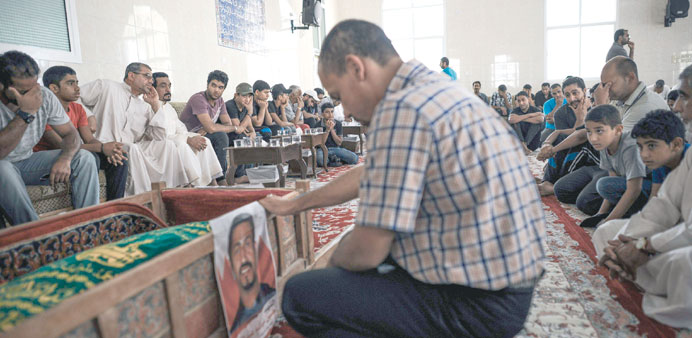
Since the failure of the “national dialogue” last summer, clashes between security forces and largely Shia protesters have regularly taken placed during emotional funerals following the deaths of individuals under suspicious circumstances.
The report of the Bahrain Independent Commission of Inquiry, which found that security forces had engaged in the excessive use of force, appears to have done nothing to inhibit the use of tear gas and other suppressive measures. Indeed, this behavior seems to have intensified. At least eight protesters have been killed since the report was filed, mostly by tear gas inhalation, including reportedly a baby.
In their own defense, the authorities have pointed to changes in the leadership of the security services, the hiring of Western policing experts, and the investigation of a number of deaths in custody. They cite the impending trial of five security officers, none of them Bahraini, for the death of a blogger while being held by the police. And King Hamad has proposed some limited constitutional reforms that are supposed to enhance the power of the legislature.
None of this has impressed any major actors in the opposition. The main Shia opposition grouping, Al-Wefaq, has continued to boycott parliament and the by-elections intended to fill the seats opened by the mass resignation of its parliamentarians. There is still no vehicle for meaningful dialogue between the government and opposition forces. Hardliners on both sides appear to have been gaining ground over those interested in a meaningful compromise.
There are signs of a serious hardening of the position of important opposition voices and groups. Most significantly, on January 12, Nabeel Rajab, the president of the Bahrain Center for Human Rights and a figure with both national and international credibility, gave a speech that seemed to break new ground for the mainstream opposition. He stated bluntly, “Our problem is with the king of Bahrain.” Addressing the king directly, he said, “If you cannot get rid of the heavy weights of your regime and the crimes that your regime has committed, then it is the appropriate time now for you to leave.”
It is not clear if he was calling for abdication or the end of the monarchy. However, the statement brings calls for what amount to regime change, which had previously been restricted to smaller and more radical opposition groups such as Al-Haq, much closer to the rhetoric of the mainstream Bahraini opposition. It may or may not prove to be a milestone, but it certainly represented a significant intensification of demands. It is worth noting that Rajab was beaten, detained and hospitalized following a January 6 protest.
There also appears to be more activity and influence by the shadowy, underground opposition groups calling themselves the “February 14 Youth Coalition,” whose rhetoric emphasizes a not-clearly defined “Right of Self-Determination.” The increased activity of the “February 14” groups demonstrates a growing impatience at the street and popular levels with mainstream organizations like Al-Wefaq that now are perceived as too conciliatory by some activists.
Some pro-government hardliners have also been escalating their rhetoric and pushing for stronger confrontation. When a civilian court overturned the death sentences handed down against two protesters by a military tribunal, extremist elements associated with the pro-government National Unity Gathering called for their lynching and created mock gallows in which they hanged photographs of the men.
Not enough has been done to defuse tensions, and an obvious step the government has so far unwisely avoided is a broad-based amnesty for the hundreds of people arrested and charged in connection with protests, and in many cases the simple exercise of free expression. In particular, the government cannot hope to open a meaningful dialogue with an opposition, 21 of whose leaders were jailed in a mass trial last year that did not distinguish between moderate and extreme figures. Their harsh sentences were upheld on September 28.
The release of important figures such as Abdulhadi Abdulla Hubail Alkhawaja, the former president and co-founder of the Bahrain Center for Human Rights, and, above all, Ibrahim Sharif—the sole Sunni defendant in the mass trial, who is the leader of the social democratic reform group Al-Waad—would be an indispensible step away from confrontation. It is probably a sine qua non for real dialogue. Without such serious measures, the situation in Bahrain is set to deteriorate significantly in the coming months.
Hussein Ibish writes frequently about Middle Eastern affairs for numerous publications in the United States and the Arab world. He blogs at HERE
January 24, 2012 Add Comments
Julian Assange: The Rolling Stone Interview
Julian Assange: The Rolling Stone Interview
Under house arrest in England, the WikiLeaks founder opens up about his battle with the ‘Times,’ his stint in solitary and the future of journalism
By Michael Hastings – 18 January, 2012
It’s a few days before Christmas, and Julian Assange has just finished moving to a new hide-out deep in the English countryside. The two-bedroom house, on loan from a WikiLeaks supporter, is comfortable enough, with a big stone fireplace and a porch out back, but it’s not as grand as the country estate where he spent the past 363 days under house arrest, waiting for a British court to decide whether he will be extradited to Sweden to face allegations that he sexually molested two women he was briefly involved with in August 2010.
Assange sits on a tattered couch, wearing a wool sweater, dark pants and an electronic manacle around his right ankle, visible only when he crosses his legs. At 40, the WikiLeaks founder comes across more like an embattled rebel commander than a hacker or journalist. He’s become better at handling the media – more willing to answer questions than he used to be, less likely to storm off during interviews – but the protracted legal battle has left him isolated, broke and vulnerable. Assange recently spoke to someone he calls a Western “intelligence source,” and he asked the official about his fate. Will he ever be a free man again, allowed to return to his native Australia, to come and go as he pleases? “He told me I was fucked,” Assange says.
“Are you fucked?” I ask.
Assange pauses and looks out the window. The house is surrounded by rolling fields and quiet woods, but they offer him little in the way of escape. The British Supreme Court will hear his extradition appeal on February 1st – but even if he wins, he will likely still remain a wanted man. Interpol has issued a so-called “red notice” for his arrest on behalf of Swedish authorities for questioning in “connection with a number of sexual offenses” – Qaddafi, accused of war crimes, earned only an “orange notice” – and the U.S. government has branded him a “high-tech terrorist,” unleashing a massive and unprecedented investigation designed to depict Assange’s journalism as a form of international espionage. Ever since November 2010, when WikiLeaks embarrassed and infuriated the world’s governments with the release of what became known as Cablegate, some 250,000 classified diplomatic cables from more than 150 countries, the group’s supporters have found themselves detained at airports, subpoenaed to testify before a grand jury, and ordered to turn over their Twitter accounts and e-mails to authorities.
…more
January 24, 2012 Add Comments
Despite Sanctions by EU & US, Irani Black Gold Turns into 24K Gold
Despite Sanctions by EU & US, Irani Black Gold Turns into 24K Gold
25 January, 2012 – Jafria News
JNN 24 Jan 2012 Tehran : Despite fresh EU sanctions against Iran’s oil exports,India has agreed to pay the price of crude oil it imports from Iran in gold, which makes it the first country to drop the US dollar for purchasing the Iranian oil. China has shown interest in Iran’s oil with hiring at least two supertankers to ship oil from the country.
According to a report published by DEBKAfile news website, unnamed sources have stressed that China is also expected to follow suit.
India and China take about one million barrels per day (bpd), or 40 percent of Iran’s total exports of 2.5 million bpd and both of them have huge reserves of gold.
The report added that by trading in gold, New Delhi and Beijing enable Tehran to bypass the upcoming freeze on its Central Bank’s assets and the oil embargo which the European Union’s foreign ministers agreed to impose on Monday, January 23.
The EU currently buys around 20 percent of Iran’s oil exports.
On the other hand, experts say the vast sums involved in these transactions are expected to boost the price of gold and depress the value of the dollar on world markets.
“An Indian delegation visited Tehran last week to discuss payment options in view of the new sanctions. The two sides were reported to have agreed that payment for the oil purchased would be partly in yen and partly in rupees. The switch to gold was kept [in the] dark,” the report stated.
India is Iran’s second largest customer after China, and purchases around USD 12-billion-a-year worth of Iranian crude, or about 12 percent of its consumption.
Delhi is to execute its transactions, the report said, through two state-owned banks: the Calcutta-based UCO Bank, whose board of directors is made up of the Indian government, the Reserve Bank of India representatives, and Halk Bankasi (Peoples Bank) — Turkey’s seventh largest bank which is owned by the government.
US President Barack Obama signed into law, on December 31, 2011, new sanctions which seek to penalize other countries for importing Iran’s oil or doing transaction with Islamic Republic’s Central Bank.
Foreign ministers of the European Union also imposed sanctions on Iran’s oil imports over the country’s peaceful nuclear program during their Monday meeting in Brussels. …more
January 24, 2012 Add Comments
Weapons ‘R’ Us – Merchants of Death
Weapons ‘R’ Us
Making Warbirds Instead of Thunderbirds
By William J. Astore, a retired lieutenant colonel (USAF)
Perhaps you’ve heard of “Makin’ Thunderbirds,” a hard-bitten rock & roll song by Bob Seger that I listened to 30 years ago while in college. It’s about auto workers back in 1955 who were “young and proud” to be making Ford Thunderbirds. But in the early 1980s, Seger sings, “the plants have changed and you’re lucky if you work.” Seger caught the reality of an American manufacturing infrastructure that was seriously eroding as skilled and good-paying union jobs were cut or sent overseas, rarely to be seen again in these parts.
If the U.S. auto industry has recently shown sparks of new life (though we’re not making T-Birds or Mercuries or Oldsmobiles or Pontiacs or Saturns anymore), there is one form of manufacturing in which America is still dominant. When it comes to weaponry, to paraphrase Seger, we’re still young and proud and makin’ Predators and Reapers (as in unmanned aerial vehicles, or drones) and Eagles and Fighting Falcons (as in F-15 and F-16 combat jets), and outfitting them with the deadliest of weapons. In this market niche, we’re still the envy of the world.
Yes, we’re the world’s foremost “merchants of death,” the title of a best-selling exposé of the international arms trade published to acclaim in the U.S. in 1934. Back then, most Americans saw themselves as war-avoiders rather than as war-profiteers. The evil war-profiteers were mainly European arms makers like Germany’s Krupp, France’s Schneider, or Britain’s Vickers.
Not that America didn’t have its own arms merchants. As the authors of Merchants of Death noted, early on our country demonstrated a “Yankee propensity for extracting novel death-dealing knickknacks from [our] peddler’s pack.” Amazingly, the Nye Committee in the U.S. Senate devoted 93 hearings from 1934 to 1936 to exposing America’s own “greedy munitions interests.” Even in those desperate depression days, a desire for profit and jobs was balanced by a strong sense of unease at this deadly trade, an unease reinforced by the horrors of and hecatombs of dead from the First World War. …more
January 24, 2012 Add Comments
Occupy Oakland A Documentary – The Oakland Commune
January 24, 2012 Add Comments
The myth of “isolated” Iran
The myth of “isolated” Iran
24 January, 2012 – by Pepe Escobar – Le Monde diplomatique
Following the money in the Iran crisis
Let’s start with red lines. Here it is, Washington’s ultimate red line, straight from the lion’s mouth. Only last week Secretary of Defense Leon Panetta said of the Iranians, “Are they trying to develop a nuclear weapon? No. But we know that they’re trying to develop a nuclear capability. And that’s what concerns us. And our red line to Iran is do not develop a nuclear weapon. That’s a red line for us.”
How strange, the way those red lines continue to retreat. Once upon a time, the red line for Washington was “enrichment” of uranium. Now, it’s evidently an actual nuclear weapon that can be brandished. Keep in mind that, since 2005, Iranian Supreme Leader Ayatollah Khamenei has stressed that his country is not seeking to build a nuclear weapon. The most recent National Intelligence Estimate on Iran from the U.S. Intelligence Community has similarly stressed that Iran is not, in fact, developing a nuclear weapon (as opposed to the breakout capacity to build one someday).
What if, however, there is no “red line,” but something completely different? Call it the petrodollar line.
Banking on Sanctions?
Let’s start here: In December 2011, impervious to dire consequences for the global economy, the U.S. Congress — under all the usual pressures from the Israel lobby (not that it needs them) — foisted a mandatory sanctions package on the Obama administration (100 to 0 in the Senate and with only 12 “no” votes in the House). Starting in June, the U.S. will have to sanction any third-country banks and companies dealing with Iran’s Central Bank, which is meant to cripple that country’s oil sales. (Congress did allow for some “exemptions.”)
The ultimate target? Regime change — what else? — in Tehran. The proverbial anonymous U.S. official admitted as much in the Washington Post, and that paper printed the comment. (“The goal of the U.S. and other sanctions against Iran is regime collapse, a senior U.S. intelligence official said, offering the clearest indication yet that the Obama administration is at least as intent on unseating Iran’s government as it is on engaging with it.”) But oops! The newspaper then had to revise the passage to eliminate that embarrassingly on-target quote. Undoubtedly, this “red line” came too close to the truth for comfort.
Former chairman of the Joint Chiefs of Staff Admiral Mike Mullen believed that only a monster shock-and-awe-style event, totally humiliating the leadership in Tehran, would lead to genuine regime change — and he was hardly alone. Advocates of actions ranging from air strikes to invasion (whether by the U.S., Israel, or some combination of the two) have been legion in neocon Washington. (See, for instance, the Brookings Institution’s 2009 report Which Path to Persia.)
Yet anyone remotely familiar with Iran knows that such an attack would rally the population behind Khamenei and the Revolutionary Guards. In those circumstances, the deep aversion of many Iranians to the military dictatorship of the mullahtariat would matter little.
Besides, even the Iranian opposition supports a peaceful nuclear program. It’s a matter of national pride.
Iranian intellectuals, far more familiar with Persian smoke and mirrors than ideologues in Washington, totally debunk any war scenarios. They stress that the Tehran regime, adept in the arts of Persian shadow play, has no intention of provoking an attack that could lead to its obliteration. On their part, whether correctly or not, Tehran strategists assume that Washington will prove unable to launch yet one more war in the Greater Middle East, especially one that could lead to staggering collateral damage for the world economy. …more
January 24, 2012 Add Comments
Saudis rally against Al Saud rule
Saudis rally against Al Saud rule
Voltaire Network – 22 January, 2012 – Voltaire
On Sunday, demonstrators took to the streets in Qatif and expressed determination to continue their anti-regime protests.
The protesters said those authorities involved in the killing of demonstrators in Eastern Province must face prosecution.
On Friday, Sheikh Nimr al-Nimr, a prominent Shia cleric in Saudi Arabia, warned the kingdom against the brutal crackdown on protesters in Eastern Province and called on the Al Saud regime to stop bloodshed.
Since February 2011, Saudi protesters have held demonstrations on an almost regular basis in the oil-rich Eastern Province, mainly in Qatif and the town of Awamiyah, calling for the release of all political prisoners, freedom of expression and assembly, and an end to widespread discrimination.
However, the demonstrations have turned into protest rallies against the Al Saud regime, especially since November 2011, when Saudi security forces killed five protesters and injured many others in Eastern Province.
The Saudi interior ministry issued a statement on March 5, 2011, prohibiting “all forms of demonstrations, marches or protests, and calls for them, because that contradicts the principles of the Islamic Sharia, the values and traditions of Saudi society, and results in disturbing public order and harming public and private interests.”
Saudi Arabia is a state party to the Arab Charter on Human Rights. Article 24 of the charter states that “every citizen has the right… to freely pursue a political activity [and] to freedom of association and peaceful assembly.” …source
January 24, 2012 Add Comments
UK Expands Blackout of Iranian Media – PressTV Banned and UK Jams Airwaves
Press TV loses UK licence, claims UK jamming IRIB signals from Bahrain
South Gate Amateur Radio News – 20 January, 2012
British authorities on Friday revoked the licence of Press TV, the Iranian state broadcaster’s English-language outlet, saying the channel had breached a string of regulations. The network hit back on its website, calling the decision ‘a clear act of censorship’.
Ofcom, Britain’s independent broadcasting reagulator, said in a statement that Press TV failed to obey a rule that its licence should be held by its Tehran headquarters, instead of by its London office as is currently the case. Press TV had also “indicated it is unwilling and unable” to pay a fine of £100,000 ($156,000, 117,000 euros) imposed in December for showing an interview in 2009 with an imprisoned journalist for a US magazine, Ofcom said.
The Ofcom statement said that under its broadcasting rules, all licence holders – in this case Press TV’s office in London – must have general editorial control of the channel. But the regulator said it was apparent that “editorial control of the channel rested with Press TV International” in Tehran, and that Press TV had ignored a 35-day deadline to transfer the licence there.
In December, Ofcom said Press TV had also invaded the privacy of Newsweek journalist Maziar Bahari by filming an interview without his consent while he was in detention during protests in Iran in 2009. It also ruled that its treatment of him was biased. At the time, Press TV alleged that Britain’s royal family had pressured the regulator to take action. Ofcom said there was no political influence.
Press TV said in a text on its website that the decision to revoke its licence was “questionable”. It also said that Ofcom had not given “a valid response” to its letters claiming influence by the royal family and allegations that the regulator was not independent of Britain’s government.
Full text of Ofcom ruling (PDF)
Meanwhile Press TV reports on its website: “The signal of Islamic Republic of Iran Broadcasting (IRIB) channels on the Hotbird satellite provider has reportedly been jammed by British technicians operating from Bahrain. The transmission of jamming signals on frequency: 12437 MHz, horizontal position, symbol rate: 27500, FEC 3/4 began on Tuesday afternoon. The Eutelsat telecommunication giant declined to comment on the problem after IRIB contacted them for clarification earlier on Tuesday.” …source
January 24, 2012 Add Comments
US issues more warnings on Bahrain unrest – remains silent on Human Rights abuse and Political Prisoners
U.S. warns over Bahrain travel before anniversary
Reuters – 24 January, 2012
(Reuters) – The United States has warned Americans travelling to Bahrain of potential unrest in the Gulf kingdom as the anniversary of a failed pro-democracy uprising approaches.
The travel alert does not specifically mention the anniversary of the uprising on February 14 last year when protesters, mainly from Bahrain’s majority Shi’ite population, took to the streets of Manama to demand political rights.
The country is dominated by the ruling Al Khalifa dynasty, a Sunni family closely allied to other Gulf rulers, and a bulwark against Shia Iran’s influence in the Arabian peninsula. It is also home to the U.S. Fifth Fleet.
The U.S. State Department said the Bahrain government had recently refused entry to some U.S. citizens at Manama airport and that U.S. embassy employees were being relocated within the country because of violent demonstrations.
It also noted what it called “isolated examples” of anti-U.S. sentiment such as flag burning during protests and warned that foreigners could become targets.
“The Department of State strongly urges U.S. citizens to avoid all demonstrations, as even peaceful ones can quickly become unruly, and a foreigner could become a target of harassment or worse,” the alert, which runs to April 19, said.
It warned of spontaneous and sometimes violent anti-government demonstrations by protesters throwing rocks and petrol bombs, lighting trash cans and blocking highways.
“The Ministry of Interior maintains official checkpoints in some areas and routinely uses tear gas, stun grenades, and other crowd control measures against demonstrators,” it said.
Washington stood behind Bahrain’s government during the protests, while removing its support for rulers in Egypt and Tunisia. However, it has made an arms deal contingent on political reform.
The protest movement was crushed after a month when Saudi troops entered Bahrain to back the government, followed by nearly two months of martial law.
A rights commission headed by international lawyers said in November that 35 people – including protesters and security personnel – were killed up to June. Activists say deaths among Shi’ites apparently as a result of the clashes have taken the casualty list to around 60.
Bahraini employees of some companies say they have been told not to take any holidays in the coming months, in an apparent effort to discourage people from taking part in protests. …source
January 24, 2012 Add Comments
UN speaks to reality in Bahrain and al Khalifa regime inaction
January 24, 2012 Add Comments
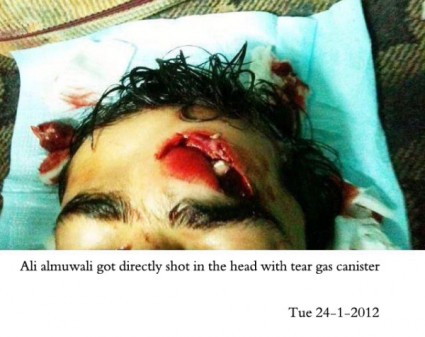
Ali Almuwali from Karanah shot in the head – deliberate misuse of “less-than-lethal” as lethal weapons
Ali almuwali from #Karanah got directly shot in the head with tear gas canister #Bahrain #humanrights #feb14

January 24, 2012 Add Comments
Putting down the call for Democracy in Sitra
January 24, 2012 Add Comments
US relocates Bahrain embassy staff in safety move
US relocates Bahrain embassy staff in safety move
(AFP) – 23 January, 2012
WASHINGTON — The United States said Monday it is relocating embassy staff and their families to new neighborhoods in Bahrain’s capital Manama as part of safety precautions amid anti-government unrest.
Tensions have remained high in Bahrain since a brutal government crackdown on pro-democracy protests in mid-March led to the death of 35 people. Sporadic violence has been on the upturn in recent weeks.
“The recent increase in violent demonstrations along the Budaiya Highway corridor has led to traffic disruptions, effectively restricting travel for those living in the area,” the State Department said in a new travel alert.
“The resulting inability to leave one’s home for an extended period poses significant safety and security concerns,” it said.
“As a result, embassy employees and their dependents are being relocated to different neighborhoods,” according to the alert that supersedes one issued on November 18 last year.
“We continue to urge US citizens to follow the latest security guidance and to avoid demonstrations.”
The State Department found no signs that Americans are being “targeted directly” but cited “isolated examples of anti-US sentiment” taking place on the streets while “US flags have occasionally been burned” during protests. …source
January 24, 2012 Add Comments
US Weapons Against Democracy
US Weapons Against Egypt Protesters
by: Geoffrey Mock, 23 January, 2012 – Human Rights Now
Egyptian protesters help man suffering from tear gas during clashes with riot police in Cairo on November 23, 2011 (Photo MAHMUD HAMS/AFP/Getty Images)
There’s something wrong when on one hand Americans continue to stand up in support for Egyptians’ aspirations for human rights and on the other the US government supplies weapons to the very military regime that is attacking protesters.
And yet, as we approach the first anniversary of the Egyptian Jan. 25 uprising, activists are still facing attacks by military and security forces, and some of the tools the military are using bear the stamp, “Made in the USA.”
Americans in large numbers offered loud and important support to the Egyptian activists in their efforts to build a new political and human rights culture. But that didn’t stop the US government from approving new shipments of weapons.
The most recent shipment for the Egyptian Ministry of Interior arrived from the United States on November 26, carrying at least seven tons of ammunition smoke, which includes chemical irritants and riot control agents such as tear gas.
Since that sale, the Egyptian military has continued to assault peaceful demonstrators. In December, female and opposition activists protesting military violence were attacked, leaving 17 activists dead, most of them reportedly from gunfire.
While US political and diplomatic officials have expressed concern about these actions, the Egyptian military express no regret or concern that they will face any consequences. One high-ranking military official even said that military forces were entitled to use live fire against protesters.
Meanwhile Egyptian activists are left to face the consequences. Egyptian women activists have made public shocking images of soldiers beating and stripping female demonstrators during previous protests. In more recent protests, Egyptian security officials have been documented beating and kicking women activists.
Sales to Egypt are just part of a larger concern that the US is undermining reform hopes throughout the Middle East with arms sales to allies such as Bahrain.
It’s time for a halt. The U.S. State Department must stop authorizing the shipment of weapons, ammunition, and equipment that Egypt’s government could use to violently suppress human rights. …source
January 24, 2012 Add Comments
“Butcher for Hire” – know thy enemy and study their tactics
From Philly to Miami to Bahrain – John Timoney’s Bloody Journey
by DAVID ROVICS – Counter Punch
John Timoney, until recently chief of police of Miami and before that Philadelphia, formerly of New York City, where he also was a high-ranking cop, is heading to Bahrain to train the cops there, according to the Associated Press. If you happen to know anybody from Bahrain who might be thinking that hiring this New Yorker could be a step in the direction of less massacre-oriented policing policies, this might be a good time to relieve them of any such illusions.
John Timoney is a deceitful thug. Here’s the background in a nutshell, for all who might be interested. In 1999 tens of thousands of peaceful protesters shut down the streets of Seattle and more or less shut down the big meeting of the World Trade Organization. Because they were peacefully blocking roads they were violently attacked by thousands of cops with massive amounts of tear gas and other weapons. In another part of town (Nike Town) a couple hundred people destroyed corporate property, were declared to be violent anarchists, and got massive amounts of media attention. The police chased them around but could never seem to catch them. Nobody got hurt in Nike Town other than the violent anarchists.
At every protest against corporate rule after that one, the corporate media went into high gear terrorizing everybody about how violent anarchists from Seattle were coming to destroy the city. Many people started believing this mythology, and it became a good enough pretext for future violent attacks on peaceful protesters after Seattle. It became a good enough pretext for cities like Philadelphia and Miami to hire police chiefs like John Timoney. They hired Timoney because of his reputation as a brutal man willing to get the job done, no matter how many heads had to be cracked open to do it.
In Philadelphia in 2000 the job was to keep the Republican National Convention flowing smoothly, with the protesters kept at bay. In 2003 the job was to keep the Free Trade Area of the Americas talks going along unimpeded. By all accounts the RNC protests in Philadelphia were especially notable because of widespread police brutality — both in the streets and in the jails. In 2003 I was in Miami for the FTAA talks, and what I saw from the time I got there to the time I left was a city under martial law.
John Timoney was the man in charge, and he was telling the people of Miami and his police force that the violent anarchists from Seattle were coming to destroy the city. He took it further, showing his troops artfully-edited video footage that was supposedly of the Seattle protests, where it appeared there were injured or dead police on the ground at the protests (this never happened). These Miami police were scared, and for no reason. Timoney presumably knew they had no reason to be scared, but there was no doubt that many of these cops believed the media lies which Timoney had been exaggerating even more for their benefit.
Every downtown exit was shut down for days, and almost all the stores and restaurants were shuttered, shop owners made to fear riots that would never happen. Massives fences were erected everywhere, and thousands of police everywhere you looked were wearing the most sinister-looking riot gear, many of them weighted down with an array of “non-lethal” weapons of all kinds, along with the lethal ones there for backup.
In one arbitrary moment the protests were declared illegal and within moments thousands of mostly young people were being drenched with tear gas and attacked, many of them in their backs, with bean bag bullets, rubber-coated steel bullets, tazers, and clubs. As people ran into the poor, mostly Black neighborhood near where the conference was taking place, people were helpful, and were also informing them that certain people in their neighborhood had been told by Miami police that they should be encouraged to rob the protesters coming in from out of town — any potential criminals were apparently given free reign to mug for the duration.
Make no mistake, unfortunate people of Bahrain — this man is coming to make everything even worse. But he’ll smile at the cameras glowingly, and tell them how his police are all acting with the utmost restraint and respect for freedom of speech and freedom of assembly. It won’t be true, though.
JT inspired me to verse twice. Here are the songs I wrote in his honor:
“Butcher for Hire” …source
January 23, 2012 Add Comments
Bahrain’s King Hamad Suffocating Himself
The King may brush aside Human Rights Watch, but deputy direct Joe Stork offers a realistic prediction of the future: “Since the crackdown on the protests authorities have violently suppressed peaceful demonstrations and silenced dissident voices through arrests, torture, and job dismissal. But people in Bahrain, and throughout the region, have made it clear that violent suppression isn’t going to make the issues go away. People want their rights.”
Bahrain’s King Hamad Suffocating Himself
The Trench – 23 January, 2012
The complex and often paradoxical nature of warfare is known to flip weakness into strength, and strength into weakness. Any actor, whether conventional or unconventional, must learn to limit or convert its deficiencies into a resource, and protect its strengths from dulling. Comfortably shielded by a thick international bubble, King Hamad bin Isa Al Khalifa now embodies this strategic decay as some of his main advantages becomes liabilities. Not just Manama’s Fifth Fleet, which simultaneously keeps Washington in his pocket and international attention on his island.
After transiting through the nexus of politics and business – complacency is bad for both – the King’s low-intensity response to Bahrain’s uprising is incrementally suffocating his own kingdom.
Every Arab regime threaten by revolution has utilized tear gas to disrupt protesters from moving or gathering en masse. No government, however, relies more extensively on gas canisters than Bahrain’s security apparatus. The King’s small military, limited armaments and use of his police force, combined with the savvy to stay low profile, dictates a non-lethal response of rubber bullets and gas waves. Smoke clouded Manama throughout last week as Al Wefaq, Bahrain’s leading Shia oppositional party, attempted to organize a secession of rallies in the capital. Determined to crush the uprising, the monarchy rejected Al Wefaq’s permit request on the grounds of disrupting traffic and quickly smothered all dissenters.
As they often do, security forces also moved north for a funeral job in Muharraq. Here protesters had gathered to attend the burial of Yousif Muwali, whose body washed up in on January 13th. Al Wefaq alleges that Muwali was being held by police at the time of his death, while the government claims that he suffered from “psychological issues.” The government also rejected a petition to protest at Muwali’s funeral, but even authorized demonstrations require indiscriminate force to scatter. Those protesters who broke for a street outside Muharraq’s graveyard were first confronted with gas and violent force by police (likely foreign) and plain-clothes men. Police later intervened and restored order through more peaceful means.
By this point Yassin Asfour, a 14-year old asthmatic, had died of asphyxiation after being gassed at a separate protest. Several other recent casualties suffered fatal trauma to the head after being struck by gas canisters, a tactic employed in Egypt and Yemen.
So goes daily life in Bahrain, a week after King Hamad articulated a list of reforms during his “keynote” address. His changes to parliament and the constitution fell short of all established oppositional parties, along with street protesters demanding total regime change. Hamad has downplayed the island’s civil strife throughout 11-months of low-intensity conflict, whether blaming Iran for instigating a revolt or denying systematic abuses by the government. His “National Dialogue” and Independent Commission of Inquiry (BICI) took the cosmetic route to reform, a dead end in the Arab revolutionary wave, and the King remains determined to restore “normality” to his kingdom. Royal officials regularly meet with U.S. officials such as CENTCOM commander James Mattis and Ambassador Thomas Krajiski, resulting in official state propaganda.
“During the meeting, the Minister welcomed the US ambassador and reviewed with him existing bilateral military cooperation relations between the Kingdom of Bahrain and the friendly United States of America in addition to discussion of a number of issues of mutual concern.” …more
January 23, 2012 Add Comments
Interpol faces legal threat for helping oppressive regimes hunt dissidents
Interpol faces legal threat for helping oppressive regimes hunt dissidents
By Ian Johnston – msnbc.com – 23 Janaury, 2012
Interpol has issued a “red notice”, above, for Benny Wenda, a tribal leader who campaigns for independence for the West Papua region from Indonesia. Wenda has been granted asylum in the U.K. on political grounds, according to Fair Trials International.
By Ian Johnston, msnbc.com
LONDON — A landmark lawsuit alleging that dictatorships and other oppressive regimes are using Interpol’s alert system to harass or detain political dissidents is being planned by rights activists and lawyers.
Campaigners allege that rogue states have fabricated criminal charges against opposition activists who have been given refuge in other countries and then sought their arrest by obtaining “red notices” from the global police body.
There are currently about 26,000 outstanding red notices. While they are only designed to alert other nations’ police forces that an Interpol member state has issued an arrest warrant, some countries will take suspects into custody based on the red notice alone.
In one case, Rasoul Mazrae, an Iranian political activist recognized by the United Nations as a refugee, was arrested in Syria in 2006 as he tried to flee to Norway after a red notice was issued.
Mazrae was deported back to Iran, where he was tortured, according to a report by Libby Lewis, of the International Consortium of Investigative Journalists. He was later jailed for 15 years, Amnesty International says.
‘Torturers and murderers’
In one of the latest cases, a red notice has been issued for Benny Wenda, a tribal leader who campaigns for independence for the West Papua region from Indonesia. He was granted asylum in the U.K. after claiming he had been tortured and prosecuted for inciting people to attack a police station. Wenda says he was in a different country at the time of the incident.
Mark Stephens, a leading British human rights lawyer, told msnbc.com that the red notice system can allow Interpol to unwittingly become “an aider and abettor of torturers and murderers in oppressive regimes.”
Amid mounting anger within the legal community, the U.K.-based rights campaign group Fair Trials International is now seeking people who allege their red notices are politically motivated to take part in a class action lawsuit against Interpol.
If successful, the case would potentially make France-based Interpol subject to the rulings of a court for the first time.
That would have implications not just for political dissidents, but could also create an extra legal hurdle for any country seeking to extradite alleged terrorists, murderers, international fraudsters, and other criminals based in another country.
Jago Russell, the chief executive of Fair Trials International, highlighted that Interpol’s 190 member states include “countries that routinely abuse their criminal justice systems to persecute individuals.”
Despite this, there is no independent court where someone can challenge a notice and “no remedy for the damage that notices can cause,” he said.
Iran, Syria, Myanmar, Sudan, Belarus and Zimbabwe — all widely condemned for human rights abuses by their governments — are members of Interpol and each country currently has red notices listed on its website.
“Powerful international organizations with the ability to ruin lives have to be accountable for their actions,” Russell wrote in an email.
“Interpol’s own credibility relies on proper accountability mechanisms to weed out cases of abuse, but if Interpol refuses to put its own house in order it could ultimately be up to the courts to step in and demand action,” he added.
There have been legal challenges to Interpol’s decisions heard in some countries’ courts in the past, but these have failed “to hold the organization to account,” Russell wrote.
Russell hopes that a court with jurisdiction over a number of countries, such as the European Court of Human Rights, will take a different view.
“This would no doubt be a long, hard process but with thousands of people affected by red notices every year and, with the rule of law at stake, it would be worth the fight,” he said.
Political persecution
Fair Trials International is currently highlighting Wenda’s case in particular and trying to help get his red notice removed.
He escaped from prison before being sentenced and fled Indonesia in 2002. Wenda traveled to the U.K., where he was granted asylum due to Indonesia’s persecution of him on political grounds, according to Fair Trials International.
Wenda then renewed his campaign, meeting politicians and others as he traveled the world. He also has a website highlighting the West Papuan cause. …more
January 23, 2012 Add Comments
Awaking the Conscience of US-UK Weapons Sales to the Despicable Tyrants of Saudi Arabia
David Cameron’s visit to Saudi Arabia to sell British armaments was a slap in the face for protesters who are demanding human rights and more of a say in their country’s affairs and facing brutal repression from the regime.
Who cares about human rights in Saudi Arabia when there’s billions to be made selling arms?
By Toby Matthiesen – The Guardian – 22 January 2012
David Cameron, trying to flog Typhoon Eurofighters to the Saudis, meets the ultraconservative Prince Nayef bin Abdul Aziz al-Saud.
As the British prime minister, David Cameron, visited Riyadh in mid-January, wooing Saudi business and strengthening bilateral relations, a young Shia man in the eastern province was shot dead.
Following the kingdom’s huge arms deal with the United States, Cameron apparently wanted to persuade the Saudis to buy Typhoon Eurofighters. His visit was a slap in the face for protesters, who are demanding human rights and more of a say in their country’s affairs.
In the week beginning 16 January thousands of people – activists say tens of thousands – took to the streets of Awwamiya in the eastern province to commemorate the death of Issam Muhammad Abu Abdallah, aged 22. He had been shot by Saudi security forces on the night of 12 January.
According to the interior ministry, the security forces were defending themselves after a police car had been attacked. Activists and local Shia news websites acknowledge that the police were attacked, but argue that the police used force indiscriminately. Issam’s funeral turned into a large rally at which emotions ran high and anti-government slogans were chanted.
These events are just the latest episodes in one of the Middle East’s most under-reported conflicts. Last year, Shia citizens in the eastern province took to the streets just days after the uprising started in neighbouring Bahrain on 14 February. Their protests were largely peaceful and they were hoping that Saudis in other areas would join them on a planned “day of rage” in March.
This day passed without major demonstrations, even in Shia areas, as the Shia protesters had allegedly been told their grievances would be addressed if they stayed at home. Those promises were never fulfilled, however, and the state chose to arrest the leaders of the demonstrations over the summer, further inflaming the situation.
Instead of using such repression, the regime should have addressed the grievances of the protesters, including the release of political prisoners. The Saudi Shia minority, mainly located in the eastern province, has long complained of discrimination in government employment and business, as well as restriction of religious practices. Initially, the protesters were not calling for the downfall of the monarchy but as repression intensified (demonstrations are illegal in Saudi Arabia) some did and also started attacking the security forces.
In October, shootings were reported between security forces and armed men outside a police station in Awwamiya. The town, which has for decades been a hotspot of Shia opposition, has since been in a virtual state of lockdown, and now seems to have started an uprising – the “intifada of dignity”, as activists have called it. …more
January 23, 2012 Add Comments