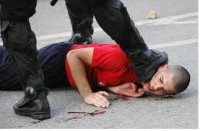
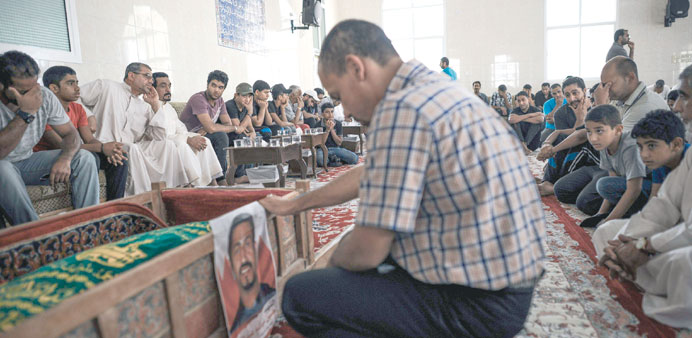
Leg injury from lethal round fired during Security Force attack on young Ahmed al-Jaber funeral

October 13, 2011 Add Comments
Head injury from misused riot control gernade during Security Force attack on young Ahmed al-Jaber funeral

October 13, 2011 Add Comments
Face and “cheek bone” injury, result of Security Forces attack on young Ahmed al-Jaber funeral

October 13, 2011 Add Comments
Eye injury, result of attack on young Ahmed al-Jaber funeral

October 13, 2011 Add Comments
Appeal from Hassan Mushaima’s family for his release and treatment of Cancer – Hassan is sick and an imprisoned leader of Haq movement
This is an urgent appeal for the life of Hassan Mushaima, 63 year old president of Haq movement, sentenced to lifetime imprisonment. Mushaima had recently been treated for cancer, and his family now tell us the doctor at the military hospital has told Mushaima that his cancer is back. Please find below the appeal sent from his family.
As received from Hassan Mushaima’s family:
1. He was arrested two days after the entry of the Saudi army to Bahrain 16/03/2011 after raiding his house by masked armed men and taken him to an unknown place.
2. Later we discovered that he was taken to a prison near “Sheikh Issa” base, and the rest of the prominent political leaders.
3. Subjected to severe torture and was placed in front of air conditioner and he sprayed with cold water; beaten from time to time that his body was trembling in the first session of the Court
4. He was taken to hospital blindfolded and his head was covered; he was given medicine but did not know what it contains. The doctor responsible for that didn’t know what it as well. Mushaima did not see anyone and did not even recognize the place, to which he was taken.
5. In the court session where he was sentenced with life imprisonment, the security forces were beating him and kicking with their shoes and wipe it in his mouth as a kind of humiliation in front of the rest of the political leaders who were subjected to torture as well.
6. He was taken as the first time to the same place with the same way, as he was blindfolded and injected again. After tests were conducted to him, his physician supervisor (who did not see him and does not know even his name) that Mushaima still has cancer. This is contradicting what was confirmed by a doctor, Professor, “Cunningham” who oversaw treatment in the hospital, “Royal Marzdn” in London to get rid of the entire tumor, which was widespread in different parts of his body. The diagnosis by the Professor was that the treatment should take the place for two years taking protection dose every two months so cancer cells do not get active again in the future, but that it had been treated.
7. As his family, We asked and through the lawyer several times to give us the results of tests conducted to him at the prison, but the military court rejected that.
8. When Mr. Bassiouni met the Hassan and the rest of the leaders in the prison, he promised to provide the family with the results of the examinations and follow up through his committee, but we did not get anything.
9. About two weeks ago, he was taken for the third time with the same way blindfolded and given third dose.
10. Two issues are dangerous and serious:
The first is that the doctor who is giving him a dose from inside the prison said that the cancer is in the body. But, Mushaima on his return to Bahrain was cured and got rid of the entire tumor. He was given doses in London, preventive rather than remedial, which is considered to be the second phase of treatment.
Second: the nature of the disease has no virtual impact and the patient can exercise his life naturally without feeling anything. But after the spread of the tumor, the patient’s life is at risk and it can be almost impossible to treat the patient if the aggravation of the tumor and the situation worsened. Therefore, as the disease returned to the Mr. without explaining its size or causes, without the provision of appropriate treatment, with poor prison conditions and harsh treatment is a try to kill him slowly.”
Brief detention of journalist: Mazen Mahdi: “I was covering the protest following funeral march when anti-riot police stopped me while they were storming the area. They detained me on-location and the bright minds thought that “press” on my vest meant “press tv”. Their idea of detention is a choke-hold and verbal threats .. The initial arrest was carried out by a unit of 8 or so men. A second unit joined them as they lead me away and despite identifying me as a press with Ministry of Interior press card they still detained me. A third unit in cars also joined “the great catch” and after the show of force Ministry of Interior control told them to release me on radio. The officer leading the cars unit words “next time neither Ministry of Interior press card, your agency card, embassy, Bush or Obama will stop us”. I did inform the Ministry of Interior of incident and all that was described as an “individual action” I guess the unit is seen as one. As “individual act” on my side I reported them to my offices considering it is not even 5 months since they had me guest at police stations. I was told 2 report my whereabouts during coverage As far as I know China, North Korea, Cuba, Irand and Saudi are only ones with such requirements.”
October 13, 2011 Add Comments
Date set for Bahrain execution decision
Date set for Bahrain execution decision
Bahrain Date: 11 October 2011 – Amnesty International
URGENT ACTION
date set for bahrain execution decision
The final judicial decision on whether the death sentences of two Bahraini men will be upheld will be heard on 24 October. If their death sentences are upheld, the two men will be executed unless the King grants them clemency.
On 22 May, the National Safety Court of Appeal, a military court, upheld the death sentences imposed on ‘Ali ‘Abdullah Hassan al-Sankis and ‘Abdulaziz ‘Abdulridha Ibrahim Hussain. The two men had been sentenced to death on 28 April, along with three other men whose sentences were commuted on 22 May. They were accused of killing two policemen during anti-government protests in March in Bahrain.
The case of the two men was referred to Bahrain’s Court of Cassation on appeal. The Court of Cassation’s verdict is scheduled for 24 October. If the sentences are upheld by the Court of Cassation, and then ratified by the King, the two men will be executed.
The two men were originally tried and sentenced by the National Safety Court of First Instance. Like the National Safety Court of Appeal, this is a military court comprising three judges – one military and two civilian. Amnesty International considers military courts inappropriate for trying civilians and that such trials directly infringe international standards of fair trial.
Please write immediately in Arabic or English:
Acknowledge the Bahraini government’s responsibility to protect the public and bring to justice those responsible for committing crimes, however this should always be done in accordance with international law and fair trial standards and Bahrain’s international human rights obligations;
Urge the King to immediately extend clemency to the two defendants and commute the death sentences imposed on them if the death sentences are confirmed by the Court of Cassation, and order their re-trial before ordinary criminal courts.
PLEASE SEND APPEALS BEFORE 23 NOVEMBER 2011 TO:
King Shaikh Hamad bin ‘Issa Al Khalifa
Office of His Majesty the King
P.O. Box 555
Rifa’a Palace, Manama, Bahrain
Fax: +973 1766 4587
Salutation: Your Majesty
Minister of Justice and Islamic Affairs
Shaikh Khaled bin Ali Al Khalifa
Ministry of Justice and Islamic Affairs
P. O. Box 450, Manama, Bahrain
Fax: +973 17531284
Salutation: Your Excellency
October 13, 2011 Add Comments
The Manama Paper – Bahrain’s road to freedom and democracy
Manama Document (English)
Published: October 13, 2011
Bahrain’s road to freedom and democracy
A joint document by opposition political societies
In the name of God
Bahrain’s reality
The reality in Bahrain is no different from any non-democratic state, a copy of Tunisia’s Ben Ali a, Egypt’s Mubarak, and Yemen’s Saleh. Lack of democracy is evidenced by absence of popular will in formation of the government, confiscation of popular resolve in legislation, and a deficient judiciary. Recent verdicts issued by the judicial system have received widespread condemnation, described by Navy Pillay, UN High Commissioner for Human Rights as political prosecution and depicted by Amnesty International as travesty of justice.
Accordingly, this unfortunate reality has produced an unelected prime minister for some 40 years, making him of the longest serving premiers, a police state as well as confiscation of natural rights of the people, in turn guaranteed by the constitution, National Action Charter and international conventions. Other shortcomings include restrictions placed on movements of opposition figures from all ideologies plus denying a large section of the population from employment opportunities in security apparatus in a clear display of discriminatory practices.
Additionally, absence of principles of elected government together with accountability has placed limits on the authorities can achieve such as failing to diversify sources of income, with the petroleum sector accounting for 80 per cent of treasury income. Other governmental inadequacies include presence of an acute housing problem, with 54000 outstanding requests, thus affecting some 270,000 nationals or nearly half of local citizens.
Likewise, the government has failed in completing essential infrastructure, with some villages still suffering from improper roads besides disruption of electricity services during the long summer months. Sadly, all these shortfalls are occurring in a country where was oil discovered in it in 1932, ahead of many regional countries.
Furthermore, education continues to suffer, as evidenced by congested classes, with number of students increasing from 25 per class in 1984 to 35 per class in 2010. With regards to health, the country largely depends on a single hospital, namely Salmaniya Medical Complex, in turn constructed in early 1960s. Yet, financial and administrative corruption has delayed commissioning of a planned hospital for some 20 years.
In reality, sustained financial and administrative corruption practices have undermined normal governmental functioning and hence on services extended to the citizens. Also, this sad state has caused loss of investment potentials from local and foreign sources. Not surprisingly, regional rivals of Dubai and Qatar continue to make headway at the expense of Bahrain.
In the presence of an unelected government under statesmanship of a single person for 40 years, some 80 per cent of public land ended being controlled by senior members from the royal family and other influential figures. Consequently, this has placed constraints on availability of lands for the purposes of developing projects for housing, municipality, education and health facilities.
Still, the country suffers from an acute poor distribution of wealth and widespread poverty notwithstanding Bahrain being an oil exporting nation, exporting some 200,000 barrels per day. Wrong policies like extending citizenship to foreign nationals have further undermined distribution of wealth in the country.
Against a backdrop of political dictatorship, economic failure and social confusion of government policies, people of Bahrain had pressed for change. Popular demands date back to 1923 with calls made for participation in decision making and 1938 for having an elected assembly with full legislator and regulatory powers. In reality, popular uprisings kept reemerging almost like those of 1954, 1965 and still 1994-2000, the largest of its kind at the time. Thus, there were the revolts of 1954 plus that of March 1965 as well as that of 1994-2000.
Still, affected primarily by events in Tunisia and Egypt as part of Arab Spring, nearly half of Bahrain’s people took to the streets in early 2011 pressing for democracy, respect of human rights and sustained human development. Yet, the demands call for retaining the royal family in terms of ruling and governing without powers, as a true constitutional monarchy.
In short, Bahrain is undergoing rivalry between two camps, one demanding democracy, comprising of people of all walks of life and diverse ideologies with another struggling to maintain the status quo despite need for addressing political, economic and social challenges.
Primary demands of Bahraini people
The majority of people and mainstream opposition groups desire to see burgeoning of democracy whilst maintaining the monarchy under the slogan of “people want reform of the system.” Proceeding upon the seven principles spelled out by the country’s crown prince on 13 March 2011, demands of the people can be summed up as follows:
1) An elected government representing will of the people rather than an appointed government. Through their elected representative, people can cast vote of confidence to the prime minister, other ministers prior to assuming their jobs and have the means to withdraw granted confidence should they fail in their duties.
2) Fair electoral districts guaranteeing political equality amongst the people and meeting the universal principle of one person, one vote. At the moment, the current 40-member electoral system is malfunctioning by virtue of dividing the country along sectarian lines, and producing a chamber comprising of loyalists of the regime. In realty, each of number one district in northern and central governances plus number nine district in the northern governance, boasts some 16,000 voters. Conversely, the same numbers of voters in the southern governorate, known for being a loyalist to the regime, can equally elect 6 representatives.
Concurrently, a call is made for establishing an independent commission for administering the election process rather than being dominated by the state through justice ministry and statistical agency.
3) A parliament comprising of a single chamber having sole legislative and regulatory powers, replacing the current bi-cameral arrangement, one elected and the other appointed.
4) A trustworthy judicial system independent from the executive branch both financially and administratively. The judicial system must act in transparent ways and serve as an impartial entity and show willingness to look on all cases including possible assaults carried out by members of security forces.
5) Security for all via participation of all walks of life in the country in formation of the army and other security apparatus on the basis of providing security for all, and trained to show respect for human rights at all times, rather than serving wishes of the government in suppressing the opposition.
These demanded reforms stipulate setting up a new constitutional formula, in turn requiring approval of the majority of people via either an elected constituent assembly or a popular referendum. In retrospect, the crown prince has embraced the notion of the referendum whilst announcing his 7 principles on 13 March 2011.
Concurrently, three critical issues must be addressed in parallel with the mentioned political reforms, namely
1) Political naturalization: This can be addressed through setting up a committee mandated to study cases of granted citizenship over the last 20 years, sorting out granting passports via questionable means and correcting wrong cases in the context of human rights.
2) Discrimination: It is vital to do away with all sorts of discriminatory practices on any basis whilst addressing consequences resulting from this wrong policy.
3) Official media: Agreeing on a new media policy encompassing views of all nationals.
Adopted methods
In pursuit of democracy, opposition forces intend to fully and solely embrace peaceful measures, as follows:
1) Popular movement: Engaging in peaceful rallies, marches and sit-ins as guaranteed by international conventions notably the Universal Declaration of Human Rights.
2) Media sources: Making use of traditional and modern media means, inside and outside Bahrain.
3) Political activities: Keeping channels of communications open for all those interested in reforming the system as well as reaching out to governments and associations across the globe.
4) Human rights issues: Recording all major human rights violations and communicating them with concerned international organisations in the hope of stopping such wrong practices.
Opposition forces are determined to attain their just demands via adoption of peaceful measures and rejection of tyranny.
Bahrain of the future
Undoubtedly, Bahrain is an Arab and a Muslim. And in of attaining the desired popular demands in pursuit of democracy, then the opposition intends to ensure the following:
* Developing full democracy by allowing formation of political parties, strengthening civil society, ensuring respect for human rights, opening up horizons for freedom of expression and assembly and strengthening of personal freedom
* Maintaining interests of all sides in Bahrain in an environment of no tolerance for discriminatory practices of all types, be they racial, religious, sectarian or political
* Exerting efforts for stopping all types of violations pertaining to immigrant workers and improving working and living conditions of non-nationals
* Strengthening ties with members of the Gulf Cooperation Council, Arab League and Organisation of Islamic Conference
* Pressing for strong ties with democratic and friendly countries, as stipulated in international conventions
* Developing the economic environment based on market economy and enticing local and foreign investments whilst ensuring sustained competitiveness and transparency
Road to solution
Undoubtedly, the wrong practices of threatening people demanding reforms and democracy could not success. Hence, the only forward is that of a dialogue between the authorities and opposition forces for the goal of achieving democracy, based on the seven principles outlined by the crown prince on 13 March 2011. Amongst others, the principles press for a government representing will of the people, an elected parliament with comprehensive powers and fair electoral districts. Still, the dialogue should take place with international guarantees.
Outcome of the dialogue should lead to a new constitutional framework resulting from approval of the majority via a constituent assembly, in turn the best possible option, or a referendum, as put forward by the crown prince on 13 March 2011. When calling for dialogue with the authorities, the opposition has not called for exclusion of any party and has no intention of monopoly of views.
For the sake of democracy
1) The international community is looked up to encourage reforms and moderates in the system and concurrently to exclude the extremists. Also, the international community would need to provide political and economic support during the transition to democracy whilst blocking whilst undermining those seeking to bock proliferation of democracy in the country.
2) Whilst welcomed, international condemnation of human rights violation in Bahrain is certainly not sufficient. Sadly, Bahrain remains a police state.
3) Support for democracy in Bahrain should encourage development of democracy elsewhere in the region and beyond.
4) Support for democracy in Bahrain should serve the benefits of all people of all walks of life in Bahrain.
Al-Wefaq National Islamic Society
National Democratic Action Society (Waad)
Nationalist Democratic Assembly
National Democratic Assemblage
Al-Ekha National Society
Manama, Bahrain, 12 October 2011
October 13, 2011 Add Comments
From underware bombers to used car salesmen, “sophiscated terror plots” always marked by low IQ, easily manipulated, importance seeking, alcohol-substance abusers – USG predictable pattern of “playing the patsy” to terrorise public emerges
Unlikely Turn for a Suspect in a Terror Plot
By ROBERT F. WORTH and LAURA TILLMAN – Published: October 12, 2011 – NYT
But Mansour J. Arbabsiar, 56, the man at the center of an alleged Iranian plot to kill a Saudi diplomat in Washington, seems to have been more a stumbling opportunist than a calculating killer. Over the 30-odd years he lived in Texas, he left a string of failed businesses and angry creditors in his wake, and an embittered ex-wife who sought a protective order against him. He was perennially disheveled, friends and acquaintances said, and hopelessly disorganized.
Mr. Arbabsiar, now in custody in New York, stands accused by federal prosecutors of running a global terrorist plot that stretched from Mexico to Tehran, and that was directed by the Quds Force of Iran’s Revolutionary Guards. Many of his old friends and associates in Texas seemed stunned at the news, not merely because he was not a zealot, but because he seemed too incompetent to pull it off.
“His socks would not match,” said Tom Hosseini, a former college roommate and friend. “He was always losing his keys and his cellphone. He was not capable of carrying out this plan.”
On Wednesday, American officials, who say the plot was endorsed by top Iranian authorities, were exploring why the sophisticated Quds Force might have chosen to rely on so amateurish an agent as Mr. Arbabsiar. …more
October 13, 2011 Add Comments
Bahrain opposition unites to decry “police state”
Bahrain opposition unites to decry “police state”
By Andrew Hammond – Reuters –October 13, 2011
DUBAI (Reuters) – In a defiant show of unity, Bahrain opposition parties have jointly denounced the Sunni-ruled Gulf Arab island as a police state and demanded a transition to a constitutional monarchy.
Five groups, including the main Shi’ite party Wefaq and the secular Waad party, vowed to keep up a pro-democracy campaign with peaceful rallies and marches — despite a Saudi-backed government crackdown that crushed similar protests in March.
In their “Manama Document,” the first such joint statement since the unrest, the opposition groups said Bahrain was a police state akin to those that prevailed in Egypt and Tunisia before popular uprisings swept their leaders from power.
The document, issued on Wednesday, said the ruling Al Khalifa family’s role should be to “govern without powers” in a constitutional monarchy, drawing attacks from pro-government media which described as a power grab by majority Shi’ites.
Unrest still roils Bahrain months after the ruling family brought in troops from Sunni allies Saudi Arabia and the United Arab Emirates to help crush a protest movement they said was fomented by Iran and had Shi’ite sectarian motives.
The government says nightly clashes between police and Shi’ite villagers and other forms of civil disobedience are hurting the economy of the banking and tourism hub. Many firms have relocated elsewhere in the Gulf.
A military court has convicted 21 opposition figures, human rights campaigners and online activists who led the protests of trying to overthrow the ruling system. Eight received life sentences, including Waad leader Ibrahim Sharif, a Sunni.
“In pursuit of democracy, opposition forces intend to fully and solely embrace peaceful measures,” the Manama Document said, calling for a direct dialogue between the government and opposition, backed by unspecified international guarantees. …more
October 13, 2011 Add Comments
State thuggery, assault and detention
Bahrain Special: Zainab Omran Tells Her Story of Detention at City Center Mall
October 7, 2011 – by AuthorScott Lucas – EA WorldView
Zainab Omran was one of 45 women detained at City Center Mall on 23 September as marchers tried to reach Pearl Roundabout, the symbolic centre of the protests against the Bahraini regime. This is the first part of her story:
We went out on Friday, Sept. 23. We did not know, “Where do we go?” We wanted to join any march to have a voice in the event.
One of my sisters suggested that we approach the City Centre becuase the route was still open and we arrived there at 2:30 pm.
We went up having only our phones in our hands and we sat waiting. Glimpsing the faces of many protesters, we exchanged smiles and greetings from a distance.
At exactly three o’clock we met and we agreed to get out of each group separately so as not to draw attention to us. I was communicating with one of the news pages and it told me they would be at the taxi gate.
We went to that point and we had parted from the rest of the groups when we got there. There were many foreigners, we were talking with foreigners and introducing them to the situation in Bahrain: we said it was not safe, as there are many dead, but we are willing to go out in a peaceful demonstration and that we will be immediately suppressed.
In the meantime, there was a tremendous amount of informers near us. And they knew from our faces that we areintending to demonstrate. Someone was watching us and brought a Bahrain TV cameraman in a bus to picture us. We saw him and screamed at him. Then one of the television broadcasters, along with a cameraman came to us. My uncle’s wife told him that he must record live to show the world that the situation in Bahrain is not safe.
And then the young people at 3:30 started to say, “Oh mighty God” and “Pray on the soul of Prophet Mohammed”. We also started to say this. Because were in the middle of foreigners, we weren’t suppressed but once we moved further away from them, we were at risk. My friend couldn’t breathe so we went to the ground floor of the parking lot [at City Centre Mall] to rest. When mercenaries arrived, the only way out was to climb of the ladder and enter the Mall compound.
as soon as we entered we saw an abnormal situation. People were screaming and people began moving toward the event and we joined the march. We were going all over the ground floor and Al-Khalifa [regime] supporters were on the second floor and third. They were throwing bottles of water on us, spitting, and shouting “People want Khalifa bin Salman”. We continued, ignoring their presence. …more
October 13, 2011 Add Comments
Urgent Appeal: Women And Girls Detained In Bahrain – A Royal Shame
Urgent Appeal: Women And Girls Detained In Bahrain
11 Oct 2011 – Amnesty International – BCHR
Sixteen women and four girls, detained on 23 September,are being tried on charges which include ‘illegal gathering’, and “incitement to hatred of the regime”. Some claim they have
been tortured in detention and their lawyers have not been allowed to visit them. They maybe prisoners of conscience if convicted.
On 23 September Bahraini security forces arrested 38 women and seven girls in a city center mall in Manama. They were preparing to take part in a protest march that was heading for the GCC Roundabout (formerly Pearl Roundabout).
The women and girls were arrested without arrest warrants and interrogated without the presence of lawyers. Some of them allege that they were tortured or otherwise ill-treated during interrogation. Most of the group was released, but 16 women and four girls were formally charged. The charges include illegal gathering, incitement to hatred of the regime and assaulting security officers. Two of the women have been released on bail and 14 remain in prison in ‘Issa Town, south of Manama. The four girls were released on bail.
The trials of all 16 women and four girls began on 3 October before a lower criminal court and a juvenile court respectively. A second session followed on 6 October, and a third on 10 October. The defendants were only allowed to meet their lawyers in court. Their lawyers have requested to visit them in prison but have received no answer. A lawyer told Amnesty International that several requests to bring defense witnesses to the court had been rejected.
Amnesty International is not aware of any evidence that the accused used or advocated violence. They may all be prisoners of conscience if convicted solely on the basis of the legitimate exercise of their rights to freedom of expression, association and assembly. As such Amnesty International would call for their immediate and unconditional release. …more
October 13, 2011 Add Comments
Students Under Attack in Bahrain – A Royal Shame
The chronicle: Bahrain Cracks Down on Student Protesters With Harsh Sentences
October 10, 2011 – By Ursula Lindsey – BCHR
Cairo – When protesters took to the streets of Bahrain eight months ago, they hoped to bring the Arab Spring to the small Persian Gulf island kingdom, and to end what they described as decades of discrimination by the ruling Sunni minority against the Shiite majority. But the repression that followed has dashed hopes for peaceful reform.
The crackdown has had “a chilling effect” on university campuses, says Joe Stork, deputy director of Human Rights Watch’s Middle East and North Africa division. Shiite students and professors told The Chronicle that discrimination against them is now “wide open” and described an atmosphere of fear, suspicion, and intimidation.
On October 3, six university students were sentenced to 15-year jail terms and another student to an 18-year term by a special military court. They were accused of attempted murder, arson, and vandalism in connection with clashes that took place on the campus of the University of Bahrain, the main national university, on March 13. The students and their supporters say the violence that day was carried out by Bahrain security forces and government supporters, none of whom have been charged.
Other students and professors are facing charges of illegal assembly, incitement, and disturbing the peace. At least 100 professors and university administrators have been fired, and about 60 students have been denied the right to continue their studies.
The court cases, dismissals, and expulsions are “part of a campaign against all antigovernment and pro-democracy protesters,” says a member of the Bahrain Center for Human Rights, a prominent local group that the government dissolved in 2004 but whose members continue to work anonymously online. “The movement hasn’t stopped yet. Although they were attacked, detained, tortured, although students were suspended, still they demanded their right. The government is trying to silence them and pressure them.”
Starting on February 14, Bahrain witnessed protests modeled on those that had toppled regimes in Tunisia and Egypt. Bahrain’s majority Shiite population began a large peaceful sit-in at a central square known as the Pearl Roundabout, demanding more democratic governance and social justice from the small island kingdom’s Sunni ruling family.
But the authorities accused the protesters of wanting to overthrow the government and of being agents of Iran. In March, they called in troops from Saudi Arabia and the United Arab Emirates (fellow Sunni monarchies), opened fire on protesters, razed the prominent monument that gave Pearl Roundabout its name, and declared a state of emergency. Since then, a wide-scale campaign of arrests, trials and dismissals has singled out not only professors and students, but also thousands of public-sector employees, doctors, and teachers.
According to a recent Human Rights Watch report, masked security forces have arrested professors in nighttime raids at their homes and have beaten and threatened students during interrogations.
Masaud Jahromi, a professor arrested in April and held incommunicado for a month, will go to trial on October 12 on charges of “attending an illegal gathering.”
Bahraini scholars have been dismissed for crimes such as “forwarding e-mails defaming Bahrain” or “criticizing the government in front of non-Bahraini professors.”
“All the dismissed are Shias. Ninty-nine-point-nine percent of those jailed were Shias. There’s no way you can say it’s not discrimination against Shias,” says a professor fired from the University of Bahrain, who spoke to The Chronicle on condition of anonymity.
Summoned before a committee of “pro-government faculty members” the professor says he was shown photographs of himself in a protest march. When he hesitated to confirm his presence, he was told by the investigating committee that the questioning could be continued at the Ministry of Interior. He remains concerned that he might face further interrogations or a trial, like some of his colleagues. …more
October 13, 2011 Add Comments
US Senators weigh in on Bahrain
Casey to Secretary Clinton: Delay Arms Sale to Bahrain
Wednesday, October 12, 2011
WASHINGTON, DC – U.S. Senator Bob Casey (D-PA), Chairman of the Senate Foreign Relations Subcommittee on Near Eastern and South and Central Asian Affairs, today led a group of Senators urging Secretary of State Hillary Clinton to delay a proposed arms sale to Bahrain in light of the country’s ongoing repression of peaceful demonstrations.
“Completing an arms sale to Bahrain under the current circumstances would weaken U.S. credibility at a critical time of democratic transition in the Middle East,” the Senators wrote in a letter to Secretary Clinton. “We urge you to send a strong signal that the United States does not condone the repression of peaceful demonstrators by delaying the possible arms sale until the Bahraini government releases its political prisoners, addresses the independent commission’s recommendations, and enters into meaningful dialogue with Bahraini civil society and opposition groups.”
Senator Casey was joined in sending the letter by Senators Richard Durbin (D-IL), Benjamin Cardin (D-MD), Robert Menendez (D-NJ) and Ron Wyden (D-OR).
The full text of the letter is below.
Dear Secretary Clinton:
We are writing to urge the administration to delay its proposed arms sale to Bahrain in light of the country’s ongoing repression of peaceful demonstrations.
We recognize the administration’s commitment to the United States’ strategic relationship with Bahrain, which has been an important feature of our national security strategy in the Middle East for many years. However, the Bahraini government’s repressive treatment of peaceful protestors during the past several months is unacceptable. The United States must make it clear to the government of Bahrain that its ongoing human rights violations and unwillingness to acknowledge legitimate demands for reform have a negative impact on its relationship with the United States.
Since February, the people of Bahrain have used peaceful means to demand democratic reforms and protection for human rights – fundamental values shared by the United States. The Bahraini government’s brutal response, including the use of torture, is inexcusable. According to Human Rights Watch, 34 people have been killed, 1,400 have been arrested, and 3,600 have been dismissed from their jobs for anti-government activities. In a country with a population of only 525,000, this represents a systematic effort to intimidate and punish those who promote democratic reform.
In May, President Obama criticized the mass arrests and brute force used to subdue protestors, and urged the Bahraini government to engage in meaningful dialogue with the opposition. While the independent commission charged with investigating the protests and ensuing events was a positive development, we have yet to see the results of the investigation or whether its recommendations will be acted upon. We were also encouraged to see that Bahraini judicial authorities nullified the prison terms of Bahraini medical professionals, some of whom have been sentenced to 15 years in prison for simply attending to injured protestors. We question the need for further legal proceedings against these individuals, but expect that they should be conducted in a fair, impartial and transparent manner. In addition, we remain deeply concerned about the treatment of countless other Bahrainis who have been detained through the special security courts.
Completing an arms sale to Bahrain under the current circumstances would weaken U.S. credibility at a critical time of democratic transition in the Middle East. We urge you to send a strong signal that the United States does not condone the repression of peaceful demonstrators by delaying the possible arms sale until the Bahraini government releases its political prisoners, addresses the independent commission’s recommendations, and enters into meaningful dialogue with Bahraini civil society and opposition groups.
We look forward to continuing a dialogue on encouraging peaceful political transitions at this historic moment in that region of the world.
Sincerely,
Senator Robert P. Casey, Jr.
…source
Senator Richard Durbin
Senator Benjamin Cardin
Senator Robert Menendez
Senator Ron Wyden
October 13, 2011 Add Comments
Senators stand up to be counted with those who cannot tolerate al Khalifa regime brutality in Bahrain
5 Senate Democrats ask Clinton to delay arms sales to Bahrain, cite human rights violations
By Associated Press – October 12, 4:10 PM – Washington Post
WASHINGTON — Five Democratic senators are asking Secretary of State Hillary Rodham Clinton to delay $53 million in arms sales to violence-wracked Bahrain.
In a letter Wednesday, the lawmakers criticized Bahrain’s human rights violations and resistance to calls for reform. They said completing the sale would weaken U.S. credibility amid democratic transitions in the Middle East.
At least 35 people have died since Bahrain’s Shiite-led majority began protests in February seeking greater rights from the ruling Sunni monarchy in the strategic nation, which is home to the U.S. Navy’s 5th Fleet.
Signing the letter were Sens. Bob Casey of Pennsylvania, Ben Cardin of Maryland, Ron Wyden of Oregon, Dick Durbin of Illinois and Bob Menendez of New Jersey. Wyden and Rep. Jim McGovern of Massachusetts have introduced a resolution blocking the sale.
Copyright 2011 The Associated Press. All rights reserved. This material may not be published, broadcast, rewritten or redistributed. …source
October 12, 2011 Add Comments
al Khalifa makes sure house of Saud has “extra bed” for retreat after the Revolution’s New Elected Government Takes Power
HRH Premier hails strong Bahraini-Saudi relations
12/10/2011 – BNA
Manama, Oct. 12 (BNA)—His Royal Highness Prime Minister Prince Khalifa bin Salman Al Khalifa described the Bahraini-Saudi relations as unparalleled due to their specificity and unique nature.
He hailed strong ties binding both countries thanks to the leaderships’ keenness to further cement them throughout history.
Speaking at a meeting today with Saudi President General of the Youth Welfare and President of the Saudi Olympic Committee Prince Nawaf bin Faisal bin Fahad bin Abdulaziz, HRH the Prime Minister lauded the outstanding role of Saudi Arabia, under the leadership of Custodian of the Two Holy Mosques King Abdullah bin Abdulaziz Al Saud, in serving Arab and Islamic issues as well as its strong influence in international decision-making.
“Saudi Arabia is the bulwark of all Arabs and Muslims,” he said.
Prince Nawaf, who is visiting Bahrain to attend the opening ceremony of the First GCC Games (Bahrain 11), which was patronized yesterday by His Majesty King Hamad bin Isa Al Khalifa, conveyed to HRH the Prime Minister the greetings of the Saudi monarch, Crown Prince, Deputy Premier, Minister of Defence and Aviation and Inspector General Prince Sultan bin Abdulaziz Al Saud and Second Deputy Premier and Interior Minister Prince Nayef bin Abdulaziz Al Saud. …source
October 12, 2011 Add Comments
Is Iran’s Alleged Cash-for-Assassinations Plot Too Implausible to Be True?
Is Iran’s Alleged Cash-for-Assassinations Plot Too Implausible to Be True?
By Paul Mutter, October 12, 2011 – FPIF
Today, US Attorney General Eric Holder reported that an FBI-DEA action, “Operation Red Coalition,” has successfully prevented a campaign of Iranian terrorist attacks in the US and Argentina. Attorney General Holder and law enforcement personnel all assert that the operations were approved at highest levels of the Iranian government, but refer to “factions of the Iranian government” rather than “the Iranian government” as being responsible. Despite the saber-rattling, it appears that the US government does not want to completely assign blame for the attack on Iran’s top leadership.
A criminal complaint has been filed, based off of an FBI affidavit presented to a New York judge, charging five Iranians, including several Iranian-Americans, with plotting to assassinate the Saudi ambassador to the US, Adel Al-Jubeir. They are also suspected of seeking to bomb the Saudi and Israeli embassies in both DC and Buenos Aires.
Purportedly undertaken in the spring with the blessing of high-level Iranian officials, an Iranian-American naturalized citizen named Mansour Arbabsiar approached a DEA informant (referred to only as “CS-1”) masquerading as a member of “Drug Cartel #1,” which ABC reports is probably the Mexican-based Los Zetas Cartel. As to why Mansour approached cartels, he is said to have been ordered to by his superiors “because people in that business are willing to undertake criminal activity in exchange for money.”
US media reports that Mansour also promised CS-1 to supply his/her cartel with “tons of opium” as part of their deal, though this has not been mentioned in any of the papers made public by the Justice Department.
CS-1 is described as “a paid confidential source” who, in exchange for having unspecified State Department charges dropped against him/her, agreed to become a mole for the DEA. The report discloses that CS-1 is on federal payrolls and is regarded as a “reliable” source of intelligence, and that some of the exchanges between Mansour took place in Mexico. The DEA’s informant policies are extremely well-kept secrets, and also very expensive and controversial. And like the FBI’s informant programs that have exposed numerous alleged terrorist plots, this plot was, apparently, held together by the informant, who presented himself as an explosives expert and promised to deliver C-4 for the operation.
Working through Mansour, the group in Iran was said to have sent US$100,000 (obtained from the Iranian government) to CS-1 as a “down payment” on a US$1.5 million assassination contract. When CS-1 suggested that an attack on the ambassador in a restaurant would also kill US civilians, Mansour replied that “sometime [sic], you know, you have no choice,” a point that US officials have (somewhat hypocritically, as Glenn Greenwald points out, given our “collateral damage” record overseas) reiterated time and again to try and demonstrate that the Iranians are somehow unbalanced psychopaths.…more
October 12, 2011 Add Comments
Models for negotiating Nascent Democracies
Rights Activists Meet with Egyptian Chief of Intelligence to Discuss the Human Rights Situation in Egypt
03/10/2011 – Cairo Institute for Human Rights Studies
On Wednesday 28th of September 2011, human rights activists Ahmed Seif al-Islam Hamad, Bahey eldin Hassan, and Khaled Ali Omar met with General Murad Muwaffi, Chief of Egyptian General Intelligence. The meeting was also attended by other national figures.
The human rights activists accepted the invitation to the meeting given the deteriorating human rights situation in the country, which requires a dialogue on the means to achieve reform and the best ways to make a clean break with repressive practices. In pursuit of improving the human rights situation, human activists attempt all necessary means, particularly official channels.
General Muwaffi provided an overview of the regional and international realities in which Egypt exists since the revolution, and expressed his interest in learning the views of the attendees, stating that his role is the careful communication of this discussion to Field Marshall Hussein Tantawi.
The attending human rights activists raised the followed observations and recommendations:
• The activists warned of the dangers of the current race to the power in Egypt and demanded swift democratic parliamentary and presidential elections, followed by an immediate handover of authority to those who would be elected by the Egyptian people.
• The activists recommended to the Supreme Council of the Armed Forces (SCAF)
• To abstain from involvement in the daily executive matters until elections are convened.
• To refrain from unilateral decision making and to establish an advisory council composed of civilians to operate with a clear mandate.
• To invest the ministerial cabinet and the Prime Minister with full executive authority, and to form a new cabinet with a new Prime Minister who has vision and political will to move out of the impasse.
• To put an end to the State of emergency and to end the referral of civilians to military trials.
• To issue an amnesty for the youth and other political activists that have been sentenced by military courts.
• The rights activists also requested the authorities:
• To issue the legislation on trade union freedoms.
• To ease the conditions for the establishment of political parties by reducing the number of founding members to 1000 persons only.
• To amend the Labor Law in a way that ensures security to workers, and protects them from arbitrary dismissal.
• To establish, without delay, a minimum and a maximum wage in order to minimize gaps of income.
• To provide permanent employment contracts to temporary workers of government agencies who have been employed (on short term contracts) for at least three years.
• To include the government’s so called ‘private funds’ in the State’s budget.
• To separate pension funds from the Finance Ministry and suspend legislation 135/2010, which is due to enter into force as of January 2012.
• To abide by court rulings and to half all delays by the authorities and public institutions in their enforcement, particularly the rulings that have invalidated privatization contracts and the sales of state-owned lands.
• To reject all pressures to amend the Tenders and Auctions Law, and to ensure accountability for those involved in drafting privatization contracts and the sales of State-owned lands.
• To adopt a plan for the revival of public-sector companies.
• To carry out international campaigns to clarify the court rulings that have rendered privatization contracts void, in response to the campaigns that have been led by businessmen that described these ruling as a return to nationalization; to expose the corruption in these deals and the elements that guided the Egyptian judiciary in its ruling.
• To dismiss the Public Prosecutor, his deputy, and the head of the State Security Prosecution.
• To investigate all cases of corruption related to the privatization process and the sale of State-owned lands, and to refer those involved to criminal courts. This is an essential step to increase Egypt’s chances in winning the claims expected to be filed by investors to courts of arbitration.
• To issue the Law of Judicial Authorities as approved by the Supreme Council of Judicial Authorities and its general assembly, without amendments from the SCAF.
The rights activists underlined that their observations represent a basic vision, and that their recommendations are basic steps that must be taken without delay, on any pretext or grounds, in order to bring tangible change to the human rights situation in Egypt. There remain many other steps and long-term institutional reforms that are necessary to give root to a human rights culture and make a clean break with repressive practices. …source
October 12, 2011 Add Comments
Eric Holder should be fired over such recklessness – baffles the world with his bullshit, global community says “WTF”?
[cb editor: as Eric Holder’s “foiled plot” fades into the ether one has to ponder WTF? How it is that the Obama administration has given the plot little more thought than media grand standing, when in fact, had the allegations had any substance we would be staring at an incident that stands on par with the attacks on the trade towers – which launched the US into two wars, one that is now the longest running in US history. Mr. President, a bit of advice, fire that dumb-shit Eric Holder, you’ll be doing the world a favor. And while your at it could you get rid of Hillary? …all that running around and so little result, another WTF? Holder’s “plot” seems to have stumped even the Iranians. They best they can can up with is it must be some sort of diversion???]
Iran Claims Terror Plot Accusation Is Diversion by U.S.
By ERIC SCHMITT and SCOTT SHANE – Published: October 12, 2011 – NYT
WASHINGTON — The Obama administration on Wednesday sought to reconcile what it said was solid evidence of an Iranian plot to murder Saudi Arabia’s ambassador to the United States with a wave of skepticism from some foreign leaders and outside experts. Senior American officials themselves were struggling to explain why the Quds Force, an elite international operations unit within Iran’s Islamic Revolutionary Guards Corps, would orchestrate such a risky attack in so amateurish a manner. But armed with evidence such as bank wire transfers and intercepted telephone calls and with knowledge of how the covert unit operated in the past, American officials said they believed that Iran’s senior leaders were complicit in the plot.
“It would be our assessment that this kind of operation would have been discussed at the highest levels of the regime,” said a senior American official, who was not authorized to speak publicly about the government’s analysis. American officials offered no specific evidence linking the plot to Iran’s most senior leaders. But they said it was inconceivable in Iran’s hierarchy that the leader of the shadowy Quds Force, Maj. Gen. Qassim Suleimani, was not directly involved, and that the country’s supreme leader, Ayatollah Ali Khamenei, was not aware of such a plan.
Iran’s leaders marshaled a furious formal rejection Wednesday of the American accusations, calling the case a cynical fabrication meant to vilify Iran and distract Americans from their severe economic problems, highlighted by the Occupy Wall Street movement. A senior member of Iran’s Parliament, Alaeddin Boroujerdi, said he had “no doubt this is a new American-Zionist plot to divert the public opinion from the crisis Obama is grappling with.” …more
October 12, 2011 Add Comments
US Prisons and Jails abusive and unchecked
30 jailers punished for inmate beatings, report says
Sheriff’s Department watchdog releases study on inmate abuse. Sheriff Baca plans to install more video cameras in jail to document misconduct
By Jack Leonard and Robert Faturechi – Los Angeles Times – October 13, 2011, 5:06 p.m
In the last two years, Los Angeles County sheriff’s officials have disciplined more than 30 jail employees for beating inmates or covering up the abuse, according to a report from the agency’s watchdog obtained by The Times.
Other deputies “get away” with unnecessary force against inmates because “they craft a story of justification … which may be impossible to disprove,” according to the report by the Office of Independent Review, which monitors discipline in the Sheriff’s Department.
The report comes in response to growing allegations of inmate abuse inside the nation’s largest jail system and has been released as the FBI investigates several cases of potentially criminal misconduct by deputies.
The report documents a dozen cases in which deputies were either fired or suspended in connection with inmate beatings. But those who were punished may be only a fraction of those who actually used excessive force. Investigations into excessive force, especially those that involve relatively minor injuries to an inmate, can be “lackluster, sometimes slanted and insufficiently thorough,” the report said.
The report by Michael Gennaco, who heads the Office of Independent Review, is expected to be made public Thursday. But even as the watchdog circulated his findings, department officials revealed Wednesday that several more deputies not mentioned in Gennaco’s report had just been disciplined in connection with the beating of an inmate. …more
October 12, 2011 Add Comments
Crushing the Presses in Bahrain, A Royal Shame
Bahrain Fines Newspapers for “False Reporting” in Ongoing Crackdown
by John Glaser, October 11, 2011 – Antiwar.com
The government of Bahrain continued its harsh crackdown on citizens’ rights to free speech and freedom of assembly by fining the editor of Bahrain’s main opposition newspaper and three staff members for supposedly publishing “false reports.”
The Al Wasat newspaper journalists were found guilty of disseminating misleading news and were fined about $2,650 each. The newspaper allegedly misreported Bahrain security forces’ crackdown on protesters as harsher than they actually were.
Editor-in-chief Mansoor al-Jamri admitted to Bahraini authorities that he mistakenly published false information, blaming plotters in Saudi Arabia who he claimed had deliberately fed his newspaper inaccurate stories. This admission should be viewed with some suspicion, however, as previous reports of detainee torture, abuse, and forced confessions have recently come out of Bahrain.
The government also claimed Tuesday that it was investigating the death of a protester, identified as Ahmed Jaber. Opposition and human rights groups say he suffered fatal injuries after he was shot in the chest with a pellet gun by security forces while participating in an anti-government demonstration.
This is the latest reported death since late August when a 14 year old boy was killed when Bahraini security forces shot him in the head with a tear gas canister. Over 30 people have been killed and hundreds more wounded since late February, when security forces opened fire on peaceful demonstrators and began to enforce martial law.
Bahrain recently agreed to a retrial for the medical professionals were had been sentenced to lengthy prison terms for treating as patients protesters who had been injured by security forces.
Despite the ongoing crackdown, the Obama administration has repeatedly reaffirmed US support for the regime. .source
October 12, 2011 Add Comments
Bahrain putting doctors in prisons, A Royal Shame
October 12, 2011 Add Comments
In Bahrain Doctors are put in prison for helping the injured
Doctor in Chains
Posted on October 4, 2011
Doctor in Chains – Introducing New Website
This site has been setup to raise awareness about and show solidarity for the 20 health workers in Bahrain, who were:
arrested without warrants;
tortured;
forced to sign confessions under duress;
given an unfair military trial;
sentenced from between 5 years up to 15 years in prison.
Their crime? There’s a long list of charges which are listed here. But it appears that the reality is the Bahrani government are attempting to silence any of the medics who witnessed first hand the injuries inflicted by government security forces and are likely to speak out about what they have seen (many of them having spoken to the media before they were arrested).
October 12, 2011 Add Comments
The Manama Paper, a way forward for the Bahraini People
Bahrain opposition demands elected govt
October 12, 2011 – Shia Post
DUBAI — (AFP) Bahraini opposition groups called in a new declaration on Wednesday for an elected government and for ending discrimination against the Shiite majority in order to break the political stalemate.
In “The Manama Paper”, a document described as Bahrain’s “path to freedom and democracy,” the five groups, including the largest Shiite formation Al-Wefaq, called for restructuring the political system while “preserving the monarchy.”
“The reality is that Bahrain resembles any non-democratic country; it is a copy of (ousted) Zine El Abidine (bin Ali’s) Tunisia, (deposed Hosni) Mubarak’s Egypt, or (embattled President) Ali Abdullah Saleh’s Yemen,” said the document, presented at a press conference.
Nearly seven months after a deadly crackdown on a month-long pro-democracy protest, the groups repeated their demand for “an elected government” in the tiny island nation that is ruled by the Al-Khalifa Sunni dynasty.
King Hamad’s uncle, Prince Khalifa bin Salman, who is widely despised among the Shiites, has been prime minister for 40 years.
The list of demands also includes “a fair electoral system,” redrawing constituencies to guarantee better representation and “a legislative authority with a single chamber that would have exclusive legislative, regulatory, financial and political authorities.”
In addition to the elected chamber, the current parliament also has the all-appointed Shura Council, which can override legislation from the lower chamber.
A chief complaint of the opposition is the naturalisation of foreigners “on political grounds,” suspected as being an attempt to change the demographic balance in favour of the Sunnis.
The document demanded an end to this policy as well as reversing “all kinds of tribal, sectarian and political discrimination.”
It also called for a international guarantees for a “genuine dialogue” after the opposition pulled out in July of a high-profile national dialogue called for by King Hamad to discuss reforms in the kingdom.
“We call upon the international community to support the reformists within the government and the removal of the extremists from the political scene through political means,” the statement added.
Authorities say 24 people, including four policemen, were killed in a month of unrest. The opposition puts the death toll at 31. …source
October 12, 2011 Add Comments
Senator Wyden, Congressman McGovern step forward as voices for reason in US policies toward Bahrain
Sen. Wyden, Rep. McGovern Praised for Action to Halt Bahrain Arms Sale
For Immediate Release: October 7, 2011 – Human Rights First
Washington, DC – Human Rights First commends the leadership shown by Representative Jim McGovern (D-Massachusetts) and Senator Ron Wyden (D-Oregon) as they fight to halt the proposed arms sale to Bahrain. McGovern and Wyden have introduced resolutions disapproving of a Department of Defense proposal to sell $53 million worth of weapons to Bahrain.
“When so many U.S. political figures have failed to respond to the calls for democracy in Bahrain, Senator Wyden and Congressman McGovern have taken a stand against the Bahraini dictatorship’s brutal crackdown against peaceful protestors,” said Human Rights First’s Brian Dooley. “When democracy activists across the Middle East look to the U.S. for support, they are often disappointed that the Obama Administration’s actions do not match its rhetoric. Senator Wyden and Congressman McGovern are challenging the United States to remain true to values of democracy and human rights.”
[Read more →]
October 12, 2011 Add Comments
Bahrain Educators under grave threat
Bahrain: Crackdown on teachers Society
October 12th, 2011 – BYSHR
The Bahrain Youth Society for Human Rights (BYSHR) expresses its deep concern regarding the trial of the Board of Directors of the Bahrain Teachers Society (BTS) because of their peaceful activities.
On 11 October 2011, The first hearing was held at the an ordinary court for Bahrain Teachers Society (BTS).
The defendants were present at the trial :
1- Mr.Anwar Abdul Aziz Akbar.
2- Mr.Salah AlBari.
3- Ms.Afrah AlAsfour.
4- Ms.Sana Abdul Razak.
5- Mr.Ali AlBanaa.
6- Ms.Fakharia Milad.
7- Ms.Gasoon Sayad Hamza.
Charges:
1-Taking part at illegal gatherings;
2-Inciting others to commit crimes;
3-leaving work on purpose and encouraging others to do so;
4-Disrupt the implementation of laws.
The Society was founded in 2002, previously called for improvement in teachers working conditions, and contributed to the protests since February 14, 2011. …more
October 12, 2011 Add Comments