Mysterious onset of reflexive gagging hits Bahraini Opposition
Bahraini king: Egypt’s revolutions an inspiration to all Arabs
31/10/2011 – ALMASRY ALYOUM
Egyptian revolutions throughout history have been a source of inspiration to Arabs everywhere, and all have benefited from their positive examples, said Bahraini King Hamad bin Isa al-Khalifa on Monday.
After meeting with Field Marshal Hussein Tantawi, head of the Supreme Council of the Armed Forces (SCAF), the king said that Egypt’s stability affects the entire region.
“We appreciate Egypt’s honorable positions, leadership and people, vis-a-vis Bahrain,” the king said.
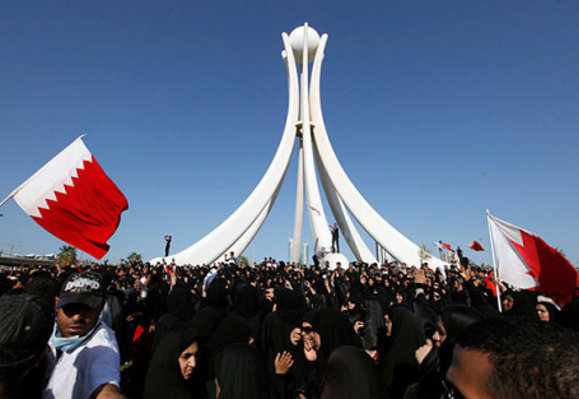
Inspired by the revolutions in Tunisia and Egypt, Shia movements in Bahrain took to the streets in February to demand greater representation and access to jobs and benefits.
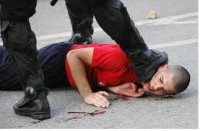
At least 30 were killed, hundreds wounded and more than 1000 arrested as a result, in a crackdown that enlisted the help of troops from Saudi Arabia and the United Arab Emirates.
Although Shias are a majority in Bahrain, the Sunni Khalifa family rules the country. Saudi Arabia and the United States, two of Bahrain’s influential allies, view the Khalifa regime as a bulwark against the regional influence of Shia Iran.
Bahrain wishes to strengthen bilateral relations with Egypt, the king said, adding that he discussed with Tantawi means of economic, commercial, cultural, informational and military cooperation.
…source
October 31, 2011 Add Comments
Sitra and a glimpse of the near future
“When they fall,” Muhammad said of the Khalifa family, which has ruled for two centuries, “there will be blood. I don’t want it to happen. Our blood is not cheap. But I don’t see it happening any other way. They just know brutality. That’s their language.”
In Rubble-Strewn Sitra, Faces of the Young Foretell a Grim Future for Bahrain
By ANTHONY SHADID – October 28, 2011 – NYT
SITRA, Bahrain — Sometimes a name suggests a condition. There was Beirut a generation ago, Baghdad more recently. In Bahrain, a Persian Gulf state so polarized that truth itself is a matter of interpretation, it is Sitra. Here, the faces of young men foretell a future for the country that looks like the rubble-strewn and violent streets of this town.
On a recent night, after clashes that erupt almost daily, one of them entered the house of a relative, squinting as though he had stumbled from a dungeon into the sun. Tear gas. His friend smirked as he showed the smooth scars left by rubber bullets fired at his leg and chest. Another shrugged as he removed his shirt to reveal a back scarred by pellets.
“Sitra,” said the friend, Sanad, “is the crisis.”
When the protests erupted in Bahrain in February, activists cast them as part of the Arab revolts, the wave of tumult that has upended an old order from Tunisia to Syria this year. That was before Saudi Arabia intervened militarily, before a crackdown ensued on the Shiite Muslim majority that was so sweeping they compared it to apartheid, before the most hard-line elements in the Sunni Muslim ruling family became ascendant.
Government officials today suggest that the crisis has ended, even as they acknowledge the damage it wrought in relations between Sunnis and Shiites in a country that had managed relative openness and even cosmopolitanism despite its entrenched inequality. “An open wound,” said Sheik Abdel-Aziz bin Mubarak al-Khalifa, a senior government counselor. But, he added, “We are in a much better place than we were three months ago.”
No one in Sitra seems to agree. This Shiite town of 80,000, a once-bucolic village of fishing and farming turned into a tableau of urban distress, is so restive that even opposition leaders shake their heads at its defiance. Nearly a third of the protesters killed — 10 so far — have come from Sitra, a half-hour drive from the capital, Manama, seething in a caldron of politicization, hardship and repression.
Though the clashes are nothing new — the 1990s witnessed similar bouts — their persistence and breadth signal the intractability of Bahrain’s conflict and mirror the unrest between the police and youths in other neglected Shiite towns.
“Sitra is a miniature version of Bahrain,” said Muhammad, another youth here, who like others interviewed did not want to be identified by his full name.
[Read more →]
October 31, 2011 Add Comments
Oppostion Parties are resolved, Counter State Violence with Continued Nonviolence
Bahraini Opposition Vows More Pro-Democracy Protests until Demands are Met
30 – Ocetober, 2011 – moqawama.org
Deputy Head of Bahrain’s main opposition party al-Wefaq, Khalil al-Marzooq stated that “this struggle will continue through peaceful means and will combat government violence with even more peace”.
In an interview with German Press, al-Marzooq indicated, “We are keen to continue a popular protest outside the Bahraini parliament by carving a stronger street presence, in order to achieve genuine democracy in Bahrain”.
Al-Wefaq party was part of the parliament for five years before leaving 18 vacant seats after protesting the regime’s violent crackdown on pro-democracy peaceful protesters.
“We were there for five years, and couldn’t change a single article of the constitution or the political system”, al-Marzooq affirmed.
On this level, he reiterated that the parliament therefore has lost legitimacy in the eyes of the Bahraini people.
Stressing on the people’s demands to have democratic elections, the Bahraini opposition figure noted, “We are asking for an acceptable level of democracy in line with universal rights and principles. So we will continue to demand that the parliament be dissolves and a constitutional monarchy be installed”.
Deputy Head of al-Wefaq party further went on to sayd, “There can be no stability in Bahrain without genuine reforms. The Bahrainis need inetantional support as that shown to other Arab Spring countries”. …source
October 31, 2011 Add Comments
The protests will continue untill the tyrants are gone
Bahraini protesters insist on demands
PressTV – Oct 30, 2011
Bahraini protesters have once again taken to the streets across the country to demand the downfall of the US-backed regime and to call for reforms and democracy.
The protests were held in Ma’ameer, Sitra, Ekr and Sinabis on Saturday night, witnesses said.
Protesters were attacked by forces reportedly deployed by the US-backed Saudi government to support the despotic Bahraini regime.
In March, troops from Saudi Arabia and the United Arab Emirates arrived in the island nation to assist Manama rulers in their brutal crackdown on protesters.
Bahrainis have been holding peaceful rallies since mid-February, demanding an end to the Al Khalifa family’s rule.
Scores of people have been killed and hundreds more arrested in a Manama-ordered and Saudi-backed crackdown in the country. …source
October 31, 2011 Add Comments
Bahrain Academic and Medical Professionals Suffer Abuse
Bahrain: Academic and Medical Professionals Suffer Abuse
31 October, 2011 – POMED
The Bahraini government has ordered Mrs. Jaleela Al Salman,Vice President of Bahrain’s Teachers Association, back to prison after her release to await her appeal. Jaleela outlined what she calls “beatings and sexual intimidation under threats of rape that lead her to making a forced confession of guilt before she received her first official day in court.” The International Federation of Health and Human Rights Organizations sent a letter to Dr. Fatima Mohammed Al-Balushi, Bahrain Minister of Human Rights and Social Development, calling for an independent investigation into allegations of abuse of jailed medical professionals as well as calling for their release from prison.
As the violent crackdown on peaceful anti-government protesters continues, reports have emerged of protesters sustaining serious eye injuries due to excessive force by security forces. The Bahrain Center for Human Rights (BCHR) reported “often riot police aim directly at protesters specifically at the chest and head area. The wounds on protesters speak for themselves, especially the countless eye injuries which have lead to many protesters losing their eyes.” …source
October 31, 2011 Add Comments
Plea to free Saudi prisoners
Plea to free prisoners
Saudi Arabia – October 31, 2011
RIYADH. Scores of Saudi Arabians have signed a petition, to be sent to newly appointed crown prince Nayef bin Abdel Aziz, to release political prisoners and lift travel bans on intellectuals.
The petition, so far signed by more than 140 people, called for the release of ”prisoners of conscience or those who were jailed without a legal justification, and lifting the unlawful travel ban”. It was posted by the Monitor of Human Rights on social networking websites.
Prince Nayef was appointed as crown prince on Thursday, six days after the death of his predecessor and brother Sultan bin Abdel Aziz in New York.
Advertisement: Story continues below
Prince Nayef, 78, has been the kingdom’s interior minister since 1975 and became a second deputy prime minister in 2007.
…source
October 31, 2011 Add Comments
The West must reassess the status quo in the Middle East – “Justice and truth are with the protesters and the untenable status quo – with power concentrated in the hands of the ruling elites – is not sustainable,”
US awakening needed after Arab spring: Mowahid
APP – 30 October, 2011
WASHINGTON, Oct 30 (APP): The West must reassess the status quo in the Middle East with respect to popular aspirations of the people, as existing uprisings show that the elite in the region are losing control, Mowahid Hussain Shah, attorney-at-law and noted expert on the region, said at a forum held on Capitol Hill, the seat of the US Congress. “Justice and truth are with the protesters and the untenable status quo – with power concentrated in the hands of the ruling elites – is not sustainable,” he maintained, at a colloquium on the Arab Spring and Bahrain.
The United States, he argued, needs an awakening to ground realities in the Middle East and has to,accordingly, reflect broader consistency in its policies, including also the plight of the Palestinian people.
Mowahid Shah particularly underlined that Washington can no longer afford bypassing issues of dignity and equality, which are driving the existing unrest in the region and elsewhere.
The packed event, which attracted congressional staffers, think-tank experts, academia, and community activists, was co-hosted by Dr. Pervez Shah, a known urologist and Secretary General of the Universal Muslim Association of America.
In this connection, Mowahid urged US leaders to adhere to their own policy statements by focusing on the next generation, instead of the next election, and by recognising that what was acceptable yesterday is no longer acceptable today. …source
October 31, 2011 Add Comments
Three Saudi YouTube social activists released
Three Saudi YouTube social activists released
(AFP) – 29 October, 2011
RIYADH — Three Saudis detained earlier this month after posting an online video showing poverty in the oil-rich kingdom were released on Sunday, activists said.
Firas Baqna, Khalid al-Rasheed and Hussam al-Darwish were arrested in Al-Sahaba district, north of Riyadh, on October 19 after their documentary was aired by the London-based opposition television Al-Islah.
“We can confirm their release … two weeks after their arrest,” the activists told AFP on condition of anonymity.
The series on poverty in Saudi Arabia, first posted on YouTube, is entitled “Malub Aleina,” meaning “We are being cheated” in Arabic.
Al-Islah channel is a mouthpiece for the banned Movement for Islamic Reform in Saudi Arabia, led by Saad al-Faqih.
At the time of their arrest, a rights activist told AFP that the authorities suspected the three young men “were receiving finance from the channel and were taken into custody for interrogation.”
One segment of the YouTube series aired on Al-Islah was filmed in Riyadh’s impoverished neighbourhoods. It featured an interview with a mosque imam claiming poverty was responsible for vice and drug abuse in his neighbourhood.
Saudi Arabia, where protests are banned, has a burgeoning youth population, with more than 50 percent aged 24 or under, according to the latest Arab Human Development report, and faces a challenge in providing jobs for graduates. …source
October 31, 2011 Add Comments
The West is Hijacking Arab Revolutions to the Benefit of Islamists
Yet despite increasing talk and concern over the unnatural relationship between the West and Islamist movements in the Arab region, there is growing insistence among the region’s enlightened and modern youths that they will not allow this relationship to direct their lives and dictate their course. It would thus be more logical for the West to listen carefully to what is happening at the youths’ scene, as well as on the traditional secularist and modernist scenes, and to realize the danger of what it is doing for these elements and the road to change brought about by the Arab Spring.
The West is Hijacking Arab Revolutions to the Benefit of Islamists
Fri, 28 October 2011 – Raghida Dergham, Dubai
While the West speaks of the necessity of accepting the results of the democratic process, in terms of Islamists coming to power in the Arab region, there are increased suspicions regarding the goals pursued by the West in its new policy of rapprochement with the Islamist movement, in what is a striking effort at undermining modern, secular and liberal movements. The three North African countries in which revolutions of change have taken place, are witnessing a transitional process that is noteworthy, not just in domestic and local terms, but also in terms of the roles played by foreign forces, both regional and international.
The Muslim Brotherhood in Egypt is trying to hijack the youth’s revolution with the help of the West. This is while bearing in mind that Egypt is considered to be the “command center” for the Muslim Brotherhood’s network in different Arab countries. The followers of the An-Nahda in Tunisia are wrapping their message with moderation as they prepare to hijack the democracy that Tunisia’s youth dream of, while being met by applause and encouragement from the West in the name of the “fairness” of the electoral process. Libya, where the North Atlantic Alliance (NATO) is in a “marriage of convenience” with Islamist rebels, has become a hub of extremism and lawlessness, with a plethora of military aid being collected by an assortment of armed Islamists who aim to exclude others from power. In Yemen, where a struggle for power rages on, a war is taking place between extremism and a harsher and more violent brand of extremism, with so-called “moderate Islam” in the middle as a means of salvation, even as the latter’s ideology remains neither modern nor liberal, and is rather lacking when it comes to the fundamentals of democracy and equality. In Syria, where the battle for freedom is at its most difficult phase, the youths of the revolution fear what could very much be under discussion behind the scenes between the West and the Islamist movements, in terms of collaboration and of strengthening the Islamists’ hold on power, in a clear bid to hijack the revolution of a youth that aspires to freedom in its every sense, not to yet another brand of tyranny and authoritarianism.
Yet despite increasing talk and concern over the unnatural relationship between the West and Islamist movements in the Arab region, there is growing insistence among the region’s enlightened and modern youths that they will not allow this relationship to direct their lives and dictate their course. It would thus be more logical for the West to listen carefully to what is happening at the youths’ scene, as well as on the traditional secularist and modernist scenes, and to realize the danger of what it is doing for these elements and the road to change brought about by the Arab Spring.
The obsession of some Westerners with the so-called “Turkish model” of “moderate Islam”, able to rule with discipline and democracy, seems naïve, essentially because of its assumption that such a model can automatically be applied on the Arab scene, without carefully considering the different background and conditions that exist in Turkey and the Arab countries. There is also some naivety in assuming than the “Iranian model” of religious autocratic rule that oppresses people, forbids pluralism and turns power into tyranny, can be excluded as a possibility.
[Read more →]
October 31, 2011 Add Comments
Occupy First. Demands Come Later – beware a debate on enemy turf
Occupy First. Demands Come Later
Critics say the Occupy cause is nebulous. Protesters will need to address what comes next – but beware a debate on enemy turf
by Slavoj Žižek – October 29, 2011 – Guardian/UK
What to do after the occupations of Wall Street and beyond – the protests that started far away, reached the centre and are now, reinforced, rolling back around the world? One of the great dangers the protesters face is that they will fall in love with themselves. In a San Francisco echo of the Wall Street occupation this week, a man addressed the crowd with an invitation to participate as if it was a happening in the hippy style of the 60s: “They are asking us what is our programme. We have no programme. We are here to have a good time.” [ Timothy A Clary/AFP/Getty Images)] ‘The protesters should fall in love with hard and patient work – they are the beginning, not the end.’ (Photograph: Timothy A Clary/AFP/Getty Images)
Carnivals come cheap – the true test of their worth is what remains the day after, how our normal daily life will be changed. The protesters should fall in love with hard and patient work – they are the beginning, not the end. Their basic message is: the taboo is broken; we do not live in the best possible world; we are allowed, obliged even, to think about alternatives.
In a kind of Hegelian triad, the western left has come full circle: after abandoning the so-called “class struggle essentialism” for the plurality of anti-racist, feminist, and other struggles, capitalism is now clearly re-emerging as the name of the problem. So the first lesson to be taken is: do not blame people and their attitudes. The problem is not corruption or greed, the problem is the system that pushes you to be corrupt. The solution is not “Main Street, not Wall Street”, but to change the system where Main Street cannot function without Wall Street.
There is a long road ahead, and soon we will have to address the truly difficult questions – not questions of what we do not want, but about what we do want. What social organisation can replace the existing capitalism? What type of new leaders do we need? What organs, including those of control and repression? The 20th-century alternatives obviously did not work.
While it is thrilling to enjoy the pleasures of the “horizontal organisation” of protesting crowds with egalitarian solidarity and open-ended free debates, we should also bear in mind what GK Chesterton wrote: “Merely having an open mind is nothing; the object of opening the mind, as of opening the mouth, is to shut it again on something solid.” This holds also for politics in times of uncertainty: the open-ended debates will have to coalesce not only in some new master-signifiers, but also in concrete answers to the old Leninist question, “What is to be done?” …more
October 31, 2011 Add Comments
Youth Coalition for Revolutions of Dignity
Youth Coalition for Revolutions of Dignity
Who we are
An independent youth coalition that is not politically or religiously affiliated, of human rights activists, striving through peaceful means to establish civil governments that institutionalize human rights and youth involvement. This unity is essential to speed up and guarantee the success of the revolutions that have been led by the youth. The countries involved in this coalition so far consist of: Syria, Yemen, Libya, Bahrain, Tunisia and Egypt.
Why we are
The revolutions for dignity ignited with the fire Mohammed AlBouazizi set to himself on December 17th, 2010, because of the indignity and humiliation practiced by the authoritarian regimes against the people. This fire quickly spread through the region after the fall of the dictator Bin Ali in Tunisia. The common violations practiced by all the regimes mentioned above are:
– Marginalization of the youth
– Arbitrary arrests
– Torture
– Unfair trials
– Corruption
– Lack of basic freedoms such as: freedom of speech and press, freedom of association, and freedom of assembly.
– Discrimination as common practice to create divides and instigate hate between the populations.
These authoritarian regimes also reacted to these uprisings in mostly the same ways:
– Extra-judicial killings
– Mass arrests
– Physical, psychological and sexual torture
– Use of excessive force
– Kidnappings
– Blaming “foreign” entities of inciting these revolutions and labeling them as conspiracies against the state
Mission
– To initiate joint actions in all these countries which will aim to do the same as the popular protests, except they will be united across the region.
-To create a platform dedicated to sharing ideas, methods, actions and means of a peaceful revolution
-To create a campaign directed at providing the media with information about the realities of what is happening on the ground, with evidence and documentation to dispel myths and misinformation.
-To pressure the media and the governments worldwide to stop the use of double standards and to support all movements for rights and freedom in all countries.
We recognize that none of these revolutions are sectarian; rather, the governments wish to create sectarianism to divide and conquer. We as a coalition will work against this agenda. We affirm that should any country reach the goal of a civil government which institutionalizes human rights and civil liberties does not mean their responsibility ends towards the other revolutions. This coalition will aim at making sure that all youth groups tay involved until all countries reach the same aspirations. The addition of other countries is encouraged and supported.
This first statement is our first action towards bringing together all youth groups leading these revolutions, as the success of this coalition depends on the involvement of the youth groups and protesters in it. We ask of all youth groups involved in the revolutions of dignity to put out a statement endorsing this initiative, so that we can begin planning the joint actions.
In conclusion
These revolutions started peaceful, will remain peaceful, and will succeed because their strength lies within its peacefulness (with the exception of Libya). We stress upon that these revolutions are not to be directed at the tools and arms of the regimes, but rather at creating a new inclusive government that represents all factions of society. Thus we enshrine this ideology of peaceful resistance, which is our strongest weapon against these authoritarian regimes.
Peacefully yours, Youth Coalition for Revolutions of Dignity Monday October 24th, 2011 See their new Website HERE
October 31, 2011 Add Comments
Slavoj Zizek: ‘Now the field is open’
Slavoj Zizek: ‘Now the field is open’
The philosopher discusses the momentous changes taking place in the global financial and political system.
Talk to Al Jazeera – 29 Oct 2011
From the Middle East to the streets of London and cities across the US there is a discontent with the status quo. Whether it is with the iron grip of entrenched governments or the widening economic divide between the rich and those struggling to get by. But where are those so hungry for change heading? How profound is their long-term vision to transform society?
Slovenian-born philosopher Slavoj Zizek, whose critical examination of both capitalism and socialism has made him an internationally recognised intellectual, speaks to Al Jazeera’s Tom Ackerman about the momentous changes taking place in the global financial and political system.
In his distinct and colourful manner, he analyses the Arab Spring, the eurozone crisis, the “Occupy Wall Street” movement and the rise of China. Concerned about the future of the existing western democratic capitalism Zizek believes that the current “system has lost its self-evidence, its automatic legitimacy, and now the field is open.”
“I think today the world is asking for a real alternative. Would you like to live in a world where the only alternative is either anglo-saxon neoliberalism or Chinese-Singaporean capitalism with Asian values?
I claim if we do nothing we will gradually approach a kind of a new type of authoritarian society. Here I see the world historical importance of what is happening today in China. Until now there was one good argument for capitalism: sooner or later it brought a demand for democracy…
What I’m afraid of is with this capitalism with Asian values, we get a capitalism much more efficient and dynamic than our western capitalism. But I don’t share the hope of my liberal friends – give them ten years, [and there will be] another Tiananmen Square demonstration – no, the marriage between capitalism and democracy is over.” Slavoj Zizek. …source
October 29, 2011 Add Comments
Bahrain Spin Monster in Washington meets with the “wicked old bastards club” and Hillary too
Bahrain foreign minister on D.C. charm offensive
By Josh Rogin – October 26, 2011 – 6:38 PM Share
Bahrain’s government is under pressure — not just from protesters in Manama, but also from parts of the Washington foreign policy community, who want to delay U.S. arms sales to the country. Bahraini Foreign Minister Shaikh Khalid bin Ahmed al-Khalifa has been in town for over a week meeting with officials and lawmakers to assuage U.S. concerns over the kingdom’s domestic crackdown, and sat down for a lengthy interview with The Cable.
Khalifa’s message was clear: The Bahraini government is sensitive to international concerns about its treatment of protesters, pledges to follow the recommendations of an upcoming commission report on its actions, and wants to reinforce that the international community should not lose sight of the broader security situation in the region, characterized by the Iranian threat.
“I’m here to see our friends in the administration and Congress to try to explain what’s happening in Bahrain,” he said. “We are just before the issuance of the commission of inquiry’s report. I’m here to show our commitment to that, how we will accept it and do all that is necessary to implement it.”
That report, being written by Bahraini Independent Commission of Inquiry (BICI), was established by King Hamad bin Isa al-Khalifa and is chaired by human rights advocate and professor M. Cherif Bassiouni. It is expected to be released on Nov. 23. Bassiouni has faced some criticism for making statements that appear to be to conciliatory to the regime, but he recently promised his report will give the Bahraini government “some bitter pills to swallow.”
After five U.S. senators wrote to Secretary of State Hillary Clinton earlier this month to protest the pending $53 million sale of armored Humvees and missiles to Bahrain, the State Department wrote a letter to Congress last week linking the arms sale directly to the BICI report.
Khalifa said his government has been alarmed by congressional opposition to the arms sale, but said that he trusts the Obama administration to judge the outcome of the commission’s report fairly. He also argued that a delay in completing the arms sale would not be in the interest of regional security.
“What worries us is that we don’t need to delay any requirement for the necessary architecture to protect the region. Bahrain is a cornerstone of that,” he said. “That’s what I’m talking about here and I’m finding very listening ears.”
Of course, one component of that emerging regional security architecture is the Peninsula Shield Force, made up of dozens of tanks and approximately 40,000 troops that came to Bahrain via Saudi Arabia, Kuwait, and the UAE during the height of the unrest in March. Those forces are still there but are “purely to deter external threats,” Khalifa maintains.
Opposition groups claim that 30 protesters have been killed by the government during its domestic crackdown, and more than 1,000 have been arrested. Independent organizations such as Human Rights Watch have reported that the government has employed brutal tactics, including using masked thugs to sweep up lawyers and other activists in nighttime raids.
The Obama administration has several interests in Bahrain, the fact that the U.S. Fifth Fleet is stationed there being chief among them. Bahrain is also a client state of Saudi Arabia and policymakers have voiced fears that a victory by the protest movement would strengthen Iranian influence in the country.
Khalifa didn’t meet with any of the senators who signed the letter, but he did meet with Sens. John McCain (R-AZ), John Kerry (D-MA), Lindsey Graham (R-SC), Mark Kirk (R-IL), Marco Rubio (R-FL), and Rep. Steve Chabot (R-OH). …more
October 29, 2011 Add Comments
Arbitrary Detention, Malicious Sentencing and Jail Time
17 malicious cases and jail terms for 96-years for prisoner of conscience, Sheikh Mohammed Habib Almiqdad
27 Oct 2011 – BCHR
Increasing issues and evidence are brought to the Bahrain Center for Human Rights, which indicates that the Bahraini authorities have exploited the events of February 14, 2011 and its repercussions for revenge against its opponents of political and human rights activists . The case of Sheikh Mohammed Habib Almiqdad is an outstanding example of this.
The cleric and independent opposition activist Sheikh Mohammed Habib al-Miqdad, 48 years, has been in arbitrary detention since April 1, 2011. There were detailed reports that he has been exposed to psychological and physical torture for few months while being isolated in incommunicado detention before being brought to the military prosecutor and the courts of the National Safety (military). He was tortured on the hands of the king’s son Nasser ben Hamad. He was charged in 17 cases ranging between the charges of “inciting and seeking to overthrow the regime” and “incitement to the formation of gangs to attack foreigners or to kidnap security officers.” According to defense lawyers, the prosecution had failed to provide real evidence on those charges. The national security men said they have their “confidential sources”, and some of the detainees accused in the same cases confessed under torture as torture marks are still visible on their bodies. Reports by Medical examiner of the military justice proved that Sheikh Mohammed Habib Al-Miqdad was himself exposed to physical torture . This is also expected to be in the reports of foreign doctors who are assigned by “Independent Commission of Inquiry ” and who had examined the health of Sheikh Al-Miqdad.
The military prosecutor has failed to provide any evidence that Sheikh Miqdad was inciting violence, nevertheless all the speeches that were presented in the papers include explicitly his call to work peacefully and avoid violence. Sheikh Miqdad so far has been brought to the military court “national safety” that lacks in international standards for fair trial and legitimacy. This court conflict with international standards laws such as the Terrorism Act and the articles on the security of the state of the Penal Code of 1976, which criminalizes the exercise of basic rights such as freedom of expression, assembly and association.
The total breach of fair trial standards to the extent that Sheikh Mikdad, as defendant did not have in most cases, an adequate opportunity to consult legal, but has not been brought to some of the sessions of the trials and was aware of them through press papers which were brought to him in prison. As he had not given, in any of the hearings, the opportunity to speak before the court as well as they didn’t allow any of the other defendants. The lawyers were not given enough room both in the preparation or provision of oral arguments or to provide defense witnesses. …more
October 29, 2011 Add Comments
Canadian government stands in silence with the Obama administration as their citizens rights are trampled by King Hamad
October 28, 2011 Add Comments
Hamad Jamal – recent indication of al Khalifa use of death squads?
October 27, 2011 Add Comments
Obama’s ‘Peace’ Legacy — Drones, Death Squads, And Destruction Everywhere
Obama’s ‘Peace’ Legacy — Drones, Death Squads, And Destruction Everywhere
8/29/11 – By Thomas H. Naylor – Counterpunch
Pressenza Pressenza International Press Agency Washington DC, 8/29/11 Hardly a week goes by in which we do not learn of the deaths of innocent civilians in Afghanistan or Pakistan resulting from attacks by U.S. drones. Attack drones have also been deployed in Libya, Somalia, and Yemen.
This form of pilotless aircraft can be used to inflict death and destruction anywhere in the world. Drones are controlled by well-trained, high-tech, gutless assassins seated in air conditioned comfort in front of sophisticated instrument panels thousands of miles away from their intended targets.
The beauty of desktop, drone warfare is that it is neat, clean, precise, risk-free, sanitized, and bloodless and can be waged by those who have never set foot on a battlefield or smelled the stench of death. It’s almost like playing a video game.
The Pentagon recently ordered 55 Global Hawk drones for a cool $23 billion. There is even talk of converting the Burlington International Airport in Vermont into a drone base.
A ‘Perfect’ Killing Machine
Drones represent the perfect instruments of war for a risk averse president who shies away from hand-to-hand political combat. With drones are associated feelings of power and control. We are in charge. There is no face-to-face conflict whatsoever.
Drones also offer endless possibilities as surveillance aircraft for high-tech spying, a practice with which the Obama administration seems to feel quite comfortable.
U.S. Special Operations In 120 Countries
Under the leadership of former CIA Director Leon Panetta, the Pentagon will have U.S. Special Operations forces deployed in no less than 120 countries around the world by year-end.
These instant strike forces include Navy Seals, Army Delta Forces, Rangers, and Green Berets. Special Operations forces have been used extensively in Afghanistan and Iraq. Navy Seals garnered international attention recently with their successful assassination attack on Osama bin Laden. Libyan leader Muammar Qadhafi surely would be next!
“Desist… Or Be Prepared To Die”
One can imagine a scenario in the not too distant future in which Mahmoud Ahmadinejad and Hugo Chavez receive phone calls from the White House saying, “Cease and desist, or be prepared to die.”
With high-tech, American death squads spread around the world, such a threat becomes increasingly credible. Will this soon become the preferred way to deal with any nation which has the audacity to challenge the American way? China and Russia might still be viewed as exceptions to the rule by the Pentagon.
Obama’s ‘Peace’ Speech…
By far, the most prescient line in President Obama’s Nobel Peace Prize acceptance speech was, “There will be times when nations will find the use of force not only necessary but morally justified.”
Is it possible that what Obama really had in mind with his “hope and change” mantra was replacing old fashioned, conventional warfare with a more sophisticated, high-tech, stealthy, cowardly form of warfare involving drones and kinetic strike death squads?
“Meaningless! Meaningless!” said the Teacher in the book of Ecclesiastes. “Everything is meaningless!” …source
October 27, 2011 Add Comments
A “death squad” by another name…
A death squad is an armed military, police, insurgent, or terrorist squad that conducts extrajudicial killings, assassinations, and forced disappearances of persons as part of a war, insurgency or terror campaign. These killings are often conducted in ways meant to ensure the secrecy of the killers’ identities, so as to avoid accountability.[1][2]
Death squads are often, but not exclusively, associated with the violent political repression under dictatorships, totalitarian states and similar regimes. They typically have the tacit or express support of the state, as a whole or in part (see state terrorism). Death squads may comprise a secret police force, paramilitary group or official government units with members drawn from the military or the police. They may also be organized as vigilante groups.
“Extrajudicial killings” are the illegal killing of leading political, trades union, dissidents, and social figures by either the state government, state authorities like the armed forces and police… …more
October 27, 2011 Add Comments
United States and state terrorism
Several scholars have accused the United States of conducting state terrorism. They have written about the liberal democracies and their use of state terrorism, particularly in relation to the Cold War. According to them, state terrorism was used to protect the interest of capitalist elites, and the U.S. organized a neo-colonial system of client states, co-operating with local elites to rule through terror. However, little of this work has been recognized by other scholars of terrorism or even of state terrorism.[1]
Works include Noam Chomsky and Edward S. Herman’s The political economy of human rights (1979), Herman’s The real terror network (1985), Alexander L. George’ Western state terrorism (1991), Frederick Gareau’s State terrorism and the United States (2004) and Doug Stokes’ America’s other war (2005).
Beginning in the late 1970s, Chomsky and Herman wrote a series of books on the United States and state terrorism. Their writings coincided with reports by Amnesty International and other human rights organizations of a new global “epidemic” of state torture and murder. Chomsky and Herman observed that terror was concentrated in the U.S. sphere of influence in the Third World, and documented terror carried out by U.S. client states in Latin America. They observed that of ten Latin American countries that had death squads, all were U.S. client states. Worldwide, 74% of countries that used torture on an administrative basis were U.S. client states, receiving military and other support to retain power. They concluded that the global rise in state terror was a result of U.S. foreign policy. …more
October 27, 2011 Add Comments
Early signs of the emergence of “death squads” as al Khalifa, under pressure from West, begins retreat from overt Human Rights abuse?
Human Rights Ministry condemns attack on Ms. Samira Rajab’s house
27/10/2011 – BNA
Manama, Oct. 27 (BNA)—The Human Rights and Social Development Ministry condemned today the Molotov cocktail attack yesterday night on the house of Shura Council member, writer and journalist Samira Rajab.
The attack by unidentified persons was carried out following Ms. Rajab’s participation in a televised programme (Opposing Views) which was aired by Al Jazeera satellite channel, the ministry said in a statement adding that this act proves that the perpetrators are using terrorist ways to oppress freedom of expression and muzzle moderate voices.The ministry denounced the terrorist attack and considered it as part of a plan to abuse Bahraini citizens’ rights by some extremists who are held responsible for the regrettable incidents which gripped the kingdom last February and March.”Such acts will not deter Bahraini citizens from exercising their inherent rights to freedom of expression which are guaranteed by the Bahraini constitution,” the statement said. The Human Rights and Social Development Ministry hailed anyone who denounced the attack and called on those who showed no stance towards it to take the initiative as the attack is a transgression of the rights of the whole Bahraini society.The ministry expressed confidence in the specialized authorities to tack down the perpetrators and bring them to justice. …source
October 27, 2011 Add Comments
In renewed illegal detention al Khalifa regime “re-arrests” educator without due process in effort to silence her
BAHRAIN: Female teacher re-arrest exposes human rights abuse as others recount torture
Women News Network – WNN Breaking News – 26 October 26, 2011
(WNN) Manama, BAHRAIN: Without proper jurisdiction and legal rights, school teacher and Vice President of Bahrain’s Teachers Association Mrs. Jaleela Al Salman has been forced to return to prison by Bahrain police security following her official release from prison while she was waiting for the appeal of her upcoming case set for December 11.
Detained in prison without access to a lawyer from March 29 to August 21, Jaleela faced a Bahraini military courtroom on September 25, 2011 where she was sentenced to 3 years imprisonment on charges of ‘inciting hatred towards the regime.’ Charges also included calling for a teachers strike and attempting to overthrow the ruling system by force. During her days in prison Jaleela later outlined what she calls “beatings” and sexual intimidation under threats of rape that lead her to making a forced confession of guilt before she received her first official day in court.
“I’m not a politician,” says nurse and President of the Bahrain Nursing Society Ms. Roula al-Safar who had volunteered, along with other medical personnel, to help injured protesters on the streets of Manama, February 14, 2011. “I’m one of these people who will run (to aid) whenever there is a disaster,” Roula, who has now been sentenced to 15 years in prison, added.
“Suddenly the hospital was in chaos,” said Roula outlining events of violence against protesters that resulted in those injured being rushed to the hospital at the Salmaniya Medical Complex emergency room in February, causing it to spill beyond capacity.
Describing continued attacks of protesters, and two persons dead, Roula’s eye-witness account outlines her own arrest. “They did not read our warrants (for arrest),” she said. “They did not tell us what we are accused of for 2 or 3 days of continuous beating,” she describes during a Skype interview with Brian Dooley from the international advocacy group Human Rights First, an international agency that works to protect human rights defenders. …more
October 27, 2011 Add Comments
Congress backs Bahrain protesters when the White House won’t
Congress backs Bahrain protesters when the White House won’t
By Editorial, Published: October 26 – Editorial Board Opinion, Washington Post
THE BELEAGUERED reformist faction within Bahrain’s ruling al-Khalifa family has good reason to thank the U.S. Congress. Until this month the Obama administration, which has enormous leverage over the Persian Gulf emirate, was blithely ignoring Bahrain’s crackdown on domestic opposition and its failure to implement promised reforms.
Even as the regime staged unfair trials of peaceful opponents in special security courts, dismissed thousands from government jobs for participating in protests and violently repressed demonstrations in restless villages, the administration notified Congress in September that it intended to sell Bahrain $53 million in military equipment, including 40 armored Humvees.
Set aside for the moment the fact that Bahrain, an island nation that hosts the U.S. Fifth Fleet, has no plausible use for armored vehicles other than against its own people. The sale sent the message to the regime’s hard-liners that domestic repression would not damage relations with the United States. Little surprise that, not long afterward, 20 doctors and nurses who had treated injured protesters were sentenced to lengthy prison terms after a grossly unfair trial.
Fortunately, Bahrain’s abuses — documented and denounced by every major Western human rights group — prompted a reaction in Congress. Legislation was introduced to block the arms sales, and a group of five Democratic senators, led by Robert P. Casey Jr. (Pa.), wrote to Secretary of State Hillary Rodham Clinton on Oct. 12 to ask that the sale be put on hold. A separate letter was dispatched by Sen. Marco Rubio (R-Fla.).
The senators got a response. On Oct. 14, the State Department wrote to Mr. Casey to say that the administration would not proceed with the sale until after the independent international commission appointed to investigate the unrest in Bahrain — with the regime’s cooperation — issues its report, scheduled for Nov. 23. Bahrain, meanwhile, was backpedaling: even before the senators’ letters were sent, the doctors’ sentences were nullified and their cases transferred to civilian court. The pro-reform foreign minister traveled to Washington to assure Congress that the commission’s recommendations will be followed.
This is progress — but there is a distinct danger that the promises of the Khalifas and the State Department will prove hollow. The credibility of the commission has been under question ever since its Egyptian-born chief appeared, in an Aug. 8 interview, to preemptively clear the Bahraini government of a policy of using excessive force or torture. The regime has failed to deliver on pledges made by its reformists in previous trips to Washington.
Rather than tying itself to this uncertain process, the United States should set its own conditions for continued good relations with Bahrain. These should include accountability for the torture and killing of protesters; the release of all political detainees; and the initiation of meaningful political reform that enfranchises the country’s Shiite majority. The current status quo in Bahrain is unsustainable; reinforcing it with U.S. military sales would be foolish as well as unconscionable. ...source
October 27, 2011 Add Comments
European Parliament – Bahrain halt the violence and release the prisoners
European Parliament: Human rights resolutions: Tibet, Bahrain, Syria
27 Oct 2011 – BCHR
Bahrain: halt the violence and release the prisoners
Parliament condemns the repression of citizens in Bahrain, which has led to dozens of deaths and injuries, and urges the immediate and unconditional release of all peaceful demonstrators, political activists, human rights defenders, doctors and paramedics, bloggers and journalists. It also expresses its solidarity with the families of all the victims.
The Bahraini security forces and authorities should stop violence, repression and detention of peaceful demonstrators and show the utmost restraint when attempting to control protests, say MEPs, who urge the authorities to act in strict accordance with their legislation and international obligations.
MEPs also reiterate their view that demonstrators in Bahrain have expressed their legitimate democratic aspirations and call on the government there to engage in a genuine, meaningful and constructive dialogue with the opposition, without further delay or additional preconditions, in order to bring about the necessary reforms, encourage national reconciliation and restore social consensus in the country.
EU Press Release
The European Parliament,
1. Condemns the repression of citizens in Bahrain which led to dozens of deaths and injuries and urges the immediate and unconditional release of all peaceful demonstrators, political activists, human rights defenders, doctors and paramedics, bloggers and journalists and expresses its solidarity with the families of all the victims;
2. Calls on the Bahraini security forces and authorities to stop violence, repression and detention of peaceful demonstrators and to show the utmost restraint when attempting to control protests; urges the authorities to act in strict accordance with their legislation and international obligations;
3. Reiterates its view that demonstrators have expressed their legitimate democratic aspirations and calls on the Bahraini Government to engage in a genuine, meaningful and constructive dialogue with the opposition, without further delay or additional preconditions, in order to bring about the necessary reforms, encourage national reconciliation and restore social consensus in the country;
4. Expresses its grave concern at the presence of foreign troops under the GCC banner in Bahrain and calls for their immediate withdrawal; reiterates its call on the GCC to contribute constructively and mediate in the interest of peaceful reforms in Bahrain;
5. Condemns the use of special military courts to try civilians, as it is a violation of international fair trial standards, and stresses that civilians must be tried in civilian courts and that every detained person deserves a fair trial, with adequate access to a lawyer and sufficient time to prepare a defence; calls for an immediate cessation of mass trials of civilians in the military court, the Court of National Safety;
6. Welcomes the decision to retry doctors and nurses in civil courts but considers that all charges against them should be dropped, and calls on the civil courts to release the doctors and medical staff unconditionally and immediately, as they were acting in accordance with their professional duty and have been accused of tending to the medical needs of those who oppose the regime, as well as of serious criminal offences which seem to be of a political nature and for which credible evidence has not been put forward, as well as to release all other political activists, journalists, teachers, bloggers and human rights defenders due to the arbitrary nature of the charges and of the entire proceedings; expresses its strong concern about the life sentences handed down to at least eight opposition activists and at least 13 people who were sentenced to up to 15 years in prison;
7. Underlines that providing impartial treatment for the wounded is a basic legal obligation under humanitarian law, and urges Bahrain, as a party to the Geneva Conventions, to respect its obligations regarding the provision of health care to the sick and injured;
8. Calls on the Kingdom of Bahrain to allow all medics to resume their jobs and allow all medics and their defence teams access to the medical examination reports from the Bahrain Independent Commission of Inquiry’s examination of the detained doctors;
9. Cautions against the abuse of national security laws;
10. Calls on the authorities to restore and respect all human rights and fundamental freedoms, including pluralism in the media, both online and offline, freedom of expression and assembly, freedom of religion, women’s rights and gender equality, and measures against discrimination, and to put an end to the censorship; calls on the Bahraini authorities to accept the requested visit by the United Nations High Commissioner for Human Rights;
11. Notes that thousands of employees have lost their jobs for their participation in the peaceful anti-government protests; calls on the national authorities as well as the European enterprises involved to order the immediate reinstatement of these individuals and to ensure that they are compensated for their lost income;
12. Takes positive note of King Hamad’s decision to set up an independent commission to investigate the human rights violations by the security forces during the government crackdown on peaceful pro-reform protesters; urges full impartiality and transparency for the commission and calls on the Bahraini Government not to interfere in its work and to ensure that perpetrators of crimes and all persons responsible for the violent crackdown are brought to justice and tried by due process;
13. Welcomes the setting-up of a Ministry for Human Rights and Social Development in Bahrain, and calls on that ministry to act in accordance with international human rights standards and obligations;
14. Calls for the admission of international observers to the trials of political prisoners as well as for them to be allowed to monitor the work of the independent commission investigating human rights violations to ensure objectivity according to international standards;
15. Calls on the Bahraini authorities and the King of Bahrain to commute the death sentences of Ali ‘Abdullah Hassan al-Sankis and ‘Abdulaziz ‘Abdulridha Ibrahim Hussain; reiterates its strong opposition to the use of the death penalty and urges the Bahraini authorities to declare an immediate moratorium;
16. Considers that the investigation which has been launched into the death of a 16-year-old boy, Ahmed al-Jaber al-Qatan, during an anti-government protest must be independent, that the findings must be made public and that those responsible must be brought to justice;
17. Underlines the importance of reconciliation as an essential part of reform and stability in Bahrain’s diverse society in which the rights of each citizen should be equally guaranteed in both the letter and the practice of the law;
18. Instructs its President to forward this resolution to the Council, the Commission, the Vice-President of the Commission/High Representative of the Union for Foreign Affairs and Security Policy, the governments and parliaments of the Member States and the Government and Parliament of the Kingdom of Bahrain. …source
October 27, 2011 Add Comments
Universal thuggery – predictible response, status quo
Oakland Police Raid on Occupy Oakland Raises Serious Questions – Right to Protest
by Linda Lye – ACLU – Oct 27th, 2011
Picture this. In response to a peaceful anti-war protest, the Oakland Police Department uses large wooden bullets, sting ball grenades and shot-filled bean bags, as a result of which at least 58 protesters are injured. That was 2003, and unfortunately sounds eerily similar to reports of OPD’s response to an Occupy Oakland demonstration Tuesday evening, in which bean bags or other projectiles appear to have been fired directly into crowds and multiple rounds of tear gas were used.
OPD’s conduct in 2003 led to a class action lawsuit brought by the ACLU-NC, the National Lawyers Guild, ILWU, Local 10 and other civil rights attorneys. The lawsuit led to a historic settlement, with OPD adopting a Crowd Control Policy that strictly limits the use of force and prohibits the indiscriminate use of bean bags and other projectiles against crowds or passive resisters, except in unusual circumstances.
The ACLU of Northern California and the National Lawyers’ Guild demanded a full investigation of Tuesday’s events. The groups also asked OPD to immediately produce records about the use of force in responding to the early morning raid of the Occupy Oakland encampment and the evening demonstration. The public has a right to transparency and accountability, and yesterday’s events are no exception. The ACLU-NC is also urging people to email the Oakland Police Department calling for transparency and an end to excessive use of force.
Reports of OPD’s conduct raise serious questions about whether it violated its own policy on dealing with demonstrations.
* The Policy requires the Department to use “the minimal police intervention needed to address a crowd management or control issue.” This video shows a protester who sustained a head injury. Injuries do not appear to be isolated. Did OPD really use the minimal amount of intervention necessary to control and disperse the crowd?
* The Policy requires the Department to use “the minimum amount of chemical agent necessary to obtain compliance.” But the quantity of tear gas that must have been used to generate this cloud-filled scene doesn’t appear “minimum” at all.
* The Policy prohibits the Department from firing bean bags or other “Direct Fired Specialty Impact Less-Lethal Munitions,” such as rubber bullets, “indiscriminately against a crowd or group of persons even if some members of the crowd or group are violent or disruptive. But this video (at 0:43) shows law enforcement firing a projectile directly into a crowd tending to an injured protester.
On Tuesday , after OPD’s early morning raid of the Occupy Oakland encampment, Acting Chief Jordan agreed to conduct an investigation of the Department’s conduct. That’s a start, but the situation demands full transparency and accountability. The investigation should clearly be expanded to the Department’s conduct in handling not just the morning raid but also the evening demonstration. But separate and apart from any internal investigation the Department conducts, the situation requires independent oversight and the public has a right to know exactly what happened. …source
October 27, 2011 Add Comments
Clinton DOS rhetoric on Bahrain arms deal precedes the conveniently overdue BICI Report
[cb editor: The “subline” in the article below by Middle East Online, “Clinton warns Bahrain: No human rights, no arms” is a curious one. I’m wondering if this is an editorial hope from Middle East Online’ or a failure to grasp the reality of US policy regarding Bahrain. And yes, it does seem, some courageous US Senators have stood up to the atrocities of the al Kahlifa regime. Adding, yet another policy dilemma that confronts the Obama-Clinton stumbling and bumbling in the Middle East. The US silence regarding Bahrain may well be broken, but what remains is the contradictory and unreconciled policy of “friends don’t stop friends from brutally oppressing their governed” – especially if the the governed want something as absurd as democracy and it might disturb your military and economic ambitions in the region. And any other cozy arrangements made with your “partners in brutality”.
The Department of State’s decision to hold up arms sales a few weeks while waiting on a tainted and discredited investigative report on Bahrain’s “unrest”, sponsored by King Hamad’s and conducted by his hand picked “independent team”, is just short of political grand standing masquerading as impartiality and fairness. Nonetheless it is an obvious strategic decision. It must be noted that at no time has Clinton said the deal would NOT go through, but rather in the usual DOS Newspeak, she says “we will wait and see how the regime responds to the report”. An unqualified expectation of a response from King Hamad – perhaps the deal can proceed if King Hamad decides to increase the frequency of gassing Sunni villages as well – fair and balanced oppression? Or maybe if Hamad admits the “the government has “some problems” and promises he will “look into them”, that will be enough to complete the deal and keep it’s challengers in the US Senate at bay?
And what of Bassiouni’s BICI Report? As the US places new value on it, there is a mad dash to rewrite it – supposedly to be more inclusive of complaints against the regime? So had Bassiouni shorted the report important testimony until the US became interested in it? The reports continues to reek of a tainted, corrupt process or at the very best, a horribly shoddy one – surely it will go down as Bassiouni’s “boondoggle in Bahrain”. What then of the rewrite? …is it a new version that adjusts the bar for “acheivibility” and couches King Hamad’s problems in something that is politically expedient for the US and a palatable compromise to more moderate Western Human Rights critics?
And what of Clinton’s praise for al Khalifa’s kangaroo courts? …get real, a civilian trial without due process, confessions extracted through torture, though some now thrown out and horribly trumped up charges? Does anyone really think justice can be dispensed by the regimes “civilian courts”? Has it ever when it comes to matters of political resistance? All the victims of Hamad’s “charade of justice” are hoping for is another opportunity to force Hamad’s capitulation or even to be granted the “King Mercies” under the charade of an appeal. The sad reality complicity only serves to legitimize his courts. Not only are the bumblings and stumblings of Obama-Clinton an embarrassment to the US they are dangerous, shallow and contemptuous. ]
US urges Bahrain to probe crackdown on anti-regime protests
26 October, 2011 – Middle East Online, “Clinton warns Bahrain: No human rights, no arms”
WASHINGTON – US Secretary of State Hillary Clinton pressed Bahrain on Wednesday to follow through on an independent probe into a crackdown on anti-regime protests, officials said.
Clinton and Bahraini Foreign Minister Sheikh Khalid bin Ahmed al-Khalifa also discussed a planned $53 million US arms sale to Bahrain that has been put on hold pending the outcome of the investigation, spokeswoman Victoria Nuland said.
“The thrust of our message to Bahrain over some months was that not only the Bahraini people but the international community and certainly the United States are waiting eagerly for the release of the results of the independent commission of inquiry,” Nuland added.
The panel’s report was expected by October 30 but its release has been delayed to November 23.
The pro-democracy protests that broke out in February amid the fervor of the Arab Spring were crushed by Bahraini security forces, backed by Saudi troops. The government says 24 people were killed, including four police officers, while the opposition puts the count at 31.
Nuland said the outcome of the investigation would be “a litmus test of transparency and accountability for what happened in Bahrain and particularly how the government chooses to deal with what is reported,” Nuland said.
Clinton also underscored the importance of Bahrain’s decision to retry in civilian courts cases that were tried by the military, she said.
Nuland defended the proposed arms sale to Bahrain, a key US ally in the Gulf that hosts the headquarters of the US Fifth Fleet, saying it would bolster Manama’s external defenses.
But “the Bahrainis know we have human rights standards attached to these sales, and actual transfer decisions are pending,” she said.
Senator Ron Wyden, a Democrat, introduced legislation earlier this month to bar arms sales to Bahrain until it addresses “alleged human rights violations” since the protests began. …source
October 27, 2011 Add Comments