Netanyahu Said Pushing for Strike on Iran
Netanyahu Said Pushing for Strike on Iran
November 03, 2011 – Associated Press – by Josef Federman and Dan Perry
JERUSALEM — An Israeli official said Wednesday that Prime Minister Benjamin Netanyahu is trying to persuade his Cabinet to authorize a military strike against Iran’s suspected nuclear weapons program – a discussion that comes as Israel successfully tests a missile believed capable of carrying a nuclear warhead to Iran.
It remained unclear whether Israel was genuinely poised to strike or if it was saber-rattling to prod the international community into taking a tougher line on Iran. Israeli leaders have long hinted at a military option, but they always seemed mindful of the practical difficulties, the likelihood of a furious counterstrike and the risk of regional mayhem.
The developments unfolded as the International Atomic Energy Agency is due to focus on the Iranian program at a meeting later this month. The West wants to set a deadline for Iran to start cooperating with an agency probe of suspicions that Tehran is secretly experimenting with components of a weapons program.
Israeli leaders have said they favor a diplomatic solution, but recent days have seen a spate of Israeli media reports on a possible strike, accompanied by veiled threats from top politicians.
In a speech to parliament this week, Netanyahu said a nuclear-armed Iran would pose a “dire threat” to the world and “a grave, direct threat on us, too.”
His hawkish foreign minister, Avigdor Lieberman, was dismissive of the reports but added: “We are keeping all the options on the table.”
The government official, who spoke on condition of anonymity because he was discussing sensitive internal deliberations, told The Associated Press that the option is now being debated at the highest levels.
The official confirmed a report Wednesday in the Haaretz daily that Netanyahu and Defense Minister Ehud Barak both favor an attack, but do not yet have the support of a majority of Cabinet ministers. The official also said Israel’s top security chiefs, including the heads of the military and Mossad spy agency, oppose military action.
It is generally understood that such a momentous decision would require a Cabinet decision. Israel’s 1981 destruction of Iraq’s nuclear reactor was preceded by a Cabinet vote.
Netanyahu spokesman Mark Regev refused to comment on the issue but did say there is a “decision-making process which has stood the test of time. … There have been precedents, and the process works.”
With most of its population concentrated in a narrow corridor of land along the Mediterranean, Israel’s homefront could be vulnerable to a counterattack.
[Read more →]
November 5, 2011 Add Comments
SOA Vigil at the Gates of Fort Benning
November 18-20, 2011: SOA Vigil at the Gates of Fort Benning, Georgia
STAND UP FOR DIGNITY, JUSTICE, SOLIDARITY AND SELF-DETERMINATION!
Join thousands of solidarity activists, torture survivors, union workers, people of faith, students, immigrants, veterans and others from November 18-20, 2011 at the gates of Fort Benning, Georgia to take a stand for justice, to close the School of the Americas (SOA/ WHINSEC) and to resist U.S. militarization.
This December will mark the 30th anniversary of the massacre of close to 800 indigenous villagers in the El Mozote region of El Salvador. Still, graduates of the SOA are leading the repression, killing hundreds and displacing thousands of Hondurans. Mexicans and immigrants passing through Mexico are the target of drug cartels and death squads like the “Zetas” – another product of SOA training. In the midst of the continuing war in Colombia, fueled by SOA violence, killings of trade union activists touched 51 in 2010.
In Guatemala, General Mario Fuentes Lopez was arrested for genocide against that country’s indigenous people in the 1980s; General Fuentes Lopez was a graduate of the SOA. Pedro Pimentel Rios, a member of the notorious Kaibiles (Guatemalan Special Forces), who was became an instructor one month after his participation in the Dos Erres massacre in 1982, was arrested and extradited to Guatemala. A member of the Zetas and former Mexican Special Forces member, Jesus Enrique Rejón Aguilar, was arrested and confessed that he helped to recruit Mexican Special Forces members trained at Ft. Benning. …more
November 5, 2011 Add Comments
Is Cold War just a structural product of US Foreign Policy? US military industrial complex can’t ‘succeed’ without an antagonist?
Iran Plot: A Pretext for War
By Richard Javad Heydarian, November 4, 2011
For many Iran observers, Washington’s latest accusations against Iran — implicating members of Iran’s Revolutionary Guard in an alleged plot to assassinate the Saudi ambassador to the United States — come off as surreal, if not wholly bizarre.
At this juncture, it may be too early to pass a credible judgment on the substance and validity of the allegations, but there are just too many reasons to dismiss them as another cynical attempt to further isolate Iran. In the greater scheme of things, such accusations might be part of America’s strategy to push its “regime change” agenda in Iran. Although only a trial in an impartial, credible, and civilian court could shed light on the truthfulness of the U.S. claims, we have every reason to take Washington’s allegations with a grain of salt.
In geo-strategic terms, these allegations might pave the way for a new stage of “cold war” between Iran on one hand, and the United States and its [Persian] Gulf allies, such as Saudi Arabia, on the other. As U.S. troops withdraw from Iraq and popular revolutions engulf much of the Middle East, the last thing Washington needs is to extinguish the prospect of a negotiated solution to Tehran’s nuclear program. Instead, Washington should accommodate Iran’s increasing interest in restarting nuclear negotiations and improving ties with its neighbors and the great powers. This is our best chance at avoiding another major clash in the region, embroiling America in an even more destructive conflict. …more
November 5, 2011 Add Comments
Sleeping Giants Stir from their Slumber on Bahrain
“We need more robust condemnation from them,” he told a seminar at the British parliament entitled ‘Bahrain; Time to support regime change and end occupation.’ He suggested that the UK government could at least call for the release of the political leaders in Bahrain and for the 3000 workers to be re-instated and compensated for lost income.
“Time for Regime Change in Bahrain”: London Seminar
5 November, 2011 – ABNA.co
(Ahlul Bayt News Agency) – “The UK Foreign Office together with other countries are not robust in the condemnation of the human rights abuses committed by the al Khalifa regime,” says veteran British peer Lord Avebury. Averbury, an elected Liberal Democrat member of the House of Lords, was also critical of the weak stance taken by the EU’s Foreign Affairs high representative Catherine Ashton about the brutal suppression of anti-regime peaceful protesters in Bahrain.
“We need more robust condemnation from them,” he told a seminar at the British parliament entitled ‘Bahrain; Time to support regime change and end occupation.’ He suggested that the UK government could at least call for the release of the political leaders in Bahrain and for the 3000 workers to be re-instated and compensated for lost income.
“Ultimately the people of Bahrain want to change their political system and we have to support them, not just for reform but for real transformation,” the 83-year old peer said. He referred to NATO intervening in Libya in support of regime change to maintain stability and asked “what was the difference with Bahrain?” “We can ask for Saudi Arabia to withdraw its forces so that Bahrainis enjoy peace and freedom,” Avebury further suggested.
“Pro-democracy activists have been languishing behind bars for months under the worst possible conditions such as Abdul Wahab Hussain, Hassan Mushaime, Abdul Jalil Al Miqdad, Mohammad Habib Al Miqdad, Dr Abdul Jalil Al Singace and Abdul Hadi Al Khawaja,” he said.
Also speaking at the seminar was renowned international lawyer Abdul Hamid Dashti, who highlighted the peaceful nature of the eight month uprising, corresponding with other revolutions in Tunisia and Egypt.
The anti-regime movement in Bahrain hoped that the world would support them as in other countries, but it has never happened because of “double standards, the narrow interests of some countries and the oil money of the Saudis,” Dashti said.
[Read more →]
November 5, 2011 Add Comments
Deification of Ronald Reagan and his legacy of enabling Human Rights Atrocities
The Reagan administration’s report claimed that “conscientious human rights and church organizations,” including Amnesty International, had been duped by the communists and “may not fully appreciate that they are being utilized.”
“The campaign’s object is simple: to deny the Guatemalan army the weapons and equipment needed from the U.S. to defeat the guerrillas,” the analysis declared.
“If those promoting such disinformation can convince the Congress, through the usual opinion-makers — the media, church and human rights groups — that the present GOG [government of Guatemala] is guilty of gross human rights violations they know that the Congress will refuse Guatemala the military assistance it needs.
Reagan and Guatemala’s Death Files
5 November 2011 – by Robert Parry – Consortium News
A 9-foot-high bronze statue honoring President Ronald Reagan has been unveiled at National Airport, continuing the deification of the right-wing icon. Left out of the celebration was anything about Reagan’s dark side, as Robert Parry recounted in this article from 1999.
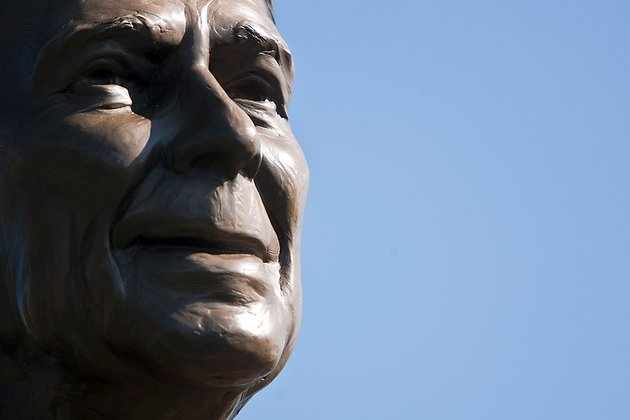
Ronald Reagan’s election in November 1980 set off celebrations in the well-to-do communities of Central America. After four years of Jimmy Carter’s human rights nagging, the region’s anticommunist hard-liners were thrilled that they had someone in the White House who understood their problems.
The oligarchs and the generals had good reason for the optimism. For years, Reagan had been a staunch defender of right-wing regimes that engaged in bloody counterinsurgency campaigns against leftist enemies.
In the late 1970s, when Carter’s human rights coordinator, Pat Derian, criticized the Argentine military for its “dirty war” — tens of thousands of “disappearances,” tortures and murders — then-political commentator Reagan joshed that she should “walk a mile in the moccasins” of the Argentine generals before criticizing them. [For details, see Martin Edwin Andersen’s Dossier Secreto.]
Despite his aw shucks style, Reagan found virtually every anticommunist action justified, no matter how brutal. From his eight years in the White House, there is no historical indication that he was troubled by the bloodbath and even genocide that occurred in Central America during his presidency, while he was shipping hundreds of millions of dollars in military aid to the implicated forces.
The death toll was staggering — an estimated 70,000 or more political killings in El Salvador, possibly 20,000 slain from the Contra war in Nicaragua, about 200 political “disappearances” in Honduras and some 100,000 people eliminated during a resurgence of political violence in Guatemala.
The one consistent element in these slaughters was the overarching Cold War rationalization, emanating in large part from Ronald Reagan’s White House.
Yet, as the world community punishes war crimes in the former Yugoslavia and Rwanda, no substantive discussion has occurred in the United States about facing up to this horrendous record of the 1980s.
Rather than a debate about Reagan as a war criminal, the former president is honored as a conservative icon with his name attached to Washington National Airport and with talk of having his face carved into Mount Rushmore.
When the national news media does briefly acknowledge the barbarities of the 1980s in Central America, it is in the context of one-day stories about the little countries bravely facing up to their violent pasts.
At times, the CIA is fingered abstractly as a bad supporting actor in the violent dramas. But never does the national press lay blame on individual American officials.
Truth Commission
The grisly reality of Central America was revisited on Feb. 25, 1999, when a Guatemalan truth commission issued a report on the staggering human rights crimes that occurred during a 34-year civil war.
The Historical Clarification Commission, an independent human rights body, estimated that the conflict claimed the lives of some 200,000 people with the most savage bloodletting occurring in the 1980s.
Based on a review of about 20 percent of the dead, the panel blamed the army for 93 percent of the killings and leftist guerrillas for three percent. Four percent were listed as unresolved.
The report documented that in the 1980s, the army committed 626 massacres against Mayan villages. “The massacres that eliminated entire Mayan villages … are neither perfidious allegations nor figments of the imagination, but an authentic chapter in Guatemala’s history,” the commission concluded.
The army “completely exterminated Mayan communities, destroyed their livestock and crops,” the report said. In the north, the report termed the slaughter a “genocide.” [Washington Post, Feb. 26, 1999]
Besides carrying out murder and “disappearances,” the army routinely engaged in torture and rape. “The rape of women, during torture or before being murdered, was a common practice” by the military and paramilitary forces, the report found.
The report added that the “government of the United States, through various agencies including the CIA, provided direct and indirect support for some [of these] state operations.” The report concluded that the U.S. government also gave money and training to a Guatemalan military that committed “acts of genocide” against the Mayans.
“Believing that the ends justified everything, the military and the state security forces blindly pursued the anticommunist struggle, without respect for any legal principles or the most elemental ethical and religious values, and in this way, completely lost any semblance of human morals,” said the commission chairman, Christian Tomuschat, a German jurist.
“Within the framework of the counterinsurgency operations carried out between 1981 and 1983, in certain regions of the country agents of the Guatemalan state committed acts of genocide against groups of the Mayan people,” Tomuschat added. [NYT, Feb. 26, 1999]
The report did not single out culpable individuals either in Guatemala or the United States. But the American official most directly responsible for renewing U.S. military aid to Guatemala and encouraging its government during the 1980s was President Reagan.
[Read more →]
November 5, 2011 Add Comments
More US Representative Stand-up for Human Rights in Bahrain
Two Cosponsors Added to Bahrain Arms Sale Resolution
POMED – 5 November, 2011
Two new cosponsors have been added to H.J. Res. 80, which calls for “limiting the issuance of a letter of offer with respect to a certain proposed sale of defense articles and defense services to the Kingdom of Bahrain.” The two cosponsors added are Representative Keith Ellison (D-MN) and Representative Jim McDermott (D-WA). Last week, two additional cosponsors were added to the resolution.
This comes as Bahraini security forces used tear gas and armored vehicles to disperse demonstrators marching towards the Pearl Square after the funeral of Ali Hasan al-Dehi. State Department spokesperson Victoria Nuland noted in the daily press briefing that ”We, the US, would encourage full transparency as this case proceeds and we obviously call on everybody to exercise restraint… It is a fragile time in Bahrain as all sides wait for the Bahraini independent commission of inquiry report.” …source
November 5, 2011 Add Comments
The Devils Own
For first time since ouster: Mubarak meets Arab leader
Published November 4th, 2011 – 16:16 GMT
In the first such visit by an Arab or foreign ruler since he stepped down on February 11, ousted Egyptian President Hosni Mubarak met earlier this week Bahrain’s King Hamad bin Issa, reports said on Friday. The rare meeting took place in Mubarak’s suite at the World Medical Center.
The visit lasted half an hour, during which Mubarak was crying. Their previous meeting was held a year ago. In that meeting, Mubarak voiced Egypt’s supports to Bahrain’s stability, independence and sovereignty.
According to an Egyptian newspaper, King Hamad bin Isa, has obtained an official permission to visit Mubarak. It is now expected that this visit will be followed by visits of a number of princes from the Gulf region. It is believed that in recent times, Mubarak’s wife has stepped up her contacts with a number of princes, kings and heads of state, to notify them about his deteriorating health conditions. Following the visit, the Bahraini leader decided to participate in the costs of treating Mubarak. He also expressed his readiness to fund the arrival of the German doctors who operated Mubarak last year. …source
November 5, 2011 Add Comments
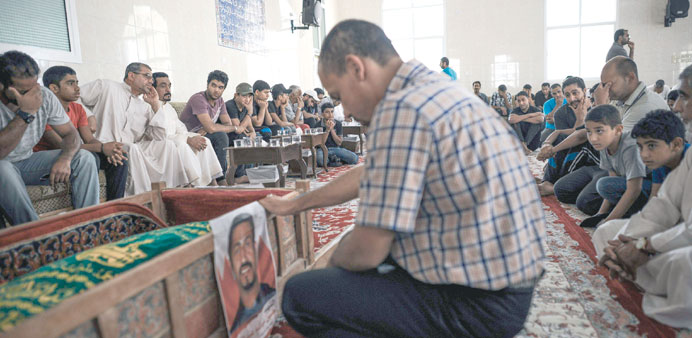
Bahrain State attack on funeral of 78 year old, Ali Hasan al-Dehi
More on the Bahrain State attack on funeral of 78 year old, Ali Hasan al-Dehi, on The Lede HERE
November 5, 2011 Add Comments
The all too familiar attack on Funeral March of 78 year old, Ali Hasan al-Dehi , beating to death by Security Forces
Tear gas used to disperse protesters after funeral of father of opposition leader, 78 year old, Ali Hasan al-Dehi was beaten to death by Security Forces police on his return home.
November 5, 2011 Add Comments
Obama are these the Armored Vehicles you want to sell to King Hamad? Of course you they won’t be used against Protesters
Bahrain national guard deploys armored vehicles to prevent funeral march by by mourner of 78 year old, Martyr Ali Hasan al-Dehi who was beaten to death. 4 November, 2011.
November 5, 2011 Add Comments
Balancing Act, code words for blood feast of oil and weapons greed
America’s Unsavory Allies
A look at the some of the bad guys the U.S. still supports.
BY URI FRIEDMAN | OCTOBER 28, 2011
The U.S. caught a lot of flak this year for having partnered with Tunisia’s Zine el-Abidine Ben Ali, Egypt’s Hosni Mubarak, Yemen’s Ali Abdullah Saleh, and Libya’s Muammar al-Qaddafi before uprisings rocked the Middle East. But in his speech on the Arab Spring in May, President Barack Obama suggested that the days of America narrowly pursuing its interests in the region without the broader priority of promoting reform and democracy were over. “We have embraced the chance to show that America values the dignity of the street vendor in Tunisia more than the raw power of the dictator,” Obama declared.
Not entirely. Sometimes, it’s difficult to reconcile that revamped formulation of American foreign policy with diplomatic realities. Take two events this week. On Thursday, the Washington Post reported that the U.S. is operating a drone base in Ethiopia, a country Freedom House recently downgraded to “Not Free” because of “national elections that were thoroughly tainted by intimidation of opposition supporters and candidates.” Only days earlier, Secretary of State Hillary Clinton visited the autocratic Central Asian leaders Islam Karimov and Emomali Rakhmon to discuss how they can help with the war in Afghanistan. “If you have no contact you will have no influence, and other countries will fill that vacuum who do not care about human rights,” Clinton explained ahead of her visit, adding that “it’s a balancing act.”
In fact, even with its post-Arab Spring foreign policy, the U.S. is still engaged in that controversial “balancing act” with a number of repressive leaders. Let’s take a look at eight of the worst offenders. …more
November 4, 2011 Add Comments
In Bahrain “doing the right thing” can cost your life or worse yet, the lives of your family
In Praise of a Bahraini Police Officer
11-4-2011 – By Brian Dooley – Director, Human Rights Defenders Program
Remember that photo from Tiananmen Square in 1989 where the guy with the shopping bags stands in front of the column of tanks? It’s an inspirational image – the unarmed man defying four tanks.
There are really two heroes in that picture. The man with the shopping bags and the man in the tank who refuses to shoot him or run him over. Protestors were being killed in and around Tiananmen Square that week and it wouldn’t have been unusual if the tank had opened fire on the unarmed man.
But the guy in the tank held his fire, possibly defying orders from his superiors. The tank commander’s career, and possibly his life, were on the line. And he did the right thing. When police officers or soldiers refuse to commit human rights abuses it’s particularly impressive – these people have everything to lose by disobeying orders in the name of conscience.
Ali Jasim Al Ghanmi
During the Arab Spring, we’ve seen it in Syria. One Syrian soldier explained how he was sent to an area of unrest. “We received the order from our officers to shoot at anything that moved, even unarmed children and the elderly in Harasta. We got close to them, we threw our weapons on the ground and the people protected us. When our officers saw that, they opened fire on us. One of my colleagues was hit in the shoulder but we succeeded in taking him into hiding.” Some Libyan soldiers were reportedly executed for refusing to fire on protestors in February.
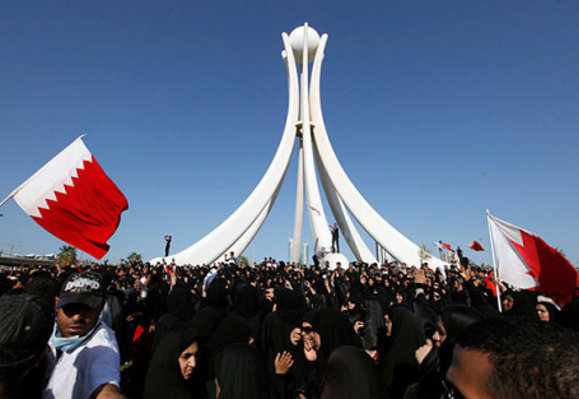
In Bahrain, too, an unknown number of the security forces have been detained for joining the calls for democracy and refusing to join the regime’s violent crackdown. Bahrain is ruled by a monarchy, and in February hundreds of thousands of protestors congregated to demand political reform.
Bahrain is an increasingly volatile state, and its violent crackdown continues. Foreign Policy Magazine last week named it as one of the U.S.’s ‘Unsavory Allies,’ right up there with Equatorial Guinea and Uzbekistan as embarrassing friends.
Ali Jasim Al Ghanmi is a 25 year-old policeman, married with a daughter. On February 17 he heard that protestors in Bahrain were being shot by the security forces – he went to the hospital and helped the medics treating the wounded.
Dressed in his uniform, he went to the crowd of protestors and publicly announced he would no longer work for the repressive dictatorship. He was carried on the crowd’s shoulders and became a mini-celebrity among the protestors, impressed that a policeman would take such a stand.
He went into hiding after the security forces attacked and removed the protestors from the central protest area of the Pearl Roundabout in mid-March. His family said they received threats that he had to turn himself in. He was eventually discovered on May 4 and arrested. His family says their house was raided twice after that date anyway, and his brothers and mother assaulted.
Ali claims he was tortured in detention and, since September 24, has been put in solitary confinement as punishment for shouting ‘Down, down, Hamad’ in the prison yard – the chant of protestors against the country’s king. He is waiting to be tried on charges including Inciting hatred against the regime, Inciting military personnel against the regime and Absence from duty.
People like Ali Jasim Al Ghanmi, who put conscience above all else, are heroes of the Arab Spring, and they should not be forgotten.
November 4, 2011 Add Comments
In bid to preserve hegemony, US moves to project more aggressive force in Gulf, GCC signs on to become US-Saudi ‘Gulf Coopted Council’
U.S. Planning Troop Buildup in Gulf After Exit From Iraq
By THOM SHANKER and STEVEN LEE MYERS – October 29, 2011 – NYT
MacDILL AIR FORCE BASE, Fla. — The Obama administration plans to bolster the American military presence in the Persian Gulf after it withdraws the remaining troops from Iraq this year, according to officials and diplomats. That repositioning could include new combat forces in Kuwait able to respond to a collapse of security in Iraq or a military confrontation with Iran.
Related
The plans, under discussion for months, gained new urgency after President Obama’s announcement this month that the last American soldiers would be brought home from Iraq by the end of December. Ending the eight-year war was a central pledge of his presidential campaign, but American military officers and diplomats, as well as officials of several countries in the region, worry that the withdrawal could leave instability or worse in its wake.
After unsuccessfully pressing both the Obama administration and the Iraqi government to permit as many as 20,000 American troops to remain in Iraq beyond 2011, the Pentagon is now drawing up an alternative.
In addition to negotiations over maintaining a ground combat presence in Kuwait, the United States is considering sending more naval warships through international waters in the region.
With an eye on the threat of a belligerent Iran, the administration is also seeking to expand military ties with the six nations in the Gulf Cooperation Council — Saudi Arabia, Kuwait, Bahrain, Qatar, the United Arab Emirates and Oman. While the United States has close bilateral military relationships with each, the administration and the military are trying to foster a new “security architecture” for the Persian Gulf that would integrate air and naval patrols and missile defense. …more
November 4, 2011 Add Comments
GCC Security Strategy Emerges as Unified Block Against Internal Dissent
The GCC shows its true colors
By Mohammed Ayoob – March 16, 2011 – Foreign Policy
Two-thousand Gulf Cooperation Council (GCC) troops, most of them from Saudi Arabia, entered Bahrain on Monday — ostensibly to provide security to government installations “threatened” by protestors. In fact, such a show of force, with more troops on the way, is an attempt by the Saudi-led GCC to stiffen the resolve of the ruling house in Bahrain to put down the democracy protests if need be with force. The violence unleashed by the Bahraini army and police against peaceful protestors on Tuesday was the direct outcome of the Saudi/GCC military intervention.
Various interpretations have been put forward as to the reasons behind the Saudi-led military intervention. These include pre-empting the emergence of a pro-Iranian, Shia-dominated government in Bahrain and tilting the balance in favor of the hard-line faction among the al-Khalifa and against the more moderate faction allegedly led by the crown prince.
What is missing from these explanations is a discussion of the essential nature of the GCC that has propelled it to intervene in the internal affairs of a member country. The Gulf Cooperation Council was established in 1981 in the wake of the Iranian revolution, ostensibly to promote economic cooperation and defend its members against external threats. However, it quickly became clear that given the similar nature of oil producing rentier economies in the Gulf, talk about increasing economic exchange was merely a façade. So was the argument that the Gulf monarchies needed an organization to coordinate their external security policies. The only act of major security cooperation they engaged in was to supply billions of dollars to the Saddam regime in Iraq, first to help it invade Iran in 1980 and then to stave off an Iranian victory that seemed imminent between 1982 and 1984.
Their lack of capacity to protect themselves against external threats was clearly demonstrated in 1990 when Iraq occupied Kuwait. Despite the billions spent by Saudi Arabia in particular to acquire state of the art weaponry from the United States, the kingdom had to invite in a half million American troops to defend itself and eventually force Iraq out of Kuwait. It was clear that the Gulf monarchies, above all Saudi Arabia, the largest and most powerful among them, were incapable of defending themselves against external threats, actual or presumed, without American boots on the ground.
The real reason for the establishment of the GCC in 1981 was not defense against external enemies threatening the security of GCC states but cooperation against domestic challenges to authoritarian regimes. Its main task was and continues to be coordination of internal security measures, including sharing of intelligence, aimed at controlling and suppressing the populations of member states in order to provide security to the autocratic monarchies of the Persian Gulf. The establishment of the GCC was in large measure a reaction on the part of the Gulf monarchies to the Iranian revolution of 1979 in which people’s power toppled the strongest autocracy in the neighborhood. The Arab autocracies of the Gulf did not want to share the Shah’s fate.
That ensuring the security of autocratic regimes was the principal reason for the existence of GCC has become crystal clear with the military intervention by Saudi-led forces in Bahrain to put down the democracy movement and prevent the freedom contagion from spreading to other parts of the Gulf. It is true that the Saudis are apprehensive of the Shia majority coming to power in Bahrain because of the impact it could have on its own restive Shia minority in the oil-rich east of the country. Riyadh is also worried about the impact of a change in regime in Bahrain on the balance of power between Saudi Arabia and Iran in the region. (One can, however, argue that Saudi military intervention in Bahrain’s affairs will in fact redound to Iran’s benefit in the long run by further de-legitimizing the al-Khalifa rule in Bahrain).
But these are secondary explanations. The primary concern of the Arab autocracies in the Gulf is the suppression of democratic movements regardless of the sectarian character of the populations engaging in democratic struggles. They are worried that if any of the autocracies fall or even reach a substantial compromise with democratic movements it will have a domino effect in the entire Gulf region consigning all of them to the dustbin of history. The GCC was established as an instrument to protect and prolong autocratic rule on the Arabian littoral of the Gulf. Its military operation in Bahrain has clearly shown this true colors.
Mohammed Ayoob is university distinguished professor of international relations at Michigan State University. …source
November 4, 2011 Add Comments
Amal, First Political Party in Bahrain and the Region under Kangaroo Military Trials
Amal, First Political Party in Bahrain and the Region under Kangaroo Military Trials
A Brief Report on The attack and Detention of Amal Political Society Leadership
On the second of May 2011, around two o’clock early morning, a special team of the so-called national security of Bahrain raided the house where AlMahfoodh and his two sons were living with his friend’s house in Jabalat-Habshi . The members of the team were all masked and fully armed with electric-shock weapons and with different types of personal guns and pistols, and they were accompanied by some members of the police. The masked armed people were around 40 persons and they just raided the house of one of the friend of AlMahfoodh . The team members attacked the house by sneaking from the roofs of the house and broke the entrances to only break everything and destroy every piece of furniture in the house.
The members of the national security team attacked AlMahfoodh with his two sons, and his friend, beating them violently with hoses, sticks, boxes and kicks. They also assaulted them verbally with bawdy language and cursed them and their Shiite faith. The house was destroyed totally, and even the fences of the stairs were broken and thrown away. Much property was stolen from the house from perfumes and watches, to money and jewelry. After some time, the four of them were taken in separate cars with their eyes covered to unknown destinations.
After around a month and a half, the family of AlMahfoodh received a phone-call from him and it lasted for 6 minutes. He did not know where he was, and he did not recognize the date or time at that moment. In addition, he could not speak about any of his being subject to torture; neither could he speak about his health. The whole family was very concerned because his voice was very thin and his focus was not acceptable.
After a bit less than two months, the family received a call from the National Security, and they were told to have a visit with their detainee in the Prison of “DryDock Center of Detention”. The visit allowed only 4 of his family members, not allowing any access to personal stuff or requirements such as toothpaste and shampoo. The visit lasted for 10 minutes where the detainee and the family were accompanied by 6 of the national security guards. Prior to the detainee’s entrance,the family was told that the conversation allowed is limited to the family status only,without any reference to the political situation or anything else. The family was asked to appoint a lawyer to speak for AlMahfoodh in the First Hearing of the Military Court – which was only after 4 days of meeting the detainee. See full report on Amal Leaders for Freedom HERE
November 4, 2011 Add Comments
Bahrain Atrocities and Brutal Crackdown Continue, Rights Organisations Warn
Bahrain: Atrocities and Brutal Crackdown Continue, Rights Organisations Warn
By Anissa Haddadi – November 3, 2011 – IB Times
Activists in Bahrain say that protests against the regime are on-going despite the targeting of civilians by the security forces. The Kingdom’s forces are accused of arresting, and attacking civilians and the Bahrain Centre for human’s rights (BCHR) say that many protesters are being hit in the chest or heads, with several cases of protesters losing their eyes being reported.
While the protests in Syria continue to grab the headlines, less is being said about the current situation in Bahrain. According to rights activists however demonstrations are on-going and so is the brutal crackdown by the regime.
According to The Bahrain Freedom Movement demonstrators took to the street Wednesday to continue protesting against the regime in the cities of Duraz, Samaheej, Daih, Karbabad and Dair with slogans reportedly including “If you become more cruel we will become more determined”.
While reports mention attacks on protesters by the regime’s riot police others say demonstrators had been attacked by armed mercenaries, while villages are also being raided and protesters taken away.
Following months of violence protests now include demands for regime change, the liberation of jailed activists or simply protests against attacks on villages and villagers.
While the regime’s forces were accused of using live ammunitions on demonstrators when the protests first started, reports suggest they have now turned to other weapons directly used against the protestors.
“Government forces use different weapons like birdshot gun, tear gas, stun grenades and rubber bullets in their attacks,” the Bahrain Centre for Human Rights says.
BCHR reports several cases where civilians taking parts in the protests have lost their eyes and have been forced to live in hiding, fearing that their injury would then make them an even greater target of the security forces.
Among them is Mohammed Yusuf Abu-Saada, who was shot in the eye during a protest and kicked repeatedly by the security forces.
The hospital report states that “patient was involved in demonstrations where he was assaulted with bullet injury to his right eye and was beaten and kicked on the right side of face by police,” BCHR reports.
According to the organisation the police now systematically targets protesters injured during the demonstrations by arresting them when they are taken to hospital.
The centre cites the case of Jaffar Salman, who had been injured on 15 March 2011 and lost both of his eyes. Salman was reportedly arrested by the police when taken to Salmaniya hospital, detained by the regime’s forces and then taken to court.
During his brief trial, he was not given the right to speak, was prevented from having a lawyer or his family with him and was sentenced to two years in prison.
“His family has not visited him in months because he told them he gets tortured and humiliated before and after every visit. His family say that when they did visit him, his 4 year old twins were not allowed to have any physical contact with their father. In most recent phone call Jaffar told his wife that he is not getting treatment for his eyes and that he worries as their condition gets much worse” the organisation points out.
The recent revelations come as Charif Bassioni , an imminent Cairo-born international United Nations war crimes expert, often called “the Father of International Criminal Law”, is due to publish the report of the Bahrain Independent Commission of Inquiry (BICI).
The commission was established by the ruler of Bahrain, King Hamad bin Isa Al Kahlifa of Bahrain, to look into the incidents that occurred in the kingdom during the period of unrest in February and March 2011.
With the recent revelations suggesting that the ‘incidents’ are still occurring, activists are waiting to see whether the report, expected on the 23rd of November will shed a light on the past and on-going atrocities conducted on civilians. …source
November 3, 2011 Add Comments
Detainees Remain in Bahrain’s Torturous Prisons
A special report on the torture and human rights violations against the detainees in the case of “Alliance for the Republic”
See Full BCHR Report HERE
All the defendants insisted that what they have done was only practicing their legitimate right to freedom of expression and peaceful assembly calling for civil, political, economic and social rights to all the people. Moreover, all their activities did not go beyond the frame of peaceful actions.
This brief report outlines some of what these activists have suffered with torture and human rights violations since their arrest until the time of writing of this report. It includes the following:
I. Violations during the arrest and detention.
II. Torture at the National Security Apparatus (Al Qal’ah).
III. Physical and psychological torture at the military prison (Al Grain).
IV. Violations related to the interrogations done by the National Security Apparatus and the Military Prosecution.
V. Violations related to trials before the Military Court.
VI. Vengeance on relatives of the detainees.
I. Violations during the arrest and detention:
All fourteen detainees in this case said that their arrests took place by raiding their houses or houses of their relatives after midnight. They had not been summoned or informed that they are wanted by any authority. No documents of a judicial warrant for their arrest or search were presented. The following are some examples of detainees’ testimonies about the detention process:
…MORE
November 3, 2011 Add Comments
Bahrain: Medics Describe Torture in Detention
Bahrain: Medics Describe Torture in Detention
October 21, 2011 – BCHR
Ill-Treatment, Torture in Detention
Authorities arrested Dr. Rula al-Saffar, 48, head of the Bahrain Nursing Society, on the evening of April 4 after summoning her to the Ministry of Interior’s Criminal Investigation Directorate (CID). She told Human Rights Watch:
I was handcuffed and blindfolded [and] interrogated for seven days. The interrogations started at 3:30 pm and went on until 5 or 6 a.m. the next day. I was electrocuted in my face and my head. They said, “We are going to rape you.” I was held in a very cold cell. They turned on the air conditioner, which made the cell even colder and I had no blanket. They forced me to stand and sit for long hours on the dirty floor.
Al-Saffar said interrogators forced her to sign a confession that she encouraged people to protest, refused treatment to Sunni patients, and stole blood from the blood bank so that protesters could simulate wounds. After 17 days, authorities transferred her to the Women’s Detention Center in Isa Town, where she was held until her release on bail on August 21. Al-Saffar said that during more than four months in detention she was allowed to speak with her family only once, for three minutes, and to meet with them another time for one hour. The special military court sentenced her to 15 years in prison.
Fatima Haji, a rheumatologist sentenced to five years in prison, was arrested on April 17 and held for 22 days. She said interrogators forced her to sign a document saying she had not been tortured and that she would not talk to the international media. She has written about her time in detention on doctorsinchains.org.
[The men started] asking me the size of my underwear, and the size of my bra. [One of them] kept asking me and I [was] not answering and he was hitting my head. My eyes were [in tears] … Then they started making fun and joking about my breast size. Then one of them asked me, “When [was] the last time you saw your husband?” I said, “Two or three days ago.” He said, “So you didn’t have sex for the last two or three days, it seems you want someone to do it with you right now.”
Dr. Ali al-Ekri, 44, told Human Rights Watch that men in military uniforms arrested him on March 17, while he was in the Salmaniya operating room. The special military court sentenced al-Ekri to 15 years on charges of possessing weapons and forming an organization to topple the regime. “I spent 14 days in solitary confinement,” he told Human Rights Watch.” I was constantly beaten by cables, hoses, and fists. One time I was forced to stand up for 24 hours.”
Dr. Ghassan Dhaif, 45, an oral and maxillofacial surgeon at Salmaniya, was arrested on March 19 at Bahrain International Airport while attempting to travel to the United Kingdom with his wife, Dr. Zahra al-Sammak, and their three children. He told Human Rights Watch that he was taken to a room at the airport where masked men in civilian clothes beat him. They then transferred him to the Interior Ministry’s Criminal Investigation Directorate (CID), where he was blindfolded and handcuffed from behind for 21 days.
I spent seven days in a solitary confinement [cell] that was 6 feet by 5 feet. I was blindfolded and handcuffed from behind and was sleep-deprived … I was not allowed to go to the toilet, that is why I had to pee in my pants. I was not allowed to sit or sleep. I collapsed several times. I was beaten every hour … what really hurt was [when] they would cover my ear, temple, and my neck then they would hit me with their hands.
On April 8, Dhaif said, authorities interrogated him for 10 hours uninterruptedly, during which they severely beat him. “I was not allowed to sit or drink water,” he said. “At one point, I was asked to sit down facing the wall. All of a sudden someone kicked my back. I felt like my back was broken.” The same day, after he was hospitalized for a few hours for his back pain, he was forced to sign a confession about 40 pages long.
Dr. Basim Dhaif, 47, brother of Ghassan Dhaif, was arrested at his home on the evening of March 19 by security forces. He told Human Rights Watch:
I was insulted and beaten in front of my wife and children at my home. In detention I was forced to stand for more than 12 days except [when] eating. I was blindfolded and handcuffed from behind … in total I was tortured for 26 days in CID. Eventually I was forced to sign confession papers under threat that they will hurt my family. I didn’t know what the contents [of these papers were].
Zahra Al-Sammak, 45, an anesthesiologist at Salmaniya sentenced to 5 years in prison, and Nada Dhaif, a dentist sentenced to 15 years, also told Human Rights Watch that they were ill-treated in detention.
On September 7, the authorities released al-Ekri and the other medics still in detention on bail, including Ghassan and Basim Dhaif. …source
November 3, 2011 Add Comments
Ever wonder who trains those who run the Prisions? Reminescent of CIA Trained SAVAK
International Committee of The Red Cross
Report on Treatment of “High Value” Detainees
February, 2007
Main Element of the CIA detention Program
1.1. Arrest and Transfer
1.2 Continuous Solitary Confinement and Incommunicado Detention
1.3 Other Methods of Ill-treatment
1.3.1 Suffocation by Water
1.3.2 Prolonged stress standing
1.3.3 Beating by use of a collar
1.3.4 Beating and kicking
1.3.5 Confinement in a box
1.3.6 Prolonged nudity
1.3.7 Sleep deprivation and use of loud music
1.3.8 Exposure to cold temperature/cold water
1.3.9 Prolonged use of handcuffs and shackles
1.3.10 Threats
1.2.11 Force Shaving
1.3.12 Deprivation/restricted provision of solid food
1.4 Further Element of the Detention Regime
2.0 Conditions of Detention in Later Stages
3.0 Health Provision and Role of Medical Staff
4.0 Legal Aspect Related to Undisclosed Detention
5.0 Fate of Other Persons who Passed Through the CIA Detention Program
Conclusion
Annex 1.
Annex 2.
Read Report HERE
November 3, 2011 Add Comments
Elderly Shiite, family member of Opposition Leadership, ‘beaten to death’ by Bahrain State Terrorists
Elderly Shiite ‘beaten to death’ by Bahrain police
The Shiite group Al-Wefaq declares the death of one of its prominent leaders after police forces attacked him, being one of many aggressions committed by the Sunni regime against the opposition Shiites
AFP , Thursday 3 Nov 2011
The elderly father of the second in command of Bahrain’s largest Shiite opposition group Al-Wefaq died of his injuries on Thursday after riot police attacked him a day earlier, the organisation said.
“Ali Hasan al-Dehi, 70, was attacked by riot police forces Wednesday evening” and died early Thursday, Al-Wefaq’s website reported.
His son, Hussein al-Dehi, is deputy head of Al-Wefaq.
The statement said the elder Dehi had told one of his sons, who had arrived home to find him on the floor, that “he had been beaten by riot police.”
Al-Wefaq member and former MP Sayed Hadi Moussaoui told AFP police were dispersing a protest in the western village of Dehi, when the man was attacked.
Moussaoui said members of Dehi household were harassed several times by the authorities, adding that the dead man’s wife had been “insulted” in the past without giving further details.
Earlier this year, Bahrain’s Sunni monarchy crushed pro-democracy protests, spearheaded by the majority Shiites, with the help of troops from other Gulf states, such as Saudi Arabia.
Twenty-four people died during the crackdown, between mid-February and mid-March, according to official figures from Manama.
Four protesters have since died in custody.
The Gulf kingdom is awaiting a report by an independent commission of inquiry into the crackdown, which is expected on November 23.
Though mass protests have ended, tensions remain high as the trials of dozens of opposition figures and protesters continue in the capital. …source
November 3, 2011 Add Comments
Hajj Ali Hassan, 70, dies after being beaten by Secuirty Forces while returning home last night
More protests as the latest martyr is buried; an elderly Bahraini
Bahrain Freedom Movement – 03/11/2011
An elderly man was martyred this morning after being pursued and hit by members of the Death Squads operated by the royal court. Hajj Ali Hassan, 70, was returning home last night when he was set upon by those heavily-armed killers.
There was a protest against the regime near his house at the time. He was spotted by one of his sons as he opened the front door of the family’s house. The elderly man was unconscious for a short while with blood coming out of his mouth and head and soaking his clothes. Few minutes later he woke up and was askedd: Have you been attacked? He said: Yes. He was immediately transferred to Al Nu’aim Hospital where photos taken by his relatives show him in a bad state with blood on his clothes. He was immediately transferred to Salmaniya Hospital (which is run by the military) where he died a short time later. It is now clear that after the beating he had received, he was so frightened by the scene and the attacks that he went into coma before being transferred to the other hospital. He remained at the Intensive Care Unit for a short while before he passed away. This is yet another tragic case in which a Bahraini citizen was murdered for being at the wrong place at the wrong time, facing the murderous gangs operated by the regime. His son, Sheikh Hussain Al Daihi is a senior figure of Al Wefaq Society. On Tuesday the body of another martyr; Riyadh Abdulla Rashid, 45, had been buried after he had succumbed to wounds inflicted by the regime’s forces. He had lost the sight of one eye as a result of beating.
[Read more →]
November 3, 2011 Add Comments
Bassiouni Systematic Torture – No discovery, No Revelation, US DOS need only read it’s own reports on Bahrain Human Rights
Department of State – 2010 Human Rights Report: Bahrain
Bureau of Democracy, Human Rights, and Labor
2010 Country Reports on Human Rights Practices
Torture and Other Cruel, Inhuman, or Degrading Treatment or Punishment
The constitution prohibits such practices; however, there were multiple allegations during the year that security forces employed them. On February 8, Human Rights Watch (HRW) issued a report asserting that “since the end of 2007, officials have repeatedly resorted to torture for the apparent purpose of securing confessions from security suspects.” The former detainees interviewed for the report claimed that security officials and prison guards subjected them to “abusive tactics” during interrogation. In some cases in 2009, Ministry of Health doctors found corroborative evidence of injuries that matched the detainees’ claims of mistreatment. According to senior government officials, the government initiated an investigation of HRW’s allegations. At year’s end the government had not published the investigation’s findings.
From August to December, local and international human rights NGOs asserted that security personnel had tortured more than two dozen detainees. During court proceedings from October to December, many of these detainees claimed that officers of the National Security Agency mistreated and tortured them. Detainees claimed that they had been beaten, suspended in painful positions, forced to stand for long periods, deprived of sleep, and subjected to electric shocks. During trial proceedings in October and November, defense lawyers requested an independent investigation into the torture allegations, to include independent medical exams. The prosecutor asserted in December that claims of torture had been investigated. At year’s end neither the court nor the government had released the findings of any such investigation.
Local human rights organizations and lawyers also reported alleged instances of abuse by law enforcement authorities in connection with the approximately200 men and juveniles detained between August and December.
Local human rights activists and attorneys alleged that many of the 23 Shia activists arrested in August and September and charged pursuant to counterterrorism legislation, including a prominent blogger, were beaten, subjected to electric shocks, hung upside down, and beaten on their feet (falaqa). During court sessions in October, November, and December (see section 1.e.), all detainees claimed they were beaten by National Security Agency officers, with some claiming they were subjected to electric shocks, made to stand for long periods of time, and made to sign confessions during or after mistreatment or torture. …source
November 2, 2011 Add Comments
Bassiouni reveals Bahrains great hidden secret, “torture going on for last two hunderd years is systematic” – the Charade goes on…
Bahrain rights probe head says torture systematic
Tue Nov 1, 2011- Reuters secret
DUBAI (Reuters) – Bahrain said on Tuesday it would push ahead with parliamentary reforms it hopes will end unrest in the Gulf Arab country in an announcement that came a day after the head of a rights commission said he had found evidence of systematic abuse.
The justice minister said constitutional amendments based on the results of a national dialogue launched this year to discuss reforms in the island kingdom would be presented to parliament after the Muslim Eid al-Adha holiday, which falls next week.
The statement came a day after the head of a fact-finding mission set up to investigate allegations of human rights violations in Bahrain during months of unrest said he now believed torture had been a systematic, though limited, policy.
The commission is due to present its final report to King Hamad on November 23. Several months ago Cherif Bassiouni had said he did not believe maltreatment was systematic, comments that provoked an angry reaction from majority Shi’ites in the Sunni-run kingdom.
“It is not possible to justify torture in any way, and despite the small number of cases, it is clear there was a systematic policy,” Bassiouni said in an interview with Egyptian daily Almasry Alyoum on Monday.
“I investigated and I found 300 cases of torture and I was helped in that by legal experts from Egypt and America.”
Bahrain crushed a pro-democracy protest movement earlier this year which was led mainly by Shi’ites, saying the uprising was sectarian in motive and backed by Iran.
Around 40 people have died, more than 1,000 detained and thousands lost their jobs in the unrest, which has continued despite the reforms promised by the national dialogue.
Bahrain invited an independent panel of high-profile international lawyers to look into protests and crackdown. …more
November 2, 2011 Add Comments
al Khalifa regime crackdown scatters burning embers as fire of Revolution burns brighter
Bahraini Opposition Figure: Suppression of Protesters Backfires
02/11/2011 – Bahrain Freedom Movement
(FNA)- A prominent Bahraini political activist and opposition figure blasted the continued suppression of peaceful protesters in the tiny Persian Gulf island and warned the Al Khalifa regime that its suppressive tactics would backfire. “Bahrain’s authorities are seeking to bring the nation to their knees through suppressive actions but the regime’s policy will backfire,” member of the Society for Supporting Bahraini People Qassem al-Hashemi told FNA on Wednesday.
He lashed out at Al Khalifa’s brutal behavior towards protesting women, and stated, “Detention and torture of women by Bahrain ruling regime means crossing all the redlines and would be a milestone signifying the end of the Al Khalifa regime.” Hashemi condemned the violation of women rights by the Manama regime and reiterated, “The Bahraini regime has turned the page for its own collapse through such aggressive actions and its end and collapse is now definite.”
Earlier, the Muslim Women Movement in a recent statement had protested against the brutal and cruel behavior of the Bahraini regime towards women in the country, and revealed that the Al-Khalifa regime has imprisoned innocent pregnant women in horrible dungeons. “They keep pregnant women in terrifying prisons, martyr their husbands under torture and attack people’s homes at night and create panic and horror,” the statement said in April, addressing UN Secretary-General Ban Ki-Moon.
The statement condemned the silence shown by the international organizations on the massacre of the Bahraini and Yemeni people by their tyrannical rulers, and said “Hundreds of the Yemeni and Bahraini women are in prison for the ambitions of their bullying rulers.” Anti-government protesters have been holding peaceful demonstrations across Bahrain since mid-February, calling for an end to the Al Khalifa dynasty’s over-40-year rule.
Violence against the defenseless people escalated after a Saudi-led conglomerate of police, security and military forces from the Persian Gulf Cooperation Council (PGCC) member states – Saudi Arabia, Kuwait, the United Arab Emirates, Oman and Qatar – were dispatched to the tiny Persian Gulf kingdom on March 13 to help Manama crack down on peaceful protestors.
Yet, protests and rallies continued throughout the country in defiance of the martial law put in place by Manama since last month. People have announced that they will continue protests until the regime collapses. ….source
November 2, 2011 Add Comments
New Mexico, Sun News Stands-up in Solidarity with Bahrain
Their View: Standing for freedom in Bahrain
10/31/2011 – WP Editorial Republished by Silver City, New Mexico – Sun News
The following editorial appeared in the Washington Post:
The beleaguered reformist faction within Bahrain s ruling al-Khalifa family has good reason to thank the U.S. Congress. Until this month the Obama administration, which has enormous leverage over the Persian Gulf emirate, was blithely ignoring Bahrain s crackdown on domestic opposition and its failure to implement promised reforms.
Even as the regime staged unfair trials of peaceful opponents in special security courts, dismissed thousands from government jobs for participating in protests and violently repressed demonstrations in restless villages, the administration notified Congress in September that it intended to sell Bahrain $53 million in military equipment, including 40 armored Humvees.
Set aside for the moment the fact that Bahrain, an island nation that hosts the U.S. Fifth Fleet, has no plausible use for armored vehicles other than against its own people. The sale sent the message to the regime s hard-liners that domestic repression would not damage relations with the United States. Little surprise that, not long afterward, 20 doctors and nurses who had treated injured protesters were sentenced to lengthy prison terms after a grossly unfair trial.
Fortunately, Bahrain s abuses — documented and denounced by every major Western human rights group — prompted a reaction in Congress. Legislation was introduced to block the arms sales, and a group of five Democratic senators, led by Robert P. Casey Jr., Pa., wrote to Secretary of State Hillary Rodham Clinton on Oct. 12 to ask that the sale be put on hold. A separate letter was dispatched by Sen. Marco Rubio, R-Fla.
The senators got a response. On Oct. 14, the State Department wrote to Casey to say that the administration would not proceed with the sale until after the independent international commission appointed to investigate the unrest in Bahrain — with the regime s cooperation — issues its report, scheduled for Nov. 23. Bahrain, meanwhile, was backpedaling: even before the senators letters were sent, the doctors sentences were nullified and their cases transferred to civilian court. The pro-reform foreign minister traveled to Washington to assure Congress that the commission s recommendations will be followed.
This is progress — but there is a distinct danger that the promises of the Khalifas and the State Department will prove hollow. The credibility of the commission has been under question ever since its Egyptian-born chief appeared, in an Aug. 8 interview, to preemptively clear the Bahraini government of a policy of using excessive force or torture. The regime has failed to deliver on pledges made by its reformists in previous trips to Washington.
Rather than tying itself to this uncertain process, the United States should set its own conditions for continued good relations with Bahrain. These should include accountability for the torture and killing of protesters; the release of all political detainees; and the initiation of meaningful political reform that enfranchises the country s Shiite majority. The current status quo in Bahrain is unsustainable; reinforcing it with U.S. military sales would be foolish as well as unconscionable. …source
November 2, 2011 Add Comments