Virtual Broadcasting – Revolution not to be silenced – Bahrain satellite channel jammed, launches on Livestation instead
Bahrain satellite channel jammed, launches on Livestation instead
Sunday August 14, 2011, Nancy Messieh
Livestation, launched in 2008, gives users an easy way to keep up with major news channels including Al Jazeera, BBC and CNN, from their computers, or on the go using the iPhone app or mobile site.
Livestation seems to be earning itself a reputation as the go-to site for opposition groups in the Middle East who want to provide users with an alternative to state-run media.
Much has been made of the Internet’s role in the Arab spring, but the site’s role has largely gone unnoticed. Aside from Al Jazeera, Livestation hosts two channels of great significance to the region. Libya TV, based in Qatar, is described on Livestation as “the first independent satellite channel broadcasting news and commentary about Libya for a Libyan audience with the aim of countering state propaganda and promoting dialogue.” Libya TV is now joined by the London based Bahraini channel, LuaLua TV, launched a couple of days ago.
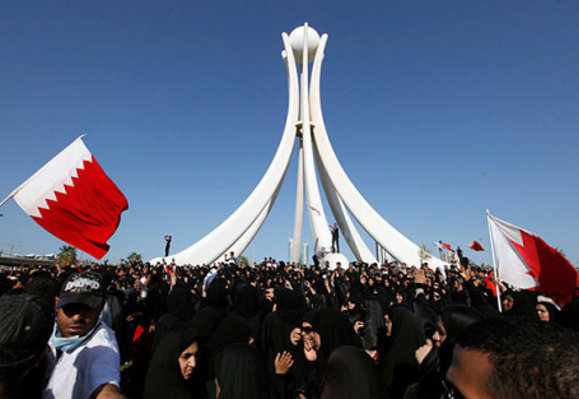
LuaLua (which literally means pearl) takes its name from the roundabout that was witness to the first protests in Bahrain in February of this year, until it was destroyed by the government barely one month later. A Bahraini expat living in London, Yasser El Sayegh chose the name for what he originally envisioned as a satellite channel, which he intended to use as a platform to broadcast a balanced and fair view of current affairs, exploring both governmental and opposition opinions. …more
August 14, 2011 Add Comments
What to do About Bahrain? A Headache For Both Obama and Blatter
What to do About Bahrain? A Headache For Both Obama and Blatter
Written by James M. Dorsey
US president Barak Obama and Sepp Blatter, the head of world soccer body FIFA, share the same headache: what to do about Bahrain?
So far, Messrs. Obama and Blatter have essentially shied away from confronting the issue of the suppression of pro-democracy demonstrators, including some of the country’s most prominent soccer players.
The protests in February and March that started with Shiites and Sunnis standing shoulder to shoulder were an expression of frustration about years of failed dialogue over the need for more equitable housing and land policies, fairer representation in parliament and constitutional reform.
The crackdown and the government’s insistence that Iran had instigated the protests aided by a Shiite fifth column transformed the situation into one of sectarian tension. To be sure, there was violence on both sides of the sectarian and political divide during the protests but healing of the wounds is likely to prove difficult if not impossible without a genuine dialogue and members of the security forces being held accountable.
The US has been quietly but unsuccessfully urging King Khalifa for years to engage in a dialogue that would lead to democracy. Mr. Obama in May cautioned that it was difficult to conduct a national dialogue with people who have been incarcerated. Bahrain has since released a number of its detainees, including opposition members of parliament and national team players, but referred some of them to security courts.
Mr. Blatter has questioned the Bahrain Football Association (BFA) about credible reports of retribution against the soccer players and officials who allegedly had participated in the anti-government demonstrations as well as predominantly Shiite Muslim clubs. The FIFA president however appears to have accepted at face value the BFA’s statement that no sports players or officials were disciplined or harassed because of their association with the people power uprising earlier this year that was brutally crushed – a statement that flies in the face of reporting in Bahrain’s state-controlled media and reports by people involved in Bahraini soccer.
For both Mr. Obama and Mr. Blatter, the issue is what is the price of postponing the inevitable?
The widespread sense of discontent remains with a deeper than ever sectarian divide that makes the status quo in Bahrain unsustainable. The crackdown has pushed the uprising out of the capital and reduced it to street skirmishes in villages. A government-inspired national dialogue has all but failed. An independent investigation into the crackdown has yet to prove its integrity and independence but is credited for some of the prisoner releases. …more
August 14, 2011 Add Comments
Bahrain keeping the Revolution in the media
Bahrain: The social media battle continues
AlJazeera
The battle over Bahrain’s future is raging online between government loyalists and opposition supporters.
It’s the latest chapter in the on-going protests organised mostly by the country’s Shia majority. That movement — believed to be inspired by popular protests for change in Tunisia and Egypt — began in February with Shia activists urging Bahrain’s rulers to give them greater political rights and freedoms.
Activists say the story is being kept alive by citizen journalists and social media in the face of a media clampdown by the government.
Shia Muslims comprise about 70 per cent of Bahrain’s population and have long complained of persistent discrimination in employment, education and housing.
A number of people were killed in clashes between security forces and pro-reform demonstrators in the capital Manama in February.
But the violence galvanised the movement with protesters demanding an end to the monarchy of the Sunni al-Khalifa family that has ruled the country since its independence from Britain in 1971. King Hamad bin Isa al-Khalifa declared a state of emergency and appealed for help from the Gulf Cooperation Council (GCC) of which Bahrain is a member, along with Saudi Arabia, Kuwait, Qatar, Oman and the United Arab Emirates.
In March, GCC forces led by Saudi Arabia rolled into the country to quell the movement and the King said an “external plot” had been foiled. Government loyalists believe Shia-majority Iran may have influenced and provoked the protests in Bahrain. At least 31 people are reported dead since the uprising began. The King announced an independent inquiry to look into the political turmoil and the commission is due to release its report on October 30.
That investigation is being headed by Cherif Bassiouni, an Egyptian-American, who has led similar UN inquiries in Afghanistan and the former Yugoslavia. He says the Bahrain government is cooperating fully but pro-reform activists dismiss the exercise as flawed.
Last month, a national dialogue backed by the U.S. also hit a snag when representatives of Bahrain’s largest Shia opposition group al-Wefaq walked out of talks with the ruling al-Khalifa family saying “the regime was not interested in political reform.”
As the stalemate continues, the battle for global public opinion is being waged on social media with bloggers and activists from both sides arguing their points of view, here are some of the different efforts being undertaken online: …more
August 14, 2011 Add Comments
Capitalism on the run, let’s see how they run – oh my, look at them run, no pennies left in the pig, see how they run
Published on Sunday, August 14, 2011 by the International Business Times
NYU’s Nouriel ‘Dr. Doom’ Roubini: ‘Karl Marx Was Right’
by Joseph Lazzaro
NYU Economics Professor Nouriel “Dr. Doom” Roubini said unless there’s another round of massive fiscal stimulus or a universal debt restructuring, capitalism will continue to experience a crisis due to a systemic flaw first identified by economist Karl Marx more than a century ago. Economist Nouriel “Dr. Doom” Roubini, the New York University professor who four years ago accurately predicted the global financial crisis, said one of economist Karl Marx’s critiques of capitalism is playing itself out in the current global financial crisis.
There’s an old axiom that goes “wise is the person who appreciates candor almost as much as good news” and with that as a guide, place the forthcoming decidedly in the category of candor.
Sees Marx’s Critique Playing Itself Out Now
Marx, among other theories, argued that capitalism had an internal contradiction that would cyclically lead to crises, and that, at minimum, would place pressure on the economic system.
Companies, Roubini said, are motivated to minimize costs, to save and stockpile cash, but this leads to less money in the hands of employees, which means they have less money to spend and flow back to companies.
Now, in current financial crisis, consumers, in addition to having less money to spend due to the above, are also motivated to minimize costs, to save and stockpile cash, magnifying the effect of less money flowing back to companies.
“Karl Marx had it right,” Roubini said in an interview with wsj.com. “At some point capitalism can self-destroy itself. That’s because you can not keep on shifting income from labor to capital without not having an excess capacity and a lack of aggregate demand. We thought that markets work. They are not working. What’s individually rational…is a self-destructive process.”
Roubini added absent organic, strong GDP growth — which can increase wages and consumer spending — what’s needed is large fiscal stimulus, agreeing with another high-profile economist, Nobel Prize-winner Paul Krugman, that, in the case of the United States, the $786 billion fiscal stimulus approved by Congress in 2009 was too small to create the aggregate demand necessary to advance the U.S. economic recovery to a self-sustaining expansion.
Absent additional fiscal stimulus, or unexpected strong GDP growth, the only solution is a universal debt restructuring for banks, homes (essentially households/families), and governments, Roubini said. However, no such universal restructuring has occurred, Roubini said.
Without that additional fiscal stimulus, that lack of restructuring has led to “zombie houses, zombie banks, and zombie governments,” he said. …source
August 14, 2011 Add Comments
Middle East teaches important lessons to repression of protest in US
BART Pulls a Mubarak in San Francisco; Shuts Cell Phone Service to Impede Protest
Published on Saturday, August 13, 2011 by the Electronic Frontier Foundation – by Eva Galperin
This week, EFF has seen censorship stories move closer and closer to home — first Iran, then the UK, and now San Francisco, an early locus of the modern free speech movement. Operators of the Bay Area Rapid Transit system (BART) shut down cell phone service to four stations in downtown San Francisco yesterday in response to a planned protest. Last month, protesters disrupted BART service in response to the fatal shooting of Charles Blair Hill by BART police on July 3rd. Thursday’s protest failed to materialize, possibly because the disruption of cell phone service made organization and coordination difficult.
Early reports indicated that BART cut off cell phone service by approaching carriers directly and asking them to turn service off. Later statements by James Allison, deputy chief communications officer for BART, assert “BART staff or contractors shut down power to the nodes and alerted the cell carriers” after the fact. AT&T, Sprint, Verizon, and T-Mobile have not yet made comment as to whether or not they were complicit in the shutdown.
Obviously, we’d like to know exactly what the carriers said to BART, but many other unanswered questions remain as well. Was pulling the plug on people’s phones a quick, on-the-spot decision, or part of a protest-response plan vetted by BART’s lawyers? Who decided that blocking all cellphone calls at these BART stations was the right response to news that there might be a protest? Were the carriers ever in the loop about this plan or action? Who decided that the news of this planned protest justified the shutdown? How do we know this isn’t going to happen again?
Indeed, BART said today that it had instituted the following rules, including:
No person shall conduct or participate in assemblies or demonstrations or engage in other expressive activities in the paid areas of BART stations, including BART cars and trains and BART station platforms.
What does that mean? We can’t talk?
One thing is clear, whether it’s BART or the cell phone carriers that were responsible for the shut-off, cutting off cell phone service in response to a planned protest is a shameful attack on free speech. BART officials are showing themselves to be of a mind with the former president of Egypt, Hosni Mubarak, who ordered the shutdown of cell phone service in Tahrir Square in response to peaceful, democratic protests earlier this year. Free speech advocates have called out British Prime Minister David Cameron for considering new, broad censorship powers over social networks and mobile communication in the UK, and we are appalled to see measures that go beyond anything Cameron has proposed being used here in the United States. …more
August 14, 2011 Add Comments
The future belongs to the Youth
August 13, 2011 Add Comments
al Khalifa regime clinging to only pretense of legitimacy it has left
Bahrain by-poll to go ahead despite opposition boycott
Khaleej Times Online
14 August 2011, 6:44 PM
MANAMA – Bahrain has confirmed that the planned by-election will take place on time next month despite the decision of some political groups to boycott it.
Al Wefaq National Islamic Society, the largest political group, announced on Friday to boycott the election. The group had won 18 out of 40 seats in 2010 election. Al Wefaq bloc resigned during unrest in protest over the deaths of protesters. Another opposition group, National Action Democratic Society (Waad) also announced that it will not participate in the election.
Minister of Justice, Islamic Affairs and Endowments Shaikh Khalid bin Ali Al Khalifa told the Press on Friday that political groups that decided to boycott election have to deal with the results of such a decision. Participating in the election provides progress to political societies and promotes development, while those who decided to boycott previous elections have been sidelined in terms of the power of decision-making, he said.
The minister revealed that certain procedures would be adopted to prevent misuse of places of worship during the election, warning that the violators would face action. He said this election held would be as usual under judicial supervision to ensure its transparency. …source
August 13, 2011 Add Comments
End Times for Kings and Tyrants
‘Bahrain uprising will soon bear fruit’
Fri Aug 12, 2011 9:41AM
A senior Bahraini cleric says the ongoing revolution in Bahamian will soon show results amid anti-regime protests in towns and villages around the Persian Gulf kingdom. Sheikh Abdullah al-Dabbaq told IRNA on Thursday that Bahrainis’ steadfastness to redress their rights, firmness and resistance under torturers, as well as international pressure have forced the ruling Al Khalifa family to bend to the public demands.
He noted that Bahrain’s nation exemplified that no government can stand against the will and desire of its own people. Dabbaq added that around 147 detainees, who were arrested earlier in anti-government protests, were released recently by Bahrain’s authorities. He said some former lawmakers were among the protesters freed.
The senior Bahraini cleric pointed out that a number of mass rallies are going to be held across Bahrain in the next few days. Besides, people plan to converge on central Manama’s now destroyed Pearl Square, and the country’s main opposition party, Al-Wefaq, is organizing a large-scale demonstration.
Dabbaq said that international pressure is mounting on Al Khalifa regime; and Bahrain’s rulers are worried to be brought to justice before the International Criminal Court in The Hague, the Netherlands.
He stated that a large proportion of Bahrain population want the fall of Al Khalifa regime, while a fraction seek an independent parliament capable of exercising its constitutional authorities.
Dabbaq, meanwhile, praised the Islamic Republic of Iran’s support for the revolution in Bahrain.
Since the beginning of Bahrain’s revolution, large numbers of anti-government protesters have poured into the streets across the Persian Gulf state, calling for more rights, freedom and wide-ranging political reforms in the political system of their country.
According to local sources, dozens of people have been killed and hundreds arrested so far during the government clampdown on peaceful demonstrations.
According to Bahrain Center for Human Rights — a non-governmental organization — there are currently over 1,000 political detainees inside the country. …source
August 13, 2011 Add Comments
Saud’s mercenaries must go!
August 13, 2011 Add Comments
His Royal Highness Prime Minister Prince Khalifa bin Salman Al-Khalifa “described Bahrainis as a loving people led by a king who spares no effort to ensure its progress and prosperity”
Bahrain embraces all its citizens”, HRH the Premier says
Bahrain News Agency
Manama-August 13 (BNA) Bahrainis were today urged to stand united and protect their country’s hard-won achievements. “This is our country and we all responsible for its unity and stability”, His Royal Highness Prime Minister Prince Khalifa bin Salman Al-Khalifa, urging utmost alert to foil designs being planned. He was speaking as he visited the majlis of Shaikh Ibrahim bin Abdullatif Al-Saad. He described Bahrainis as a loving people led by a king who spares no effort to ensure its progress and prosperity, deploring parties intent on subverting national security and stability.
” “We will protect our country and people with utmost determination, absolute confidence and unflinching resolve”, he said. He lauded Bahraini people its pro-Arab and Islamic issues, hailing its drive to extend a lifeline to all brothers and friends everywhere and supporting them in their suffering and crises. “These stances are inseparable from Bahrainis dedication, loyalty and allegiance”, he said. He said that Bahrain was and will always be a model of love, tolerance, lauding its elite of scholars who are dedicated to serving their society and religion. He paid tribute to Imams for preaching unity and rejecting divisions, dissensions and sparing their society all seditious trends. HRH the Premier pointed out the strong unity bonding Bahrainis and their leadership, stressing citizens’ keenness to stick to their customs and traditions, especially in Ramadan. He reaffirmed strong resolve to continue the march of development and construction, vowing that nothing would hamper the achievement of national goals for the good of citizens and the nation. HRH the Premier then visited the majlis of Shura Council President Ali bin Saleh Al-Saleh, where he exchanged talks on national issues. He described Bahrain as the country embracing all citizens, without any discrimination or segregation, pledging that the Government would spare no efforts to promote the all people’s living standards.
AHN
August 13, 2011 Add Comments
London Calling, understanding Anarchy amidst chaos or the riots
Anarchists respond to the London riots – Solidarity Federation
Submitted by Rob Ray on Aug 9 2011 amidst
Riot police in Hackney – photo by Henry Langston from viceland.com
With media sources blaming “anarchy” for the unfolding violence in London and across England, the North London Solidarity Federation has released the following statement as a response from an anarchist organisation active in the capital.
Over the last few days, riots have caused significant damage to parts of London, to shop-fronts, homes and cars. On the left, we hear the ever-present cry that poverty has caused this. On the right, that gangsters and anti-social elements are taking advantage of tragedy. Both are true. The looting and riots seen over the past number of days are a complex phenomenon and contain many currents.
It is no accident that the riots are happening now, as the support nets for Britain’s disenfranchised are dragged away and people are left to fall into the abyss, beaten as they fall by the batons of the Metropolitan Police. But there should be no excuses for the burning of homes, the terrorising of working people. Whoever did such things has no cause for support.
The fury of the estates is what it is, ugly and uncontrolled. But not unpredictable. Britain has hidden away its social problems for decades, corralled them with a brutal picket of armed men. Growing up in the estates often means never leaving them, unless it’s in the back of a police van. In the 1980s, these same problems led to Toxteth. In the ’90s, contributed to the Poll Tax riots. And now we have them again – because the problems are not only still there, they’re getting worse.
Police harassment and brutality are part of everyday life in estates all around the UK. Barely-liveable benefits systems have decayed and been withdrawn. In Hackney, the street-level support workers who came from the estates and knew the kids, could work with them in their troubles have been told they will no longer be paid. Rent is rising and state-sponsored jobs which used to bring money into the area are being cut back in the name of a shift to unpaid “big society” roles. People who always had very little now have nothing. Nothing to lose.
And the media’s own role in all of should not be discounted. For all the talk of the “peaceful protest” that preceded events in Tottenham, the media wouldn’t have touched the story if all that happened was a vigil outside a police station. Police violence and protests against it happen all the time. It’s only when the other side responds with violence (on legitimate targets or not) that the media feels the need to give it any sort of coverage.
So there should be no shock that people living lives of poverty and violence have at last gone to war. It should be no shock that people are looting plasma screen TVs that will pay for a couple of months’ rent and leaving books they can’t sell on the shelves. For many, this is the only form of economic redistribution they will see in the coming years as they continue a fruitless search for jobs.
[Read more →]
August 13, 2011 Add Comments
Abbas – Palestine Statehood on the Board for September
Abbas reiterates plan to submit UN bid
Published today (updated) 13/08/2011 15:53
RAMALLAH (Ma’an) – President Mahmoud Abbas reiterated Friday that the Palestinian leadership would stick to its UN bid aimed at obtaining international recognition of an independent Palestinian state in September.
Abbas said that the choice to take the case to the UN was a result of Israel’s stubbornness, the official Palestinian Authority news agency Wafa reported. The Israelis, he said, thwarted every attempt to resume substantive negotiations which would eventually lead to ending the occupation and establishing an independent Palestinian state on the pre-1967 borders with East Jerusalem as its capital.
“The first choice, the second choice, and the third choice for the Palestinians is to establish a Palestinian state through negotiations,” Abbas added. He asserted that settlement activities of all kinds must be stopped, because that contradicts with the peace process.
The president explained that the UN bid was not a unilateral step, neither would it contradict with the essence of the peace process. It is not aimed to delegitimize Israel or isolate it, but rather to strengthen the two-state solution.
Abbas also reiterated that national reconciliation remained a top priority through the formation of a technocrat government which will reconstruct the Gaza Strip and prepare for presidential and legislative elections.
Abbas’ comments came during a speech he delivered in the evening at a meeting for Fatah movement’s consultative council held in the presidential office in Ramallah.
Chairman of the Palestinian National Council Salim Za’nun attended the meeting along with secretary of Fatah’s central committee Abu Mahir Ghneim and other members of the committee.
The council elected Ahmad Qurei secretary, Mohammad Al-Hourani his deputy, and Abu Ali Msoud rapporteur. …source
August 13, 2011 Add Comments
The future belongs to youth
Egypt’s Youth Revolution: Building a New Future
Posted on August 11 2011
25 January 2011 was a day like no other for 26-year-old Egyptian women’s activist Sally Zohney. Through a youth-led campaign on Facebook, she received a message to protest against poverty, unemployment and corruption. As a successful, educated middle-class woman, Zohney says her parents did not understand why she had to go. But she could not turn her back on the issues. Zohney snuck out of her home in the direction of Cairo’s Tahrir Square, where she was met with thousands of others demanding a new Egypt.
“Being in the square was a 24-hour adrenaline rush, a place of utopia that I cannot put into words,” describes Zohney, who says there was no turning back.
Those 24 hours turned into 18 days of protests that would eventually topple the country’s 30-year regime under Hosni Mubarak. Some call the defining moment Egypt’s “Berlin Wall,” others the “Social Media Revolution” for its use of Facebook and Twitter to mobilize crowds. To Zohney, like many of her generation, it was a “Youth Revolution.”
“It was the first time for so many of us, the young generation, to take to the streets and see how large our numbers are,” says Zohney, who today is a Youth Specialist at UN Women. Well before the protests, youth were already speaking out and mobilizing through Facebook groups, such as “We are all Khaled Said,” to protest against corruption and police brutality. What is more, she says, was the sheer strength and determination of all around her, particularly women, who dispelled the image of women wearing “burkas” to the world. Instead, they were “chanting, leading protests, organizing meetings late at night.”
“Now activism allows diversity,” adds Zohney. She explains that before the revolution, women’s movements were led by older generations, mainly upper-class women from non-governmental organizations (NGOs) and established institutions. Since the uprising, she sees a younger crowd, including young women from different educational and social backgrounds, shaping the dialogue for Egypt’s shared vision. …more
August 12, 2011 Add Comments
Stand against fascism and imperialism, stand with the revolutionary Arab masses
Stand against fascism and imperialism, stand with the revolutionary Arab masses
Bassem Chit – International Viewpoint
On August 2nd, 2011 a sit-in was called in-front of the Syrian embassy in Beirut at 8:00 pm in support of the syrian revolution. Around 50 independent activist and leftist gathered at the embassy, in 10 minutes time, groups of pro-Assad supporters (which included members of the Syrian Baath Party and Syrian Social Nationalist Party (SSNP)) gathered as a counter sit-in and stood at the gates of the embassy.
At 8.15, the pro-Assad supporters launched an attack at the activists standing in support of the Syrian revolution, with knives, metal rods, and leather belts, which resulted in the injury of five people, two of them having severe injuries.
The police present at the scene retreated and did not even call for any backup but let the protestors get severely beaten up, as a result none of the attackers were arrested, and when some of the activist tried to report the attack at the local police station the reply came: “we do not have the jurisdiction to file this incident” while another policeman said that: “the counter attack is covered by the SSNP, and reporting it will lead us to loose our jobs”.
Both of these political parties are solid supporters of the Assad regime in Syria, and after the outbreak of the Syrian revolt, they have been spreading security checkpoints all over Hamra (one of the busiest streets in beirut, and the street where the Syrian embassy is based). Attacks have been widespread against many pro-Syrian revolution activist throughout the past few months.
The threat of these groups trespasses the incident that occurred on August 2nd, but warns of the development of a extremely violent political wing that threatens the state of liberties in Lebanon, especially that the direct allies of the syrian regime are now in government in Lebanon.
Moreover, the opposition currently composed of Pro-Hariri political groups, who since 2005 have been the classical enemies of the Syrian regime are attempting to ride the wave of protests to benefit their positions within the Lebanese political scene and to win leverage over the loyalist forces currently in government.
The hypocrisy of both the loyalist camp and the opposition camp in lebanon when dealing with the Arab uprisings has been widely exposed, as their support is limited to the extent of their regional allies, while the loyalists support the uprising in Bahrain, while supporting the regime in Syria, the opposition supports the uprising in Syria, and opposes the uprising in Bahrain.
The reasons behind these double standards are due to the sectarian affiliations both camps are strongly engaged in, on the one hand Hizbullah supports the uprising in Bahrain, due to the fact to its oppressed Shia population, and Hariri supports the uprising in Syria due to its oppressed Sunni population, while ignoring calls from the masses of both countries to reject sectarianism.
The revolutionary left, along with some independent activists (excluding the Communist Party) have been pushing since the outbreak of the Tunisian revolution to create a political space that gather popular support to the Arab revolutions as a whole, and pushing to look at this revolutionary wave as a process, that engages the whole of arab masses, while acting against sectarian politics that are being injected by the ruling dictatorships and western imperialism as well as the dominant regressive political forces in the region.
This last incident in Beirut, triggered a widened support for the Syrian uprising, but it is still not enough, and a new correlation now exists between supporting the syrian uprising and defending the freedoms of expression in Lebanon that are being threatened by a bourgeoning fascist political forces such as the SSNP, which is a copy-cat organization of Nazi Party in germany, and whose main ideology call for the purification of Natural Syria from “alien elements”, while the Syrian Baath Party which is the ruling party in Syria is trying to extend its oppression into Lebanon and threatening the lives of both syrian and lebanese activists who dare support the syrian people in their fight against the regime.
Due to this situation, we call on all progressive and revolutionary currents to heighten the level of support to the Arab masses in their struggle for freedom and especially in Syria, as it is one of the hardest knots in this revolutionary wave, and to stand united against the interference of western powers in these revolutions and to show that the only real ally for these uprisings and revolutions are the world masses and not western ruling classes.
The only guarantee for the success of the Arab uprisings are the heightening of the struggle against the ruling classes, heightened solidarity with the Syrian and the Arab people as a whole in its fight against oppression, dictatorship, impoverishment and for freedom and social justice.
…source
August 12, 2011 Add Comments
Come September – September set to be huge month in the history of MENA
September rallies to avoid confronting army
13 August, 2011 Maan News Agency
BETHLEHEM (Ma’an) — All rallies in support of the Palestinian bid for UN membership in September will be confined to areas where the Palestinian Authority has security control, thus avoiding confrontation with the Israeli army, high-ranking Palestinian Authority sources told Ma’an Thursday.
“Ramallah rallies will be carried out in Manara square, Bethlehem rallies will be carried out in yard of the Nativity Church and so on,” the sources said, adding “we will not give the [Israeli] occupation any excuse to abuse our children or to kill our residents.”
The locations are in the heart of urban areas that were designated “Area A” under the 1993 Oslo agreement — and thus formally under full Palestinian Authority civil and security control, making up 17.2 percent of the West Bank.
All other areas are under Israeli military control, and Israeli incursions into “Area A” are not unknown.
The Ramallah-based government sources told Ma’an, however, that rallies — whether organized or spontaneous — would not spill over into “Area C,” where Israeli military and settlers have entire freedom of movement.
Palestinian students will return to school come September, the sources said, as this does not contradict the Palestinian struggle for a state, independence, and freedom.
The Palestinian Authority are preparing to ask the UN’s recognition of a Palestinian state, with the UN General Assembly due to vote on the proposal on September 20.
The date is expected to see large-scale demonstrations in support of Palestinian statehood, and the Authority has vowed not to allow them to get out of control.
The government sources criticized the role of the Israeli media in publicizing Israel’s preparations for September protests, saying that stories had been falsified in order to mislead the public.
Referring to the wide-scale protests being held in Israeli cities on socio-economic issues, the sources said the media stories speculating about violence in September are “an attempt by [Israeli Prime Minister Benjamin] Netanyahu to export his internal crisis with the protesters in Israel to the Palestinian territories.” …more
August 12, 2011 Add Comments
The brutal crackdown in Syria continues unabated, and is likely to become the stage for a regional conflict involving Turkey, Iran, Saudi Arabia, and the rest of the Gulf
Published 23:03 12.08.11
Latest update 23:03 12.08.11
Syria uprising may lead to regional war
The brutal crackdown in Syria continues unabated, and is likely to become the stage for a regional conflict involving Turkey, Iran, Saudi Arabia, and the rest of the Gulf.
By Zvi Bar’e – HAARETZ
Thousands of Egyptians have already signed a petition circulating on Facebook that calls for the expulsion of the Syrian ambassador from their country. For once, it is not an Israeli ambassador who receives such attention. The initiators of the petition hope to have over one million Egyptians sign the appeal, which may push the current Egyptian military government to publicly condemn Syrian President Bashar Assad.
New Syrian Facebook pages have decided to use humor to recruit people to the opposition, ironically describing the recent events in Syria as if they happened in Britain. Turkey, however, does not find the situation in Syria so funny.
In recent days, the Turkish army summoned hundreds of officers for reserve duty, placing them in bases near the border with Syria. Turkish sources report that the military has been on high alert along the border to prepare for a massive flight of Syrian refugees into the country, as well as for the possibility of NATO strikes in Syria. Only hours after Turkey’s foreign minister visited Damascus did the government understand that Prime Minister Erdrogan’s ultimatum to Assad fell on deaf ears, after news broke that the city of Homs was being battered by Syrian security forces.
The protests and the bloodshed continued on Friday, when human rights organizers claim 13 protesters were shot to death by Syrian security forces. According to reports, live fire was shot at thousands of worshippers on their way home from Friday prayers in the town of Dir al-Zur. Crowds went out into the streets across the country calling for Assad to step down.
While Turkey prepares for the worst, Iran refuses to print any news on the uprising in its state-run newspapers, while the government has warned that Syria may become the center of an international war. Iran has also transferred approximately five billion dollars to Syria in recent weeks, and according to Iraqi sources, Iran has demanded that Iraq transfer ten billion dollars to the Syrian government.
The involvement of Iran, Turkey, Saudia Arabia, and other gulf states has turned the Syrian uprising from an internal event – resulting from mass poverty, oppression, and a lack of economic and political future – into a potential regional war. Syria, whose regional strategic importance is based less on oil and natural resources, and more on its strong relationship with Iran and ability to intervene in Iraqi affairs, has been able to prevent the establishment of a military front against it. As opposed to the immediate international consensus that allowed for a military offensive in Libya, there has been no initiative to promote a similar UN Security Council in regards to Syria. …more
August 12, 2011 Add Comments
Summer of Discontent
August 12, 2011 Add Comments
Egypt finds Reform evasive without Justice
Egypt: The Education Of The Generals
By William Fisher – The Public Record – Aug 12th, 2011
While the leaders of Egypt’s revolution argue with the ruling generals about when to hold elections and when to rewrite the Constitution, many Egypt experts are saying that the problem central to the success of the revolution is being cosmeticized or ignored altogether: Overhaul of the government security apparatus.
“Comprehensive reform of the security state — and specifically, the Ministry of Interior and its sub-organizations, the ‘bowels’ of Mubarak’s repressive state apparatus — is crucial if Egyptians are to establish a democratic society based on the rule of law,” says one such expert, Samer S. Shehata, professor of Arab Politics at Georgetown University.
Shehata charges that during the Mubarak administration, “ensuring the regime’s survival, not protecting the citizenry or upholding the rule of law, was its primary function.”
Speaking at a conference organized by Jadaliyya magazine, Shehata said, “Absent was the understanding that the police and the security forces more generally, are not above the law or immune from accountability. In fact, Habib El-Adly, the despised former Minister of Interior, now on trial, changed the police’s motto several years ago. The motto had long been – somewhat ironically — “the police in the service of the people.” Adly replaced this with an Orwellian-sounding slogan, “the police and the people in the service of the nation” (the old motto has since been readopted).
He explained: “Abuse by security personnel took both small and large forms: in daily interactions with the police, on the street, at traffic stops, and police checkpoints, to more serious cases involving torture and human rights violations. The arbitrary exercise of authority was widespread. In the absence of any real accountability, security officials acted with near impunity. Suspected criminals were routinely mistreated, especially those accused of petty crimes. Heavy-handed techniques were the norm. Police stations were feared by many. Few rights or protections were afforded, especially to those without connections or money. And corruption was endemic.” …more
August 12, 2011 Add Comments
Cameron seeks advice on civil unrest from worlds most experienced and effective fascist organizations
UK’s Cameron seeks U.S. advice on gangs after riots
Thu, Aug 11 2011 – By Jodie Ginsberg
LONDON (Reuters) – British Prime Minister David Cameron, under attack over his leadership during the rioting and looting that swept English cities this week, has enlisted U.S. street crime expert William Bratton to advise the government on handling gang violence.
“I’m being hired by the British government to consult with them on the issue of gangs, gang violence and gang intervention from the American experience and to offer some advice and counsel on their experience,” Bratton told Reuters in New York.
British police flooded the streets again on Friday night to ensure weekend drinking does not reignite the rioting that shocked Britons and sullied the country’s image a year before it hosts the Olympic Games.
Steve Kavanagh, deputy assistant commissioner of the Metropolitan Police, said 16,000 officers, instead of the usual 2,500, would remain on duty in London in their biggest peacetime deployment — a measure of the perceived public order challenge.
Other forces, including those in Nottingham, Birmingham and Liverpool, said they would maintain a high level of policing over the weekend, though they said they did not expect further trouble after a couple of nights of quiet.
Even in normal times, alcohol-fueled street disorder is common across urban Britain at weekends.
Cameron, describing the four nights of looting, arson and violence, in which five people were killed, as “criminality, pure and simple,” said the initial police response had been inadequate.
His remarks drew a sharp reaction from the police service, which is facing deep cuts in numbers as part of a government austerity drive aimed at cutting the large public debt.
“The fact that politicians chose to come back is an irrelevance in terms of the tactics that were by then developing,” said Hugh Orde, head of the Association of Chief Police Officers, referring to Cameron and other senior ministers who cut short their holidays after two days of mayhem at home. …more
August 12, 2011 Add Comments
Other Press Perspective on Saudi-backed forces attack Bahrainis
Saudi-backed forces attack Bahrainis
Friday, 12 August 2011
Bahrain, August 12: Saudi-backed forces have stepped up their attacks on anti-regime demonstrators that have once again taken to the streets of Bahrain, calling for the downfall of the Al Khalifa regime.
The rallies on Friday were held in the capital Manama and the town of Sitra, Press TV reported.
Reports also indicate that regime forces have responded by firing tear gas at protesters as well as by cutting off electricity in Sitra.
The protesters, however, have refused to give in until a new democratic government is formed.
Since mid-February, Bahraini protesters have been holding anti-government protests demanding an end to the rule of Al Khalifa dynasty, which they say has instituted despotic governance, discrimination, and the suppression of all dissent.
The US-backed regime has met the popular protests with a brutal crackdown, killing scores and arresting hundreds.
Amnesty International and Human Rights Watch have harshly criticized Bahrain for its violence against protesters as well as doctors, nurses, lawyers and journalists that expressed support for the protest movement. …source
August 12, 2011 Add Comments
Early morning unprovoked gas attack on local village – collective punishment for being Shia
August 12, 2011 Add Comments
Lacking brokered power sharing arrangement from “National Dialogue” or fundamental restructuring of Baharin power base, Al Wefaq leads boycott of September Special Elections
Bahrain opposition plans boycott of election to fill parliament seats after walkout
By Associated Press, Updated: Friday, August 12, 11:03 AM
MANAMA, Bahrain — Bahrain’s main Shiite opposition party will boycott next month’s special parliamentary elections for seats left vacant by mass resignations to protest a crackdown on anti-government demonstrators, a senior opposition official said Friday.
An election snub by the group Al Wefaq would be a serious blow to efforts by Bahrain’s Sunni monarchy to portray stability in the strategic island kingdom, which is home to the U.S. Navy’s 5th Fleet. But Bahrain remains bitterly divided after months of unrest and clashes between security forces and protesters seeking greater rights for the country’s majority Shiites.
Al Wefaq envoys walked out of reconciliation talks last month after claiming they were insulted by pro-government officials. The Sept. 24 ballot was called after Al Wefaq 18 lawmakers resigned in March — a month after Shiites began protests inspired by other Arab uprisings.
Shiite’s represent about 70 percent of the population, but are denied top political and security jobs. Protesters also demand that Bahrain’s more than 200-year-old Sunni dynasty loosen its control on top government posts. More than 30 people have died and hundreds have been arrested or purged from jobs in the crackdown on the opposition.
Moments after Al Wefaq official Khalil al-Marzooq announced the planned election boycott at a rally, the crowd chanted: “No going back after our sacrifices.” …more
August 12, 2011 Add Comments
al Khalifa’s new Public Relations effort presenting Armed and Violent Security Forces as Victims
Published: Friday, Aug. 12, 2011 / Updated: Friday, Aug. 12, 2011 07:28 AM
Police Injured During Demonstrations in Manama
Bahrain Ministry of Interior
MANAMA, Bahrain, Aug. 12, 2011 —
The General Director of Bahrain’s Capital Governorate Police announced Thursday night that eight members of the security forces were injured after attempting to control demonstrators that vandalized public property and created roadblocks in Bahrain.
One policeman sustained a serious head injury and seven others were treated for minor injuries. Security forces warned protesters that acts of vandalism and disturbing the peace would not be tolerated.
Freedom of expression and opinion are guaranteed by Bahrain’s constitution. Peaceful gatherings are allowed for those that seek appropriate authorization to demonstrate or gather publicly. Protests Thursday night in Manama lacked the proper permits.
Security forces in Bahrain follow strict protocol to avoid physical contact with protesters.
SOURCE Bahrain Ministry of Interior
August 12, 2011 Add Comments
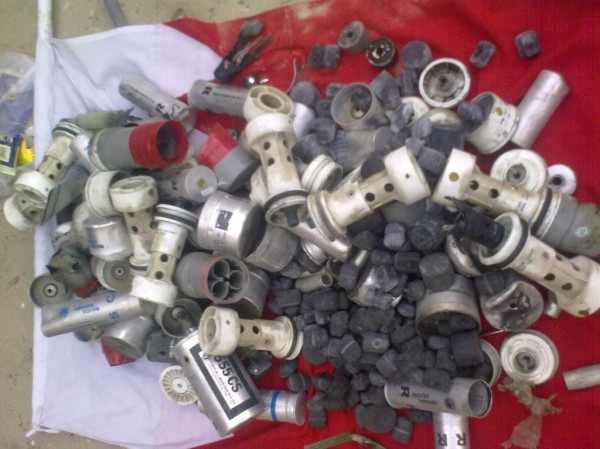
Riot police litter Magaba Village with Less-than-lethal artifacts – 12 August, 2011
Riot police litter Magaba Village with Less-than-lethal artifacts – rubber bullets, assorted CS gas canister
August 12, 2011 Add Comments
Social Networks provide intelligence to Private and Government Security Agencies about subscribers and users
Concern that social networks to be targeted as BlackBerry helps British police identify rioters
Published on Friday 12 August 2011. – Reporters Without Borders
Reporters Without Borders is worried about cooperation between Research in Motion (RIM), the Canadian manufacturer of the popular BlackBerry smartphone, and the British authorities in the wake of this week’s rioting in London and other cities in which, according to the authorities, rioters used its messaging service, BlackBerry Messenger (BBM), to communicate with each other.
BBM uses the Internet rather than the mobile phone network and requires user authentication, which makes it hard for the authorities to intercept messages. To help address this difficulty, RIM has already provided Scotland Yard with information about a number of BlackBerry users, jeopardizing their personal data.
“We have engaged with the authorities to assist in any way we can,” RIM announced on Twitter.
What consequences will this cooperation have on respect for the privacy of BlackBerry users? If information provided by RIM leads to arrests, questions will be raised about the validity of the evidence and the legality of the way it was acquired. Reporters Without Borders is also concerned about habeas corpus implications.
Reporters Without Borders is not minimizing the gravity of the situation in the United Kingdom and the urgency of the need to restore order, but it believes that the provision of personal data to the police sets a disturbing precedent in a western country and could have significant consequences as regards setting an example for others kinds of government.
Reporters Without Borders is also shocked by the statements of several politicians. David Lammy, the parliamentary representative for the London district of Tottenham, went so far as to ask BlackBerry to consider suspending its messaging service. This is an astonishing suggestion in a democracy, one with potentially grave consequences. The threats to freedoms are now real. …more
August 12, 2011 Add Comments