EU May Probe Bahrain Spy Gear Abuses
EU May Probe Bahrain Spy Gear Abuses
By Vernon Silver – Aug 24, 2011 9:59 AM MT – Bloomberg
European Union legislators asked the EU to investigate whether companies have aided human rights violations by selling surveillance gear to repressive governments.
Marietje Schaake, who is a Dutch member of the European Parliament, and five of her colleagues in the assembly, requested the probe today after Bloomberg News reported that a monitoring system sold and maintained by European companies had generated text-message transcripts used in the interrogation of a human rights activist tortured in Bahrain.
The legislators made their request in writing to EU foreign-policy chief Catherine Ashton, who is also vice president of the European Commission, the 27-nation EU’s executive body in Brussels. The probe would determine whether any European security and communications companies contributed to “human rights violations, in particular in Tunisia, Egypt, Syria, Bahrain and Iran,” the request says.
The surveillance technology in Bahrain was sold by Siemens AG (SIE), and later maintained by Nokia Siemens Networks, followed by NSN’s divested unit, Munich-based Trovicor GmbH, Bloomberg reported yesterday, citing Ben Roome, a Nokia Siemens spokesman. Egypt, Syria and Yemen also purchased monitoring centers from the business now known as Trovicor, according to two people familiar with the installations. The equipment plays a surveillance role in at least 12 Middle Eastern and North African nations, they said.
Supporting Export Ban
Barbara Lochbihler, a German member of the EU Parliament who signed the letter and sits on the Subcommittee on Human Rights, said she plans to speak with company officials about the uses of their products. She supports a European export ban of such technology to regimes that could abuse it, she said.
“As a deputy from Bavaria I´m very interested in the follow up of what happens with the company Trovicor and also with Siemens,” she said in an e-mail. Munich, where Trovicor and Siemens are based, is the Bavarian capital. The other legislators asking for an inquiry are the Netherlands’ Hans van Baalen, Estonia’s Tunne Kelam, the U.K.’s Sarah Ludford and Slovenia’s Ivo Vajgl, according to a copy of the letter provided by Schaake’s office.
The European Commission will revisit the EU’s corporate responsibility strategy this fall, said Cristina Arigho, a spokeswoman for the commission. She said the EU is also considering how to support the implementation of United Nations principles on business and human rights, passed in June, which say corporations have a duty to respect human rights.
For Law Enforcement
Monitoring centers are sold around the globe by many suppliers, and form the heart of what the industry refers to as lawful interception surveillance systems. The equipment is marketed largely to law enforcement agencies for tracking terrorists and other criminals. The clusters of computers typically tap into communications networks, scan and sort calls and data — sometimes by keywords or voice recognition — and send the results to operators at police and intelligence agencies. The company behind the Bahraini monitoring center started in 1993 as the voice and data-recording unit of Siemens. In 2007 it became part of Nokia Siemens Networks, the world’s second biggest maker of wireless communications equipment.
NSN, a joint venture with Espoo, Finland-based Nokia Oyj (NOK1V), sold the unit, known as Intelligence Solutions, in March 2009. It’s now called Trovicor.
Sold to Iran
Siemens and Trovicor declined to comment for the Bloomberg investigation; Siemens said it no longer had records of the business, while Trovicor said contracts prevented it from disclosing clients or countries where it does business. NSN said a major reason it sold the business was the risk of human rights abuses. The company has since established a human rights policy and due diligence program, Roome said. In 2009, the company disclosed that it delivered a monitoring center to Iran, prompting hearings in the European Parliament, proposals for tighter restrictions on U.S. trade with Iran, and an international “No to Nokia” boycott campaign.
NSN issued a statement yesterday reiterating its concern for human rights.
“Nokia Siemens Networks has stated clearly that such abuse, if it has occurred, is wrong and is contrary to its Code of Conduct and accepted international norms,” the statement said.
Tracking Terrorists
“Partly as a result of the issues raised by the potential for misuse of its technology, Nokia Siemens Networks is the first telecommunications equipment provider to adopt a human rights policy specifically addressing the issues of new technologies and privacy, access to information, and freedom of expression,” it said.
NSN’s Roome and Siemens spokesman Wolfram Trost declined to comment on the inquiry request. Birgitt Fischer-Harrow, Trovicor’s head of marketing communications, didn’t immediately respond to an e-mailed request for comment. There was no response at her office phone.
The Netherlands’ Schaake helped sponsor and pass a nonbinding parliamentary resolution in February 2010 that called for the European Commission to ban exports of such technology to regimes that could abuse it. The Bahraini government said it is taking allegations of abuse seriously and an independent committee is investigating alleged torture. “The Kingdom of Bahrain does not advocate the abuse of human rights,” Luma Bashmi of the Bahrain Information Affairs Authority wrote in an e-mail yesterday to Bloomberg.
“The committee will investigate any allegations regarding the Bahrain Defense Forces” and security operations and submit its report by October 30, she wrote. “At that point the government of Bahrain can and will address all of these issues in a just manner.” …source
August 29, 2011 Add Comments
Bahrainis reject king’s speech
Bahrainis reject king’s speech
shiapost – August 29, 2011
Bahraini anti-regime protesters have rejected King Hamad bin Isa Al Khalifa’s decision to pardon the demonstrators who were arrested during the country’s popular uprising.
The protesters took to the streets immediately after the king’s televised speech on Sunday, blaming him for the brutal crackdown on the peaceful demonstrations. King Hamad said in his speech that he would “dismiss charges against some of the detained protesters and allow compensation to prisoners abused by security forces.” He also promised to reinstate employees and students who have been dismissed for participating in anti-regime protests.
Thousands of employees lost their jobs in punishment for supporting the protests. Some of the students were denied scholarships to study abroad. The Bahraini king’s remarks come more than six months after his regime launched a Saudi-backed crackdown on peaceful demonstrations.
Meanwhile, a special security court on Sunday resumed the trial of 20 doctors and nurses accused of treating injured anti-government protesters. The court adjourned until September 7, when it will begin hearing defense witnesses.
Thousands of anti-government protesters in Bahrain have been holding peaceful demonstrations since mid-February, demanding an end to the Al Khalifa dynasty.
August 29, 2011 Add Comments
Potential Demonstrations in Bahrain 30 Aug. – 02 Sep.
Potential Demonstrations in Bahrain 30 Aug. – 02 Sep.
by U.S. Naval Forces Central Command / U.S. 5th Fleet on Monday, August 29, 2011 at 5:29am
The following potential or planned demonstrations in Bahrain should be avoided by all U.S. Forces, DOD civilians, DOD contractors and family members.
Tuesday, 30 AUG 0600-0900 in the vicinity of Sanabis.
Tuesday, 30 AUG 0600-0900 in the vicinity of Hamad Town.
Tuesday, 30 AUG in the evening in the vicinity of Sanabis.
Wednesday, 31 AUG, in the vicinity of Seef.
Thursday, 01 SEP, in the viciinity of Nuaim, Ras Ramman, Sanabis, Diah and Karbabad.
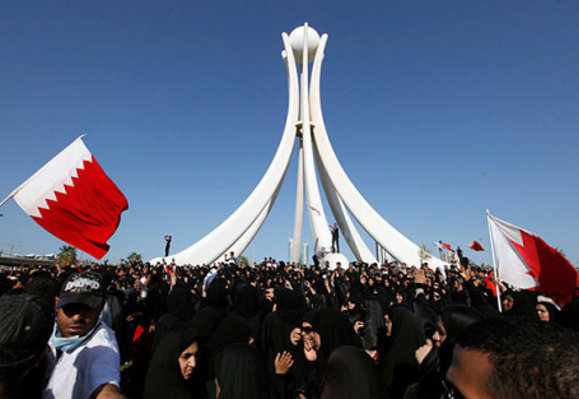
Friday, 02 SEP, in the vicinity of Farooq junction (aka GCC Circle or former Pearl Roundabout).
August 29, 2011 Add Comments
Bahrain’s Military Trial of Doctors a Travesty
Bahrain’s Military Trial of Doctors a Travesty
August 28, 2011- Human Rights First
Washington, DC — Today’s trial of doctors and other medics in Bahrain’s military court exposes that the country’s judicial process is a farce, Human Rights First said. The authorities reintroduced the military courts last week after having said they would abolish them and in today’s proceedings adjourned the health professionals’ case until September 7. It will resume again in the military court on that day.
“To hear the cases of civilians in a military court that falls far short of international standards of justice is totally illegitimate,” said Human Rights First’s Brian Dooley. “When the Bahraini authorities announced on June 26 that they were transferring all cases from military courts to civilian courts they lied to the defendants, to their families and to the world.”
The return to military trials undermines the Bahrain Government’s claim to take human rights violations seriously. The King of Bahrain appointed a commission, headed by Cherif Bassiouni, to investigate abuses. But the reversion to military courts exposes the monarchy’s real intentions to continue its crackdown on peaceful activists. The United States Government should publicly condemn these trials as shams and ask the Bahraini government to drop charges against those prosecuted for the peaceful expression of their opinions.
More than a dozen doctors and other medical professionals appeared before the military court today, including Roula Al-Saffar, the head of the Bahrain Nursing Society, who spent over four months in custody. She studied at Widener University in Pennsylvania and at the University of North Texas, and worked for many years as a nurse at Baylor University Medical Center in Dallas.
“I met some of those on trial today when I was in Bahrain last month, “ said Dooley. “They told me credible and consistent stories of having been tortured in detention. The U.S. government should make clear that continuing with discredited military courts to try pro-democracy activists will have consequences for the relationship between the United States and Bahrain.” …source
August 29, 2011 Add Comments
Abducted Mexican journalist found shot dead, second murder in past month
Mexico: Abducted journalist found shot dead, second murder in past month
Published on Friday 26 August 2011. – Reporters without Borders
Reporters Without Borders firmly condemns the murder of Humberto Millán Salazar, a journalist based in Culiacán, in the northwestern state of Sinaloa, who edited the online newspaper A-Discussion and presented a programme on Radio Formula. His body was found yesterday, a day after his abduction in Culiacán. He had been shot in the head.
Gunmen kidnapped Millán on 24 August together with his handicapped brother, who was released at Millán’s request. His body was discovered yesterday morning in Campo Morelia, 10 km north of the city. The Sinaloa prosecutor’s office said measures have been taken to protect his relatives and some of his colleagues.
The murder is being investigated by a team set up by Sinaloa state prosecutor Marco Antonio Higuera Gómez in coordination with the federal prosecutor-general’s office. The state prosecutor’s office confirmed that an investigation was under way but declined to say what hypotheses it was working on.
Reporters Without Borders urges the authorities not to rule out the possibility that Millán was killed in connection with his work. He was frequent critic of the local authorities and, on the eve of his abduction, had published an article about the municipal government’s management of its accounts in A-Discusión.
He was the second journalist to be murdered in Mexico in the past month. …more
August 28, 2011 Add Comments
Stage set for all hell to break loose in Palestine
The Upcoming Palestinian Uprising
By Adil E. Shamoo, August 23, 2011
If conditions do not change quickly by the time of the U.S.-promised veto of Palestinian statehood at the UN General Assembly on September 20, the Palestinian-Israeli conflict could explode into a new uprising with hundreds of deaths. The recent attack of Palestinian extremists on a bus in the southern Israeli resort town of Eilat and the eager over-reaction of Israeli President Benjamin Netanyahu is a harbinger of what is to come.
The uprising will bring the United States into sharp conflict with not only the Palestinians but also the rest of the Arab world. A new Arab spirit is demanding that the rest of the world, especially the United States, treat Arabs with equal respect and dignity.
The Palestinian Struggle
The Palestinians will ask the upcoming UN General Assembly to vote for “non-member state” status for the Palestinians on September 20. Since this resolution bypasses the Security Council, the promised U.S. veto will not be operative. The least desirable choice for the United States is to vote no in the General Assembly. It would isolate the United States from the rest of the world community, which is expected to agree to the Palestinians’ sought-after status. With the United States at its lowest popularity in the Arab world, this further isolation would only create additional challenges as the Arab Spring turns cloudy and many long-term challenges complicate U.S.-Arab relations.
The Palestinians have struggled for over 60 years to regain their rights, economic justice, and dignity. They have tried peaceful confrontation, military action, terrorism, and negotiation — without any success. The 1.5 million Palestinians in Gaza live in an open-air prison with the highest unemployment (45 percent) in the world, near-starving conditions, and little or no medical care. Israel even stops humanitarian flotillas from reaching Gaza. Another 1.5 million Palestinians live in Israel as second-class Israeli citizens. Do the Israelis consider the Palestinians as equal human beings?
The Israelis paint the conflict at every step as an existential threat. Israel has legitimate security concerns, which have been addressed as part of successive deals. The existential threat may have been true in the first few decades of Israel’s existence. However, most reasonable observers and many Israelis know that a demilitarized Palestinian state is not an existential threat. Israel has the upper hand militarily, and it has used it with a vengeance to suppress Palestinian aspirations. The Israelis are engaged in a policy of open-ended negotiation while confiscating and resettling Palestinian land.
President Obama has attempted to move the negotiations forward slightly by endorsing the blueprint used by previous administrations, namely the 1967 borders with mutually agreed land swaps. But the Obama administration remains as reluctant as its predecessors to pressure its Israeli ally to negotiate in good faith. The Israeli lobby remains powerful on Capitol Hill, the State Department is staffed by strong supporters of Israel, and the U.S. media features a very few voices representing Arab concerns. It’s no surprise that U.S. policies rarely reflect Arab views. …more
August 28, 2011 Add Comments
Egypt – In a press conference at CIHRS, 36 NGOs condemn the campaign waged by Egyptian authorities against civil society organizations
Egypt – In a press conference at CIHRS, 36 NGOs condemn the campaign waged by Egyptian authorities against civil society organizations
Human rights NGOs demand the dismissal of the Ministers of Solidarity and of International Cooperation
Cairo – 24 August 2011 – CIHRS
In a press conference sponsored by 36 Egyptian human rights organizations this morning at the Cairo Institute for Human Rights Studies (CIHRS), the NGOs announced their condemnation of the fierce campaign waged by the government and the Supreme Council of the Armed Forces (SCAF) on civil society organizations and human rights groups.
Human rights organizations presented their statement at the press conference declaring their position towards these infringements, and voicing their demands to competent authorities, on top of which is the dismissal of the Minister of Solidarity Gouda Abdul-Khaliq and the Minister of International Cooperation Faiza Abul-Naga. The organizations further presented a complaint that they have raised to the relevant Special Rapporteurs of the United Nations and the African Commission for Human Rights in this regard.
The conference was attended by a large number of journalists, media professionals and artists concerned with the role of civil society in Egypt.
Mr. Bahey El-Din Hassan, director of the Cairo Institute for Human Rights Studies, presented the NGOs position towards the military council’s and the Egyptian government’s recent attacks against civil society, expressing resentment regarding the ways in which SCAF and the Cabinet have been dealing with these organizations recently. The statements highlighted the restrictions imposed on the activities of civil society organizations, and denounced accusations to NGOs of being foreign agents implementing foreign agendas. Such accusations are seen as a direct response to independent human rights organizations’ criticism of the human rights violations occurring in post-Mubarak’s Egypt. .
Ahmed Ragheb, director of the Hisham Mubarak Law Center, declared that the number of military trials of civilians that were held since SCAF took office reached 12,000 for the past 6 months alone, noting that during the 30 years of Mubarak’s rule they were 10,000. He further stated that violations being committed now will dictate Egypt’s future and whether it would find its way towards a true transition to democracy or back to a situation worse than before. …more
August 28, 2011 Add Comments
Human Rights Activist González Arrested in Colombia
Human Rights Activist González Arrested in Colombia
For Immediate Release: August 23, 2011 – Human Rights First
Washington, DC – Human Rights First condemns the ongoing harassment and persecution of Colombian human rights defender Principe Gabriel González, who was arrested last Friday to serve seven years imprisonment on trumped-up charges.
“As a prominent student activist and the Regional Coordinator for the Political Prisoners Solidarity Committee, González was instrumental in exposing the ill treatment of Colombian political prisoners. This advocacy led to his own arrest in 2006 when he was detained on politically motivated charges of rebellion and association with the FARC guerrilla group,” said Human Rights First’s Quinn O’Keefe.
After González was detained for 15 months awaiting trial, a judge acquitted him of all charges, finding them entirely baseless. The prosecution appealed the court’s decision. In March 2009, the Superior Tribunal of Bucaramanga overturned the acquittal and sentenced González to an additional seven years imprisonment.
“The prosecution relied on false accusations from two witnesses to impede González’s human rights work and secure a conviction. The first witness couldn’t identify or even name González before he was detained, and the second witness actually admitted to providing statements under duress from the prosecutors,” added O’Keefe.
In December2010 the Supreme Court declined to hear González’s appeal, and he was arrested last Friday in Pamplona. He had been living in exile, but returned to Colombia to visit his ailing mother.
In 2009, Human Rights First released In the Dock and Under the Gun: Baseless Prosecutions of Human Rights Defenders in Colombia, a comprehensive report that documents the widespread use of trumped-up charges to silence Colombian human rights activists. A year later, in 2009, Human Rights First celebrated González’s human rights work with its prestigious human rights award. …source
August 28, 2011 Add Comments
Bahrain: Medical staff trial- The case has been adjourned till 7 September, 2011
Bahrain: Medical staff trial- The case has been adjourned till 7 September, 2011
August 28th, 2011 – BYSHR
Bahrain Youth Society for Human Rights (BYSHR) is deeply concerned about the trial of the Medical staff before a military court.
The BYSHR lawyer said that:” The lawyers were presented Statement on the unconstitutionality of Decree no “28″ 2011 (Trial of civilians before a Military courts) and the judge refused a request to release them”
The case has been adjourned till 7 September, 2011 for defense witnesses. …source
Attached : The list of Medical Staff undergoing trial (click Here)
August 28, 2011 Add Comments
Bahrain: The Teachers before a Military court
Bahrain: The Teachers before a Military court
August 28th, 2011 – BYSHR
Lawyer informed the BYSHR that the Teachers will be presented before a military court on 29th Aug, 2011.
The defendants:
1- Mr. Mahdi Isa Abu Dheeb – Chairman, Bahrain Teachers Society
2-Ms. Jalila Mohammed Ridha Al Salman – Deputy Chair, Bahrain Teachers Society
Charges:
1-inciting others to commit crimes;
2-calling for the hatred and overthrow of the ruling system;
3-holding pamphlets, disseminating fabricated stories and information;
4-leaving work on purpose and encouraging others to do so;
5-taking part at illegal gatherings.
Bahrain Youth Society for Human Rights (BYSHR) expresses deep concern at the targeting of institutions of civil society and calls for urgent action to stop the punishment of civil society institutions by the Bahraini authorities. .source
August 28, 2011 Add Comments
HIS MAJESTY THE KING OF BAHRAIN’S SPEECH
HIS MAJESTY THE KING OF BAHRAIN’S SPEECH
Manama, Aug 28 (BNA) In a speech marking the final days of the Holy Islamic Month of Ramadan, His Majesty King Hamad bin Isa Al-Khalifa of Bahrain has said that his Government’s aspiration is “for tolerance and for shunning violence, and not for excessive punishment that affects our unity, cohesion and national co-existence.”
In a television address broadcast on Sunday evening on Bahrain Television, and relayed on other television and radio stations, King Hamad spoke of reconciliation. “When we see workers at their places of work and students at their learning institutions, while some other workers are not working and some other students are not studying, we are prompted,” he said, “to look into their situation in order to help them join their colleagues and classmates.”

“Such an accomplishment will benefit the workers, the students, their families and the whole nation, “ said King Hamad. “These are our orders to the concerned institutions and they should implement them more quickly.”
The King’s remarks come as more than 400 Bahraini students, who were suspended during the unrest earlier this year, were this week reinstated.
Referring to those who were charged with crimes in the past, King Hamad said “even though we do not wish to interfere in the process of justice and the application of the law, we stress that all civil cases will have their final ruling issued in civil courts.”
King Hamad noted that the past months of this year have been painful for all Bahrainis, but he said that the Holy Month of Ramadan has contributed to the restoration of cohesion and “made us all recall our traditional interactions, compassion and fraternity.”
Referring to the international commission of inquiry that he set up to look into the unrest of earlier this year, King Hamad said the decision to set up the Bahrain Independent Commission of Inquiry (BICI) was “the best indication of our full commitments to knowing the whole truth and to giving people their rights.”

He also commended the outcome of the National Dialogue. “Your agreements on further reforms are highly appreciated, deeply welcomed and greatly supported,” said King Hamad. Congratulating Bahrainis on Eid Al-Fitr, marking the end of Ramadan, King Hamad said he hoped Bahrain now “will witness a new stage of outstanding productivity, cohesion and stability as our reforms move forward. …dead end
August 28, 2011 Add Comments
Calls for international role in support of Bahrain’s revolution
Calls for international role in support of Bahrain’s revolution
Bahrain Freedom Movement – 25/08/2011 – VOB
A seminar on Bahrain’s independence was held at the House of Lords at the invitation of Lord Avebury on Tuesday 23rd Agust 2011. Several people took part in it including two former prisoners from Bahrain who addressed the seminar by Skype. Here is a brief of the proceedings
Lord Avebury: I have been corresponding with our ministers for years. In 1993 Bahrain’s minister of interior was referring to a human rights committee as terrorist body. We know that Ian Henderson had been engaged in torture for years before. Today, the Al Khalifa assume absolute power; they arrest, abuse, torture and other violations. They added two more practices; systematic dismissal and recruitment of mercenaries. To protect himself the king appointed a committee to investigate the abuses that took place in February and March. It is a mistake to accept investigation by royal commission. Proper investigation should be held by an international commission sent by Navi Pillay. There is a common perception that the royal commission is susceptible to influence. Bissiouni has already exonerated the king, his sons and the military prosecutor. He is reported to have said that there were no signs of torture. Bissiouni knows that there are torture methods that leave no marks. He may have been misquoted but he is naïve to speak to the local media in the way he did. There was a demonstration at the commission’s office. I must emphasise that the commission must be given space to operate. It is my hope that grievances of victims are addressed. The regime is still holding senior figures such as Hassan Mushaime, Abdul Hadi Al Khawaja, Abdul Jalil Al Singace and others, some of whom had been with us before. Trade unions are also behind bars. More than 2600 people have been dismissed from their jobs and the number is likely to be over 3000. This means that at least 15000 people are destitute. Bissiouni has given the impression that these will be reinstated. The military court has been re-convened and more trials will be held in October while demonstrations have continued to protest the outrages of the regime. How can Bahrain be excluded from change while other countries are allowed to have regime changes. Our task is to wake up the media to the injustice in the Gulf. Let us mobilise our efforts to achieve this.
Sandrine Tiller of the Doctors Without Borders, the UK office, spoke briefly about the experience of her organization in Bahrain especially the attack last July on their personnel who were treating the injured Bahrainis. We found it difficult to register officially although the ministry of health knew of our presence. Most important event was on 27th July when our offices were raided violently. The door was smashed and property was taken and one member of our staff arrested. He was subsequently release but is awaiting trial.
Lord Avebury: This is humanitarian work, yet they were raided.
Mohammad Al Tajir (a lawyer who had defended many prisoners before): I was detained on 15th April when twenty people came to my house, confiscated my computers and other papers. They could not charge me for any offence and my only guilt was defending the defenceless. I gave a speech at the Pearl Roundabout. I was accused of inciting against the regime. My speech was a normal one. I was tortured for three weeks and was held in solitary confinement from 15th April until 9th June. I was taken to the military court on 12th June. I was released 7th August. I am suffering now as a result of the solitary confinement. I felt the experience of what had happened to the others before. Today there has been a decree to refer political cases to the military court once again. All detainees are civilians, yet they are tried by military courts which will start from the beginning. The doctors will be tried tomorrow by the military court. We could not reach Bissiouni despite several attempts. The reason is that he has an agenda that he is pursuing. I was sent to the Grane Prison which is run by the military. My neighbours were Sheikh Abdul Jalil Al Singace, Abdul Hadi Al Khawaja, Abdul Jalil Al Singace, Hassan Mushaime, and Sheikh Al Miqdad. I net them one week before my release. I heard their cries day and night. Abdul Hadi was severely Jawad and so was Mohammad Hassan Jawad. I also saw how Mahdi Abu Deeb, the President of the Teachers Association was tortured. I saw Sheikh Mohammad Habib Al Miqdad repeatedly because he was taken to the military court and had nine cases filed against him. I saw torture marks on his knee and legs. The worst times were when I saw Mr Al Khawaja being tortured. Sheikh Al Miqdad told us that he was tortured by a senior Al Khalifa figure at the Grain prison. We were threatened that we would get an order from “the Sheikh” to be handed to the Saudis. I can confirm that I had seen Yemenis, Pakistanis and Jordanians working with the security forces and torturing people. I was blindfolded for three weeks. I like to thank Pete Wetherby and Joshua Collingulu whose work played a role in our release.
Ayat Al Qurmuzi: (a female poet who had been imprisoned and tortured)
[Read more →]
August 28, 2011 Add Comments
As streets buzz with protests in over 45 areas, King Hamad promises to dismiss charges against “some people”, “forgives” his victims in psychotic rant
Bahrain king pardons some protesters
King Hamad offers compensation to victims of February crackdown, but says protest-related trials will continue.
28 Aug 2011 – AlJazeera
Bahrain will dismiss charges against some people detained during a deadly government crackdown against pro-democracy protests earlier this year, the Gulf nation’s king said in a televised speech to the nation. King Hamad bin Isa al-Khalifa made the pledge in an address on Sunday to mark the approaching end of the Muslim fasting month of Ramadan – more than six months after his government launched its crackdown.
“There are those who are charged with abusing us and senior officials in Bahrain, we today announce that we forgive them,” he said. “Although I do not like to interfere in the course of justice, I would like to confirm that all the cases of civilians will have their verdicts issued by a civil court,” he said.
No clear concessions
However, he offered no clear concessions towards Bahrain’s majority Shia population, who helped lead the protests and whose demands include an easing of the Sunni dynasty’s hold on power, setting policies and hand picking government officials.
Bahrain’s Shia make up about 70 per cent of the island kingdom’s 525,000 citizens, and complain that they face widespread discrimination, such as being excluded from top political and security posts.
Rights groups say at least 32 people have been killed and hundreds arrested since the protests began in February, inspired by other Arab uprisings.
After the protests, thousands of employees lost their jobs in apparent punishment for supporting the demonstrations, while students were dismissed from schools and universities.
King Hamad said that he had given orders to solve the problem of employees and students who were dismissed.
“When we see workers at their work places and students at their learning institutions, while some other workers are not working and other students are not studying, we are prompted to look into their situation in order to help them join their colleagues and classmates,” he said.
“These are our orders to the concerned institutions and they should implement them more quickly,” he added.
Compensation claims
King Hamad urged those who had been mistreated in custody in the aftermath of the crackdown to file a complaint, saying that the law allows compensation for them.
“The recent period was painful to all of us. Although we live in one country, some have forgotten the inevitability of co-existence. Therefore, we should not abandon our belief in having the same and common future, and should not lose trust in each other as brothers, colleagues and citizens,” he said.
The Bahraini security forces, boosted by Saudi led troops from elsewhere in the Gulf, crushed the protests in March after allowing demonstrators to camp in central Manama the capital, for about one month.
Bahrain’s crackdown on protests earned the staunch US ally criticism from human rights organisations, but the international community did not show the support for the protests as it did in other countries, as the West blamed Iran for instigating its co-religionists in the small kingdom to cause dissent – a claim Bahrain’s Shia deny.
In July, Bahrain’s leaders opened reconciliation talks, but the country’s main Shia party walked out and threatened to stage further protests.
An independent fact finding panel is investigating alleged rights abuses in Bahrain and is expected to release its findings at the end of October. …source
August 28, 2011 Add Comments
Hamad “forgives” his victims with “drive by shooting” in Sitra – 26 August, 2011
August 28, 2011 Add Comments
Vigilantism, Medicals trial travesty and more about detainees
Military trial of doctors and teachers, and more updates from Bahrain
28 August 2011 – BCHR
The trial of the doctors took place this morning and was postponed until September 7th when defense witnesses are supposed to be called in. The trial took place in a military court or a “national safety court” as per the government.
List of medical staff undergoing military trial (Via BYSHR)
Leaders of the Bahrain Teachers Society, Mr. Mahdi Abu Dheeb (Chairman, detained since last April), and Ms. Jalila Al Salman (Deputy Chair , released last week after 5 months of detention) will be presented before a military court on 29th Aug, 2011.
Several released detainees have told activists that they have been threatened by prison security guards that they will be tortured after the Bahrain Independent Commission of Inquiry leave.
Recently we have been receiving numerous cases in which riot police enter villages at very high speeds and run over protesters with their cars. The following are pictures and videos of the victims. (Advise: Graphic)
see videos here, here, here and here
Ministry of Interior announced that two Asian workers were attacked in village. An individual from the same village then released a video showing what appears to be men in civilian clothing accompanied by riot police arranging metal rods and water on ground for incriminating photo of the alleged incident.
Young child being taken away by riot police: video
Bahrain authorities now block the twitcam Internet feature which allows people to take videos and directly upload them to the internet through Twitter.
Video taken via a hidden camera during one of the disciplinary committees’ interrogations which caused hundreds of dismissals (Arabic): youtube.com/watch?v=LTFNnN1lXSo
Video taken via a hidden camera at a check point (Arabic): youtube.com/watch?v=chB7hflEOjo
University of Bahrain president today announced the return of 389 of the expelled students, and the referral of 38 others to the courts.
Bahrain Polytechnic announced the reinstating of 31 expelled students.
In a case that raises serious concern armed thugs opened fire and severely beat other civilians (MOI Statement). It is very disturbing that pro-government groups now have access to guns that are being used in violence against other civilians. The threat of widespread violence is quickly increasing due to the regime’s policies and the way they have dealt with the recent uprising. Especially with the latest information about the arming of groups.
Summary translation of victim testimony from AlWasat newspaper:
At the Bahrain International Circuit after 12pm on the 26th August, a fight started after an event at the circuit, after which the victim and his friends decided to leave. On their way out a man in civilian clothing in a pickup told them they were not allowed to leave, and when they tried to leave he shot at them with a gun. They were then chased and stopped, after which they were taken to a secluded area where they were severely beaten and forced to insult political opposition figures. They were also asked if they had taken parts in the protests that took place in February/March. Others arrived in other cars carrying different types of weapons and took turns beating them. The assailants then received a call telling them to let them go, after which they were going to drive the victims back to their car but received a call not to go to that area as there were police units there. They let the victims go and told them to run, and when they did, they started shooting their guns. The victim giving the witness account suffered an injury to the head. Another witness said that the shooting that took place at the circuit happened in front of the police units. Another young man was shot several times in the leg …more
August 28, 2011 Add Comments
Footballers dream turned nightmare
Bahrain Footballers Pay Price for Protesting
by Michael Casey – AP – 26 August, 2011
SITRA, Bahrain – When anti-government protests broke out in Bahrain, Alaa and Mohammed Hubail hunkered down in their family compound and refused to take part. They feared their reputations as top footballers would make them easy targets for police.
But Crown Prince Salman bin Hamad Al Khalifa soon came out in support of peaceful protests. It was the green light the Hubail brothers were looking for and they joined a march of several hundred athletes to Pearl Square, the epicenter of Shiite-led protests against the Gulf nation’s Sunni rulers.
Two weeks after the February march, the 31-year-old Alaa Hubail was interrogated on state-run television and called a traitor. He and his 29-year-old brother were arrested a day later along with national team goalkeeper Ali Saeed Abdullah as they trained at their Al Alhi club. They were among six players from the national team who were hauled into jail, where they say they were tortured for taking part in the protests.
Mohammed Hubail was tried and sentenced to two years in jail. He is out of jail while he appeals the sentence. Alaa’s case is pending. They have gone from celebrities to pariahs among Bahrain’s pro-government factions — barred from playing on the national team and blacklisted from the local league for what they contend was simply following the advice of the crown prince.
“I served my country with love and will continue as much as I can,” Alaa Hubail, nicknamed the Golden Boy after the prolific striker was the top scorer in the 2004 Asian Cup, told The Associated Press at his home in the Shiite-dominated village of Sitra in the first interviews the brothers have given to foreign media.
“But I won’t forget the experience which I went through for all my life,” he said. “What happened to me was a cost of fame. Participating in the athletes’ rally was not a crime.”
The backlash against the Hubail brothers was part of a sweeping, government crackdown in a bid to snuff out opposition to the regime. Besides the arrest of hundreds of citizens, students were expelled from universities, government employees were fired, and doctors and nurses put on trial for treating injured protesters.
Protesters were denigrated and interrogated on state television and then accused of anti-state conspiracies in trials before a secretive, security court. Even some of the slightest infractions were dealt with harshly, including a 20-year-old woman who was sentenced to a year in prison for reading a poem critical of Bahrain’s king.
Inspired by uprisings in Tunisia and Egypt, Bahrain’s Shiite majority took to the streets on Feb. 14 to demand that the country’s more than 200-year-old Sunni dynasty loosen its control on top government and security posts. After days of mostly peaceful protests, the regime cracked down on the protesters, resulting in the deaths of more than 30 people and the detention of thousands. …more
August 28, 2011 Add Comments
Which one came first twitter ot the revolution?
The Middle Ground between Technology and Revolutions
Aaron Bady 08/26/2011
Social media didn’t cause the revolutions in Egypt and Tunisia, but it did achieve unique visibility.
Is there still a debate on whether social media can cause revolutions? If this was ever a serious question, it was mainly an argument between straw men: on the one hand, wild idealists who saw the internet as an all-encompassing force for freedom and on the other, the crusty curmudgeons who fear technology and pooh-pooh the idea that social media is good for anything but posting pictures of cats. NYU professor Jay Rosen characterized the debate as “Wildly overdrawn claims about social media, often made with weaselly question marks (like: ‘Tunisia’s Twitter revolution?’) and the derisive debunking that follows from those claims (‘It’s not that simple!’)” and argued that these “only appear to be opposite perspectives. In fact, they are two modes in which the same weightless discourse is conducted.”
I think we can safely put that debate aside. While Malcolm Gladwell made a lot of noise last October by declaring that “the revolution will not be tweeted,” reporting like John Pollock’s “Streetbook” demolishes the idea that there is some intrinsic and impassable barrier separating “street” activism from the kind of “slacktivist” organizing of which Gladwell is so dismissive. But it’s worth noting that even the most visible “cyber-utopians” and “cyber-pessimists” seem to be converging on a point somewhere in the middle. In March, Clay Shirky significantly qualified the kinds of claims he makes for the centrality of social media—arguing that it is access to each other, not access to media, that makes revolutions—while Evgeny Morozov has pointed out that both he and Gladwell have been clear that the internet can be an effective tool for political change, as long as it is “used by grassroots organizations (as opposed to atomized individuals).” If you can see the fundamental divide between these arguments, you see more clearly than I do.
[Read more →]
August 28, 2011 Add Comments
President Obama even after your deafening silence on the brutal crushing of the people of Bahrain by your partner al Khalifa, in spite of double standards you maintain that pain the good people of Bahrain, they cry out to you for help and mercy and plead that you stop al Kahlifa’s tyranny
An open letter to President Obama: People of Bahrain need your help
An open letter to President Obama: If there is any country where the USA can install democracy without a single bullet fired, it is Bahrain
Dear Mr. President,
In one of your recent addresses to international audience, you pledged that America’s “commitment—our responsibility—is to stand up for those rights that should be universal to all human beings”. The commitment you made is rooted in the founding principles of your country, echoed in the Declaration of Independence, which states that all men and women around the world are endowed with the right to “Life, Liberty, and the pursuit of Happiness.”
These founding principles are undeniable truths that have guided the United States, since its inception, on a path toward justice and universal rights for all people. We call upon you, Mr. President—as the leader of this country and a Nobel Peace Prize Laureate—to wholeheartedly pursue these ends in your dealings with the popular uprising for democracy in Bahrain.
Mr. President, It is a known fact that because of its strategic and short-term interests, the United States has often aligned itself with repressive autocrats in the Middle East right from Egypt to Saudi Arabia and from Bahrain to Jordan.
The current uprising in Bahrain presents a test of America’s commitments to the American and universal values of human rights, freedom and democracy.
Therefore we, the undersigned, academics and researchers, teachers and students, lawyers and traders, women and men, young and old, U.S. citizens, Bahraini citizens, call upon you to use all the powers of your office to stand unequivocally behind the Bahraini People’s Movement, withdraw US support from King Sheikh Hamad bin Isa Al Khalifah’s security state, and establish 2011 as a watershed in US relations with the peoples of the Middle East.
All we want is freedom, free and fair elections, a representative government, equality of women and men, equality of Muslims and non-Muslims, equality of Shia and Sunni, and a responsible government in Bahrain. These basic rights cannot be achieved without moving to replace the current regime, and the transition process must include real representation from the pro-democracy movement.
While it is not the role of any other country to determine Bahrain’s leaders, the Bahraini people’s right to self-government has been obstructed by a military and intelligence apparatus that is trained and funded by Washington and London, fiercely loyal to the current King, and inimical to popular sovereignty. The current Prime Minister, an uncle of the King, widely known as Manama’s renditions czar, provides a constant reminder of American complicity in the Bahraini repression — as do the helicopters flying over the Pearl Square and the tanks that stood passively while the dictators forces killed peaceful protesters freely.
It is imperative that your administration rescind support from all Bahraini security forces opposing democracy and civilian control.
Compared to the U.S., Bahrain is a tiny nation with a population of 1 million, almost half of them foreign workers. The tiny island is home for 6,000 members of the U.S. Fifth Fleet. Bahrain’s military numbers about 9,000 personnel who remain totally dependent on the U.S. and U.K. for their training and equipment.
If there is any single country on this planet where the U.S. can constructively help the local people in achieving their aim of democracy without a single bullet fired, it is Bahrain.
Mr. President,
Accordingly, we kindly ask you to use your strategic and political influence forcing King Hamad Khalifah to resign, the current government be replaced by an interim civilian council representing proportionate number of Shias, Sunnis and Christians who will oversee a free and fair election in the next three months.
We kindly ask that you leverage American power in the United Nations Security Council to demand from Secretary General Ban Ki-Moon and High Commissioner for Human Rights Navanethem Pillay to send special envoys to Bahrain on a fact-finding mission to investigate the regime’s human rights abuses particularly against the 80% Shia majority who remain oppressed and discriminated against. Specifically, we call for the UN to inspect the condition of prisoners, investigate the claims of torture or other cruel and unusual treatment, and meet with members of the rights groups and lawyers concerning restrictions on their ability to defend their clients. During the past years the regime has systematically increased its violations of numerous articles within its own constitution that guarantee the right of freedom of speech and assembly.
The demonstrators have called for democratic regime change, not a US-facilitated transition to another despot, nor any intervention by the neighbouring dictator kingdom of Saudi Arabia. We urge you to help ensure that their demands are met, their rights are honored, and the Bahraini kingdom and its security apparatus ceases its attacks on journalists and peaceful protesters.
In the end, we would like to emphasize the importance for America of being seen as an advocate for human rights for all peoples in all parts of the world. Throughout the years, the vast majority of Bahraini people have expressed their utmost respect for Americans. We encourage you to stand on the side of the people in their time of difficulty by focusing on human rights and democracy in our motherland.
With Utmost Respect,
Citizens of Bahrain and the U.S.A.
August 27, 2011 Add Comments
Barack Obama’s blundering, bumbling and bull-shit costs the US credibility and leadership throughout MENA
Arab Spring gives US a new chance in the Middle East
Michael Young – Aug 25, 2011
Barack Obama has not faced the continuing revolutions in the Arab world with any passion. Rather, the US president has often behaved as if these were annoying intrusions into his domestic agenda. Yet change has come, and whether Mr Obama likes it or not this will alter Middle Eastern attitudes toward the United States.
Mr Obama has been lucky – not a bad thing for a politician. The president has avoided taking the lead amid regional convulsions, failing to exploit openings to Washington’s advantage. He has not even outlined a strategy defining American interests and aims, beyond the generalities in his speech at the State Department last May. And yet the US administration has almost everywhere managed to fall on its two feet, with limited negative consequences. Those who predicted that the Arab Spring would be a disaster for the US have so far been proven wrong.
For a superpower that has spent 60 years claiming to be a sentinel of Middle Eastern stability, even stalemate, the record recently has been very different. Mr Obama helped push an old friend, Hosni Mubarak, out of office in Egypt. He has sought to midwife a new order in Yemen to replace that led by another partner, Ali Abdullah Saleh. He has blessed the removal of an ally in Tunisia, Zine Al Abedin bin Ali. He is demanding that Bashar Al Assad step down in Syria. And he has used the US military to help unseat Muammar Qaddafi in Libya. US support for the monarchy in Bahrain is the exception confirming the rule.
Mr Obama’s paralysing caution has been a mitigating factor. The president has tried, though not very convincingly, to play up the fact that the US, as the world’s leading democracy, has a desire to see democracy triumph elsewhere.
However, American abandonment of comrades in Egypt and Tunisia came only when there was no other choice. In Libya, Mr Obama seemed perpetually to move one step forward and two back in sponsoring Nato military action. In Syria it took the president almost six months of slaughter by the regime to take a stance against Mr Assad – though this would have been justified, even essential, much sooner, on both moral and political grounds.
Perception is important in politics. Mr Obama could have accumulated valuable cards by being out ahead of the transformations in the region. Ideas are equally important in this period of Arab upheaval, yet Washington has not been good at using its democratic ideals as a means of influencing what comes next in the Middle East and North Africa.
But perceptions can cut both ways and the reality is that, disturbing contradictions aside, in the public imagination the Americans today are increasingly perceived as having chosen the side of insurgent populations against overbearing despots. …more
August 27, 2011 Add Comments
Peace and Roses met with Bombs, Bullets and Bastards
August 27, 2011 Add Comments
Translated letter by Ebrahim Sharif, from prison in Bahrain
Translated letter by Ebrahim Sharif, from prison, on the occasion of re-opening @Waad_bh’s headquarters (original: http://pastie.org/2428128)
Brothers (& sisters), partners on the path of national struggle;
Steadfast companions (male & female) members of Waad’s organization;
Respected attendees;
I greet you on this occasion, “shake your hands” and say that our party is not a building, headquarters and offices only; rather it is essentially the soul of the martyrs… Mohamed Bu-Naffoor, Mohamed Ghuloom and tens beside them.
It is the solid determination that does not compromise truth to our activists/strugglers and at their helm is the national symbol, Abdul-Rahman al-Noaimi, may God heal him… It is the rejectionist stance our youth took towards the statement that the organization compellingly released after being politically blackmailed.
In prison, oh companions, I found some of the best days of my life. I found that I can re-new my revolutionary youth, even if I am not a revolutionary, per se; rather demanding reform.Here, I re-discover myself. I read, I contemplate and I always think of you, to return to you after months or 5 years with my head held high. I am free in my prison, for detaining the body does not affect one at all, especially versus the authenticity of one’s stances and conscience.
Prison, dear friends, is not worth anything versus victory for people’s concerns and their legitimate dreams in a country that implements justice and equality for all.
On the path of truth & dignity, the biggest hardships & afflictions become small… And with you on the paths of resistance, we remain.
Long live our organization for people’s service;
Eternal glory to the martyrs of the national movement;
Victory & dignity to the people of Bahrain;
And peace be on you, & God’s mercy & blessings
…source
August 27, 2011 Add Comments
Bassiouni seizes arranged photo opportunity and staged meeting with political prisoners on behalf of al Khalifa’s charades
Bahrain’s inquiry chief meets with prisoners
By Habib Toumi, Bureau Chief – August 26, 2011
Head of commission discusses arrest, trials and allegations of torture with detainees held under National Safety Law
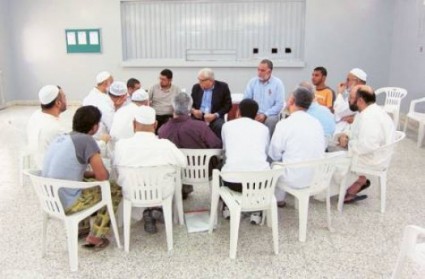
Professor M. Cherif Bassiouni meets with prisoners at Al Qurain prison.
Manama: Bahrain’s probe commission chief has reviewed with prisoners held under the National Safety Law their legal status and detention conditions, the commission has said.
“Professor M. Cherif Bassiouni, the chairman of the Bahrain Independent Commission of Inquiry (BICI), visited Al Qurain prison where he met all the prisoners indicted under the National Safety Law,” the BICI said on Wednesday.
“Among those were the 14 political prisoners, convicted of collaboration in an attempt to overthrow the Bahrain regime and government. The prisoners were Ebrahim Sharif, Abdul Hadi Al Khawaja, Hussain Mushaima, Abdul Wahab Hussain, Jalil Singace, Mohammad Al Saffaf, Saeed Ahmad, Abdul Jalil Al Moqdad, Salah Al Khawaja, Mohammad Jawad, Abdul Hadi Hassan, Al Hurr Mohammad, Abdullah Al Mahroos and Mohammad Esmail.”
Bassiouni discussed the facility conditions, the personal circumstances of their arrest and their trials, allegations of torture and the status of the legal proceedings against them, BICI said.
The head of the five-member commission also visited the military public prosecutor and discussed the status of all cases under the National Security Law.
The meetings were part of a series of visits conducted by the BICI within the mandate of its investigation of the events of February and March 2011 and their consequences.
BICI staff have met a range of political and civic organisations as well as prisoners and detainees, health workers, trade union activists and representatives of large commercial organisations.
The commission has also issued two strong denials that at least one of its members had resigned and shut down its offices for three days following verbal abuses and aggressions. However, the commission said that it would continue its work. …source
August 27, 2011 Add Comments
Iran frees 100 political prisoners: report – good start, if Iran’s ambitions are true and to be respected many more should follow – we wait to see Iran shine in the light of liberty
Iran frees 100 political prisoners: report
Sat Aug 27, 2011
TEHRAN (Reuters) – Iran’s supreme leader ordered the release of 100 political prisoners Saturday including some involved in the huge protests against the disputed June 2009 re-election of President Mahmoud Ahmadinejad.
The decision, reported late Saturday by the semi-official Mehr news agency, appeared timed to coincide with the Muslim holy month of Ramadan which is in its final days, when compassionate release is sometimes issued to prisoners. The report did not name the pardoned prisoners and there was no indication it included two Americans who were sentenced to eight years’ jail last week for spying after they crossed the border from Iraq where they said they had been hiking.
“Based on an agreement of the supreme leader (Ayatollah Ali Khamenei), 100 prisoners charged with security crimes have been granted amnesty. Some of them were involved in post-election sedition two years ago,” Mehr said. The release comes as Iranian politicians start preparing for parliamentary elections due next March which will be the first national poll since the presidential race which brought unprecedented numbers of protesters onto the streets. Most reformists have yet to say whether they will run for election. Iranian authorities are likely to ban people from standing who were connected to the post-election unrest.
Opposition leaders Mehdi Karoubi and Mirhossein Mousavi have been held under house arrest since February when they called the first Green Movement demonstration for more than a year. The group International Campaign for Human Rights in Iran estimated at least 100 people were killed in the unrest which the government blamed on “seditionists” funded by Iran’s foreign enemies. Many more were arrested.
(Reporting by Hossein Jaseb; Writing by Robin Pomeroy) .source
August 27, 2011 Add Comments
Security forces attack the home of Bahraini opposition leader
BJDM Statement on Attack on Sheikh Ali’s Home
August 27, 2011
At around midnight last night, police attacked the home of Bahraini opposition leader, Sheikh Ali Salman.
Sheikh Ali, the General Secretary of the largest opposition party Al Wefaq, was asleep in the house when the attack took place, along with his family.
Police smashed windows, fired rubber bullets and sent tear gas into the home, located in the town of Bilad Al Qadeem.
Fortunately there were no serious injuries sustained in the attack, beyond the psychological damage caused by such high level harassment.
The tactic of terrorizing the homes of opposition activists has been well used by Bahraini Police in the past few months. Many others have faced the same treatment, which is an attempt to scare the opposition into silence.
Sheikh Ali is well known in Bahrain for his moderate views and his peaceful approach to political reform. He advocates dialogue as a form of change and in the past has encouraged protestors to remain peaceful.
But despite his insistence on peaceful activities he has not been treated in the same way by Bahrain authorities. This latest attack is another example of the punishment given to opposition leaders and activists who simply want to create a more just society.
Ali Al Aswad, a resigned MP for Al Wefaq, said:
“We wholeheartedly condemn this thuggish behaviour that has been inflicted upon Sheikh Ali. Everyone in Bahrain knows he is a moderate man who always encourages peaceful protest and dialogue. This is a clear attempt to try to scare the opposition and subsequently silence any criticism. However, we will continue to highlight injustice and not be intimidated or provoked by such an attack.” …source
August 27, 2011 Add Comments
Protests breakout across Bahrain
Bahrain: First Widespread Protests in Months
Security forces in Bahrain heavily attacked numerous areas where protests were taking place and reports of numerous injuries were made. Riot police were targeting the head and upper body of the protesters. Police fired tear gas into people’s homes. Reports were made that police were using a “strange looking tear gas which is much more powerful and affects the nerves.” Additionally, two boys, ages 15 and 18 were arrested.
Reports also show that the Deputy Head of Waad Radhi Almosawi’s sister’s home was caught on fire as a result of the tear gas being shot at people’s homes.
In addition, sectarian tensions are increasing in Bahrain. …Source
August 27, 2011 Add Comments