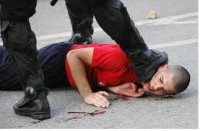
Universal thuggery – US, Oakland police critically wound OWS protester in assassination attempt
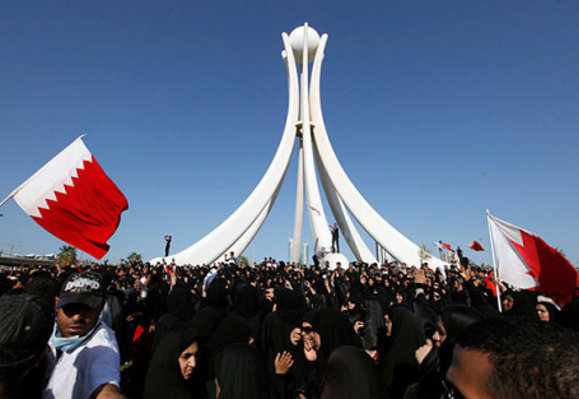
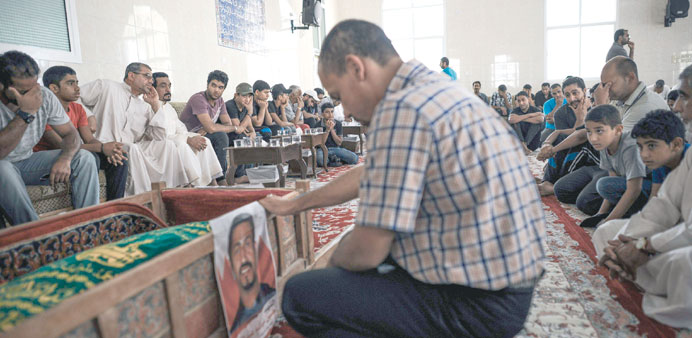
The Familiar Sound (Excerpt Amnesty International – 31 August 2011) A 14-year-old boy was killed during a peaceful demonstration in Bahrain’s central town of Sitra today, where dozens of demonstrators took part in anti-government protests marking the feast of ‘Eid al-Fitr, the end of the holy month of Ramadan. Ali Jawad Ahmad al-Shaikh died from a head injury after being hit by a tear gas canister thrown by riot police, a local human rights group said.
Occupy Oakland Protester Severely Injured in Police Clash ID’ed as Iraq War Veteran
26 October, 2011 – ABC News
The group Iraq Veterans Against the War has identified the demonstrator who endured a skull fracture after Occupy Oakland protesters clashed with police Tuesday night. According to the organization’s statement, Scott Olsen, also a member of Veterans for Peace, was “shot in the head with a police projectile while peacefully participating in the Occupy Oakland march.”
A news release from Mike Ferner, Occupy Oakland’s interim director, said that Olsen’s condition was stable but serious. Olsen, 24, a former Marine, did two tours of duty in Iraq before leaving the military in 2010. Formerly of Wisconsin, he now lives and works in Daly, Calif.
On Tuesday, a number of clashes erupted between police as a group of nearly 500 protesters who’d marched from the main branch of the Oakland Public Library to City Hall to reclaim the camp they’d been evicted from earlier in the day. According to Ferner, a video with slow-motion footage showed police tossing a flash-bang into a group of people standing around someone in the street, though it was not clear whether Olsen was the person on the ground.
Authorities have denied reports that they used flash-bang canisters to help break up the crowds, saying the loud noises came from large firecrackers.
During a late-night news conference, Oakland Interim Police Chief Howard Jordan told reporters that authorities had no other choice then to use the tear gas, saying the protesters were throwing rocks and bottles at officers. According to Ferner’s statement, a Veterans for Peace member, Josh Sheperd, who’d witnessed Olsen’s injury, said that after police fired tear gas, bean bags and flash-bangs and warned demonstrators to leave, “people in the rear of the crowd threw eggs at the police.”
Carlos Villarreal, a spokesman for the National Lawyers Guild, which represents the protesters, told ABC News station KGO-TV that two protesters suffered broken hands when they were arrested, and that one protester had been taken to a hospital with head injuries.
The statement from the Iraq Veterans Against the War said that Olsen was sedated at a local hospital and would be examined by a neurosurgeon. …source
October 26, 2011 Add Comments
al Khalifa regimes Western Allies allow their expatriate rights to be trampled
Canadian jailed for protesting in Bahrain
Oct 25 2011 – The Star
Canadian Naser al-Raas will begin a five-year sentence in a Bahraini prison on Wednesday. He is one of 13 people sentenced Tuesday to jail terms related to the uprising in the country. Canadian Naser al-Raas will begin a five-year sentence in a Bahraini prison on Wednesday. He is one of 13 people sentenced Tuesday to jail terms related to the uprising in the country.
Canadian Naser al-Raas will begin a five-year sentence in a Bahraini prison on Wednesday. He is one of 13 people sentenced Tuesday to jail terms related to the uprising in the country.
Naser al-Raas remembers the cramped office, the beatings, and the small gun pointed at his head. He remembers the cables used to tie his hands behind a chair and the blindfold fastened around his face.
He remembers the ambush at Bahrain International Airport on March 20, just as he was preparing to present his Canadian passport to customs and fly to Kuwait, where he was born.
He remembers three mock executions held under the desert sun. And he remembers the dingy cell in the notorious Al Qala prison, where he said he spent more than a month in solitary confinement, beaten and electrocuted daily, the screams of other tortured prisoners echoing through the halls.
Now on Wednesday, nearly six months after he was inexplicably released from that cell, authorities are set to enter his in-laws’ home in Bahrain — where he is staying with his Bahraini fiancée Zainab — and steer him to prison, for a five-year term for participating in antiregime demonstrations that swept the country beginning in February. At least 30 people have been reported killed in the crackdown.
Al-Raas was sentenced by a civilian court Tuesday for violating Bahrain’s illegal-assembly laws. A defence lawyer in Bahrain said he was one of 13 people sentenced to jail terms for links to anti-government protests and unrest in the Gulf kingdom.
The 28-year-old lived in Ottawa from 1996 to 2000, and his mother and brother are still there. He now works as an IT specialist in Kuwait.
Al-Raas had arrived in the tiny Persian Gulf kingdom of Bahrain on March 6 amid a countrywide crackdown on Shiites protesting against the Sunni monarchy.
“I didn’t chant against the government; it’s not my business,” he told the Star. “The country was in chaos.”
But when he tried to return to Kuwait two weeks later, he said, he was whisked away by men from Bahrain’s National Security Agency, an intelligence wing of the Ministry of the Interior.
Over the course of his imprisonment, al-Raas said he was beaten daily with a rubber hose. He also suffered excruciating chest pain. Al-Raas has pulmonary hypertension, a heart and lung condition.
His torture in Bahrain is recorded in a medical report filed by Doctors Without Borders obtained by the Star.
When he was released on April 28, al-Raas stripped off his prisoners’ garb and put on the Ottawa Senators T-shirt he’d worn to the airport. He said he made a forced on-camera confession to spying for the Iranian government. Then he was dumped in the street outside the prison, given back his glasses and wallet and told to take a taxi home. ..more
October 26, 2011 Add Comments
US labor team probes job purges in Bahrain
US labor team probes job purges in Bahrain
By BRIAN MURPHY – Oct. 26, 2011 – The Sacramento Bee
DUBAI, United Arab Emirates — A U.S. fact-finding team in Bahrain wrapped up talks Wednesday to investigate workplace purges that have spurred calls to suspend a key trade pact over the Gulf nation’s crackdown on protesters.
The firsthand inquest by the Department of Labor is in response to efforts by America’s biggest labor group to force a stinging U.S. rebuke of Bahrain’s rulers, who have crushed opposition groups but have avoided serious backlash from Washington because of strategic concerns.
Bahrain is home to the U.S. Navy’s 5th Fleet, and its ruling monarchy is closely backed by another critical U.S. ally, Saudi Arabia. The Saudis have dispatched troops to help Bahrain’s Sunni monarchy battle Shiite-led protesters calling for greater rights.
The Labor Department has until December to complete a report on a complaint filed by the AFL-CIO, seeking to block the free-trade pact with Bahrain in retaliation for widespread dismissals of workers and union leaders with suspected ties to protesters.
Bahrain’s majority Shiites began protests in February calling for reforms, including an end to the monarchy’s monopoly on appointing top government officials. At least 35 people have died in the unrest, and hundreds have been purged from jobs or arrested, including some sentenced to life in prison or given death sentences for killing security forces.
The number of people pushed from their jobs is unclear. Bahrain’s biggest labor group, the General Federation of Bahrain Trade Unions, has put the figure as high as 2,500.
A statement Wednesday by Bahrain’s government said 1,623 cases are pending before disciplinary councils, which were set up to review the dismissals of employees.
In possible reaction to the U.S. investigations, Bahrain’s deputy prime minister, Sheik Mohammed bin Mubarak Al Khalifa, urged for a “resolution” of the review of workers dismissed from jobs. The statement said the disciplinary councils have so far cleared 156 people for reinstatement and confirmed the dismissals of 174 employees.
In September, more than 100 workers returned to jobs at the state oil company.
Suspending the 5-year-old trade pact would have not have major financial effects – the two-way trade is less than $1.5 billion a year – but it would be seen as a direct blow to Bahrain’s efforts to reassure international companies and investors.
The pact, which waives tariffs on industrial and consumer products, is just one of 17 such bilateral agreements with Washington. Others in the Middle East include Israel, Jordan and Oman.
In Bahrain’s capital Manama, U.S. Embassy spokesman Bradley Niemann said the Labor Department envoys have held talks since last week with government officials, union representatives and workers. The mission was scheduled to end Wednesday.
In Washington, rights groups have urged the U.S. Congress to block a proposed $53 million arms sale to Bahrain.
…source
October 26, 2011 Add Comments
Blowback hell amidst Libya’s phoenix
Smuggled Libyan weapons flood into Egypt
By Leila Fadel – Washington Post – 26 October, 2011
EL ARISH, Egypt — Large caches of weapons from Libya are making their way across the Egyptian border and flooding black markets in Egypt’s already unstable Sinai Peninsula, according to current and former Egyptian military officials and arms traders in the Sinai.
Egyptian security officials have intercepted surface-to-air missiles, most of them shoulder-launched, on the road to Sinai and in the smuggling tunnels connecting Egypt to the Gaza Strip since Moammar Gaddafi fell from power in Libya in August, a military official in Cairo said. Arms traders said the weapons available on Sinai’s clandestine market include rockets and antiaircraft guns.
The seizures raise fresh concerns about security along the sensitive area that borders the Gaza Strip and Israel, at a time when unrest is roiling the region. The addition of shoulder-fired antiaircraft missiles to arsenals of Palestinian fighters in Gaza could add significantly to the threat against Israel, whose helicopters and fixed-wing aircraft frequently patrol the strip, which is controlled by the militant Islamist group Hamas.
“We don’t want to see Egypt as a pathway to smuggle weapons,” said Sameh Seif el-Yazal, a retired Egyptian general in military intelligence who said several surface-to-air missiles have been intercepted on the desert road from Libya to the Egyptian city of Alexandria and north on to Gaza. “We believe some Palestinian groups made a deal with Libyans to get special weapons such as shoulder-fired surface-to-air missiles.”
Concerns about security in the Sinai have been growing in Egypt and among Israeli and American officials, who have called on Egypt to do more to protect the sensitive area, which borders the Gaza Strip and Israel. In the months since Egypt’s January-February revolution, the pipeline that feeds natural gas to Israel has been attacked seven times by militants. A cross-border attack by assailants in August killed eight Israeli civilians and prompted an Israeli counterstrike that killed six Egyptian troops, including three who later died of their wounds
Palestinian militants in Gaza command a potent arsenal that includes surface-to-surface missiles capable of striking deep inside Israel. But they are not known to have employed more than rudimentary antiaircraft weapons.
Resistance by Bedouins
The vastness of the Sinai, with its deserts and mountains, poses a major challenge to efforts by Egyptian authorities to maintain security there. In recent months, Egypt has sent reinforcements, bringing the number of troops on the peninsula to 20,000, but it has struggled to gain control in an area governed by tribal customs and populated primarily by Bedouins, who distrust the government and call the shots.
A security official and an Egyptian brigadier general who served recently in the Sinai said the seizures have included ammunition, explosives, automatic weapons and caches of heavier arms, including Russian-made Strela-2 and Strela-3 heat-seeking, shoulder-fired antiaircraft missiles.
“We’ve intercepted more advanced weapons, and these weapons aren’t familiar to the Egyptian weapons markets; these are war weapons,” said the brigadier general, who spoke on the condition of anonymity. …more
October 25, 2011 Add Comments
Saudi Arabia police open fire at protest in Qatif back
Saudi Arabia police open fire at protest in Qatif back
25 October, 2011 – xfmnewscenter.com
Police in Saudi Arabia have opened fire to disperse protesters in the eastern city of Qatif, a day before planned countrywide anti-government protests.
Witnesses said police also beat demonstrators with batons injuring at least three people.
The protesters, from the Shia minority, were demanding the release of prisoners they say have been held without charge.
Protests are illegal in Saudi Arabia, which has had an absolute monarchy since its unification in the 1930s.
But last month the arrest of Shia cleric Sheikh Tawfiq al-Amer, detained reportedly for calling for a constitutional monarchy, sparked outrage and drew crowds on to the streets.
He was released last weekend, but relatively small-scale protests have continued in the Eastern Region, where much of the country’s crude oil is sourced.
The protesters have been demanding the release of nine Shia prisoners who they say have been held without trial for more than 14 years.
A witness in Qatif told AFP news agency the crowds had once again been demanding the prisoners’ release.
“As the procession in the heart of the city was about to finish, soldiers started shooting at the protesters, and three of them were wounded,” the witness said.
Other accounts said the police had also used stun grenades and had beaten the protesters with batons, injuring many more than three.Rights groups have accused the police of beating protesters during previous rallies in Qatif.
[Read more →]
October 25, 2011 Add Comments
Dead men tell no tales, like the dark secrets of the CIA – leaves one wondering who pulled the trigger and who scrubbed the site?
Volunteers in Surt removed bodies of people apparently killed in reprisal by anti-Qaddafi militias. Many had their hands bound and had been shot in the head
In Libya, Massacre Site Is Cleaned Up, Not Investigated
By KAREEM FAHIM and ADAM NOSSITER – October 24, 2011 – NYT
The volunteers said the victims included at least two former Qaddafi government officials, local loyalist fighters and maybe civilians. The killers, they believed, were former rebel fighters, belonging to anti-Qaddafi units that had used the hotel as a base in recent weeks. It appeared to be one of the worst massacres of the eight-month conflict, but days after it occurred, no one from Libya’s new government had come to investigate.
The interim leaders, who declared the country liberated on Sunday, may simply have their hands full with the responsibilities that come with running a state. But throughout the Libyan conflict, they have also shown themselves to be unwilling or incapable of looking into accusations of atrocities by their fighters, despite repeated pledges not to tolerate abuse.
The lack of control came into sharp focus last week, when former rebel fighters arrested Col. Muammar el-Qaddafi. In videos of the capture on Thursday morning, victorious fighters were shown manhandling Colonel Qaddafi, who appeared to be bleeding and distressed but conscious. This was moments after he was pulled from a large drainage pipe where he had hidden after a NATO air assault destroyed part of his convoy. Subsequent video shows his bruised corpse, with at least one bullet wound to the head. …more
October 24, 2011 Add Comments
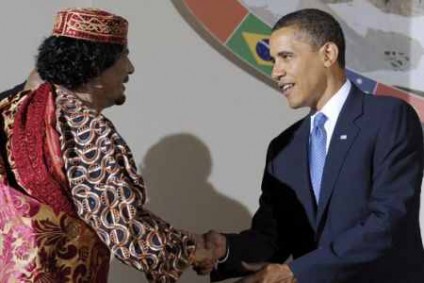
Humvees, canons, shotguns, rubber bullets, canister gas, gernades, torture training? I think we can help you out Colonel
October 24, 2011 Add Comments
A little decency please or would that every greedy bastard who lined their pockets selling Gaddafi weapons and then cheered his demise, share the same horrible end
Bury Gaddafi with dignity
Gaddafi’s body should be treated with dignity in order to send a message to other dictators and future generations.
Hamid Dabashi – 22 Oct 2011 – AlJazeera
The unseemly pictures and videos circulating the internet capturing the final moments of Gaddafi’s life should be the last signs of indignity that Libyan people would ever see marking their historic revolution. Future generation of Libyans, the children of these very freedom fighters, deserve better.
Reports indicate that Colonel Gaddafi’s body is in the possession of authorities from the National Transitional Council (NTC). They must see that he gets a proper and dignified funeral, befitting a fallen head of state.
The body now in possession of NTC authorities is not just the remains of a fallen dictator to be violated freely on the battlefield of a cruel history. It is also the body-politic of future Libya. The triumphant euphoria of Libyans feasting on their victory, richly deserved, must not be marred by the undignified pictures of abusing the image they will most remember and tell their grandchildren for an entire history yet to unfold.
Treat Gaddafi’s body with dignity not because he deserved it. But because the Libyan people need it. They must commence the rest of their history with a sense of self-dignity, of triumphant pride. That self-dignity is now determined by how they will treat the dead body of Colonel Gaddafi.
Treat that body not as the fallen tyrant deserved, but as the future of your children deserves.
Shakespearian dilemma
There is a scene in Hamlet where the bereaved Prince turns to the conniving Polonius asking him to treat a group of actors visiting the Elsinore with dignity and generous hospitality. “Good my lord,” Hamlet says, “Will you see the players well bestowed? Do you hear, let them be well used, for they are the abstract and brief chronicles of the time. After your death you were better have a bad epitaph than their ill report while you live.”
These days are indeed “the abstract and brief chronicles of the time” for future Libyans, for the future of the Arab and Muslim world. They should treat the fallen tyrant not “according to his desert,” but after their own honor and dignity.
Follow Al Jazeera’s ongoing coverage
Let the pictures and videos of a proper burial and a dignified resting place for Colonel Gaddafi fill the schoolbooks in which future generations of Libyans will read their Arabic alphabet and learn the dignity of their parentage.
The man was a relic, a frightful echo from a past, a monster not entirely of his own making. Heads of state, who in some cases enabled the dictator, are now rejoicing in his downfall. …more
October 24, 2011 Add Comments
US Hawks circle ready for “old buzzard” feed cheering opportunity at Syria’s misery
US senator talks about military options in Syria
The Associated Press – Sunday, Oct. 23, 2011- Las Vegas Sun
U.S. Senator John McCain said Sunday that military action to protect civilians in Syria might be considered now that NATO’s air campaign in Libya is ending.
However, President Barack Obama’s administration has made clear it has no appetite for military intervention in Syria _ a close ally of Iran that sits on Israel’s border _ and U.S. Secretary of State Hillary Rodham Clinton noted Sunday that the Syrian opposition has not called for such action as President Bashar Assad’s regime.
“Now that military operations in Libya are ending, there will be renewed focus on what practical military operations might be considered to protect civilian lives in Syria,” McCain said at the World Economic Forum in Jordan. “The Assad regime should not consider that it can get away with mass murder. Gadhafi made that mistake and it cost him everything,” he added, referring to ousted Libyan leader Moammar Gadhafi who was captured and killed last week by fighters loyal to the new government.
“Iran’s rulers would be wise to heed similar counsel,” McCain said.
It was not clear whether the Republican senator from Arizona was referring to American or NATO military action against the Syrian regime, which has waged a 7-month crackdown on opposition protesters and killed about 3,000 people, according to the U.N.
However, international intervention, such as the NATO action in Libya that helped topple Gadhafi, is all but out of the question in Syria. Washington and its allies have shown little inclination for getting involved militarily in another Arab nation in turmoil. There also is real concern that Assad’s ouster would spread chaos around the region.
Syria is a geographical and political keystone in the heart of the Middle East, bordering five countries with which it shares religious and ethnic minorities and, in Israel’s case, a fragile truce. Its web of alliances extends to Lebanon’s powerful Hezbollah movement and Iran’s Shiite theocracy. There are worries that a destabilized Syria could send unsettling ripples through the region.
Most Syrian opposition groups, inside and outside Syria, also have said they oppose military intervention. …more
October 24, 2011 Add Comments
The quagmire of War Profiteering and gulf dominance – Human Rights double standard easy for foreign policy that is built upon it
The U.S. State Department announced Oct. 14 that it was putting the Bahrain sale on hold until a government commission set up by King Hamad bin Isa al Khalifa in June to investigate Manama’s harsh crackdown on protesters demanding the end of the Sunni monarchy. It’s more than likely the report will exonerate the Bahraini government, which would clear the way for the Pentagon to complete the $53 million sale. quagmire
Arms sales to Mideast under the gun
Oct. 24, 2011 – UPI
MANAMA, Bahrain, Oct. 24 (UPI) — Amid growing calls for halting arms sales to repressive Arab regimes, the U.S. administration has delayed a planned $53 million deal with Bahrain. But it’s a token gesture at best and is expected to go through eventually.
Not surprising since U.S. officials disclosed in September that the United States had secretly extended a defense agreement with the tiny Persian Gulf kingdom, a key regional financial hub, in 2002 that will run until 2016. The Pentagon declared the agreement, reached in 1991, is classified and declined comment on the extension. Because it’s not a full-blown defense treaty, the agreement didn’t require approval from Congress. The pact allows the United States access to bases in the island state, strategically located in the middle of the Persian Gulf opposite Iran, and the headquarters of the U.S. Navy’s 5th Fleet. That’s a powerful U.S. military force in the volatile region and its importance grows as the U.S. military withdrawal from Iraq moves toward completion Dec. 31.
The U.S. State Department announced Oct. 14 that it was putting the Bahrain sale on hold until a government commission set up by King Hamad bin Isa al Khalifa in June to investigate Manama’s harsh crackdown on protesters demanding the end of the Sunni monarchy. It’s more than likely the report will exonerate the Bahraini government, which would clear the way for the Pentagon to complete the $53 million sale.
It includes 44 Humvee armored vehicles, several hundred TOW anti-tank missiles with associated equipment and support programs. Primary U.S. contractors are AM General and the Raytheon Co.
The United States clearly has strategic interests in Bahrain and doesn’t want to see the Al Khalifa monarchy fall as that would jeopardize U.S. bases in Bahrain and boost Iran’s influence.
The U.S. Navy is extending its naval base in Manama, which supports more than a dozen U.S. warships. The Navy has taken over the Mina Salman port, which will be large enough to berth Nimitz class aircraft carriers. The Navy has been in Bahrain since 1973, when the British pulled out of the Persian Gulf, and has built a minor naval station into one of the most crucial bases in the region.
According to the Marine Times newspaper, the U.S. Marine Corps plans to locate one of two new Marine Expeditionary Brigade headquarters in Bahrain under the U.S. Central Command.
Manama authorities claimed the mass protests, mainly by the kingdom’s downtrodden majority Shiites, were instigated by Iran, which has long claimed the island state as its territory.
The revolt took place as the Arab world was convulsed by uprisings by pro-democracy protesters that have toppled the presidents of Tunisia and Egypt, both U.S. allies, and overturned the regime of Libyan leader Moammar Gadhafi, who was killed by rebel fighters.
Other uprisings are taking place in Syria and Yemen, with some 5,000 people killed since January, most of them by the forces of regimes they seek to topple. Western human rights organizations claim the weapons used by these repressive regimes, with records of large-scale human rights abuses, were provided by U.S., European and Russian governments and defense companies.
These groups demand tighter regulation of arms sales to such regimes. Amnesty International said Oct. 18 that many of the world governments calling for political reforms and human rights in the Middle East were the very ones preventing it by selling weapons to those regimes. Amnesty’s report on arms sales to despotic regimes listed Austria, Belgium, Britain, Bulgaria, the Czech Republic, France, Germany, Italy, Russia and the United States as the main suppliers since 2005 to the countries — Bahrain, Egypt, Libya, Syria and Yemen — covered by the study.
Britain has said it plans to tighten export regulations to halt the sale of weapons, ammunition and tear gas to regimes that maintain police states and abuse human rights. But, like the Americans, Britain and its European partners are coming to rely heavily on military exports to maintain production lines and research and development at a time when defense budgets are being slashed because of the global economic slowdown. So it wasn’t surprising that when British Prime Minister David Cameron visited the gulf in February, when the Arab uprisings were getting into full swing, a posse of executives from U.K. defense companies went with him. …source
October 24, 2011 Add Comments
King Hamad stop another travesty of justice free the Medics Now!
HRW: Bahrain: Medics Describe Torture in Detention
Appeals Court Should Void Flawed Convictions – OCTOBER 21, 2011 – BCHR
(Beirut) – Medical staff convicted by a military court of alleged serious crimes during the period of anti-government protests in Bahrain in early 2011 were subjected to abuse and torture in detention, Human Rights Watch said today. Given the fundamental unfairness of the trial, including that civilians were tried in a military court, Bahrain’s High Court of Appeals should reverse the convictions of 20 medical staff when they hear their appeal on October 23, 2011, and order an independent investigation into the defendants’ allegations of abuse and torture.
The prosecutors should drop all charges based solely on their exercise of freedom of speech and assembly, and ensure a new trial for defendants in a civilian court only if there is evidence of possible criminal activity, Human Rights Watch said. On October 5, Attorney General Ali Al Buainain announced that the appeal will “be equivalent to a retrial.” Human Rights Watch interviewed 7 of the 20 medical staff convicted of serious crimes, who told of severe abuse in detention and extensive violations of their rights to a fair trial.
“The appeals court should decisively overturn the unfair verdicts against the medics and dismiss outright all politically motivated charges,” said Joe Stork, deputy Middle East director at Human Rights Watch. “The new hearing should also disallow allegedly coerced confessions.”
On September 29, the National Safety Lower Court, a special military court, convicted the 20 doctors, nurses, and paramedics on charges including forcibly taking over the Salmaniya Medical Complex and refusing treatment to patients based on sectarian affiliation. The court also convicted the 20 of transparently political offenses, such as “instigating hatred against the ruling system,” “incitement to overthrow the regime,” and “spreading false news.”
On March 16, the Bahrain Defense Force (BDF) took control of the Salmaniya Medical Complex, the largest medical complex in Bahrain. Beginning on March 17, security forces arrested 48 medics, 28 of whom separately face lesser misdemeanor charges before a civilian court for speech-related offenses.
Medical staff interviewed by Human Rights Watch said that interrogators subjected them to physical and psychological pressure during pretrial detention, typically to coerce confessions. Authorities held many of them for weeks, much of that time incommunicado. None could meet with their lawyers to prepare their defenses prior to the military court trial. Many saw family members and lawyers for the first time on June 6, at their first trial session. …more
October 24, 2011 Add Comments
Let democracy flourish where there is hope, vision and the will of people who demand it
Geopolitics and Democracy in Bahrain
By: Abbas Bu-Safwan – Published Friday, October 21, 2011 – Al-Akhbar
The Bahraini popular uprising is bound by its local framework and by regional and international factors that guide its direction and may define its outcome. In light of this reality, a more comprehensive approach needs to be taken towards the choices and outcomes that await the current political situation in Bahrain.
The uprising in Bahrain is purely an internal event. It is the manifestation of people’s bitterness toward the ruling dynasty and their monopolization of power. The uprising is merely the translation or embodiment of people’s resentment stemming from a dictatorial regime and from corruption, including the inconsistent implementation of law and the strong hold that security forces have over politics. The regime in Bahrain has demonstrated an increasingly entrenched discrimination against its Shiite citizens. The government has taken steps to change the demographics by illegally offering Bahraini nationality to non-Shiite migrants, though Shia still represent at least two-thirds of the population in the country. This internal tension is at least a century old, and its renewal reflects the depth and longevity of the crisis. Since the 1930s, Bahrainis have demanded an elected parliament and a regime that upholds the law equally for all its citizens.
The geopolitical realities of the small islands of Bahrain may prevent a democracy from ever taking hold. At the very least, the characteristics of the Bahraini ruling system and its rentier economy impede any transition to a democratic regime. The geographic location of Bahrain is a factor that also hinders renovation of the country’s tribal structure. How so?
Bahrain is in the center of a turbulent region, with a history of wars that precedes the establishment of the relatively new state. This region that includes Saudi Arabia and the Gulf countries is governed by tribes. Bahrain’s Al Khalifa tribe has controlled political power and the national wealth for the past 230 years. Such regimes don’t tolerate authentic democratic transformations that allow people to effectively participate in the ruling of their country. Moreover, Saudi Arabia considers Bahrain to be its backyard. In other words, it has a real say in Bahraini affairs. When demonstrations spread in Manama between mid-February and March, Saudi Arabia felt that its influence in Bahrain was threatened. It intervened militarily in a crude and unprecedented manner. …more
October 24, 2011 Add Comments
Bahrain’s Doctors in Chains
24 October.2011
Latest News regarding Bahrain’s Doctors in Chains:
On 23rd October the medics went back to court, unsure whether it was for an appeal or a retrial. The Public Prosecution dropped a few of the lesser charges and stated that a retrial would begin, starting on 28th November. The trial will be open to the public. We encourage everyone to write to their government to encourage them to send representatives to observe the proceedings to ensure a fair trial. This is a fact sheet handed out by the Public Prosecution in court on 23rd October regarding the proceedings: Public Prosecution statement on 23 Oct 2011 distributed in Appeal Court HERE
This is the response from the medics’ lawyers, released on 24th Oct: Arabic & English Medics’ Lawyers statement in reply to PP statement on 23 October 2011
In the name of God the most merciful and precious
Statement by the Lawyer of the Bahraini Medics regarding the Start of the Hearings before the Criminal High Court of Appeal The Criminal High Court of Appeal yesterday, 23rd October 2011, held its first hearings of the appeals filed by the Medical Staff and also by the Public Prosecution. In a precedent considered the first of its kind in the history of the Courts of Bahrain, the Public Prosecution distributed among the persons attending the Court hearing, just a few minutes before the hearing started, an English statement printed on the Public Prosecution’s letterhead papers, consisting of three pages. The statement was entitled “Fact Sheet for Hearing of 23.10.2011.”
In our capacity as the defense lawyers for the Medical Staff charged in the Case, we hereby lay our response to the Public Prosecution’s statement and also what the Public Prosecution’s representative recorded in the hearing minutes, as follows:
First: There is difference in the charges put against the Medical Staff before the Court of Appeal and those which were put against them before the military National Safety Court. The Public
Prosecution, for example, dropped three minor charges out of 14 charges put against them. The three charges which the Public Prosecution dropped from the list of charges are only misdemeanors
the punishment for which does not exceed a maximum of three years’ prison term. Those three misdemeanors are:
1. Public incitement of hatred to the ruling regime or showing contempt towards it, which is punishable according to Article 165 of the Penal Code. Statement by the Lawyer of the Bahraini Medics regarding the Start of the Hearings before the Criminal High Court of Appeal 1
2. Publicly broadcasting false or malicious news or statements which are detrimental to the public interest, which is punishable by Article 168 of the Penal Code.
3. Inciting others, by any method of publication, not to comply with the applicable laws or to do any act that constitutes a crime, which is punishable by Article 173 of the Penal Code.
Therefore, it is clear that the Public Prosecution maintained all charges against the Medical Staff the constitute felonies, which are the most grave and serious, mainly the following:
1. Occupying a public hospital which is punishable with up to life imprisonment as per Article 149 of the Penal Code.
2. Possessing arms without license which is punishable with up to 15 years’ imprisonment as per Article 7 of the Explosives and Arms Law.
3. Detaining public servants and preventing them of carrying their duties which is punishable with up to 15 years’ imprisonment as per Article 357 of the Penal Code.
4. Promoting the overthrow of the political system of the State by force which is punishable with up to 10 years’ imprisonment as per Article 160 of the Penal Code.
Practically speaking, dropping the said three minor charges by the Public Prosecution will have no impact on the prison sentences passed against the Medical Staff, in case the Court of Appeal upheld the ruling handed down by the military National Safety Court for any of the felony charges above-mentioned. This is because according to Article 66 of the Penal Code, a single punishment
which is that or the gravest offense will be applied. .FULLTEXT HERE
October 24, 2011 Add Comments
Obama-Clinton foreign policy of bumbling and bungling or crass opportunism and war profiteering without regard for Human Rights?
Ignoring Human Rights, Defense Dept. Considers Selling Weapons to Bahrain
by Zachary Foster – 24 October, 2011 – policymic.com
Last week, Amnesty International published a report urging the international community to ban arms sales of any kind to countries in which there is a substantial risk that these arms will be used to commit or facilitate serious violations of international human rights law.
The report analyzed arms transfers to Bahrain, Egypt, Libya, Syria, and Yemen since 2005, finding that the principle weapons suppliers were Austria, Belgium, Britain, Bulgaria, Czech Republic, France, Germany, Italy, Russia, and the United States.
The evidence is at times disturbing. In 2009, Finland authorized the sale of sniper rifles to Bahrain for “demonstration purposes.” Egyptian security forces (mostly from the Ministry of Interior) killed hundreds of peaceful protestors with shotguns and automatic weapons obtained from the U.S. government as well as other U.S. commercial suppliers. Libya used Spanish-made MAT-120mm mortars in the city center of Misrata – weapons that are altogether prohibited by the Convention on Cluster Munitions. These and thousands more weapons sales, the report documents, have enabled tyrants in the Middle East to slaughter their own people.
To the credit of the West, in most cases the U.S. and European states froze contracts or revoked licenses to states that began using their weapons en masse against their own people.
Still, exceptions can be made for friends. A September 14 Department of Defense press release noted a possible Foreign Military Sale to the government of Bahrain, which had requested 53 million dollars of military equipment, including 44 Armored High Mobility Multi-Purpose Wheeled Vehicles, a variety of wire guided missiles, Night Sight Sets, spare parts, and other support and test equipment. Perhaps some of the tanks and armored vehicles used in the February 17 raid on peaceful Bahraini protesters — in which five people were killed and 250 injured — were damaged and in need of urgent U.S. government repair before the next round of protests broke out?
The State Department, in response to pressure from Congress and other NGOs, recently announced a “delay” in the shipment of new arms to Bahrain pending the results of an international commission investigating “alleged” abuses by the Kingdom’s security forces. Is Foggy Bottom incapable of conducting its own investigation? Is there not enough independent evidence of flagrant human rights violations to “cancel” the shipment altogether?
The main recommendation of the report, however, is not to prohibit arms sales to erstwhile violators – something about which there seems to be general consensus (with the possible exception of the Defense Department) – but rather to establish “objective and non-discriminatory” criteria “designed to prevent arms transfers where there is a substantial risk of serious violations occurring” in the future.
How it is possible to establish “objective” criteria to predict which countries will commit “serious” violations in the future? If these criteria were so easy to develop, why didn’t Amnesty publish this report a year or two ago? Amnesty could only conceive of producing such a priori criteria after violations have taken place.
The inevitable risk – one acknowledged in the report – is that politicians will exploit this kind of law to punish some states and reward others, for reasons that may or may not have anything to do with the potential for human rights violations (if such a potentiality is even possible to determine). Short of banning the sale of any kind of arms to anyone for any reason, I think the Amnesty recommendations need a great deal more deliberation – including public debates over the objective criteria – before U.S. lawmakers consider accepting them. …source
October 24, 2011 Add Comments
Roula Al-Safar, Head of the Bahrain Nursing Society Tortured
Roula Al-Safar is a nurse, head of the Bahrain Nursing Association. She spent eighteen years in the United States where she trained at Baylor medical facilities in Dallas, Texas and studied at Widener University in Pennsylvania. Roula was detained for over five months for treating wounded protestors. The Bahrain military court sentenced her to 15 years in prison. She is currently released pending an appeal on October 23, 2011.
October 23, 2011 Add Comments
Fears for Bahraini teacher after pre-dawn arrest – Speakout Your Gone
Fears for Bahraini teacher after pre-dawn arrest
Jalila al-Salman was previously ill-treated and verbally abused in detention
18 October 2011 – Amnesty Intenrational
There are fears for the safety of a former vice-president of the Bahrain Teacher’s Association after she was arrested in heavy-handed fashion before dawn this morning after recently speaking out about earlier abuses.
Jalila al-Salman was taken from her home in Bahrain by a force of more than 30 security officials, including riot police, who arrived in seven vehicles. The officials reportedly said that they were enforcing a court order for her arrest though they refused to produce a formal arrest warrant.
Last month, Jalila al-Salman was convicted on charges that included attempting to overthrow the Bahrain government after a trial before the military National Safety Court, although she is a civilian. Her appeal is due to be heard in a civilian court on 1 December.
“The manner in which Jalila al-Salman was arrested this morning appears to have been intended to intimidate her and her family and to put them through another terrifying ordeal,” said Malcolm Smart, Amnesty International’s Middle East and North Africa Director.
“She has told us how she was previously ill-treated and verbally abused after she was arrested in the middle of the night by armed officials following popular protests in Bahrain last March. This latest action by the security forces inevitably raises renewed concerns about her safety in detention.”
“The Bahraini authorities also need to explain why Jalila al-Salman has been arrested at a time when others who are waiting for their promised civilian court appeals to be heard have been allowed their release on bail.” …more
October 23, 2011 Add Comments
Obama and Extrajudical Killing of American Children
The killing of Awlaki’s 16-year-old son
Extreme secrecy, as usual, shrouds this act, but it underscores how often the U.S. uses violence around the world
By Glenn Greenwald – Salon.com – 20 October, 2011
Two weeks after the U.S. killed American citizen Anwar Awlaki with a drone strike in Yemen — far from any battlefield and with no due process — it did the same to his 16-year-old son, Abdulrahman al-Awlaki, ending the teenager’s life on Friday along with his 17-year-old cousin and seven other people. News reports, based on government sources, originally claimed that Awlaki’s son was 21 years old and an Al Qaeda fighter (needless to say, as Terrorist often means: “anyone killed by the U.S.”), but a birth certificate published by The Washington Post proved that he was born only 16 years ago in Denver. As The New Yorker‘s Amy Davidson wrote: “Looking at his birth certificate, one wonders what those assertions say either about the the quality of the government’s evidence — or the honesty of its claims — and about our own capacity for self-deception.” The boy’s grandfather said that he and his cousin were at a barbecue and preparing to eat when the U.S. attacked them by air and ended their lives. There are two points worth making about this:
(1) It is unknown whether the U.S. targeted the teenager or whether he was merely “collateral damage.” The reason that’s unknown is because the Obama administration refuses to tell us. Said the Post: “The officials would not discuss the attack in any detail, including who the target was.” So here we have yet again one of the most consequential acts a government can take — killing one of its own citizens, in this case a teenage boy — and the government refuses even to talk about what it did, why it did it, what its justification is, what evidence it possesses, or what principles it has embraced in general for such actions. Indeed, it refuses even to admit it did this, since it refuses even to admit that it has a drone program at all and that it is engaged in military action in Yemen. It’s just all shrouded in total secrecy.
Of course, the same thing happened with the killing of Awlaki himself. The Executive Branch decided it has the authority to target U.S. citizens for death without due process, but told nobody (until it was leaked) and refuses to identify the principles that guide these decisions. It then concluded in a secret legal memo that Awlaki specifically could be killed, but refuses to disclose what it ruled or in which principles this ruling was grounded. And although the Obama administration repeatedly accused Awlaki of having an “operational role” in Terrorist plots, it has — as Davidson put it — “so far kept the evidence for that to itself.” …more
October 23, 2011 Add Comments
Weapons Sales to Bahrain – Examples of Injury
BAHRAIN
Small arms – Austria (€28,709), Belgium (€5,643,483), Finland (€13,500), France (€1,254,772), Germany (€87,862), Switzerland (SFr292,804), the UK (£1,065,795)6 and the USA ($929,904) all authorised the transfer of small arms to Bahrain, including assault rifles, sniper rifles, semi automatic and non-automatic firearms, and shotguns.
Smooth-bore weapons over 20mm – Austria (€384,000), France (€1,628,630), Italy (€6,796,430)7, and the UK (£1,458,000) authorised the sale of equipment under the category of smooth bore weapons over 20mm that covers grenade launchers, riot guns used for firing tear gas and other projectiles, or machine guns, for example. The problem is governments usually do not report on exactly what equipment was sold under the reporting categories in their annual reports on arms exports and despite asking for clarification on what was sold no further information has been obtained to indicate the type of weaponry allowed.
EXAMPLES OF DEADLY FORCE
Riot police and soldiers fatally wounded seven people between 14 and 18 February. Security forces used live ammunition, sometimes at close range, fired medium-to-large calibre bullets from high-powered rifles, and apparently targeted people’s heads, chests and abdomens. ‘Ali ‘Abdulhadi Mushaima’, aged 21, suffered multiple gunshot wounds from being shot by the riot police while at a demonstration on 14 February in al-Daih village, east of Manama. He died soon after in hospital. ‘Isa ‘Abdulhassan, aged 60, died instantaneously from a massive head wound caused by a shot fired probably from less than 2m away. Mahmood Maki ‘Ali, aged 23, and ‘Ali Mansoor Ahmed Khudair, aged 52, were shot dead from within 7m. ‘Ali Ahmed ‘Abdullah ‘Ali al-Mo’men, aged 23, died in hospital of multiple gunshot wounds. ‘Abdul Redha Mohammed Hassan, aged 20, died in hospital after also being shot in the head from close range.
full report HERE
October 23, 2011 Add Comments
Bahrain: ill-treatment and torture threaten the lives of leaders
Bahrain: ill-treatment and torture threaten the lives of leaders
Bahrain Freedom Movement – 20/10/2011
Fears for the lives of the opposition leaders jailed for their opinion and political demands have grown in the past two weeks after reports of criminal behavior by the Al Saud and Al Khalifa security forces were reported.
The case of Hassan Mushaima, the ledear of Haq Movement, has been of special concern due to lack of treatment to his cancer ailment. Last year he was treated at the Royal Brompton Hospital in London and was completely cleared of cancer. This was concluded by his doctor after a PET scan confirmed that all traces of cancer had disappeared. However, the ill-treatment he received after his arrest last March and the lack of proper medical care had led to serious concerns about his condition. He had been given three doses while blindfolded the nature of which is not known. His condition deteriorated for a while and his real condition now is unknown. International human rights bodies are urged to take the cases of Bahraini detainees seriously, especially those of Mr Hassan Mushaima and Mr Abdul Wahab Hussain who also has been ill-treated despite his serious illness in the nervous system.
[Read more →]
October 23, 2011 Add Comments
Video from Saudi Arabia Activist that landed them in jail
October 23, 2011 Add Comments
Woolsey and Payne Coddle Dictator in Bahrain
Woolsey and Payne Coddle Dictator in Bahrain
10/20/11 – Naiman – Policy Director, Just Foreign Policy – Huff Post
Folks who claim that it doesn’t matter who we elect to represent us in the House of Representatives should be compelled to confront a new piece of evidence: a report from Bahrain of a recent meeting between a U.S. Congressional delegation and representatives of Wefaq, the largest political party in Bahrain. The report illustrates a key political fact about the world in which we live: some of the most progressive congressional districts in the country, districts that won’t elect a Republican unless the Democratic incumbent is caught red-handed in a major crime the week before the election, are represented by people who, when the curtains of big media are drawn, oppose the basic human rights that most Americans take for granted.
People in these congressional districts could, if they wished, be represented in the House by people who are consistent supporters of human rights. The key obstacle to this development isn’t ideology or corporate power per se. It’s the lack of effective channels for communicating to voters what their Representatives in the House are doing on foreign policy issues. This lack is of course a symptom of corporate domination of the media. But the media isn’t totally under the control of corporations, and thanks to the internet, we can now communicate with each other for free. So this problem could be solved through effective organization, and every progressive district in the country could be represented in the House by people who are consistent supporters of human rights.
Lynn Woolsey represents California’s 6th Congressional district. The Cook PVI of this district is D23. Judged by the vote in presidential elections, the district is 23 points more Democratic than the country as a whole. It’s going to be a long time before a Republican gets elected there. ...more
October 23, 2011 Add Comments
Armed Bahraini Youth block roadway to National Airport
Dangerous youth Armed with Rubbish Bins engage in street battle – these are the violent rioters that Congresswoman Woolsey (D-CA) spoke of earlier in the week – WTF were you smoking in the hookah the al Khalifa’s had you puffing on Congresswoman? This protest and that which is even less aggressive justifies King Hamad’s murders of protesters, using weapons supplied by the West and his imprisonment of the Political Society leadership? Democrats need to get a grip on reality.
October 23, 2011 Add Comments
Bassiouni Report started as political tool for al Khalifa regime delayed, under goes rewrite to leverage arms sales from the West
Bahrain panel delays report on protest unrest
By Barbara Surk – Associated Press – October 20, 2011
MANAMA, Bahrain—An international commission investigating months of protests and crackdowns in Bahrain on Thursday delayed its final report on the unrest in the Gulf kingdom, saying it needs more time to review thousands of personal accounts and official documents.
The report by The Bahrain Independent Commission of Inquiry, which has been probing alleged abuses during the Shiite-led protests against the country’s Sunni rulers, was due Oct. 23. A statement by the five-member panel said the highly anticipated report has now been delayed until Nov. 23.
At least 35 people have been killed since February, when Bahrain’s Shiite majority started protests for greater rights in the tiny, but strategically important Gulf nation that is the home of the U.S. Navy’s 5th Fleet.
The United States said earlier this week it will await the commission’s report before deciding on a $53 million arms sales to the violence-wrecked Bahrain, the Gulf country hardest hit by anti-government protests inspired by other Arab uprisings.
The delay of the final report will “ensure that every testimony, complaint, and item of evidence is considered and examined,” the Commission said in a statement posted on its website Thursday. It also said more time is needed “to prepare a final report that establishes the facts about what occurred in Bahrain during February and March 2011.”
The Commission is headed by Mahmoud Cherif Bassiouni, an Egyptian-born professor of international criminal law and a former member of U.N. human rights panels. It was set up in July with the consent of Bahrain’s Sunni monarchy.
Over the past months, the panel received more than 8,000 complaints, testimonies and documents. Its members have interviewed more than 5,000 witnesses and alleged victims of the unrest, including detainees, police personnel, doctors and journalists.
The panel also said it is still awaiting responses from various ministries and government agencies, and that its interviews aim to establish “whether these governmental institutions and their agents upheld the rule of law and respected international human rights law” during months of protests and crackdowns on dissent.
Bahrain imposed martial law in March and invited 1,500 troops from neighboring Gulf states to help quell dissent. Hundreds of protesters, activists, opposition leaders and Shiite professionals such as lawyers and doctors have been detained and hundreds of suspected opposition supporters have been purged from their jobs.
Dozens have been convicted of anti-state crimes in a special security court over the past months and sentenced to prison terms. Three protesters have been sentenced to death and eight prominent opposition figures got life in prison after they were convicted of trying to overthrow the Al Khalifa dynasty that has ruled Bahrain for more than 200 years.
Several doctors and nurses who had treated injured protesters were also convicted of anti-state crimes in the special tribunal that includes military persecutors and judges. Twenty medics were last month sentenced to prison terms, ranging from 5 to 15 years. …source
October 23, 2011 Add Comments
Bassiouni indicates BICI report is simply political tool for al Khlafia regime
BCHR Statement: Cherif Bassiouni interview with Worldview
22 Oct 2011 – BCHR
Recent comments to the press, most notably the interview conducted with Worldview on October 4th 2011 with the Head of the Commission, underscore the growing concerns we at the Bahrain Centre for Human Rights (BCHR), have in respect to the report which is to be published by the Bahrain Independent Commission for Inquiry (BICI). Indeed, we were very surprised to learn that Mr Bassiouni had conducted yet another interview regarding the situation in Bahrain after publicly announcing that he would no longer agree to any further interviews after his comments to Al-Ayam.
BCHR welcomed the establishment of the Commission in June this year and have assisted the Commission to the full extent possible. It is, therefore, with a sense of growing dismay that we have followed the statements given and published on behalf of the Commission. The interview with Worldview has reinforced the conviction amongst many that the Commission’s findings have been pre-determined.
The strong implication maintained throughout the interview was that no blame could ever be presumed of the King of Bahrain or his cabinet, that they should be distanced from any fault attributed and that the fault lay with particular misguided individuals. The Head of the Commission’s remarks consistently reinforced this message. His response as to why the Commission was established was that he was “able to convince both the King and the cabinet that… you need to know how functional or dysfunctional your government is, in particular each ministry” with the clear implication that any dysfunction was somehow removed from the responsibility of the heads of government, notwithstanding that part of the Head of Commission’s investigation should have looked at whether the reality in Bahrain is that ministries do not act independently of the will of the monarchy.
Criticism in respect of the Commission was dismissed by Professor Bassiouni as a “campaign by the opposition to discredit the Commission”. We would suggest that such a ‘campaign’ was rather a reaction that happened amongst many Bahrainis because of statements which had been made early on in the commission and resulted in the frustration and anger of people who were victims of human rights violations. The language which was used in the interview with Worldview to describe the conflict in Bahrain is an example of this: the situation was presented as a “Shiaa rebellion” which created a Shiaa-Sunni split within the country. The use of the word “rebellion” implies violence, and many international human rights organizations have attested that the majority of the protests were peaceful. This over-simplified presentation of the facts insults the involvement of the many individuals from both the Shiaa and Sunni population who were involved in the peaceful protest movement. In addition, it backs the government’s claims that this was a Shiaa uprising, rather than protests led by citizens for legitimate demands. Reference is also made in the interview that, as part of the split in opinion, the Shiaa of Bahrain may be seeking an Islamic republic. The Head of Commission said, “if you go to the Shia they will say… maybe we do want an Islamic republic”. Such views have not been expressed by any of the major parties involved in the protest movement. Framing the request of the protest movement in this light is not only factually incorrect but also has damaging consequences in respect of future engagement with western governments. In addition, it may justify the Bahraini government’s excessive and widespread crackdown on the protesters, and their preferred narrative that the events represent a plot instigated by the Iranian government.
Possibly the most disappointing remarks emanating from the Worldview interview were in respect of the person sentenced to death and the arrest, detention and sentences of the medical staff of Salmaniya Hospital. In the interview, he began by confirming that the person who received the death penalty is guilty of his crime, and seemed to justify the sentence against him. Due to the conditions of the majority of detainees, as well as the widespread use of torture, any case presented before a military court in Bahrain needs to be re-tried, with proper evidence, and according to international standards. Then, he dismissed out of hand the numerous reports detailing abuses in the treatment of protesters, with ambulances being prevented from leaving hospitals to treat patients due to the presence of military personnel in hospital facilities with the intention of intimidating both medical staff and patients. Instead, he suggests that the medical staff who acted in accordance with the obligations of their profession were “not exactly angels” and that some of them had in fact attempted to take over the hospital. Such accusations have been condemned not only by human rights organizations worldwide, but also by international governments. This again legitimizes the Bahraini government’s narrative of events and is demonstrably disproved by documentary evidence shown in the Al-Jazeera documentary Shouting in the Dark, in which Sunni and Shia doctors attest to non-discrimination in their treatment of all protesters and show the cameras the ID cards of Ministry of Interior plainclothes thugs who were injured and came for treatment at the hospital. ...more
October 23, 2011 Add Comments
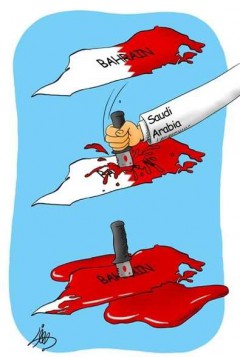
Saudi Arabia out of Bahrain!
October 22, 2011 Add Comments