MENA, Media, and Freedom
Jillian York on MENA, Media, and Freedom
29 November 2011 – Aslan Media
Al Jazeera English’s The Stream co-host Ahmed Shihab Eldin, described Jillian C. York as “[this] generation’s go-to person for Internet neutrality.”As the Director of Freedom of Expression at the Electronic Frontier Foundation, York has worked passionately on digital activism, Internet privacy, and freedom of expression online in the Middle East and North Africa.
This year’s turmoil in the Mideast and the still burgeoning Arab Spring have kept York busy, and brought new awareness to the power of digital media and online activism. York noted that “it’s hard to generalize” across the region, and pointed out the varying levels of Internet penetration in different MENA countries. For instance, Egypt has about 25% Internet penetration while Libya has about 5%. This makes for quite different populations; and though driven by similar objectives of democracy and political reform, this online cultural variance makes each country’s “spring” experience unique.
Nonetheless, the world witnessed how social media amplified the voices of protesters in Egypt and Tunisia and accelerated the fall of the Mubarak and Ben Ali regimes, respectively. E-activism has evolved dramatically over the course of the past year in both these countries. For instance, in Egypt, a number of protesters who were crucial to the momentum of the critical mass that drove Mubarak out of office have opted for being active solely on the Internet, rather than taking to the streets. This phenomenon is known as slacktivism. In Tunisia, where the first free and fair elections were just held after the ouster of Ben Ali, 30% Internet penetration was enough to organize mass protests. But while these protest movements have been pushed forward by online activism, York notes “there’s not a whole lot of great use of the Internet for political representation.”
Syria’s revolution has yet to come to a resolution. Syria’s Electronic Army—a clique of hackers loyal to the Syrian regime that floods a variety of Facebook pages and defaces and disables various websites—is, says York, “ the biggest [coordinated cell of hackers in a country] I’ve ever seen!” She continued, “ the intention is to attack the website of any organization or agency that has spoken out in favor of the Syrian opposition. Because they’re so distributed, they’re unclear about their targets.”
When asked whether the efforts of companies such as Facebook and Twitter, not to mention that of the U.S. government, to protect Internet freedom of expression and privacy online are up to acceptable standards, specifically in light of a politically volatile Middle East, York remarked, “I have less to be critical of now than say 8 months ago. The Arab spring has taught [social media] companies a lot of lessons.” She went on: “Twitter and Google’s speak2tweet was an interesting instance of trying to adapt to a local need. They’re doing more than they were a year ago…[but] the push to end online anonymity is a huge problem. Facebook and Google+ are not listening at all when it comes to protecting the need for anonymity…I understand that they want to make a certain type of community but they’re not listening to the needs of international and domestic users. It doesn’t feel like they’re thinking internationally yet.” …more
November 29, 2011 Add Comments
Disappearing Dissent: How Bahrain Buried Its Revolution – looking for the part about the King disappears the opposition leadership into torturous dungeons
Disappearing Dissent: How Bahrain Buried Its Revolution
Posted by Aryn Baker Tuesday, November 29, 2011 – Time
Every dictator worth his epaulets knows that the best way to nip a revolution in the bud is to have his opponents “disappear.” No body to mourn, no martyrs raised, and of course the ever-useful plausible deniability. But in Bahrain, with its tightly packed population of 230,000 citizens living on a small sandy archipelago in the Persian Gulf, it is difficult to bury the bodies. People notice. So what’s an authoritarian government to do when the people rise up and protest the regime? Bury the evidence and pretend it never happened.
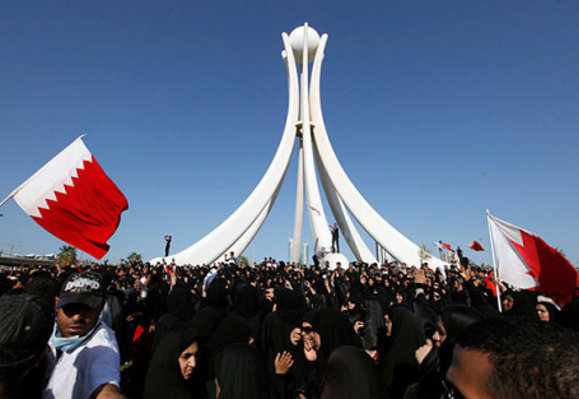
Pearl Roundabout was the locus of Bahrain’s anti-government protests last spring, the Bahraini answer to Egypt’s Tahrir Square. The roundabout, located at the intersection of several major roads leading to the capital’s major business centers, was crowned by a soaring white monument constructed in 1982 on the occasion of the third Gulf Cooperation Council Summit, which was held in Manama that year. The six convex arches, one for each of the council member nations, were topped by a giant pearl, symbol of the region’s maritime heritage. Before oil transformed the coast from sand spit to skyscrapers, the gulf was best known for its pearling industry.
But soon after the protests started on Feb. 14, the monument took on a new symbolism—defiance against a regime that had repeatedly failed to deliver on a decade old promises of reform and political freedoms. As in Tahrir, protestors set up a camp around the monument, and used the hexagonal fountain at its base as a stage for rallies. In the early hours of Feb. 17, security forces broke up the camp with a combination of rubber bullets, tear gas and live ammunition. Six people died and the Bahraini revolution was born. What started as a unified protest soon devolved into a ugly sectarian split; Bahrain’s Sunni minority rallied in support of the Sunni royal family, and Shias, who make up an estimated 70% of the population, lobbied for rights they said they had long been denied. Protestors started calling their movement the Lulu Revolution after the Arabic word for pearl.
…more
November 29, 2011 Add Comments
Boris Kagarlitsky: Reflections on the Arab revolutions
Boris Kagarlitsky: Reflections on the Arab revolutions
International Journal of Socialist Renewal – November 28, 2011
By Boris Kagarlitsky, translated from Russian by Renfrey Clarke
November 28, 2011 – Links International Journal of Socialist Renewal — “Turning-points in the history of humanity,” a contributor to the left-wing Algerian newspaper Le Matin observed in the summer of 2001, “are never simple for contemporaries to understand. Rarely are people able fully to assess the significance of these episodes, or their consequences. The developments concerned do not proceed in the manner, or at the time and place, that people expect. The early years of the twenty-first century have seen this rule reaffirmed. During this time, new and increasingly powerful trends have been mingled with the heritage of the past, dragging us back. History, however, operates through these new forces, which gradually but inevitably will succeed in overcoming the inertia of the past.” (1)
The Arab revolutions of 2011 came as a surprise to many people, including left analysts, who expected and predicted social and political shocks everywhere, from Latin America to Eastern Europe, except in the countries of North Africa and the Middle East. These events, however, were not historical accidents (in history, nothing on this scale happens by chance), but were the logical and natural results of earlier developments. The effect of surprise was due to the fact that the societies of the Middle East had been kept under heavy pressure by authoritarian regimes that did not allow any serious mass protests; in outside observers, this created an impression of graveyard-like tranquillity. This very stability, however, was the precursor to an explosion of extraordinary force. Tightening the lid of repressive police rule on the boiling cauldron of Arab societies, the ruling classes unknowingly guaranteed that social pressures would blow this lid to pieces.
Another reason for the confusion among the analysts lay in the relatively favourable figures for indices of economic and even social development. Gross domestic product kept growing right up until the outbreak of the world crisis, levels of education were improving, and achievements had also been registered in the areas of housing construction, public transport, and social security. The only problem was that the statistics, while recording certain quantitative improvements, concealed an accumulation of systemic contradictions and even structural decline in the economy.
The crisis of 2008 not only brought a sharp rise in food prices, creating an unprecedented social crisis on what might have seemed a level space. It also revealed numerous problems which along with everything else proved that the development strategies chosen by most of the governments in the region, and considered relatively successful in the 1990s, had finished up in a dead-end.
Liberals and dictators
The neoliberal reconstruction of capitalism that took place in the 1980s and 1990s was accompanied by a shift of production and jobs from Europe to countries where cheap labour power was available. From this angle, the prospects for the countries of North Africa seemed bright. Not only were wages low, but significant numbers of the population spoke European languages. In this situation, the governments of Tunisia, Algeria and Egypt seemed justified in deciding to develop education systems capable of raising the quality of labour power and of making these countries more attractive to foreign capital. Prospects in Libya, where the income from oil sales created additional possibilities for industrialisation, also looked promising.
Geographically these countries were close to Western markets, and many of them possessed their own raw materials and energy bases. Even Egypt, which did not have large oil reserves, was located not far from energy sources, and thanks to the Aswan Dam which had been built with Soviet help, had an abundance of cheap hydroelectric power. The infrastructure of all the countries in the region was in reasonable condition. For investors, the dictatorial regimes were an attraction, guaranteeing stability and preventing problems from arising with public criticism, environmental bans, trade unions and strikes. The only more or less obvious risk factor was the Islamist movement, whose influence was gradually increasing. This movement, however, was the target of systematic repression by the apparatus of the various states. …read the rest of article HERE
November 29, 2011 Add Comments
US praises Bahrain probe as ‘transparent, credible’
US praises Bahrain probe as ‘transparent, credible’
(AFP) – November 27, 2011
WASHINGTON — The United States on Monday praised Bahrain’s King Hamad for allowing an “unfettered” probe into a government crackdown on protests, and called its work “transparent” and “credible.”
It amounted to further US reaction to the publication last Wednesday of a special independent commission report in Bahrain that found police used “excessive force” and tortured detainees in a crackdown on the Shiite-led democracy protests in March.
“We certainly believe it was a transparent, credible process, carried out with due diligence,” State Department deputy spokesman Mark Toner told reporters, adding US officials were still studying the probe’s findings.
“We do commend the commission’s work, and we commend the king for allowing it to work in an unfettered environment,” Toner said.
But he said “we’re still waiting and monitoring” when asked if he saw signs that the Bahraini government would hold accountable those responsible for the deadly crackdown.
Toner described Bahrain’s decision to set up a national committee to implement the report’s recommendations a “good first step.”
But “we would just urge the government to meet the high standards of transparency and accountability that were recommended by the report,” he said.
The White House last Wednesday called on Bahrain to punish those guilty of human rights abuses in anti-government violence this year, and said it would closely follow its ally’s actions.
White House spokesman Jay Carney welcomed King Hamad’s commitments to pursue reform following the report, which he commissioned to probe allegations of government misconduct and human rights abuses against protesters. …more
November 29, 2011 Add Comments
Elreda TwoSea Revolt
November 28, 2011 Add Comments
Arab hip-hop and rap artists get inspired by recent events
Arab hip-hop and rap artists get inspired by recent events
by Janne Louise Anderson – Nov 28, 2011 – The National
On January 25, 2011, the day of the first major demonstration in Tahrir Square in Cairo, the 28-year-old Syrian-American rapper Omar Offendum, aka Omar A Chakaki, went to his studio in Los Angeles and wrote a verse calling for the overthrow of the former president Hosni Mubarak.
He called a fellow rapper, the Iraqi-Canadian and Dubai-born Yassin Alsalman – more widely known as The Narcicyst.
“Yo, Yassin,” he said. “Do you have time to write a verse?”
The Narcicyst did and recorded it that same day in Montreal. Quickly the stars aligned: The HBO Def Poet Amir Sulaiman sent in a third verse from Atlanta.
Freeway, an American Muslim MC, sent a verse from Philadelphia. And finally, the Palestinian-Canadian R&B vocalist Ayah did the hook. Everything was produced by Sami Matar, a Palestinian-American composer from California, and within three days #Jan25Egypt hit YouTube:
“First they ignore you, then they laugh at you, then they fight you, then you win.”
The words are Gandhi’s but the voice is Offendum’s, laid over a backdrop of rows of praying men being dispersed by a water canon. Then, saluting the 26-year-old Tunisian vegetable-seller whose self-immolation prompted the Tunisian revolution, The Narcicyst raps:
“But first God rest the soul of those who choose to be free, from poverty they rose, knee-deep in robbery, souls will plummet and burn like Mohammed Bouazizi. From Cairo to Baghdad.”
On the day of the video upload, tweets from Tahrir Square started ticking in, thanking the artists.
Within a week the track had been viewed more than 100,000 times, mainly in the Middle East. A Libyan, Yemeni and Syrian uprising later, the number has more than doubled. …more
November 28, 2011 Add Comments
Bahraini activist Ala’a Shehabi, Wife of a political detainee, Ghazi Farhan
November 28, 2011 Add Comments
So absurd even the defendants thought the accusations were “hilarious” – from Military Kangroo Court to Circus Civilian Court, the tragedy of Bahrain’s Injustice System
Bahrain medics face new charges of supplying weapons to protesters
Monday 28 November 2011 – by The Guardian
Bahraini medical staff accused of trying to overthrow the government of the Gulf state earlier this year, and who had hoped charges against them might now be dropped, faced new accusations in a court hearing.
Twenty staff from the Salmaniya Medical Complex in Manama had thought their ordeal might be ending on Monday after the release of last week’s report detailing human rights abuses by Bahrain’s security forces during the Pearl revolution in February.
The report by the Bahrain Independent Commission of Inquiry (BICI) found allegations that the medics “assisted the demonstrators by supplying them with weapons” to be unfounded.
But prosecutors produced guns, swords, knives and chains and claimed this was proof against the doctors, nurses, and paramedics. These weapons had not been presented previously – and led to an incredulous response in court. “It was really hilarious,” one of them, Dr Nada Dhaif, told BBC Radio 5. “The government has missed the chance that anyone will take this seriously.”
The 20 were initially convicted in the military-run national safety court in September on a raft of charges, including incitement to overthrow the regime. The government said they were involved with “hardline protesters” and they were sentenced to five to 15 years. …more
November 28, 2011 Add Comments
That Rocky Road to Damascus
That Rocky Road to Damascus
By Pepe Escobar – November 28, 2011 – OP ED News
The trillion-dollar question in the “Arab Winter” is who will blink first in the West’s screenplay of slouching towards Tehran via Damascus.
As they examine the regional chessboard and the formidable array of forces aligned against them, Supreme Leader Ayatollah Ali Khamenei and the military dictatorship of the mullahtariat in Tehran must face, simultaneously, superpower Washington, bomb-happy North Atlantic Treaty Organization (NATO) members, nuclear power Israel, all Sunni Arab absolute monarchies, and even Sunni-majority, secular Turkey.
Meanwhile, on their side, the Islamic Republic can only count on Moscow. Not as bad a hand as it may seem.
Syria is Iran’s undisputed key ally in the Arab world — while Russia, alongside China, are the key geopolitical allies. China, for the moment, is making it clear that any solution for Syria must be negotiated.
Russia’s one and only naval base in the Mediterranean is at the Syrian port of Tartus. Not by accident, Russia has installed its S-300 air defense system — one of the best all-altitude surface-to-air missile systems in the world, comparable to the American Patriot — in Tartus. The update to the even more sophisticated S-400 system is imminent.
From Moscow’s — as well as Tehran’s — perspective, regime change in Damascus is a no-no. It will mean virtual expulsion of the Russian and Iranian navies from the Mediterranean.
Yet key lateral moves by the West are already on. Diplomats in Brussels confirmed to Asia Times Online that the former Libyan “rebels” — now trying to come up with a credible government — have already given the go-ahead for NATO to build a sprawling military base in Cyrenaica. …more
November 28, 2011 Add Comments
Saturday 26th November – International Day of Action to support the medics
Saturday 26th November – International Day of Action to support the medics
Location: Freedom Plaza to the Embassy of Bahrain.
Time: Meet in Freedom Plaza at 11:30 am or the UDC metro station at 12:00 pm for a march to the Embassy of Bahrain
Washington, DC—(ENEWSPF)—November 26, 2011. Over 1,000 medical workers from 30 different countries have signed a petition calling for an immediate dropping of all charges gainst the 20 Bahraini medics facing up to 15 years in jail.
On Monday, Nov. 28, the 20 will face a civilian court after international outrage forced the prosecution to backtrack on the original sentences. In what is a clear case of political ersecution, the medics face trial for treating injured protesters.
In an attempt to support the medics, physicians around the world will be handing the petition to different Bahrain embassies and consulates on Saturday 26th November.
The action has already been confirmed in London, Washington, Ottawa, Beirut and Cairo with others expected to be confirmed within the next 24 hours.
In United Kingdom, the British Health Trade Union, UNISON, has supported the petition and will representatives will be joining the team handing the petition to the Bahrain Embassy in London. They will meet with Bahraini Doctors who were working in Manama’s Salmaniya Hospital during the unrest in February and March.
There is hope that, given the recent report of the Bahrain Independent Commission of Inquiry that openly criticized the Bahrain Governments crackdown on pro-democracy protesters, that the charges will be dropped.
However it remains to be seen as to whether the Government will indeed implement the recommendations made in the report.
Dr. Fatima Haji, one of the 20 Doctors being tried said:
“We have had these false charges hanging around our necks for the past few months and the emotional and physical stress we have gone through has caused so many problems. We have been unable to work, due to the charges, and we are living each day not knowing if it will be the last time we see our children and families for up to 15 years. We are pleased that the international pressure has led to our case being heard again, but we hope and pray that justice will be done and all the charges will be dropped. We are medics and all we want to do is help people regardless of their political, religious or any other belief. The international support we have received has been very warming and we hope that it will work to force the Government to drop these hurtful and untrue accusations.”
Karen Reissmann, a mental health nurse and national executive member of UNISON, said:
“This is a disgrace. The medics should all be released immediately with all charges dropped. All health staff has a duty to treat anyone who needs their care. They were simply doing their job.”
Dr. Margaret Flowers adds, “Medical providers who are treating people in times of war or protest have traditionally been exempted from arrest. However, recent trends such as the arrest of the medics in Bahrain and arrest of nurses caring for protesters in the occupations in the US are unethical and very disturbing. We must demand that this be stopped.” …more
November 28, 2011 Add Comments
Hillary Clinton aide at the helm of Amnesty International USA
Hillary Clinton aide at the helm of Amnesty International USA
Voltaire Network – 23 November 2011
Suzanne Nossel, former assistant to Richard Holbrooke in his capacity as UN Ambassador and currently Hillary Clinton’s Deputy Assistant for International Organization Affairs, has been selected as the new Executive Director of Amnesty International USA. In the discharge of her duties at the State Department, she diligently exploited human rights to benefit imperial ambitions.
Ms. Nossel had previously worked for Human Rights Watch, as well as for Bertelsmann Media Worldwide and the Wall Street Journal as Vice President of Strategy and Operations.
The AI-USA Board of Directors deemed that Suzanne Nossel’s commitment to the Clinton and Obama administrations was sufficient proof of her competence and decided not to hold a grudge against her for the crimes committed in Yugoslavia, Afghanistan, Iraq, Lebanon, etc.
Ms. Nossel has launched several campaigns against Iran, Libya and Syria. In recent months she made a name for herself by misinforming the Human Rights Council in Geneva with a view to getting the resolution authorizing the war on Libya adopted by the Security Council. Ms. Nossel’s allegations have since been debunked. …source
November 28, 2011 Add Comments
In training exercise for Bahrain Security Forces due APCs from US, Saudi’s demonstrate how to run over protesters with Weapons intended for use against “external threats” only
November 28, 2011 Add Comments
Bahrains Human Rights Report Likely Absolves the GCC
Bahrains Human Rights Report Likely Absolves the GCC
by Samuel Halpert, November 28, 2011 – 1948 A Human Rights Forum
As indicated by my last post, I’ve been eagerly awaiting the report from the Bahrain Independent Commission of Inquiry into that country’s recent crackdown on political protests. The Commission has just released its report, and under current international law the GCC probably can’t be held accountable.
First of all, the Commission has determined that several Bahraini governmental agencies perpetrated “a systemic practice of physical and psychological mistreatment, which in many cases amounted to torture.” (BICI Report, 292) They also concluded that such a systematic pattern could not have developed without the knowledge of the upper-level commands of the Bahraini government. (BICI Report, 275) Which means the Bahraini government had a role in the torture that occurred during the crackdown.
And what of the other governments with troops in Bahrain last spring? Starting in mid-March, Gulf Cooperation Council (GCC) forces from Saudi Arabia, Kuwait, Qatar, and other member states played a role in the crackdown as well. Presupposing that the Bahraini government had engaged in torture, when anticipating the Commission’s findings there were three questions related to the GCC Peninsula Shield Force’s (referred to in the report as the Jazeera Shield Force, or GCC-JSF) involvement I said were necessary to analyze GCC responsibility under international law:
(1) Did the GCC-JSF itself torture Bahrainis?
(2) What degree of control, if any, did the GCC-JSF exercise over Bahraini detainees who were subsequently tortured?
(3) Did GCC-JSF at any point exercise effective control over Bahraini territory where torture—by any party—occurred?
The report does examine the role of the GCC-JSF in the crackdown. The Commission, relying mostly on reports received from the Bahraini government, found no evidence that the GCC-JSF committed human rights violations in Bahrain. GCC-JSF troops were in Bahrain only in anticipation of foreign intervention, protecting vital infrastructure in the south. (Manama, the center of the unrest, is on the north end of the island.) The sole allegation made to the Commission against the GCC-JSF, which the Commission duly investigated, turned out to be the work of the Bahrain Defense Force. The Commission’s conclusion also noted that no GCC-JSF units reported firing any weapons, engaging civilians, or sustaining injuries (BICI Report, 377-378).
[Read more →]
November 28, 2011 Add Comments
Webcast with Nabeel Rajab, Winner of 2011 Ion Ratiu Democracy Award
Webcast with Nabeel Rajab, Winner of 2011 Ion Ratiu Democracy Award, and events in Washington DC
NABEEL RAJAB – RECIPIENT of the 2011 ION RATIU DEMOCRACY AWARD
The Ratiu Foundation is pleased to announce the programme of events connected with Nabeel Rajab, a human rights activist and co-founder of The Bahrain Human Rights Society, receiving the 2011 Ion Ratiu Democracy Award.
Thursday 1 December 2011 – NABEEL RAJAB at the 2011 Ion Ratiu Democracy Award Workshop
14:00, 5th Floor, Woodrow Wilson Center, One Woodrow Wilson Plaza, 1300 Pennsylvania Ave. NW, Washington, DC 20004-3027
RSVP online HERE at
This event is scheduled to be WEBCAST LIVE at HERE at 14:00 (Washington DC time), 19:00 UK time …more
November 28, 2011 Add Comments
Western Islamaphobia an impediment to Democracy – too cozy with dictators Western greed fears economic liberation
Those who support democracy must welcome the rise of political Islam
From Tunisia to Egypt, Islamists are gaining the popular vote. Far from threatening stability, this makes it a real possibility
guardian.co.uk – Sunday 27 November 2011 – by Wadah Khanfar
Ennahda, the Islamic party in Tunisia, won 41% of the seats of the Tunisian constitutional assembly last month, causing consternation in the west. But Ennahda will not be an exception on the Arab scene. Last Friday the Islamic Justice and Development Party took the biggest share of the vote in Morocco and will lead the new coalition government for the first time in history. And tomorrow Egypt’s elections begin, with the Muslim Brotherhood predicted to become the largest party. There may be more to come. Should free and fair elections be held in Yemen, once the regime of Ali Abdullah Saleh falls, the Yemeni Congregation for Reform, also Islamic, will win by a significant majority. This pattern will repeat itself whenever the democratic process takes its course.
In the west, this phenomenon has led to a debate about the “problem” of the rise of political Islam. In the Arab world, too, there has been mounting tension between Islamists and secularists, who feel anxious about Islamic groups. Many voices warn that the Arab spring will lead to an Islamic winter, and that the Islamists, though claiming to support democracy, will soon turn against it. In the west, stereotypical images that took root in the aftermath of 9/11 have come to the fore again. In the Arab world, a secular anti-democracy camp has emerged in both Tunisia and Egypt whose pretext for opposing democratisation is that the Islamists are likely to be the victors.
But the uproar that has accompanied the Islamists’ gains is unhelpful; a calm and well-informed debate about the rise of political Islam is long overdue.
First, we must define our terms. “Islamist” is used in the Muslim world to describe Muslims who participate in the public sphere, using Islam as a basis. It is understood that this participation is not at odds with democracy. In the west, however, the term routinely describes those who use violence as a means and an end – thus Jihadist Salafism, exemplified by al-Qaida, is called “Islamist” in the west, despite the fact that it rejects democratic political participation (Ayman al-Zawahiri, the leader of al-Qaida, criticised Hamas when it decided to take part in the elections for the Palestinian legislative council, and has repeatedly criticised the Muslim Brotherhood for opposing the use of violence).
This disconnect in the understanding of the term in the west and in the Muslim world was often exploited by despotic Arab regimes to suppress Islamic movements with democratic political programmes. It is time we were clear. …more
November 28, 2011 Add Comments
Saudi Arabia: Shia Protests Against the State Intensify
Saudi Arabia: Shia Protests Against the State Intensify
By Bhaskar Prasad: – November 28, 2011 – IB times
Four people were killed and nine wounded in clashes between Shiite Muslims and Saudi Arabian security forces in the oil-rich Eastern Province, according to the official Saudi Press Agency. The latest round of fighting took place last Wednesday, during a funeral for one of the protesters.
“Security checkpoints and vehicles have been the target of gunfire from aggressors hiding among civilians since Monday,” the ministry said, “Security forces have dealt with the situation with as much restraint as possible.”
Saudi Arabia’s Shiite minority is concentrated in the kingdom’s eastern oil-producing hub. There were violent clashes in February and March this year as security forces crushed protests by Shiites demanding democracy and representative governments.
The politics of Saudi Arabia takes place in a framework of a particular form of absolute monarchy whereby the King of Saudi Arabia is both head of state and the head of government. Predominantly Sunni Muslim Saudi Arabia has accused Shiite-led Iran of interfering in the affairs of Arab countries in the Persian Gulf, home to three-fifths of the world’s oil reserves. Iran denies the allegation and accuses the Sunni rulers of Saudi Arabia and Bahrain of discriminating against Shiites.
Shiites say they face discrimination in education and government jobs and that they are spoken of disparagingly. They also complain of restrictions in setting up places of worship and marking Shiite holidays.
The Saudi government denies these charges of discrimination and asserts that the latest confrontations by protesters were “ordered by their masters abroad”, by which the government invariably means Iran.
As per the latest report from AFP, Saudi security forces have withdrawn from Shiite villages in Qatif in eastern Saudi Arabia. …source
November 28, 2011 Add Comments
Trial of Bahrain’s 20 medics adjourned: activist
Trial of Bahrain’s 20 medics adjourned: activist
November 28, 2011 – Agence France Presse
DUBAI: A Bahraini court on Monday adjourned to January the hearing in the trial of 20 medics held for their role during anti-regime protests that rocked the kingdom earlier this year, a rights activist said.
“The High Criminal Court adjourned the hearing to January 9,” Mohammed al-Maskati, head of the Bahrain Youth Society for Human Rights, said.
“The public prosecution presented to the court a group of guns and swords which it said were found in Salmaniya Medical Complex” where the doctors worked, saying they were “proof” against the detainees, Maskati said.
The medics have been handed down long jail terms for their role during anti-regime protests.
The doctors, nurses, and paramedics were initially tried and convicted in the military-run National Safety Court on September 28 on a raft of charges, including incitement to overthrow the regime.
They were given sentences ranging from five to 15 years each.
But in a dramatic reversal, the prosecutor told the court it was dropping confessions from the defendants, after medics had protested that the statements were extracted under duress, and a new trial began on October 23.
Most of the medics worked at or volunteered at the Salmaniya Medical Complex in Manama that was stormed by security forces in mid-March after they drove protesters out of nearby Pearl Square.
An independent inquiry commission that has investigated a month of unrest in the Sunni-ruled kingdom had put the death toll at 35, including five security personnel and five detainees who were tortured to death while in custody. Its report, released last week, said that 11 other people were killed later, and concluded that a total of 2,929 people were detained during the protest movement and at least 700 remain in prison.
King Hamad vowed reforms following the commission’s findings, but tensions have remained high.
…source
November 28, 2011 Add Comments
Bahrain creates commission to study report on nation’s turmoil
Bahrain creates commission to study report on nation’s turmoil
By Associated Press – November 27 – WP
MANAMA, Bahrain — Bahrain’s state media says the country’s king has ordered the creation of a special commission to study recommendations from an independent investigation into political unrest.
The decision by King Hamad Bin Isa Al Khalifa follows the release last week of a 500-page report that detailed abuses such as torture and excessive force in a crackdown on protests by Bahrain’s majority Shiites for greater rights.
The report urges Bahrain’s Sunni monarchy to take measures that include possible reforms in legal and security codes.
The official Bahrain News Agency said Sunday the new commission will evaluate the report and make its own suggestions before the end of February. …source
November 28, 2011 Add Comments
Defiance, Her voice is many and Her actions grow louder with every protest and every injustice done by you King Hamad
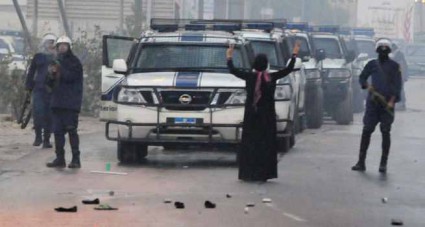
We do not wish to live in a palace nor do we yearn for leadership, We are a nation that slays humiliation and assassinates misery, We are a nation that demolishes injustice peacefully from its foundations… Ayat al-Gormezi – 14 February, 2011
November 27, 2011 Add Comments
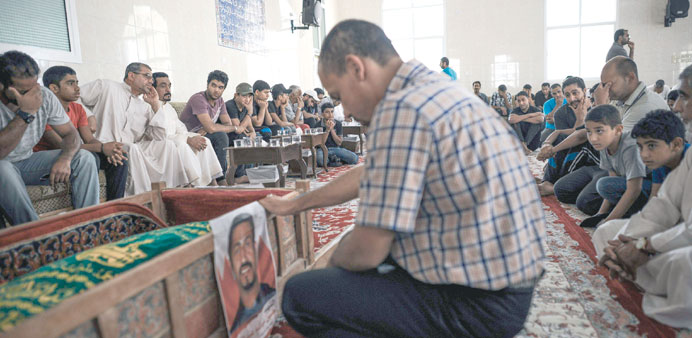
Security Forces on Funeral Duty, Gassing Mourners
November 26, 2011 Add Comments
A visit to imprisoned Human Rights Defender Abdulhadi Al Khawaja
Bahrain – Adam Shapiro finally gets to Meet jailed HRD Abdulhadi Al Khawaja
jimloughran’s blog – Front Line Defenders
The drive out to the military court building took us on a main road bypassing villages and eventually newly built apartment buildings.
We were about 20 minutes outside of downtown Manama, and heading to a military base in order to visit with Abdulhadi Al Khawaja, father of Zainab Al Khawaja who was driving fast in the hope of getting to see her father. We were late on the road because Zainab was at the appeal hearing of her husband who was sentenced to a 5-year prison term.
At the military court building, Abdulhadi and his 13 other co-defendants are brought into two rooms where family members are allowed to spend 3 hours with them every two weeks. They are allowed to bring clothes, books, food and other things to the men, most of which is permitted to be taken back to the prison. When Zainab and I arrived, colleagues from other human rights organizations had already tried to get in to see Abdulhadi but had been turned away. I checked in with the military police guards and headed to the door where Zainab was waiting. She opened and I rushed in in front of her, and headed straight for her dad, standing at the front of the room. Normal Arabic greetings were shortened to a quick “Salaam” to others in the room, as I reached out my hand to grasp Abdulhadi’s. As we greeted in the traditional Arab style (kisses on each cheek), I explained who I was and that I was from Front Line. His face lit up and he almost started laughing. I heard a shout behind me and glanced over my shoulder to see the big military policeman gesturing me out of the room. Abdulhadi held onto my hand to keep me there another minute to tell me a message of thanks to Mary, Andrew and everyone at Front Line. I then left Abdulhadi to his family and chased after the policeman to find out what the deal was.
I finished the day by going to another village, Aker Sharqiya, to observe a protest march. The villagers had asked for human rights organisations to come, knowing that we were here, in part, because of the Bassiouni report. The plan was for the entire march to be in the interior of the village so as to avoid provoking the riot police from attacking. Walking through the village, after the protest, Zainab came up and showed me a rendering of her father’s face on a wall. On another wall in the village it had been painted over by riot police, but this was relatively new. The man I had earlier seen for minutes during his prison visiting time, who has 18 metal plates and 26 screws holding his jaw and face together as a result of the beating and torture he was subjected to, was staring at me from the wall in this poor village with a helicopter buzzing overhead, watching, monitoring. …source
November 26, 2011 Add Comments
And who will be held to account for the abuses of today and tomorrow King Hamad? And who will account for the wrongfully detained that languish in your prisons?
Bahrain King Says Abuses To Be Punished
November 23, 2011 – Radio Free Europe – Radio Liberty
Bahrain’s king says officials involved in abuses during a crackdown on antigovernment protests earlier this year will be held accountable and replaced.
King Hamad bin Isa al-Khalifa made the pledge on November 23 at the release of a report by an independent commission into the February-March events.
The report concluded that “there have been instances of excessive force and mistreatment of detainees, as well as five deaths as a result of torture” during the crackdown on the protests.
It also said it found no proof of an Iranian link with the incidents. Bahrain has accused Tehran of inciting the protests.
King Hamad vowed to do everything possible so “those painful events won’t be repeated,” adding: “We must reform our laws to bring them in line with international standards.”
On November 21, authorities said 20 members of the security forces had been charged for alleged abuse of protesters during the month of unrest, in which several dozen people were killed and hundreds of others were injured.
The Shi’ite-led protests were calling for greater rights in the Sunni-ruled island nation. …source
November 26, 2011 Add Comments
Bassiouni-al Khalifa show and charade over for Western powers, regime reaffirms it’s unrestrained comittment to Human Rights abuse with funeral attack
Clashes with police follow Bahrain funeral
by Gregg Carlstrom – 27 Nov 2011 – AlJazeera
A’ali, Bahrain – The evening call to prayer in this village on Thursday was punctuated by the explosions of sound bombs fired by Bahraini police.
Tear gas canisters arced overhead as residents crouched on their rooftops and huddled in doorways, chanting allahu akhbar (“God is greatest”) and yasqat Hamad (“down with Hamad”). “This is Bahrain now,” one teenaged boy said, wearing a scarf over his face to shield his identity.
The violence began moments after the funeral of Abdulnabi Kadhem, a local man who was killed here yesterday, allegedly when police jeeps drove him off the road. Hundreds of protesters, some of them throwing stones and Molotov cocktails, marched from the cemetery to the main road, where a large group of police had been waiting all afternoon.
Police responded with a volley of tear gas that sent mourners and protesters alike fleeing into A’ali’s back alleys. Many ducked into houses, where women offered vinegar and perfume to ease the sting of the gas.
“This is Bassiouni’s tear gas,” one woman shouted, between gasps of a perfume-drenched tissue.
She was referring to Cherif Bassiouni, the Egyptian judge who headed the official inquiry into this year’s human-rights abuses in Bahrain.
The commission released its final report on Wednesday afternoon, handing a copy to King Hamad bin Isa Al Khalifa in a ceremony at one of his palaces. It accused Bahraini security forces of numerous abuses: torture, wrongly killing unarmed protesters, arbitrary arrests, and more.
It recommended a number of reforms, including investigations into torture and human rights training for the police and army.
“These are his reforms,” another woman said bitterly.
But Bahrain’s king has set up a commission to implement the findings of the report. It accused Bahrain of using torture to crush protests in the Gulf Arab state earlier this year.
‘Bassiouni says you are killers’
Several people collapsed from tear gas inhalation on Thursday afternoon, and residents said a number of people were arrested. Police could also be seen trying to break into at least one home to conduct a search.
Reports from A’ali village
These sorts of small-scale clashes have become a routine part of life over the last few months in Bahrain. Police have effectively sealed off A’Ali and other villages, which prevents protesters from massing in one location, like they did in Manama’s Pearl Roundabout earlier this year.
So they provoke the police stationed outside their villages, and the police inevitably respond, often with overwhelming force.
The actual funeral procession was peaceful: Thousands of people marched through the streets of A’Ali, chanting “Down with Hamad”,”Leave, you murderer”, and “The people demand the overthrow of the regime”.
Kadhem died on Wednesday morning. Witnesses said the police, who often drive at high speed down the narrow streets of Bahrain’s villages, drove Kadhem’s car off the road and then collided with him.
Bahrain’s interior ministry said Kadhem drove into a house, but the damage to his car, which was crumpled on the sides, was inconsistent with that statement.
Dozens of police jeeps had gathered outside A’Ali in the hours before the funeral, clearly anticipating a confrontation.
They tried to bar at least one foreign journalist from entering the village to cover the funeral.
“Bassiouni says you are torturers,” one man shouted at the police through a loudspeaker. …more
November 26, 2011 Add Comments
al Khlifa regime offers paranoid divisive position toward opposition Societies, makes excuses to continue Human Rights abuse and maintain wrongful detention of Society leadership
Bahrain to start new reform talks
Irishtimes.com – November 25, 2011 – societies
Bahrain will start new talks on political reforms and overhaul its security policies but still blames Iran for fomenting civil unrest, the foreign minister said today.
Foreign minister Khalid bin Ahmed al-Khalifa was talking after an inquiry into the unrest and the government crackdown to quell the protests came out with a hardhitting report that described systematic torture of detainees.
He said a national commission called for by the inquiry, headed by international rights lawyer Cherif Bassiouni, to promote reconciliation would go beyond some reforms that emerged from a controversial national dialogue in June.
He said that the main opposition party Wefaq, which commands support among majority Shia, would need to be involved but it should distance itself from daily clashes between riot police and Shia protesters.
“For them to be present we should make sure that all important issues are on the table,” the minister, a former ambassador to London, said.
“Everybody concerned should be in it, and we are taking that as an important step forward. We ask everybody not to keep themselves out of these talks. Keeping yourself out means we won’t be able to discuss all the demands.”
The ruling Sunni al-Khalifa family dominates Bahrain’s government. King Hamad’s uncle Khalifa bin Salman is the world’s longest serving prime minister and the elected lower chamber of parliament does not form cabinets or have full legislative powers.
Shias complain of discrimination in jobs, housing, education and some government departments including the security forces and army.
Bahrain’s government has said it is addressing the concerns. …more
November 26, 2011 Add Comments
Defiance leaves Her adversaries powerless, Her protest echos the call for freedom in every square
Bahrain 1st-Hand: How Activist Zainab Alkhawaja Defied the Police…And Escaped Arrest
November 26, 2011 – by Scott Lucas – EA World News
Today in A’ali in Bahrain, security forces — as is their standard practice — moved against protesters after a funeral procession for a man killed last week, allegedly after an incident with a police jeep. They used tear gas in an attempt to disperse demonstrators who had blocked roads into the village.
Activist Zainab Alkhawaja (@angryarabiya), despite attempts to dissuade her by fellow demonstrators, went up to the police in a dramatic expression of personal resistance. It was feared for some time that she had been arrested, but she escaped detention. This is her account of what happened:
Hi all, first of all I hope there were no serious injuries after the attack today by riot police on the mourners in Aali.
I have been thinking for awhile about our protests, and tweeting that we should be sitting peacefully in front of police, not running. Today I didn’t run, and as police ran towards me, shooting at the protesters, I remained on my knees holding up a Bahraini flag.
Brave, no. I just read the BICI [Bahrain Independent Commission of Inquiry] forensic team report of my dad’s testimony about the torture he was subjected to. [Abdulhadi Alkhawaja, a prominent political activist, has been sentenced to life in prison during the current protests.] Going through details of how my father was tortured, I kept thinking… I WILL NOT accept living under this regime.
I expected to get injured with the amount of shooting, but I didn’t and within seconds I was surrounded by riot police. Civilian clothed [plainclothes] police surrounded me & started filming & taking pictures. Someone kept shouting at them, “Not this one, don’t beat her.”
As they ran past me to attack the protesters, one riot police [officer] grabbed the Bahrain flag in my hand and threw it on the ground. Then some of the riot police got back in their jeeps to follow the protesters into the village and attack them there.
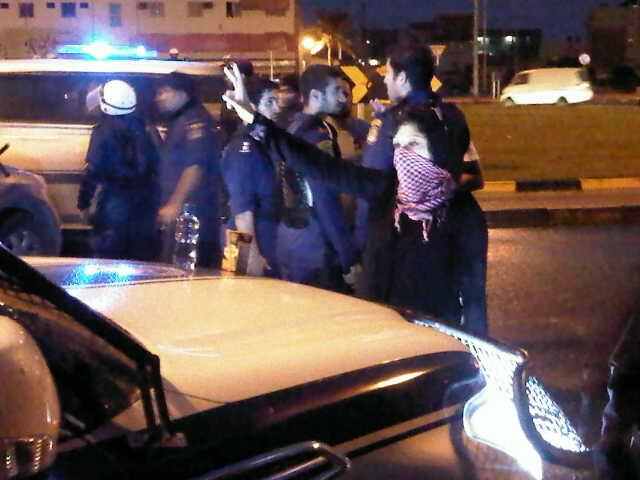
I was already in front of them but I stood up and held up my hands in a victory sign. and I started shouting “Yasqot Hamad (Down Down King Hamad)”. So they all got out of their jeeps, some came towards me wanting to beat me but again were prevented from hitting me
[Read more →]
November 26, 2011 Add Comments