XIX International Special Rapporteurs for Free Expression Call for Internet Speech Rights
For immediate release – 1 June 2011
PRESS RELEASE
International Special Rapporteurs for Free Expression Call for Internet Speech Rights
Budapest 01:06:11: The four international special rapporteurs on freedom of expression have today released their annual Joint Declaration on Freedom of Expression and the Internet.
The new declaration calls on national governments and other parties to respect freedom of expression in internet communications. It reminds governments that international human rights rules on freedom of expression apply to internet communications, and that it is necessary to develop tailored approaches which emphasises speech rather than simply applying traditional rules on media.
The declaration sets out principles in key areas of internet policy including intermediary liability, filtering and blocking of web sites, criminal and civil liability, network neutrality, and access to the internet.
“Freedom of expression on the internet must be fully protected”, says Dr Agnes Callamard, ARTICLE 19 Executive Director. “These principles provide important guidance for national governments to meet their obligations,” continued Dr Callamard.
The four special mandates on freedom of expression are Frank La Rue, United Nations Special Rapporteur on Freedom of Opinion and Expression; Dunja Mijatovic, the Representative on Freedom of the Media of the Organisation for Security and Cooperation in Europe; Catalina Botero, Special Rapporteur on Freedom of Expression for the Organisation of American States; and Pansy Tlakula, Special Rapporteur on Freedom of Expression and Access to Information for the African Commission on Human and People’s Rights. They were brought together by
ARTICLE 19 in November 2010 and draft of the declaration was assisted by ARTICLE 19 and the Centre for Law and Democracy. The special rapporteurs have issued a Joint Declaration each year since 1999.
The principles were released at a press conference in Budapest at the Open Society Archive on 1 June.
[Read more →]
June 3, 2011 Add Comments
Bahrain Grand Prix to sell prestige seats in Fascist’s Club, chance to see F1 with Eccelstone and al Khalifa
Bahrain GP back on the calendar
Motor Sport: The Bahrain Grand Prix, postponed in March due to violent civil unrest, will now go ahead on October 30th with India moving to the end of the season.
No date was set for the inaugural Indian race, which was originally scheduled for October 30th, but it is most likely to be December 11th – which would be the latest finish to a championship since 1963.
The season was due to end in Brazil on November 27th.
“After considering all the factors and taking into consideration all stakeholders’ concerns, the WMSC (world motor sport council) unanimously agreed to reinstate the Bahrain Grand Prix in the 2011 FIA Formula One World Championship,” an International
Automobile Federation (FIA) statement said.
“The WMSC feels that reinstating the Grand Prix is a means of helping to unite people as the country looks to move forward.”
The decision was highly controversial, with human rights campaigners calling for the Bahrain race to be called off entirely and the teams unhappy about the season extending well into December.
The teams’ association, Fota, said in a statement that they acknowledged the decision taken, while indicating also that the matter was far from closed.
“That decision is likely to be discussed internally within Fota, and a more detailed joint position may be defined after those discussions have taken place,” it said.
The FIA meeting in Barcelona followed a visit by Spanish FIA vice-president Carlos Gracia to the Gulf kingdom this week to assess the situation and meet officials and international organisations.
The country lifted a state of emergency this week after 11 weeks of martial law, with troops from Saudi Arabia and United Arab Emirates arriving in March to help quell protests mostly by majority Shi’ites. …source
June 3, 2011 Add Comments
Dr. Mohamed Badie – Respect Democracy, Respect the Majority
MB Chairman: Democracy Means Respecting the Will of the Majority
Muslim Brotherhood chairman Dr. Mohamed Badie called on Egypt’s political forces to respect the values of democracy which stipulates one should respect the opinion of the majority.
Thursday, June 2,2011 18:30 – IkhwanWeb
Muslim Brotherhood Chairman Dr. Mohamed Badie called on Egypt’s political forces to abide by the principles of democracy, which stipulate that in a transparent and free elections the minority must respect the choice of the majority.
Referring to the March 19th referendum, Badie maintained that it was wrong to try to change the outcome of a vote after the people have already made their choice with vast majority
Speaking about the MB’s principles, Badie cited that the group is prepared and obliged to accept the will of the people so long as they are demonstrated through the ballot boxes in a free and transparent elections captured the respect of the free world. He added that the group is committed to the morals and values of Islam, which respects and promotes democracy.
Badie argued that each individual is entitled to defend his or her rights, but we must value the views of others. Badie maintained that the rules of democracy must be respected and that discussing an opinion which has already been made defeats the purpose of going to the polls and can create chaos and instability.
Calling political forces to unite, Badie urged them to put their differences aside for the wellbeing of Egypt, and get to work preparing for elections instead of wasting their energy trying to the impose their extreme views on the majority of Egyptians. …more
June 3, 2011 Add Comments
Eccelstone reminsces his fascist bent with support for al Khalifa’s Grand Prix – permantly stains Formula One
Nazi tyrant Adolf Hitler got things done, says Bernie Ecclestone
Jul 5 2009 Lauren Crooks, Sunday Mail
FORMULA ONE chief Bernie Ecclestone has sparked outrage after praising Hitler’s ability to “get things done”.
The outspoken billionaire also slammed today’s politicians for being weak and declared Britain was wrong to help overthrow Saddam Hussein. He claimed democracy had done nothing for Britain and we would be better off with a government based on tyranny.
He said: “In a lot of ways – terrible to say this I suppose – but apart from the fact that Hitler got persuaded to do things that I have no idea whether he wanted to do or not, he was in the way that he could command a lot of people, able to get things done.
“All these guys – Gordon and Tony – are trying to please everybody all the time.”
He claimed democracy was a failure, saying: “It hasn’t done a lot of good for many countries – including this one.”
He also claimed close friend Max Mosley would do a better job as prime minister.
Motorsport boss Mosley – son of Sir Oswald Mosley who headed up the British Union of Fascists – was recently accused of being a dictator by F1 racing teams. ..more reminiscing
June 3, 2011 Add Comments
Formula One Fractures, Eccelstone idiocy and moral catasrophe
Bahrain return angers Formula One teams
AFP
Bahrain return angers Formula One teams AFP/File – A general view shows the Bahrain International Circuit in Sakhir in February 2011. Bahrain is ready to …
by Tim Collings
LONDON (AFP) – The Bahrain Grand Prix was reinstated on the Formula One calendar on Friday, a decision that sparked opposition from teams, drivers and promoters.
F1’s governing body the FIA unanimously voted to reschedule the race which was canceled in March due to civil unrest in the Gulf state. The 2011 Bahrain GP will now be held on October 30, the original slot for the inaugural Indian GP which has been shifted to a season-closing date on December 11.
Mercedes Grand Prix team chief Ross Brawn said this week that he had told F1 commercial ring-master Bernie Ecclestone that a December 11 finale was not an option.
Brawn said: “I think it is unacceptable and we’ve told Bernie that and he knows our opinion.
“If we continue to take those sort of approaches then we will run into problems because our people cannot be expected to work in that environment and situation.” …more
June 3, 2011 Add Comments
Bernie Ecclestone shows remarkable idiocy, says ‘Too Many overeducated people’ is problem in Bahrain – in good company with al Khalifa
F1 holds breath before Bahrain decision
Friday June 3, 2011 05:24:47 AM UTC
The F1 world is holding its breath early on Friday as the sport considers returning to troubled Bahrain later this year.
Bernie Ecclestone wants the race’s $40 million fee and said recently politics should not influence sport.
But that did not stop him hypothesising about the reason for the kind of protests seen in Bahrain and elsewhere in recent months and days.
“Too many overeducated people,” he told CNN earlier this week. “If we can find a way to do something about that then a lot of our problems will disappear.”
It is believed the team bosses agreed during a meeting in Monaco last weekend that, on the grounds of logistics, they are uniformly opposed to the rescheduling in 2011.
That would give the FIA an easy reason to cancel the event but still support Bahrain’s ongoing place on future calendars.
Privately, the sport’s figures are also taking the political situation into consideration, like BRDC president Damon Hill, who thinks F1 should stay away on those grounds alone.
The team bosses and drivers, however, are largely keeping quiet — except Australian Mark Webber, who was a lone voice among his peers on Twitter late on Thursday.
“When people in a country are being hurt, the issues are bigger than sport. Let’s hope the right decision is made,” he said.
He is referring to Friday’s World Motor Sport Council, and ahead of that Barcelona meeting Spanish official Carlos Gracia travelled to Bahrain to assess the latest situation there, according to Marca sports newspaper. …more
June 3, 2011 Add Comments
FIA disgraces F1 and Grand Prix with shameful acceptance of Bahrain’s brutality against Human Rights – Competitors to bid Boycott
June 3, 2011, 12:53 pm
Bahrain Grand Prix Approved Despite New Clashes
By ROBERT MACKEY
Activists in Bahrain said that this video was recorded during a protest on Friday in Sanabis, outside Bahrain’s capital, Manama.
Hours after Bahrain’s security forces again fired teargas at protesters on Friday, the World Motor Sport Council unanimously approved a decision to hold the Bahrain Grand Prix in October. The race was to have been held in March, but was postponed as the country struggled to come to grips with mass demonstrations against the government.
As video circulated online showing force being used against protesters chanting “Peaceful! Peaceful!” the governing body of Formula 1 racing issued a statement explaining that a fact-finding delegation had visited Bahrain on Tuesday “to assess the situation in the country.” The day after the racing officials left the country, Bahrain lifted martial law and protesters returned to the streets. …source
June 3, 2011 Add Comments
Bahrain police ‘suppress protest’ warm up for Grand Prix
Bahrain police ‘suppress protest’
Eyewitnesses say police fired tear gas and rubber bullets at protesters marching in capital, Manama.
Last Modified: 03 Jun 2011 16:21
Anti-government protests took place around the country after emergency laws were lifted on Wednesday [EPA]
Bahraini police have fired tear gas and rubber bullets at protesters marching against the government near the capital Manama, eyewitnesses say.
The crackdown on Friday came just two days after the tiny Gulf kingdom’s authorities lifted emergency rule.
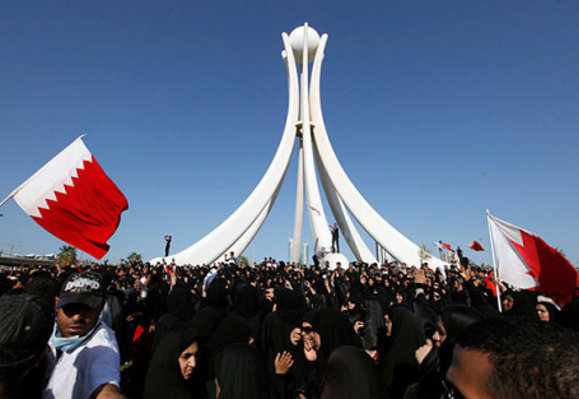
The protesters in Manama were marching adjacent to the city’s Pearl Roundabout, which was the epicentre of weeks of protests against the kingdom’s Sunni rulers, with demonstrators in particular demanding more rights for the island nation’s majority Shia population.
There were no immediate reports of injuries during the protests, the eyewitnesses said. They spoke on condition of anonymity, fearing reprisals.
Witnesses said that police fired tear gas at a crowd of hundreds of people who had gathered to mourn Zainab Altajer, who died on Thursday. Opposition activists said she died as a result of exposure to tear gas, but the government said her death was due to natural causes.
This video, uploaded to YouTube by user Bhtv100, appears to show the security forces’ crackdown on protesters in Sanabis on Friday. Al Jazeera cannot independently verify the footage, as the Bahraini government has barred journalists
from entering the country.
The protesters marched through the village of Sanabis, adjacent to the Pearl roundabout.
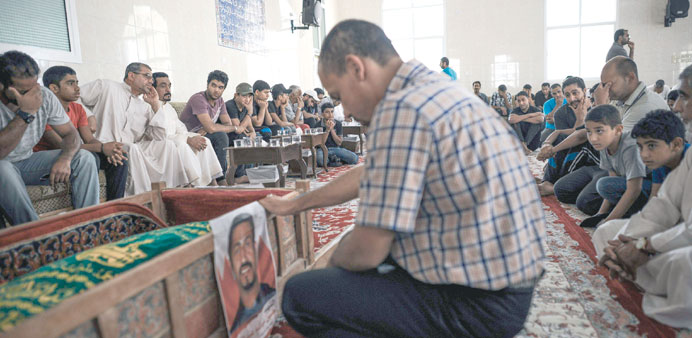
Also on Friday, hundreds of mourners gathered at a cemetery in Manama to bury Salman Abu Idris, a 63-year old protester who died in hospital earlier in the day of injuries from a demonstration in March, a witness told Al Jazeera.
Security forces had set up multiple checkpoints around the cemetery in Gudaibya, where they were checking the identities of those attempting to attend the funeral, and refused entry to “many”, the witness said.
He said that people at the funeral were “calm”, and while some in the crowd did raise slogans against the ruling al-Khalifa family at one point, “not many people chanted with them”.
He said some left after the funeral to protest at the slums near Bab al-Bahrain, but were stopped by security forces armed with tear gas and rubber bullets. It did not appear that security forces used these weapons in that confrontation, however. …more
June 3, 2011 Add Comments
Bahrain: human rights briefing
Bahrain: human rights briefing
Posted: 03 June 2011
In a new briefing today, Amnesty International said that serious human rights violations continue to be committed in Bahrain. These include:
Arrests
Following the declaration of the state of emergency, hundreds of people were arrested and in many cases detained incommunicado; some were reportedly subjected to unprovoked assaults at the time of their arrest, often at their homes in the early hours of the morning. Some detainees allege that they were tortured while held at undisclosed locations. In April, at least four detainees died in custody in suspicious circumstances.
Trials
A number of those arrested in relation to the protests have already been tried and sentenced by the National Safety Court. This is a military court established under the state of emergency that is being used to try civilians. It will continue to conduct trials after the lifting of the state of emergency on 1 June.
To date, those tried include 15 people who were convicted of “participating in illegal demonstrations” and “inciting hatred” against the government during the protests and sentenced in May to prison terms of up to four years. Amnesty International believes they may be prisoners of conscience imprisoned for their peaceful exercise of the rights to freedom of expression and assembly.
Fourteen alleged leaders of the protests, including leading members of Bahrain’s majority Shi’a community, are now on trial before the National Safety Court – seven others accused are being tried in their absence. International observers have so far been barred from the trial in which at least one accused has told the judge he was tortured in pre-trial detention.
Death sentences
Four people have been sentenced to death on charges of deliberately causing the deaths of two police officers; two of these have had their sentences confirmed by the National Safety Appeals Court and now face possible execution.
Job dismissals
More than 2,000 people have been dismissed or suspended from their employment in the public and private sector, apparently for having participated in the protests.
Failure to investigate
The government has failed to conduct independent investigations into alleged abuses by Bahraini security forces in response to peaceful and other public protests in February and March. These include the use of lethal and other excessive force against protestors and assaults on medical workers seeking to help the wounded.
Amnesty is calling on the Bahraini authorities to:
* Release all prisoners of conscience
* Release all other detainees unless they are to face recognisable criminal charges and to be tried in full conformity with international fair trial standards, with civilians being tried before ordinary criminal courts not military courts, and without recourse to the death penalty
* Independently investigate all allegations of torture or other ill-treatment, excessive use of force and unlawful killings and deaths in custody and bring to justice those responsible human rights violations. …source
June 3, 2011 Add Comments
Gas Incident – 03 June, a camera the protestors only weapon – Security Forces Rehearse for Grand Prix
June 3, 2011 Add Comments
Sitra, Crushing Dissent – 02 June, The Whole World’s Watching
June 2, 2011 Add Comments
Ayat al-Gormezi , 20, a poet and student arrested two months ago after reading out a poem at a prodemocracy rally, is due to go on trial
Rose Revolution In Bahrain
Bahrain’s security forces are increasingly targeting women in their campaign against prodemocracy protesters despite Wednesday’s lifting martial law in the island kingdom.
Ayat al-Gormezi , 20, a poet and student arrested two months ago after reading out a poem at a prodemocracy rally, is due to go on trial [June 3] before a military tribunal , her mother said.
Original Report Date : 02-04-2011 04:59 مساء
Action Alert: Bahrain – Bahraini mother’s cry for help
Bahraini police tells father: “If you don’t tell us where Ayat is in fifteen minutes, we will kill each of your sons in front of your eyes”
1. Summary
The mother of Ayat Al-Qormezi appeals to all campaigners and human rights activist to ascertain the whereabouts of her daughter and ensure her safe return. Ayat was arrested for reciting a poem which criticised the Bahraini government.
2. Background
Ayat Al-Qormezi, a 20 years old poet and student at the Faculty of Teachers, was arrested on Wednesday, March 30th 2011. The reasoning for her arrest is that she recited a poem which criticised government policy in Pearl Square, on February 23rd, 2011. Al-Qormezi had been receiving has been subjected to harassments, defamation, intimidation and threats of rape and murder.
Her mother has told IHRC that they live in constant fear, since the police raided their house on Tuesday at 1:00 AM. Having not found Ayat, they destroyed the contents of the house and confiscated books and CDs. Before leaving, they told the family that they will continue pressuring the family until they reveal the whereabouts of the 20 year old student.
On Wednesday, riot forces and over 50 jeeps surrounded their house. They raided their house again, gathered four of Ayat’s brothers, and laid them on the floor at gunpoint. They shouted at Ayat’s father “If you do not tell us where Ayat is in fifteen minutes, we will kill each of your sons in front of your eyes – I have orders to do so”, her mother told IHRC.
After this terrifying ordeal, her mother and father had no choice but to ask Ayat to return home. The riot forces and the police, faces covered, told the mother that they would take her to be interrogated and sign documents. They were told that they would then be able to take her home from Al-Howra police station. Her mother states that her daughter has been missing ever since, has been told that her daughter is being treated at a military hospital for wounds incurred during being tortured by her interrogators.
Her mother pleads desperately, saying: “Please find my daughter and bring her back to me before they kill her”.
IHRC urges all campaigners to write letters to the Bahraini authorities and the Foreign Secretaries in their countries, urging them to put pressure on the Bahraini authorities to reveal immediately the whereabouts of Ayat Al-l-Qormezi, and ensure her return. …source
June 2, 2011 Add Comments
Dissent Crushing 101, right out of Mao, Stalin and the CIA torture and repression Playbooks
A female poet whose “death” became the focus of an Iranian state propaganda campaign against Bahrain has been brought before a military tribunal in the island kingdom.
By Adrian Blomfield, Middle East Correspondent
1:33PM BST 02 Jun 2011
Ayat al-Ghermezi, who is 20, was charged with incitement and insulting members of the Al Khalifa royal family.
Arrested after reading a self-penned poem to anti-government protesters in the Bahraini capital Manama, she has been in custody for two months.
Bahraini human rights activists say that although Miss Ghermezi was not raped, she was badly tortured while in custody. Her purported crime centres on a poem she read to protesters at the Pearl Roundabout in Manama, the epicentre of the street movement until it was destroyed by the authorities.
Its lyrics include the lines: “We are the people who will kill humiliation and assassinate misery/We are the people who will destroy the foundation of injustice/Don’t you hear their cries, don’t you hear their screams?” She said the poem was addressed to King Hamad bin Isa Al Khalifa and his hawkish prime minister and relative Prince Khalifa bin Salman Al Khalifa. …source
Ayat al-Ghermezi (Arabic: آيات القرمزي) is a 20-year-old poet and student at the Faculty of Teachers in Bahrain From Sadad, Bahrain. She was arrested on 30 March for reciting a poem critical of the government during the pro-democracy protests in Pearl Square, the main gathering place for demonstrators, in February. She was forced to give herself up after police raided her parents’ house and made four of Ayat’s brothers lie on the floor at gunpoint. She was not there at the time. One policeman shouted at their father to “tell us where Ayat is or we will kill each of your sons in front of your eyes”.[1]
Wiki Note: Masked police and special riot police later took Ayat away telling her mother that her daughter would be interrogated. Her mother was told to pick up her daughter from Al-Howra police station, but has not seen her since her arrest. She did speak to her once on the phone when Ayat told her that she had been forced to sign a false confession. Her mother has been told confidentially that Ayat is in a military hospital as a result of injuries inflicted when she was tortured.
June 2, 2011 Add Comments
Bahrain’s King Hamad Bin Eisa Al Khalifa, Zain Bahrain, to install teleconference system in Prisons for National Dialogue on Democracy
Bahrain king offers dialogue
Wednesday, Jun 01, 2011
Gulf News Manama
Bahrain’s King Hamad Bin Eisa Al Khalifa yesterday asked the government and parliament to call for a dialogue on July 1 to “boost a national consensus on the ideal development for the kingdom.”
Addressing local editors and columnists, King Hamad said that the dialogue is a national strategic choice to reach common solutions and should be “serious, comprehensive and without preconditions”.
All parties should take part in the dialogue to discuss the future of the country and offer their views on ways to bolster reforms and development in all areas, contribute to reinforcing positive changes and fulfilling the aspirations of the Bahraini people in achieving peace and justice, King Hamad said. …more absurdity
June 2, 2011 Add Comments
Understanding Bahrain’s Shia Protesters
Understanding Bahrain’s Shia Protesters
By Genieve Abdo and Jasim Husain Ali*
WASHINGTON, Apr 4, 2011 (IPS/Al Jazeera) – Listening to the rhetoric coming out of Tehran, one might assume that Bahrain’s Shia opposition is relying on help from its co-religionists next door. But, in fact, the opposite is true: the Shia opposition wants nothing more than for Tehran to stay out of the sectarian dispute unfolding in the tiny kingdom.
The major demand of the mainstream opposition is to turn the country into a constitutional monarchy, much like those in Europe. Other selected goals include: an elected government; a free press; an unrestricted civil society; and an end to discriminatory practices against religions other than the Sunni minority, such as unequal employment practices, unfair distribution of wealth, and the elimination of all forms of administrative and financial malpractice.
As the world’s attention has focused on Libya, Bahrain’s mainstream opposition has made every attempt to distance itself from Tehran’s rulers.
Sheikh Ali, secretary general of Al-Wefaq, the main Shia opposition group, publicly announced in March that his organisation had no desire to implement Iranian-style Vilayat-e Faqih, the concept of supreme clerical rule.
Yet, even given these facts, the grand promises from Tehran – which now include sending young Iranian boys to Bahrain to protest, if not fight, alongside the opposition – show that Iran continues to manipulate the crisis in its favour by trying to persuade the world that the Shia in Bahrain are one with those in Iran.
In reality, Bahrain stands as one of the most politically- aware states in the region. Demands for reform did not emerge only a few weeks ago when the unrest started, but date back to the years before the kingdom’s independence from Britain in 1971.
In the view of many Shia, the arrival of Saudi troops weeks ago is merely a ploy by Bahrain’s rulers to quell calls by the opposition for a Western-style democracy in favour of the status quo. For the Saudis, a crackdown on the Shia protesters in Bahrain sends a message to their own restive Shia citizens in the eastern part of the country who also demand democratic rule. …more
June 2, 2011 Add Comments
After lift of Emergency Rule, heavy handed sentencing for protesters
Bahrain: 7 demonstrators were sentenced after the lifting of the National Safety law ( Emergency law)
June 2nd, 2011
Bahrain Youth Society for Human Rights (BYSHR) is deeply concerned about sentencing of 7 demonstrators Today in National Safety court ( Military court) .
Today 2 June 2011 , 7 demonstrators sentenced :
1-Abdullah Ahmad Hassan was sentenced to one year imprisonment for taking part in illegal protests and disrupting public order.
2-Mohamed Ibrahim Ali was sentenced to one year imprisonment for taking part in illegal protests and disrupting public order.
3-Abdul Amir Mohammed Ali was sentenced to one year imprisonment for taking part in illegal protests and disrupting public order.
4-Jaafar Mohammad Redha was sentenced to one year imprisonment for taking part in illegal protests and disrupting public order.
5-Abdul Nabi Hassan Ahmed was sentenced to four year imprisonment for taking part in illegal protests and disrupting public order and riot.
6-Ali Abdullah Hassan was sentenced to three year imprisonment for taking part in illegal protests and disrupting public order and Inciting publicly towards the hatred of the governing.
7-Saleh Mahdi Issa was sentenced to five year imprisonment for taking part in illegal protests and disrupting public order.
June 2, 2011 Add Comments
Security forces attack Bahraini protesters
Security forces attack Bahraini protesters
Bahraini troops attack anti-government protesters in villages near the capital, hours after martial law is lifted.
Last Modified: 02 Jun 2011 00:19
Scores of people have been killed and many more arrested in the crackdown on peaceful protests in Bahrain. Bahraini troops have attacked anti-government protesters in several villages near the capital Manama, witnesses say.
Despite the lifting of martial law on Wednesday, regime forces fired tear gas on protesters who had poured into the streets to stage protest rallies in villages around Manama, including Diraz, Bani Jamrah and Karzakan, according to witnesses. “Protests are to be in main streets and squares … the movement must return to important places ahead of the imminent return, God willing, to Martyr’s Square”. One activist reported a heavy security presence in Bani Jamrah and said about 30 women had gathered in front of his house, but security forces used batons and tear gas to disperse them.
“With the end of the emergency situation, the security would not be here but they still are,” said Ali Zirazdi, a 30 year-old man, who said police had fired tear gas after a few hundred people gathered in the predominantly Shia village of Diraz.
“The security presence is even stronger and their approach now is as soon as they hear of any protest in advance, they come down to stop it from happening,” Zirazdi added.
Opposition activists in Bahrain called for a “fresh wave” of anti-government protest rallies across the country on Wednesday, as a state of emergency imposed during a March crackdown on protesters has ended.
“Protests are to be in main streets and squares … the movement must return to important places ahead of the imminent return, God willing, to Martyr’s Square,” said a post on “February 14 Revolution Youth Coalition” Facebook page, referring to the site of the demolished Pearl Square, which was the focal point of anti-government demonstrations from February until being destroyed during the government crackdown in March.
Bahraini activists say their protest campaign will continue until the nation’s demands are met.
Amnesty International, the human rights group, had called on Manama to allow the planned protest rallies to go ahead and stop using violence against peaceful protesters.
Law lifting ‘insincere’
The unrest comes despite the lifting of an emergency law, a step the authorities hope will help to restore normalcy in the kingdom rocked by political upheaval following anti-government protests.
Nabeel Rajab, the vice president of the Bahrain Centre for Human Rights, told Al Jazeera the government was not sincere in its lifting of the emergency law.
Click here for more of Al Jazeera’s special coverage
“I think we are going to see more protests in the coming days. The lifting [of the] state [of] emergency it was more to attract the Formula One … which was going to act as an indicator if Bahrain has come to normal or not,” he said.
“The Bahraini government is desperately trying to send out the message that everything is back to normal, but it is not. Today Bahrainis are gathered again, protesting on the streets of all the villages, more than 40 different protests all around Bahrain … all of them were attacked from the moment they started and many people were injured by live ammunition, rubber bullets or tear gas.”
Bahrain imposed emergency rule in mid-March, giving the military powers to suppress demonstrations led by the country’s Shia majority against the minority Sunni rulers. The protesters were inspired to rise up by other revolutions sweeping Arab nations around the Middle East and North Africa.
With the end of martial law, tanks and soldiers withdrew from the centre of Manama, the capital, but numerous police checkpoints remained around the city.
The move came a day after King Hamad bin Isa al-Khalifa offered a national dialogue with opposition figures on reforms. …more
June 2, 2011 Add Comments
Cancellation to advert Moral Stain on respected tradition of Grand Prix
Damon Hill urges Bernie Ecclestone not to reschedule Bahrain Grand Prix
Damon Hill, the 1996 F1 world champion, along his son Joshua and wife Georgie arrive at the UK premier of the movie Senna. Photograph: Dave M. Benett/Getty Images
Damon Hill has asked Formula One to take a moral stance on the eve of the World Motor Sport council meeting’s decision on the fate of the Bahrain Grand Prix, which was cancelled in March because of civil unrest.
Following comments from the sport’s commercial-rights holder, Bernie Ecclestone, who in a recent CNN interview said the problem in the world today was “too many over-educated people”, Hill said: “We cannot duck this issue.”
Hill, the 1996 F1 world champion and the president of the British Racing Drivers’ Club, which will host next month’s British Grand Prix at Silverstone, added: “Formula One cannot put its head in the sand concerning the Bahrain Grand Prix because it is a very volatile situation out there and F1 is involved.
“I am not a spokesman for Formula One. But I am surprised and disappointed that there is a lack of intelligent comment coming from the sport at a time when we should be trying to promote it in a positive way, a way which recognises human values.”
Hill, the son of the two-time F1 world champion Graham, has always been concerned about the image of the sport and he added: “Formula One, its teams, its drivers and its sponsors, has to stand for values which are positive and aspirational. …more
June 2, 2011 Add Comments
Threats of Rape Mode of Operation for Bahraini State Terrorists
Women the latest target of Bahrain’s crackdown
by News Source on June 2, 2011
Kelly McEvers reports:
The woman who spoke to NPR says she was taken by bus to a police station, blindfolded, and made to stand for five hours in a room. She was accused of working to bring down the Bahraini regime.
“They tried to force me to confess that I told people at my work to be against the regime,” she says.
Authorities showed the woman a picture of someone protesting at Pearl Roundabout. At the time, Bahrain’s crown prince said it was legal to protest. Now, authorities say it’s a crime.
“They tried to force me to confess that a picture in a protest — that it is my picture. And it was really not my picture,” the woman says.
She was taunted about one of her relatives, who has been jailed without charge for many weeks. “They said very bad things about him,” she says. “And they told me that, ‘Do you think he will come out of the jail? He will die in jail.’”
But perhaps the worst part of the ordeal was that the woman was detained at all. In an Arab culture, particularly in the Gulf, detaining a woman is the ultimate humiliation, going back to the days when the way one tribe defeated another was to capture and rape its women.
“They told me if I didn’t confess they will let men come and — continue with me,” the woman says. “They told me that.” …source
June 2, 2011 Add Comments
Al Khalifa’s brutality and anti-democracy terror creates choice of moral shame for Grand Prix organizers
Bahrain wary of protests before Formula One ruling
By Andrew Hammond
MANAMA | Thu Jun 2, 2011 6:13pm EDT
MANAMA (Reuters) – Bahrain, eager for Formula One organizers to reinstate a motor race postponed after popular protests erupted in February, acted to prevent any unrest on Thursday after lifting martial law earlier in the week.
Police patrolled the streets of Manama and villages around the capital to snuff out any pro-democracy protests before the world motor racing body meets Friday to decide whether Bahrain can stage its prestigious Grand Prix race this year.
Bahrain’s Sunni royal family imposed military rule for three months and brought in Saudi and United Arab Emirates troops in mid-March to help quell protests mostly by majority Shi’ites.
The government says the end of emergency law this week is a sign that things have gone back to normal in the island state, on the frontline of the cold war between Shi’ite power Iran and Sunni-ruled Gulf Arab dynasties allied with the United States.
Thursday the Interior Ministry said it had imposed an indefinite ban on fishing and other activities in the country’s northern waters. It gave no reason but the government accuses Iran of fomenting unrest through links to opposition parties.
“Let’s bring Bahrain Formula One back. Together we can,” signposts say in Manama.
Rights activists say emergency law was ended two weeks early in order to win back the Bahrain Grand Prix.
U.S.-based Human Rights Watch has said the sport’s governing body should weigh a heavy crackdown on opposition activists during 11 weeks of martial law when it makes its decision.
Military trials of 21 mostly Shi’ite dissidents continue, but King Hamad bin Isa al-Khalifa has offered new dialogue on reform with all sides, without spelling out its parameters.
Zainab al-Khawaja, the daughter of one of the accused, was questioned by police Thursday over whether she took part in protests, she said on her Twitter account. She held a hunger strike in April after her father was arrested and later charged, like the others, with seeking to overthrow the system.
…more
June 2, 2011 Add Comments
The trouble with Normal is it only gets worse
Special Reports
Violence mars end of Bahrain’s emergency
Published: June 2, 2011 at 1:48 PM
Mass Arrests in Bahrain Government Crackdown
Al Jazeera English
MANAMA, Bahrain, June 2 (UPI) — Security forces were reported on the streets of Bahrain a day after the United Nations said the end of a state of emergency was a sign for hope.
Bahrain’s King Hamad bin Isa al-Khalifa lifted a state of emergency in place since March 15 though unrest continued throughout the country. The minority Sunni monarchy is struggling to quiet an uprising by the Shiite majority.
Government troops descended on anti-government protesters using tear gas near the capital Manama after the king issued his orders, al-Jazeera reports.
Nabeel Rajab, the vice president of the Bahrain Center for Human Rights, told the Arab broadcaster that king’s orders were an effort to display a sense of normalcy in the country.
“The Bahraini government is desperately trying to send out the message that everything is back to normal but it is not,” he said.
Nevertheless, the international community welcomed the lifting of the state of emergency as a sign the monarchy was embracing reform. …more
June 2, 2011 Add Comments
Sometimes a retweet can make me cry…
RT @angryarabiya: Now I’m home safe & sound, but many of my bahraini sisters & brother r in jail, being interrogated, tortured and humiliated.
June 2, 2011 Add Comments
Know your ‘friends’
Social Media: Air Force ordered software to manage army of Fake Virtual People
by Stephen C. Webster
Global Research, May 30, 2011
These days, with Facebook and Twitter and social media galore, it can be increasingly hard to tell who your “friends” are. But after this, Internet users would be well advised to ask another question entirely: Are my “friends” even real people?
In the continuing saga of data security firm HBGary, a new caveat has come to light: not only did they plot to help destroy secrets outlet WikiLeaks and discredit progressive bloggers, they also crafted detailed proposals for software that manages online “personas,” allowing a single human to assume the identities of as many fake people as they’d like.
The revelation was among those contained in the company’s emails, which were dumped onto bittorrent networks after hackers with cyber protest group “Anonymous” broke into their systems.
In another document unearthed by “Anonymous,” one of HBGary’s employees also mentioned gaming geolocation services to make it appear as though selected fake persons were at actual events.
“There are a variety of social media tricks we can use to add a level of realness to all fictitious personas,” it said.
Government involvement
Eerie as that may be, more perplexing, however, is a federal contract (PDF) from the 6th Contracting Squadron at MacDill Air Force Base, located south of Tampa, Florida, that solicits providers of “persona management software.”
Update: The contract has since been taken off FBO.gov. The link above has been updated.
While there are certainly legitimate applications for such software, such as managing multiple “official” social media accounts from a single input, the more nefarious potential is clear.
Unfortunately, the Air Force’s contract description doesn’t help dispel suspicions. As the text explains, the software would require licenses for 50 users with 10 personas each, for a total of 500. These personas would have to be “replete with background , history, supporting details, and cyber presences that are technically, culturally and geographacilly consistent.” …more
June 1, 2011 Add Comments
Arms sales to Arabs states under fire
Arms sales to Arabs states under fire
by Staff Writers
Beirut, Lebanon (UPI) May 31, 2011
The disclosure that the United Kingdom trained Saudi Arabian forces used to crush protests in Bahrain and has sold to 15 Middle Eastern states military equipment that could be used against civilians is raising questions about the morality of providing arms to repressive regimes.
Since pro-democracy uprisings erupted across the Middle East and North Africa in January, several thousand people have been killed, mainly by the security forces of regimes under attack.
The British government has withdrawn 160 export licenses — mainly involving Egypt, Bahrain, Tunisia and Libya — since January, according to a report by a parliamentary panel drawn from four House of Commons committees on defense, business, foreign affairs and international development.
It described London’s action as “vigorous back-pedaling” and declared the withdrawals reflected the extent “of policy misjudgment that has occurred.”
The report, issued in April, “will be uncomfortable reading for the (British) government, which put trade at the heart of its diplomatic mission,” the Financial Times observed. …more
June 1, 2011 Add Comments
Saudi Royal Family Organizes Fight against Arab Democracy
Saudi Royal Family Organizes Fight against Arab Democracy
Tuesday, May 31, 2011
by Noel Brinkerhoff
Under the guise of combating instability in the Middle East and countering Iranian influence, the royal family of Saudi Arabia has taken military and diplomatic steps to reduce the likelihood of more democratic revolutions gaining power in the region.
Having observed the fall of dictators in Tunisia and Egypt, and threats to others in Libya, Bahrain, Syria and Yemen, Saudi leaders are determined to limit the outbreak of more anti-monarchy revolutions in the region, for fear such developments might embolden political opponents at home to rise up.
To help secure the kingdoms of Jordan and Morocco, Saudi Arabia has invited these rulers to join the Gulf Cooperation Council (GCC), a union of Persian Gulf monarchies. By doing so, Saudi leaders can send troops into Jordan or Morocco if those governments become threatened by democratic uprisings. Saudi Arabia did just that earlier this year when GCC member Bahrain faced heated internal protests, resulting in elite Saudi military units crossing the border in March to quell the trouble.
Saudi Arabia is receiving military assistance from the United Kingdom to help put down protests in the Gulf. The support has included British advisers training Saudi Arabia’s national guard, the same soldiers who were sent into Bahrain, on the use of sniper rifles.
The Saudis also have reached out to the ruling military council of Egypt, providing $4 billion in aid in an attempt blunt the rise of the Muslim Brotherhood, whose view of Islamic law does not support absolute monarchies like the one operated by the Saudi royal family. …source
June 1, 2011 Add Comments