Bahrain Military Court attempt Cover-up Saud, al Khalifa Crimes against Humanity in Medics conviction
Bahraini medical staff charged
6 June 2011
Dozens of doctors and nurses who treated injured protesters in Bahrain have appeared in court charged with attempting to topple the monarchy. The 47 medics appeared in a special military court in Manama. They have been held since March, when Bahrain declared an emergency law, which was only lifted last week.
Bahrain‘s mainly Shia protesters have been calling for democratic reforms and more rights for the country’s Shia majority in the Sunni-ruled kingdom. Hundreds of opposition supporters have been detained since March, when Bahrain‘s rulers called in military support from its Gulf Arab neighbours – mostly Saudi Arabia and the UAE – to suppress the protests.
More than 20 people were killed during the government’s campaign to stifle the demonstrations. Two people have been sentenced to death for their part in the protests. Four have died in police custody.
Court restrictions
Only select journalists are allowed to cover the latest trials from inside the special security court, which has military and civilian judges.
In April, Physicians for Human Rights (PHR) expressed concern about attacks on physicians, patients and unarmed civilians since protests began in February. It said dozens of medics have been arrested – some by masked men in the middle of the night.
The Bahraini authorities have denied targeting medics, saying some of Bahrain‘s main medical facilities “had been overrun by political and sectarian activity”. Since the lifting of the emergency law, small protests have been held in Shia villages, but they have been quickly dispersed by police using tear gas, rubber bullets, sound grenades and birdshot (small metal pellets), videos on YouTube appear to show.
June 9, 2011 Add Comments
Bahrain’s Shiite clerics criticize police
Bahrain’s Shiite clerics criticize police
Tue Jun 7, 10:59 AM EDT
MANAMA, Bahrain — Bahrain’s Shiite clerics on Tuesday criticized the Gulf kingdom’s police for attacking religious processions just days after emergency rule was lifted.
Five clerics said in a statement that the force police committed “a flagrant violation of freedom of religious practice” against Shiite pilgrims on Sunday, when they attacked a procession commemorating the death of a revered saint, when Shiites were marching around the tiny island and thumping their chests in mourning.
Bahrain’s majority Shiites were complaining of discrimination by the nation’s Sunni rulers long before they started a wave of protests earlier this year, demanding greater political freedoms, more rights and an elected government in Bahrain, the home of the U.S. Navy’s 5th Fleet.
Bahrain imposed martial law in March to quell the revolt that was inspired by uprisings against autocratic rulers around the Middle East. Hundreds of opposition supporters, political figures and Shiite professionals like doctors and lawyers were arrested during the emergency rule that expired last week.
“The targeting of processions … forces us to express our strong rejection and to assert that there is no justification whatsoever for the practice,” the clerics’ statement said.
The head of Bahrain’s Public Security, Brig. Gen. Tariq bin Mubarak bin Dayna, defended the action, saying the police advanced on several processions because some pilgrims broke the law by chanting political slogans during the commemoration of Imam Hadi’s death. …more
June 9, 2011 Add Comments
Blood in the Street, Injustice in the Courts, Silence from the US
Blood in the Street, Injustice in the Courts, Silence from the US
Posted by: Christoph Koettl, June 8, 2011 at 4:42 PM
While Bahraini authorities are silencing activists, opposition leaders and even medical personnel in military courts, the United States Government remains silent. We have seen the US respond to the popular uprisings in Egypt and Tunisia, yet government officials so far have remained relatively silent on the crackdown in Bahrain – imposed on the streets and in the courts.
The most recent indications for this silent acceptance of human rights violations include the (rather secret) meetings of high level US government officials with the Bahraini Crown Prince yesterday, and the recent refusal by the State Department to testify before the Congressional Human Rights Commission.
The United States’ failure to act in Bahrain represents a tragic double standard in US Middle East policies. In Obama’s May 19th speech on the Middle East and North Africa, the President won applause for rhetoric admonishing the Bahraini Monarchy’s repression of dissent, stating that “you can’t have a real dialogue when parts of the peaceful opposition are in jail.”
Currently, Amnesty has reports of 14 Bahrainis on trial in military court (plus seven in absentia) for organizing and leading recent protests. We believe that many of them are likely to be Prisoners of Conscience.
Beyond Obama’s bold rhetoric, no action from the US has followed, and the unfair trials continue. The newest victims are doctors and nurses, put on trial for helping wounded protesters – and a poet who is on trial for a protest reading! …more
June 9, 2011 Add Comments
Obama’s impotent leadership leaves Bahrain’s future and struggle for Democratic reforms in the lurch
Bahrain needs to adopt reforms or risk interference from Iran, says US
Source: BI-ME with AFP , Author: Posted by BI-ME staff
Posted: Sun March 13, 2011 1:06 am
BAHRAIN. US Defense Secretary Robert Gates said on Saturday that Bahrain’s leaders needed to move quickly to adopt major reforms or else risk interference from Iran.
After talks with Bahrain’s king and crown prince, Gates said he was hopeful the government would take “far-reaching steps” but warned that countries across the region could no longer ignore popular demands for democracy.
Although there were no signs Shiite-led Iran was behind unrest in the Gulf kingdom or elsewhere in the region, Tehran would likely work to meddle in Bahrain’s politics amid sectarian tensions, Gates told reporters on his plane after a visit to Manama.
“I expressed the view that we had no evidence that suggested that Iran started any of these popular revolutions or demonstrations across the region,” said Gates, recounting his talks with the country’s king and crown prince.
“But there is clear evidence that as the process is protracted, particularly in Bahrain, the Iranians are looking for ways to exploit it and create problems,” Gates said.
“So I told them, in this instance, time is not our friend.”
Bahrain, a Shiite-majority state ruled by a Sunni dynasty, has been gripped by protests calling for political change since February 14. The US defence chief, who arrived Friday evening in Bahrain amid rising tensions, said he came away encouraged that the country’s leaders king were prepared to accommodate anti-government protesters.
But Gates said he warned them that minor changes would not be enough.
“And I also said that under the circumstances and with the impulse behind the political and economic grievances across the region, that baby steps probably would not be sufficient… that real reform would be necessary.”
With unrest sweeping the Middle East and North Africa, the United States has struggled to balance its longstanding ties with Arab regimes with support for protests demanding democratic reform.
Gates said that Arab governments needed to recognise the scale of the change shaking their countries.
“I told both the king and the crown prince that across the region I did not believe there could be a return to the status quo ante,” he said. “That there was change, and it could be led or it could be imposed.” “And obviously leading the reform and being responsive is the way we’d like to see this move forward,” he said. …more
June 9, 2011 Add Comments
The socio-political turmoil in Bahrain, which broke out in February 2011, obscures its economy’s
MIDDLE EAST– Kingdom of Bahrain
Analysts: Chuan Shyang Lin , Hafiza Abdul Rashid
Summary
The socio-political turmoil in Bahrain, which broke out in February 2011, obscures its economy’s near- and medium-term prospects. Amid the unrest, economic activities will be predisposed to disruptions, if not already; perhaps more so following the declaration of martial law by the government in mid-March 2011. Meanwhile, the impact of the unrest on Bahrain’s reputation as a stable and liberal financial centre could have adverse medium-term implications for its economy. Notably, the financial- and banking-services sector is the single largest economic sector in Bahrain, accounting for about a quarter of its gross domestic
product (“GDP”).
We believe that the Bahraini government’s net-asset position could help shield its fiscal health from short-term economic shocks, even as it provides the government with the flexibility to extend fiscal support to the economy. We believe, however, that the positive implication of this cushion may also struggle to find a voice amid the uncertainties surrounding the social, political and economic landscapes in Bahrain.
Economy
Recent political upheaval casts cloud of uncertainty over prospects of Bahrain’s small, external-sector-driven economy. Concern lies in the longer-term impact on Bahrain’s reputation as a relatively stable financial centre in the region.
Critical issues
The political turmoil and violent clashes in Bahrain have negative implications for its position as a regional financial hub, as well as for its economy in general. The financial- and banking-services sector is a major contributor to Bahrain’s economy, accounting for about a quarter of its real GDP. Amid the tension, we believe that foreign and offshore banks operating there may consider relocating to an alternate base in the near to medium term, especially if the situation is prolonged. Economic uncertainties and the repatriation of foreign assets out of Bahrain could pose challenges on both the fiscal and monetary-policy fronts. …more
June 9, 2011 Add Comments
Bahrain Suppressing Truth by Intensifying Crackdown on Photographers
Bahrain Targets Freedom of Expression and Suppressing Truth by Intensifying Crackdown on Photographers
Thursday, June 2, 2011
Ahlul Bayt News Agency
“A picture is worth a thousand words” a saying proven true once again by Bahrain’s uprising; since February 14, photography spoke out of the peacefulness and nonviolent nature of the Bahraini protesters in pearl roundabout and revealed the legitimacy of their demands for political reforms to the world. It, also, exposed the brutality of the Bahraini government through photos of killing, arresting, torturing and terrorizing civilians.
Photographers, both professional and amateur, have had a vital role in documenting pro-democracy protests in Bahrain. During the first days and through their photos they were able to educate and inform the public of the demands of the protesters by covering their peaceful rallies[1] , events calling for unity like the human chain[2] and informative and educational speeches by Bahraini intellectuals held every night in the pearl roundabout. Bahraini photographers were also active protesters with their own demands which they expressed in the photographers’ rally on 28 Feb 2011; they held signs saying “A Picture delivers an effective message of Justice” and “No for arresting photographers”[3] . Whilst, international media was either banned from entering Bahrain or did not give any priority to covering Bahrain’s events, it was the Bahraini photographers who have covered the violent crackdowns on the protesters by the pearl roundabout, in front of Salmaniya Medical Center[4] , and by Bahrain Financial Harbor[5] by using tear gas canister, rubber bullets and live ammunition against unarmed protesters. Also, their covering exposed the role of the thugs protected by the security men in the attack on the University of Bahrain[6] . These photos and videos were soon distributed via the social networks and some of the media channels.
Their role became even more critical especially after imposing the Martial law on March 15, 2011 which limited media coverage; foreign journalists and photographers have been deported and banned from entering Bahrain and local media coverage was limited to government’s official statements, in order to prevent the dissemination of information about protests. Despite of that, Bahraini photographers continued to cover the atrocities of the Bahraini government by documenting the daily security crackdowns on citizens at checkpoints[7] , vandalizing their cars[8] and exposing the use of army vehicles to seize villages, although, Bahraini officials claimed that their role was to guard the vital institutions of State, not only that but they went as far as demolishing Shiite mosques and places of worship[9] . …more
June 9, 2011 Add Comments
Debt troubles at Bahrain investment firm GFH
Debt troubles at Bahrain investment firm GFH
June 9 (Reuters) – Bahrain’s Gulf Finance House GFHB.BH (GFHK.KW) has been badly hit by a regional real estate crash and has struggled to reduce its debt as the repayment of a $100 million loan looms in August.
Its troubles underscore how the financial crisis has challenged banks and regulators in the oil exporting economies of the Gulf, once thought immune from shocks due to energy income, and how far some must go before regaining solid ground.
Below are questions and answers on the risks to GFH, its financial partners and Bahrain’s banking industry.
HOW LARGE IS THE BANK’S EXPOSURE?
The investment house in February narrowly escaped default by striking an eleventh-hour agreement with lenders to roll over a portion of a $300 million loan after massive write-downs on its property portfolio.
GFH has deleveraged its balance sheet over the past months and shrunk liabilities from a peak of $2.6 billion in mid-2008 to $855 million as of March 31.
This includes $169 million in placements from financial and other institutions and $397 million in financing liabilities.
It also includes a $100 million loan arranged by German lender WestLB that is due in August and a $50 million money market placement by First Energy Bank, established by GFH in 2008, which is due in 2011.
It also has an $80 million loan outstanding for which Bahrain’s Liquidity Management House (LMC) acted as lead arranger, maturing in several tranches until 2012.
About $137 million of a GFH sukuk, or Islamic bond, that matures in 2012 was outstanding at the end of the first quarter. …more
June 9, 2011 Add Comments
Obama Hides Meeting with Top Bahraini Leader—And Mutes Criticism of Ongoing Crackdown
Obama Hides Meeting with Top Bahraini Leader—And Mutes Criticism of Ongoing Crackdown
Bahrain_crackdown
Amidst an intensifying crackdown on anti-government protesters in the tiny Gulf island kingdom of Bahrain, President Obama met Tuesday with Crown Prince Salman bin Isa al-Khalifa, a visit that was not announced beforehand. We speak with Nabeel Rajab, president of Bahrain’s Center for Human Rights, based in Manama. “On the ground, we don’t see anything, any signal, that makes us optimistic that the government has the willingness to go for a dialogue with the opposition and to listen to the grievances and the demands of the people,” says Rajab, noting that soldiers from Saudi Arabia, Jordan and Bahrain continue to arrest protesters and the doctors treating those injured during pro-democracy demonstrations. [includes rush transcript]
June 9, 2011 Add Comments
Nabeel Rajab, IFEX Rise above Bahrain’s repressive scourage – Internet enables loosing of chains
8 June 2011
Bahrain testimony a highlight of “best ever” IFEX conference
Security forces prevented IFEX member Nabeel Rajab, president of the Bahrain Center for Human Rights (BCHR), from attending the IFEX General Meeting and Strategy Conference in person in Beirut last week. But they couldn’t prevent him from talking about recent human rights abuses in Bahrain via Skype, nor IFEX members and partners who were listening from initiating an international mission to Bahrain in the coming days. This was just one of the many highlights of the IFEX 2011 conference.
The Bahraini government had prevented Rajab from flying to join his IFEX colleagues in Beirut on 29 May. Maryam al-Khawaja, who heads BCHR’s foreign relations department, cancelled her trip after receiving death threats.
Instead, fellow free expression and human rights defenders gathered for a 40-minute call on 2 June, during which Rajab thanked them for their support and welcomed plans for a mission composed of IFEX members and other concerned groups to Bahrain in the coming months.
Rajab also brought them up to date with the rounds of arrests, detentions, assaults and threats that both preceded and followed 1 June when the King cancelled the state of emergency and called for “national dialogue” on reform.
“How can there be a dialogue when people even this morning are being detained?” he asked. If the government is serious about dialogue, it must “stop persecuting people for doing their human rights work, allow journalists to publish freely, stop the bans on blogs,” he said.
Rajab repeatedly thanked IFEX members for shining a light on Bahrain when other internationals failed to do so: “We are victims of the West who won’t criticise the Bahrain government even though they criticised Libya and supported the revolutions in Egypt or Tunisia. …more
June 9, 2011 Add Comments
King Hamad, Please Release My Friend
Release My Friend!
By NICHOLAS D. KRISTOF
Published: June 8, 2011
Dear King Hamad of Bahrain,
Among those whom you’re imprisoning in Bahrain is a friend of mine. He is an artist, one of the most gentle souls alive, and my deepest fear is that your government may be brutalizing him because of his friendship with me.
Your Majesty, I’m speaking of Hassan al-Sahaf. Now 57, he studied in Britain and then in Los Angeles, Boston and in Oregon, where my mother taught art history — and Hassan became one of my mother’s all-time favorite students. That was 30 years ago, but we have remained in touch ever since.
King Hamad, you present the crackdown on the democracy movement as an effort to restore order. But Hassan is not some teenage firebrand hurling rocks; he’s a slight, graying scholar committed to peace. That’s the pattern: So many of the people in your jails are doctors and intellectuals whose only offense is to dream of democracy. …more
June 9, 2011 Add Comments
Sectatrian divide consistent with Obama-Petreaus Policy-Practice in Af-Pak, Iraq
FEATURE-Sectarian divide widens after Bahrain unrest
Thu Jun 9, 2011 8:00am GMT
By Andrew Hammond
MANAMA, June 9 (Reuters) – Sectarian tension between Sunni and Shi’ite Muslims has reached new heights in Bahrain after pro-democracy protests that the Sunni minority government crushed with martial law and foreign military forces.
Inspired by the uprisings in Egypt and Tunisia, Sunni and Shi’ite Bahrainis took to the streets in early February to demand political reforms in a country where the ruling Al Khalifa family appoints cabinet ministers and an upper house of parliament, neutering the powers of the elected assembly.
An idealistic movement began with slogans such as “No Sunni, No Shi’ite — Just Bahraini”, but now sectarian fear and anger are uppermost on this small island state where Saudi Arabia and Iran are playing out a proxy contest for regional supremacy.
Sunnis and Shi’ites talk of friends lost and of a rift that once seemed manageable. Sunnis feel threatened, Shi’ites abused.
Fatima, a Shi’ite accountancy graduate, recalled past tensions, when Shi’ites clashed with police and faced trials in the 1990s, but said the government response was harsher this time because the protest movement was so large and unexpected.
“It hurts me. I have very close Sunni friends. People inter-married and had close personal relations,” she said. “Even if the government took a step back now, the Sunnis have been convinced that we are criminals.”
Shi’ites have long complained of discrimination in Bahrain, saying the government distributes jobs and housing on a pro-Sunni sectarian basis, to the extent of giving nationality to Sunnis from other countries to offset Shi’ite numbers.
There are few Shi’ites in the army and their number in the state bureaucracy has steadily dwindled since independence from Britain in 1971, Shi’ites say. The government denies this.
Sunnis often point to the wealth of many Shi’ites and accuse them of clannishness in business.
Thousands of Shi’ites were detained, fired or suspended from work under martial law — 21 rights activists and political figures face military trial for trying to overthrow the system and 48 doctors and nurses are on trial for storing weapons, seizing control of a hospital and anti-government incitement. …more
June 9, 2011 Add Comments
Continuing Crackdown in Bahrain
Continuing Crackdown in Bahrain
Interviewee: Roy Gutman, Middle East Correspondent, McClatchy Newspapers
Interviewer: Bernard Gwertzman, Consulting Editor, CFR.org
June 8, 2011
Roy GutmanPresident Barack Obama met briefly June 7 with Bahrain’s Crown Prince Salman bin Hamad bin Isa al Khalifa and supported the Sunni royal family’s ending of martial law, calling for a national dialogue to begin in July. However, the crackdown on Bahrain’s majority Shiite population continues. Dozens of doctors and nurses went on trial June 6 on charges of participating in efforts to overthrow the monarchy, and leading Shiite political figures are in prison. It seems that little has changed, says Roy Gutman, Middle East correspondent for McClatchy newspapers, who believes the ending of martial law was largely staged to encourage the staging of the Formula One in Bahrain this fall. While the visit of the crown prince, a reform proponent, was an effort to ease tensions, Gutman says the government seems to be pressing its offensive against protesters.
The United States government has been critical of the arrests of Shiite protesters in Bahrain, and President Obama, in fact, called for Bahrain to release prisoners and facilitate a dialogue. How do you see the situation in Bahrain?
I’m not there, to be honest. The Bahraini authorities wouldn’t let me in. They don’t let reporters in except perhaps one a week from the international media. Everything I say is with the caveat that I’m speaking to you from Baghdad.
From what I hear, Bahrain is a very tense place. The state of emergency was formally lifted on June 1, but so many elements of the state of emergency prior to June 1 are still there. In some ways, things are not getting any better. They might in fact be getting worse. In the last twenty-four hours, Bahraini authorities put forty-eight doctors and nurses on trial on charges that were possibly invented. The lawyers and defendants did not see the charges until yesterday. This has been a military tribunal where the international media was completely excluded. It’s shocking that they’ve done this on the eve of the crown prince’s visit to the United States (CSMonitor).
What is the crown prince hoping to do here? He was recently in England, where he met (AFP) with Prime Minister David Cameron.
There’s an effort to restore some good will between Bahrain and its major international partners in the West, as opposed to the Middle East, because these relations have been very strained by this brutal crackdown. The crown prince is the face of reform in Bahrain; he’s the man who really called for it, supported it, urged it, put his neck on the line to achieve it. He’s about the best person they could possibly send, in terms of a person who has respect. The problem is, he has not been in charge. In fact, one has the feeling that most everything he stands for is being stripped away and undermined by hardliners in the same regime.
The crown prince is the son of the king, Hamad bin Isa Al Khalifa. But many experts say that the real power belongs to the prime minister, Sheikh Khalifa Bin Salman Al Khalifa. Is that true?
There’s a lot of evidence that he is getting his way, and certainly over issues of great importance. This is all a guessing game. Nobody except for the royal court knows what’s going on inside the palace. I will say that two days after Obama delivered the speech that was quite critical of Bahrain–the first time that the Obama administration had used strong words and called for changes of policy publicly–the prime minister gave an interview and used very harsh language regarding the people who were being detained and the respected, moderate Shiite political opposition. Perhaps it was not an intentional rebuff to Obama’s speech, [but] he was saying, we’re going to continue with the crackdown. He’s the strongman, and the king is probably the person in the middle between the crown prince and the prime minister. The chief of the armed forces is also a hardliner. …full interview
June 9, 2011 Add Comments
Bahrain faces fresh torture claims over health workers’ trial
Bahrain faces fresh torture claims over health workers’ trial
Most of the medical staff facing trial work at Manama’s Salmaniya Medical Complex
The Bahraini authorities must independently investigate fresh claims that dozens of doctors and nurses on trial before a military court were tortured in detention and made to sign false confessions, Amnesty International said today.
Relatives of the accused have alleged to Amnesty International that security officials at Bahrain’s Criminal Investigations Directorate forced detainees to stand for long periods, deprived them of sleep, beat them with rubber hoses and wooden boards containing nails, and made them sign papers while blindfolded.
One of the detainees, who was bailed last month, was slapped in the face while blindfolded, insulted and threatened: “if you don’t confess I’ll take you to someone who will make you confess”.
The same detainee was forced to remain standing for hours, denied sleep and placed in front of a cold air conditioning unit all night and then interrogated again the next morning while still blindfolded.
“I was so tired that I kept quiet and only answered yes or no,” he told Amnesty International.
“After a while he gave me some papers and made me sign them while I was still blindfolded. I did not see what I signed, but I signed on eight or nine papers.”
The trial of the 48 medical staff, most of whom worked at the Salmaniya Medical Complex, opened at a military court in Manama on Monday but was adjourned until 13 June. Some of the defendants have been released on bail but others remain in prison.
The doctors and nurses face a range of charges arising from their involvement in treating people injured when security forces violently crushed mass pro-reform protests in February and March. They are accused of misusing their positions at Salmaniya hospital to make false allegations of security force violence, to have operated on some patients unnecessarily causing their deaths and to have denied medical treatment to others for sectarian reasons, as well as a string of related offences.
A relative of one of the accused who attended the court yesterday told Amnesty International that the prisoners’ heads had been shaved and most had lost a lot of weight since their arrest weeks ago. The men among them were made to stand in the hot sun for around 30 minutes before the session began: “They were blindfolded and handcuffed, and these were only removed when the session began.” …more
June 8, 2011 Add Comments
MENA and Eurozone slide in global rankings, Bahrain slides to 54th
Euromoney Country Risk June results: MENA and Eurozone slide in global rankings
07 June 2011
Andrew Mortimer
Bahrain now ranks 54th in the table, 17 places below its peak. The kingdom, which economists had previously ranked alongside Spain, Saudi Arabia and Malaysia in the table, needed $10 billion of financial support from the Gulf Co-operation Council in March to avert a financial crisis after mass demonstrations in March.
But political unrest in the country is far from over. The lifting of emergency laws on June 1 was immediately followed by clashes between security forces and protesters. King Hamad has called for a national dialogue to begin on July 1, but opposition parties warn that discussions cannot take place without concessions over political reform. “Bahrain remains vulnerable to unrest among the civilian population, and we expect to see more flashpoints during the second half of 2011,” says Said.
The military intervention in Bahrain by Saudi security forces on March 14 also increased tensions between Saudi Arabia (down three places) and Iran (unchanged). Meir Javedanfar, founder of the Middle East Economic and Political Analysis Company (MEEPAS), says: “The entry of Saudi armed forces into Bahrain has opened a new phase in the cold war between Saudi Arabia and Iran, and has intensified the conflict between the two. The repercussions will be felt in the region for years to come.”
Egypt falls by one place to 96th in the overall table, a cumulative fall of 24 places since January. Egypt now has a lower survey score than Lebanon, Nigeria and Venezuela. The results could indicate a potential overcorrection by economists. CDS spreads on 5-year sovereign debt have been on a downward trend since May, while the country remains relatively stable. The Supreme Military Council has demonstrated a willingness to co-operate with secular opposition movements. The IMF’s decision to grant a $3 billion standby credit facility is a further boost to the beleaguered country.
Said points out that “significant political developments have occurred [in Egypt]: the creation of new political parties, the constitutional referendum vote, dissolving the National Democratic Party and announcements by key figures of their plans to run for the presidential election – most notably Mohamed El Baradei and Amr Moussa”.
But she warns: “The transition will be messy if things continue at their current pace, with dire economic repercussions that could further hamper the transition phase.” …see full article charts
June 8, 2011 Add Comments
al Khalifa’s botched bid to return F1 results in failed hype to wow businesses back to Bahrain
Business standstill hits Bahrain economy
Farah Halime
Apr 10, 2011
Billions of dollars have been wiped off the value of Bahrain’s economy in the month of protests that brought business there to a virtual standstill, top banking executives in Manama say.
“Definitely there is an impact on growth … but the impact cannot be more than 10 to 15 per cent impact of Bahrain’s GDP,” said Yousif Taqi, the chief executive of the sharia-compliant Al Salam Bank in Manama.
“As a financial centre there will be challenges for the government. I’d be surprised if it was more than 15 per cent.”
Mr Taqi estimated losses of at least US$3 billion (Dh11.01bn) from Bahrain’s GDP of $22.9bn last year. The Bahraini economy accelerated in the final quarter of last year from the previous three months, and grew 4.5 per cent for the whole year, data from the government showed.
The small oil exporter, which is not a member of Opec, grew 1.1 per cent in the fourth quarter of last year, up from a revised 0.9 per cent rise in the third quarter.
Sheikh Salman bin Hamad bin Isa Al Khalifa, the Bahraini crown prince, said the kingdom’s economy had experienced “painful losses” worth hundreds of millions of dinars during the unrest.
In a speech on Bahraini TV last week, Sheikh Salman said the protests had “escalated beyond all limits”, forcing the security forces and government to step in.
“Bahrain’s progress and prosperity cannot be ruined by a few that wanted to make it fail,” he said. “The main challenge … is to work for the continuation of the process of building, modernising and development in this country.” …more
June 8, 2011 Add Comments
Does Obama’s Reckless Silence on Bahrain risks blow-back remenicent of Iran 1979?
Is Bahrain Creating a New Terrorist Threat?
By leaving no room for peaceful dissent, the Bahraini monarchy is creating the conditions for a violent revolt.
BY HUSSEIN IBISH | APRIL 14, 2011
[excerpt]
A campaign of violence by opposition extremists might seek and receive support from Iran or other regional Shiite powers such as the Lebanese militant group Hezbollah. But it would not require it. Iran and Hezbollah might, for their own reasons, strongly urge any Bahraini Shiites considering such action to restrain themselves. But would all of them heed such a call? Modern urban terrorism only requires a tiny handful of people with rudimentary knowledge, armed with a combination of readily available household items and both deep ruthlessness and extreme recklessness, to begin the process.
Such a movement need not initially be particularly ambitious in its destructive acts to have a powerful impact. A handful of people with crude devices acting around the same time in strategic locations is capable of stoking extreme panic. The goal of a modest opening salvo of urban terrorism is typically to provoke an overreaction on the part of the authorities, and in this case that seems virtually guaranteed. The calculus would then be that the overreaction would seem to justify these violent acts in the eyes of many people who otherwise might have been disapproving, allowing the movement to gain strength and develop over time to the point that it becomes a real threat to national security and political stability. The Bahraini government and its allies have already succeeded in turning what should have been a manageable political situation into an unmanageable one. How likely is it that they would react in a more rational and prudent manner to a violent security threat, however limited and symbolic?
The total crackdown in Bahrain has plainly opened the door for just such a scenario. If this situation continues for an extended period of time, it is probably more a matter of when rather than if some group eventually walks through that door. Largely because of their own actions, all the worst fears of Bahrain’s royal family and the Sunnis of both the island and the rest of the Gulf are perfectly positioned to begin to come true, and the opportunity to avoid this is dwindling by the day. …full article
June 8, 2011 Add Comments
High Oil Prices providing Economic cover for Bahrain’s Human Rights misdeeds – but for how long?
High oil prices not a panacea for Gulf economic woes
By Damian Reilly
Tuesday, 29 March 2011 10:37 AM
High oil prices will hurt Gulf economies’ prospects of recovering from the global economic downturn, forcing up the cost of imports to the region, Nick Bullman, founder and CEO of London-based consultancy firm CheckRisk said on Monday.
Speaking to Arabian Business, Bullman said: “A high oil price is of course good for the Gulf economies, but anyone who thinks it is a cure-all for all economic problems there is mistaken. The cost of oil is factored into everything. Fuel is used to import foodstuffs and building materials. The higher the oil price, the higher those fuel costs, the higher the prices at market.”
He added the optimum oil price for Gulf economies was around $80 a barrel.
“$80 is the price that puts a smile on everyone’s face. It doesn’t scare buyers away, it doesn’t cause the cost of filling cars in the West to rocket, and it’s twice the price upon which most GCC states’ fiscal budgets are predicated. If we could keep the price at $80, everyone wins,” he said. …more
June 8, 2011 Add Comments
Al Khalifa missteps and crass media manipulation to cost Bahrain dearly – glimers of al Khalifa racism served with Saud fascism
Winning the Battle, Losing the (Media) War: Formula 1 Edition
It seems that Bahrain’s authorities have spent a bit too much time recently attacking the U.S. and Embassy Manama (in the press) and Shi’a religious processions (in real life) and not enough time convincing the international community that “Business-friendly Bahrain” is indeed back in business. Just days after apparently reinstating the Bahrain Grand Prix, Formula One boss Bernie Ecclestone now says the race is “not on.” And, as the BBC aptly summarizes,
If, as Bernie Ecclestone accepts, the Bahrain Grand Prix will not go ahead in October, it will be a huge and humiliating blow to the tiny Arabian island.
Indeed. It will also mark the utter failure of what Simon Henderson in a great piece in Foreign Policy today describes as “Bahrain’s diplomatic charm offensive,” an effort doomed by the apparent assumption that somehow the world would pay attention only to government press releases and not to actual events in Bahrain.
For, as Henderson outlines in systematic fashion, the days following the end of martial law on June 1 and King Hamad’s coinciding “National Dialogue Initiative, Part Deux” have witnessed a Bahrain that has hoped to win over international observers at the same time that it “declares war on protesters back home.” …more
June 8, 2011 Add Comments
Bahrain State Controlled Media spews bizzare anti-US propoganda in anticipation of Obama Rebuke that never happened
Posted on Monday, June 6, 2011
Bahrain media charge that U.S. backs regime’s overthrow
By Roy Gutman | McClatchy Newspapers
BAGHDAD — As Bahrain’s reformist Crown Prince headed to Washington Monday for top-level talks, official news media in the Gulf state stepped up a drumbeat of anti-American attacks, some even accusing of the U.S. administration of colluding with opposition leaders they claim are trying to overthrow the state.
Al Wasat, the onetime opposition paper now under direct control of the Sunni minority government, carried an editorial with possible racial overtones Monday that claimed that “American black fingers are aiming to weaken the Gulf” states so the U.S. can create its own “Greater Middle East.”
Media attacks have also been directed against individuals at the U.S. Embassy, first the human rights officer, who departed early, and now against the acting head of mission, Stephanie Williams, a foreign service officer.
The Akhbar Al Khaleej newspaper on Sunday accused Williams of “collusion” with the moderate opposition group, Al Wefaq, and adopting what it said was the group’s “sectarian Shiite agenda.”
Another paper, Al Ayyam, charged in a column Monday that the U.S. is in an “evil alliance” with the opposition group.
The government ostensibly lifted martial law on June 1, but it’s still rushing highly dubious cases to its military tribunal. On Monday, 47 doctors and nurses were formally charged with a variety of crimes, from the murder of patients to attempting the overthrow of the regime, as well as some lesser offenses, such as taking part in an unauthorized public gathering.
In a May 19 speech on the “Arab Spring,” President Barack Obama called for Bahrain to release political leaders now in jail. “You can’t have a real dialogue when parts of the peaceful opposition are in jail,” he said.
But more than a month after arresting two former members of parliament, the Bahrain government hasn’t allowed them to see their families or consult lawyers, and seems to be preparing to bring them before the military tribunal.
It’s out of this cauldron of shrill rhetoric that Crown Prince Salman bin Hamad bin Isa al Khalifa, 41, a graduate of American University in Washington, is coming to call on members of the Obama administration, which has done its best to avoid public criticism of Bahrain, with the exception of the Obama speech. …more
June 8, 2011 Add Comments
Bahraini poet set to face verdict for protest reading
Bahraini poet set to face verdict for protest reading
Ayat al-Qarmezi has reportedly been tortured in prison.
8 June 2011
A Bahraini poet faces possible imprisonment for reading out a poem criticizing the country’s King when a military court rules on her case next Sunday.
Ayat al-Qarmezi, 20, a poet and student was arrested in March for reading out a poem at a pro-reform rally in the capital Manama. She has been charged with “incitement to hatred of the regime” and has reportedly been tortured while in detention.
“Ayat al-Qarmezi has been put on trial merely for expressing her opinion, peacefully and openly. Her case represents an appalling and sinister attack on free speech. The charges against her should be dropped and she should be released immediately,” said Malcolm Smart, Amnesty International’s Director for the Middle East and North Africa.
“If convicted, Ayat al-Qarmezi could face a long prison sentence. If she is imprisoned, she will be the first woman prisoner of conscience to be locked up in Bahrain for peacefully expressing her views,” he added.
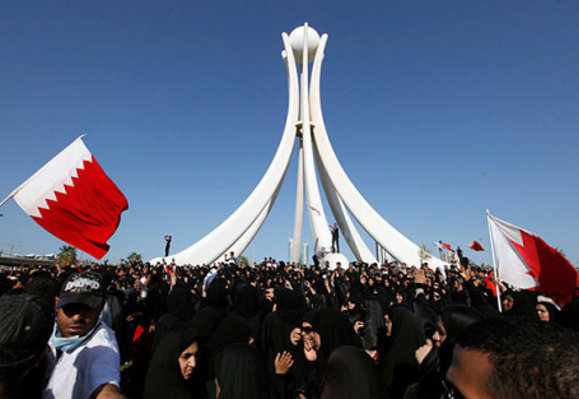
While attending a pro-reform rally in Manama’s Pearl Roundabout in February, Ayat al-Qarmezi read out a poem which she said was addressed to King Hamad bin ‘Isa Al Khalifa, Bahrain’s head of state.
Its lyrics include the lines “We are the people who will kill humiliation and assassinate misery/ Don’t you hear their cries, don’t you hear their screams?”.
She was forced to turn herself in to the authorities on 30 March after masked police raided her parents’ house repeatedly and reportedly threatened to kill her brothers unless she did so.
She was held incommunicado for the first 15 days of her detention and since then has only been permitted to see her family twice.
[Read more →]
June 8, 2011 Add Comments
Deterioration of Laborers’ Rights in the Kingdom of Bahrain
BCHR Letter on the Deterioration of Laborers’ Rights in the Kingdom of Bahrain
08 June 2011
Mr. Juan Somavia
Director General, International Labor Organization
Greetings,
Sub: Letter on the Deterioration of Laborers’ Rights in the Kingdom of Bahrain
We would like first of all to cordially extend our thanks for your precise follow-up on the laborers’ conditions in Bahrain; for the tremendous efforts as reflected in the various statements in which you declared your deep concern on the deteriorating situation of the Bahraini workforce; and for the ILO Delegation that visited Bahrain at the end of April to look into the working conditions of laborers. This led to the assembly of a committee chaired by the Labor Minister to address the issues pertaining to the cases of mass lay-offs.
Although such a committee was formed, the number of laborers being laid off is accelerating day after day. The estimates released by The General Federation of Workers Trade Unions in Bahrain show that, as of May 29, 2011 the total number of sacked laborers reached 1724 [1]. The actual number, however, is even greater than this as it incorporates only the laborers who reported their cases to the Union and not the total number who have actually been laid off. According to the same statistics, Bahrain Petroleum Company (Bapco) and Bahrain Aluminum (Alba), of which the government of Bahrain owns 100% and 70% respectively, have topped the list for layoffs, accounting for around 40% of the total number of sacked laborers in Bahrain.
ALBA has dismissed 364 laborers. About 250 of these were dismissed without any Interrogation. ALBA alleges that the main reason for dismissal was due to participation in the strike which was called by the company’s Trade Union as well as the General Federation of Bahrain Trade Unions in solidarity with the protesters who were violently oppressed. However, Bahrain Center of Human Rights (BCHR) received several testimonies from some ALBA laborers that they were not absent from work but were still dismissed. Other laborers said that they were absent from work due to the deteriorating security situation, or due to annual or sick leave however they were also dismissed. BCHR has documented a case in which an ALBA laborer was arrested from his workplace and dismissed under the pretext of an absence of more than 10 consecutive days. Other employees were given the option of either resignation, demotion or immediate dismissal [2]. …more
June 8, 2011 Add Comments
Al Khalifa opposition tourtured, killed, jailed and open dialogue quited – Al Khalifa’s hand picked ‘champions of reform’ engage in ‘national dialogue’
Planned Talks Bring Hope for Peace
By Suad Hamada
MANAMA, Jun 8, 2011 (IPS) – A national dialogue with no preconditions could bring the situation in Bahrain back to normal after a military crackdown that followed months of unrest.
Three opposition groups – the Democratic Nationalist Rally, the Democratic Progressive Tribune and the National Democratic Action Society (Waad) – have welcomed the dialogue slated to start Jul. 1. The Al Wefaq National Islamic Society that led protests in February and March before the declaration of a three-month state of emergency also hinted that it approved of the talks.
In a statement issued early this month, Al Wefaq welcomed a comprehensive dialogue based on a national consensus to achieve the demands and aspirations of Bahrainis. The group hinted that its engagement in the talks would depend on the involvement of Crown Prince Salman bin Hamad Al Khalifa, who suggested the idea at the height of the unrest in February.
The protests in Bahrain, inspired by the political movements in Egypt and Tunisia, started on Feb. 14 with calls for better housing services and living conditions, and escalated to demand the overthrow of the regime.
The unrest has affected people’s lives and the economy. One example was the postponement of the Formula One race that had been scheduled for March. The announcement of the dialogue might have influenced the FIA Grand Prix’s decision to agree to hold the games in October. …more
June 8, 2011 Add Comments
Obama ‘green light’ to al Khalifa, US, Saud security plan for Bahrain ‘on target’
The ProPublica Blog
White House Makes Nice With Bahrain as Detentions and Prosecutions Continue
by Marian Wang
ProPublica, June 8, 2011, 11:42 a.m.
As the Bahraini government continued its crackdown on largely Shiite pro-democracy groups, the Obama administration reaffirmed its friendship with Bahrain this week.
More Shiites were arrested and about 50 medical workers were charged by the Bahraini government this week. The government has accused the doctors and nurses of supporting the pro-democracy protests that the government has been trying for months to stop. Reuters reported yesterday that the medics have been denied access to their attorneys.
The Crown Prince of Bahrain, Salman bin Hamad Al-Khalifa, paid a visit to the White House yesterday and met with State Department officials as well as President Obama. There, the Obama administration’s soft touch on Bahrain continued, with Obama urging the Sunni monarch to “hold accountable” those responsible for human rights abuses without specifying who be held accountable, the Los Angeles Times reported.
Bahrain, of course, has long been a close ally of the United States, which has in turn benefitted from the Persian Gulf country’s willingness to host the U.S. Navy’s Fifth Fleet. As we’ve noted, the U.S. has kept its criticism muted in the face of a slew of alleged abuses—mass arrests of protesters, activists and medical workers; torture; abuse of Shiite women and girls and the destruction of at least 47 Shiite mosques.
The strongest condemnation came in President Obama’s Middle East speech last month, when he cited Bahrain’s “mass arrests and brute force,” calling them “at odds with the universal rights of Bahrain’s citizens.” But words of partnership and friendship have remained at the forefront. (Read the White House’s account of the Crown Prince’s visit with the president.)
“Bahrain is a partner, and a very important one, to the United States,” Hillary Clinton said in remarks yesterday. “We are supportive of a national dialogue and the kinds of important work that the Crown Prince has been doing in his nation, and we look forward to it continuing.”
[Read more →]
June 8, 2011 Add Comments
Bahrain ‘accepts’ UN Rights Mission
Bahrain accepts U.N. rights mission
Published: June 8, 2011 at 11:59 AM
GENEVA, Switzerland, June 8 (UPI) — Bahrain has accepted a U.N. mission in the country to examine reports of human rights violations during pro-reform demonstrations, the United Nations said.
Bahrain is facing international criticism for its response to a Shiite uprising in the country. The governing body of Formula One racing said Wednesday it was canceling a race in Bahrain because of security concerns expressed by the teams.
Rupert Colville, a spokesman for U.N. High Commissioner for Human Rights Navi Pillay, said Manama had agreed to let a U.N. mission examine alleged violations in the country. “The mission has been accepted in principle by the Bahraini government but no dates have yet been set,” he said in a statement.
Pillay’s office Tuesday complained her recent comments in the official news agency of Bahrain about the conflict were “blatantly” misrepresented. Bahrain’s Crown Prince Salman bin Hamad al-Khalifa said in Washington during talks with Secretary of State Hillary Clinton that the uprising was a challenge for his country.
“It is a great test, but also a great opportunity to drive the nation forward,” he said in a statement.
Bahrain is a key strategic ally to the United States, hosting the U.S. Navy’s 5th Fleet.
…source
June 8, 2011 Add Comments
Crackdown on teachers Society
Bahrain: Crackdown on teachers Society due to it is active role in protecting the rights of those working in educational institution
June 8th, 2011
On 8 June 2011, The first hearing was held at the National Safety court ( Military court) for Bahrain Teachers Society (BTS).The case has been adjourned till 15 June, 2011.
The defendants were present at the trial :
1- Mr. Mahdi Isa Abu Dheeb – Chairman, Bahrain Teachers Society
2-Ms. Jalila Mohammed Ridha Al Salman – Deputy Chair, Bahrain Teachers Society
Charges:
1-inciting others to commit crimes;
2-calling for the hatred and overthrow of the ruling system;
3-holding pamphlets, disseminating fabricated stories and information;
4-leaving work on purpose and encouraging others to do so;
5-taking part at illegal gatherings.
The Society was founded in 2002, previously called for improvement in teachers working conditions, and contributed to the protests since February 14, 2011.
BTS: Activities”2009″
On 13 March 2011, The BTS issued a statement criticizing the violations by the security forces in schools and called for a strike. (Ref: http://www.bhteachers.org/portal/news.php?action=view&id=61)
On 23 March 2011, Issued a statement to suspend strike. (Ref: http://www.bhteachers.org/portal/news.php?action=view&id=62)
On 6 April 2011, The Bahrain Teachers Society (BTS) suspended by Ministry of Development. (Ref: http://www.bna.bh/portal/news/451949).
BTS’s website blocked by Bahraini authorities: www.bhteachers.org
Bahraini authorities arrested some members of the Board of Directors.
Bahrain Youth Society for Human Rights (BYSHR) expresses deep concern at the targeting of institutions of civil society and calls for urgent action to stop the punishment of civil society institutions by the Bahraini authorities.
June 8, 2011 Add Comments