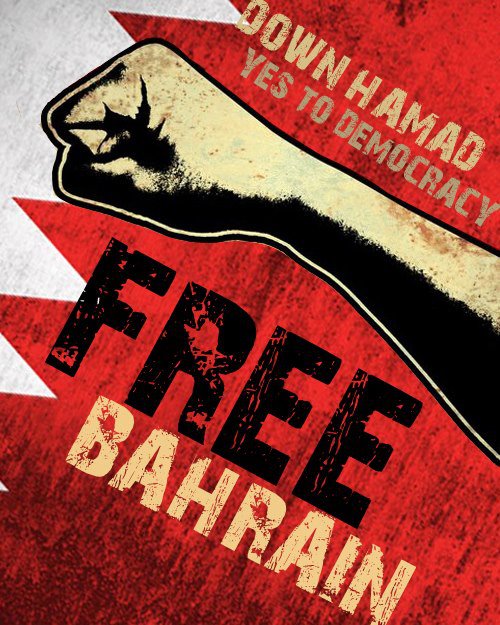
UNESCO becomes absurd, crass and cynical playground for Bahrain’s fascist flaunt
HRC Action Alert: UNESCO / Bahrain – Bahrain to Chair UNESCO’s World Heritage Committee whilst destroying its own heritage
15 JUNE 2011 – BCHR
IHRC urges all campaigners to wirte to the Director-General of UNESCO calling for the removal of Bahrain from the committee’s list.
1. Summary
On 19 June 2011 Bahrain will be chairing the 35th Session of The World Heritage Committee at UNESCO in Paris, France.
IHRC urges all campaigners to write letters to Irina Bokova, Director-General of UNESCO calling for the removal of Bahrain from the committee’s list. Furthermore, condemning the decision to give Bahrain the chairing position while destroying its own heritage, including demolishing mosques, destroying traditional jobs and its social natives.
2. Background
The World Heritage Committee consists of 21 States who examine the proposals made by State Parties, in order to identify cultural and natural properties of outstanding universal value to be protected under itsConvention and further added to the World Heritage List.
The Committee members are:
Australia, Bahrain, Barbados, Brazil, Cambodia, China, Egypt, Estonia, Ethiopia, France, Iraq, Jordan, Mali, Mexico, Nigeria, Russian Federation, South Africa, Sweden, Switzerland, Thailand, United Arab Emirates.
Bahrain is currently undertaking brutal crackdown on protests with the support of GCC troops from Saudi Arabia. It will be chairing UNESCO’s 35th Session of the World Heritage Committee in Paris.
Bahrain has been carrying out a systematic destruction of heritage and culture over the past 50 years, where old buildings, palm tree huts, were demolished as well as a group of 21 ancient and licensed mosques, including one that is more than 640 years old. Furthermore many traditional industries such as carpentry have been destroyed.
Bahrain is a chain of islands where residents in the past used to rely on fishing as their main source of income. Bahraini residents feel that their history is being stamped out due to the demolition of their heritage and culture by the Bahraini government and feel that it is hypocritical for that same government to be chairing this event. …source
June 18, 2011 Add Comments
Bahrain: Authorities targeting anyone who talks to the media with arrest and prosecution
Bahrain: Authorities targeting anyone who talks to the media with arrest and prosecution
18 Jun 2011 -BCHR
Bahrain Center for Human Rights (BCHR) expresses its extreme concern over the continuous violation of the right to freedom of speech and expression by the Bahraini regime towards all those who are speaking out their opinions and beliefs to the media and exposing the human rights violations committed by the security forces in Bahrain.
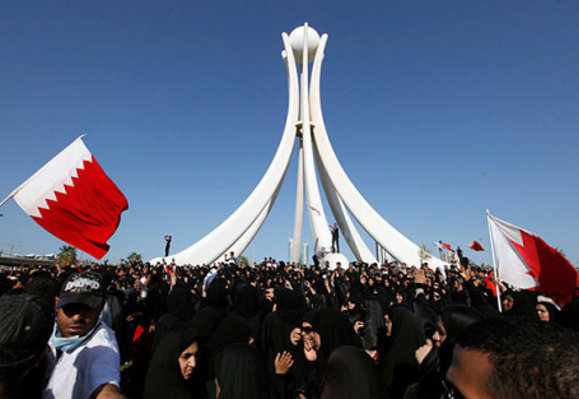
Foreign media and journalists have been interested since February 14 in the Bahraini uprising, many have been to the pearl roundabout, been present in protests and rallies and have interviewed protestors, to report later on to the whole world the peacefulness and civilized nature of the uprising, their legitimate demands and calls for political reform.
On March 18, Bahraini government imposed the Martial Law and has started a campaign to conceal the facts about the on ground situation and hide its ongoing brutality and crimes. In its attempt to silence and intimidate whoever would speak out and contact the media, Bahrain regime started targeting those who have appeared on television or talked to journalists about the uprising and exposed the violations.
“They are going to Target us one by one, whoever appeared on a camera”, said Sayed Ahmed Al Wadae, (Photo on top) an engineer graduated from the UK, on AlJazeera Bahrain: Fighting for Change documentary [1], as if he was foreseeing what was going to happen, however, it did not hold him form expressing his opinion and his demands for reform, as he spoke of discrimination against shia citizens and explained how he was attacked and beaten on the first crackdown on the pearl roundabout on February 20. On March 16, right after the crackdown on the protesters at the pearl roundabout, Sayed Ahmed’s house was raided late at night and he got arrested and held incommunicado for a month before getting released on 11 April to be arrested again weeks later and presented before the military court on May 23, to be sentenced to one year imprisonment for “taking part in illegal protests and disrupting public order” [2]. The sentence was later reduced to 6 month imprisonment by the court of appeals. …source
June 18, 2011 Add Comments
US Government Will Review AFL-CIO Complaint Against Bahrain
US Government Will Review AFL-CIO Complaint Against Bahrain
by James Parks, Jun 16, 2011
The AFL-CIO today applauded the U.S. Department of Labor’s decision to accept its complaint regarding the government of Bahrain’s failure to live up to its trade agreement commitments with respect to workers’ rights.
The complaint, filed April 21 with the Office of Trade and Labor Affairs, documents the Bahrain government’s repression of peaceful protests and attacks on the General Federation of Bahraini Trade Unions (GFBTU). Click here to read the complaint.
For two months, the union movement around the world and in the United States has called on the government of Bahrain to halt its all-out attack against workers. In retaliation for peaceful protests and as part of the Bahraini government’s overall crack down on dissent, more than 1,700 workers have been summarily dismissed from their jobs, frequently in contravention of Bahrain’s labor laws.
“The egregious attacks on workers must end, and the Bahraini government’s systematic discrimination against and dismantling of unions must be reversed. These actions directly violate the letter and the spirit of the trade agreement,” AFL-CIO President Richard Trumka said in a statement.
Workers must be reinstated to their jobs and the elected union leadership must be allowed to function without fear of reprisals. Failure by the United States to intervene to support workers and their democratic institutions would make a mockery of the labor protections included in the free trade agreement. …more
June 18, 2011 Add Comments
Rhetoric Versus Reality: US Involvement in Bahrain
Rhetoric Versus Reality: US Involvement in Bahrain
by grtv
While NATO continues bombarding Libya, they have quite a different approach with other countries–take for instance Bahrain. The country’s crown prince was in Washington DC last week and made a statement at a briefing with Secretary of State Hillary Clinton. “We are committed to changes and to find out ways to closer work with the US. We are a very important ally to the US,” said the prince.
Clinton expressed support for Bahrain, stressing it was a very important for the US. While they were talking about reforms, however, dialogue out of Bahrain shows that that is very far from the case overseas.
Michel Chossudovsky, the director of the Center for Research on Globalization, joins RT to talk about the matter. …source
June 18, 2011 Add Comments
al Khalifa smoke and mirrors, media misdirection, as Political Societies “unbanned” leadership still in prisons
Bahrain to lift ban on major opposition party
Government “taking steps” to reinstate Waad party, but opposition officials remain sceptical of talks with Manama. – Last Modified: 18 Jun 2011 17:53
Bahrain’s government is preparing to lift a ban on the country’s second largest opposition party, ahead of a national dialogue to ease the Gulf island kingdom’s political crisis.
Radhi al-Mousawi, a spokesman for the National Democratic Action Society, or Waad, said on Saturday that the government would lift the ban on its headquarters in the capital, Manama, and later at its office in Muharraq.
The state news agency BNA confirmed the news, citing the justice ministry as saying steps were being taken to lift the ban.
Authorities shut down Waad in April amid a crackdown by security forces on pro-democracy protests.
Welcoming political dialogue
Mousawi said the group had sent a statement to the government welcoming the political dialogue, set by King Hamad bin Isa al-Khalifa to begin on July 1, and asked for the king to look into the case of Waad’s detained leader.
Ibrahim Sharif is in prison along with several other opposition leaders, including Hassan Mushaimaa, the president of the Shia Islamist party al-Haq.
Both are among 21 people facing trial on charges of plotting a coup with backing from “foreign terrorist groups”.
Bahrain’s Sunni rulers have accused the protesters, backed mostly by Shia groups but also by the secular Waad party, of being backed by Iran. Opposition groups deny the charges.
Bahraini opposition activists said that Waad had been under pressure to welcome the national dialogue in return for an end to the ban.
Both Waad and Wefaq, the largest Shia opposition group, have stopped short of saying they will join the talks. Some Wefaq members have said they are wary of taking part because of reports that dozens of groups will be invited.
Diluting the opposition
Government supporters say groups that are not political parties should attend to represent Bahrainis who are not politicised.
The opposition argues it will dilute their voice in negotiations.
Sheikh Ali Salman, head of Wefaq, told crowds in a rally of more than 10,000 people on Friday that too many groups would “be a social gathering, not a political dialogue”.
Sheikh Salman bin Hamad al-Khalifa, Bahrain’s crown prince, who led an earlier round of talks that failed just as the government began its crackdown, called on all citizens to work for dialogue.
Seen as a moderate in the ruling family, Sheikh Salman is the preferred choice of the opposition to lead talks.
The opposition has criticised the king’s choice of the speaker of the state’s lower parliament, who is seen as conservative on political reform. …more
June 18, 2011 Add Comments
Amal Islamic Society leadership in prison and woefully absent at Protest Rally in Sitra
Bahrainis hold mass protest in Sitra
By shiapost – June 17, 2011Posted in: Bahrain
Thousands of Bahraini anti-government protesters have poured into the streets in the island city of Sitra, following a call by the country’s largest opposition group al-Wefaq.
The Friday rally was the second mass anti-government demonstration organized by al-Wefaq since the heavy mid-March government crackdown on protesters.
Witnesses say regime forces were closely monitoring the rally and a military helicopter was hovering over the city. But there were no reports of clashes or arrests.
The first protest rally was hold last Saturday under the banner “Bahrain, homeland for all” in the village of Sar 10 days after a state of emergency was lifted.
Al-Wefaq leader cleric Sheikh Ali Salman told protesters on Friday that the opposition was not against dialogue with the government if rights interlocutor and officials were involved.
“The success of dialogue, reform and transition to democracy need officials that believe in it. One of the problems of the past was that many officials did not believe in democracy and reform,” AFP quoted Salman as saying to the crowds.
Similar protest rallies were also held in some other Bahraini villages and towns. Witnesses say regime forces fired teargas at protesters in Karzakan village, west of the country.
Bahraini opposition demands the release of detained anti-government protesters, the suspension of trials against opposition activist and a halt to the dismissal of students and workers before the beginning of the national dialogue set for July 1. …more
June 17, 2011 Add Comments
The last Bahrain, Saudi Royal Wedding – End Times for Kings and Tryants!
Bahrain, Saudi Royal Wedding Set, Further Cementing National Ties
Riyadh Mosque Skyline
06/17/11 04:40 AM ET AP
MANAMA, Bahrain — Bahrain says the son of the island nation’s king and the daughter of Saudi Arabia’s monarch have agreed to wed – further cementing ties boosted by cooperation to crush pro-reform protests.
An announcement on the official Bahrain News Agency says Bahrain’s Sheik Khalid bin Hamad bin Isa Al Khalifa signed a marriage contract Thursday with the daughter of Saudi King Abdullah. The Friday report did not give the woman’s name or when the ceremony would occur.
Such strategic family alliances are common among the Gulf’s Sunni leaders.
Saudi Arabia is leading a Gulf military force sent to Bahrain in March to help smother Shiite-led protests demanding greater rights. …source
June 17, 2011 Add Comments
Continuing Abuses by Bahraini Government Demand Stronger Response by U.S.
Press Release
FOR IMMEDIATE RELEASE
Contact: Mary McGuire 202-747-7035
Continuing Abuses by Bahraini Government Demand Stronger Response by U.S. and International Community
Washington – June 17, 2011
Freedom House welcomes yesterday’s statement by the United States at the United Nations Human Rights Council in Geneva listing Bahrain as one of several countries that should receive additional scrutiny by the body and urges stronger U.S. and international action in response to the ongoing abuses in that country.
Despite a violent crackdown by the Bahraini government, in which at least 31 people have been killed since demonstrations began in February, responses by most countries to the abuses taking place in the Gulf country—including by the United States—have been muted. Just last week, President Obama personally met with Crown Prince of Bahrain Salman bin Hamad Al Khalifa and reaffirmed the “strong commitment of the United States to Bahrain.”
“Freedom House welcomes yesterday’s call by the U.S. to focus the Human Rights Council’s attention on serious human rights violations occurring in the midst of protests by peaceful activists seeking political reform,” said Charles Dunne, senior program manager for Freedom House’s Middle East and North Africa program. “However, as an important ally to Bahrain, the United States must do more to stem the Bahraini government’s continued violence against and arrests of activists, journalists, medical professionals and demonstrators. We further urge the Bahraini government to cooperate fully with the Office of the UN High Commissioner for Human Rights, and to investigate all allegations of violence in an accountable, just, and transparent manner.” …more
June 17, 2011 Add Comments
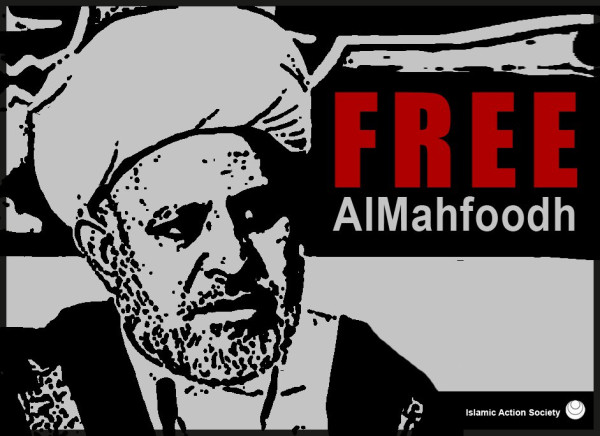
Free Almahfoodh
June 17, 2011 Add Comments
Shaikh Moahmmed Ali Almahfoodh and his friends and many other innocent citizens and leaders of this people are paying the cost of their defense of Bahraini people…
IslamicActionSociety
On Thursday 16th June 2011, @AmalSociety said:
#Bahrain Statement: provision of “Amal” staff to trials and the desire of tens of international lawyers to defend
——————————————-
In the name of Allah, the most merciful, the most graceful,,
Islamic Action Society announces, according to the information issued by some human rights organizations and innocent detainees’ families, that the authority is to provide Islamic Action Society’s staff headed by the Secretary General Shaikh Moh’d Ali Almahfoodh to military trials within next week and to accuse them with fabricated charges that authority used to fabricate to other honorable strivers from the sons of this country.
In this context, many lawyers from different countries announced their readiness to defend the Secretary General and his faithful brothers from the Society’s staff, who were arrested during the last period of nightly raids on their houses or by the arrest of their loved ones as hostages until they surrender themselves to police.
Shaikh Moh’d Ali Almahfoodh and his friends and many other innocent citizens and leaders of this people are paying the cost of their defense of Bahraini people and not keeping silent on the unjust, the violations and the blatant suppression. What Sh. Almahfoodh did and stand for of moral principles toward the hardship of this great people, that are declared and undeclared, is the main reason for throwing the honorable such his eminence into detentions, and these stands are stemmed from deep faith in his eminence of religious, moral and historic responsibility that lying on his shoulders toward the people which matches with his principles and his jihad and sacrificing biography in which he bear the pain of detention, emigration and staying away from his family and homeland for many years ago.
Along four decades of his age, Sh. Almahfoodh sought with his companions to demand a democratic and just regime that is accepted by people and established on the bases of equality and freedoms respect which result from a real people participation in drawing their present and future, a regime in which people are treated on the bases of their efficiency and faithfulness, not on their sectarian affiliation or relations with corrupters, so Sh. Almahfoodh sought to a regime that rewards the good man on his goodness, and punishes the abusers who steal the country and use it for their interests, who arrested and tortured and killed the sons of this people in order to save their privileges at the expense of the homeland and citizens.
That is why today he is bearing the tax of this seek and this national brave stand toward his own people to confirm to us that defending the suffering of Bahraini people is an essential and urgent issue that cannot endure the delay, because every day more on this suffer, it means more victims fall and tortured, tried and imprisoned and possibly killed.
The trial of such ones like Sh. Almahfoodh is a trial of the people’s conscious and all that is clean and honor and national and faithful by the staff of corrupts and torture and violations that control the people’s and country’s fate. At a time when the American delegation visits Bahrain, it turns blind eye on the detention of the societies’ and movements’ leaderships in a clear reference to the US double standards in dealing with the political forces in Bahrain through separation and sorting.
Freedom to honorable, and the victory from Allah, and freedom to this great people,,
No right lost as long as demands behind it,,,
Islamic Action Society – Amal
Manam – Bahrain
16th june, 2011
…source
June 17, 2011 Add Comments
Protest Sitra Island 16 June , 2011
June 17, 2011 Add Comments
Protest Sanabis 16 June, 2011
June 17, 2011 Add Comments
Alert – Call for end to trial of five pro-democracy activists
Alert – Call for end to trial of five pro-democracy activists
(Human Rights Watch/IFEX) – Beirut, June 15, 2011 – The United Arab Emirates attorney general should immediately drop all charges against five pro-democracy activists to halt their trial, Human Rights Watch said today. The charges of “humiliating” top officials relate solely to the defendants’ peaceful use of speech to criticize the UAE government and therefore violate their freedom of expression, Human Rights Watch said. UAE authorities should release the activists unconditionally and without delay.
The five defendants, who include a leading human rights activist, Ahmed Mansoor, and a university lecturer, Nasser bin Ghaith, pled not guilty on June 14, 2011, during a closed-door hearing in Abu Dhabi’s Federal Supreme Court. The trial follows a campaign of harassment against the activists after they and dozens of other UAE nationals signed a petition published on March 9 that sought constitutional and parliamentary changes in the Emirates and free elections in which all citizens could participate. …more
June 17, 2011 Add Comments
Bahrain hunger striker sees husband for first time in two months
Bahrain hunger striker sees husband for first time in two months
# guardian.co.uk, Friday 17 June 2011 12.42 BST
by Peter Walker
Zainab al-Khawaja allowed to spend six minutes with her husband Wafu Almajed, who was arrested in April
The young Bahraini woman who became a prominent voice of the Arab uprisings after going on hunger strike to protest at the detention of relatives has described in a series of heart-rending tweets her first meeting with her husband in more than two months.
Zainab al-Khawaja, who staged a 10-day fast in April following the beating and arrest of her father, a leading human rights activist, and the arrest of her husband and her brother-in-law, described being allowed to spend just six minutes with Wafu Almajed.
Much of Khawaja’s overseas profile comes from her much-read and prolific updates under the Twitter moniker angryarabiya. Friday’s brief reunion, in which Khawaja was allowed to bring along the couple’s 20-month-old daughter, Jude, was described immediately afterwards in a series of breathless and emotional 140-character missives. Beginning, “Hi every1, at long last, finally, I have seen my husband,” Khawaja described being let into the jail in Manama, Bahrain’s capital, by one of the police officers who arrested and beat up her father, Abdulhadi al-Khawaja. He also remains in custody.
The description continued: “They took us to a room, after searching us. Then Wafi walked in. I dunno how to explain how I felt … We hugged Wafi, then he was asked to sit on a chair abt 4 mtrs away from us … There were at least 5 police with us in the small room, and 2 by the door. all looking and listening to us … I woke jude and walked over and put her in his lap. I cud tell he’s fighting tears … Wafi started singin Barneys ‘I love u song’ to jude, infront of all the police … Jude had just woken up and was staring at Wafi, probably surprised. Then wafi sang ‘if all the raindrops’ another of Judes favorites.” …more
June 17, 2011 Add Comments
Bahrain Shiite cleric demands rulers ease crackdown before talks on reforms
Bahrain Shiite cleric demands rulers ease crackdown before talks on reforms
By Associated Press, Updated: Friday, June 17, 6:15 AM
MANAMA, Bahrain — Bahrain’s top Shiite cleric denounced the Gulf kingdom’s rulers for “damaging the country” and warned Friday that tension-easing dialogue cannot take place until authorities halt crackdowns used to crush protests demanding greater political rights.
Shiites comprise about 70 percent of the population in the strategic nation, which is home to the U.S. Navy’s 5th Fleet. But Shiites claim widespread discrimination at the hands of the Western-backed Sunni monarchy.
“The reactions of the security forces result in damaging the country, but the people are patient and peaceful,” Sheik Qassim told worshippers in a mostly Shiite area outside the capital Manama.
Bahrain’s ruling dynasty has proposed opening talks with opposition delegates July 1, but the outreach has met a cool reception from Shiite leaders demanding that authorities roll back security measures and halt trials against activists and others on anti-state charges. At least 31 people have died in the unrest and hundreds have been detained. …more
June 17, 2011 Add Comments
Crackdown Continues in Bahrain, Bloggers Go on Trial in Emirates
Crackdown Continues in Bahrain, Bloggers Go on Trial in Emirates
[Media News]
Thursday, June 16, 2011
Reporters Without Borders
BAHRAIN
Regime officials have reportedly taken over the Facebook and Twitter pages of Rasad News, a major source of news about human rights violations in Bahrain, and are posting anti-protest and pro-regime material after the arrest on 9 June of Hussein Ali Makki, administrator of the pages. Rasad News has since opened a new Facebook page to continue its work.
PalTalk, an audio and video chat group that was becoming increasingly political, especially one chatroom called Bahrain Nation, has been blocked since the beginning of the month.
Access to a new anti-government news site, http://bahrainmirror.com, has been blocked since 5 June.
Ali Omid, administrator of an online forum arrested on 10 May, was released on 22 May but is still liable for prosecution.
Mattar Ibrahim Mattar, a member of parliament for the Al-Wefaq party and leading pro-democracy activist, was charged by a military court on 12 June with “calling openly for the overthrow of the ruling system, disseminating tendentious rumours and taking part in illegal gatherings.” He had been arrested on 2 May after warning of the possible arrests of opposition leaders in a interview with Al-Jazeera.
Hussein Al-Durazi, a sports reporter for the daily Al-Ayam arrested after a police summons in Riffa on 23 May, was freed on 2 June. The paper has reportedly dismissed him.
The trial of the editors of the newspaper Al-Wasat has been postponed until 19 June. (http://edition.cnn.com/2011/WORLD/m…).
UNITED ARAB EMIRATES
The trial of human rights bloggers Ahmed Mansour, Farhad Salem and Nasser bin Ghaith began on 14 June for undermining state security, disturbing public order and insulting the head of state, the vice-president and the crown prince of Abu Dhabi. He was arrested in early April after signing a petition calling for democratic reforms. He is being tried with two other signatories, Hassan Ali Al Khamis and Ahmed Abdul Khaleq.
All pleaded not guilty and asked for a trial behind closed doors to avoid any pressure on the federal supreme court, which postponed the hearing until 18 July.
Reporters Without Borders calls on the authorities to drop all charges against them and release them immediately.
The United Arab Emirates is one of the countries “under surveillance” on the Reporters Without Borders list of worldwide “Internet enemies.”
KUWAIT
A Kuwaiti Internet user, Nasser Abul, has been imprisoned since 7 June after strongly supporting online the rebellion in Bahrain. He reportedly has no access to a lawyer and has only been allowed to make one phone call to his family.
YEMEN
The regime’s Republican Guard seized 5,000 copies of the daily paper Akhbar Al-Youm at the Qahaza checkpoint in Sanaa on 12 June as they were on their way to the Taiz, Ibb and Dhamar provinces.
Security forces seized copies of the daily Al-Oula and the weekly Al-Sharia in Sanaa on 9 June, the ninth time Al-Oula had been seized since pro-democracy demonstrations began four months ago.
LIBYA
Reporters Without Borders welcomes the release on 13 June of Al-Jazeera cameraman Kamel Al-Tallou, a Libyan-born British citizen arrested on 19 March near Zawiya with three other Al-Jazeera journalists – Tunisian Lotfi Al-Masoudi (freed on 31 March), Mauritanian Ahmad Val Ould Eddin (released on 11 April) and Iraqi-born Norwegian Ammar Al-Hamdan (freed on 14 April). …source
June 17, 2011 Add Comments
Facebook Facial Recognition Draws EPIC Privacy Concern
Facebook Facial Recognition Draws EPIC Privacy Concern
By: Clint Boulton
2011-06-16
EPIC and Congressman Edward Markey complained to the Federal Trade Commission that Facebook abused users’ privacy rights with its new facial recognition feature for tagging photos.
Facebook is facing pressure from the Electronic Privacy Information Center, other consumer advocates and Congress members over its use of facial recognition software for its tag suggestions feature in its photo application.
When users upload new photos, Facebook scans them with facial recognition software to match new photos to other photos a user is tagged in. Similar photos are then grouped together, with Facebook suggesting the name of the friend in photos.
Facebook revealed plans to use facial recognition in its tag suggestions feature last December. The original launch was contained to the United States, but the company recently changed its privacy settings to enable the tag suggestions feature more broadly — without explicitly warning users of its intentions.
However, tag suggestions are only made to people when they add new photos to the site, and only friends are suggested. Moreover, all suggestions can be ignored and if someone doesn’t want their name to be suggested to their friends, they can disable the feature in their privacy settings. …more
June 16, 2011 Add Comments
Careful – WSJ and Al-Jazeera Lure Whistleblowers with False Promises of Anonymity
WSJ and Al-Jazeera Lure Whistleblowers With False Promises of Anonymity
Legal Analysis by Hanni Fakhoury – EFF
June 7th, 2011
The success of Wikileaks in obtaining and releasing information has inspired mainstream media outlets to develop proprietary copycat sites. Al-Jazeera got into the act first, launching the Al-Jazeera Transparency Unit (AJTU), an initiative meant to “allow Al-Jazeera’s supporters to shine light on notable and noteworthy government and corporate activities which might otherwise go unreported.” AJTU assures users that “files will be uploaded and stored on our secure servers” and that materials “are encrypted while they are transmitted to us, and they remain encrypted on our servers.”
On May 5, the Wall Street Journal (WSJ), a subsidiary of Dow Jones & Co., Inc., launched its own site, SafeHouse. That same day, the Atlantic published a story describing SafeHouse as a “secure uploading system” with “separate servers,” two layers of encryption, and a policy of discarding information about uploaders “as quickly as possible.” You can “keep yourself anonymous or confidential, as needed,” the SafeHouse site promises, as you “securely share documents with the Wall Street Journal.”
Immediately after its launch, however, online security experts ripped SafeHouse apart. The Atlantic published its story online at noon on May 5 and by 5 p.m., the page was updated with a link directing readers to the Twitter feed of Jacob Appelbaum, a security researcher and Wikileaks volunteer, who had already exposed an embarrassing number of security problems with SafeHouse.
EFF’s review of the legal side of these websites doesn’t fare any better. While some of the more egregious technical problems with SafeHouse have been fixed since its launch, its terms of use haven’t changed. We read through the Terms of Service for both SafeHouse and AJTU (pdf). Don’t fall for the false promises of anonymity offered by these sites. Here’s what you should know.
They Reserve the Right to Sell You Out
Despite promising anonymity, security and confidentiality, AJTU can “share personally identifiable information in response to a law enforcement agency’s request, or where we believe it is necessary.” SafeHouse’s terms of service reserve the right “to disclose any information about you to law enforcement authorities” without notice, then goes even further, reserving the right to disclose information to any “requesting third party,” not only to comply with the law but also to “protect the property or rights of Dow Jones or any affiliated companies” or to “safeguard the interests of others.” As one commentator put it bluntly, this is “insanely broad.” Neither SafeHouse or AJTU bother telling users how they determine when they’ll disclose information, or who’s in charge of the decision. …more
June 16, 2011 Add Comments
Rethinking and reframing the dialogue and assumptions – it’s about the People and their Democracy and Human Rights
The Proxy Battle in Bahrain
By MICHAEL SLACKMAN
Published: March 19, 2011
CAIRO — King Abdullah of Saudi Arabia has demonstrated one lesson learned from the course of pro-democracy uprisings across the Middle East: The world may cheer when autocrats resign, but it picks carefully which autocrats to punish for opening fire on their citizens.
That cynical bit of realpolitik seems to have led the king to send troops last week over the causeway from Saudi Arabia to Bahrain, where they backed up a violent crackdown on unarmed protesters by Bahrain’s own security forces.
The move had immediate consequences for Middle East politics, and for American policy: It transformed Bahrain into the latest proxy battle between Iran and Saudi Arabia for regional dominance. And it called into question which model of stability and governance will prevail in the Middle East, and which Washington will help build: one based on consensus and hopes for democracy, or continued reliance on strongmen who intimidate opponents, sow fear and co-opt reformist forces while protecting American interests like ensuring access to oil and opposing Iran.
For Saudi Arabia, the issue in Bahrain is less whether Bahrain will attain popular rule than whether Iranian and Shiite influence will grow.
Iran and Saudi Arabia have sparred on many fronts since the Iranian Revolution of 1979 — a Shiite Muslim theocracy in Tehran versus a deeply conservative Sunni Muslim monarchy in Riyadh — in a struggle for supremacy in the world’s most oil-rich region. The animosity was evident in Saudi Arabia’s support for Iraq during its war with Iran, and it still shows in Iran’s backing for Hezbollah in Lebanon.
Now, after a decade that seemed to tilt the regional balance toward Iran, Saudi Arabia decided that Bahrain was the place to put its thumb more heavily on the scale. It sent troops under the auspices of the Gulf Cooperation Council to help crush pro-democracy demonstrations because most of the protesters were Shiites challenging a Sunni king. …source
June 16, 2011 Add Comments
Noam Chomsky Recent on ‘Arab Spring’ and Democracy
Noam Chomsky (2011.03.13) – Amsterdam Westerkerk – NOAM TALKS about EGYPT, TUNISIA, SAUDI, BAHRAIN, IRAN, US IMPERIALISM & FAKE DEMOCRACY with his usual intelligence and diamond-cutter precision AN ABSOLUTE MUST… Heard on one of his talks recently when the US government invades it is called stabilization. If a “rogue” sate invades it is interference or even invasion.
June 16, 2011 Add Comments
Bahrain’s dialogue met with skepticism – No dialogue with opposition in Prison
Bahrain’s dialogue with opposition groups met with skepticism
June 17, 2011 02:49 AM
By Brian Murphy
Associated Press
DUBAI: Bahrain’s ruler has canceled all vacations for top officials next month and a special center and mediator have been named for talks with opposition groups, proposed to open on July 1.Now the question is whether anyone will show up.
The Shiite groups that speak on behalf of protesters – who took to the streets four months ago to demand greater rights – have shown no rush to embrace the appeals for dialogue by the Sunni monarchs they accuse of creating a two-tier society in the Gulf kingdom.
The possible failure to open talks could be interpreted as far more significant than simply a payback snub by Bahrain’s Shiite majority after unrest that’s claimed at least 31 lives and left hundreds of people detained or expelled from jobs and studies.
It would serve as clear recognition that the complexities on the tiny island – drawing in heavyweight issues such as U.S. military interests and Arab worries over Iran – are too vast to solve over cups of tea between the rulers and the opposition.
“Events seem to have gone too far and too fast for some kind of quick fix through talks,” said Toby Jones, a Bahrain expert at Rutgers University.
Bahrain’s choice of mediator for the proposed talks is under question. The government appointed the Parliament speaker to head the dialogue, but opposition groups consider it a downgrade from the first pointman, Crown Prince Salman bin Hamad al-Khalifa. …source
June 16, 2011 Add Comments
President Obama’s “ears” starting to hear?
U.S. to probe Bahrain labor rights concerns – AFL-CIO
WASHINGTON, June 16 | Thu Jun 16, 2011 4:22pm EDT
(Reuters) – The Obama administration has agreed to investigate concerns raised by the AFL-CIO labor federation that Bahrain has failed to live up to its obligations to protect workers rights under a free trade pact with the United States, the labor group said on Thursday.
“The egregious attacks on workers must end, and the Bahraini government’s systematic discrimination against and dismantling of unions must be reversed. These actions directly violate the letter and the spirit of the trade agreement,” AFL-CIO President Richard Trumka said in a statement. (Reporting by Doug Palmer; editing by Anthony Boadle) …source
June 16, 2011 Add Comments
Aiming to Preserve Autocratic Mideast Rule, Saudi Arabia Helps Crush Uprisings in Bahrain, Yemen
Aiming to Preserve Autocratic Mideast Rule, Saudi Arabia Helps Crush Uprisings in Bahrain, Yemen
While the United States remains heavily involved in the Libya conflict, it has been noticeably silent on the violent suppression of popular uprisings against autocratic regimes in Bahrain and Yemen, both of which are close allies of Saudi Arabia. In March, Bahrain called in Saudi troops to help crush massive pro-democracy protests. We discuss the role of Saudi Arabia in recent regional uprisings with Toby Jones, assistant professor of history at Rutgers University and a former Persian Gulf analyst with the International Crisis Group. …source
June 16, 2011 Add Comments
Open Letter from banned lawyer for Bahrainis detained in Guantánamo
Bahrain: an open letter
Joshua Colangelo-Bryan, 15 June 2011
A lawyer for Bahrainis detained in Guantánamo is now excluded from a country where he was once welcome. Joshua Colangelo-Bryan tells the story.
Joshua Colangelo-Bryan is a consultant to Human Rights Watch
The Bahraini government effectively barred me from entering the country in early May 2011. What makes this of more than personal interest is that I have a longstanding relationship with the country, as a lawyer who from 2004-07 represented the Bahrainis detained at Guantánamo Bay.
This involved over 3,200 hours’ work on my clients’ behalf, including twelve trips to Guantánamo – often despite great efforts made by the United States to keep me and other lawyers from going there. I saw clients through suicide-attempts and hunger-strikes. When my clients were sure Bahrain had forgotten them, I promised this was not true and remained committed to advocating for the “Bay Bahrainis”, as they were called.
My clients had strong allies inside Bahrain. During a visit to Manama in 2005, Sheik Adel al-Maawda invited us to parliament and delivered there an impassioned speech about my clients’ rights to due process and humane treatment. He said that my law firm had done more for his compatriots than anyone else, and led the other parliamentarians in a standing ovation. …more
June 16, 2011 Add Comments
In Bahrain corruption and dispossession, it’s just Business
Special Report: In Bahrain, a symbol at the heart of revolt
By Frederik Richter and Martin de Sa’Pinto
MANAMA/ZURICH, Jun | Thu Jun 16, 2011 11:25am EDT
MANAMA/ZURICH, Jun (Reuters)- Until a few months ago, the twin towers of the Bahrain Financial Harbour development — clad in green glass and shaped like over-sized toy sea-horses — were symbols of the island state’s role as a regional financial hub.
Today the towers have taken on a different significance: concrete expressions of the way business and politics so often merge in the Gulf and, as a result, targets in the unrest that has roiled Bahrain and the wider Middle East since the beginning of the year.
Built by Gulf Finance House, a listed investment company run by Bahraini businessman Esam Janahi, the towers have also come to embody the ruling al-Khalifa family’s fight to preserve its power and protect the vast wealth of the country’s economic elite.
Land in the Gulf Arab region is largely controlled by a small number of ruling families who use it as a kind of currency, doling out plots to favored families and developers to forge political relationships and make money. For it to work, the system depends on businessmen like Janahi, merchants who ostensibly operate independently from the state but whose success rests, at least in part, on political connections.
Janahi, whose net worth local bankers estimate was several hundred million dollars before the global financial crisis, used his close ties to the al-Khalifas to build the centerpiece of the Bahrain Financial Harbour. He could then point to the development as a model to help secure further land deals from rulers and governments across the Middle East and as far away as India, convincing investors to put up billions of dollars for property projects, most of which have never been built.
GFH was far from the only firm to turn sand into money. The basic game plan was played out dozens of times by various companies across the Gulf in the past decade or so. But Janahi and his firm were among the biggest. …more
June 16, 2011 Add Comments