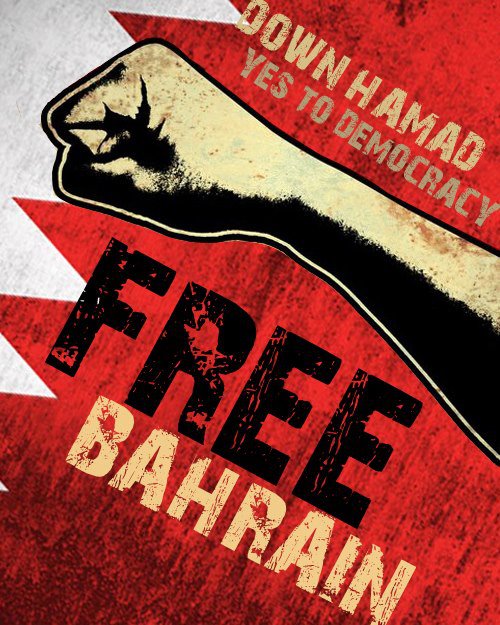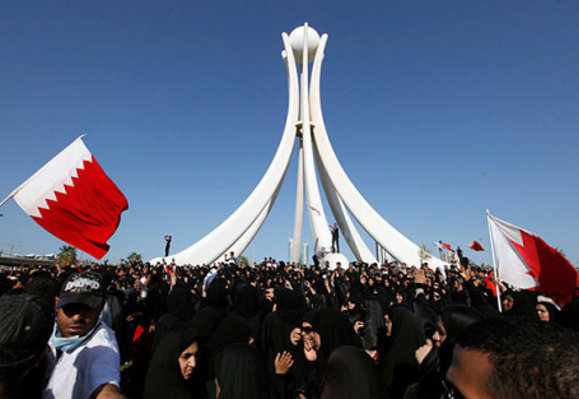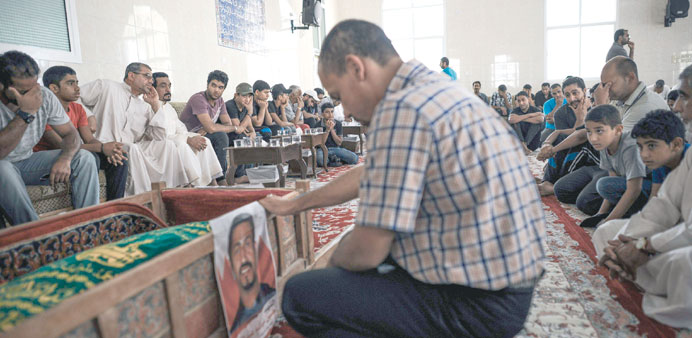
The poem is never silenced
Khalifa
by Ayat al-Ghormezi
Hear me:
You, the elder,
the “good man”, who “safeguards justice”
(so you have always declared),
if I were to make excuses for you,
I, for you,
for the things you have done,
I would only look the fool,
for you would continue in your ways,
and murder us as “traitors”.
Hear me:
Hear us all, for we all demand likewise –
both sects, all Bahrainis:
You must go.
Take His Majesty with you,
and leave your deeds behind.
You, oppressor,
from where do you derive your power,
the power to keep your people down? –
all your people,
even women
even children
even men.
Yet you call for “dialogue”,
even in the midst of your brutality?
No! … No! …
One word: No!
One demand:
Give us back our Bahrain.
Return this country to its people;
to us, its people.
Our Bahrain is ours.
Translated from the Arabic by Ghias Aljundi with Mitchell Albert …source
June 28, 2011 Add Comments
al Khalifa in dellusional rhetoric fails to understand “business as usual” is not acceptable
Bahrain’s opposition to boycott dialogue, elections
By shiapost – June 28, 2011Posted in: Bahrain
MANAMA: Bahrain’s largest Shiite opposition group says it will boycott the national dialogue next month and the September parliament elections in protest against the authorities for “not doing enough.”
Al Wefaq National Islamic Society said it was in no mood to give in to the authorities’ call for a national dialogue starting July 1st that would attract 300 participants from political societies, human rights groups and civil society organizations.
“There has to be real dialogue that results in political reforms. We believe the dialogue was a step forward for the country but setting conditions before the process is not acceptable,” said Al Wefaq leader Shaikh Ali Salman.
He told Xinhua that it was important for the government to first address all issues such as sacking of workers, arrest of medics, lawmakers and other citizens before entering any dialogue.
“This dialogue will be successful if there is a principal person from Royal Family like the Crown Prince present in the process. He understands the demand and the opposition sees him as a leader, who could solve this crisis.”
National Dialogue spokesperson, Isa Abdulrahman said in a statement on Monday that refusal of any group to participate in the National Dialogue will “not mean failure of the initiative.” “We hope that all those invited would participate to come out with resolutions that represent the needs and aspirations of all people in Bahrain,” he said.
Regarding the non-confirmation of Al Wefaq’s attendance, Abdulrahman said he hoped all parties would participate in healthy and smooth talks.
However, he assured that refusal of some societies to participate does not mean dialogue failure.
“The success of talks could be determined with fruitful talks, good approach and implementation of its recommendations,” he said.
But it is not only the National Dialogue the Shiite opposition is boycotting, Shaikh Ali said their party has no interest to contest in the by-elections on September 24. It would be held in 18 Shiite dominant constituencies. “I don’t see us participating in these elections as the demand and issues faced by people is more important and is still ignored, ” he said. …more
June 28, 2011 Add Comments
Bahrain authorities continue to abuse human rights advocates, doctors, reformers
Bahrain authorities continue to abuse human rights advocates, doctors, reformers
28/06/2011
In the absence of international accountability and the complicity of the Arab League, the Bahraini authorities continue to abuse human rights advocates, doctors, and reformers
The Cairo Institute for Human Rights Studies (CIHRS) expresses its deep concern and total condemnation of the severe penalties targeting prominent political and advocacy figures in Bahrain whose only crime has been to aspire to genuine reforms to construct a democratic system that respects human rights, guarantees equality, and ends systematic discrimination against the Shiite community.
The National Safety Court, a special military court formed pursuant to the declaration of a state of emergency in the Kingdom, sentenced some of the most prominent human rights defenders in the Gulf region to life imprisonment. Among them is Abdul Hadi al-Khawaja, the former president of the Bahrain Center for Human Rights who, until a few months ago, was the Middle East and North Africa regional coordinator for Front Line Defenders. Seven other prominent political dissidents and democratic reform advocates also received life sentences, including Hassan Mushaima, the secretary-general of the Movement for Civil Liberties and Democracy (HAQ), and Abduljalil Alsingace, a leading member of the same organization and a blogger. Thirteen other defendants received prison sentences ranging from 2 to 15 years. The defendants were convicted of a host of spurious charges, including conspiring to overthrow the regime, establishing or managing a terrorist group, and colluding with terrorist groups outside the country.
CIHRS expresses its full solidarity with the victims of these simulated trials, which the Bahraini authorities have long employed to confront those it deems its enemies for merely exercising their right to peaceful expression, for publicly criticizing government practices and policies, or for defending human rights. CIHRS also notes that the investigative authorities in the case took no action regarding the brutal physical assault on Abdul Hadi al-Khawaja during his arrest in April, nor over his torture in detention nor the attempted sexual assault on him. As a result of the torture, al-Khawaja sustained a shattered jaw and several other serious injuries for which he underwent surgery at a military hospital several weeks ago. The hospital refused to provide a medical report or any information about the nature of the surgery. CIHRS learned that al-Khawaja was taken yesterday to a military hospital due to his deteriorating health condition. In addition, the “judges” of the military court refused to hear al-Khawaja’s complaint about the torture he endured or to issue a court order to investigate the complaint. …more
June 28, 2011 Add Comments
“Shia bloc” – stop torture, free prisoners
Shia bloc questions talks
Last Modified: 28 Jun 2011 21:31
However, the main Shia opposition group, Al Wefaq, has questioned the Kings’s offer of dialogue while political activists are being tortured and prosecuted on allegedly false charges.
The group has questioned how reconciliation efforts can proceed when many activists, particularly Bahraini medics have been sentenced by military trial courts.
“It’s not a good atmosphere,” said Ali Salman, the leader of Wefaq, who suggested Bahrain’s rulers are seeking dialogue to improve the country’s image as safe again for tourism and foreign investors.
The absence of Wefaq would be a blow to the credibility of the talks, which start on Saturday.
Washington has publicly backed the talks as the only option to calm tensions in one of its main Gulf military allies.
At the same time, the US is under growing pressure to take a harder line against Bahrain’s ruling dynasty, which claims that Shia power Iran has a role in the protests.
The US had urged Bahraini King to meet some opposition demands. It also expressed concern about the severity of the sentences and the use of military-linked security courts against protesters. …more
June 28, 2011 Add Comments
Saudi forces to leave a contingent of perverts behind to chase school girls
Saudis to pull some troops out of Bahrain
Officials confirm “redeployment” plan, but say there are no moves for a full withdrawal of Gulf forces.
Last Modified: 28 Jun 2011 21:31
Bahraini king requested its Sunni neighbours to send troops in March to help quell Shia unrest [Reuters]
A Saudi Arabian official has said some of its troops sent to back Bahraini security forces as part of Gulf Co-operation Council troops, are to be “redeployed”.
A Saudi military official told Associated Press news agency on Tuesday that the kingdom plans to pull some units out of the 1,500-strong GCC force sent to help quell the Shia-led uprising for greater rights.
The official refused to give any further details on the movements of the GCC force, which is mainly made up of Saudi and Emirati troops while Kuwait only committed its naval forces.
Also Nabil al-Hammar, an adviser to Bahrain’s King Hamad bin Isa Al Khalifa, told AP that there were no plans for a full withdrawal of the Gulf reinforcements.
He said some of the Saudi-led force that came to the aid of Bahrain’s rulers in March will reposition units within the tiny kingdom, but no major withdrawal plans were under way.
The Saudi’s pull out plan comes amid Bahraini government efforts to open a dialogue with the Shia opposition they crushed a few months ago. …more
June 28, 2011 Add Comments
…in unchoreographed near exit, Saudi and Bahraini officals bumble like keystone cops looking for an exit door then return
No plans to pull out all Saudi troops from Bahrain – source
RIYADH, June 29 (RIA Novosti)
Saudi Arabia has no plans to withdraw its entire security contingent from Bahrain “because the threats still remain,” a Bahrain government source told RIA Novosti on Wednesday.
A 1,500-strong force from Saudi Arabia and the United Arab Emirates, dubbed the Peninsula Shield, was sent to Bahrain in mid-March to help quell Shiite opposition protests that swept the country since February.
Reuters reported on Tuesday that Saudi Arabia was preparing to pull out its contingent from Bahrain starting next week because the situation in the country had stabilized.
“Part of the Peninsula Shield contingent will return to Saudi Arabia, but that does not mean all the troops will be pulled out because there are still some threats remaining,” the source said on the condition of anonymity.
The current political unrest in Bahrain started in February with opposition protesters demanding far-reaching democratic reforms in the mainly Shiite country which has been ruled by a Sunni Muslim dynasty for more than 200 years. …more
June 28, 2011 Add Comments
..with no children left to molest, blood lust satisfied and world Human Rights community looking on Saudi forces retreat
Saudi Forces Withdrawing From Bahrain
Lynsey Addario for The New York Times
Published: June 28, 2011
BEIRUT, Lebanon — Saudi Arabia will withdraw most of its 1,200 troops from neighboring Bahrain by next week after a three-month mission to quell an uprising against the monarchy there, a Saudi official said on Tuesday.
King Hamad bin Isa al-Khalifa of Bahrain asked for help from Saudi Arabia and the United Arab Emirates in mid-March to end demonstrations against the governing Sunni elite. Most Bahrainis are Shiite.
The intervention underscored Saudi Arabia’s deep fears of protests on its doorstep and marked a crucial step in what many see as the kingdom’s attempt to stop the wave of pro-democracy demonstrations across the Arab world.
Saudi Arabia, which tolerates almost no dissent, has a restive Shiite minority of its own in the eastern part of the country. “Both parties have reached a decision that troops should withdraw now,” said a Saudi government official who spoke on condition of anonymity because he was not authorized to speak publicly. “The troops entered Bahrain under the request of Bahrain authorities to help the people and the government of Bahrain, and the kingdom doesn’t need help anymore.” …more
June 28, 2011 Add Comments
al Khalifa releases opposition hostages in smoke and mirrors move to placate Western diplomatic pressures for another round of make believe reform
Bahrain releases 20 more detained medics
DUBAI | Tue Jun 28, 2011 1:34pm EDT
(Reuters) – Bahrain has released 20 more medical staff detained in connection with a wave of protests that hit the Gulf island kingdom earlier this year, relatives and lawyers said on Tuesday, but they still face military trial.
They are among 48 doctors and nurses who were arrested in the wake of a March crackdown by Bahrain’s Sunni rulers on pro-democracy protests led mostly by the Shi’ite majority. Hundreds of people have been arrested and dozens put on military trial.
The move comes days before a planned national dialogue, set to start on Saturday, which the government has hailed as a chance for reconciliation. Opposition groups, many of whom have yet to say if they will attend the dialogue, had called on the government to ease up on detentions and military trials as a gesture of goodwill.
Military trials of the 48 will continue, even though all but 14 of them have now been released.
Lawyers expressed relief at the decision, but were skeptical of the timing.
“I think it’s all part of a political move, no more than that,” one lawyer said. “We had been requesting their release in court for the last several hearings. Nevertheless, it’s good news for them.”
Charges against the defendants, almost all of them Shi’ite, range from stealing medicine and stockpiling weapons to seizing control of the country’s main medical center. The cases have drawn condemnation from international human rights groups. …more
June 28, 2011 Add Comments
Bahrain destination country for men and women subjected to forced labor and sex trafficking- time to get new friends in Bahrain President Obama!
US Department of State
Office To Monitor and Combat Trafficking in Persons
Trafficking in Persons Report 2011
Bahrain is a destination country for men and women subjected to forced labor and sex trafficking. Men and women from India, Pakistan, Nepal, Sri Lanka, Bangladesh, Indonesia, Thailand, the Philippines, Ethiopia, and Eritrea migrate voluntarily to Bahrain to work as domestic workers or as unskilled laborers in the construction and service industries. Some, however, face conditions of forced labor after arriving in Bahrain, through use of such practices as unlawful withholding of passports, restrictions on movement, contract substitution, nonpayment of wages, threats, and physical or sexual abuse. A study by the Bahrain government’s Labor Market Regulatory Authority (LMRA) found that 65 percent of migrant workers had not seen their employment contract, and that 89 percent were unaware of their terms of employment upon arrival in Bahrain. Many labor recruitment agencies in Bahrain and source countries require workers to pay high recruitment fees – a practice that makes workers highly vulnerable to forced labor once in Bahrain. The LMRA study found that 70 percent of foreign workers borrowed money or sold property in their home countries in order to secure a job in Bahrain. Some Bahraini employers illegally charge workers exorbitant fees to remain in Bahrain working for third-party employers (under the “free visa” arrangement). The LMRA estimates that approximately 10 percent of migrant workers were in Bahrain under illegal “free visa” arrangements – a practice that can contribute to debt bondage – while the Bahrain Chamber of Commerce and Industry puts the figure at 25 percent. Women from Thailand, the Philippines, Morocco, Jordan, Syria, Lebanon, Russia, China, Vietnam, and Eastern European states are subjected to forced prostitution in Bahrain.
The Government of Bahrain does not fully comply with the minimum standards for the elimination of trafficking; however, it is making significant efforts to do so. The government continued to investigate and prosecute forced prostitution cases and convicted nine trafficking offenders during the reporting period. In addition, the government assisted 17 victims of forced prostitution. Nonetheless, there were no reports of government efforts to punish forced labor crimes nor any indication that the Government of Bahrain took steps to institute a formal victim identification procedure or otherwise improve victim protection efforts during the reporting period. The government’s lack of efforts to acknowledge and address forced labor remains a key gap in its anti-trafficking response. …more
June 28, 2011 Add Comments
Trial of 28 Bahraini medics today – there is no such thing as “mass justice”, court is a travesty and perverison of justice by the criminals holding the courts
Trial of 28 Bahraini medics underway
A mass trial is underway for 28 doctors and nurses charged as part of a broad crackdown on peaceful anti-government revolutionaries in Bahrain.
The medical personnel are accused of joining the protests and spreading false information, by speaking to foreign media, the Associated Press reported on Monday.
On June 22, a special security court in Bahrain sentenced eight prominent activists and opposition leaders to life in prison on charges of “plotting to overthrow the government” during demonstrations in the Persian Gulf island earlier this year.
Senior Bahraini cleric Sheikh Issa Qasim censured the Persian Gulf kingdom’s government over the life sentences.
“We are all feeling pain, suffering and a sense of depression from the sentencing,” the cleric said in a sermon on Friday.
Despite the lifting of an emergency law, the Manama regime continues to try civilians in its so-called special courts, as part of the government’s crackdown on peaceful popular protests.
In March, Saudi Arabia and the United Arab Emirates deployed military forces to Bahrain to help the government crush the nationwide protests.
Dozens of people have been killed and hundreds arrested in the Saudi-backed crackdown on the protests in Bahrain since mid-February.
Amnesty International and Human Rights Watch have rebuked the Manama regime for its brutal crackdown on innocent civilians. http://www.islamidavet.com/english/2011/06/27/trial-of-28-bahraini-medics-underway/
June 27, 2011 Add Comments
Bahrain timeline of dismay and outrage
TIMELINE – 27th June 2011 19.44 GMT:
http://www.petercliffordonline.com
INTERNATIONAL CONDEMNATION OF BAHRAIN PROTESTER TRIALS CONTINUES:
International condemnation of the harsh sentences imposed by the Bahraini government’s “special” military court on some of its citizens arrested after the recent protests, continues to spread around the world.
In Ireland, the Minister for Foreign Affairs, Eamon Gilmore, said he was “appalled” at the life sentences given to 7 leading protesters recently. One of them, Abdulhadi al-Khawaja, had previously been the Middle East protection co-ordinator with the Irish Human Rights organisation Front Line.
Mary Lawlor, Front Line’s Director, said, “This trial was a total legal charade and followed his brutal arrest and torture for exercising his legitimate rights to freedom of expression and association by campaigning for democracy and human rights in Bahrain.”
Niall Holohan, Ireland’s Ambassador to Saudi Arabia met with the Bahraini Ambassador to Riyadh last week and expressed Ireland and its people’s deep concern over the matter.
Mr. Gilmore added in a statement that Ireland would continue to raise human rights issues in Bahrain bilaterally and in conjunction with its EU partners at every appropriate opportunity.
Abdulhadi al-Khawaja whilst born in Bahrain, is in fact a naturalised Danish citizen and was given politiical asylum in Denmark in 1991. He is well known for establishing the Bahrain Human Rights Organisation (BHRO).
The Danish Foreign Minister, Lene Espersen, took up his case in May after reports that al-Khawaja had been “tortured and sexually asaulted” while awaiting trial, because the Bahraini authorities refused to investigate those charges.
http://www.petercliffordonline.com
Abdulhadi al-Khawaja Fighting for Human Rights in Bahrain
Despite promises made to the Danish Government by Bahrain’s Foreign Affairs Minister, access to al-Khawaja in prison has still not been granted to Danish representatives.
The Danish Government has a right of access visits to any of its nationals under the terms of International Law, despite the fact that al-Khawaja retains dual citizenship of Bahrain.
Following his conviction last Wednesday, al-Khawaja told the court that the Bahraini people would continue to fight against the country’s authoritarian regime. He was then hit by court officers and dragged from the room, reports public broadcaster DR.
Maryam al-Kwawaja, his daughter said after the sentence was handed down, “It is a typical reaction for an authoritarian regime. They suppress everybody who criticises the establishment.”
Al-Khawaja’s other daughter Zainab, who was in the courtroom for the hearing, protested when the sentence was announced. She was also dragged out of the courtroom and arrested afterwards but released 2 hours later.
At the same hearing, 7 others were given life sentences and 13 more sentences of between 2 and 15 years.
Condemnation of the Bahraini Governments oppressive and heavy handed opproach to dissenters has also been expressed in support of the 47 doctors and nurses on trial in the same court for “attempting to overthrow the monarchy.” http://www.petercliffordonline.com/bahrain-news/
June 27, 2011 Add Comments
Other blow-back and human rights massacres with US complictity – Veracruz journalist shot dead in home with wife and son
Veracruz journalist shot dead in home with wife and son
Published on Tuesday 21 June 2011.
Reporters Without Borders is shocked to learn that Miguel Ángel López Velasco, an editor and columnist with the local online daily Notiver, was shot dead along with his wife and his son in their home in the east coast city of Veracruz early yesterday, just seven days after a reporter was found murdered in the northwestern state of Sonora.
“The violence against journalists in Mexico never ends,” Reporters Without Borders said. “We call on the authorities to ensure that López’s work as a journalist is treated as the most likely motive for his murder and that those responsible are identified and brought to justice as quickly as possible.”
López’s colleagues told Reporters Without Borders that the 55-year-old journalist, his wife and his 21-year-old son were asleep in their home in the northern Veracruz suburb of López Arias when unidentified armed intruders burst in and shot all three.
Also known by the pen-name of “Milo Vera,” López had been working for Notiver for about 20 years, first as a crime reporter and then as a columnist and deputy editor of the crime and local news section. In his column “Va de Nuez,” he wrote about crime, kidnappings, corruption and abuse of authority in the Veracruz area. He had also written about the case of Evaristo Ortega Zarate, a journalist missing since April 2010.
López had been threatened. In 2007, drug traffickers left a human head outside the Notiver office with this message (in which López’s pen-name was misspelled): “We are leaving you a present here (…) Heads are going to roll. Milovela knows it and many others know it too. These heads are for my dad. Yours truly, A son of Mario Sánchez and the New People.” …more
June 27, 2011 Add Comments
Bahrain: Four protesters sentenced to death by firing squad – Medics in peril of same fate
Bahrain: Four protesters sentenced to death by firing squad
Human rights activists claim men convicted of killing two policemen did not receive a fair trial
Protesters in Bahrain in March 2011
Four anti-government protesters in Bahrain were sentenced to death on Thursday by a military court over the killing of two policemen when violence erupted in the capital last month.
The ruling means the four men could be the first to face a firing squad in Bahrain since 2007. It has dismayed human rights activists who claim the men did not receive a fair trial, and the British Foreign Office urged Bahrain “to ensure that due process is carefully and transparently followed in all cases, particularly where severe penalties are proposed”.
The defendants’ lawyer, Mohammed al-Tajer, was arrested in the runup to the hearing, and Nabeel Rajab, president of the Bahrain Centre for Human Rights, said his replacement may not have had enough time to prepare for such a serious case. He added the decision to try the civilians in a military court which is ultimately controlled by Bahrain’s ruling family breached norms of international human rights.
The condemned men were named as Ali Abdullah Hassan al-Singees, Qasim Hasan Matar Ahmad, Saeed Abduljalil Saeed, and Abdulaziz Abdulridha Ibrahim Husain. Three other men, Isa Abdullah Kadhem Ali, Sayyed Sadiq Ali Mahdi and Husain Jaafar Abdulkareem, were sentenced to life in prison over the deaths of the two policemen.
Rajab said the men were well-known anti-government protesters from villages in Bahrain, and he believed they were targeted because of that. They all pleaded not guilty on charges of premeditated murder of government employees.
June 27, 2011 Add Comments
President Obama, Senator McConnell float balloon for expanded use of illegal torture prison at Guantanamo
Sending New Inmates to Guantánamo a Step in the Wrong Direction
For Immediate Release: June 14, 2011
Washington, D.C.—Today, Senator Mitch McConnell (KY), the top-ranking republican in the U.S. Senate, argued that two Iraqis facing terrorism-related charges in Kentucky should be transferred to the prison at Guantánamo Bay. Senator McConnell stated that Kentucky residents do not want 30-year-old Waad Ramadan Alwan and 23-year-old Mohanad Shareef Hammadi treated like “common criminals in their own backyards.”
“Sending new terrorism suspects to Guantánamo to languish in a failed system would be a step in the wrong direction. Criminals can and should be prosecuted in civilian courts,” said Human Rights First’s C. Dixon Osburn.
To date, there have been 400 convictions of persons on terror related charges in federal courts versus only six convictions in tribunals. …source
June 27, 2011 Add Comments
U.S. supports arrest warrant for Gaddafi while offering empty words and meaningless listings for Obama’s crimal partner al Khalifa
U.S. supports arrest warrant for Gaddafi
English.news.cn 2011-06-28 03:29:50 FeedbackPrintRSS
WASHINGTON, June 27 (Xinhua) — The United States said on Monday that the International Criminal Court (ICC) has spoken about the need for “justice and accountability” by issuing an arrest warrant for Muammar Gaddafi, repeating its demand that the Libyan leader cede power.
“Our view is that the actions of the security forces and the Gaddafi regime that are highlighted in the court’s decision underscore the gravity of what we have been witnessing and what the coalition has been trying to prevent in Libya,” U.S. State Department spokeswoman Victoria Nuland said at a news briefing at the department.
“And in the face of these crimes of this kind of magnitude and this gravity, the need for justice and accountability is absolutely clear,” she added.
The Hague-based ICC issued arrest warrants on Monday for Gaddafi as well as his son Saif al-Islam and his brother-in-law Abdullah al-Senussi, Libya’s head of intelligence, on charges of crimes against humanity. ICC prosecutors allege that they were involved in the killing of protesters when anti-government protests broke out in the North African state in February against Gaddafi’s 41-year rule.
“The U.S. believes that the decision to refer the case to the ICC was the right decision, that the ICC has spoken now about the need for justice and accountability,” Nuland said.
“With regard to whether this hurts or helps, it doesn’t change the fact that Gaddafi’s got to take the message that it’s time to go,” she added. …more
June 27, 2011 Add Comments
Bahrain leftists head to talks, but fear crisis – they make an effort , substaintial diagoue cannot happen without freedom for leadership in torturous prisons
Bahrain leftists head to talks, but fear crisis
Tuesday, 28 June 2011
By ERIKA SOLOMON
Reuters Manama Bahrain
A leader of Bahrain’s second largest opposition group said the party would join a national dialogue next week but a sectarian crisis was inevitable unless talks led to genuine political reform.
Four months after Bahrain’s Sunni Muslim rulers quashed pro-democracy protests led by the Shiite majority, King Hamad bin Isa al-Khalifa has set July 1 as the start of a national dialogue to discuss economic, political and social reforms.
The opposition has said only deep political reform, not mere dialogue, can permanently end popular unrest.
“The government needs to develop progressive solutions. This crisis is political,” Radhi al-Mousawi told Reuters in an interview. “Without a permanent solution to reforming the constitutional monarchy, the crisis will return in a few years.”
Mainstream opposition groups such as Waad seek a more representative parliament with legislative powers that are not weakened by an upper Shura council appointed by the king.
The government has said all types of political, economic and social reform can be discussed but the opposition is suspicious that the wide variety of issues will diminish the chances of agreeing on real democratization.
Participants in the dialogue will send their proposals for approval to Bahrain’s ruling family at the end of the talks.
Waad, a secular leftist party run by Sunnis and Shiites alike, was the worst-hit during unrest this year. Both of its offices were repeatedly set ablaze and the government banned its operations, a decision it reversed just last week.
Waad members believe their non-sectarian voice made them a target by hardliners in support of the government, who they accuse of stoking sectarian tensions in the Gulf island kingdom.
“The government cannot gain victory over people by sewing sectarian divisions. Sectarianism could destroy us. The wars in Lebanon and Iraq have shown us that,” Mr. Mousawi said as he examined the charred walls of Waad’s offices in Manama. …more
June 27, 2011 Add Comments
UK concern is not enough, the people of Bahrain need protection and they need real justice brought to the criminal state of al Khalifa
UK Parliamentarians express concern for Bahrain activists
23rd June, 2011
Politicians in the UK have been speaking out against the showtrials of opposition leaders in Bahrain. Lord Avebury, a long-time human rights activist who has been supporting the pro-democracy movement in Bahrain since the mid-1990s, wrote to Foreign Secretary William Hague, saying:
“We should have realised long ago that you can’t hold a dialogue with a man whose foot is on your neck, and I suggest that we ask the UN High Commissioner for Human Rights to visit Bahrain and report to the world on the human rights situation, and particularly on the state of health of the people convicted, most if not all of whom have apparently been tortured. May I also ask you to protest to the authorities about the trial and life sentence passed on the British citizen Saeed Al-Shehabi, who wasn’t notified of the charges against him, let alone represented by a lawyer of his choice. This was a grossly irregular process, and one that I hope you will publicly condemn.”
Foreign Office minister for the Middle East, Alistair Burt also reiterated that the government is ‘concerned’ about the situation in Bahrain[1]. However, the UK government has been expressing concern for some time now, and even the addition of Bahrain to the US list of human rights abusers[2] has not proved embarrassing enough for the authorities to change their hard-line stance. Lord Avebury told BCHR that ‘action needs to be taken at the level of the Secretary of State [William Hague]’, and that the UK needs to do more than just continually express ‘concern’ about the situation. http://www.bahrainrights.org/en/node/4306
June 27, 2011 Add Comments
Bahrain history and use of sexual assault as a weapon of oppression
“Bahrain: The Systematic Use of Sexual Abuse”
Posted on June 17, 2011 by arabunity2011
“Ahmed talked about the oppression of the Khalifa family in the old days . If any of Baharnis were known to have a decent house, donkey or daughter they were robbed of it by the Shaikh” Belgrave Diaries
Bahrain’s security apparatus and secret police were established by the British, and were headed by Ian Henderson, “The Butcher of Bahrain” for 30 years. The rationale is that the people of Bahrain are basically the subjects of their (the British’s) subjects (the Khalifas). Add to that, the mentality of the ruling “conquering” family who believe Bahrain is their private property (owning 30% of its land) and its people are their slaves. With naturalization of foreigners to work in the security forces, things became messier for Bahrainis. The people were not only subjected to a colonial power, and a non-compromising ruling family; but also subjected to an uneducated and ruthless foreign mercenary force. Since Shiites are generally not allowed into security forces, the animosity they are faced with has an ugly anti-Shia and sectarian nature. The police and security forces feel no shame destroying their mosques, wrecking their cars, stealing their possessions, verbally abusing them and their beliefs, humiliating them, and even sexually molesting and abusing their children, men, and women. The systematic nature of such behavior means that it’s not just an anti-Shia sentiment that drives them, but a well-designed policy dictated from the high chair of the decision maker down the ladder to the recently shipped Pakistani mercenary.
Sexual Abuse is used and has been used systematically in Bahrain. The same methods used in the 80s, were used in the 90s, and are being used now. The main aims are to extract confessions and to crush the prisoner’s will and dignity. Of course, with time, it becomes just a normal perverted behavior of a sadistic security force. In a conservative society like that of Bahrain, a rape victim can face a multitude of psychological and social problems and in many instances refrain from speaking out. In recent events, the government is accusing protesters with all kinds of bogus charges, and most of the time these charges are baseless. Following an old protocol, interrogators force detainees to sign confessions after severely torturing them and sexually assaulting them, or threatening them with rape. …more
June 27, 2011 Add Comments
Footballers on charges that could bring decades to life in torturous prisons, for participating in prodemocracy protests
Bahrain:The first football players’ agent and general supervisor of the national team before the court
June 25th, 2011 – BYSHR
Mr. Abdul Razzaq Mohammed-43 years old, former general supervisor of the national team “football”, was arrested on Wednesday, April 13th 2011.
For 7 years he was general supervisor of the Bahraini team and resigned in January 2011.
“Mr. Mohammed was present at the trial for first hearing without lawyer” Mr.Abdul Razzaq’s family informed the BYSHR.
Charges: taking part at illegal gatherings and Broadcasting false news and information.
The case has been adjourned till 29th June, 2011.
Mr.Mahmood Hassan Abu-Idrees- 39 years old, the first football players’ agent in Bahrain, was arrested on Saturday, April 9th 2011.
Received a license from the FIFA in order to be an agent for players. Ref : read here
The first hearing will be on July 11th, 2011.
Photo: Mr.Mohammad in the Pearl Roundabout
On the 23th of June 2011, Mr.Mohammed Hubail, Bahrain national team player, court decided to sentence him to two year imprisonment because of taking part at illegal gatherings.
Attached: List of sport players, Referee and Clubs targeted Because of their involvement in the protests. …more
June 27, 2011 Add Comments
It’s time to bring the real criminals to justice in Bahrain and it’s time for Obama to quit hiding from the truth about the USG murdering allies
Home
The Systematic torture in Bahrain continues with full impunity on torturers
26th June, 2011
The prohibition on torture has been considered a peremptory norm of jus cogens (Latin for ‘compelling law’) international law since this body of law was first conceived over a century ago.
“A peremptory norm of general international law is a norm accepted and recognised by the international community of states as a whole as a norm from which no derogation is permitted.”[1]
Bahrain ratified the 1984 Convention Against Torture (CAT) in 1998. Article 2 of the Convention requires states “to take effective measures to prevent [torture] in any territory under its jurisdiction”. The effect of peremptory norms in that states will never admit that they violate such basic moral principles. Which state would admit to piracy, genocide, slavery, racial discrimination or torture, even if it did in fact commit such acts?
Dr Saqer Al-Khalifa, a member of the royal family, wrote a blogpost in which he plays down acts of torture as rare and not officially sanctioned.[2] He tacitly admits that acts of torture occurred in prison, saying that “We hear a lot of cases of over-reactions on the street and some times in prisons. Seeing someone detained in jail who ordered or literally killed a friend dear to you requires an enormous amount of self-control not to throw a punch at least. It was a mistake to keep close friends of the deceased policemen near those responsible for their murder.” This refers to the case of Ali Saqer, the only death in custody which has been officially investigated, and does not explain the prevalence of such claims.
Because torture is a peremptory norm of international law, Al-Khalifa frames his admission of torture in a way which makes it seem rare, justified and an exception to the rule. This denial of a state policy to torture political opponents can be seen in official government statements also.[3] Whether or not torture is state sanctioned, states signatory to the CAT are required to prevent torture occurring within their borders.
Since February 14th, four people have died in Bahraini police custody with obvious signs of torture apparent on their bodies[4] . Human Rights defenders like Abdulhadi Al-Khawaja, opposition politicians like Ebrahim Sharif and government critics like Abdulla Isa Al Mahroos[5] have also been suffered abuse in prison[6]. Furthermore, “Médecins Sans Frontières (MSF), alleges that security forces… regularly beat hospital patients who had injuries that could have been sustained during the rallies that started in February.”[7] …more
June 27, 2011 Add Comments
Bahrain begins second trial of doctors and nurses accused in protests
Bahrain begins second trial of doctors and nurses accused in protests
By Associated Press, Updated: Monday, June 27, 1:54 PM
MANAMA, Bahrain — The mass trial of 28 Bahraini health professionals who treated injured anti-government protesters campaigning for greater freedoms in the Gulf kingdom resumed on Monday in a special security court.
The prosecution of 28 doctors and nurses, who were charged with participating in efforts to topple Bahrain’s monarchy, signals that the kingdom’s Sunni rulers do not intend to end their relentless pursuit of the Shiite-led opposition despite appeals for dialogue.
The outreach by King Hamad bin Isa Al Khalifa has met a cool reception from Shiite leaders who demand that authorities roll back security measures and halt the trials against activists.
Reports of abuse of Bahrain’s leading human rights activist, who’s been in custody since April, have further eroded the opposition’s appetite for reconciliation talks, set to begin Friday.
The activist, Abdulhadi al-Khawaja, was convicted last week by a special security tribunal of supporting anti-government protesters and sentenced to life in prison along with seven opposition leaders.
Nabeel Rajab, an activist, said that al-Khawajah was severely beaten in prison after the court session and was taken to a military hospital for treatment. Authorities denied al-Khawajah has been hospitalized and said in a statement to The Associated Press late Monday that the activist remains in custody and is “in stable health.” …more
June 27, 2011 Add Comments
Perhaps yeilding to pressure, al Khalifa transfers trials of illegally detained, torutured and falsely accused to civilian courts – cases should have been dismissed
Special Reports
Bahrain transfers cases to civilian courts
Published: June 27, 2011 at 1:25 PM
MANAMA, Bahrain, June 27 (UPI) — A decision by Bahrain to refer cases tied to a Shiite uprising to the civilian courts is a sign of a recognition of international rights, an official said.
U.N. Secretary-General Ban Ki-moon condemned the prison sentences handed down last week to 21 opposition figures in Bahrain. He called on Manama to “allow all defendants” to receive a fair trial and “do everything possible” to create a climate for concrete national dialogue.
Bahrain’s Minister of Social Development and Acting Health Minister Fatima al-Beloushi told Gulf Daily News that life was returning to normal and therefore the civilian courts could handle any cases yet to be tried before tribunals.
“Such a step is a strong indication of Bahrain’s keenness on applying the highest rights and legal standards,” she added.
Meanwhile, the official Bahrain News Agency reported Monday that one unnamed defendant pleaded not guilty though military prosecutors found there was enough evidence from his confessions to indict him. A second trial involving 28 figures accused of spreading “malicious information” was adjourned while the defense reviewed case documents, BNA added.
…more
June 27, 2011 Add Comments
Bahraini King’s Son Weds Saudi King’s Daughter in “shot-gun wedding” – out-of-wedlock child yet to be named
Bahraini King’s Son Weds Saudi King’s Daughter
The Bahraini news agency BNA reported that Sheikh Khalid bin Hamad Al-Khalifa, the son of Bahrain’s king, married Sahab bint Abdallah bin Abd Al-Aziz, the daughter of the Saudi king, on June 16.
The report added that this marriage strengthens Saudi-Bahraini relations even more, following the Saudi assistance in quelling the unrest in Bahrain in March, 2011.

…unplanned and still unnamed child of Bahrain-Saudi Royal newlyweds.
[cb editor note: I’ve been trying to find a story on par with al Khalifa’s call for “national dialogue” on democratic reform… …enjoy!]
June 25, 2011 Add Comments
Bahrain al Khalifa to hold Medicals trials this week when the al Khalifa regime should be on trial
Special Reports – Bahrain accused of abuse inside hospitals
Published: June 20, 2011 at 1:21 PM
Bahraini Medics Accuse Security Forces of Severe Abuses
Al Jazeera English
GENEVA, Switzerland, June 20 (UPI) — Security forces in Bahrain turned one of the country’s main hospitals into a torture chamber, an official with Doctors without Borders said.
Bahrain is facing international criticism for its response to a Shiite uprising against the country’s ruling Sunni minority.
Officials with Doctors without Borders claim security forces in the country routinely beat patients at the Salmaniya Medical Complex who suffered injuries during anti-monarchy rallies.
Jonathan Whittall, head of Doctors without Borders’ mission in Bahrain, was quoted by London newspaper The Independent as saying torture was routine in the country’s hospitals.
“The security forces basically took control of the (Salmaniya) hospital on March 17 when tanks moved outside and set up checkpoints for anyone entering or leaving,” he said. “Inside, many of the wounded with injuries that could have been sustained during the protests were taken to the sixth floor, where they were beaten three times a day.”
U.N. High Commissioner for Human Rights Navi Pillay described the March seizure by security forces of the hospital as “shocking and illegal conduct.”
Bahrain has been able to silence much of the anti-monarchy sentiments. The country called in support from neighboring countries to help respond to demonstrations.
Washington was rapped for its steadfast support for Bahrain, which hosts the U.S. Navy’s 5th Fleet. The government last week, however, included the country on a list of human rights abusers. …source
June 25, 2011 Add Comments
Bahrain Military trials and perversion of justice
June 25, 2011 Add Comments