Bahrain government creates Disastrous National Security Crisis – alarming turn of events, villages attacked, people wounded by “mystery gas” and weaponzied biologcal or chemical agents
(cb Editorial Bulletin – 26 August) – Bahrain “new hires” are filling a collapsing governments “security force” with dangerous, unregulated and poorly trained quasi-mercenaries. The new “security forces” appear to be largely ignorant criminals and thugs who’s own governments would not have them as proper “security agents” or military troops.
As the al Khalifa’s lose grip on their governance, they have unleashed a dangerous and unqualified “security force” as a scourge on the people of Bahrain, which they can neither maintain or control. The al Khalifa’s are importing and creating the destabilization of their own Nation. This is an emerging National Security Disaster. Below are pictures from early reports of an illegal weapon used to gas people today in Bahrain. It was likely produced by “security forces” imported from others nations who have training in guerrilla warfare and in making such weapons. This is a clear indication of the destabilizing effects of the failed regimes desperate effort to maintain power through violence for hire, against the people of Bahrain.
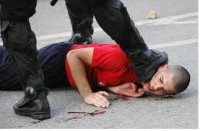
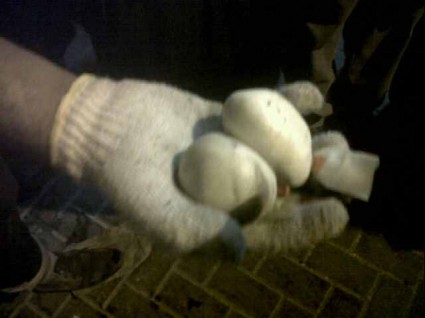 Above – mysterious substance used is gassing attack. Legitimate “international observers” and “commissions” have been denied the Bahraini people from the West by it’s complicity through silence that enables the Al Khalifa regime. Trusted and legitimate experts and resources to properly investigate, properly identify and catalog this substance and it’s use are non-existent in Bahrain. Below – image of a young man who was injured, suffocated and passed-out as a consequence of exposure this mystery gas, a weaponized substance, apparently manufactured by a increasingly “rouge security force”, hired by the al Khalifa regime to maintain their violent reign.
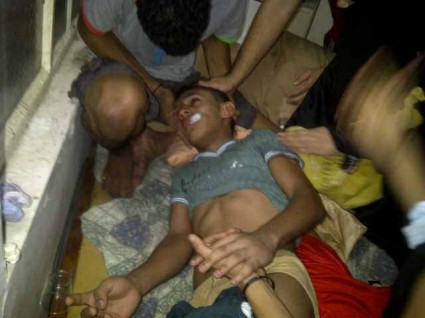
Update – 27 August – Below: An unknown weaponized substance has been used in Nabeeh Saleh. A chemical or quite possibly a biological agent has been introduced as a means of suppression against democracy protesters in Bahrain. This is a dangerous escalation in State Violence inflicted on the people of Bahrain. It is unknown if the Bahrain government has supplied this illegal weapon or if elements of al Khalifa’s “imported security force” have brought this weapon from their countries of origin or manufactured it using their training in guerrilla warfare.

August 27, 2011 Add Comments
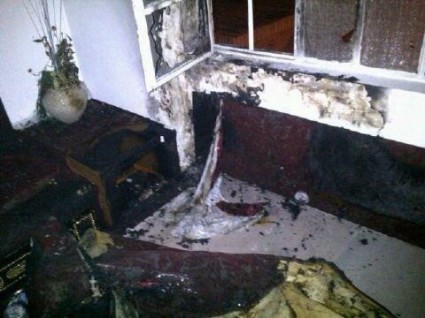
al Khalifa “security forces” deliberately misuse CS Gas supplied by the West as “incendiary bombs” against Villages
August 26, 2011 Add Comments
Free Bahrain’s Prisoners of Conscience, Human Rights Defenders, Democracy Advocates Now!
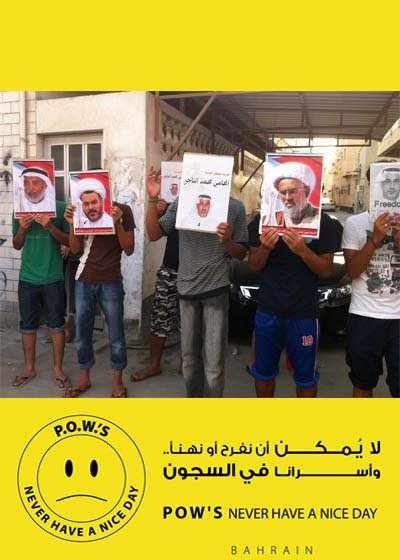
HRC: Action Alert: Bahrain – Dr Abduljalil Al-Singace and Co-Defendants Face Uncertain Future
23 AUGUST 2011 – IHRC
Concerns are raised over the future of Dr Abduljalil Al-Singace and his co-defendants in run up to appeal.
1. Summary
Dr Abduljalil Al-Singace, a Bahraini human rights activist, was sentenced to life imprisonment by a military court on 22 June with 20 other activists calling for justice. He is currently appealing against this conviction along with his co-defendants, who were also handed heavy sentences.
2. Background
Dr Abduljalil Al-Singace and many of his co-defendants were sentenced on 22 June to life imprisonment for their political activism during the course of widespread protests in the country in the spring. Their trial was conducted in an ‘emergency’ military court, despite martial law having ended on 1 June. The co-defendants received sentences ranging from 2-15 years imprisonment.
Reports have indicated that immediately after the verdict, many of them were beaten and tortured in an effort to extract a confession from them.
The UN High Commissioner has condemned these proceedings and the lengthy prison sentences as being part of a campaign of political repression being perpetrated by the Bahraini regime on its people.
These men were clearly not given the rights expected in a fair trial, and for this reason are appealing against their conviction.
Al-Singace and many of his co-defendants are currently being held at the notorious Qrain prison, which is famed for its frequent use of torture and widespread human rights violations.
If enough attention can be brought to their appeal, there remains a strong chance that the Bahraini regime will be forced to release Al-Singace and his co-defendants. We must not let the injustices which permeated the first trial to spill over into their appeal, which would force these men to suffer life sentences for bravely speaking out against government brutality.
A list of those convicted in June who will be appealing, along with their sentences, is as follows:
Abdulwahab Hussain Ali (life), Hassan Ali Mushaima (life), Mohammed Habib Al Safaf (life), Ebrahim Sharif Abdulraheem Mossa (5 years), Abduljalil Mansoor Makk (life), Abduljalil Abdullah Al Singace (life), Saeed Mirza Ahmed (life), Abdul Hadi Abdullah Mahdi Hassan (15 years), Abdullah Isa Al Mahroos (15 years), Abdulhadi Al Khawaja (life), Salah Hubail Al Khawaj (5 years), Mohammed Hassan Jawad (15 years), Mohammed Ali Ismael (15 years), Al Hurr Yousif Mohammed (2 years), Akeel Ahmed Al Mafoodh (15 years), Ali Hassan Abdullah (15 years), Abdulghani Ali Khanjar (15 years), Saeed Abdulnabi Shehab (life), Abdulraoof Al Shayeb (15 years), Abbas Al Omran (15 years), Ali Hassan Mushaima (15 years). …more at BCHR
August 26, 2011 Add Comments
Bahrain government creates Disastrous National Security Crisis – alarming turn of events, village attacked, people wounded by “mystery gas”
cb editor: Bahrain “new hires” are filling a collapsing governments “security force” with dangerous, unregulated and poorly trained quasi-mercenaries. The new “security forces” appear to be largely ignorant criminals and thugs who’s own governments would not have them as proper “security agents” or military troops.
As the al Khalifa’s lose grip on their governance, they have unleashed a dangerous and unqualified “security force” as a scourge on the people of Bahrain, which they can neither maintain or control. The al Khalifa’s are importing and creating the destabilization of their own Nation. This is an emerging National Security Disaster. Below are pictures from early reports of an illegal weapon used to gas people today in Bahrain. It was likely produced by “security forces” imported from others nations who have training in guerrilla warfare and in making such weapons. This is a clear indication of the destabilizing effects of the failed regimes desperate effort to maintain power through violence for hire, against the people of Bahrain.
Above – mysterious substance used is gassing attack. Legitimate “international observers” and “commissions” have been denied the Bahraini people from the West by it’s complicity through silence that enables the Al Khalifa regime. Trusted and legitimate experts and resources to properly investigate, properly identify and catalog this substance and it’s use are non-existent in Bahrain. Below – image of a young man who was injured, suffocated and passed-out as a consequence of exposure this mystery gas, a weaponized substance, apparently manufactured by a increasingly “rouge security force”, hired by the al Khalifa regime to maintain their violent reign.
Update – 27 August – Below: An unknown weaponized substance has been used in Nabeeh Saleh. A chemical or quite possibly a biological agent has been introduced as a means of suppression against democracy protesters in Bahrain. This is a dangerous escalation in State Violence inflicted on the people of Bahrain. It is unknown if the Bahrain government has supplied this illegal weapon or if elements of al Khalifa’s “imported security force” have brought this weapon from their countries of origin or their possible manufacture using their training in guerrilla warfare.
August 26, 2011 Add Comments
Times up, al Khalifa regime must cede power or it will be thrown out
Bahrain cleric to rulers: Reform or risk ouster
Associated Press August 26, 2011 cede
(08-26) 03:39 PDT MANAMA, Bahrain (AP) — Bahrain’s most senior Shiite cleric warned the Gulf kingdom’s rulers Friday to either ease their grip on power or risk joining Libya’s Moammar Gadhafi and other Arab leaders swept aside by uprisings.
The sermon by Sheik Isa Qassim was attended by thousands of worshippers, and was a show of defiance after Bahrain’s justice minister accused the cleric of promoting unrest in the strategic island nation, which is home to the U.S. Navy’s 5th Fleet.
A police helicopter hovered low over the crowds spilling from the mosque after the service. Some worshippers unfurled banners saying “We will never submit to anyone but God” and warning that government pressure on Qassim is “political suicide.”
Qassim vowed he would never be silenced, and said it was his religious duty to support demands by Bahrain’s majority Shiites for greater rights and a stronger voice in how the country is run.
Bahrain’s ruling Sunni dynasty, which has conducted sweeping crackdowns on protests since February, opened reconciliation talks in July to examine possible political changes. But the moves have not gone far enough for Shiite-led demonstrators seeking to break the Sunni rulers’ monopoly on picking government officials and setting policies.
“Can’t they learn from the fall of dictatorships and see what happens to those who denied their people basic rights?” Qassim told worshippers. “We now see what happens to the Libyan dictator, just as what happened to Tunisian and Egyptian despots.”
Shiites comprise about 70 percent of Bahrain’s population, but complain of systematic discrimination including being blocked from top political or security posts. Earlier this week, Justice Minister Khaled bin Ali Al Khalifa sent a letter to Qassim, accusing him of using his mosque for “intervening in politics and promoting violence.”
At least 32 people have been killed since protests began in February, inspired by other Arab uprisings. A panel of international investigators is looking into claims of abuses and is expected to issue its report Oct. 30.
“There is no exit to the crisis except through political reform,” said Qassim. “To run away from this fact will not solve anything and to delay reforms will only deepen the crisis.”
The U.S. and other Western leaders have urged Bahrain’s monarchy to open political dialogue with the opposition, but have held off on any further pressure that could undermine their military partnerships. Gulf Arab nations, including key ally Saudi Arabia, also claim that Shiite powerhouse Iran could gain new footholds in the region if Bahrain’s Shiites gain more political clout.
Last week, Qassim lashed out at Arab neighbors for backing Libyan rebels and other revolts in the region while standing by Bahrain’s rulers.
…source
August 26, 2011 Add Comments
Bahrain: From colonialism to dictatorship and occupation
Forty years after the British withdrawal
Bahrain Freedom Movement – 25/08/2011
Bahrain: From colonialism to dictatorship and occupation
In mid-August 1971 Britain withdrew its forces from all areas east of Suez, including Bahrain. The end of the 150 years of British protection heralded a new era of extreme repressive dictatorship. How much did the British legacy influence the subsequent decades? How deeply-rooted is the on-going revolution in that legacy? Can the regime survive?
Tuesday 23rd August 2011
House of Lords, London
Lord Avebury, Vice Chairman Parliamentary Human Rights Group: As most of you know, we have been holding seminars on human rights and democracy in Bahrain here in the Palace of Westminster for the best part of two decades in the hope of conributing in a small way to the struggle by the people for their freedom, and my correspondence also dates back to 1993. The Bahrain Minister of the Interior then, who was needless to say a member of the prolific al-Khalifa family, was referring to the Committee for the Defence of Political Prisoners as a ‘terrorist-controlled propaganda organisation’, and Ian Henderson, a British citizen, was head of the Bahrain security apparatus, where he presided over the systematic torture and detention without trial of opponents of the government.
Today the al-Khalifas still exercise absolute power, now with a fake parliament and gerrymandered elections as a smokescreen for the same pattern of abuse: mass arrests, show trials, torture to extract confessions, extrajudicial executions, and two added twists compared with 20 years ago: the systematic dismissal from jobs in the private as well as the public sector of anyone suspected of being sympathetic to the opposition, and the recruitment of Sunni mercenaries from Syria, Yemen and Pakistan to beef up the security forces and change the demographic balance of the population.
To protect himself and his family against international obloquy for these heinous crimes against the people, the king has appointed a commission of inquiry, to look into charges of gross abuses of human rights, but only during the months of February and March, and not up to the time they arrived in Bahrain in July when the abuses were continuing unabated. It was a mistake for the investigation to be conducted by a body appointed by the man who stands at the apex of the alleged criminal activities.. The right approach would have been for an independent inquiry by the UN High Commissioner for Human Rights, Navi Pillay, as indeed she contemplated originally. Even if the royal commission had preserved its distance from the government, the perception would have been that, owing its existence to the king, it would be susceptible to influence by the boss. In practice, it seems they have had a cosy relationship with the oligarchs. The chairman, Mr Cherif Bassiouni, has exonerated the king and the crown prince of any responsibility for the actions of their government; has praised the interior minister, the attorney-general and the military prosecutor; he says that there was no proof whatsoever of crimes against humanity, and he declares that if there are no signs of torture on a person’s body, that means he wasn’t tortured. As most people know, and Mr Bassiouni must surely be aware as a human rights expert, there are methods of torture that don’t leave marks, such as water-boarding, low-level electric shocks, or sexual abuse. …more
August 25, 2011 Add Comments
Saudi blood money spent to stop Arab democracy movements – bid to silence Twitter Activism – “tweet on” my Arab Brothers and Sisters, the fascists must fall
Governments attack Twitter activists
24 August 2011 – IFEX
The governments of at least three Arab countries – Egypt, Bahrain and Kuwait – have launched investigations into or prosecuted Twitter activists, provoking other countries in the region to follow suit, reports the Arabic Network of Human Rights Information (ANHRI).
In Egypt, activist Asmaa Mahfouz faces a military investigation for her comments on Twitter and Facebook, in addition to a phone call she had made to a religious satellite channel, that “insulted the military,” report ANHRI and Human Rights Watch. Mahfouz had criticised the military for failing to intervene to protect protesters on 23 July. Although she was released on 20,000 Egyptian Pounds (US$3,400) bail, Mahfouz still awaits trial.
The Mahfouz case is the latest in a series of moves prosecuting critical expression by Egypt’s military, which is increasingly setting narrower and narrower limits on what is permissible, Human Rights Watch said. According to Human Rights Watch, military courts have sentenced at least 10,000 civilians since January 2011 after unfair proceedings.
Bahrain started targeting Twitter users last April when it investigated well-known rights activist Nabeel Rajab for publishing a picture of a Bahraini citizen who allegedly died after being tortured in police custody. According to ANHRI and the Bahrain Center for Human Rights (BCHR), of which Rajab is president, another investigation is planned into Rajab’s tweets. …more
August 25, 2011 Add Comments
More security force conflicts with protesters and al Khalifa control slips away
Bahrain police clash with protesters
Aug 25, 2011
Bahraini protesters wear masks to avoid being identified by regime forces. Saudi-backed Bahraini police have clashed with peaceful protesters who are demanding an end to the decades-long rule of the Al Khalifa regime in the country.
The clashes took place on Wednesday night in the village of Nuwaidrat where young men and women staged a protest rally to demand the downfall of the Al Khalifah regime, witnesses said. Saudi-backed police forces resorted to firing tear gas to disperse demonstrators after more people joined the protesters chanting anti-regime slogans.
Male protesters were wearing masks to avoid being identified by the police. Nuwaidrat was not the only village in Bahrain to see overnight anti-regime protests. Demonstrators in the village of Sanabis also took to the streets on Wednesday, chanting slogans against the rule of King Hamad bin Isa Al Khalifa.
A separate demonstration also took place in the village of Dair.
Bahrainis have been holding anti-government rallies since mid-February, demanding the Al Khalifa dynasty to release its four-decade grip on power in the Persian Gulf country. Scores of people have been killed, many under torture in prison, and hundreds more have been arrested in a brutal crackdown on peaceful protesters in Bahrain, home to the US Navy’s Fifth Fleet.
In March, a number of Persian Gulf Arab states, including Saudi Arabia and the United Arab Emirates, deployed military forces to Bahrain in an attempt to assist Manama quell peaceful protests. …source
August 25, 2011 Add Comments
As internal control slips away from al Khalifa, regime embarks on massive hiring of foreign security forces
Saudi-backed raids continue in Bahrain
shiapost – August 25, 2011
Saudi-backed security forces in Bahrain continue their brutal crackdown against protesters who are demanding an end to the rule of the Al Khalifa regime in the country. Latest footage posted online showed police firing teargas to disperse peaceful demonstrations in the town of Sanabis, the capital of Manama.
Bahraini human rights activists said the incident happened on Wednesday night after police stormed the village. Meanwhile, more images have surfaced, showing Saudi-backed police conducting overnight attacks in Bahraini towns. Anti-government protesters have been holding massive protest rallies across Bahrain since mid-February.
Saudi Arabia and the United Arab Emirates deployed military forces to Bahrain in mid-March to assist the Manama government in its violent crackdown on the popular protests. …source
August 25, 2011 Add Comments
al Khalifa regime engaged in Sectarian cleansing campaign in security institutions
Bahrain: Sectarian cleansing campaign to the security institutions
31 July 2011 – BCHR
Bahrain’s regime aims at the slight Shiites manpower in the police and the army by killing, torturing and imprisoning. This campaign comes after decades of excluding Shiites out of military. Bahrain’s regime aims at the slight Shiites manpower in the police and the army by killing, torturing and imprisoning…
Bahrain Center for Human Rights expresses its deep grave due to the crackdown led by the regime in Bahrain against anyone expressing his/her views demanding freedom, democracy and human rights, this time it affected the employees of both Ministry of Interior and Ministry of Defense which are chaired by members of the ruling family. The authorities have killed, arrested, and demobilized large numbers of their employees, BCHR has documented more than 248 cases.
Since decades Bahrain’s regime practiced the policy of sectarian discrimination in the military, in the Ministry of Interior, Ministry of Defense and any other military institutions. Since the seventies and after the independence of Bahrain, the Bahraini authority led a sectarian discrimination and marginalization campaign conduce to separate and imprison large number of military personnel, this discrimination against Shiite in these institutions continued until this day, reaching its peak in last March, through murdering, imprisonment and torturing lots of Shiites working in the police and the army. To fill this void in the military institutions, Bahrain’s regime employs foreign forces in the security forces and the army.
Since Monday, February 14, 2011 peaceful demonstrations inspired by the Arab spring in Tunisia and Egypt broke out in Bahrain, and many workers at the military stood side by side with the rest of the people demanding freedom, political and civil rights guaranteed by the international human rights covenants as well as the Constitution of Kingdom of Bahrain. Thursday, February 17, forces launched a surprised attack on the peaceful protestors at the Pearl Square in the early morning hours. This sparked an outrage among Bahraini people of all sects, affiliations and orientations, protests promoted Bahrain’s Crown Prince Salman bin Hamad Al Khalifa, to appear on the official TV trying to ease the demonstration and announced that every citizen has the right to express his opinion peacefully. …more
August 25, 2011 Add Comments
In shameful move Pakistan displays no dignity or self respect, agrees to send troops to repress Bahrain opposition
Pakistan to send more troops to Bahrain
23/08/2011 – August 22, 2011
TEHRAN – Pakistan has agreed to dispatch more mercenaries to Bahrain to help Al Khalifa regime’s crackdown on anti-government protesters in the Persian Gulf state.
The agreement was reached when President Asif Ali Zardari met King Hamad bin Isa Al Khalifa during his one-day visit to Bahrain on Wednesday last, Iranian news agency IRNA reported.
Manama has been recruiting former soldiers and policemen from Pakistan at a steady rate to strengthen the government’s forces. In many demonstrations, Bahraini protesters shouted slogans against Pakistani security forces in Urdu. Pakistani and Saudi forces have played a major rule in suppressing anti-government protests in Bahrain since the beginning of unrest in the Persian Gulf country.
Tens of thousands of Bahraini protesters have been holding peaceful anti-government rallies throughout the Middle Eastern country since February, demanding an end to the rule of the Al Khalifa family.
Scores of people have been killed and many more arrested and tortured in prisons in a government-sanctioned crackdown on protests since the beginning of the demonstrations.
According to a Bahraini human rights group, there are currently over 1,000 political detainees inside the country. …source
August 25, 2011 Add Comments
Installation of mechanisms for the prevention of torture and ill-treatment in Bahrain
Installation of mechanisms for the prevention of torture and ill-treatment
Public submission to the Bahrain Independent Commission of Inquiry – Geneva, August 2011 – APT Association for Prevention of Torture
Background
The Association for the Prevention of Torture (APT) is an independent non-governmental organization based in Geneva, Switzerland, that specializes in the prevention of torture and other forms of ill-treatment. The APT has been working with the Government of Bahrain and Bahraini NGOs from 2008 until June 2010 on raising awareness about the prevention of torture and ill-treatment, in particular in the context of follow-up to commitments and pledges that Bahrain has taken in the UN Human Rights Council’s Universal Periodic Review process (UPR) in 2008. Namely, the UPR Steering Committee had invited the APT to conduct two trainings on the prohibition and prevention of torture for the Bahraini judiciary and law enforcement in May 2009 and in June 2010.
The Bahrain Independent Commission of Inquiry (BICI) is mandated to investigate and report about the events that occurred in February and March 2011 and to make recommendations on providing justice and ensuring non-repetition. The BICI can thus, inter alia, make “recommendations concerning the institutionalization of mechanisms designed to prevent the recurrence of similar events” (Royal Decree No. 28 of 2011, §10) Based on APT’s mandate and expertise on prevention, this public submission will focus on suggesting measures and mechanisms to prevent torture and other ill-treatment. …more
August 25, 2011 Add Comments
Putin and Medvedev join fascist ranks of al Khalifa and Saud oppression and tyranny
Russia Strikes First Bahrain Arms Deal After U.K., French Bans
By Henry Meyer and Ilya Arkhipov – Aug 25, 2011 2:01 PM MT – Bloomberg
Russia for the first time is selling weapons to Bahrain after the U.K. and France banned deliveries of security equipment to the Gulf monarchy because of its crackdown on protesters.
Rosoboronexport, Russia’s state-run arms trader, says it wants more business in Bahrain. The country is selling AK103 Kalashnikovs with grenade launchers and ammunition for tens of millions of dollars to Bahrain, according to a person close to the Russian Defense Ministry who declined to be identified because the information isn’t public.
In February, France and the U.K. revoked export licenses for security equipment that could be used to quash internal unrest in Bahrain after government forces shot dead several protesters. At least 30 people were killed in this year’s uprising in Bahrain, a U.S. ally situated between Qatar and Saudi Arabia that is home to the U.S. Navy’s Fifth Fleet.
“The relationship between Russia and Bahrain has been increasingly getting stronger,” Abdul-Aziz bin Mubarak Al Khalifa, a Bahraini government spokesman, said by phone on Aug. 24 from the capital, Manama. “We are looking to cooperate with Russia in trade and technical services. One of the fields is in the area of light arms.”
He declined to comment on the details of specific contracts. Rosoboronexport Chief Executive Officer Anatoly Isaikin last week said Bahrain has become a new customer for Russian armaments.
“States in the region are interested in Russian air- defense systems, aviation equipment and weapons for ground forces,” the Moscow-based company said in an e-mailed response Aug. 24 to questions from Bloomberg News about the arms deal.
Human Rights
Bahraini security forces beat paramedics, doctors and nurses who treated the wounded during the uprising and prosecutors charged dozens of medical workers with crimes such as “incitement against the regime,” according to Human Rights Watch. In June, the U.S. put Bahrain on its list of human-rights violators.
“We will not issue licenses where we judge there is a clear risk that the proposed export might provoke or prolong regional or internal conflicts, or which might be used to facilitate internal repression,” U.K. Foreign Office Minister Alistair Burt said on Feb. 18.
Rosoboronexport said a mutually beneficial partnership between the two countries would help to strengthen Russia’s position among the Gulf’s U.S.-allied monarchies. …more
August 25, 2011 Add Comments
Call to Postpone upcoming Bahrain Elections – unfair representation, broken government, unjest detentions of opposition leadership
BJDM Call for Postponing of Bahraini By-Election
By admin – August 25, 2011
The Bahrain Justice and Development Movements believe the forth coming by elections in Bahrain must be postponed, as they will not legitimately represent the will of the people.
The September by-election is due to replace the 18 MP’s that resigned in February in protest at the treatment of pro-democracy demonstrators.
All 18 previous MP’s came from Bahrain’s largest opposition party, Al Wefaq, who along with other opposition groups have boycotted the by-election.
The lack of any real opposition is just one of many reasons why the poll cannot take place at this time.
Primarily, the Bahrain Government is trying very hard to portray the country as having ‘returned to normal’ following the state of emergency that was their response to the mass protests of February and March.
This is simply not the case. Hundreds of political prisoners still languish in jails, whilst there has been no justice for those injured and killed by Security Forces. An election cannot take place amidst this backdrop, with so many potential opposition voters having their suffrage removed.
Furthermore, the recent national dialogue did nothing to address the very serious problems that Bahrain has with its electoral process. One of the biggest stumbling blocks for democratic change is the unfair distribution of voting constituencies. Despite opposition candidates winning the more than half of the overall votes, they still always find themselves in a minority in parliament.
We believe that before an election can take place, the field must be levelled. All political prisoners must be released from prison and serious democratic reforms have to be made.
Until this point any election will be considered illegitimate. We reject this sham democracy and instead demand the basic democratic rights that the people of Bahrain have been demanding for years.
Ali Al Aswad, a former MP who resigned in February and whose seat is being replaced, said:
“Not re-contesting my seat was a very difficult decision for me, but one which was made out of principle. We simply cannot endorse this mock election and we ask that it be postponed until basic democratic conditions are met.” …more
August 25, 2011 Add Comments
Free AlMahfoodh!
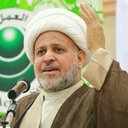 Sheikh Mohamed Ali AlMahfoodh : Secretary General of Amal Society http://www.amal-islami.net . One of the widely known clergymen around the Islamic world and one of the opposition symbols in the country, a leader of a major civil society organization elected freely by its members. A father of 2 sons and 3 daughters. He was arrested on May 3rd 2011 , within the government crackdown on recent uprising in Bahrain. Almahfoodh two sons , (Hassan 17 years old and Hussain 26 years old ) and his son in law were arrested too.
August 24, 2011 Add Comments
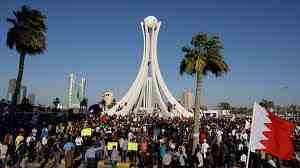
The Protest that brought together the liberation of Bahrain
August 24, 2011 Add Comments
Bahrain Trials Bear Marks Of ‘Political Persecution,’ – how many more investigations, how many more unjustly detained, free the prisoners of conscience!
Bahrain Trials Bear Marks Of ‘Political Persecution,’
Saturday, 25 June 2011, 2:12 pm
Press Release: United Nations
Bahrain Trials Bear Marks Of ‘Political Persecution,’ SAYS UN Human Rights Office
New York, Jun 24 2011 10:10AM
The United Nations human rights office today spoke out against the harsh sentences, including life imprisonment, handed down this week to several activists in Bahrain, saying their trials bear the marks of “political persecution.”
On Wednesday, Bahrain sentenced 21 activists and opposition leaders reportedly for plotting to overthrow the Government, which has been has engaged in a violent crackdown against protesters calling for greater democracy, as witnessed in other countries across the Middle East and North Africa.
The UN High Commissioner for Human Rights, Navi Pillay, is writing to King Hamad bin Issa Al Khalifa of Bahrain to convey her concerns, her spokesperson, Ravina Shamdasani, told reporters in Geneva.
“There are serious concerns that the due process rights of the defendants, many of whom are well-known human rights defenders, were not respected and the trials appear to bear the marks of political persecution,” said Ms. Shamdasani.
She added that, according to reliable sources, the Lower National Safety Court has convicted more than 100 individuals since March this year, mostly for crimes allegedly committed during the protests.
“We urge the authorities to act in strict accordance with their international human rights obligations, particularly regarding the right to due process and a fair trial,” Ms. Shamdasani said.
“We call for an immediate cessation of trials of civilians in the Court of National Safety, and an immediate release of all peaceful demonstrators who were arrested in the context of the protest movement in February.”
Up to 1,000 people reportedly remain in detention, according to the Office of the High Commissioner (OHCHR), which has received “worrying” reports about the way they are being treated.
Ms. Shamdasani noted in particular that four individuals previously arrested reportedly died in detention due to injuries resulting from severe torture. She called on the Government to urgently conduct an independent investigation into these allegations.
OHCHR’s comments echo those of Secretary-General Ban Ki-moon who voiced his deep concern at the sentences handed out this week. In a statement issued yesterday by his spokesperson, Mr. Ban urged Bahraini authorities “to allow all defendants to exercise their right to appeal and to act in strict accordance with their international human rights obligations, including the right to due process and a fair trial.”
Jun 24 2011 10:10AM
August 24, 2011 Add Comments
Bahrain Anti-union Repression expands with collective punishment measures from al Khalifa
Bahrain’s Anti-union Repression
ITUC-CSI-IGB
23 August 2011: The authorities in Bahrain are stepping up repression of the country’s trade union movement, with further suspensions and sackings of workers due to their actual or suspected participation in trade union and political actions earlier this year.
Government workers in particular are being targeted, including in health, education and municipal services, as the authorities seek to cleanse the public sector of workers who hold political opinions of which it does not approve.
Dismissals have in fact increased since June, and government workers facing dismissal report having to appear before disciplinary boards with no opportunity to mount a defence of any kind. There is little question that the outcomes of these hearings are predetermined. Minister of Labour, Jamil Humaidan, has disclaimed any responsibility over the public sector, effectively giving a green light to the on-going dismissals.
This year, some 2,600 workers in both the public and private sector have been fired, with an additional 361 workers suspended. Despite numerous promises to the contrary, the government has largely failed to reinstate workers illegally dismissed. According to the General Federation of Bahraini Trade Unions (GFBTU), only 134 workers have been reinstated to date. Many of these workers had to agree to unacceptable, indeed illegal, conditions in order to get their jobs back – including agreeing not to take part in any future political activity, waiving the right to participate in legal cases against the government and agreeing not to re-join their trade union.
Six members of the GFBTU Executive Board remain dismissed as well as 44 Executive Board members of GFBTU-affiliated unions. Of great concern, the Vice-President of the Bahrain Teachers Association, Jalila al Salman and Roula al-Saffar, head of the Bahrain Nursing Society, are to stand trial before a military tribunal next week, despite the fact that they are both civilians. It is highly unlikely that either will get a fair trial on the dubious charges related to the protests earlier this year. The two were only recently released on bail after being jailed for months, where they were reported to have been subjected to torture and degrading treatment during their detention. …more
August 24, 2011 Add Comments
Systematic forced unemployment continues as al Khalifa weapon of collective punishment
Bahrain’s anti-union repression escalates
Despite growing international pressure, the Bahraini authorities have stepped up the repression of the country’s trade union movement, sacking more than 100 government employees in recent weeks.
In total, more than 2,600, workers have been sacked since the pro-democracy uprising earlier this year. According to the International Trade Union Confederation (ITUC), ‘Despite numerous promises to the contrary, the government has largely failed to reinstate workers illegally dismissed. According to the General Federation of Bahraini Trade Unions (GFBTU), only 134 workers have been reinstated to date. Many of these workers had to agree to unacceptable, indeed illegal, conditions in order to get their jobs back – including agreeing not to take part in any future political activity, waiving the right to participate in legal cases against the government and agreeing not to re-join their trade union.’
The TUC is supporting an international appeal by Education International and Amnesty International to secure the release of two leaders of the Bahrain Teachers’ Association (BTA). While Jalila al Salman the Vice President of the BTA has been released on bail over the weekend, she is due to face trial before a military tribunal next week where it is ‘highly unlikely’ that she will get a fair trial according to the ITUC and Amnesty. Roula al-Saffar, head of the Bahrain Nursing Society is also standing trial.
Please sign Education International’s urgent action appeal calling on the Bahraini authorities to drop the charges against the BTA leaders and to respect the human rights of all workers in Bahrain. …more
August 24, 2011 Add Comments
Six Months on Bahrain still Bleeds for Liberty, Silence still deafening
Bahrain Bleeds for Liberty
3 March 2011 – By Mamoon Alabbasi – LONDON
Just before the Arab revolt erupted across the region there was much talk about how minorities in the Middle East we being mistreated. Of course such concerns were not unfounded, but many vocal critics never really cared for finding real solutions nor did they give much attention to the plight of minorities elsewhere around the world. In fact, they often were the very same people who encouraged abusing minorities in Europe and the US.
Minorities in the Arab world (and elsewhere) continued to suffer. However, what has really been missed was that the majorities in most Arab countries felt they were discriminated against more than anyone else. The signs were always there but few bothered to report it till the uprisings that swept the region left no room for doubt.
In Bahrain, a persecuted majority has literally been bleeding for equality and now, after days of anti-regime protests, dare dream of democracy. Unfortunately, many mainstream media outlets and so called analysts have failed to report the protests in Bahrain as a people’s struggle for democracy and equal rights.
Instead, they sought to stress the sectarian divides of the country, even though the protesters were calling for Sunni-Shiite unity against dictatorship. Analysts were also too preoccupied with the implications a democratic Bahrain would have on Saudi Arabia (negative) and on Iran (positive) – as if it is OK to deny Bahrainis their basic human rights just because that might not sit well regionally.
The role of the US in all of this is, of course, also crucial. The Fifth Fleet, a major US Navy base, has been in Bahrain for 63 years. As seven Bahrainis were killed following police crackdown on protesters, the US praised the monarchy for taking “positive steps” to reach out to demonstrators. During a visit to Bahrain, the top US military officer Admiral Mike Mullen reaffirmed Washington’s support for King Hamad’s “handling (of) the popular crisis” and “strong commitment” to Bahrain’s army. Mullen said his visit to the Gulf was aimed at “reaffirming, reassuring and also trying to understand where the leaderships of these countries are going, and in particular in Bahrain.”
Despite US calls for “restraint”, I do not see the people of Bahrain being reassured.
Some analysts fear that a democratic Bahrain would give Iran more influence in the region. This is ironic since many of those who claim to want total democracy for Iran do not wish that same privilege for the people of Bahrain, Palestine, Lebanon and Iraq (and elsewhere) precisely because they think that would benefit Iran. But why would a free and democratic Bahrain threaten anyone’s ‘legitimate’ interests? Freedom and equality in Bahrain serve first and foremost the people of Bahrain. The majority of the people of Bahrain are the legitimate voice of Bahrain; they cannot – by default – betray Bahrain. Nor do they wish any trouble in the region.
Saudi Arabia urged Bahraini’s opposition “to be reasonable in proposing their ideas, and accept what was offered by the government.” This is the same Saudi Arabia that said it rejects foreign intervention in Bahrain’s affairs and pledged its backing to the regime in Manama. But which of the opposition demands or slogans by protesters at Pear Square run against the interest of the people of Saudi Arabia (or any people for that matter)? None. Read some of them for yourself:
-“No Sunni, no Shiite, we are Bahraini!”
-“We are brothers, Sunnis and Shiites. We shall not abandon this country.”
-“Did you hear anybody raising a sectarian demand, or a demand for one part of the people of Bahrain?”
-“The time has come for true unity.”
-“We want a real consitutional monarchy”
-“We want an elected government.”
-“We want the people to write their constitution themselves through an elected council.”
-“The people should choose their government.”
-“We want a parliamentary, democratic regime — a regime with a free parliament elected by the free will of the people, and this parliament will form a government.”
-“People here are demanding democracy, and fair distribution of wealth, and these demands are for all the people.”
Mamoon Alabbasi (MA in applied linguistics) is a news editor and translator based in London. His op-eds, reports, poetry, and reviews have appeared in a number of media outlets.
August 24, 2011 Add Comments
Al Khalifa free those you have so harshly detained, these men and the thousand who will follow are Bahrain’s free and peaceful future
21 prominent activists Appeal on 6th of September before a Military court
August 24th, 2011 – BYSHR
Bahrain Youth Society for Human Rights (BYSHR) is deeply concerned about the appeal hearing of the 21 prominent activist before a military court.
The BYSHR lawyer said that “the hearing for the final pleading.”
On the 22th of June 2011, Military Court judge issued a sentence on 21 defendants:
1-Abdulwahab Hussain Ali ( life sentence imprisonment)
2-Ibrahim Sharif Abdulraheem Mossa ( 5 Years imprisonment)
3-Hassan Ali Mushaima.( life sentence imprisonment)
4-Abdulhadi Al Khawaja ( life sentence imprisonment)
5-Abduljalil Abdullah Al Singace.( life sentence imprisonment)
6-Mohammed Habib Al Safaf. ( Mohammed Habib Miqdad) ( life sentence imprisonment)
7-Saeed Mirza Ahmed. ( Saeed AlNouri) ( life sentence imprisonment)
8-Abduljalil Mansoor Makk. (Abdul Jalil Miqdad) ( life sentence imprisonment)
9-Al Hurra Yousif Mohammed.( 2 Years imprisonment)
10-Abdullah Isa Al Mahroos.( 5 years imprisonment)
11-Salah Hubail Al Khawaj.( 5 years imprisonment)
12-Mohammed Hassan Jawad.( 15 years imprisonment)
13-Mohammed Ali Ismael. ( 15 years imprisonment))
14-Abdul Hadi Abdullah Mahdi Hassan ( Abdulhadi AlMukhodher) ( 15 years imprisonment)
Defendants ( not being arrested yet) :
15-Akeel Ahmed Al Mafoodh.( 15 years imprisonment)
16-Ali Hassan Abdullah.( Ali Abdulemam) ( 15 years imprisonment)
17-Abdulghani Ali Khanjar.( 15 years imprisonment)
18-Saeed Abdulnabi Shehab.( life sentence imprisonment)
19-Abdulraoof Al Shayeb.( 15 years imprisonment)
20-Abbas Al Omran.( 15 years imprisonment)
21-Ali Hassan Mushaima.( 15 years imprisonment)
Attached information about the Defendants – Click Here
August 24, 2011 Add Comments
Cat and Mouse Protests move up a notch of sophistication and militancy, al Khalifa forces maintain repressive violence
August 24, 2011 Add Comments
Bahrain Prime Minister, UK envoy celebrate mutual ties and long history of tyranny and oppression in Bahrain
HRH Premier Hails Bahraini-UK Ties
BNA
Manama, Aug. 23. (BNA) – His Royal Highness Prime Minister Prince Khalifa bin Salman Al Khalifa received at his court today the newly appointed UK Ambassador to Bahrain Iain Lindsay.
During the meeting, HRH Premier welcomed the new UK envoy and wished him every success in consolidating the deep-rooted solid Bahraini-UK ties of friendship, pledging that he will be provided with the necessary support in order to ensure the success of his mission.
tyranny
HRH Premier also reviewed with Iain Lindsay ways of bolstering bilateral relations in all development, economic and investment fields, asserting that doors are wide open for enhancing economic and investment cooperation in light of the strong bilateral ties bonding the two friendly countries.
The latest regional and global developments and issues of mutual concern were also spotlighted. On his part, the British envoy praised the advanced level of bilateral relations, hailing HRH Premier’s keen desire to consolidate and broaden bilateral cooperation.
He also commended the distinguished reputation enjoyed by the kingdom as a hub of financial and banking services thanks to its highly developed investment infrastructure which has attracted many world financial firms, including British ones. …source
August 23, 2011 Add Comments
Shout it from the mountain tops, in the valleys and to the seas, FREEDOM!!!
Potential Demonstrations in Bahrain 23-26 Aug., 2011
by U.S. Naval Forces Central Command / U.S. 5th Fleet on Tuesday, August 23, 2011 at 6:40am
The following potential or planned protests from a U.S. Embassy Manama Demonstration Notice in Bahrain should be avoided by all U.S. Forces, DOD civilians, DOD contractors, and family members:
Tuesday, August 23 at 1700 in the vicinity of Diraz.
Thursday, August 25 from 0600 to 0900, a vehicular demonstration from Alba Company towards Sitra bridge and on to the business district/diplomatic area in Manama.
Thursday, August 25 at 2100 in the vicinity of Billad al Qadeem.
Friday, August 26 at 1100 in the vicinity of Diraz.
Friday, August 26, time TBD in the vicinity of Al Dair.
…source
August 23, 2011 Add Comments
Tweet On my Arab Brothers and Sisters!
ANHRI: Arab governments target Twitter users; Bahraini rights activist summoned
(ANHRI/IFEX) – 20 August 2011 – ANHRI is deeply concerned over the targeting of Twitter activists by Arab governments for the news and comments they post. Thus far, it is certain that at least three Arab governments, in Bahrain, Kuwait and Egypt, have launched investigations or prosecuted Twitter activists. In addition, the Emirati Security Service has issued serious warnings stating that it closely watches social networking websites, especially Twitter and Facebook.
Bahrain started the hostility against users of Twitter in April, when it investigated famous rights activist Nabeel Rajab for publishing a picture of a Bahraini citizen who died during his detention by police. More recently, on 19 August, Rajab was summoned to the Dawar 17 police station. An investigation was opened based on allegations that he published false news on the situation in Bahrain and incited violence against a Special Forces police officer. Rajab was surprised to see that his “tweets” had been printed on several papers. He was later released.
In Kuwait, blogger Nasser Abel was arrested in June for what the Kuwaiti government considered “criticism of the Saudi and Bahraini governments”. The blogger awaits a hearing in the case in September.
In Egypt, a military investigation has been conducted against activist Asmaa Mahfouz for comments she posted on Twitter and Facebook, in addition to a phone call she made to a religious satellite channel. Despite the fact that the Military Council announced that it would waive the lawsuit and release the activist on an exorbitant bail of 20,000 Egyptian Pounds (approx. US$3,400), Mahfouz still awaits a hearing in yet another lawsuit filed by a citizen over a “tweet”. The hearing is to be held in September. …more
August 23, 2011 Add Comments