US economic Engine dependent on Saudi string of puppets, fascists and tyrants
Emirates to add 50 new planes worth $18 billion
Jet maker Boeing says deal biggest single order in dollar terms in history
11/13/2011 – AP
DUBAI, United Arab Emirates — Dubai’s fast-growing airline Emirates kicked off the region’s biggest airshow Sunday with an order for 50 Boeing 777s, which the U.S.-based aircraft maker described as its biggest single order in dollar terms in history.
The list price for the deal is $18 billion, but airlines typically negotiate discounts for large orders.
Although the Gulf airlines are the among the world’s most ambitious in expanding their fleets and routes, a deal the size of the Emirates contract had not been expected at the airshow because of the large backlog of planes already on order for Emirates and rivals such as Abu Dhabi-based Etihad and Qatar Airways.
The deal, announced by Emirates chairman and CEO Sheik Ahmed bin Saeed Al Maktoum, is for an extended-range version of the 777-300. Emirates already has 95 777s in service, which is the most of any carrier.
Chicago-based Boeing Co. said the deal is the largest single aircraft order in dollar terms in its history.
“It sustains a lot of jobs in the United States — several thousand,” said Jim Albaugh, president and CEO of Boeing Commercial Airplanes.
Before Sunday’s order, Emirates already had 40 of the planes booked. That means it now has nearly as many of the twin-aisle planes on order as it already operates.
Emirates is the Middle East’s largest carrier. It is owned by the government of Dubai, which is recovering from a debt-fueled financial crisis that came to a head two years ago.
Its young fleet also includes Airbus A330s, A340s and the double-decker A380.
November 15, 2011 Add Comments
Arab leauge mirrors contradiction and hypocrisy of Bush’s, US foreign policy carried on by Obama-Clinton in Middle East
Bahraini activists rally across Manama , Slams Arab League’s Double Standard
JafriaNews – 13 November, 2011
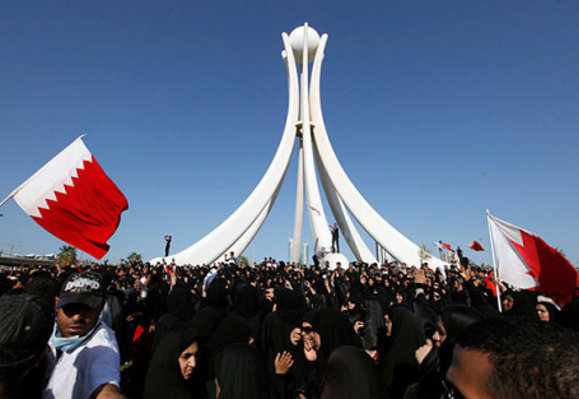
JNN 13 Nov 2011 : Bahraini activists have held new anti-regime protests across the capital Manama against the ruling Al Khalifa family, and Arab League’s Double Standard on Syria and Bahrain , Press reports.
The demonstrators took to the streets on Saturday in the face of continued crackdown by Saudi-backed Bahraini forces on peaceful protests in the Persian Gulf island.
They shouted slogans against the regime and its allies, including Saudi Arabia, which has been heavily contributing to Manama’s suppression of the popular uprising it has been facing since February. In the eastern village of Ma’ameer, regime forces stormed a house and detained a young boy. Meanwhile, a teenage girl was rearrested in spite of her deteriorating health condition.
The 17-year-old Ashwaq al-Magabi, who suffers from sickle cell anemia, was first detained among dozens of women during a protest in a Manama mall in October.
According to local sources, scores of people have been killed, some while in custody, and hundreds more arrested during the campaign of suppression.
Bahrainis demonstrate against Arab League silence on Manama’s deadly crackdown, as the League met to vote on several anti-Syria moves, Press TV has learned.
Protesters gathered in front of the AL headquarters in the Egyptian capital, Cairo, on Saturday, demanding the body to adopt a clear stance on the brutal suppression of Bahrainis. They also held banners saying that the Saudi-backed Al Khalifa regime has suppressed thousands of pro-democracy protesters. …more
November 15, 2011 Add Comments
Collective Punishment, the Kidnapping and detention of Ghazi Farhan – An Interview with Alaa Shehabi
Struggle for Bahrain: An Interview with Alaa Shehabi
15 November, 2011 – Shia Post
Alaa Shehabi (AS): I am Alaa Shehabi from Bahrain. I am a lecturer, economist, and writer by day. I am also the wife of a political detainee. My husband is called Ghazi Farhan, he is a businessman, completely apolitical.
A month after the Saudis invaded, he was arrested from his office car park. On that day, 12 April, he came home for lunch and played with our baby and then drove back to his office. I did not hear from him again. I went online and read on Twitter that Ghazi Farhan has been successfully arrested—someone from the intelligence network was tweeting about it, bragging about it. It was a very big shock. He was not expecting it; he was the guy that stayed away from this. He knows that politics is trouble in this part of the world, so he was not involved in any activism.
I am sure they went after my husband because of his relationship to me. I come from a strong opposition background, my father is an opposition activist in the United Kingdom. I was very active and I have never been quiet about my views. I think they knew of me so they selected one of us. I have seen his interrogation notes and I appear in most of them. It was punishment by proxy.
So, Ghazi was held for the next fifty days and then suddenly appeared in a military tribunal at the end of May. He was charged with participating in the protests. The technical term is “participating in an illegal assembly consisting of more than five persons,” and he was also charged with spreading false information. And then in a matter of ten minutes, he was sentenced to three years in prison. It has been seven months since he was convicted. It has been a very difficult time for my family personally. But I would like to emphasize that in the prison he is in, he is one of at least five hundred people who have been arrested, charged, and convicted because of their participation or involvement in the political uprising. …more
November 15, 2011 Add Comments
After decades of the same horse-shit another promise of a “fast track to nowhere”
Bahraini Premier calls for fast-track reforms
Manama: Mon, 14 Nov 2011
His Royal Highness Prime Minister of Bahrain, Prince Khalifa bin Salman Al Khalifa, yesterday urged ministers to fast-track implementation of National Dialogue recommendations.
Yesterday’s Cabinet session, which he chaired, discussed an update on 10 draft laws endorsing a set of 15 recommendations, which were referred to the legislative authority. They include the draft laws on the press, child, labour in the private sector and audio-visual media.

The Cabinet was also updated on draft laws reflecting 25 other recommendations.
Ministries are also putting in place legal tools to implement 16 other recommendations. HRH the Premier instructed ministries to fast-track draft laws in co-ordination with the follow-up committee and the legal jurisprudence authority. …source
November 15, 2011 Add Comments
The profits of the U.S. defense industry have quadrupled since 2001 – Exports lifesaver for U.S. defense contractors
Gulf arms sales vital for U.S. companies
Nov. 15, 2011 – UPI
DUBAI, United Arab Emirates, Nov. 15 (UPI) — The Pentagon’s reported plan to sell the United Arab Emirates nearly 5,000 bunker-buster bombs to counter Iran is part of a move to strengthen Arab monarchies of the Persian Gulf as the U.S. withdrawal from Iraq nears completion.
But it’s also a lifesaver for U.S. defense contractors who’re having to rely on exports to keep assembly lines running because of hefty cuts in military spending at home after the feeding frenzy of the post-Sept. 11 era.
“The defense industry is coming to the end of what many of its senior figures regard as a golden decade,” The Financial Times reported in a September assessment of the sector.
“Ten years ago, in the immediate aftermath of the Sept. 11 attacks, the U.S. government began a huge injection of cash into the Pentagon budget.
“Over the course of the decade, the U.S. annual defense budget has doubled in cash terms to reach nearly $700 billion in 2010.
“The profits of the U.S. defense industry have quadrupled over that period,” the FT reported. “The country has come to dwarf all other nations in the amount it spends on military equipment.
“Now, however, the tap has been turned off and defense companies in the United States — as well as in Europe — face more challenging times.
“Some senior executive in the industry believe Congress will take out up to $1,000 billion from the core Pentagon budget over the next decade,” the business daily said.
…more
November 15, 2011 Add Comments
Bahraini teachers’ appeal going ahead
Bahraini teachers’ appeal going ahead
14 Nov 2011 – BCHR
Jalila al-Salman, former vice-president of the Bahrain Teachers’ Association (BTA), was released on 1 November following her re-arrest in October. Her appeal and that of her colleague Mahdi ‘Issa Mahdi Abu Dheeb, former president of the BTA, is on 11 December.
Jalila al-Salman was first arrested on 29 March. She was held in prison for over five months. During that time, she alleges, she was subjected to ill-treatment and verbal abuse. She was released on bail on 21 August, but sentenced by the National Safety Court of First Instance, a military court, on 25 September to three years in prison. She was not present in court at the time. She was rearrested on 18 October and subsequently released on bail on 1 November pending an appeal hearing. Her colleague Mahdi ‘Issa Mahdi Abu Dheeb was tried and sentenced by the same court to 10 years in prison. He remains in prison, having been detained since his arrest. Both were convicted of using their positions to call for a strike by teachers, halting the educational process, inciting hatred of the regime, attempting to overthrow the ruling system by force, possessing pamphlets and disseminating fabricated stories and information, among other charges.
Both made appeals against their sentences, which will be heard by the High Criminal Court of Appeal on 11 December. Her lawyer has reportedly said he will ask the appeal court also to lift an outstanding travel ban on Jalila al-Salman. Amnesty International believes Mahdi ‘Issa Mahdi Abu Dheeb and Jalila al-Salman have not used or advocated violence. They appear to have been targeted solely for their leadership of the BTA and for peacefully exercising their rights to freedom of expression, association and assembly. As civilians they should not have been tried and sentenced by a military court. …more
November 15, 2011 Add Comments
Bahrain’s 16 year old Political Prisoner
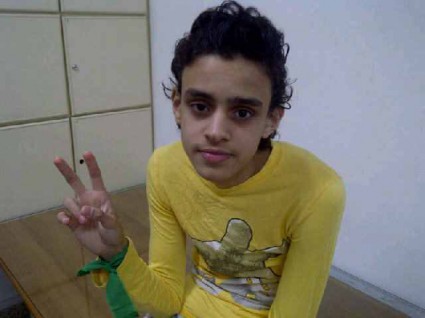
November 15, 2011 Add Comments
Who are the terrorists?
November 15, 2011 Add Comments
Obama’s bipartisan jobs program
War: The Wrong Jobs Program
By Mark Engler, November 15, 2011
More than 40 years ago, long before anyone had ever heard of Barack Obama, before the collapse of Bear Stearns, and before contemporary debates about bailouts and debt ceilings, two authors, Paul Baran and Paul Sweezy, considered a tricky problem. In times of downturn, the government must spend to stimulate the economy. Yet getting the political establishment to agree on one particular program of spending seemed nearly impossible.
Baran and Sweezy phrased the conundrum as a question: “On what could the government spend enough to keep the system from sinking into the mire of stagnation?”
After assessing the political realities that steer America’s power elite, they could find only one response. It was not what typically comes to mind when we think of economic stimulus or government-led job creation.
Their answer: “On arms, more arms, and ever more arms.”
The authors did not approve of military spending as a strategy of economic development. But, even at the very outset of the Cold War, they saw the deep hold that it had on decision-makers in Washington, DC.
We can see the continuing hold it has today. This fall, responding to high and persistent unemployment, President Obama called for a federal jobs act. Among its measures, the act proposed investment in schools and infrastructure. Conservative opponents responded with cries of derision. The critics charged that the plan “doubles down on a failed government stimulus strategy.” It means “adding more money to the same broken system” they said. Finally, they insisted, “It comes to a point that you can’t keep borrowing in a futile attempt to stimulate the economy when the increased debt itself is weakening the economy.” …more
November 15, 2011 Add Comments
It’s the “boogey man”, just in time to avoid a Human Rights dialogue about Bahrain in the US
Hezbollah denies Al-Khalifa’s accusations
Nov 15th, 2011 – By shiapost
Retorting to accusations made by Bahrain MPs that Hezbollah was involved in a recently busted “terrorist cell” in Manama, Hezbollah denied on Monday having ties “to an alleged cell in Bahrain”.
Hezbollah said in its statement that the alleged terrorist cell might be “one of the fabrications [weaved] by the Al-Khalifa authoritarian regime in Bahrain,” in reference to Bahraini King Hamad bin Issa al-Khalifa.
Those accusations “are not true and baseless,” the statement read.
The allegations are part of “an unsuccessful attempt made by the Al-Khalifa regime to blackout the real popular and peaceful revolution staged by patient and oppressed Bahraini people, amid the silence of international community and the suspected disregard of Arab League,” Hezbollah added.
Hezbollah stressed in its statement that such a silence of hostility “will not deter the people of Bahrain from continuing the project of its legitimized struggle until the achievement of its noble and national objectives.” …more
November 15, 2011 Add Comments
Obama-Clinton lack of foreign policy substance is continuance of the Bush legacy of abuses
Reports Say U.S. Continued Detainee Transfers to Known Torturers
October 31, 2011 – Human Rights First
Washington, DC – Human Rights First today voiced concern about reports that the United States had long been transferring detainees captured by U.S. forces in Afghanistan to the Afghan intelligence agency, the NDS, which has a well-documented history of torture and other forms of detainee abuse. These reports are a signal that – despite repeated assurances to the contrary – the United States remained complicit in the illegal practice of torture after it knew or should have known of abuses in the Afghan facilities to which detainees were sent.
“Numerous times in my conversations with Pentagon and civilian officials in Afghanistan and Washington, I was assured that the United States does not transfer detainees to the NDS where there is a substantial risk of torture,” said Human Rights First’s Gabor Rona. “Those assurances were apparently false.”
According to Human Rights First, the transfer of anyone to another State where there are substantial grounds for believing that he would be in danger of being subject to torture is a violation of the United Nations Convention Against Torture, to which the United States is a party. U.S. funding and support for Afghan security services known to engage in torture is also a violation of the Leahy amendment, a measure that requires the U.S. Departments of Defense and State to ensure recipients of U.S. security assistance are not engaged in torture or other human rights abuses. …more
November 15, 2011 Add Comments
US Anti-Muslim Violence comes home to roost in Obama’s continuance of the Bush Crusader mentality abroad
FBI Report Shows Sharp Incline in Anti-Muslim Violence
November 14, 2011 – Human Rights First Continuance of Bush Crusader mentality
Washington, DC – The Federal Bureau of Investigations today released its annual data on hate crime in the United States for 2010. According to the data, the most comprehensive annual record of hate crime in the United States, most categories of hate crime increased slightly from 2009 levels. The sharpest increase came in the number of anti-Muslim hate crimes, up a staggering 50% from 107 in 2009 to 160 in 2010.
“After hate crime declined in 2009, it’s disturbing to see it rise again in 2010. The rise anti-Muslim violence is particularly significant. Human Rights First has long maintained that anti-Muslim violence, as well as other forms of hate crime, must be viewed and responded to as a serious violation of human rights. The U.S. Government can and must do more to confront these abuses,” said Human Rights First’s Paul Legendre.
According to LeGendre, one important step to combat all hate crime violence would be for the U.S. government to enhance police reporting of hate crime. In 2010, only 13% of all participating law enforcement agencies reported even a single hate crime in their jurisdictions – a shortcoming that LeGendre notes “undoubtedly masks the true extent of hate crime in the United States.”
To speak with LeGendre or for more information about anti-Muslim violence and other forms of hate crime in the United States and globally, please contact Brenda Bowser Soder at bowsersoderb@humanrightsfirst.org or 202-370-3323. …source
November 15, 2011 Add Comments
Secretary Clinton suffers sever attack of rhetoritis
Clinton urges Saudi, Bahrain to embrace Arab Spring
By Bloomberg – 8 November 2011 rhetoric
Secretary of State Hillary Clinton, saying that the US has a role in democracy movements that continue to roil the Middle East, urged Saudi Arabia and Bahrain to embrace reform and Syria to accept protesters’ demands.
“These revolutions are not ours – they are not by us, for us, or against us, but we do have a role,” Clinton said in remarks to the National Democratic Institute, a democracy support organization based in Washington. “Fundamentally, there is a right side of history. We want to be on it. And without exception, we want our partners in the region to reform so that they are on it as well.”
Clinton addressed skepticism in both the Arab world and at home about US motives and commitments since the Arab Spring began with a Tunisian fruit vendor’s protest self-immolation in December 2010.
Developments in the months since then have raised the possibility of Islamic groups gaining political power in Egypt, highlighted differences in the way the US has approached protest movements in places like Bahrain and Syria and drawn questions about US opposition to unilateral Palestinian attempts to gain recognition. …more
November 15, 2011 Add Comments
Iran terror plot – no way, there is nothing to gain politically
[cb editor: The terror cell plot makes no sense for one simple reason, there is nothing to be gained politically by Iran or anyone in opposition to the attacks that were supposedly planned. The ones that do have something to gain are the Saudi’s, Israel and the al Khalifa regime. This Saudi hatched plot has all the making of the ludicrous plot of Iran agents planning an assassination in the US. – WTF?]
Bahrain: Alleged terror cell had high Iran links
November 13, 2011 – Yahoo News – AP
MANAMA, Bahrain (AP) — An alleged Iranian-linked terror cell had contact with the Tehran’s powerful Revolutionary Guard and planned attacks against high profile sites, including Saudi Embassy and a Gulf causeway linking Bahrain and Saudi Arabia, authorities in Bahrain claimed Sunday.
The allegations from Bahrain’s public prosecutor seek to strengthen charges of ties between the suspected underground group and Iran. Bahrain’s Sunni leaders have accused Iran of encouraging Shiite-led protests that erupted in February on the island kingdom.
The report in the Bahrain News Agency, however, gave no further information on the suspects or other details to back up the allegations. …more
November 15, 2011 Add Comments
Regime rearrests hallmark of oppression over women protesters
Bahrain girl teen protester re-arrested in spite of health conditions
14/11/2011 – Bahrain Freedom Movement
Holding up a banner with photos of injured anti-government protesters, women protesters stand in public on February 19, 2011 to bring attention to human rights abuse by Bahrain military security officials. Image: Al Jazeera English/cc
(WNN) Manama, BAHRAIN: Following the late September arrest of 38 women and 7 girl protesters during a pro-reform rally at a local shopping center in Bahrain’s capital city of Manama, one teenager has been re-arrested in spite of her ongoing health conditions and hospital stay.
Seventeen-year-old Ashwaq Al Magabi suffers from a severe form of sickle cell anemia. The fatal disease can cause chronic pain, weakness and deteriorating damage to the bones, kidneys, lungs, eyes, heart, and liver. Ashwaq was sentenced in Bahrain’s penal court 26 days following her first arrest on October 19,2011. Her current sentence includes six months imprisonment.
In March 2011 Bahrain officials set up a military tribunal court, called the ‘National Safety’ court, to handle cases involving government reform protesters and human rights activists, in what Human Rights Watch called a “travesty of justice.”
Following international outcry by global governments as well as human rights groups, Bahrain’s Attorney General, Dr. Ali Fadl al-Buainian, asked that cases involving medical personnel who were arrested during the past months of reform protests and unrest in Manama be transferred to civilian courts October 7.
“All civilian cases should be tried before civilian courts,” said a spokesperson for the Foreign Office to the UK Mission to the United Nations on October 6.
On May 13, 2011 the U.S. Tom Lantos Human Rights Commission House Committee on Foreign Affairs brought Bahrain Center for Human Rights Director of Foreign Relations, Ms. Maryam Al Khawaja, before the Congress as part of a special expert panel brought to share her insights into the situation of human rights abuse in Bahrain.
“We have reason to believe that many of those who are being held incommunicado detention are being subjected to torture, and this, of course, raises high concern for their well being and for their lives,” said Maryam during the U.S. Congress hearing last May. …more
November 14, 2011 Add Comments
al Khalifa regime sytematically silencing press – blocks air wave
Bahrain TV station struggles as signal blocked
By Simon Atkinson, BBC News
WATCH: It’s your cue: LuaLua TV is using technology to make sure that although the service is blocked in Bahrain, every effort is made to broadcast as widely as possible
Rim Abdolah delivers her news bulletin with admirable gusto for a woman who knows hardly any of the target audience is watching. The Lualua TV presenter has been with the station since its launch in July.
Aimed at people in Bahrain, it carries news and talk shows about the country.
But since its inception, it has only managed to reach to televisions in the Gulf kingdom for four hours – before the signal was blocked.
“As a broadcaster I’m very upset and frustrated because we try to work hard to put our work out to let everyone see it, especially in Bahrain,” Miss Abdolah says.
“But it’s very disappointing, no-one in Bahrain can see us.”
Reports from the satellite provider show the signal is being blocked from within Bahrain.
Screens Presenter Rim Abdolah is frustrated that the channel is blocked in Bahrain
While not officially blaming the country’s government, station management say it is hard to see who else would intervene.
Miss Abdolah’s pink headscarf stands out brightly against the blue backdrop of the news studio.
And while it was intended to run the channel from Bahrain’s capital Manama, it failed to get a licence there.
So instead, it operates thousands of miles from the Gulf, in a two-storey industrial unit on a drab north London estate – with cables running through the front door to a satellite dish in the car park.
The station was formed in the aftermath of pro-democracy protests earlier this year, which ended after Bahrain called in the Saudi military to crush the uprising. Bahrain protest The station was formed in the aftermath of pro-democracy protests in Bahrain
Several people were killed in clashes with security forces, while hundreds of people were detained including doctors, teachers and opposition leaders – many of whom allege they have been tortured and now face military trials.
Thousands of demonstrators had gathered for several days in the centre of Manama, inspired by the popular uprisings which toppled the leaders of Tunisia and Egypt.
They demanded a greater say in government and an end to what the majority Shias said was systematic discrimination against them in jobs and services. …more
November 14, 2011 Add Comments
al Khalifa regime continues it’s reign of terror and intimidation over press
Bahrain Journalist Jailed Overnight
IPI: Journalists Have Right to Work without Fear of Imprisonment
11 November 2011 – International Press Institute
By: By Nisha Thanki
Shi’ite Bahraini men sit on a wall with graffiti that reads ”People want self-determination”, as they attend a rally held by the Wefaq opposition party, in the village of Boori, south of Manama, October 14, 2011, to mark the 8-month anniversary of the February 14 uprising. REUTERS/Hamad I Mohammed
VIENNA, 11 Nov. 2011 – Jaffer al-Alawai, a prominent journalist, blogger and poet, was arrested on 8 November. He was released after spending over 24 hours in custody. It is still unclear why he was arrested and whether he will be formally charged. Al-Alawai previously worked as an anchor for the Bahrain Radio and Television Corporation, the state-controlled, sole television channel in Bahrain. Previously this year, al-Alawai was dismissed from his position there along with many other journalists. He is now well known for his poetry, which he tweets, and for being the leader of a youth group called Taa AlShabab.
On 8 November, al-Alawai’s house in Boori was surrounded by armed forces and subsequently searched. It followed an incident in which some protesters cut through his house during a protest. He was summoned to the police station in Hamad Town to be interrogated.
Mr al-Alawai has written on Twitter since that he was not ill-treated during his time in custody nor was he asked about his writing. It remains unclear why al-Alawai was held for 24 hours.
Gamal Eid, the executive director of the Arabic Network for Human Rights Information, said: “Like many Bahraini journalists, he is a victim of the government campaign of retribution. Not only is he a victim of the government, but also a victim of the Saudi Arabian and American retaliation campaign.” There was no mention of al-Alawai’s arrest in any local newspapers.
The case of al-Alawai follows the intimidation of a number of journalists and bloggers. The Bahrain Centre for Human Rights “fears that his detention is due to (his) being a media professional who has expressed views in support of democracy”. There has been a wave of dismissals from the state television this year, which is thought to be based on religious and political affiliations. The accounts of threats and harassment against journalists in Bahrain have been disturbing.
Earlier this year IPI reported on the cases of two journalists who were arrested and tortured to death. Karim Fakhrawi, creator of Al-Wasat newspaper, was detained in March 2011. Authorities claimed that he died from kidney failure, yet his body showed clear signs of torture. …more
November 14, 2011 Add Comments
al Khalifa regime steps up deceptions to direct attention away from it’s atrocities
Iran rejects Bahrain’s claim of terror cell links
By NASSER KARIMI, Associated Press – 13 November, 2011
TEHRAN, Iran (AP) — Iran rejects Bahrain’s allegations that a terror cell uncovered in the tiny island nation has links to the Shiite powerhouse’s Revolutionary Guard, an Iranian deputy foreign minister said.
Bahrain’s public prosecutor on Sunday alleged the cell planned attacks against high profile sites, such as the Saudi Embassy in the Bahraini capital Manama and a Gulf causeway linking Bahrain and Saudi Arabia.
The cell purportedly had contact with Iran’s Guard, according to a Bahrain News Agency report, which gave no further details to back up the allegations.
Iran’s Deputy Foreign Minister Amir Abdollahian said the claims were “baseless and fabricated” and urged the Bahraini government to focus instead on repairing the “deep schism” between its ruling Sunni monarchy and Shiite majority.
Abdollahian spoke to the Arabic Language al-Alam channel late on Sunday.
“We reject such deceptive allegations,” he said. “We believe it is necessity to deal peacefully and democratically with legitimate demands voiced over the past months by the Bahraini people.”
Bahrain’s Sunni leaders have repeatedly accused Iran of encouraging Shiite-led protests that erupted in February in the kingdom, a charge Iran denies.
The Bahraini claim followed recent U.S. accusations that an elite unit of the Revolutionary Guard — which is closely tied to Iran’s ruling clerics — was involved in a foiled plot to assassinate the Saudi ambassador in Washington. Iran has denied the American charges.
Bahrain’s majority Shiites insist they have no political links to Iran. Bahrain’s Sunni monarchy and its Gulf allies claim that Iran seeks to gain another foothold in the Arab world through unrest in the tiny strategic nation, which hosts the U.S. Navy’s 5th Fleet.
The unrest in Bahrain has killed more than 35 people since it began nearly nine months ago, inspired by Arab uprisings elsewhere. Protesters say they are seeking greater rights and an end to the Sunni dynasty’s hold on top political decisions. Bahrain’s rulers have offered some compromises, such as expanding the powers of parliament, but not enough to satisfy the opposition.
The Iran-Bahrain tensions are not limited to politics.
On Saturday, Iran summoned Bahrain’s envoy to Tehran to protest what it called mistreatment of Iranian football players and supporters following a 2014 World Cup qualifier in Manama.
Iran’s official IRNA agency said security forces failed to confront some Bahraini supporters who threw water bottles and other objects at the Iranian players and supporters.
November 14, 2011 Add Comments
Critical Month in The Kingdom of Bahrain
Latest Bahrain trials begin tomorrow
14 November 2011 – International Transport Workers’ Federation
Dr Kate Webb reports for the ITF on why November is going to be a critical month in the Kingdom of Bahrain. Tomorrow, November 15th, three officers of the Gulf Air union will appear in court on unspecified charges concerning “national security”. In a fortnight a group of sports journalists and athletes that includes the country’s top-scoring footballer, A’ala Hubail, are to be tried for “illegal assembly and inciting hatred against the regime”, and on November 28, the doctors arrested at the Salmaniya Medical Complex, already tried in a military court, will, after international outcry, be retried in a civilian court.
In the middle of this period, on November 23, the Bahrain Independent Commission of Inquiry (BICI) – set up by King Hamad bin Isa Al-Khalifa and chaired by the international jurist, M. Cherif Bassiouni – will produce its report into whether or not there were human rights violations during the spring uprisings.
A lot rides on this report. The fate of hundreds of protestors already imprisoned or still going through the courts may depend upon it. And for the Bahraini state – where financial services have overtaken oil as the nation’s prime business – at stake is its credibility on the world stage and ability to do business in the international market. In America, after objections from a handful of senators, Hilary Clinton has decided to delay a $53 million arms sale to Bahrain until the BICI’s findings are announced; while complaints raised by international trade unions and the European Parliament about the mistreatment of workers have put the US-Bahrain Free Trade Agreement in jeopardy. …more
November 14, 2011 Add Comments
Systematically Disenfranchising Bahrains Opposition
Royal Fact Finding Commission: Five Fatal Breaches of the Standards of the United Nations High Commissioner for Human Rights.
النسخة العربية من التقرير – Bahrain Mirror
Bahrain Mirror (Exclusive): Bahrain Mirror observed that the Royal Commission for Inquiry had committed five fatal breaches of the standards of the United Nations High Commissioner for Human Rights. Bahrain Mirror monitored those violations through the preliminary assessment of the establishment and the works and practices of the Commission. It sought the help of the Human Rights organizations and prominent Human Rights figures. The breaches included the following:
-The Commission was established by an individual will not by the principle of national consultation
-The mistakes in selecting the members of the Commission
-Marginalization of the role of the national non-governmental organizations (NGOs).
-Circumventing the role of the United Nations and other international actors
-The mistakes in the practice, professionalism and neutrality
1. The Commission was established by an individual will not by the principle of national choice
The publication of the Truth Commissions issued by Office of The United Nations High Commissioner for Human Rights states that the national choice is one of the core principles to establish a Truth Commission and it stresses that “..the decision to have a commission must always be taken by nationals. This decision should be based on a broad consultative process to seek especially the views of victims and survivors, and make clear the functions, strengths and limitations of truth commissions” [Page 5], and under the section of “Consultation” in establishing a Truth of Commission the publication says: “The consultation should explicitly include victim communities and civil society organizations, and should allow for a period of significant input into the fundamental mandate of the commission, as well as feedback on specific draft terms of reference as they are developed” …more
November 14, 2011 Add Comments
Bahraini Opposition Calls for Renewed Action After BICI
Bahraini Opposition Calls for Renewed Action After BICI
The POMED Wire – November 10 – by Todd
According to the Bahrain Freedom Movement website, the 14th February Youth have called for a rejuvenation of popular protests on November 23, the day the BICI report will be released. The website also asserts that many pilgrims returning from Saudi Arabia have been arrested on suspicion of taking part in anti-regime chanting in Mecca. Meanwhile, Ashwaq al-Maqabi, a 17-year-old Bahraini girl who was being treated for complications related to sickle cell anemia, was rearrested in Salmaniyya hospital and returned to prison. She was originally convicted for taking part in a protest at Bahrain’s City Center, and Bahrain’s Ministry of Information tweeted that “after the end of treatment according to [al-Maqabi’s] doctor she was taken to female prison to serve her sentence & she is under health supervision.”
Additionally, Eli Lake examines the assertion that Bahrain’s primary opposition party, al-Wefaq, is a “pawn of Iran,” saying that Jasim Husain, a leading opposition figure in Bahrain, “does not look like a pawn of Iran’s mullahs… [and] doesn’t sound like a pawn of Iran’s mullahs either. “ …source
November 13, 2011 Add Comments
Having Their Say: Women Protesters Emerge as a Force in the Arab Spring
Having Their Say: Women Protesters Emerge as a Force in the Arab Spring
Published November 08, 2011 in Arabic Knowledge@Wharton
Mary Hope Schwoebel, senior program officer at the Academy for International Conflict Management and Peacebuilding at the United States Institute of Peace in Washington, D.C., tells Arabic Knowledge@Wharton that Western observers need to withhold judgment about election results following the Arab Spring, and focus on supporting the development of women’s rights in those countries. “You need to have secular feminists and you need to have Islamic feminists,” Schwoebel says. “Women of all persuasions need to put aside their differences long enough to identify and advocate for their common interests in the face of rapidly changing circumstances.”
Arabic Knowledge@Wharton: How have women played a role in the Arab Spring?
Mary Hope Schwoebel: First and foremost, they’ve been out in the forefront as demonstrators, as protesters. They’ve come out in unprecedented numbers in Tahrir Square [in Egypt] and in Change Square in Yemen. And of course, on the negative side, it was a policewoman who set the whole thing off in Tunisia. A street vendor being harassed by female police member in Tunisia reportedly triggered the Arab Spring. She slapped him several times on his face in front of his friends. The police had harassed him repeatedly for his business. He was so humiliated that he immolated himself. He went to Tunis and set himself on fire, just out of frustration because he wasn’t able to maintain his livelihood due to police harassment.
In Algeria, there was an interesting story about protesters comprised of feminists. They were feminist independence leaders from back in the day when Algeria was fighting against France. They were older, highly respected women. Oddly enough, they were arrested by female police officers, who beat them and then failed to protect them from male police officers who began sexually molesting and harassing them. Women haven’t always been angels, but women have played a significant role in the Arab Spring.
Arabic Knowledge@Wharton: How important have women been? Would the Arab Spring have happened without women?
Schwoebel: Their participation in Egypt and Yemen has been key in the democracy movements, even the simple symbolism of their participation alone, was significant. It was a woman in Yemen, Tawakkol Karman, a human rights activist [a co-recipient of the Nobel Peace Prize this year], who is credited for starting the Yemeni uprising.
Arabic Knowledge@Wharton: Do female protesters have a greater burden, not only demanding rights for citizens of their country but also rights as women in their country? …more
November 13, 2011 Add Comments
Arab Spring and the Arab League
Arab Spring revolution at the Arab League
By Jon Leyne – BBC News – 13 Novemeber, 2011
For years the Arab League has been seen as a cosy club of Arab autocrats and dictators.
Ministerial meeting followed summit followed emergency summit, all having no apparent impact on the lives of ordinary Arabs in this troubled region.
But the Arab League headquarters are barely a couple of hundred metres from Tahrir Square, in central Cairo.
And the effect of the protests there, which unseated former Egyptian President Hosni Mubarak, are still echoing round the marbled halls of the League.
In March the League voted in support of a no-fly zone over Libya. The move led directly to a UN resolution and subsequent Nato intervention. Without the Arab League vote, that would not have been possible.
Now in an almost equally dramatic step, the League has voted to suspend Syria from its work in response to the continuing violence in the country.
That means one of the standard-bearers of Arab nationalism, the Syrian Arab Republic, is now excluded from the body committed to Arab unity.
Members of the Syrian opposition – just the sort of activists whom the Arab League members happily ignored or repressed for years – are being invited to Arab League headquarters, for the League to help them co-ordinate their efforts.
All of this is being pushed forward not by the traditional Arab leader, Egypt, but by tiny Qatar, whose prime minister is chairman of the ministerial committee dealing with Syria.
The hard line towards Syria emanating from the Qatari capital, Doha, is almost equalled by the tough stand from neighbouring Saudi Arabia.
The diplomatic map of the Middle East is being redrawn almost as quickly as governments and regimes are falling. …more
November 13, 2011 Add Comments
BNA Reports of Dubious Nature – uncorroborated by any legit intelligence – part of disinformation campaign?
Bahrain: suspects say had contact with Iran
DUBAI – Sun Nov 13, 2011
(Reuters) – Members of a cell arrested before they could carry out planned attacks on Bahrain’s Interior Ministry and the Saudi Arabian embassy had been in contact with Iran’s elite Revolutionary Guards, Bahrain’s state news agency BNA reported on Sunday.
Bahrain said on Saturday that the suspects, four of them Bahrainis detained in neighboring Qatar, had also planned to attack a causeway joining Bahrain to Saudi Arabia. The suspects’ interrogation led to the arrest of a fifth member of the group in Bahrain, BNA reported.
Some of the suspects had confessed that “the group was set up abroad … to carry out terror operations in Bahrain … and was in coordination with the military overseas, including the Revolutionary Guards and the Basij (militia),” BNA quoted a Bahraini prosecution spokesman as saying.
Activists among Bahrain’s Shi’ite Muslim majority began a series of mainly peaceful demonstrations in the capital in February, pushing for more political freedoms and better living conditions, inspired by the Arab Spring uprisings across the Arab world.
The country’s Sunni rulers, helped by Saudi security forces, crushed the demonstrators, who they said had been supported by predominantly Shi’ite Iran. Tehran has denied involvement in the unrest in Bahrain, a U.S. ally which hosts the U.S. Fifth Fleet.
Last month U.S. authorities said they had broken up a plot by two men linked to Iran’s security agencies to assassinate the Saudi ambassador to the United States, Adel al-Jubeir. One of the two was arrested in the United States last month and the other was believed to be in Iran.
Iran has denied the allegations.
(Reporting by Firouz Sedarat, editing by Tim Pearce) …source
November 13, 2011 Add Comments
Justice for Three
Upcoming Event – Bahrain Lobby of Parliament
Posted on November 9, 2011 by admin
Bahrain Lobby of Parliament
6-8pm, Monday, November 14th
Committee Room 1 ,
Houses of Lords
Help campaign for Bahrain by lobbying your MP as part of the Justice for Three campaign.
Write to your elected representative and ask them to attend the public Meeting at House of Lords, chaired by Lord Nazir Ahmed.
To discuss the case of the Three Bahraini protesters sentenced to death and other human rights issues in Bahrain.
The meeting will also host speakers from Human rights organizations, the defendant lawyer, member of the defendant family and member of the Bahrain Center for Human rights
About Justice for Bahrain
Founded in March 2011 following the Bahraini Revolution of 14 Feb 2011. It was set up by a group of individuals of different cultural and professional backgrounds, who with the help of many volunteers eventually prospered into a leading and very active campaign. We are a cross-party organisation campaigning for justice, fundamental human rights and freedom in Bahrain and in other parts of the Middle East. We are an independent organisation based in the. …more
November 13, 2011 Add Comments