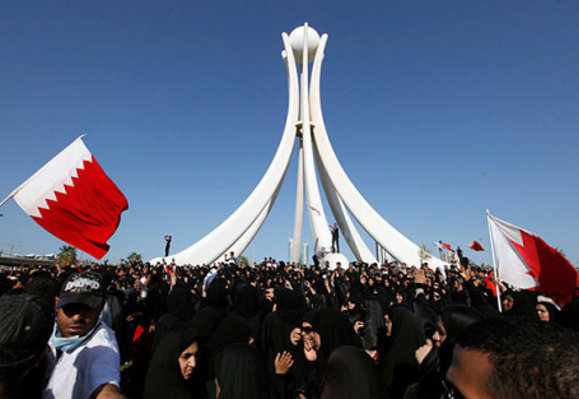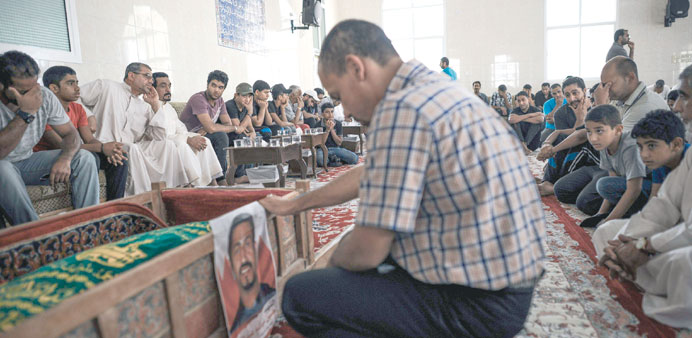
Bahrain Grand Prix a tragic wreck on the road to Democracy

March 28, 2012 Add Comments
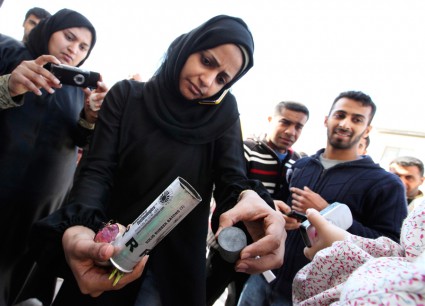
Your F1 money buys pain and suffering for Bahrainis
March 28, 2012 Add Comments
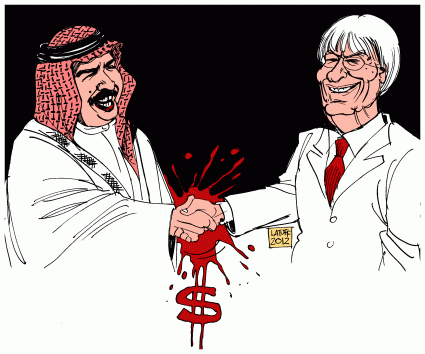
Blood Money for Formula One
March 28, 2012 Add Comments
Bahrain: Hundreds Still in Prison for Speaking Out; Senior Officers Unpunished
Bahrain: Vital Reform Commitments Unmet
28 March, 2012 – Human Rigths Watch
Bahrain has taken some positive steps, but the Bahraini authorities can hardly claim that the BICI’s recommendations have been implemented as long as hundreds of people remain behind bars solely for speaking out and demanding a change of government. And it seems that no high-ranking officials have been investigated for their roles in rampant torture or unlawful killings.
Joe Stork, deputy Middle East director at Human Rights Watch
(Beirut) – Bahrain’s government has not carried out critical recommendations by the independent commission that looked into extensive human rights violations during the crackdown on pro-democracy protesters in 2011, Human Rights Watch said today.
The Bahrain Independent Commission of Inquiry (BICI), established by King Hamad bin Isa Al Khalifa and headed by the Egyptian-American jurist Cherif Bassiouni, issued its findings in November 2011. The king promised at the time to carry out all of its recommendations and established a National Commission to monitor the process. That body reported on March 20, 2012, that the implementation of the BICI’s recommendations had been “comprehensive and far reaching” and “touched all aspects of Bahraini life.” But some of the BICI’s most serious concerns, like accountability for crimes such as torture and relief for people wrongly imprisoned, were not adequately addressed, Human Rights Watch said.
“Bahrain has taken some positive steps, but the Bahraini authorities can hardly claim that the BICI’s recommendations have been implemented as long as hundreds of people remain behind bars solely for speaking out and demanding a change of government,” said Joe Stork, deputy Middle East director at Human Rights Watch. “And it seems that no high-ranking officials have been investigated for their roles in rampant torture or unlawful killings.”
In one positive step recommended by the BICI, the government stripped the National Security Agency (NSA) of authority to arrest and detain people. The king replaced Shaikh Khalifa bin Abdullah Al Khalifa as head of the agency, but then in a disturbing move promoted him to secretary general of the Supreme Defense Council and a national security adviser to the king with ministerial rank.
The BICI report found that the NSA played a major role in the arrests of 2,929 people during the 10-week state of emergency, from mid-March until early June last year, typically in nighttime raids on homes.Its report said that NSA and other security forces “intentionally broke down doors, forcibly entered and sometimes ransacked the houses,” used “sectarian insults and verbal abuses,” and humiliated relatives and terrified children of those targeted. It said that the pattern of the arrests showed the “existence of an operational plan” that was “designed to inspire terror” among those targeted for arrest. …more
March 28, 2012 Add Comments
Syria Rebels Form Death Squads, Carry out Beheadings, Summary Execution of Prisoners
Syria Rebels Form Death Squad, Behead Army Soldiers
Posted on March 28, 2012
Syrian rebels have formed their own laws, courts and death squads in Baba Amr neighborhood in the restive city of Homs and beheaded the captured army soldiers, a report has revealed.
The report, published by Spiegel Online on Monday, discloses violent measures by the anti-government armed groups, laying bare the other side of the unrest in the Middle Eastern country.
Hussein, one of the rebels fighting the government of President Bashar al-Assad, is quoted in the report as saying that he himself decapitated four army soldiers who had been detained by gunmen.
Hussein said that he beheaded the first victim, a Shia soldier who had confessed to using violent tactics, in mid-October, 2011, in a cemetery.
Hussein did not care whether the soldier’s confessions were real or he had made them under duress. He had simply grabbed a knife and beheaded the soldier who had knelt down in front of him.
The soldier had been captured out of sheer “bad luck”, said Hussein.
While he is a member of a rebel death squad killing government forces in the name of the “Syrian revolution,” there are others who are responsible for torturing captured soldiers.
Many rebels can torture, but not everyone can kill, admits Hussein, who is now receiving treatment in a hospital in the Lebanese city of Tripoli where he and his fellow companions are openly talking about torturing and killing Syrian army soldiers.
“But I do not know why killing is not difficult for me,” he added.
Hussein’s life story demonstrates the course of actions rebels have taken during more than a year in the Arab state.
The report further divulges that Syrian rebels in Homs have since August, 2011 begun regular execution of Syrian soldiers.
“As of last summer, we have executed 150 men, which constitutes only 20 percent of our prisoners,” claimed another hospitalized rebel identified as Abu Rami.
“Moreover, when we realize that a Sunni is spying against us we then hold a brief trial for him,” Abu Rami said, adding that they have executed between 200 and 250 people in such cases.
Revealing the shocking incidents in which rebels even kill Sunnis, he went on to say that “Syria is not a place for the squeamish. “
The West and the Syrian opposition accuse the government of killing the protesters. …more
March 28, 2012 Add Comments
U.N. gets reports of child soldiers with Syria rebels
U.N. gets reports of child soldiers with Syria rebels
By Louis Charbonneau – 25 March, 2012 – Reuters
(Reuters) – Syrian rebels fighting to oust President Bashar al-Assad have been accused of using children as fighters in violation of international conventions banning the recruitment of child soldiers, a senior U.N. official said on Monday.
The U.N. concern about the possibility that Syria’s opposition may be using child soldiers follows last week’s report from the New York-based rights group Human Rights Watch that armed Syrian opposition groups have kidnapped, tortured and executed members of supporters of Assad and members of his security forces.
“We are receiving allegations of children with the Free Syrian Army,” Radhika Coomaraswamy, U.N. special representative for children and armed conflict, said in response to a question about Syria’s rebels. She gave no details.
“We haven’t been able to verify or check” the veracity of those allegations, Coomaraswamy added.
Earlier this month the International Criminal Court in The Hague convicted Congolese warlord Thomas Lubanga Dyilo of using child soldiers in the Democratic Republic of Congo. Coomaraswamy said on Monday that she welcomed that guilty verdict.
The main focus of her news conference was South Sudan, Africa’s youngest country and a region that has long been a concern for those opposed to the use of child soldiers.
Coomaraswamy said was encouraging that the South Sudanese army, the SPLA, has released some 3,000 children from its ranks and expects to free another 2,000 in the near future. …source
March 28, 2012 Add Comments
US Senate readies vote to sends tanks to Syria
Senate offers resolution arming Syrian rebels
By Lisa Mascaro – 28 March, 2012 – LA Times
Washington — Saying President Obama and the United Nations are not doing enough to stop the bloodshed in Syria, leading Senate hawks have proposed supplying Syrian rebels with weapons and support in the first congressional move toward ending the Assad regime.
The senators made it clear Wednesday they were not calling for the authorization of U.S. military intervention as they pressed to send munitions and aid to the Syrian rebels as they battle President Bashar Aassad.
“How can you sit on the sidelines in Syria and not take a stand?” said Sen. Lindsey Graham (R-SC), who put forward the resolution with fellow Republican Sen. John McCain of Arizona and Sen. Joseph Lieberman, the independent from Connecticut, among others.
McCain, Graham and Lieberman had previously called for U.S.-led military airstrikes in Syria, but their resolution Wednesday fell short of that stance.
The resolution states the Senate would support calls by Arab leaders to support the Syrians “through the provision of weapons and other material support.”
It is unclear if the resolution introduced Wednesday to send munitions and tanks to the rebels would be voted on in the Senate, especially as lawmakers are set to adjourn for a spring recess at the end of this week. …more
March 28, 2012 Add Comments
Poland charges former intelligence chief over secret CIA prison site
Poland charges former intelligence chief over secret CIA prison site
Associated Press – guardian.co.uk – 28 March, 2012
Poland has pressed the first charges in an investigation into a secret CIA prison on its territory, according to reports.
The Gazeta Wyborcza newspaper says former intelligence chief Zbigniew Siemiatkowski has been charged with exceeding his powers, depriving prisoners of war of their freedom and allowing corporal punishment in an investigation that began in 2008.
“I cannot comment because all the proceedings are a state secret. I can neither negate nor confirm,” said Siemiatkowski, who was head of Poland’s Intelligence Agency between 2002 and 2004 when it joined the US-led war on terrorism. The charges make Poland the first country to incriminate an official over CIA sites operated during Washington’s fight against terror.
Prosecutors are investigating whether Poland’s leaders illegally allowed the CIA to run a site and whether terrorism suspects were tortured there a decade ago.
Former CIA officials said the prison operated from December 2002 until autumn of 2003, and that prisoners were subjected to harsh interrogations. The Council of Europe and the United Nations have also said they have evidence the site existed.
However, Polish officials in power at the time deny there was ever such a site.
Two Guantánamo Bay prisoners, Abd al Rahim al-Nashiri and alleged al-Qaida facilitator Abu Zubaydah, have been given victim status in the investigation after claiming they were held in Poland and subjected to harsh treatment.
The investigation was recently taken from prosecutors in Warsaw and given to investigators in Krakow, but officials have not explained the reason behind the move. …source
March 28, 2012 Add Comments
Saudi forces occupy Bahrain and there is right to resist: Kuwaiti deputy
Saudi forces occupy Bahrain and there is right to resist: Kuwaiti deputy
27 March, 2012 – Shia Post
The deputy in the Kuwait Parliament and Secretary General of the General Conference spoke to Al-Manar channel in support of the people of Bahrain about what happened in the meeting of the Human Rights Council held a few days ago in Geneva.
Abdul Hameed Dashti said: ” We are surprised that the system sent 40 people and leaves them for the duration of the session which is more than a month, and provides them with coverage of material, including those who participated in the suppression and killing of detainees. We pointed out to this in disgrace, so they understood to leave immediately, and fled. Among the delegation were security officers and intelligence that shall not be in the building of the United Nations”.
About the position of the United Nations, Dashti replied: “It did not do what it must to learn about what all of this, and when it learned about it after we exposed it, we will follow any action taken by the UN organization”.
The member of the Kuwaiti parliament considered that Saudi forces are occupied by troops of Bahrain, and that even if the Bahraini people responded to this non-peacefully, they have the right in accordance with international law.
He commented on the annexation of Bahrain to Saudi Arabia, saying that the annexation is not allowed, and that Bahrain will resist this with all legitimate means. He stressed that what is being proposed of alliance or annexation comes under the legitimization of Saudi Arabia’s occupation of Bahrain. …more
March 28, 2012 Add Comments
5th on Global Execution list, United States only Western democracy that executes prisoners
Amnesty: U.S. Ranks 5th on Global Execution Scale
PETER JAMES SPIELMANN – Associated Press – 27 March, 2012
NEW YORK (AP) — The United States was the only Western democracy that executed prisoners last year, even as an increasing number of U.S. states are moving to abolish the death penalty, Amnesty International announced Monday.
America’s 43 executions in 2011 ranked it fifth in the world in capital punishment, the rights group said in its annual review of worldwide death penalty trends. U.S. executions were down from 46 a year earlier.
“If you look at the company we’re in globally, it’s not the company we want to be in: China, Saudi Arabia, Iran, Iraq,” Suzanne Nossel, executive director of Amnesty International USA, told The Associated Press.
The United States seems deeply divided on the issue.
Texas Gov. Rick Perry was cheered at a Republican presidential candidates’ debate last September when he defended his signature on 234 execution warrants over more than 10 years as being the “ultimate justice.”
Just weeks later, young people rallied in person and online to protest the execution of Troy Davis in Georgia for the 1991 murder of a police officer. In the intervening years, key witnesses for the prosecution had recanted or changed their stories.
“I think the debate on the issue may be nearing a tipping point in this country,” Nossel said. “I think we’re seeing momentum at the state level, in the direction of waning support for the death penalty.”
Illinois banned the death penalty last year, and Oregon adopted a moratorium on executions.
Maryland and Connecticut are close to banning executions, Amnesty said. And more than 800,000 Californians signed petitions to put a referendum on the state ballot in November that would abolish the death penalty.
However, 34 U.S. states have the death penalty.
Richard Dieter, executive director of the Death Penalty Information Center, which tracks U.S. trends, told the AP that last year 78 prisoners received death sentences, down from an average of more than 300 annually a few years ago. “Executions peaked in 1999 at 98,” he added. “By all measures, the death penalty is on the defensive.”
Dieter attributed much of the decline to the introduction of DNA testing, which has exposed some mistaken convictions. With stronger defense tactics and appeals processes getting longer, U.S. states also found it more and more expensive to pursue death penalty cases, he said. …more
March 28, 2012 Add Comments
al Saud regime targets Rights Activists, Writers for Peaceful Expression, Assembly
Rights Activists, Writers Targeted for Peaceful Expression, Assembly
Saudi Arabia: Stop Arbitrary Arrests, Travel Bans on Opposition
28 March, 2012 – Human Rights Watch
Saudi Arabia is redoubling its efforts to punish those who dare to demand democracy and human rights reform. Instead of imposing arbitrary travel bans and holding activists in long-term detention, Saudi authorities should be respecting basic rights including freedom of expression and movement.
Sarah Leah Whitson, Middle East director at Human Rights Watch
(Sanaa) – Saudi Arabia should end the arbitrary detention and travel bans inflicted on those who peacefully exercise their freedom of speech or assembly, Human Rights Watch said today. Several intellectuals remain in detention one year or longer for charges relating to their exercise of freedom of speech and assembly, while others have been newly targeted over the past two weeks with bans on foreign travel.
“Saudi Arabia is redoubling its efforts to punish those who dare to demand democracy and human rights reform,” said Sarah Leah Whitson, Middle East director at Human Rights Watch. “Instead of imposing arbitrary travel bans and holding activists in long-term detention, Saudi authorities should be respecting basic rights including freedom of expression and movement.”
The latest steps in Saudi Arabia’s relentless campaign to quash peaceful political dissent came in late March, when prosecutors banned foreign travel by two prominent rights activists, Muhammad Fahd al-Qahtani and Walid Abu al-Khair.
On March 20, al-Qahtani responded to a summons from Riyadh prosecutors the day before for interrogation about his human rights activities. On March 25, prosecutors imposed a travel ban on him, al-Qahtani told Human Rights Watch.
Jeddah prosecutors summoned Abu al-Khair on March 21, when they showed him an “urgent secret telegram” from the head of the Saudi prosecution service, Shaikh Muhammad al-Abdullah, stating that authorities had imposed an immediate ban on his planned foreign travel for “security reasons.”
Saudis have no judicial means to challenge travel bans. …more
March 28, 2012 Add Comments
Poetry, and Journalism of the Spirit
Poetry, and Journalism of the Spirit
26 March, 2012 – By Yahla Lababidi – FPIP
Physical distance is difficult because of the helplessness it engenders. To see one’s world unraveling continents and oceans away and to feel that you can’t do anything can be terribly frustrating. But with distance, one also sees more clearly. Art, as I understand it, and this includes philosophy, is about cultivating a certain distance so that we might, in turn, lend our vision to those in the thick of historic events. Which is to say, one cannot evaluate the play while sharing the stage with the actors. At least this is how I justified my decision, as an Egyptian, to remain in the United States, my adopted home of the past six years, during the Arab Spring Revolution.
Since the Egyptian Revolution began over a year ago, discerning the meaning of poetry in trying times has been a quandary very much weighing on my heart and mind. Until then, I pretty much viewed art and politics as separate spheres. Journalism, I thought, was better suited to tackle the here and now, like Kierkegaard’s parable of the “matchstick” men: upon their head is deposited something phosphorescent, the hint of an idea; one takes them up by the leg, strikes them against a newspaper, and out comes three or four columns. Artists were creatures of another order, I suspected; they were closer to Nietzsche’s lovers of truth (in Zarathustra): “Slow is the experience of all deep wells: long must they wait before they know what fell into their depth.”
Of course, Kierkegaard is not being entirely fair to journalists, and there is a place and a need in this world for both: speed of coverage and slowness in reflection. For a journalist to achieve his highest function, which is to serve as a kind of moral watchdog, it might be necessary to rush—to the battlefield and to print—to keep their eye on the moment and to tell the story as it unfolds. Such near-sightedness is a virtue. For their part, artists and thinkers excel in a form of far-sightedness, somehow seeing just past the moment, over its head, to tomorrow. That is how they are able to lend us their vision.
And so it is that I have come to realize the role of poetry in times of crisis: Vision. By “vision” I mean that unblinking witness is only half of the equation. This is what I mean by seeing over the head of the times. It is not enough to bear witness toNow; journalists, to an extent, do that. Poetry lends us a third (metaphysical) eye, one that collapses distances, at once reminding us of our essential selves and who we can become. This vision provides more insight than mere sight. …more
March 28, 2012 Add Comments
F1 Don’t Come until Bahrain is Free
March 27, 2012 Add Comments
Dan Rather Reports, “Behind the Scenes,” Bahrain
March 27, 2012 Add Comments
Brutal Bahraini King killing nearly one a day with lethal chemical gas attacks in lead up to Bahrain F1
Bahrain: Human rights violations continue ahead of F1 Grand Prix
27 March 2012 – BlottR
Last Tuesday, the Bahraini King claimed “significant and broad progress” toward reforms in a report following up earlier recommendations to correct widespread abuse committed during the government’s crackdown on pro-democracy protests last year. Less than a week later, the Bahrain Centre for Human Rights (BCHR) published a report challenging Hamad’s declarations whilst illustrating human rights violations committed in the Kingdom since the Bahrain Independent Commission of Inquiry report (BICI).
In the report published on Monday, the BCHR listed 31 deaths since the BICI report, including 20 due to teargas suffocation. It said that several police officers have been put on “show trials”, but “none were officially charged with murder, but rather only for accidental death or beating that lead to death”. The BCHR also documented 266 arbitrary arrests in 2012, 3 reports of deaths by torture, 600 political prisoners and 100 cases of kidnappings.
Prof. Cherif Bassiouni, the former Chair of the Bahrain Independent Commission of Inquiry (BICI) said in an interview to Al-Jazeera on March 15 that there had not been cases of torture in Bahrain since the BICI report last November. It did not take long for the opposition to react. Soon after, Ali Alaswad, a resigned Bahraini MP, wrote an open letter to Bassiouni, in which he criticized his claim and voiced his disappointment.
“You claim very clearly and confidently that since you and your fellow investigators entered Bahrain there have been no more allegations of torture and mistreatment. I must sadly inform you that this claim is false,” the letter read. “The fact that you cannot recognize this suggests that either you are being fed incorrect information that you are not verifying, or you are remaining willfully ignorant of the reality,” he added before saying, “In January there were two cases of deaths whilst in custody which can be attributed to torture. Since you are clearly not aware of these cases I shall report them to you now and I hope you can change your stance with immediate affect.”
Bassiouni replied to Alaswad with very few and very unconvincing arguments admitting not being aware of new cases of torture and justifying his lack of knowledge with the fact that his mission terminated when the report was published, which, coming from an international United Nations war crimes expert, often called “the Father of International Criminal Law”, is very unprofessional.
This new report comes as another blow for the Bahraini government which has repeatedly attempted to reinforce its image of unity and its capacity to inspire confidence and generate stability ahead of the Bahrain Formula One Grand Prix. Despite the government’s claims, the situation has barely improved, if not at all across the Kingdom and the reforms announced have so far been no more than statements. …more
March 27, 2012 Add Comments
F1 circuit spectators, sponsors and racers waking up to reality of brutal and belligerent Bahraini King as host
Bahrain Grand Prix to be cancelled: racing experts
27 March, 2012 – Al-Akhbar
Racing experts expect the Bahrain Grand Prix to be cancelled due to continuing instability in the Gulf statelet.
The influential F1Today.net website said it was looking likely that the race, due to take place on April 22, would be abandoned as the sport’s governing body could not guarantee the safety of all those involved.
“The FIA is preparing a statement to announce the cancellation of the Bahrain Grand Prix, sources in the paddock reveal,” it said.
“The situation in Bahrain still isn’t safe enough to host a Formula 1 race, according to the FIA.”
The Bahrain Grand Prix was dropped from the calendar last year after violent clashes between the police and protesters against the regime.
Organizers of the race, which is a key showpiece for the the country’s ruling royal family, have come under pressure to cancel it again as pro-democracy campaigners have returned to the streets in greater numbers in recent months.
There has been concern that it would be impossible to protect the spectators and racers in the event of a mass protest, with activists promising to make their voices heard.
The president of Bahrain’s Automobile Federation said on Tuesday that there was no need to increase security for the race as he tried to calm the row.
Sheikh Abdullah bin Isa Al Khalifa told PA Sport: “We’ve never had any violence towards foreigners…All I can guarantee you is you will be as safe as at any other grand prix.”
The Grand Prix Diary website tweeted that it would be “highly embarrassing” for the royal family if the race was abandoned. …more
March 27, 2012 Add Comments
Breaching Democracy, Obama-Clinton Policies rescuing tyranny from the grip of liberty
Enabling Egypt’s Military Rulers
26 March, 2012 – NYT – Editorial
The United States has built its relationship with Egypt around the Army, which it has supported with more than $39 billion in military aid over the last three decades. Egypt’s year-old, pro-democracy revolution gave Washington a chance — and a reason — to alter that relationship to support civil society. The Obama administration made a serious error in choosing not to do so. Even worse, the purpose was largely to protect American arms manufacturers who produce the weapons sent to Egypt.
On Friday, Secretary of State Hillary Rodham Clinton approved the resumption of military aid, which totals $1.3 billion annually. The money was held up in October because of a new law that required the administration to certify that Egypt was making progress on basic freedoms before military aid could be released. Congress acted after Cairo’s military rulers began prosecuting four American-financed democracy groups and detained 15 workers.
Mrs. Clinton did not certify that Egypt had met the democratic standards that Congress set. Instead, she waived that requirement. That move allowed money for F-16 fighters and Abrams M1A1 tanks to flow again. While there has been some progress toward a new democratic order, with a new Parliament seated earlier this year, the military government has not repealed the emergency law under which thousands of activists are detained and tried in military courts. Many Egyptians doubt the military will ever cede power to elected civilian leaders. Still, there are sound reasons to keep working with the Egyptian Army, including maintaining the peace treaty with Israel, cooperating on counterterrorism and dealing with Iran. But this decision seems driven mainly by political calculations because the weapons are mostly built in the United States, with officials claiming that withholding the aid would cost jobs and penalties.
The administration should have found a way to delay at least some of the aid to show firm support for the democratic process. Mrs. Clinton could still maintain some leverage over the money by putting it in a Treasury Department account where the United States would retain control, rather than in a separate interest-bearing bank account controlled jointly by the Egyptians and the United States, which has been the custom. Between now and July 1, the country is to rewrite its Constitution and elect a president. All Egyptians need to be assured that the United States is behind the democratic transition. The release of military funds sends exactly the wrong message. …more
March 27, 2012 Add Comments
The Gassing Must Stop! BYSHR launches Brilliant Campaign to Stop use of Chemical Gas as Lethal weapon in Bahrain
Campaign: Tear Gas- Lethal weapon in Bahrain
March 27th, 2012 – Bahrain Youth Society for Human Rights
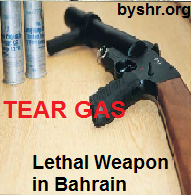
The Bahrain Youth Society for Human Rights (BYSHR) today launched an international campaign about what it is used in Bahrain to suppress the demonstrators, especially the “Tear Gas”
“We believe that the “Tear Gas” turned into a lethal weapon rather than a weapon to disperse demonstrators” Mohammed AL-Maskati, president of the BYSHR, said.
The BYSHR calls for an immediate and independent investigation for allegations of deaths and damage caused by the use of tear gas.
See full campaign work HERE
March 27, 2012 Add Comments
Nations attempt to carve up Syria in Proxy War as Syria Accepts U.N.-Arab League Peace Plan
Syria Accepts U.N.-Arab League Peace Plan
27 March, 2012 – Project on Middle East Democracy
The six-point peace plan proposed by the U.N. -Arab League special envoy to Syria, Kofi Ananan, in an attempt to end the conflict, has reportedly been accepted by Syrian regime. The plan stressed the need for the Syrian government and the opposition to agree on a cease-fire and engage in a dialogue. However the plan does not call for the resignation of President Bashar al-Assad, at the behest of Russia and China. However, China and Russia both claim to support the peace process. During a Press Briefing, U.S. Deputy National Security Advisor for the White House, Ben Rhodes, stated “I think we felt like we made some progress with regard to Syria in that, despite the differences that we’ve had — and they continue with regard to Syria — there is the framework for cooperation through the Kofi Annan initiative, which, again, at the very least provides a framework for stopping the violence, initiating greater humanitarian access to the people of Syria, and initiating a transition in that country.” However Rhodes added that the transition “has to involve Assad leaving power.”
Today, members of the Syrian opposition met in Istanbul, including the Syrian National Council (SNC), to strengthen a unity and “hammer out their objectives.” During the gathering, Bassam Jaara, SNC member, called all the parties involved on a transition process to sign “a declaration that sets Syria’s new identity after the fall of Bashar al-Assad, a Syria that is democratic, plural, civil and guarantees equality to all the Syrian people.”
Meanwhile, Iraq hosted the Arab League summit, to discuss about agreeing on a strategy to end the Syrian ‘stalemate.’ Syria was not invited to the summit. The Arab League consensus favored a Yemeni scenario, where the President would “peacefully transfer power to his vice president until new, open elections can be held,” according to Iraqi Foreign Minister Hoshyar Zebari. Zebari also called the opposition for unity ”With all our respect to the Syrian opposition … the opposition should unite before anything else. The opposition should join ranks and have one vision.”
Despite the announcement that Syrian regime accepted the Peace plan, violence continued. Violence erupted near the border between Syria in Lebanon between government and it was reported that and a single mortar shell from those clashes landed 30 or 40 yards inside Lebanon. The Local Coordination Committees, an activist group that monitors the violence, mentioned that 20 people had died on Tuesday in the central town of Hama, in Damascus and Deir Ezzor,in the east.
State Secretary Hilary Clinton will go in the Middle East later this week to drive diplomatic to end Syrian conflict. Clinton will first stop in Saudi Arabia to meet Saudi King Abdullah and Foreign Minister Prince Saud al-Faisal as well as foreign ministers of Saudi Arabia’s five Gulf Arab neighbors. State Department spokeswoman Victoria Nuland said in a press statement on Monday, Secretary Clinton “will discuss the full range of bilateral and regional issues, including ongoing security cooperation in the region, as well as the international community’s continuing efforts to stop the bloodshed in Syria.” Then, Clinton will attend to the second “Friends of Syria” summit in Istanbul on April 1st. The first summit was held in Tunis last February. Nuland said “this meeting will build upon steps that our friends, allies, and the Syrian opposition continue to take in an attempt to halt the slaughter of the Syrian people and pursue a transition to democracy in Syria.” …source
March 27, 2012 Add Comments
Use of ‘Miami model’ puts Bahrain on the Brink
Even Bahrain’s use of ‘Miami model’ policing will not stop the uprising
3 December, 2011 – theguardian
Bahraini leaders have hired the architect of Miami’s brutal policing methods, showing their disregard for reform
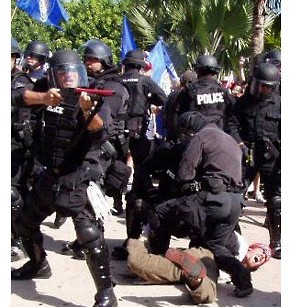
Chief Timoney graduates from Thug in Miami(top) to Brutality in Bahrain(below)
In 2003, as a photography student in Chicago, I travelled to Miami to cover protests by trade unionists and other activists at a meeting of the Free Trade Area of the Americas. I had just returned from witnessing the repressive tactics of the Israeli army against Palestinians – invasions, curfew, violent crackdown on unarmed protests – but never expected to see them deployed at home in a US city.
I was shocked when I reached Miami and found it similar to a West Bank town under occupation. The city was largely empty save for police vehicles speeding in every direction and helicopters hovering above. Once the protests began, it was impossible to move more than a few feet in any direction without confronting the police and their brutality. The thousands of police dressed in full riot gear and armed with teargas, rubber bullets, batons, electric tasers – all of which were used against protesters and journalists – were everywhere around Miami.
The “model”, as Miami public officials called it at the time, was the brainchild of police chief John Timoney. After leading the head-bashing of protesters as Philadelphia’s police commissioner during the Republican party’s national convention in 2000, Timoney was hired by Miami and given more than $8m to introduce a level of police brutality unlike any we had ever seen in the US.
In the weeks following the protests, journalist Jeremy Scahill wrote:
“No one should call what Timoney runs in Miami a police force. It’s a paramilitary group. Thousands of soldiers, dressed in khaki uniforms with full black body armour and gas masks, marching in unison through the streets, banging batons against their shields, chanting, ‘back … back … back’. There were armoured personnel carriers and helicopters.”
Journalists who were not embedded with the police were deliberately targeted. I myself was hit with teargas and rubber bullets and chased by police who tried to detain me and confiscate my photography equipment. The suffocating display of a violent police force became known as the Miami model, elements of which were frequently used in following years against other large-scale demonstrations in the US.
Now the Miami model is coming to Bahrain. The Associated Press reported on Thursday that Timoney has been hired by the kingdom’s interior ministry “as part of reforms” following the release of a report last week by a government-sponsored fact-finding commission.
As the ruling family continues the crackdown against pro-democracy demonstrators it has not been a hard task to find spent teargas canisters and other items marked “Made in USA” covering village roads.
In 2010, the US gave $20.5m to Bahrain for “peace, security and stability”. Calculated per capita, the military aid to the kingdom (which hosts the US navy’s fifth fleet) comes out at roughly $10 more per person than the $1.3bn the US gave to Hosni Mubarak’s dictatorship in Egypt that same year.
Looking to the US not only to fund the crackdown but also to help spin it, the regime has hired a number of US public relations firms. One of the PR agents, Tom Squitieri of TS Navigations, has been given space by Huffington Post and Foreign Policy blogs to write articles in defence of the ruling family.
March 27, 2012 Add Comments
USA Incarceration Nation
Zakaria: Incarceration nation
By Fareed Zakaria – 22 March, 2012
“Mass incarceration on a scale almost unexampled in human history is a fundamental fact of our country today,” writes the New Yorker’s Adam Gopnik. “Over all, there are now more people under ‘correctional supervision’ in America – more than 6 million – than were in the Gulag Archipelago under Stalin at its height.”
Is this hyperbole? Here are the facts. The U.S. has 760 prisoners per 100,000 citizens. That’s not just many more than in most other developed countries but seven to 10 times as many. Japan has 63 per 100,000, Germany has 90, France has 96, South Korea has 97, and Britain – with a rate among the highest – has 153….
This wide gap between the U.S. and the rest of the world is relatively recent. In 1980 the U.S.’s prison population was about 150 per 100,000 adults. It has more than quadrupled since then. So something has happened in the past 30 years to push millions of Americans into prison.
That something, of course, is the war on drugs. Drug convictions went from 15 inmates per 100,000 adults in 1980 to 148 in 1996, an almost tenfold increase. More than half of America’s federal inmates today are in prison on drug convictions. In 2009 alone, 1.66 million Americans were arrested on drug charges, more than were arrested on assault or larceny charges. And 4 of 5 of those arrests were simply for possession….
Bipartisan forces have created the trend that we see. Conservatives and liberals love to sound tough on crime, and both sides agreed in the 1990s to a wide range of new federal infractions, many of them carrying mandatory sentences for time in state or federal prison. And as always in American politics, there is the money trail. Many state prisons are now run by private companies that have powerful lobbyists in state capitals. These firms can create jobs in places where steady work is rare; in many states, they have also helped create a conveyor belt of cash for prisons from treasuries to outlying counties.
Partly as a result, the money that states spend on prisons has risen at six times the rate of spending on higher education in the past 20 years. In 2011, California spent $9.6 billion on prisons vs. $5.7 billion on the UC system and state colleges. Since 1980, California has built one college campus and 21 prisons. A college student costs the state $8,667 per year; a prisoner costs it $45,006 a year.
The results are gruesome at every level. We are creating a vast prisoner underclass in this country at huge expense, increasingly unable to function in normal society, all in the name of a war we have already lost…. …more
March 27, 2012 Add Comments
50 Years of UK Police Brutality
March 27, 2012 Add Comments
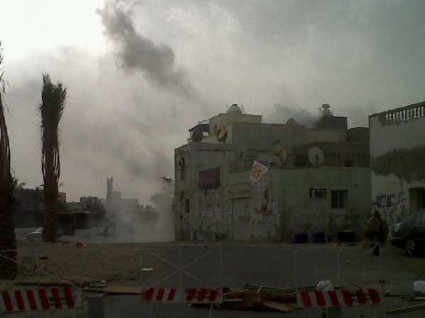
Bahrain MOI directs use of chemical agents transforming homes in “gas chambers”
Deaths through MOI deliberate and directed misuse of less-than-lethal “Tear Gas” since 14 February, 2011
1 – Alhaji Isa Mohammed from Ma’ameer, died 25.3.2011 in his house bcoz of suffocation by tear gas
2-fetus Houra from Sanabis, cited in 29.3.2011 bcoz of toxic gas that her mum has been breath in her pregnancy period
3- khadeeja from sanabis , died 5.4.2011 in her house bcoz of suffocation by tear gas
4-the child Mohammed farhan from sitra, died 30.4.2011 in his house bcoz of suffocation by tear gas
5 – Zainab altajer from sanabis , died 2.6.2011 in her house bcoz of suffocation by tear gas
6 -S.adnan from almarkh, died 23.6.2011 in his house bcoz of suffocation by tear gas
7 -Zainab aljuma from sitra, died 15.7.2011 in her house bcoz of suffocation by tear gas
8- issa altawil from sitra, died 31.7.2011 in her house bcoz of suffocation by tear gas
9-S.jawad S.ahmad from sitra, died 14.9.2011 in his house bcoz of suffocation by tear gas
10 -jaffer lotallah from abusaiba, died 30.9.2011 in his house bcoz of suffocation by tear gas
11 -infant sajida 6days frm albelad-alqadim, died 11.12.2011 n her house bcoz of suffocation by tear gas
12- abd-Ali almwali from almugsha, died 17.12.2011 in his house bcoz of suffocation by tear gas
13- salma muhsin from barbar, died 14.1.2012 in her house bcoz of suffocation by tear gas
14 -child Yaseen Al-asfour from ma’amir ,died 20.1.2012 in his house bcoz of suffocation by tear gas
15-saeed al-sekari from alne’am ,died 25.1.2012 in his house in a’ali bcoz of suffocation by tear gas
16- zahra’a al-hawaj from alne’am ,died 1.2.2012 in her house bcoz of suffocation by tear gas
17-abd-Ali abdullah from alma’amer,died 1.2.2012 in his house bcoz of suffocation by tear gas
18- Ali al-hayki from samaheej ,died 6.2.2012 in his house bcoz of suffocation by tear gas
19- Fatima albasri from alnabih salih ,died 12.2.2012 in her house bcoz of suffocation by tear gas
20-mansoor salman from sitra,died 17.2.2012 in his house bcoz of suffocation by tear gas
21-abida hussain from alsehla,died 25.2.2012 in her house bcoz of suffocation by tear gas
22-habeeb almula from alsihla ,died 29.2.2012 in his house bcoz of suffocation by tear gas
23-infant yehgya yousef 1.5M from rasroman ,died 5.3.2012 in his house bcoz of suffocation by tear gas
24-sakeena marhoon from abu saiba ,died 6.3.2012 in her house bcoz of suffocation by tear gas
25-jaffe jaseem from almugsha, died 17.3.2012 in his house bcoz of suffocation by tear gas
26-Sabri mahfudh from shahrakan, died 18.3.2012 in his house bcoz of suffocation by tear gas
27-abida Ali from jedhafs, died 23.3.2012 in hir house in a’ali bcoz of suffocation by tear gas
28- ahmad abdulnabi from shahrakan, died 24.3.2012 in his house bcoz of suffocation by tear gas
29-the Indian lady neesha , died 21.2.2012 in her house bcoz of suffocation by tear gas
end………………as of 3/26/2012
March 27, 2012 Add Comments
The al Khalifa Regime legacy of brutality against Bahrain Villagers – regime has no legitimacy
March 1996: The Ruling Al-Khalifa Family murders Isa Qambar and threatens to “wipe out villages”!
jeeran.com
1 March: The Bahraini security forces attacked the small village of Abo-Gowa, 5 km west of the capital Manamaat 8.30 pm local time. The siege by 400 fully-armed riot police continued until 3.00 am of Saturday, 2 March. House-to-house breaking-in took place and many young people were arbitrarily detained. Screams of women were heard as the undisciplined forces attacked houses and started beating people indiscriminately. This latest attack comes as part of a series of attacks on residential areas implementing the policy of “preventative measures” referred to by the prime minister in his recent statements on the events. Other areas that were attacked in the past few days include Dair, Daih, Sanabis, Duraz, Bani Jamra, Jonnossan, Karzakkan, Malkeya, Sitra, Marwazan, Arad, Demestan and Samahij.
At midnight of 3 March, the undisciplined and forces mounted a vicious attack on the village of Demestan (south-west of Bahrain). Families were attacked and many youths were snatched. Later, a similar attack was mounted against Karbabad village and clashes resulted in many people arrested.
3 March: The Bahraini crown prince, Sheikh Hamad bin Isa al-Khalifa arrived, Sunday 3 March, in London starting a tour that took him to Washington and back to London. US circles advised him to resort to dialogue. Lord Avebury propsed an initiative to resolve the crisis but the crown prince refused.
At evening (5 March) Sanabis, 5 km west of Manama, was besieged and Budaya Highway was sealed-off in that area. Heavy clashes were reported, houses were raided and many were arrested. It was also reported that live ammunition was fired as well as rubber bullets and tear gas.
One of the leading lawyers, Mr. Abdulla Abdul Rahman Hashim, was summoned by the intelligence department at 12.00 am of 5 March. Mr. Hashim was accused of agitation and contacting outside organizations. The outside organization refers to the BBC Arabic Radio which interviewed Mr. Hashim on the political situation in Bahrain.
6 March: Several loud explosions, believed to be those of gas cylinders, were heard in Ma’amir area (Sitra) and around Manama. The students of Sehla Intermediate, Jedhafs Secondary, Sheikh Abdulaziz Secondary, Jaberya Secondary schools staged simultaneous demonstrations. Security forces continued raiding houses and amongst the twelve arrested on 6 March from Sanabis is Dr. Nabil Al-Sadadi, 38 years old. The authorities continued publishing statements ahead of the major US-Gulf business conference to be held on 10 March. The nervous security forces have been mounting security operations in Sanabis and Daih as these are the nearest areas to the conference venue. An explosion in Isa Town on Wednesday 6 March at 22.00 local time resulted in the death of one person and injury of two others, according to government’s sources. The explosion occurred at the automatic teller machine of a local bank. The explosion in the National Bank of Bahrain is still a mystery. The person who was killed is Mohammed Hassan Taher Samih from Iskan-Jedhafs (new residential area of Jedhafs). Two persons were also injured one of them is serious. The injured are Mohammed Al-Mukhtar and Aqeel Naji, both from Iskan-Jedhafs. On Tuesday night (5 March) riot police attacked Iskan-Jedhafs and arrested several people.
9 March:Students in several schools marched in protest against the mass jailing of innocent peaceful people and the intimidation of residents by foreign-staffed security forces. Demonstrations re-surfaced in Jedhafs, Sanabis, Nuaim, Jabreyah, Sheikh Abdulla, Ahmad Al-Omran, Manama secondary (girls) and several other schools. Security forces stormed Jidhafs boys and girls schools and arrested many students. Similarly, riot police entered and attacked other schools to silence students. The notorious Khalid Al-Wazzan and his units attacked the small village of Jannossan again and arrested many people. …more
March 27, 2012 Add Comments
“Will of the Fields is more Persistent than Rifles of the Army” – Bahrain Human Rights Abuse on Exhibition
Bahrain Regime Violations in Pictures in Beirut
27 March, 2012 – Al Arabiya
Under the sponsorship of Lebanese Parliament Speaker Nabih Berri, “Bahrain Forum for Human Rights” inaugurated Monday in “Golden Tulip” Hotel in Beirut a 2-day photo exhibition entitled “Will of the Fields is more Persistent than Rifles of the Army”.
The event, which revealed in photos the violations that the Bahraini authority practiced against peaceful, armless demonstrators in the fields, began with Bahraini revolutionary songs, an opening speech for “Bahrain Forum for Human Rights” Chief Youssef Rabih, and another statement for the event sponsor delivered by Sheikh Hasan Al-Masri.
In his statement, Rabih pointed out that the Bahrain Forum in Beirut wanted to deliver a message that “oppression intensifies when democracy is absent”.
He stressed unity between the Shiites and the Sunnis in Bahrain, stating that “Bahraini Sunnis and Shiites, Conservatives and Liberals will always support each other in saying that : We demand freedom and justice… and you must hear this voice.”
The Bahraini activist indicated that “this exhibition responds to the misleading media which boycotted the developments in Bahrain to cover other revolutions that we are also proud of.”
Rabih added that the forum has sent a letter to UN Secretary General Ban Ki-Moon, asking him to interfere in the case of imprisoned Bahraini activist Abdul Hadi Khawaja who has been on a hunger strike for 45 days now.
In an exclusive statement to Al-Manar Website, “Bahrain Forum for Human Rights” chief emphasized that “the peaceful movements and the sacrifices assure that the Bahraini people are full of life, and that the regime’s tanks, armored vehicles and toxic gases cannot destroy them.”
“Photographers are everywhere. They are on the roofs, in the fields, and behind the windows to uncover the real moral crisis of the Bahraini regime,” he said.
For his part, Sheikh Hasan Al-Masri considered that the real Arab Spring is that which calls for human rights, freedom, and justice, adding that “we tell the leaders what Sayyed Moussa Al-Sadr said 30 years ago: Do just or else you will look for your nation and find in the dunghill of history.” …more
Video via PressTV HERE
March 27, 2012 Add Comments