…with the fear of tyranny dead, the tryrant becomes powerless. Is this not revolution?
April 4, 2012 Add Comments
An example of Obama’s “quite diplomacy” with “friends” in Bahrain
April 4, 2012 Add Comments
Abdulhadi al-Khawaja, Situation Critical
Twitter: angry arabiya @angryarabiya: In todays call, we cud no longer hear my fathers smile in his voice…
Free Alkhawaja! @KhawajaStrike It’s 1am in #Bahrain. #AlKhawaja has turned 51 while entering his 57th day of hunger strike. Doctors say he can’t survive for much longer.

Bahrain transfers jailed activist on hunger strike to prison clinic for observation
By Associated Press – 4 April, 2012 – Washington Post
MANAMA, Bahrain, — An imprisoned Bahraini human rights activist, who has been on a hunger strike for more than 50 days has been moved to a prison clinic for medical observation and care, authorities said Wednesday.
Abdulhadi al-Khawaja is serving a life sentence for his role in last year’s uprising in the Gulf kingdom. He was arrested last April during a crackdown against anti-government protests led by Bahrain’s Shiite majority that has been demanding greater rights from the island nation’s Sunni rulers.
Al-Khawaja, who is also a Danish citizen, has been refusing food since Feb. 8.
Bahrain’s opposition supporters have been rallying for his release almost daily. Another protest is planned for later Wednesday.
Last week, Amnesty International urged Bahrain to free him because of fears he could die. On Tuesday, the Danish government said it has been “exerting maximum efforts” to have al-Khawaja sent to Denmark for medical treatment.
A government statement on Wednesday said the prison’s rehabilitation official recommended the day before that al-Khawaja be transferred to the clinic “for constant medical observation and care.”
It said that medical tests have showed al-Khawaja has lost “approximately 10 kilograms and was showing signs of low hemoglobin, although not at a critical level.” It gave no further details on his health.
Al-Khawaja is one of seven opposition figures who have been sentenced to life imprisonment in a special security court, which was set up after Bahrain imposed martial law last March to quell political unrest in the tiny, but strategically important nation.
Bahrain is the home of the U.S. Navy’s 5th Fleet.
Hundreds of other Bahrainis including protesters, activists, athletes and Shiite professionals such as doctors and nurses have been tried in the court. Dozens were jailed after being convicted of anti-state crimes, including medics who treated injured protesters during the unrest.
Bahrain lifted martial law in June. The special tribunal was disbanded in November and all protest-related trial were transferred to civilian courts. Al-Khawaja’s lawyers appealed his conviction in Bahrain’s highest court on Monday when judges refused to release him on bail. …more
April 4, 2012 Add Comments
Obama sends US Troops to Australia to destabilize region and improve prospects for weapons profiteering
US Marines Arrive in Australia
Phil Mercer – VOA – 4 April, 2012
United States Marines of Fox Company, 2nd Battalion, 3rd Marine Regiment complete quarantine checks as they arrive at a Royal Australian Air Force Base in Darwin, April 4, 2012.
Photo: Reuters
United States Marines of Fox Company, 2nd Battalion, 3rd Marine Regiment complete quarantine checks as they arrive at a Royal Australian Air Force Base in Darwin, April 4, 2012.
U.S. Marines have started to arrive in northern Australia as Washington strengthens its presence in the strategically vital Asia-Pacific region. Two hundred troops touched down in Darwin late Tuesday as part of a deployment outlined during a visit to Australia by President Obama in November, a move that has irritated China.
The detachment is the first batch of an expected deployment of 2,500 military personnel to be posted to northern Australia.
The troops are based in Australia’s Northern Territory on a six-month rotational basis and will be stationed at Robertson Barracks on the outskirts of Darwin.
The Australian government says the arrangement was the latest chapter in a six-decade military alliance with the United States.
Australian Defense Minister Stephen Smith says the stationing of U.S. Marines in Darwin is in the interests of global peace and stability.
“The world is to essentially comes to grips with the rise of China, the rise of India, the move of strategic and political and economic influence to our part of the world and we need to ensure that we do that in a way in which the international community responds to that change, manages that change and we believe very strongly that what we are doing will enhance that rather than detract from it,” he said.
Australia is keen to stress that the U.S. military presence will only be temporary and that there are no plans for any permanent American bases on its soil. U.S. officials also say that they want to expand their disaster relief capabilities in Southeast Asia. …more
April 4, 2012 Add Comments
Visiting Bahraini activist Al-Khawaja tells of state-led torture and killings
After being held at Cairo’s main airport for hours, celebrated Bahraini human rights worker Maryam Al-Khawaja makes downtown conference to relate continued abuses of protesters by the island state’s government
Visiting Bahraini activist Al-Khawaja tells of state-led torture and killings
3 April, 20120 – Osman El Sharnoubi – ahram.online
Al-Khawaja is a human rights activist and head of the foreign relations office for the Bahrain Centre for Human Rights (BCHR), co-founded by her father, Abdulhadi Al-Khawaja. He is presently serving a life sentence in Bahrain for anti-state crimes.
After landing in Cairo airport, Al-Khawaja was initially denied entry due to being “blacklisted and banned,” said Al-Khawaja on her Twitter account citing the Bahraini embassy. However, her lawyer was able to get her through customs hours later.
Al-Khawaja and another Bahraini student activist, Iman Oun, each spoke at the conference held Monday afternoon about the Bahraini uprising and current conditions in the island kingdom.
Al-Khawaja started by relating the recent developments in the recent Bahraini protest movement, which began in February 2011.
The state continues to carry out systematic violations of human rights even after the government initiative, known as the “Bassiouni report”, which supposedly investigated these abuses, was published, Al-Khawaja explained.
The Bassiouni report, or the Bahrain Independent Commission of Inquiry (BICI) was a government sponsored probe into the events of February and March 2011. It was published in a few months later in November last year.
The BICI said it found cases of abuse and torture by regime forces as well as, allegedly, violence on the part of protesters to be true.
Al-Khawaja refutes the regime’s assertion that reforms are being implemented following recommendations by the BICI. Claims that individual rights, human rights and freedoms are being respected are false, the Bahraini activist said. In contrast, Al-Khawaja added, they have increased.
She continued by asserting that excessive use of force, torture and killings are perpetrated daily by security and intelligence forces with impunity.
She mentioned the story of a 16-year-old boy who was, reportedly, sexually abused and tortured for refusing to work as an informant. When the boy decided to press charges against the security apparatus, he was tried for submitting a false report.
One of the main problems, believes Al-Khawaja, is the lack of accountability.
Officials committing crimes, even when acknowledged by the government in the BICI, are not held accountable but on the contrary, she added, they are lauded and even promoted. …more
April 4, 2012 Add Comments
Bahrain: Abdulhadi al-Khawaja life in Imminent Danger on day 56 of “Freedom or Death” Hunger Strike
‘Al Khalifa regime proves worse than Israel’
PressTV – 4 April, 2012
The health of prominent Bahraini human rights activist Abdulhadi al-Khawaja has worsened as he entered the 55th day of his hunger strike in jail.
His daughter Maryam al-Khawaja says there are now fears that Abdulhadi may go into a coma any time. He is being held despite mounting popular calls for his release.
On Tuesday, a group of Bahraini women held a sit-in outside the US embassy in Manama, against al-Khawaja’s detention.
Press TV talks with Dominic Kavakeb, with the Bahrain Justice and Development Movement from London, regarding the issue. What follows is a transcript of the interview.
Press TV: Mr. Khawaja has been on a hunger strike for the past 55 days. We know his condition is deteriorating and there is a growing concern that he may die in prison but the regime in Bahrain is refusing to release him.
At the same time, a Palestinian woman Hana Shalabi who was on a hunger strike in an Israeli jail for the past 44 days was released a few days ago. The comparison might point to the fact that the situation for Mr. Khawaja in a Bahraini jail is worse than Hana Shalabi’s conditions in an Israeli prison.
Kavakeb: Yes, I think it is a real shame for Bahrain that really Israel seems to be more lenient in this case than Bahrain itself. It is really quite worrying for Bahrain and embarrassing.
As you say, he is now entering the 55th day of his hunger strike and he is still being refused to be released and I think it shows just how important leaders and activists like Abdulhadi al-Khawaja are for the Bahraini people there.
The government will refuse to release them because they know how important they are, what characters they are and how they can inspire the population into protesting. So it does not look like they are going to release him at the moment.
There was another appeal today but he is still behind bars and it is looking increasingly dangerous for his life now, as you said.
Press TV: Despite the pressures and the brutal clampdown, the protests are continuing in Bahrain. How far do you think the revolutionaries will keep up with their demands?
Kavakeb: They will keep up with their demands until they win their demands. I fundamentally believe that and I think they made that clear over the past year by continuously coming out to protest, despite that in face of the huger pressure, etc. that continues to come out onto the streets.
So there is no reason to think that they will stop until they achieve the democratic change that they are fighting for and I think Abdulhadi al-Khawaja really exemplifies the fact that this is now, as you say, 55 days of hunger strike and he is still continuing to pursue it.
And there is no doubt at the moment and he will do that; he will keep going, as he said, until death or freedom. Those are his words and that really sums up the mood of the Bahraini people. …more
April 4, 2012 Add Comments
Bahrain Homes turned into gas chambers by misuse of chemical gas
April 3, 2012 Add Comments
Bahrain improving human rights one cracked head at a time

Bahrain: Crushing Pro-Democracy Protests. American and British Police Chiefs Step Up State Repression Top Western appointments allegedly aimed at improving human rights…
29 March, 2012 – by Finian Cunningham – Global Research
Two former police chiefs from the US and Britain have brought discernible Western “expertise” to the Bahraini force only weeks following their appointments – a surge in repression and state terrorism.
Former Miami police chief John Timoney and his British counterpart, John Yates, formerly commander at London’s Scotland Yard, were assigned last month by Bahrain’s royal rulers to “oversee reform” of the Persian Gulf kingdom’s security forces. Officially, the appointment of the American and Briton was to bring Western professional policing to the Bahraini force and specifically to upgrade the human rights record of Bahrain’s ministry of interior and National Security Agency.
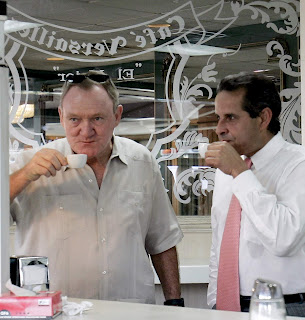
Timoney left sips coffee while villages being attack with chemical gas
The assignments were announced by King Hamad Al Khalifa following a report by an international commission of inquiry into widespread human rights violations in the US-backed oil kingdom since pro-democracy protests erupted there last February.
As reported earlier by Global Research, the inquiry report and the subsequent appointment of the US and British police chiefs appeared to be a public relations exercise to burnish the tarnished image of this key Persian Gulf ally of Washington and London [1].
However, only weeks into their jobs, the Western commanders appear to have been given a remit that goes well beyond public relations, namely, to sharpen the repression against the pro-democracy movement.
Human rights activists and several political sources say that state forces have dramatically stepped up violence towards protesters and targeting of the Shia community generally. The diminutive island state of less than 600,000 nationals is comprised mainly of Shia muslims (70 per cent) who are ruled over by a Sunni elite installed by Britain when the kingdom gained nominal independence in 1971. American and British government support for the unelected Al Khalifa monarchy is viewed by the majority of Bahrainis as being at odds with their claims for democratic rights.
Over the past year, Bahraini state forces have killed some 50 people; thousands have been maimed, wounded and detained, many of the latter tortured. Proportionate to its population, such state violence is comparable to what Washington and London have loudly denounced the Libyan and Syrian regimes for – indeed mounting a military invasion of the former and threatening to do so in the latter – under the guise of “protecting human rights”. By contrast, there is hardly a word of denunciation from Washington or London towards the Bahraini regime, which hosts the US Navy’s Fifth Fleet. …more
April 3, 2012 Add Comments
One size fits all talk of “Arab Spring” is an injustice
Bahrain’s uprising is more complex than the way it’s usually described.
Bahrain: One of Many Arab Springs
31 March, 2012 – Mitchell A. Belfer – M mathaba
The prevailing tendency to depict unrest in the Middle East as symptomatic of region-wide social and political injustice, exacerbated by suppression of dissent and a lack of democracy, is dangerously myopic. Using this template keeps observers from knowing the specific reasons for violent political demonstrations, by treating crowds as the rudderless, leaderless sum of their parts.
But crowds are not rudderless. They are governed — often by leaders who deliberately misremember the past in order to misconstrue the present, for better or worse — and those who govern them must be held accountable for their actions, especially when human life is sacrificed. So despite strong desires to forgive “unthinking crowds” for waves of destruction, especially when carried out for “progressive” reasons, individual accountability is key.
Too many political activists are allergic to self-reflection and tend to deflect calls for dialogue and moderation. They prey on the truth — manufacturing convenient politics with modern technologies and shrewd imaginations — to fulfill their own larger objectives. This has resulted in the proliferation of serial revolutionaries who upload decontextualized or manipulated pictures and videos to the Internet. Owing to the moral (and financial) austerity of many news agencies, such uploads are accepted, replayed with only scant warning that “independent verification” is impossible.
Within such a climate, how can accuracy be restored, and accountability applied, to balaclava-clad warriors who occupy the stern of revolutionary movements? The key is to deconstruct each crowd, reveal those individuals whose objectives are gaining power for themselves, and force them to practice democracy — not the democracy of votes, but of public accountability. Elections are just a part of democracy, dwarfed by bonds of social trust and a stable civil society. There can be no democracy without civil society, and civil society cannot exist in an atmosphere of political violence.
A criminalization of political violence must therefore be instituted, weighing each action on its merit so that assault is treated as assault, murder as murder, and arson as arson. In the Middle East, too many morally dubious actions are routinely categorized as legitimate political expressions, or suppressions, instead of crime. Whether committed by demonstrators or members of a state’s security forces, crime must be recognized as crime.
As these points become more widely grasped, broadly depicting Arab unrest as a “Spring” is becoming passé, and each demonstration has started to be viewed within its specific context. Members of crowds are finally being distinguished to see who is an honest demonstrator for economic and political reform, who is a radical, who is being manipulated by external actors, who is a criminal, and who a victim of circumstance.
Still, many in the media have not gotten the message. Misplaced shock accompanies reports that Libya’s Benghazi or Misurata crowds have been infiltrated by al-Qaeda, and that the Syrian opposition is actually a motley crew of radical ethno-religious movements. Few have publicly explored the segregation of men and women in Bahrain’s demonstrations, or the tribal nature of those in Yemen. Few have sought to identify the members of demonstrations to understand the essence of what is actually occurring. …more
April 3, 2012 Add Comments
French Chemical Gas deployed against Bahrain portesters
Bahrainis protest against use of tear gas
29 March, 2012 – France 24
AFP – Hundreds of Bahrainis staged on Thursday a sit-in outside the offices of the United Nations demanding action over the “excessive” use by police of tear gas against protesters.
Protesters gathered outside the UN house in Manama, in a rally organised by the Shiite-led opposition, according to a statement by Al-Wefaq, the main opposition formation.
Police are regularly clashing with protesters who take to the streets in Shiite villages despite last year’s brutal crackdown on a month-long protest that demanded democratic change in the Sunni-ruled Gulf monarchy.
Protesters, including men and women, wore medical masks and carried used tear gas canisters of the type reportedly used by police to disperse demonstrations, according to pictures provided by the opposition.

Dozens of used tear gas canisters were also piled up by the protesters outside UN offices, the pictures showed.
Protesters chanted slogans demanding the international community to “take a stance against those crimes, and dangerous violations by Bahraini authorities against unarmed” people, said the statement.
Representatives of the opposition delivered a letter addressed to UN Secretary General Ban Ki-Moon demanding action.
“This excessive use (of tear gas) is a daily flagrant violation to the UN’s Basic Principles on the Use of Force and Firearms by Law Enforcement Officials,” the letter said.
The UN High Commissioner for Human Rights last week criticised Bahraini forces for their “disproportionate use of force” as they sought to quell protests, saying their use of tear gas may have led to over 30 deaths.
“We have been receiving worrying reports of the disproportionate use of force by Bahraini security forces, including the excessive use of tear gas, the use of birdshot pellets and rubber bullets,” said spokesman Rupert Colville. …source
April 3, 2012 Add Comments
Support Bahrain Don’t Come to the F1

April 3, 2012 Add Comments
The Revoltuion Since 14 February, 2011
April 3, 2012 Add Comments
Whitewash is not reform! Dialogue is not necessary for regime about face!
Whitewashing the regime: Bahrain, press freedom paradise?
WAN IFRA – 2 April, 2012
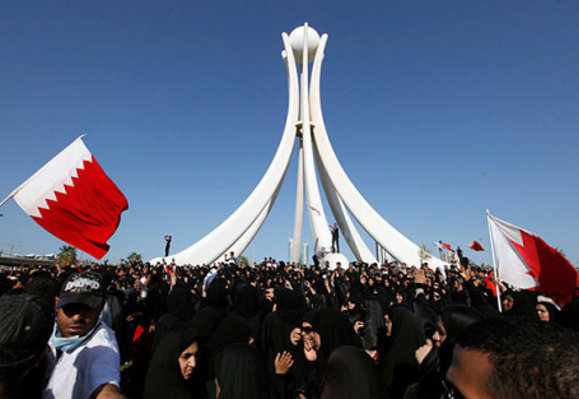
Inspired by events in Tunisia and Egypt, the people of Bahrain took to the streets on 14 February, 2011 demanding change. More than a year after protests began on Pearl Roundabout, the epicentre of the Bahraini revolution, many argue that little has changed for the better. For the press, this sentiment is echoed most acutely.
A number of organisations have conducted missions and produced reports that investigate the state of freedom of expression in Bahrain, only to come up with one common result; things are getting worse. Journalists and human rights defenders have faced military trials, life imprisonment, torture, harassment, and in some cases even death whilst in the custody of the Bahraini authorities.
Despite this, Manama named itself the Capital of Arab Press for 2012 (it has been awarded the status of Capital of Arab Culture for 2012 by the Arab League as part of UNESCO’s cultural capitals programme), and recently hosted the Arab Youth Media Forum under the patronage of King Hamad Al-Khalifa. “This choice is the result of the freedom of the press enjoyed by Bahrain thanks to the reform project of His Majesty King Hamad bin Isa Al Khalifa as well as IAA attraction of Arab and international media institutions to operate from Bahrain,” said Information Affairs Authority President Shaikh Fawaz bin Mohammed Al Khalifa in an interview with the state-run Bahrain News Agency (BNA). Shaikh Fawaz also pointed out that “the King has asserted on many occasions that no journalist will be imprisoned nor will any newspaper or media establishment be closed,” adding that “approving a modern press and publication law reflects HM the King’s full support to Bahrain’s press.” The choice seems incongruous at best given the numerous attacks against independent journalists documented throughout 2011 – and that are reportedly still on-going.
Newspapers in Bahrain are mostly state-controlled, with the exception of Al-Wasat whose staff have certainly paid the price for being the only opposition newspaper. On 12 April 2011, Al-Wasat founder Karim Fakhrawi died after spending a week in police custody. Bahrain’s official news agency published on its Twitter page the news that Fakhrawi died of kidney failure, however photographs later emerged online showing the body identified as Fakhrawi’s covered in extensive cuts and bruises. Mansoor Al-Jamri was forced to resign from his position as Editor-in-Chief after being found guilty by a Manama court on 8 November 2011 of publishing false news and “harming Bahrain’s image” along with Managing Editor Walid Noueihed, Local News Director Aqeel Mirza, and Senior Editor Ali Al-Sherify. The four men each had to pay a fine of 1,000 dinars (US$2,650). …more
April 2, 2012 Add Comments
One year on US complicity and support of Bahrain Regime takes country to brink of Civil War
April 2, 2012 Add Comments
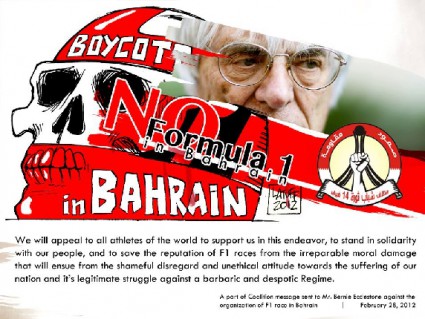
Bahrain F1, 2012 – Stop the Blood Money, Don’t Come!
April 2, 2012 Add Comments
The whole monarchy of Bahrain, Saudi Arabia, GCC, if you don’t reform, listen to the demands of the people you will go away
April 2, 2012 Add Comments
Human rights defender, Maryam AlKhawaja enters Egypt after being threatened with deportation
Human rights defender enters Egypt after being threatened with deportation
Viral Chopra – 2 April, 2012
Maryam Al-Khawaja, Bahraini human rights defender has been allowed to enter Egypt after being held at Cairo international airport for several hours on her arrival early Monday morning. She had travelled to Cairo from Copenhagen via Warsaw to attend a human rights conference but Egyptian border authorities told her she had been blacklisted and would be deported back to her country. News of Maryam Al-Khawaja’s detention quickly spread around via Twitter. A number of prominent Egyptian activists and her acquaintances tried to make a contact to help her. Another Palestinian Blogger and human rights defender Majed AbuSalama was also held at the airport at the same time as Maryam Al-Khawaja, but he was immediately deported back to Gaza.
Maryam Al-Khawaja comes from a Bahraini family known for its political activities. She is the daughter of human rights activist Abdulhadi Al-Khawaja, who is currently serving a life sentence in a Bahraini prison for his role in the country’s uprising, and sister to prominent blogger Zainab Al-Khawaja, better known as @angryarabiya. While there are counter statements that it was in fact a name mix-up at the border, Al-Khawaja was tweeting live @maryamalkhawaja and claiming that she was in fact denied access, and describing her treatment.
…more
April 2, 2012 Add Comments
Day 55 of Abdulhadi al-Khawaja “freedom or death” hunger strike as Court schedules Appeal case for 23 April
Lawyers appeal sentence for Bahrain hunger striker
2 April, 2012 – Associated Press – AJC
MANAMA, Bahrain — Lawyers for a Bahraini human rights activist who is on hunger strike and attorneys for 20 other opposition figures appealed their convictions on anti-state charges on Monday.
Activist Abdulhadi al-Khawaja is serving a life sentence for his role in last year’s uprising in the Gulf kingdom. Seven other prominent opposition leaders were also sentenced to life imprisonment. Another 12 received lengthy prison sentences in a special security court, which was set up after the country imposed martial law last March to quell political unrest.
Al-Khawaja was arrested in April during a government crackdown on protests staged by the country’s Shiite majority demanding greater rights from Sunni rulers.
His lawyer Mohammed al-Jaishi said that he and the attorneys for the other 20 leaders appealed their clients’ convictions and sentences during Monday’s session in Bahrain’s Court of Cassation.
The attorneys also asked a five-judge panel to free the prisoners on bail — a request the judges declined, al-Jaishi said.
Another hearing in the case was set for April 23.
The 21 activists were convicted by a special security court in June of participating in efforts to overthrow the ruling dynasty. Of those, seven had been tried in absentia.
Al-Khawaja has been on hunger strike for more than 50 days. He has been refusing food since Feb. 8.
Last week, Amnesty International urged Bahrain to free him because of fears he could die. …more
April 2, 2012 Add Comments
F1 fund State sponsored murder in Bahrain as protester gunned down in street by plain clothes operatives
Bahrain protests flare against F1 after protester dies
02 April, 2012 – The Telegraph
Ahmed Ismael Abdulsamad was shot in the right thigh on Saturday as he filmed a protest in the Shia village of Salmabad that plainclothes security forces tried to break up with tear gas and rubber bullets.
Opposition groups blamed “militiamen” accompanying security forces fired live bullets at the protesters from a civilian car, hitting Abdulsamad.
Dozens of young protesters gathered in the village of Abu Saiba, west of Manama, and Tubli, south of the capital, according to postings by the Coalition of the Youth of the February 14th Revolution on Facebook.
Police fired tear gas to disperse the small gatherings and made some arrests, according to provided footage.
Activists have intensified their campaign to push Formula One to cancel the Bahrain round of the world championship, slated for April 20-22 at the Sakhir circuit, southwest of Manama.
The race was cancelled last year due to the unrest that gripped the Shiite-majority state after a mid-March brutal crackdown on protests demanding democratic reforms that would challenge the power of the Sunni Al-Khalifa ruling dynasty.
“We (object to) holding a sports race that belittles the sacrifices of our children and ignores our suffering and wounds,” said a statement read by a youth dressed in a white death shroud and a black hood, according to a video posted online.
“Do not tarnish the reputation of the respected auto sport with the blood of Bahrain victims.”
On Twitter, a whole campaign has been launched against the return of the Grand Prix to Bahrain.
“Stop, my blood is flowing” and “race over blood,” were two slogans posted by activists on Twitter, where hashtags like BloodyF1 and NoF1 generate scores of tweets.
Formula One supremo Bernie Ecclestone has insisted that the outbreak of fresh violence will not affect this year’s grand prix.
Defending champion Sebastian Vettel and seven-time winner Michael Schumacher lately supported the return to Bahrain. …more
April 2, 2012 Add Comments
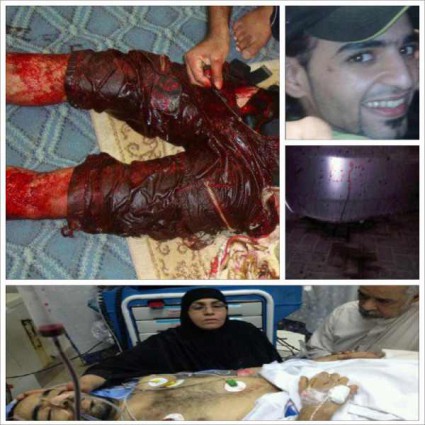
Ahmed Ismail, Assassinated by MOI Plain Clothes Operatives while filming a Peaceful Protest, 30 March, 2012
Bahrain: Armed civilians affiliated with the security forces kill a citizen journalist
31 March 2012 – Bahrain Center for Human Rights
Bahrain Center for Human Rights condemns the continued use of excessive force against unarmed protesters and the targeting of media people who cover these protests that has resulted in a new death of a cameraman.
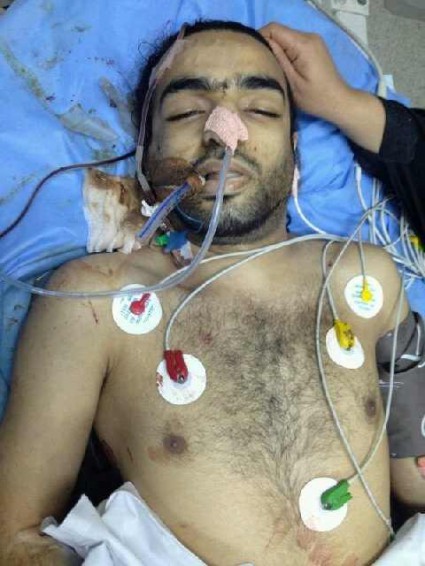
Citizen journalist and cameraman, Ahmed Ismael Hassan AlSamadi, (22 years old) from Salmabad, was shot in the right thigh (lower abdomen) last night at around 01:30 AM 31 March 2012, and was later announced dead. According to eye witnesses, there was peaceful protest in Salmabad which was suppressed by security forces with tear gas and rubber bullets. Armed men in a civilian car (Toyota Land Cruisers) accompanying the security forces were shooting live rounds at protesters.
Witnesses said Ahmed was filming the violations of security forces. At approximately 1:30 am he was shot with a laser-guided weapon by one of the civilian vehicles accompanying the formal security forces. He was hit in the upper right thigh (lower abdomen), as he was targeted for holding a video camera. (top right – photo of the camera with Ahmed’s blood on it). …more
March 31, 2012 Add Comments
Saudi oil fields may go up in flames as King Abdullah agitates conflict with Syria
Clinton in Saudi amid oil supply concerns
30 March, 2012 – Al-Akhbar
US Secretary of State Hillary Clinton met Saudi Arabia’s king and foreign minister in Riyadh on Friday to discuss the Syria conflict against a backdrop of tension with Iran and oil policy differences.
The world’s main superpower and its top oil exporter have been strategic allies since the 1940s, but discord over how to respond to Arab popular uprisings strained relations last year.
“Both sides have recognized that their common interests are much more significant than the issues that have recently been dividing them,” said Robert Jordan, US ambassador to Saudi Arabia from 2001-03, citing anti-terrorism cooperation, concerns over a nuclear Iran, and wider Middle East stability.
Pictures broadcast on state television showed Clinton meeting King Abdullah as other officials, including Foreign Minister Prince Saud al-Faisal, Defense Minister Prince Salman, and Intelligence Minister Prince Muqrin, looked on.
Although the two states have mended the rift, differences persist on regional policy and how to tackle high oil prices.
The United States and other consumer countries fear Saudi Arabia may cut oil output if they release emergency reserves, neutralizing their effort to cool world energy markets.
Diplomats and industry sources said Western countries may want Clinton to seek reassurances that the Saudis will not undercut their bid to cut their fuel costs. …more
March 31, 2012 Add Comments
Bahrain Youth Society for Human Rights, demands the immediate release of 14 prominent activists
14 prominent activists Appeal on 2 April before the Court of Cassation
30 March, 2012 – Bahrain Youth Society for Human Rights
The were arrested after protests February 14 and have been protests calling for democracy and human rights.
14 prominent activists Appeal on 2 April, 2012 before the Court of Cassation in ordinary court.
On the 22th of June 2011, Military Court judge issued a sentence on 21 defendants:
1-Abdulwahab Hussain Ali ( life sentence imprisonment)
2-Ibrahim Sharif Abdulraheem Mossa ( 5 Years imprisonment)
3-Hassan Ali Mushaima.( life sentence imprisonment)
4-Abdulhadi Al Khawaja ( life sentence imprisonment)
5-Abduljalil Abdullah Al Singace.( life sentence imprisonment)
6-Mohammed Habib Al Safaf. ( Mohammed Habib Miqdad) ( life sentence imprisonment)
7-Saeed Mirza Ahmed. ( Saeed AlNouri) ( life sentence imprisonment)
8-Abduljalil Mansoor Makk. (Abdul Jalil Miqdad) ( life sentence imprisonment)
9-Al Hurra Yousif Mohammed.( 2 Years imprisonment)
10-Abdullah Isa Al Mahroos.( 5 years imprisonment)
11-Salah Hubail Al Khawaj.( 5 years imprisonment)
12-Mohammed Hassan Jawad.( 15 years imprisonment)
13-Mohammed Ali Ismael. ( 15 years imprisonment))
14-Abdul Hadi Abdullah Mahdi Hassan ( Abdulhadi AlMukhodher) ( 15 years imprisonment)
Defendants ( in Absentia) :
15-Akeel Ahmed Al Mafoodh.( 15 years imprisonment)
16-Ali Hassan Abdullah.( Ali Abdulemam) ( 15 years imprisonment)
17-Abdulghani Ali Khanjar.( 15 years imprisonment)
18-Saeed Abdulnabi Shehab.( life sentence imprisonment)
19-Abdulraoof Al Shayeb.( 15 years imprisonment)
20-Abbas Al Omran.( 15 years imprisonment)
21-Ali Hassan Mushaima.( 15 years imprisonment)
Attached information about the Defendants – Click Here
The Bahrain Youth Society for Human Rights (BYSHR) has issued list of charges and articles (click here) used by the military prosecutor to prosecute 21 opposition leaders and human rights defenders. …more
March 31, 2012 Add Comments
Dr. Kissinger on Arab Spring and Doctrine of Intervention
A new doctrine of intervention?
By Henry A. Kissinger – 30 March, 2012 – Washington Post
Henry A. Kissinger was secretary of state from 1973 to 1977
Not the least significant aspect of the Arab Spring is the redefinition of heretofore prevalent principles of foreign policy. As the United States is withdrawing from military efforts in Iraq and Afghanistan undertaken on the basis (however disputed) of American national security, it is reengaging in several other states in the region (albeit uncertainly) in the name of humanitarian intervention. Will democratic reconstruction replace national interest as the lodestar of Middle East policy? Is democratic reconstruction what the Arab Spring in fact represents?
The evolving consensus is that the United States is morally obliged to align with revolutionary movements in the Middle East as a kind of compensation for Cold War policies — invariably described as “misguided” — in which it cooperated with non-democratic governments in the region for security objectives. Then, it is alleged, supporting fragile governments in the name of international stability generated long-term instability. Even granting that some of those policies were continued beyond their utility, the Cold War structure lasted 30 years and induced decisive strategic transformations, such as Egypt’s abandonment of its alliance with the Soviet Union and the signing of the Camp David accords. The pattern now emerging, if it fails to establish an appropriate relationship to its proclaimed goals, risks being inherently unstable from inception, which could submerge the values it proclaimed.
The Arab Spring is widely presented as a regional, youth-led revolution on behalf of liberal democratic principles. Yet Libya is not ruled by such forces; it hardly continues as a state. Neither is Egypt, whose electoral majority (possibly permanent) is overwhelmingly Islamist. Nor do democrats seem to predominate in the Syrian opposition. The Arab League consensus on Syria is not shaped by countries previously distinguished by the practice or advocacy of democracy. Rather, it largely reflects the millennium-old conflict between Shiite and Sunni and an attempt to reclaim Sunni dominance from a Shiite minority. It is also precisely why so many minority groups, such as Druzes, Kurds and Christians, are uneasy about regime change in Syria.
The confluence of many disparate grievances avowing general slogans is not yet a democratic outcome. With victory comes the need to distill a democratic evolution and establish a new locus of authority. The more sweeping the destruction of the existing order, the more difficult establishment of domestic authority is likely to prove and the more likely is the resort to force or the imposition of a universal ideology. The more fragmented a society grows, the greater the temptation to foster unity by appeals to a vision of a merged nationalism and Islamism targeting Western values. …more
March 31, 2012 Add Comments
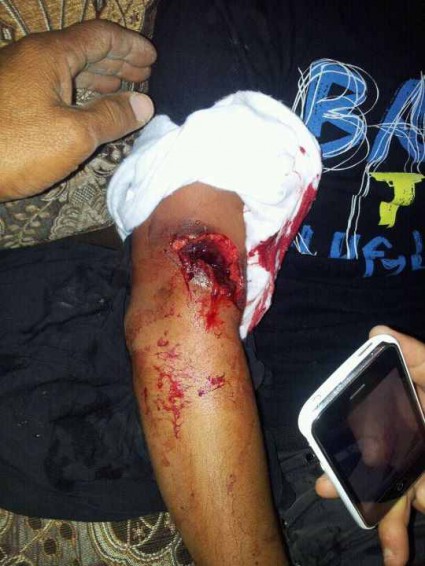
MOI Police cause serious injury with “shoot to kill” tactic deployed using Chemcial Gas Canisters in “direct hits” on victims
March 31, 2012 Add Comments
Salmabad Streets littered, strewn with Chemical Gas Canisters in Salamabad as protesters flee new attack
March 31, 2012 Add Comments