The Enablers of Human Rights Abuse
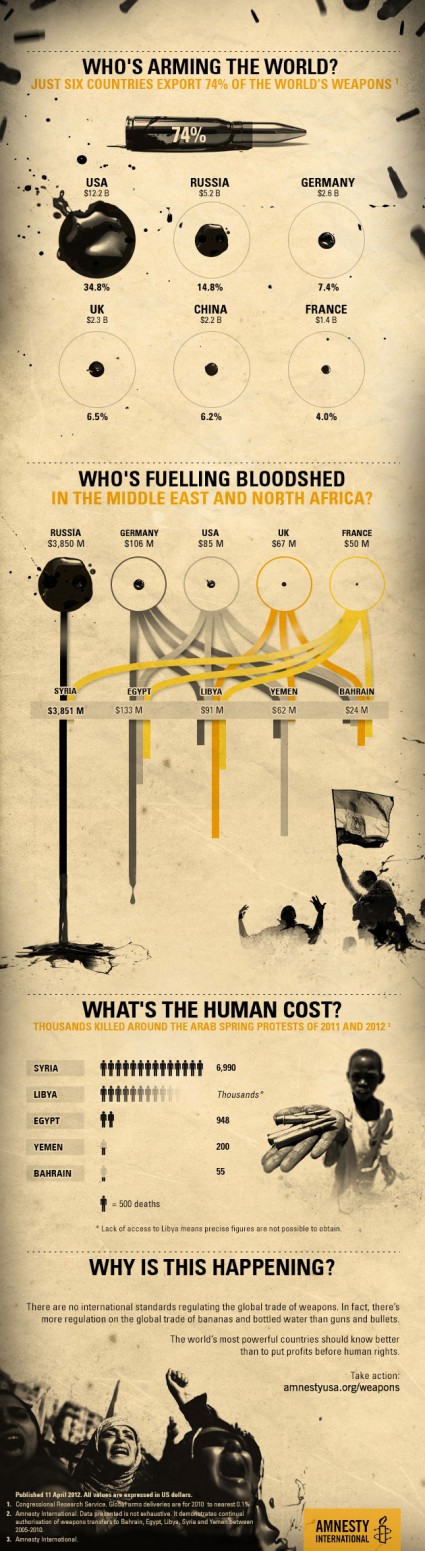
Shocking Facts About Who’s Arming Human Rights Abusers
12 April, 2012 – Amnesty Interational
Just six countries export a whopping 74 percent of the world’s weapons, with the US making up 35 percent of the global total.
Treaties regulate the global trade of many products – even bananas and dinosaur bones – but not guns and bullets. We need a strong Arms Trade Treaty that will stop tools of death from getting into the hands of people like Syria’s Assad and Sudan’s Bashir who continue to brutalize their people.
In July, UN member countries will debate the adoption of a global Arms Trade Treaty. Take action to make sure they make the right decision — to keep weapons out of the wrong hands!
April 12, 2012 Add Comments
F1 Circus – MOI scandal riddled “hired gun” Yates, reassures F1 attendees. US calls to protect protesters
Yates is a credible figure to a point, he is after all being employed by the Interior Ministry; he was forced to resign from the police over the way he conducted the investigation into the phone hacking scandal at the News of the World. Yet despite his intervention and the British Government’s ongoing advice that travel to Bahrain is not restricted, the teams’ own risk assessments indicate that there are potential risks from isolated incidents and even a kidnap risk. They are also concerned about protestors getting hurt whilst making their voices heard against F1′s presence in the country, as everyone feels is inevitable.
FIA sends out message that Bahrain is safe for F1 as US government speaks up
12 April, 2012 – Darren Heath – JA.F1
[Updated] In the paddock at Shanghai today the talk is all on one subject: the Bahrain Grand Prix and whether it will take place next week. Although an emerging protest into the Mercedes front wing looks like it will soon take some of the spotlight off the politics.
The Bahrain situation is now acquiring an acute feel to it, with many team members and media due to fly from Shanghai to Bahrain in little over 72 hours time. The teams are clearly very concerned about the event and looking to the FIA for leadership.
FIA president Jean Todt will arrive in Shanghai on Friday night and will come into the circuit on Saturday, while Bernie Ecclestone arrived today and will meet with the 12 teams at lunchtime on Friday. Ecclestone told Reuters this afternoon that the race is on, unless the Bahrainis themselves decide to call it off.
Although he has said nothing on the matter in public, Todt has today issued a letter from former Metropolitan Police chief John Yates, who was heading the security operation at the London 2012 Olympics and is now on a short term contract with the Bahraini Government on a security brief, following the BICI enquiry into last year’s uprising. The letter is intended to show that the FIA’s assessment is that it will be safe for F1 to race in Bahrain next week.
Yates, who has been living in Bahrain since January, says that the situation on the ground in Bahrain is not as is being portrayed in the media and that trouble consists of a few small protests involving youths and that there is no security risk to F1 teams and personnel. What he calls “the real picture of life in Bahrain” is being distorted by the opposition messaging and this is leading to an inaccurate picture being portrayed in the media and to the teams. A report by Lotus following a recce last week also found the situation relatively normal, but the teams’ fear is that once the F1 circus sets up at Sakhir, things could quickly escalate.
Yates’s letter says the protests are from a “very small minority – often groups of 15-20 young men. These are criminal acts being perpetrated against an unarmed police force who, in the face of such attacks, are acting with remarkable restraint.
“These people are intent on causing harm to the police and the communities in which they live. They are not representative of the vast majority of delightful, law-abiding citizens that represent the real Bahrain that I see every day. Along with my family, I feel completely safe. Indeed, safer than I have often felt in London.”
Yates is a credible figure to a point, he is after all being employed by the Interior Ministry; he was forced to resign from the police over the way he conducted the investigation into the phone hacking scandal at the News of the World. Yet despite his intervention and the British Government’s ongoing advice that travel to Bahrain is not restricted, the teams’ own risk assessments indicate that there are potential risks from isolated incidents and even a kidnap risk. They are also concerned about protestors getting hurt whilst making their voices heard against F1′s presence in the country, as everyone feels is inevitable.
So far however, there has been no focal point for calls to abandon the race, rather a general fear and unease. However a statement from the US Government on Wednesday may provide the start of such a rallying point. White House spokesman Jay Carney said, “The United States continues to be deeply concerned about the situation in Bahrain, and we urge all parties to reject violence in all its forms.
“We condemn the violence directed against police and government institutions, including recent incidents that have resulted in serious injuries to police officers.
“We also call on the police to exercise maximum restraint, and condemn the use of excessive force and indiscriminate use of tear gas against protesters, which has resulted in civilian casualties.”
April 12, 2012 Add Comments
MOI use of “birdshot”, “live rounds” increases prior to Bahrain F1
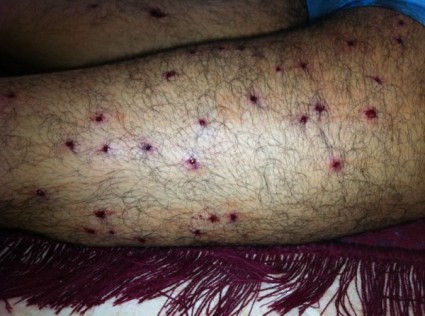
April 12, 2012 Add Comments
Violent MOI Police attacks on protesters could cause bad press for Bahrain F1?
Bahraini Police Must Protect Peaceful Demonstrators during Formula One Event
12 April, 2012 – Human Rights First
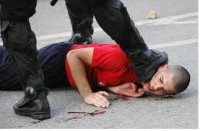
Washington, DC – Human Rights First today raised concerns that Bahraini police will attack, rather than protect peaceful protestors who are expected to demonstrate during this weekend’s Formula One racing event. The organization noted that, in past protests, Bahraini demonstrators have been met with excessive force and that organizers have an obligation to thwart a repeat of these abuses.
“In the past year, the Bahraini police have proven time and again that their preferred response to peaceful demonstrators is brutality, arrest, and torture,” said Human Rights First’s Brian Dooley. “Until the government addresses these issues, we remain concerned for the safety of protesters.”
Since February of last year, the government of Bahrain has engaged in an ongoing crackdown on protestors, unfairly prosecuting protestors, including medics and educators, and torturing those in police custody. The police force is not trusted by Bahraini citizens, who often fear that going to the police for any reason will result in their prosecution. Human Rights First is concerned that there is no guarantee for the safety of protestors during the Formula One race; in the past they have been subjected to excessive force, beatings, and tear gas.
“Until the government of Bahrain addresses the pervasive human rights abuses, the Formula One race will forever be associated with a brutal regime intent on violently attacking its own citizens,” concluded Dooley. …source
April 12, 2012 Add Comments
Support the future of Bahrain F1 – Don’t Come in 2012
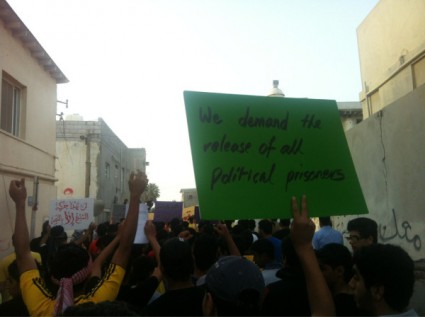
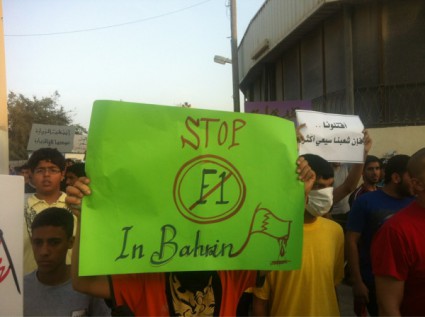
April 12, 2012 Add Comments
Bahrain F1 is simple choice, fund the blood spilling by the regime or Steer Clear
editor: The teams and the FIA can “steer clear” and wait for “fair day” in Bahrain to hold their race or they can let it become a bloody stain that rolls around every year. It seems a no brainier, but if one heeds the idiocy of an ego tripping Ecclestone and fiscally desperate King Hamad, they put the entire FIA enterprise to shame and push the whole pack into the bloody walls of Bahrain. Phlipn.
Bernie Ecclestone will meet F1 teams to discuss Bahrain GP
By Dan Roan – 12 April, 2012
F1 boss Bernie Ecclestone will meet the sport’s 12 teams in Shanghai on Friday to discuss whether the controversial Bahrain Grand Prix should go ahead, the BBC has learned.
However a senior FIA official told the BBC “The race is still on. The situation is not like last year.”
2011’s race was called off following pro-democracy protests in the country.
But now a number of them expect the race to be called off amid security concerns caused by civil unrest.
On Tuesday Ecclestone said no teams had expressed concerns to him and a summit has been called ahead of this weekend’s Chinese Grand Prix.
Despite holding the meeting, Ecclestone said on Thursday only the Bahrain sporting authorities could cancel the race. “The race is on the calendar,” he said. “It’s scheduled.”
Formula 1: Bahrain GP row explained
The Formula One Teams’ Association (Fota), meanwhile, insists it is down to the sport’s governing body, the FIA, to cancel the race. But the BBC can reveal Friday’s crisis meeting will not include FIA chief Jean Todt who does not arrive in Shanghai until Saturday.
That may mean any decision is delayed until the weekend, with cars scheduled to be air-freighted to Bahrain on Sunday night.
Bahrain authorities remain confident the race will go ahead.
Unlike last year, the Bahrain authorities are in no mood to cancel the race themselves, so the decision rests with the FIA this time.
But, speaking on condition of anonymity from Shanghai where the third stage of the F1 takes place on Sunday, the senior FIA official told the BBC’s Bill Law that John Yates – Scotland yard’s assistant commissioner until he resigned last year but now serving as a special advisor to Bahrain’s Minister of Interior – has been reassuring. …more
April 12, 2012 Add Comments
Webber, if you come to F1 your “involved in the situation”, most Bahrainis are for F1, just not with murderous regime as benefactor
Webber, “We don’t want to be involved in the situation that is out there, but the people that support our race are on one side and that’s why it is so sensitive.”
Webber says F1 drivers have no choice but to trust FIA to make right call on Bahrain
By Jonathan Noble and Edd Straw – 12 April, 2012 – AutoSport.com
Mark Webber, Red Bull RacingMark Webber believes that Formula 1 drivers have no choice but to trust the FIA to make the right decision on whether the Bahrain Grand Prix will be safe.
The Australian described it as a “waste of time” for the drivers to discuss the issue because there are so many different agendas and perspectives and that the FIA is in the position to make a call on whether the race should go ahead.
“We can only go on what the FIA are reading into the situation and we are putting an immense amount of trust in them in going to and from the track each day, competing at the track and having a normal grand prix weekend,” said Webber.
“There are some massive decisions to be made. It is a difficult decision now because we are a week away. Now it’s topical, there is a lot more pressure involved in the decision-making process and it’s on the FIA as the teams and Bernie [Ecclestone] have stated.
“We all know why it has dragged a bit. With the funding and finances that have come from Abu Dhabi and Bahrain and the Middle East, they are excited about F1 and they clearly want to give it another go.”
The Australian was a critic of the possibility of racing in Bahrain last year, but admitted that it is difficult to get reliable information on the real situation to make a judgement on next week’s event.
“I’ve tried to watch the news to get the most balanced view that I can possibly get without being too corrupted with other information,” said Webber. “It has been a little quieter but sitting here I have as much information as anyone else really.
“If I have a choice, then I want to race. That’s what I want to do. But saying that, you cannot ignore the fact that in the back of your mind there are a lot of good people in our sport and all of them want it to go down smoothly. We don’t want to be involved in the situation that is out there, but the people that support our race are on one side and that’s why it is so sensitive.”
Webber added that while increased security provisions have been put in place, he does have concerns that not everyone involved with F1 will benefit from the same level.
“There are [safety] measures in place and there is added security,” said Webber. “But we also accept that not everybody can have that and that doesn’t make me feel comfortable. Let’s hope that it [the extra security] is complete overkill.
“We need to trust that the people taking the decision know how these people are going to operate. I don’t know.” …more
April 12, 2012 Add Comments
The Bahrain Grand Prix: Another Case of Burying Heads in the Sand?
Just yesterday, F1’s biggest player, Bernie Ecclestone, was reported as saying: “We’re not involved in any of the politics in Bahrain, over who is right or wrong” while world champion Sebastian Vettel’s view is: “We should go and race and not worry about something that’s not our business.”
The Bahrain Grand Prix: Another Case of Burying Heads in the Sand?
12 April, 2012 – Huffington Post – David Hobbs
Mike Gatting famously demonstrated some jaw-dropping naivety 22 years ago when, on the eve of a rebel England cricket tour to South Africa in 1990, he revealed: “I don’t know much about how apartheid works but one way to find out is by going there.”
As captain of the rebels who toured the country the year that Nelson Mandela was released after 27 years in prison, Gatting personified all that was wrong then – and still is now – about some sportsmen and women and their various governing bodies: ignorance and-or a refusal to believe that their actions may have ramifications far greater than they are willing or able to grasp.
Sport and politics don’t or shouldn’t mix was the favourite line from those justifying their actions but that hasn’t stopped Olympic boycotts over the years such as African nations staying away from Montreal in 1976 in protest at the New Zealand rugby tour of South Africa and more than 60 countries who didn’t travel to Moscow in 1980 over the Soviet Union’s invasion of Afghanistan. The UK government tried to stop the British team from going but the British Olympic Association was having none of that and sent a team that included the future London 2012 boss, Lord Coe. It seems boycotts and protests are a ‘good thing’ until it affects the people who have actually trained – probably for years – for their shot at the big time.
But politics and sport are inseparable, now more than ever. Surely nobody really believes that organisations such as FIFA or the International Olympic Committee operate in bubbles, untainted by world events or political pressures. How else can you explain Russia and China getting their hands on two of the world’s biggest sporting events? And Formula 1 is no different.
Seventeen years ago, the Federation Internationale du Sport Automobile (FISA) cancelled the South African Grand Prix because of the issues surrounding apartheid. In the UK, this was at the height of the anti-apartheid movement that was desperately trying to persuade the British government to impose economic sanctions on South Africa. Mrs Thatcher resisted those calls but F1 gave in and didn’t return to the country until 1992. So, is it a big hurrah for F1’s noble stand?
Well, no. There had been a GP in South Africa every year bar one since 1960. So those are the years that included the Sharpeville Massacre, the Soweto uprising, the death of Steve Biko and many other related tragedies. FISA’s exit was belated to say the least, so why should the sport now care about protestors in a small middle-eastern kingdom.
Just yesterday, F1’s biggest player, Bernie Ecclestone, was reported as saying: “We’re not involved in any of the politics in Bahrain, over who is right or wrong” while world champion Sebastian Vettel’s view is: “We should go and race and not worry about something that’s not our business.” …more
April 12, 2012 Add Comments
Enough is enough: Abdulhadi al-Khawaja has waited long enough for justice
Enough is enough: Abdulhadi al-Khawaja has waited long enough for justice
11 April, 2012 – IRCT
The International Rehabilitation Council for Torture Victims (IRCT) today reiterated its calls for the immediate release of Abdulhadi al-Khawaja, now on his 63rd day of hunger strike. The call comes following a visit to al-Khawaja by an IRCT doctor in recent days.
As a result of the hunger strike, al-Khawaja is in extremely poor health.
The IRCT doctor, a European Union citizen, was joined in assessing al-Khawaja by an Egyptian Doctor. The resulting report will be the first medical report on his condition since his hunger strike began.
The medical report on al-Khawaja’s current condition is being finalised and will be sent to the Bahraini authorities upon completion. The Bahraini authorities will then make this report public, as agreed with the doctors.
Prior to his recent hunger strike, Mr al-Khawaja was already a documented survivor of torture. The Bahraini state is therefore ultimately responsible for his current condition.
“He is therefore in need of holistic rehabilitation,” said Scott McAusland of the IRCT.
“And of course, the perpetrators of his torture must be held to account by the Bahraini authorities,” added McAusland.
For more information:
Please see our previous press release (“IRCT calls on Bahrain to immediately release human rights defender” 17 February 2012) regarding Mr al-Khawaja here.
Media contact
Scott McAusland, IRCT Head of Communications
+45 36 93 87 32
sma@irct.org
About The International Rehabilitation Council for Torture Victims
The International Rehabilitation Council for Torture Victims is an independent non-profit global organisation with a membership of 144 rehabilitation centres in 73 countries and with over 25 years’ experience.
The work of the IRCT is threefold:
* Rehabilitation of torture victims and their families
* Ensuring victims’ access to justice
* Eradication of torture
April 12, 2012 Add Comments
Shooting the Messenger, well the videographer anyway
April 11, 2012 Add Comments
AlKhawaja in Solidarity with his Brothers who have walked his road to freedom
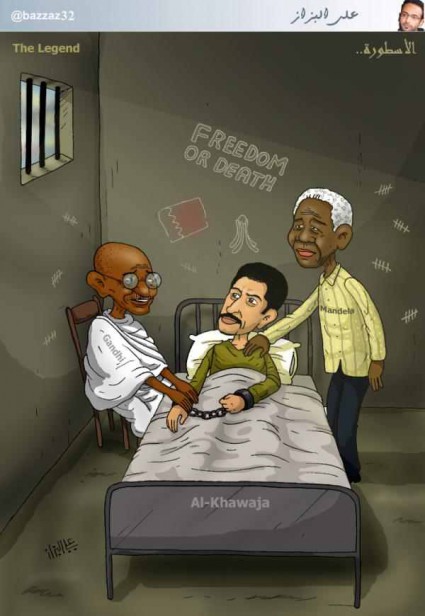
April 11, 2012 Add Comments
No F1 on Bahraini Blood
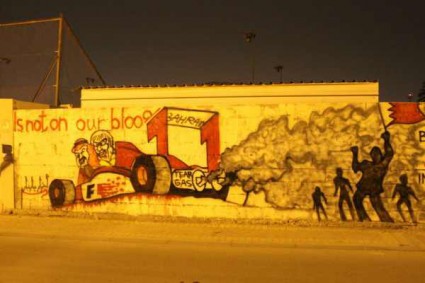
April 11, 2012 Add Comments
Abdulhadi al-Khawaja and the unjust detention of Bahrain’s Political Prisoners
Abdulhadi al-Khawaja and Bahrain’s Political Prisoners
Tahiyya Lulu = 11 APril, 2012 – Jadaliyya
There are currently an estimated six hundred political prisoners in Bahrain, as a result of the regime’s ruthless retaliation against a popular uprising that started in February 2011. 397 citizens are thought to be currently serving sentences delivered by military and civilian courts that fall far short of international standards for fair trials.
On Saturday, 7 April 2012, one of these prisoners was transferred to a prison clinic after allegedly losing twenty-five percent of his body weight as the result of a hunger strike begun on 8 February 2012. Fifty-one-year-old human rights defender Abdulhadi al-Khawaja has reportedly said: “My hunger strike is a part of my human rights defense inside jail. It’s very important to focus on all detainees as I’m just a part of them. I will continue with my hunger strike until I reach my demands despite the consequences. I’m aware that freedom is expensive and we must sacrifice to gain it.”
The Bahrain Independent Commission of Inquiry (BICI), paid for by the government itself and led by Professor Emeritus at De Paul University M. Cherif Bassiouni, found wide-ranging and grave violations of prisoners’ human rights committed by government personnel. These include, but are not limited to, civilian deaths attributed to security forces, arbitrary detention, destruction and theft of property on arrest, prisoner injuries consistent with torture, and a deliberate practice of mistreatment by state agents. What is also notable about the BICI is that it does not call for the release of political prisoners.
Al-Khawaja, a pioneer of human rights work in Bahrain, is serving a life sentence alongside other notable dissidents for “plotting to overthrow the government.” A founding member of the prolific Bahrain Center for Human Rights, al-Khawaja worked most recently as a regional representative for Ireland-based Frontline Defenders and previously as a consultant for Amnesty International.
According to his daughter Zainab al-Khawaja, masked security personnel arrested her father on 8 April 2011 after attacking him and dragging his unconscious body out of her home. As described in the BICI report Case no. 8, Al Khawaja suffered physical abuse and sexual assault in prison, as well as threats of execution and harm to members of his family. He was due to be tried in a civilian court on 2 April, but reports now suggest that the trial has been postponed to 23 April.
As an individual case, al-Khawaja’s hunger strike has led to a resurgence of international media attention in Bahrain at a crucial time: the government is trying desperately to shift focus toward the upcoming Formula 1 Grand Prix in a bid to salvage its reputation. The media spotlight comes partly as a result of al-Khawaja’s public persona as a longtime and high-profile human rights defender, but also due to concerted campaigns on social media networks and an upsurge in street action. Protesters dispersed violently by state security forces last weekend chanted for his release. The majority of media coverage, however, lacks perspective, presenting the issue as one man on a hunger strike without due recognition of the background which led him to take this action. …more
April 11, 2012 Add Comments
Human Rights groups press Obama on Bahrain
Human rights groups press Obama on Bahrain
By Josh Rogin – 11 April, 2012 – Foreign Policy
Several NGOs have written to U.S. President Barack Obama demanding he weigh in on the case of Abdulhadi al-Khawaja, the jailed Bahraini human rights activist who they say may die soon due to an ongoing hunger strike.
“We write to urge you to publicly call on the Government of Bahrain to immediately and unconditionally release from prison Abdulhadi al-Khawaja. Al-Khawaja is a Bahraini human rights defender and democracy activist who may soon die, as he has been on a hunger strike for more than two months,” reads an April 9 letter signed by Amnesty International, 3P Human Security, Physicians for Human Rights, Freedom House, Human Rights First, Human Rights Watch, Just Foreign Policy, the Project on Middle East Democracy, the Foreign Policy Initiative, the AFL-CIO Solidarity Center, Citizens for Global Solutions, and Americans for Democracy and Human Rights in Bahrain.
Khawaja has been a human rights and democracy activist in Bahrain for decades, having been exiled to Denmark during most of the 1980s and allowed to return to Bahrain with his family in 1991. His daughter Maryam, who lives in Bahrain, is one of the leaders of the Bahrain Center for Human Rights and has actively spoken out against the Bahrain government’s actions against peaceful protesters since the current bout of unrest began in February 2011.
He was arrested in April 2011 and two months later sentenced to life in prison in a group trial with 20 other activists before a military court. The Bahrain Independent Commission of Inquiry (BICI) later stated that the trials did not meet international standards of due process.
The human rights groups allege that Khawaja was tortured in prison and was subsequently admitted to a military hospital, where he has undergone multiple surgeries due to a broken jaw and a cracked skull. He began his hunger strike in February.
“The evidence is clear that Al-Khawaja and others were sentenced in violation of their rights to freedom of expression, assembly and association, which are protected under international law,” they wrote. “We are deeply concerned about the health of human rights defender Abdulhadi Al-Khawaja, and respectfully request that the United States urge the Government of Bahrain to release Al-Khawaja immediately, and allow him to travel abroad, including for medical treatment, if he wishes to do so.” …more
April 11, 2012 Add Comments
Bahrain on the Brink – Interview with Nabeel Rajab
April 11, 2012 Add Comments
Casuality from Malkiya Village caused by MOI Police assault on peaceful assembly
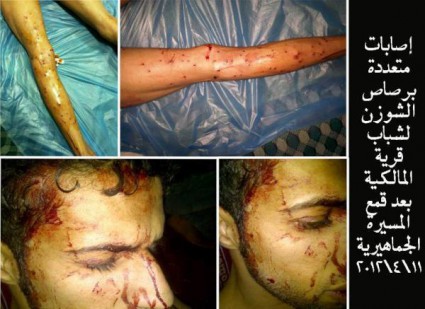
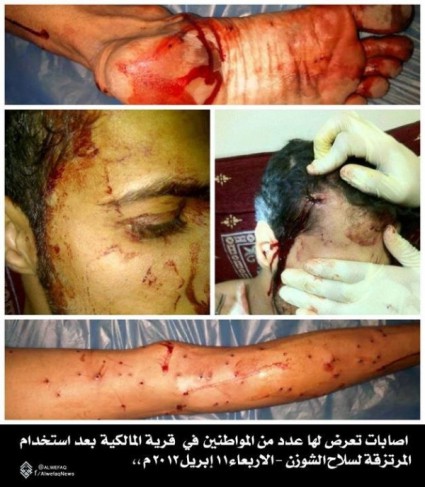
April 11, 2012 Add Comments
The White House – Statement by the Press Secretary on the Situation in Bahrain
The White House
Office of the Press Secretary
For Immediate Release
11 April, 2012
Statement by the Press Secretary on the Situation in Bahrain
The United States continues to be deeply concerned about the situation in Bahrain, and we urge all parties to reject violence in all its forms. We condemn the violence directed against police and government institutions, including recent incidents that have resulted in serious injuries to police officers. We also call on the police to exercise maximum restraint, and condemn the use of excessive force and indiscriminate use of tear gas against protestors, which has resulted in civilian casualties.
We continue to underscore, both to the government and citizens of Bahrain, the importance of working together to address the underlying causes of mistrust and to promote reconciliation. In this respect, we note our continued concern for the well-being of jailed activist Abdulhadi Al-Khawaja and call on the Government of Bahrain to consider urgently all available options to resolve his case. More broadly, we urge the government to redouble its ongoing efforts to implement the recommendations of the Bahrain Independent Commission of Inquiry, and renew our call for the government, opposition parties, and all segments of Bahraini society to engage in a genuine dialogue leading to meaningful reforms that address the legitimate aspirations of all Bahrainis.
…source
April 11, 2012 Add Comments
The protest will not cease until King Hamad is gone, done, finished!
April 11, 2012 Add Comments
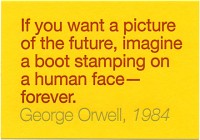
Orwell shakes his head – Activists call for media blackout in country already under media blackout
Bahrain Grand Prix’s future in doubt amid mounting pressure over continued violence and fears for health of hunger striker
Bahrain activists call on BBC and Sky to boycott Formula One race The Guardian – 11 April, 2012
The BBC and Sky have been called upon to boycott the Bahrain Grand Prix as organizers face mounting pressure over the Formula One race due to be staged in the troubled Gulf state on 22 April.
Prominent human rights activists said they want broadcast organizations not to air the race, if it goes ahead, given recent events in the country.
The call comes as sources told BBC Sport that a number of teams have indicated they expect the race to be called off amid safety concerns following a recent spike in violence in Bahrain over calls for democratic reform.
Formula One boss Bernie Ecclestone said on Tuesday that no teams had expressed concerns to him, but added that if any team did pull out it would be a breach of contract.
But the Formula One Teams’ Association (Fota) has said the decision over whether or not to cancel is one for the sport’s governing body, the Fédération Internationale de l’Automobile (FIA). The teams are due to meet Ecclestone in Shanghai at the Chinese Grand Prix this weekend.
Concerns over the fate of an imprisoned anti-government activist, as well as continued demands for reforms from Bahrain’s Shia majority from its Sunni monarchy, have led to calls for the race to be cancelled. Abdulhadi al-Khawaja, 52, has been on hunger strike for 63 days.
His daughter Zainab al-Khawaja, told the Guardian: “If the Formula One does come to Bahrain, despite calls from the Bahraini people and activists for it to be cancelled, then we would like to see that there are people supporting our cause, and who would not broadcast this race.
“Bringing Formula One, putting all these ads everywhere, celebration, celebration, celebration, while people are suffocating in their villages from teargas, while a marcher dies just two weeks ago and while my father is dying in a military hospital is just sending the message to the people of Bahrain that nothing has changed.”
Dr Ala’a Shehabi, an activist who has been in communication with Ecclestone over the race’s future, said she was writing to the BBC and Sky. “Formula One is all about advertising, marketing, it’s more about the commercial side than the actual sport itself.
“So we know that in broadcasting, you’re encouraging all of the commercial interests in the sport which puts finance over human rights. That is what the major moral issue is here. So, if we can target the broadcasters, we can at least cut some of the possibility of profits made from advertising, at least.
“We will be asking them [the broadcasters] to examine their endorsement of Formula One. If they stay unquestioned, they won’t think twice about broadcasting.”
The BBC, which share broadcast rights in the UK with Sky until 2018, said in a statement: “As the race had been officially sanctioned by the FIA we would expect to cover the events as part of our contractual obligations. However, we are in regular communication with the FIA and will be monitoring the situation closely.”
Sky had no comment.
Bahrain has a contract until 2016 to stage the grand prix, but rules state that any race cancelled two years running cannot be put back on the calender. The authorities, which cancelled the race in 2011 owing to political unrest during the Arab spring, show no indication of doing so this year.
This week, Bahrains’ interior ministry said seven policemen were injured by a homemade bomb on Monday in Eker, a village outside the capital, Manama. The government blamed protesters calling for Khawaja’s release, and described the bombing as “an act of terrorism”.
On Wednesday, the Associated Press reported that mobs with iron rods and sticks ransacked a supermarket belonging to a major Shia-owned business group. The agency said the attack appeared linked to a series of reprisals and intimidation by suspected Sunni groups angered by the 14-month-old uprising.
Fears for the health of Khawaja, a Bahrain-Danish human rights activist and co-founder of the Bahrain Human Rights Centre who was imprisoned a year ago, grew after his family and lawyer said they had been denied contact for three days earlier this week. Amnesty International has called for his release, and UN secretary general Ban Ki-moon, has urged Bahrain to re-consider its refusal to allow Denmark to take custody of him.
His daughter said she “got a very short call” from her father on Wednesday, after he agreed to “drink some water” if they allowed him to “let us know he was still alive”.
“He sounded very weak. We are happy we heard his voice, but we don’t know where it is going to go from here. Today is the 63rd day of his hunger strike,” she said. ..source
April 11, 2012 Add Comments
Nearly one year later, numerous hearings and reports confirming crime and abuse, still: Why no outcry over these torturing tyrants?
Robert Fisk: Why no outcry over these torturing tyrants?
14 May, 2011 – The Indpendent
Christopher Hill, a former US secretary of state for east Asia who was ambassador to Iraq – and usually a very obedient and un-eloquent American diplomat – wrote the other day that “the notion that a dictator can claim the sovereign right to abuse his people has become unacceptable”.
Unless, of course – and Mr Hill did not mention this – you happen to live in Bahrain. On this tiny island, a Sunni monarchy, the al-Khalifas, rule a majority Shia population and have responded to democratic protests with death sentences, mass arrests, the imprisonment of doctors for letting patients die after protests and an “invitation” to Saudi forces to enter the country. They have also destroyed dozens of Shia mosques with all the thoroughness of a 9/11 pilot. But then, let’s remember that most of the 9/11 killers were indeed Saudis.
And what do we get for it? Silence. Silence in the US media, largely silence in the European press, silence from our own beloved CamerClegg and of course from the White House. And – shame of shame – silence from the Arabs who know where their bread is buttered. That means, of course, also silence from al-Jazeera. I often appear on their otherwise excellent Arabic and English editions, but their failure to mention Bahrain is shameful, a dollop of shit in the dignity that they have brought to reporting in the Middle East. The Emir of Qatar – I know him and like him very much – does not need to belittle his television empire in this way.
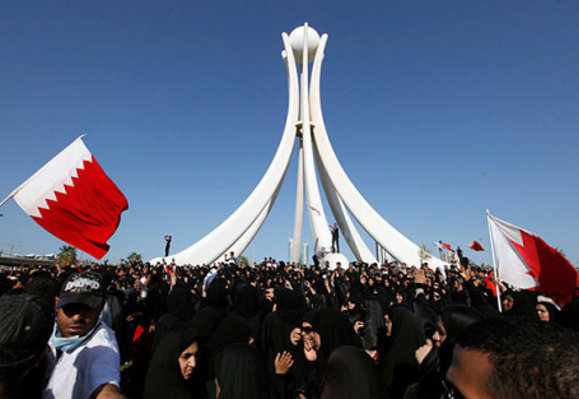
CamerClegg is silent, of course, because Bahrain is one of our “friends” in the Gulf, an eager arms buyer, home to thousands of Brit expatriates who – during the mini-revolution by Bahrain’s Shia – spent their time writing vicious letters to the local pro-Khalifa press denouncing Western journalists. And as for the demonstrators, I recall a young Shia woman telling me that if only the Crown Prince would come to the Pearl Roundabout and talk with the protesters, they would carry him on their shoulders around the square. I believed her. But he didn’t come. Instead, he destroyed their mosques and claimed the protests were an Iranian plot – which was never the case – and destroyed the statue of the pearl at the roundabout, thus deforming the very history of his own country.
Obama, needless to say, has his own reasons for silence. Bahrain hosts the US Fifth Fleet and the Americans don’t want to be shoved out of their happy little port (albeit that they could up-sticks and move to the UAE or Qatar anytime they wish) and want to defend Bahrain from mythical Iranian aggression. So you won’t find La Clinton, so keen to abuse the Assad family, saying anything bad about the al-Khalifas. Why on earth not? Are we all in debt to the Gulf Arabs? They are honourable people and understand when criticism is said with good faith. But no, we are silent. Even when Bahraini students in Britain are deprived of their grants because they protested outside their London embassy, we are silent. CamerClegg, shame on you. …more
April 11, 2012 Add Comments
State Preliminary medical report of Al Khawaja, 10 April, 2012
editor: Please note the Bahrain News Agency is a State Apparatus. It is notorious for distortion and lies and has a history of misstatements that have been flatly denied by those it quoted and has been in numerous scandals over information it has released. Since we have not other source of information regarding AlKhawaja’s health at this hour its “the best available information”. Phlipn.
Preliminary medical report of Al Khawaja
10 April, 2102 – Bahrain News Agency
Manama, April 10 (BNA) — Chief Prosecutor and Attorney General Abdulrahman Al Sayed stated today that within the Public Prosecution’s efforts in safeguarding all defendants of different cases, as soon as it was notified of Abdulhadi Al Khawaja’s hunger strike, an official was referred to discuss reasons of the defendant’s strike and assigned the supervising doctor to follow-up on his case and reviewed all his medical report.
And here is the following content of the medical report:
The Government of Bahrain Commissioned two international independent experts to conduct an evaluation of the medical condition of Abulhadi Al Khawaja of who has been on hunger strike for more than 55 days at the time of their request, and this was the reason for this medical assignment.
The undersigned medical experts visited Abdulhadi Al Khawja on 8th as well as the 9th April 2012 on the premises of the Bahrain Defence Force Royal Medical Services hospital. Where he was hospitalised on the second floor of the new hospital since April 5th around 11.00 pm. He stated he did not want to be hospitalised in this hospital because he did have some bad memories of the previous hospitalisation approximately one yeara ago.
Clinical examination :
During the clinical examination we saw a cachectiv somewhat pale man. His weight was 51.5 kg and his height 172 cm, his blood pressure 100 / 68 mm HG, pulse 64, respiration rate 21/min and body temprature 36.8c.
He seemed well and ws cooperative, quite coherent, well oriented in time, place and person. He was able to move around and stand normally for some time , and able to move around and stand normally for some time, and able to read and write.
He was also able to comprehend and respond to our conversation in a normal way. He stated that he had lost approximately 10 kg since he started his current hunger strike. Compared to his wight prior to his detention in 2011 he stated it to be 7 kg more, as at that time his regular weight was 67 kilograms , however neither in medical file of the Bahrain Defence Force Royal Medica Service hospital in April 2011, nor in the medical file of the prison his weight was recorded at the time of his admission.
Al Khawaja has commenced this hunger strike on Janaury 30th 2012 (so it is lasting now more than 60 days) During the current hospitalisation he has been accepting to receive intravenous fluids as well as medication to increase his pottasium level. he has not been continuously on a total fast. During this hospitalisation both orally taken fluids as well as the fluids given intravenously are recorded in his files.
Previously he was also taking oral rehydration solutions prescribed by his treating physician Dr. Kamal.
He did not complain of any symptoms related to the upper or lower gastro – intenstinal tract, and he had neither vertigo (dizziness)nor diplopia (double vision) or blurring vision. His hand writing was also normal.
His clinical examination showed fairly normal vial signs, with no signs of skin lesion, his fat tissue (which is normally present under the skin) was totally disappeared. There were no signs of the pedal oedema. Local cardiopulmonary and abdominal examinations were also undermarkable.
His mental health examination showed signs and symptoms of depression and posttraumatic stress disorder.
Laboratory assessments and investigations The blood tests taken during our examination showed normal renal function and blood electrolytes, and a normal serum uric acid level.
his red cell blood count showed a mild normacytic normochromic anaemia decrease. His white cell showed blood count showed a decrease. His serum bilirubin showed a mild elevation , with the indirect fraction being higher however , the patients supervisor clinician stated that this is related to Gilbert syndrome which is fmilial inherited disease . He gave on history of sickle cell disease .
The computerised tomography of the brain, chest X-rays as well as sonography of his heart, his abdonmen (including liver and kidneys) were all normal , except for the liver which was described as a fatty liver.
The report concluded the health condition of Al Khawaja has been severely deteriorated since his detention last year.
Since he started this hunger strike he has lost between 10 to 11 kg of body weight as documented in his files compared to the 62 kg when he started the hunger strike on Janaury 30th 2012.
his laboratory results over the period prior to this examination showed specially verly low blood sugars and low pottasium which might be dangerous when no proper medical assessment or treatment is available.
Moreover, he is prone to infections due to his low white blood cell count. his current medical satus is stable , after he has been stabilised over the past week.
If he countinues to a hunger strike and does not allow any medical interference his life will be in serious danger.
If he is transferred will back to the prison, he would need daily monitoring of his health and clinical status and the same specialist treatment as he currently receives in the Bahrain Defence Force Royal medical Services hospital.
EM …source
April 11, 2012 Add Comments
Twitter Crimes in Kuwait
Kuwait: Writer imprisoned
11 April, 2012 – Xindex
Kuwaiti writer Mohamed al-Melify was jailed for seven years on Monday on charges of spreading false statements via Twitter. He was arrested last February, and the Kuwait Criminal Court found him guilty of spreading false news about sectarian divisions in the country and publishing insults about Shiism, in addition to charges of libel and defaming a member of the Kuwaiti National Assembly, Ahmed Lari. …source
April 11, 2012 Add Comments
“What must be said”, Günter Grass
A poem by antimilitarist writer Gunter Grass, published in the German daily Süddeutsche Zeitung, has sparked a storm of controversy in the Western world. Yet the author only limited himself to stating the facts: Iran has no nuclear bombs while Israel is in possession of an illegal nuclear arsenal. The virulence of the attacks unleashed against the Nobel Prize laureate would appear to bear no relation to the text, which merely repeats what has already been stated by U.S. intelligence chiefs: that Iran is not developing a nuclear weapons program. In reality, such virulence reflects the edginess of the political-media system, now that the extent of their involvement in the industry of lies and war is out in the open. …source
What Must Be Said
Why do I stay silent, conceal for too long
What clearly is and has been
Practiced in war games, at the end of which we as survivors
Are at best footnotes.
It is the alleged right to first strike
That could annihilate the Iranian people–
Enslaved by a loud-mouth
And guided to organized jubilation–
Because in their territory,
It is suspected, a bomb is being built.
Yet why do I forbid myself
To name that other country
In which, for years, even if secretly,
There has been a growing nuclear potential at hand
But beyond control, because no inspection is available?
The universal concealment of these facts,
To which my silence subordinated itself,
I sense as incriminating lies
And force–the punishment is promised
As soon as it is ignored;
The verdict of “anti-Semitism” is familiar.
Now, though, because in my country
Which from time to time has sought and confronted
Its very own crime
That is without compare
In turn on a purely commercial basis, if also
With nimble lips calling it a reparation, declares
A further U-boat should be delivered to Israel,
Whose specialty consists of guiding all-destroying warheads to where the existence
Of a single atomic bomb is unproven,
But as a fear wishes to be conclusive,
I say what must be said.
Why though have I stayed silent until now?
Because I thought my origin,
Afflicted by a stain never to be expunged
Kept the state of Israel, to which I am bound
And wish to stay bound,
From accepting this fact as pronounced truth.
Why do I say only now,
Aged and with my last ink,
That the nuclear power of Israel endangers
The already fragile world peace?
Because it must be said
What even tomorrow may be too late to say;
Also because we–as Germans burdened enough–
Could be the suppliers to a crime
That is foreseeable, wherefore our complicity
Could not be redeemed through any of the usual excuses.
And granted: I am silent no longer
Because I am tired of the hypocrisy
Of the West; in addition to which it is to be hoped
That this will free many from silence,
That they may prompt the perpetrator of the recognized danger
To renounce violence and
Likewise insist
That an unhindered and permanent control
Of the Israeli nuclear potential
And the Iranian nuclear sites
Be authorized through an international agency
By the governments of both countries.
Only this way are all, the Israelis and Palestinians,
Even more, all people, that in this
Region occupied by mania
Live cheek by jowl among enemies,
And also us, to be helped.
April 11, 2012 Add Comments
The Illegitimacy of Violence, the Violence of Legitimacy
“Those who said that the Egyptian revolution was peaceful did not see the horrors that police visited upon us, nor did they see the resistance and even force that revolutionaries used against the police to defend their tentative occupations and spaces: by the government’s own admission, 99 police stations were put to the torch, thousands of police cars were destroyed, and all of the ruling party’s offices around Egypt were burned down. Barricades were erected, officers were beaten back and pelted with rocks even as they fired tear gas and live ammunition on us . . . if the state had given up immediately we would have been overjoyed, but as they sought to abuse us, beat us, kill us, we knew that there was no other option than to fight back.” – Solidarity statement from Cairo to Occupy Wall Street, October 24, 2011
The Illegitimacy of Violence, the Violence of Legitimacy
CrimethInc. Ex-workers Collective
What is violence? Who gets to define it? Does it have a place in the pursuit of liberation? These age-old questions have returned to the fore during the Occupy movement. But this discussion never takes place on a level playing field; while some delegitimize violence, the language of legitimacy itself paves the way for the authorities to employ it.
“Though lines of police on horses, and with dogs, charged the main street outside the police station to push rioters back, there were significant pockets of violence which they could not reach.” – The New York Times, on the UK riots of August 2011
During the 2001 FTAA summit in Quebec City, one newspaper famously reported that violence erupted when protesters began throwing tear gas canisters back at the lines of riot police. When the authorities are perceived to have a monopoly on the legitimate use of force, “violence” is often used to denote illegitimate use of force—anything that interrupts or escapes their control. This makes the term something of a floating signifier, since it is also understood to mean “harm or threat that violates consent.”
This is further complicated by the ways our society is based on and permeated by harm or threat that violates consent. In this sense, isn’t it violent to live on colonized territory, destroying ecosystems through our daily consumption and benefitting from economic relations that are forced on others at gunpoint? Isn’t it violent for armed guards to keep food and land, once a commons shared by all, from those who need them? Is it more violent to resist the police who evict people from their homes, or to stand aside while people are made homeless? Is it more violent to throw tear gas canisters back at police, or to denounce those who throw them back as “violent,” giving police a free hand to do worse?
In this state of affairs, there is no such thing as nonviolence—the closest we can hope to come is to negate the harm or threat posed by the proponents of top-down violence. And when so many people are invested in the privileges this violence affords them, it’s naïve to think that we could defend ourselves and others among the dispossessed without violating the wishes of at least a few bankers and landlords. So instead of asking whether an action is violent, we might do better to ask simply: does it counteract power disparities, or reinforce them?
This is the fundamental anarchist question. We can ask it in every situation; every further question about values, tactics, and strategy proceeds from it. When the question can be framed thus, why would anyone want to drag the debate back to the dichotomy of violence and nonviolence?
The discourse of violence and nonviolence is attractive above all because it offers an easy way to claim the higher moral ground. This makes it seductive both for criticizing the state and for competing against other activists for influence. But in a hierarchical society, gaining the higher ground often reinforces hierarchy itself. …more
April 11, 2012 Add Comments
Thugs or Groupies? Highlighting Issues of Police Discrimination in Bahrain
Thugs or Groupies? Highlighting Issues of Police Discrimination in Bahrain
11 April, 2012 – Marc Owen Jones – marcowenjones.wordpress.com
In what was apparently a display of solidarity with Bahrain’s security forces, hundreds of pro-regime Sunnis ended up at Alba roundabout to protest against what the Ministry of Interior described as a ‘terrorist blast’ in the village of Al-Eker. The explosion, which injured 7 policeman, has already resulted in the arrest of 4 people following a dawn raid on the village. Al-Wefaq reported that the sister of one of those arrested had her shoulder broken when security forces attacked the family during the raid.
Such reports of heavy-handed policing are of course commonplace in Bahrain, but to what extent are they selective, and to what extent are the security forces just an instrument used to prop up ‘Sunni hegemony’ in Bahrain (Strobl, 2011). Although the answer to that question is self evident for many, the events of last night and the past week provide a very good snapshot of how the police in Bahrain operate, for they illustrate how the MOI deal with crime when it is carried out by those who support the regime.
Firstly, despite the presence of hundreds of pro-regime supporters at a roundabout, the security forces seemed reluctant to commit the same excessive force they employ when dealing with anti-government protests. The video shows civilians overturning and smashing up the car of a man who reportedly honked ‘down with Hamad’. It is sometime before the security forces intervene, despite the considerable amount of time it would have taken to damage the car. This photo even shows a man standing on the upturned vehicle.
A number of people then proceeded to attack 24 Hour Supermarket, a property owned by Jawads Group, a company frequently targeted by some pro-regime elements after they were accused of giving out free food to those at the Pearl Roundabout. Indeed, this report from the 2nd April 2012 states that Jawads owned properties had suffered 54 attacks on their premises since March last year. Some of the attackers even appeared to have firearms. …more
April 11, 2012 Add Comments