Corn May Be More Vulnerable to Warming, Stanford Study Shows
Corn, the world’s second-most- widely grown grain, may be more vulnerable to global warming than previously thought, based on a study led by Stanford University that examined data from field trials.
The study found that a gain of 1 degree Celsius (1.8 degrees Fahrenheit) in temperatures would lower yields for 65 percent of Africa’s corn fields assuming optimal rainfall, Stanford said in an online statement. The same warming under drought conditions would cut corn yields for all of Africa, with declines of 20 percent or more in 75 percent of growing areas, the study showed.
“The pronounced effect of heat on maize was surprising because we assumed maize to be among the more heat-tolerant crops,” Marianne Banziger, co-author of the study and deputy head of research at the International Maize and Wheat Improvement Center, or Cimmyt, said in a statement.
Global food output will have to rise 70 percent between 2010 and 2050 as the world population swells to 9 billion people and rising incomes boost meat and dairy consumption, the United Nations estimates. Crop failures are likely to become more common this century as climate change causes more extreme weather, a study led by the U.K.’s University of Leeds has shown. …more
March 14, 2011 Add Comments
Wave of Sabotage Reported at Iowa Factory Farms
Trade group offers $7,500 reward for information in sabotage at multiple farms
Police have reported a rash of sabotage actions against pig and turkey farms across northeastern Iowa. Damage is described as “considerable”. Neither the Animal Liberation Front nor other clandestine animal liberation group has yet claimed responsibility.
The actions are described as occurring at “multiple” farms in three counties. Three pig factory farms were vandalized in Chickasaw and Fayette Counties. One turkey factory farm in Bremer County was also targeted. One of the sabotaged farms was 5 miles northwest of New Hampton, site of the largest Animal Liberation Front mink liberation in U.S. history.
The sabotage included damaged office equipment and broken windows. Police have not ruled out the actions could be merely apolitical vandalism. However if there was no danger of animal’s being harmed in the action, factory farms would be a likely A.L.F. target and these attacks would fit the model of an Animal Liberation Front action.
Police are advising farms to be vigilant in monitoring their farms, and call police if they notice suspicious vehicles.
– Peter Young …source
March 8, 2011 Add Comments
Raze of Glory: NASA Earth-Observing Climate Satellite Fails to Reach Orbit
A launch malfunction sent the Glory satellite crashing into the ocean, almost exactly mimicking the 2009 loss of NASA’s Orbiting Carbon Observatory By John Matson | March 4, 2011 | 23
In the last few years NASA has built and launched two world-class climate satellites, both of which promised invaluable new data on the natural and human influences on Earth’s changing climate. Neither of them, however, will ever deliver the data that climate scientists so eagerly expected from them. Both spacecraft, in fact, are at the bottom of the ocean, having succumbed to nearly identical rocket mishaps that prevented them from reaching orbit.
The latest incident occurred in the wee morning hours of March 4, just after the Glory spacecraft lifted off atop a Taurus XL rocket from Vandenberg Air Force Base in California. About three minutes into the flight the protective nose cone, or fairing, enshrouding Glory failed to separate from the rocket as commanded, and the entire assembly came tumbling back to Earth. That is just what happened in February 2009, when NASA’s Orbiting Carbon Observatory (OCO) blasted off on board another Taurus XL rocket and came crashing down in the waters off Antarctica.
“All indications are that the satellite and rocket are in the southern Pacific ocean somewhere,” NASA launch director Omar Baez said of Glory in a somber March 4 news conference following the liftoff. Given the comparable launch weights of Glory and the OCO and the similarity of the malfunction, Glory may have ended up in close proximity to its fellow climate satellite. “Physics says it’s likely in the same spot or close to it,” Baez said. …more
March 8, 2011 Add Comments
Can We Trust Climate Models? Increasingly, the Answer is ‘Yes’
Forecasting what the Earth’s climate might look like a century from now has long presented a huge challenge to climate scientists. But better understanding of the climate system, improved observations of the current climate, and rapidly improving computing power are slowly leading to more reliable methods.
by michael d. lemonick
A chart appears on page 45 of the 2007 Synthesis Report of the Intergovernmental Panel on Climate Change (IPCC), laying out projections for what global temperature and sea level should look like by the end of this century. Both are projected to rise, which will come as no surprise to anyone who’s been paying even the slightest attention to the headlines over the past decade or so. In both cases, however, the projections span a wide range of possibilities. The temperature, for example, is likely to rise anywhere from 1.8 C to 6.4 C (3.2 F to 11.5 F), while sea level could increase by as little as 7 inches or by as much as 23 — or anywhere in between.
It all sounds appallingly vague, and the fact that it’s all based on computer models probably doesn’t reassure the general public all that much. For many people, “model” is just another way of saying “not the real world.” In fairness, the wide range of possibilities in part reflects uncertainty about human behavior: The chart lays out different possible scenarios based on how much CO2 and other greenhouse gases humans might emit over the coming century. Whether the world adopts strict emissions controls or decides to ignore the climate problem entirely will make a huge difference to how much warming is likely to happen. ..more
March 8, 2011 Add Comments
Of Wolves and Despicable People
Senate includes wolf delisting bill in must-pass funding package
Provision would strip ESA protections for wolves in Idaho and Montana
Washington, D.C. (March 4, 2011) – In the latest effort to strip federal endangered species protections from gray wolves in the Northern Rockies, a Continuing Budget Resolution to fund federal government operations for the remainder of the fiscal year was unveiled in the Senate today. The provision directs the Secretary of the Interior to reissue the 2009 delisting rule, which was struck down in 2010 by a federal district court, and would insulate the reissued rule from further judicial review. If enacted, wolf management authority would be returned to all states in the region other than Wyoming. Idaho and Montana have made clear that wolf numbers will be drastically reduced in those states, and Wyoming has thus far refused to produce a wolf management plan that passes muster under the Endangered Species Act.
The following is a statement by Rodger Schlickeisen, president of Defenders of Wildlife:
“What do wolves have to do with critical funding for our federal government? Absolutely nothing. Congress should be focused on keeping our nation’s essential services up and running, not going back on America’s commitment to restore wolves to Yellowstone and the Northern Rockies.
“This provision would hand over responsibility for wolves to the states when their approach of late has been anything but responsible. Idaho Gov. Butch Otter has repeatedly stated his intent to kill as many wolves as possible in Idaho, and Montana Gov. Brian Schweitzer recently encouraged ranchers to take the law into their own hands and kill wolves on sight. We should not be rewarding these states for thumbing their noses at the conservation of wolves, wildlife that belongs to all Americans. ..more
March 8, 2011 Add Comments
Bahrain: Political Prisoners suffer appalling conditions in Jaw Central Prison
Bahrain: Hundreds of prisoners suffering from appalling conditions in Jaw Central Prison
Overcrowding, harsh punishments, and deprivation of contact with the outside world or complain
05 Nov 2011 – BCHR
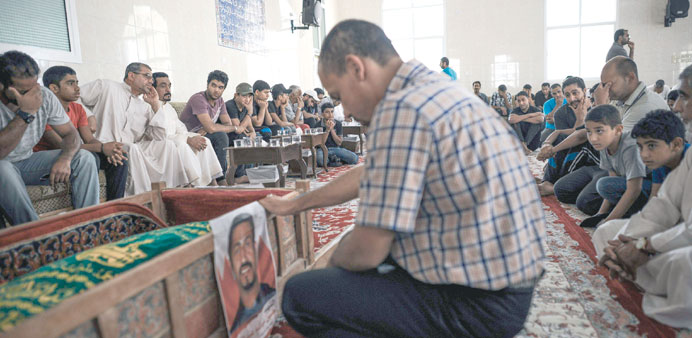
Bahrain Centre for human rights (BCHR) is following up with great concern the deterioration of the situation of prisoners detained in the Jaw Central Prison of Bahrain, including being subjected to mistreatment and arbitrary punishments, especially solitary confinement which are sometimes associated with physical abuse. Moreover, this includes the General poor conditions caused by overcrowding the prison of large numbers of convicts that exceed its capacity, where 17 prisoners being crammed in one cell that could not accommodate more than four beds (with 2-floors). Those prisoners are being kept in the cell for at least twenty hours a day where they have only one health facility for shower, toilet and washing, and the room itself is being used to eat, sleep, rest and worship.
One cell is gathering different ages, where a large number of prisoners held on security and political issues are adolescents and young people who are rounded up with people convicted in criminal cases of various nationalities and some with criminal records. Prisoners find considerable difficulty in obtaining a sufficient number of Quran, religious books associated with worship daily, and the biggest difficulty is the ability of getting any cultural or general books. Although daily newspapers provided by the prison administration are only those which support the Government’s policies, these newspapers are subject to censorship, and often are blocked because they contain news or information about the situation outside the prison.
Add to all that the complete denial of access to daily news through television channels. Despite the availability of televisions in the places that prisoners go to for few hours a day, but it display movies only to make the prisoners in almost total blackout from what’s happening in the country or abroad. Since there is tight control to communicate with families and that is once a week for half an hour, as well as family visit with a very limited number of them twice a month, the prisoner cannot convey their suffering in prison via communication with family, and if so, it is liable to penalties of imprisonment in solitary confinement, mistreatment and sometimes physically abused.
Beginning of mistreatment starts since the first reception of the prisoner where they are humiliated, offended and threatened. However, the Proper or bad treatment later depends on those in charge of the Prisoners Affairs Department where many of them seem to be part of political or sectarian mobilization, especially against prisoners with cases of political background. The prison lacks an effective inspection system to detect the abuses carried out by those or by the prison administration. Prisoners also do not have the opportunity to speak to the top freely and safely, thereby reducing their ability to fully improve conditions or protesting mistreatment. Indeed, the only tool left for prisoners to improve their situation is the hunger strike where any prisoner on hunger strike is being treated so cruelly exposing any paddle to solitary confinement and mistreatment and sometimes being beaten as a warning to other prisoners, as was the case July 2010 when the prison used the riot police to stop the prisoners on hunger strike by attacking and injuring them [1].
Prisoners are subjected to degrading treatment each time they are taken outside the prison or to meet their relatives as well as upon return. Where they are forced to take off all their clothes and wearing wrapper only, then sit in a certain way on the grounds that such a procedure to “prevent the smuggling of narcotic substances” as they claim, while that in itself is reason enough for separating prisoners according to their quality and nature of the charges against them. …more
March 8, 2011 Add Comments
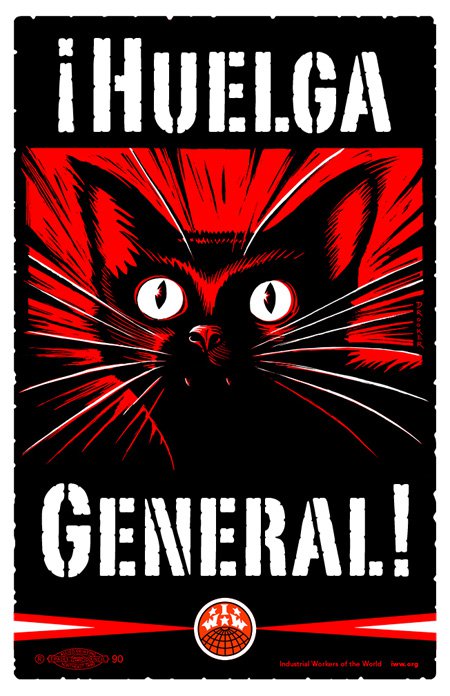
May Day 2011
March 7, 2011 Add Comments
Call to Action May Day United
Call to Action! Primero de Mayo Unido–Llamada a Accion!
Feb 19, 2011
This is a call to join a network of worker centers, community organizations, and labor unions to increase national participation and power on May Day 2011 to win good jobs, legalization, and equality for every worker. As we all know, Congress and state governments across the nation have begun to wage a relentless attack against all workers this year and in years to come, especially immigrant workers and workers of color. At the same time, the remarkable energy, turnout, and spirit seen five years ago on May 1, 2006 has yet to be duplicated.
Stagnant and falling wages, lingering unemployment, and escalating attacks on immigrants workers and the right of all workers to organize call for an outpouring of energy and action in the United States on May 1, 2011. A powerful grassroots movement can win fair-paying jobs and equality while defending against the expansion of Arizona-style racial-profiling laws, rampant firings, workplace raids, deportations, and the downward economic spiral confronting U.S. working families. To that end, we invite you to support and participate in the May Day United network along the following principles of unity:
1) Supporting increased participation in May Day 2011 actions and supporting local groups in organizing May Day actions where they do not yet exist.
2) Encouraging workers to request May 1st off, or for workers interested in striking, providing organizing and legal support in advance of May Day as well as comprehensive solidarity in the event of retaliation.
3) Calling for:
a) Jobs for all and legalization for all
b) The right to organize and true equality for every worker
To embrace this call, please e-mail or call Jen Waller at 510-326-3652 or info @ maydayunited.org.
March 7, 2011 Add Comments
‘Reefs at Risk: Global Threats Require Global Action’
by Jane Lubchenco, Ph.D.
This is a critical time for ocean ecosystems in general, but especially for coral reefs. Mounting pressures on land, along the coast and in the water converge in a perfect storm of threats to reefs. Since the last ‘Reefs at Risk’ report a decade ago, threats have gone from worrisome to dire. Reef ecosystems are changing rapidly and radically, with profound consequences for humanity.
But what’s really at stake?
Preserving coral reefs is about protecting coastal communities:
* Coastlines protected by reefs are more stable, more resistant to erosion, than those without. Up to 90 percent of the energy from wind-generated waves is absorbed by reef ecosystems. In Belize alone, coastal protection afforded by reefs and mangroves provides an estimated $231 to $347 million dollars in avoided damages per year.
Preserving coral reefs is about preserving cultures:
* As an example, the most linguistically diverse place on earth, Papua New Guinea, is home to approximately 820 different languages and to many people who are dependent on coral reefs. If we lose these reefs, we risk losing the communities and cultures that gave rise to such diversity.
Preserving coral reefs is about food security:
* We need to expand the way we think about food security far beyond just grains and livestock on land to include fisheries, given that vast numbers of people in developing countries rely on their coastal waters for essential protein.
* 500 million people worldwide depend daily upon coral reefs for their food and livelihoods. That’s 200 million more people than live in the U.S. alone.
Preserving coral reefs is about ensuring thriving economies:
* It is difficult to put a precise dollar value on many of the benefits provided by coral reef ecosystems, but by any estimate they are globally and locally valuable. Tourism, reef fisheries and shoreline protection are particularly noteworthy.
But most of all, preserving coral reefs is about our collective commitment to one another, to the rest of life on the planet and to our future.
A deadly combination of local and global threats are putting these important ecosystems and their services at risk. …more
March 2, 2011 Add Comments
The End in Sight
06 Dec 2010: Analysis
Is the End in Sight for
The World’s Coral Reefs?
It is a difficult idea to fathom. But the science is clear: Unless we change the way we live, the Earth’s coral reefs will be utterly destroyed within our children’s lifetimes.
by j.e.n. veron
Over the past decades, there have dozens of articles in the media describing dire futures for coral reefs. In the 1960s and ‘70s, we were informed that many reefs were being consumed by a voracious coral predator, the crown-of-thorns starfish. In the 1980s and ‘90s, although these starfish still reared their thorny heads from time to time, the principal threats had moved on — to sediment runoff, nutrients, overfishing, and general habitat destruction.
For me, an Australian marine scientist who has spent the past 40 years working on reefs the world over, these threats were of real concern, but their implications were limited in time or in space or both. Although crown-of-thorns starfish can certainly devastate reefs, the impacts of sediments, nutrients and habitat loss have usually been of greater concern, and I have been repeatedly shocked by the destruction I have witnessed. However, nothing comes close to the devastation waiting in the wings at the moment.
You may well feel that dire predictions about anything almost always turn out to be exaggerations. You may think there may be something in it to worry about, but it won’t be as bad as doomsayers like me are predicting. This view is understandable given that only a few decades ago I, myself, would have thought it ridiculous to imagine that reefs might have a limited lifespan on Earth as a consequence of human actions. It would have seemed preposterous that, for example, the Great Barrier Reef — the biggest structure ever made by life on Earth — could be mortally threatened by any present or foreseeable environmental change. …more
February 22, 2011 Add Comments
Wall Street goes to Jail – NOT
By Matt Taibbi
Rolling Stone
February 16, 2011 9:00 AM ET
Over drinks at a bar on a dreary, snowy night in Washington this past month, a former Senate investigator laughed as he polished off his beer.
“Everything’s fucked up, and nobody goes to jail,” he said. “That’s your whole story right there. Hell, you don’t even have to write the rest of it. Just write that.”
I put down my notebook. “Just that?”
“That’s right,” he said, signaling to the waitress for the check. “Everything’s fucked up, and nobody goes to jail. You can end the piece right there.” …more
February 17, 2011 Add Comments
Corporate Infiltration and Spying on Activists
Revealed: how energy firms spy on environmental activists
Leaked documents show how three large British companies have been paying private security firm to monitor activists
Rob Evans and Paul Lewis guardian.co.uk, Monday 14 February 2011 21.00 GMT
Three large energy companies have been carrying out covert intelligence-gathering operations on environmental activists, the Guardian can reveal.
The energy giant E.ON, Britain’s second-biggest coal producer Scottish Resources Group and Scottish Power, one of the UK’s largest electricity-generators, have been paying for the services of a private security firm that has been secretly monitoring activists.
Leaked documents show how the security firm’s owner, Rebecca Todd, tipped off company executives about environmentalists’ plans after snooping on their emails. She is also shown instructing an agent to attend campaign meetings and coaching him on how to ingratiate himself with activists. The disclosures come as police chiefs, on the defensive over damaging revelations of undercover police officers in the protest movement, privately claim that there are more corporate spies in protest groups than undercover police officers.
Senior police officers complain that spies hired by commercial firms are – unlike their own agents – barely regulated.
Sir Hugh Orde, the president of the Association of Chief Police Officers, which until recently ran the secretive national unit of undercover police officers deployed in protest groups, said in a speech last week that “the deployment by completely uncontrolled and unrestrained players in the private sector” constituted a “massive area of concern”. …more
February 16, 2011 Add Comments
Climate Change and the Global Food Crisis
Climate’s role in global food crisis
By PAUL KRUGMAN
NEW YORK TIMES
Feb. 7, 2011, 8:34PM
We’re in the midst of a global food crisis — the second in three years. World food prices hit a record in January, driven by huge increases in the prices of wheat, corn, sugar and oils. These soaring prices have had only a modest effect on U.S. inflation, which is still low by historical standards, but they’re having a brutal impact on the world’s poor, who spend much if not most of their income on basic foodstuffs.
The consequences of this food crisis go far beyond economics. After all, the big question about uprisings against corrupt and oppressive regimes in the Middle East isn’t so much why they’re happening as why they’re happening now. And there’s little question that sky-high food prices have been an important trigger for popular rage.
So what’s behind the price spike? American right-wingers (and the Chinese) blame easy-money policies at the Federal Reserve, with at least one commentator declaring that there is “blood on Bernanke’s hands.” Meanwhile, President Nicolas Sarkozy of France blames speculators, accusing them of “extortion and pillaging.”
But the evidence tells a different, much more ominous story. While several factors have contributed to soaring food prices, what really stands out is the extent to which severe weather events have disrupted agricultural production. And these severe weather events are exactly the kind of thing we’d expect to see as rising concentrations of greenhouse gases change our climate — which means that the current food price surge may be just the beginning.
[Read more →]
February 16, 2011 Add Comments
Food Security becomes Global Security Risk
By Lesley Wroughton
WASHINGTON | Tue Feb 15, 2011 5:21pm EST
WASHINGTON (Reuters) – World Bank chief Robert Zoellick on Tuesday said global food prices have reached “dangerous levels,” and warned that their impact could complicate fragile political and social conditions in the Middle East and Central Asia.
World Bank data released on Tuesday showed higher food prices — mainly for wheat, maize, sugars and edible oils – have pushed 44 million more people in developing countries into extreme poverty since June 2010.
“There is no room for complacency,” Zoellick told a conference call. “Global food prices are now at dangerous levels and it is also clear that recent food price rises are causing pain and suffering for poor people around the globe.”
Zoellick said although higher food prices were not the main cause leading to recent protests in Egypt and Tunisia, it was an aggravating factor and could become worse.
He warned that a sharp rise in food prices across Central Asia could also have social and political implications for that region.
The World Bank report comes days before a meeting of the Group of 20 major economies in France where higher food prices and the reasons for those upward spikes will be discussed.
Zoellick also said he was concerned that as countries such as Egypt, Tunisia and Jordan address causes of their social upheaval, higher food prices may add to “the fragility that is always there any time you have revolutions and transitions.”
The World Bank chief said the international community needed to be aware of such risks and should not exacerbate problems by imposing policies, such as export bans or price fixing, that would push global food prices even higher.
“There is no silver bullet to resolving the potent combination of rising and volatile food prices,” Zoellick said, “but food security is now a global security issue.”
…more
February 16, 2011 Add Comments
Life in the Anthropocene – A New Epoch
Yale environment 360
24 Jan 2011: Opinion
Living in the Anthropocene:
Toward a New Global Ethos
A decade ago, Nobel Prize-winning scientist Paul Crutzen first suggested we were living in the “Anthropocene,” a new geological epoch in which humans had altered the planet. Now, in an article for Yale Environment 360, Crutzen and a coauthor explain why adopting this term could help transform the perception of our role as stewards of the Earth.
by paul j. crutzen and christian schwägerl
It’s a pity we’re still officially living in an age called the Holocene. The Anthropocene — human dominance of biological, chemical and geological processes on Earth — is already an undeniable reality. Evidence is mounting that the name change suggested by one of us more than ten years ago is overdue. It may still take some time for the scientific body in charge of naming big stretches of time in Earth’s history, the International Commission on Stratigraphy, to make up its mind about this name change. But that shouldn’t stop us from seeing and learning what it means to live in this new Anthropocene epoch, on a planet that is being anthroposized at high speed.
For millennia, humans have behaved as rebels against a superpower we call “Nature.” In the 20th century, however, new technologies, fossil fuels, and a fast-growing population resulted in a “Great Acceleration” of our own powers. Albeit clumsily, we are taking control of Nature’s realm, from climate to DNA. We humans are becoming the dominant force for change on Earth. A long-held religious and philosophical idea — humans as the masters of planet Earth — has turned into a stark reality. What we do now already affects the planet of the year 3000 or even 50,000.
Changing the climate for millennia to come is just one aspect. By cutting down rainforests, moving mountains to access coal deposits and acidifying coral reefs, we fundamentally change the biology and the geology of the planet. While driving uncountable numbers of species to extinction, we create new life forms through gene technology, and, soon, through synthetic biology. …more
February 15, 2011 Add Comments
Obama worse than Reagan?
WASHINGTON (February 10, 2011) – The following is a statement from Rodger Schlickeisen, president of Defenders of Wildlife:
“Our nation’s wildlife is getting the short end of the stick in the Obama administration’s proposed forest policy. The administration appears to be looking to do the bare minimum for wildlife and is abandoning its responsibility for keeping common species common. The public expects a lot more from President Obama.”
Background:
Congress passed the National Forest Management Act in 1976 to reform the Forest Service and to ensure that the agency give due consideration to non-timber values, such as recreation, wildlife, and water. In 1982, the Reagan administration adopted wildlife viability protection in response to declines in the population and range of many species caused by the routine approval of logging and other development projects that did not take the need to conserve wildlife into account. The Reagan rule, currently in effect, supports populations of popular game species such as elk, moose, and black bear, and helps keep sensitive and rare species off the endangered species list by identifying and correcting wildlife population declines before species become imperiled. …more
February 15, 2011 Add Comments
Muslim Brotherhood rejects Khamenei’s attempt to hijack the revolution
Wednesday, February 9,2011 10:21
by Paul Woodward eurasiareview.com
The Iranian nation has become a model for the other nations through its resistance and insistence on Islam and Islamic establishment and due to the eye-catching progress it has made on this path throughout the last 32 years,” Ayatollah Khamenei said while addressing a military gathering in Tehran today.
But the Muslim Brotherhood is more interested in expressing its solidarity with its secular co-revolutionaries than its Iranian co-religionists. This isn’t an Islamic revolution, they say — stating the obvious. It’s an Egyptian revolution.
[Read more →]
February 10, 2011 Add Comments
Democracy supporters should not fear the Muslim Brotherhood
Thursday, February 10,2011 15:07
by Abdel Moneim Abou el-Fotouh WashingtonPost
Like Egyptians from all walks of life, we in the Muslim Brotherhood are taking part in the popular uprising to depose a repressive dictator. The overwhelming majority of Egyptians demand the immediate ouster of Hosni Mubarak and his regime.
Once this basic demand is met, we seek to share in the debate sweeping the country and to be part of the resolution, which we hope will culminate in a democratic form of government. Egyptians want freedom from tyranny, a democratic process and an all-inclusive dialogue to determine our national goals and our future, free of foreign intervention.
We are mindful, however, as a nonviolent Islamic movement subjected to six decades of repression, that patent falsehoods, fear mongering and propaganda have been concocted against us in Mubarak’s palaces the past 30 years and by some of his patrons in Washington. Lest partisan interests in the United States succeed in aborting Egypt’s popular revolution, we are compelled to unequivocally deny any attempt to usurp the will of the people. Nor do we plan to surreptitiously dominate a post-Mubarak government. The Brotherhood has already decided not to field a candidate for president in any forthcoming elections. We want to set the record straight so that any Middle East policy decisions made in Washington are based on facts and not the shameful – and racist – agendas of Islamophobes.
[Read more →]
February 10, 2011 Add Comments
Western Fear Mongering and Egypt’s Revolution
Why fear the Arab revolutionary spirit?
Slavoj Žižek
guardian.co.uk, Tuesday 1 February 2011 09.00 GMT
The western liberal reaction to the uprisings in Egypt and Tunisia frequently shows hypocrisy and cynicism
What cannot but strike the eye in the revolts in Tunisia and Egypt is the conspicuous absence of Muslim fundamentalism. In the best secular democratic tradition, people simply revolted against an oppressive regime, its corruption and poverty, and demanded freedom and economic hope. The cynical wisdom of western liberals, according to which, in Arab countries, genuine democratic sense is limited to narrow liberal elites while the vast majority can only be mobilised through religious fundamentalism or nationalism, has been proven wrong. The big question is what will happen next? Who will emerge as the political winner?
When a new provisional government was nominated in Tunis, it excluded Islamists and the more radical left. The reaction of smug liberals was: good, they are the basically same; two totalitarian extremes – but are things as simple as that? Is the true long-term antagonism not precisely between Islamists and the left? Even if they are momentarily united against the regime, once they approach victory, their unity splits, they engage in a deadly fight, often more cruel than against the shared enemy.
Did we not witness precisely such a fight after the last elections in Iran? What the hundreds of thousands of Mousavi supporters stood for was the popular dream that sustained the Khomeini revolution: freedom and justice. Even if this dream utopian, it did lead to a breathtaking explosion of political and social creativity, organisational experiments and debates among students and ordinary people. This genuine opening that unleashed unheard-of forces for social transformation, a moment in which everything seemed possible, was then gradually stifled through the takeover of political control by the Islamist establishment.
Even in the case of clearly fundamentalist movements, one should be careful not to miss the social component. The Taliban is regularly presented as a fundamentalist Islamist group enforcing its rule with terror. However, when, in the spring of 2009, they took over the Swat valley in Pakistan, The New York Times reported that they engineered "a class revolt that exploits profound fissures between a small group of wealthy landlords and their landless tenants". If, by "taking advantage" of the farmers' plight, the Taliban are creating, in the words of the New York Times "alarm about the risks to Pakistan, which remains largely feudal," what prevented liberal democrats in Pakistan and the US similarly "taking advantage" of this plight and trying to help the landless farmers? Is it that the feudal forces in Pakistan are the natural ally of liberal democracy? ...more
February 1, 2011 Add Comments
Internet in an age of Revolution
People Power in Action
The Making of Egypt’s Revolution
By ESAM AL-AMIN
Freedom lies behind a door, closed shut
It can only be knocked down with a bleeding fist
— Egyptian Poet-Laureate Ahmad Shawqi (1869-1932)
On April 21, 2008, an assistant high school principal placed an advertisement in Al-Ahram, the largest daily newspaper in Egypt, pleading disparately with President Hosni Mubarak and his wife to intervene and release her daughter from prison.
It turned out that her 27 year-old daughter, Israa’ Abd el-Fattah, was arrested 10 days earlier because of her role in placing a page on Facebook encouraging Egyptians to support a strike in the industrial city of al-Mahalla that had taken place on April 6.
In her spare time, she and two of her colleagues created the Facebook page. Within days of posting it, over 70,000 people supported their call. After the security forces cracked down against the huge riots in al-Mahalla on April 6, Abd el-Fattah was arrested.
What was odd about this arrest was that although thousands of people have been arrested over the past three decades, it was the first time that a warrant was issued against a female under the notorious emergency laws imposed in the country since 1981. To get out of prison she had to apologize and express regret for her actions. But the experience made her more determined than ever to be politically active.
On that day, the “April 6 Youth” movement was created. For the next two and a half years it maintained its presence and created one of the most popular political forums on several social networking sites such as Facebook, Twitter, YouTube and Flickr.
When the president of Tunisia, Zein al-Abideen Ben Ali, was deposed on January 14, following a four week popular uprising, the April 6 movement, like millions of youth across the Arab World, was inspired, energized, and called for action.
Changing of the Guard: the Youth leads
Looking at the calendar, Israa’ and her colleagues picked the next Egyptian holiday, which was ironically “Police Day” falling on Tuesday, January 25. Within a few days they called on all social media sites for massive protests and an uprising against the Mubarak regime.
They called for marches to start from all major squares, mosques and churches in Cairo and Alexandria while asking others to help plan in other Egyptian cities. They insisted that the protests would be peaceful and that no one should bring weapons of any type. …more
February 1, 2011 Add Comments
Get up stand up, stand up for your rights…
The signs of the new era
The popular uprising witnessed in Egypt is seizing great attention in the region and around the world, in light of Egypt’s status, weight and role in the region throughout history. Regardless of the political transformations which might reach a record speed within the next few days, the rise of the Egyptian popular action after what happened in Tunisia and what is happening in Jordan constitutes a sign for the arrival of a new Arab era carrying new features. This is still at the beginning and will impose major transformations on the entire region.
– Firstly: The Egyptian uprising erupted in a way similar to the Tunisian revolution, and these elements of similarity reflected the deep roots of the transformation that is ongoing in the collapsing Arab countries, where regimes affiliated with American and Western hegemony are establishing blunt capitalist control and are continuously pillaging national wealth through privatization and by implementing the recipes of the World Bank, the International Monetary Fund and the American and European consultancy groups.
– Secondly: The Egyptian public clearly conveyed the motives behind its revolution. People thus spoke on satellite channels and to the international press about the blockade on Gaza, Camp David, the squandering of Egypt’s rights to the Nile, the division of Sudan, poverty, hunger, corruption and the selling of the public sector to the private companies owned by influential figures. The demonstrators also shed light on oppression, and the issues of freedom and democracy, all of which emerged in the backdrop of the Tunisian revolution and the popular actions in Jordan.
– Thirdly: The consecutive events revealed a new characteristic which came together throughout the last two decades, i.e. the formation of young rebellious groups of students and intellectuals from outside the traditional partisan framework of the opposition, which was granted some margins of freedom by the regime in the last few years in order to contain popular anger.
– Fourthly: Throughout what is happening, the observers are detecting a new awareness being spread via satellite channels and the web and accompanying a new Arab revolutionary circumstance, with which we are seeing the collapse of what many Arab writers and intellectuals called the bad times which prevailed since the Camp David accords. The Arab people thus woke up from their long sleep with confidence and determination to reject tyranny, oppression, social injustice and capitalist hegemony.
– Fifthly: There are ongoing complex and confused questions in Tel Aviv, Washington, Paris and London about the alarming future of the Western-Israeli alliance in the Arab region, one which has been in place for thirty years and was based on regimes whose sponsors thought they were safe. Today, the officials in Israel and in the Western capitals are afraid of seeing the transfer of the revolutionary contagion that will cause the fall of governments that constituted the pillars of an entire stage of political, economic and security hegemony.
– Sixthly: The popular action in Tunisia and Egypt revealed a high level of awareness in dealing with the army and the police. This resulted in the military’s clear bias in favor of the demonstrators. The popular action also proved to enjoy a high level of organization by stringently deterring the elements whose presence was exploited by the authorities to disfigure the image of the revolution and turn the public opinion against it.
This popular awareness is the result of the accumulation of an advanced general culture in the times of stalemate and was the main motive behind keeping the actions open until drastic changes are instated based on the demands of the crowds. …more
January 31, 2011 Add Comments
Climate Change – The Next Decade
Thursday, 20 January 2011
By Graeme Pearman
Projecting the future, even only a decade ahead, can be achieved by extrapolating current trends and/or using insight concerning the fundamental processes of the involved systems. Either way, uncertainties will exist.
This is certainly true with climate change and the likely emerging impacts of that change. Nevertheless, foresight has enormous potential benefits for seizing opportunities and avoiding pitfalls. In the end, it is about the management of risk, albeit recognising that in some cases anticipation of outcomes will turn out to be useful, if not essential, while in others, in the light of experience, it may be seen as having been a waste of effort.
Both the changes that have occurred to the global and regional climate over recent decades and our theoretical understanding of the climate system make it likely that for the next decade the trend towards warmer global average temperatures will continue. There will be year-to-year variations in average temperatures and even more so in climatic parameters at the regional level. The natural climate system is variable and that variability will continue.
more…
January 19, 2011 Add Comments
One third of working families in US struggling to meet basic needs
By Jerry White
22 December 2010
Nearly one in three working families in the United States are struggling to meet their most basic needs, according to a new analysis of US Census data by the Working Poor Families Project. Between 2007 and 2009, the share of working families that were low-income—earning less than 200 percent of the official threshold—increased from 28 percent to 30 percent.
The new report was issued as the Obama administration and Congressional Republicans agreed to a range of tax cuts that will further enrich the wealthiest two percent of the American population. In the face of staggering levels of unemployment, poverty and social need, the politicians of both corporate-backed parties in Washington have pledged that 2011 will be the year for making “tough choices” to slash vitally necessary social programs.
The ranks of the working poor swelled by another 1.7 million as corporations used the economic downturn to wipe out full-time positions and force ever-larger numbers of workers to take part-time, temporary and low-paying jobs.
The authors of the new report note, “The plight of these families now challenges a fundamental assumption in America, work pays.” …more
December 22, 2010 Add Comments
here we go again…
Deja vu, all over again… …wars rage on as students protest because funds are cut to make profits soar and they charge another fee. The journalist don’t lie, they just spin the truth, as a thousand cameras look on and no one sees a thing. The gas they use is more friendly now, no more tears rather “pepper spray” to choke the young people who just don’t agree.
November 22, 2010 Add Comments
Escape From The Petty Bourgeois Lifestyle
by Gerard Donnelly Smith
Leave this messy house behind:
the arguments piled up like dirty dishes,
the denials hidden like dust bunnies,
beneath the polished floors of our daily routine.
Behind the lips, our teeth shine:
sincerity reflects from the well-ground lens
with which children torture other children
upon the concrete sidewalks of our lovely neighborhoods.
Shine this light upon the route of our escape:
the dead ends and wrong turns illuminate,
the choices seen piled up like fatal accidents,
upon the well-paved thoroughfares of our rapid transience.
Escape this petty, bourgeois lifestyle:
the accumulated fashion and furniture,
the comforts work like an anesthetic
upon the central nervous system or our fiscal responsibility.
Leave now, before the Villagers torch the house:
frustration progresses into outright rebellion
with which monsters overthrow monsters
upon the revisionist screen of our collective memory.
Torch this house and all its shining artifacts:
reject the security brightly proffered;
deny the acquiescence so easily adopted
piled-up behind the revolving doors of our corporate egos.
November 4, 2010 Add Comments