Bahrain court adjourns trial of protest activists
Bahrain court adjourns trial of protest activists
May 16, 2011, 7:43 a.m. CDT
Associated Press
MANAMA, Bahrain (AP) — Bahrain’s special security court on Monday adjourned until next week the trial of 21 opposition leaders and political activists, mostly Shiites, accused of plotting against the state.
The suspects — 14 in custody and the others charged in absentia — are accused of attempting to overthrow the 200-year-old Sunni dynasty and of having links to “a terrorist organization abroad.” That is an apparent reference to Iranian-backed Hezbollah in Lebanon, which Bahrain’s rulers have claimed was involved in the strategic island kingdom’s Shiite-led protests earlier this year.
Authorities are seeking to prosecute opposition leaders and others after months of clashes and protests in Bahrain, which hosts the U.S. Navy’s 5th Fleet.
The 21 accused are being tried in a special security court set up under martial law. Last month, the court sentenced four people to death for killing two policemen during the unrest.
Among those on trial are Hassan Mushaima, the leader of Al Haq movement. He was among the first opposition leaders arrested after emergency rule was declared in March to quell weeks of anti-government protests. …more
May 16, 2011 Add Comments
Appeal Postponed for Protesters Illegally Convicted
Published: May 15, 2011 at 10:25 AM
MANAMA, Bahrain, May 15 (UPI) — A Bahraini court has temporarily delayed an appeals hearing for seven men convicted of killing two police officers.
Four of the men were sentenced to death and the other three received life in prison sentences in the killing of policemen Kashef Ahmad Mandhoor and Mohammad Farouq Abdul Samad, Gulf News reported Sunday.
The prosecution sought the death penalty for all seven defendants. Sentenced to die in the double-killings are Ali Abdullah Hassan Al Singees, Qassim Hassan Mattar Ahmad, Saeed Abdul Jalil Saeed and Abdul Aziz Abdul Rida Ebrahim Hussain.
Eisa Abdullah Kadhem Ali, Syed Sadiq Ali Mahdi and Hussain Jaafar Abdul Kareem were sentenced to life in prison for their role in the double killings.
The appeals hearing is now scheduled for Wednesday. …more
May 15, 2011 Add Comments
Another Agency May Have Lied to Court in a FOIA Case
May 13th, 2011
Another Agency May Have Lied to Court in a FOIA Case
Commentary by Jennifer Lynch
In an ongoing battle in the Southern District of New York about whether the government must disclose metadata when it releases documents under the Freedom of Information Act, it now appears Immigration and Customs Enforcement (ICE) may have lied in a declaration it filed with the court. This comes on the heels of our earlier report about the FBI lying in a FOIA case in California and does not instill confidence that the government is acting honestly or ethically in FOIA litigation.
The case is National Day Laborer Organizing Network v. ICE, and it was brought by the Center for Constitutional Rights (CCR) and the Immigration Justice Clinic at Cardozo Law School. The plaintiffs are trying to get information on an ICE program called “Secure Communities” that conscripts state and local entities into enforcing federal immigration law by requiring the entities run the fingerprints of all individuals arrested (not convicted) through a federal database. …more
May 14, 2011 Add Comments
Fair Trails impossible for Activists in Kangaroo Court amidst Bogus Charges, is proceding, in spite of International out cry…
Bahrain : updates following the hearing of 21 political opponents and human rights defenders
13 May 2011
Despite an announcement by the Bahraini authorities, the second hearing of the trial being held against 21 political opponents and human rights defenders before the National Security court was not held in public. Two observers from International human rights NGOs were not allowed to attend the hearing. The defendent’s lawyers complained that they did not have enough time with their clients and that the prison conditions were very bad. The request by one of the lawyers for the release of the detainees was refused.
During the hearing, AbdulHadi Alkhawaja told the judge that he feared for his life as he had been threatened by his jailers that they would kill him. After the hearing, all the families were allowed to see the detainees except his family.
The families of the detainees have been threatened to not be allowed to see the detainees if they speak to one of the international observers. …source
May 14, 2011 Add Comments
Obama’s silence on Bharain increases Dissonance within his Adminstration – irreconcilable policy, akward and avoided
Obama Administration Declines Opportunity to Lay Out Bahrain Position
For Immediate Release: May 13, 2011
Washington, D.C. — Under Secretary William Burns and Assistant Secretary Jeffrey Feltman declined the opportunity to testify today before the Tom Lantos Human Rights Commission on rights abuses in Bahrain. After this disappointing decision, Human Rights First is increasingly concerned by the Obama Administration’s unclear approach to handling the Bahraini government’s violation of human rights.
While the Administration maintains that it disapproves of the Bahraini government’s treatment of peaceful dissenters, the U.S. has failed to take concrete steps to hold Bahrain accountable. In yesterday’s State Department press briefing, Acting Deputy Mark Toner claimed that the U.S. remains very concerned with reports of human rights abuses in Bahrain, and will continue to encourage dialogue with the Bahraini government and ask that the government take action against individuals in a “transparent manner in accordance with international human rights obligations.”
Human Rights First recognizes the Obama Administration’s desire to maintain a positive relationship with the Bahraini government during this period of turmoil, but the U.S. can do much more to support human rights in the country, and its failure to lead in doing so creates considerable confusion about U.S. foreign policy. The U.S. should speak vigorously and publicly not only about the imperative of international human rights norms, but also about the specific types of violations perpetrated by the Bahraini security forces against individuals with names.
Yesterday, Acting Deputy Toner also admitted there has been only loose communication between Secretary of State Hillary Clinton and Bahraini officials, explaining that there has been no contact with the Bahraini Government since the Secretary met with the Bahraini Foreign Minister last week. HRF’s Brian Dooley, who today left Bahrain, said, “The Obama Administration needs to be assertive with the Bahraini government, and President Obama and Secretary Clinton need to publicly challenge the abuses happening in Bahrain. The U.S. should tell the Bahraini government to free those imprisoned for peaceful protests, conduct fair trials, make credible investigation into official acts of violence and hold people accountable.” ..more
May 14, 2011 Add Comments
Bahrain Monarchy from British Empire to US Fifth Fleet
[cb – editor note] In Bahrain, Saudi troops continue to occupy Bahrain to prop-up King al Khalifa and his regime as they detain, kidnap and torture, democracy supporters and Human Rights Activists in an all out effort to silence a resistance that cannot be quieted – with each blow, with each attack on the people of Bahrain, the King hastens an end to his days as ruler.
Bahrain Monarchy from British Empire to US Fifth Fleet
by TRNN
Listen to this talk about how the king came to power in Bahrain is Husain Abdulla. He’s the director of Americans for Democracy and Human Rights in Bahrain.
Transcript
PAUL JAY: Welcome to The Real News Network. I’m Paul Jay in Washington. Thanks for joining us again.
HUSAIN ABDULLA: Thank you.JAY: I should remind people who didn’t see our other interview, you’re a small business man in Alabama, and you represent this organization, which has members across the United States. So talk a little bit about the history of the Khalifa family, how they came to power, and what keeps them there.
ABDULLA: Al Khalifa came to Bahrain in 1790. So they’ve been ruling–or close to that period. They’ve been ruling Bahrain for over 220 years. Since they came to Bahrain, they had this hereditary dictatorship, which mean the father gives the rule to his son. And major government post, actually over 80 percent, held–or 70 percent, held by Al Khalifa ruling family. And it’s basically an autocratic, authoritarian rule, where there is no free or fair elections. Human rights are violated. Torture is a policy against political prisoners. Prisons are full of political prisoners. And there is no real freedom of press or expression. And the government brought mercenaries in their security forces so they can attack the majority of the people.
JAY: Let’s go back a little bit. They more or less become the British protectorate, if I understand it correctly, in the late 1890s, and for most of the 20th century are really under British control. They’re certainly in alliance with Britain. When does that transfer, where the Americans become more dominant? Then when does the Fifth Fleet show up?
ABDULLA: Bahrain became an independent country in 1970, ’71. The relationship between the United States and Bahrain started in mid ’50s. And then Bahrain was chosen to be the base for the Fifth Fleet. Bahrain and the government of Bahrain, the Al Khalifa ruling family, enjoyed a very strong, robust relationship with different US administration[s]. …more
May 14, 2011 Add Comments
Bahrain: Women Struggle to Unite Fractured Bahrain
Bahrain: Women Struggle to Unite Fractured Bahrain
By Suad Hamada
Manama (IPS) – Women in Bahrain have launched new initiatives to tackle sectarian tensions that emerged as the fallout of widespread unrest sweeping the country since Feb. 14.
The tiny island with oil incomes representing around 70 percent of government revenues was known for years for its peaceful coexistence between its majority Shiite and minority Sunni populations. The majority of those who participated in demonstrations before the declaration of the three-month state of emergency in March were Shiites. Sunnis were mainly involved in pro-government rallies. The result: long-time friends have turned enemies. Each sect has issued a list of shops that should be boycotted because Bahrainis of the opposite sect own them. Those lists are circulated through leaflets, email and e-forums.
‘Women for Bahrain’ is an initiative that is working to unite Bahrainis once again. “Through the group we are trying to tell people that religion is for god, and the country is for all of us, and how sectarianism could lead to serious complications,” activist and member of the media committee Fawziya Al Khaja told IPS. The recently formed women’s group of different walks of life stands against powers in Bahrain backing sectarian tension to promote their agendas, she says. The group commenced its activities in March, calling for love and tolerance through Internet social networks. A unity petition was launched.
A gathering in the same month followed the call for love and tolerance. It promoted meditation and other exercises.
“The group’s activities wouldn’t have a timeframe and would continue as long as we are needed, we want from the people of Bahrain to respect and accept each other regardless of their differences and to share the love of their country,” Al Khaja says. …more Gunda Werner Institute
May 14, 2011 Add Comments
Bahraini Women in Protest, Prison and Terrorized by the State
Bahraini women are paying dearly for expressing their views
Dozens are detained in prison facing torture and humiliation for participating in peaceful protests.
Bahrain regime is killing, detaining, physically and verbally abusing and dismissing women from work and education.
“States should condemn violence against women and should not invoke any custom, tradition or religious consideration to avoid their obligations with respect to its elimination. States should pursue by all appropriate means and without delay a policy of eliminating violence against women and, to this end, should refrain from engaging in violence against women and exercise due diligence to prevent, investigate and, in accordance with national legislation, punish acts of violence against women, whether those acts are perpetrated by the State or by private persons”
-Article 4- Declarations on the Elimination of Violence against Women.
Bahrain center for Human Rights strongly condemns the ongoing crackdown against the peaceful protesters in Bahrain, specially the repression and detention of a great number of Bahraini women such as political and social activists, doctors, teachers, housewives as well as school and university students. These women are facing torture as well as physical and verbal abuses that leads to death in some cases; in addition to the dismissal from work and education. This is thought to be a vengeance against Bahraini women for the key role they played since the beginning of the protests; a way to force them giving up that role and retreat any activity they had in the protesting movement since last February. It is also a way to add pressure on the opposition to retreat their legitimate demands.
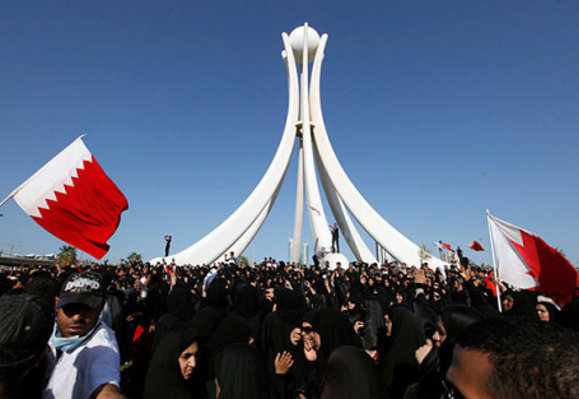
Since the early days of the Bahraini revolution on February 14th, 2011, Bahraini women participated as an active and influential entity in the protests. They advanced in great numbers on the front lines of the peaceful protests and expressed their opinion by demanding their political and human rights, giving speeches and reciting poetry. Their presence in the Pearl Square -The symbol of Bahrain’s revolution- was significant in taking up management roles, rescuing those injured by the excessive force used by Bahraini security forces; as well as documenting the brutalities committed against protesters and speaking to various media outlets. …more
May 14, 2011 Add Comments
Bahrain: The first prisoner of conscience after Feb 14 protests, still imprisoned – BYSHR
Bahrain: The first prisoner of conscience after Feb 14 protests, still imprisoned
May 14th, 2011
Bahrain Youth Society for Human Rights (BYSHR) is deeply concerned about Mr. Mohammed Albuflasa (a former Bahrain Defence Force officer), 36 years old.
On 15 Feb 2011 , Bahraini security forces arrested Mr. Albuflasa, who worked in the office of the Crown Prince Salman bin Hamad Al Khalifa, after he gave a speech on the podium during protests in Manama’s Pearl Roundabout demanding political reforms.
Towards the End of February he had been presented before the military court without a lawyer and the military court charged him with the following:
1- Engage in political activity
2- Participate in the gathering
3- Incitement against the regime
Court decided to sentence Mr. Albuflasa to two months imprisonment.
He is sentence was due to end on 14 April, 2011 but the military prosecutor extended his detention for 45 days till further notice which often means to an unknown period without any new charges or clarification. At the end of February 2011, the Parliament had requested the release of Mr.Albuflasa , however, the Bahraini authorities has to date ignored these calls.
Every Friday Mr.Albuflasa is permitted to make a phone call to his family. The family has informed the BYSHR that it demands visitation rights and that he be allowed to appoint a lawyer and have access to him as soon as possible.
The BYSHR calls for immediate release of Mr. Mohammed Albuflasa as he has not been allowed the basic right to an attorney before, during and after his trial that the demands of his family, visitation rights and access to an attorney, be met. …more
May 14, 2011 Add Comments
Norway concerned over the human rights situation in Bahrain
Norway concerned over the human rights situation in Bahrain
“I am deeply concerned about the deterioration in the human rights situation in Bahrain,” commented Minister of Foreign Affairs Jonas Gahr Støre.
The Foreign Minister is particularly concerned about the fact that four protesters were sentenced to death for their alleged involvement in the killing of two policemen during the protests in the country in March. “The fact that the trial took place behind closed doors in a military court gives cause for concern. The accusations against the four protesters are serious, and for that reason it is important that the trials are held in civilian courts, in accordance with the conventions that Bahrain itself has acceded to,” said Mr Støre.
“Norway is opposed to the use of the death penalty in general, and I would like to encourage the Bahraini authorities to introduce a moratorium on executions,” Mr Støre commented.
Foreign Minister Støre is also very concerned about the fact that so many healthcare workers have been arrested in Bahrain, and finds it unacceptable that the Bahraini authorities have threatened in recent weeks to ban opposition parties in the country.
“Dialogue is the only way of solving the political conflict in Bahrain. It is therefore crucial that a national dialogue between the royal family and the protesters on necessary reforms gets under way as soon as possible. The Bahraini authorities must respect freedom of expression and protect human rights defenders in the country,” Mr Støre said. …more
May 14, 2011 Add Comments
‘Mass sackings’ in Bahrain crackdown
‘Mass sackings’ in Bahrain crackdown
Part four in our exclusive series on Bahrain examines claims that a government crackdown has moved into the workplace.
Last Modified: 14 May 2011 12:02
More than 2,000 private sector employees, most of them Shia, have either been sacked or suspended in an expanding Bahraini crackdown on anti-government protests, an Al Jazeera investigation has found. The General Federation of Bahrain’s Trade Unions puts the figure of those who have been fired at 1,300, with Bahraini rights groups reporting that hundreds more have been suspended from their government jobs.
The International Labour Organisation says that the number of people dismissed or suspended currently stands at over 2,000.
Al Jazeera spoke to a number of people who had been fired in recent weeks. They spoke on condition of anonymity, fearing government reprisals. One man said that lawyers asked him questions related to anti-government protests the day he was fired. “He kept asking if I went to the Pearl Roundabout, if I went to the protests. If I met any of the opposition leaders. If I was a member of any political societies. If I made donations to the protesters. These questions were repeated again and again,” he said.
Turning point
The turning point for this side of the crackdown came when labour unions called a general strike on March 13. Under Bahraini law, companies are within their rights to terminate the employment of staff members who miss days of work above and beyond a specified period of unexcused leave. Another man who lost his job told Al Jazeera that he was struggling to support his family. He said that the mass dismissals were completely unexpected. “We have never faced this before. We have no idea how to deal with it. We are waiting for news from the company. Will they let us back? Will i be compensated?” he asked. “It’s the only job I know and I loved it.”
The International Labour Organisation has appealed to the Bahraini government to ensure that workers are not subjected to “unfair, unjust and degrading” treatment. …more
May 14, 2011 Add Comments
BAHRAIN: Activist describes electroshock, torture by government forces
BAHRAIN: Activist describes electroshock, torture by government forces
May 14, 2011 | 12:57 pm
by LA Times and Carnegie Middle East
After reports this week of security forces in Bahrain torturing detainees, particularly medical personnel, Babylon & Beyond spoke with Mohammed Maskati, president of the Bahrain Youth Society for Human Rights who has been working to document human rights abuses in the capital, Manama, and throughout the Gulf nation with international partners such as Amnesty International and Human Rights Watch.
Q: What is your focus now?
50356_10604207164_4576_n A: On Thursday the first nurse got sentenced in Bahrain, his name is Hassan Matooq. He is also a photographer, he took photos of all the injured people who came to the hospital. They charged him with four charges: torturing the injured, illegal gathering, participating in a rally and also broadcasting false news. He was sentenced to three years.
If he has only four charges and he is sentenced to four years, we are very afraid for the 47 medical staff (in custody), many of them have more than 10 charges against them.
Q: Why are medical personnel being detained?
A: They helped the injured and they are witnesses. If the government wants to destroy all the evidence, it’s one answer — you accuse medical staff because the main witness of what happened in Salmaniya Hospital, the number of figures of the injured and what kind of weapons were used at that time, was the medical staff. The medical staff know everything.
Q: Have you spoken with any of the medical personnel?
A: We did not speak with them but we spoke with some people who were with them. They said the police, they were tortured. We talked with the ones who were released.
Q: How many people did you speak with?
A: More than 30. Six talked about the doctors.
Q: Were the doctors treated differently than other detainees?
A: Yes, they get more torture. Some doctors, a very famous doctor, we don’t want to announce his name, they forced him to dance to music and they filmed.
Q: Was that meant to shame him?
A: We don’t know. All of those who were released talk about the security forces forcing them to chant for the government. Some of them forced them to say bad words about another opposition leader. Some of them more than 10 days they were handcuffed with plastic ones, not the normal handcuffs, and blindfolded.
Q: There have been reports police used electroshock on the detainees — did anyone tell you about that? What did they say was done to them?
A: Yes. You know an electric shaver? It looks like that but it is for electroshock. What was explained to us, it is the same size, the same style, but it shocks.
Q: How would police use that in interrogations?
A: They say they put it for 10 seconds, then they take it. Some of them, they say, they say they put it on sensitive places.
Q: Where would they put it?
A: On the back, on the head. Some of them they put it down in their private parts. But they don’t put it more than 10 seconds.
…more
May 14, 2011 Add Comments
US eases travel warning for Bahrain
May 13, 1:58 PM EDT
US eases travel warning for Bahrain
WASHINGTON (AP) — The United States has eased its travel warning for Bahrain, citing security improvements in the Middle East country.
Yet the State Department also warned of continuing unrest and said Americans traveling to Bahrain should take precautions. Some U.S. citizens might not be allowed to enter the country because of increased scrutiny by authorities, while demonstrations and ongoing security operations mean travel could become dangerous.
The State Department says U.S. diplomats in Bahrain are back at work, after authorizing the departure of non-essential personnel in April. The embassy is open and operating normally.
Protests that have gripped much of the Arab world spread to Bahrain earlier this year, but the government has cracked down hard.
There are no indications Americans or Westerners are being threatened or targeted, the State Department said.
…source
May 14, 2011 Add Comments
Obama Administration Fights to Allow Warrantless GPS Tracking
Obama Administration Fights to Allow Warrantless GPS Tracking
Tuesday, May 10, 2011
The Obama administration has asked the U.S. Supreme Court to hear a case involving warrantless tracking of suspects by law enforcement using GPS devices.
Federal prosecutors from the U.S. Department of Justice reached out to the Supreme Court after a three-judge panel of Democratic and Republican appointees in Washington D.C. unanimously threw out the conviction and life sentence of Antoine Jones, a nightclub owner convicted of operating a cocaine distribution ring. The judges objected to the month-long auto surveillance of Jones by police, ruling that law enforcement should have obtained a warrant before using a GPS tracker.
In many instances, suspects are not aware police are monitoring the movement of their cars unless they stumble upon the tiny GPS devices, usually hidden behind automobile bumpers.
In addition to the Jones case, an Arab-American college student, Yasir Afifi, has filed a lawsuit against the government alleging the FBI violated his privacy rights by placing a GPS device on his car without a warrant. Afifi contends he was targeted simply because of his ethnic background. -Noel Brinkerhoff …source
May 13, 2011 Add Comments
Neighborhood Protest
May 13, 2011 Add Comments
Bahraini State Terror Continues
Bahraini State Terror Continues
Friday, 13 May 2011 07:47
By Stephen Lendman
Bahraini-crackdownBahraini and Saudi security forces continue daily terror in Bahrain, human rights groups condemning the violence, including Amnesty International (AI), providing regular updates.
[excerpt]
On May 12, the Bahrain Center for Human Rights (BCHR) confirmed over 900 arrested, disappeared, and/or tortured, as well as at least 31 deaths. Most participated in peaceful protests. Others were engaged in routine daily activities, but were arrested anyway in broad sweeps.
Among the dead was a 15-year old boy shot in the eye with a rubber bullet while playing near his home. His father said he was also pistol-whipped on his neck, causing it to snap. “I picked him up, and I could hear him breathing in pain,” he said. “He took his last breath and then he did not breathe again. He died in my arms.”
A 71-year old, Isa Mohammed, died of asphyxiation in his home from heavy tear gas firing. His family’s plea for medical care was denied. Others died in custody from beatings and torture.
BCHR called torture “institutionalized within the Bahraini judicial and penal systems.” A 2010 Omar Ahmed Islamic Human Rights Commission (IHRC) report titled, “Broken Promises: Human Rights, Constitutionalism and Socio-economic Exclusion in Bahrain” explained abuses and unfulfilled reforms. Most Bahrainis are politically and economically deprived. Poverty and unemployment are extreme. High level corruption is extensive. Past confrontations between protesters and security forces resulted in violence, arrests, torture, other abuses and deaths. Oppressive measures are taken to prevent democratic reforms, including restricting free expression, assembly and association.
Moreover, human rights groups accuse authorities of “arbitrarily detaining opposition figures and….activists, subjecting (them) to torture and ill-treatment.” Overall, monarchical rule represents failed constitutionalism and state cronyism, institutionalized by security force harshness, enforced through brutal crackdowns, including widespread use of torture.
Explicitly prohibited under international law, Chapter III, Article 19, Clause (d) of Bahrain’s 2002 Constitution also states:
“No person shall be subjected to physical or mental torture, or inducement, or undignified treatment, (and any) statement or confession proved (made) under torture, inducement, or such treatment, or the threat thereof, shall be null and void.”
The Arab Charter on Human Rights also bans torture and other abuses and ill-treatment. It’s strictly prohibited at all times, under all conditions, with no allowed exceptions. …more
May 13, 2011 Add Comments
Testimony of Joe Stork before the Tom Lantos Human Rights Commission
Testimony of Joe Stork before the Tom Lantos Human Rights Commission
Hearing on the Human Rights Situation in Bahrain
May 13, 2011
The efforts of the Obama administration to transform and rehabilitate the role of the Human Rights Council are badly undermined by its deafening silence when it comes to Bahrain.
Joe Stork, deputy Middle East director at Human Rights Watch
Congressman McGovern and other Distinguished Commission Members:
Thank you very much for holding this important hearing on the human rights situation in Bahrain, and for inviting me to participate.
Human rights conditions in Bahrain have grown increasingly grave since mid-March, when the government violently put down pro-democracy and anti-government street protests. Since then, we have seen an unrelenting official campaign of punitive retribution against Bahrainis who participated in or otherwise supported the protests.
This campaign has included the apparently arbitrary detention of more than a thousand persons, of whom some 630 remain in detention. Almost all have had no contact with lawyers or a brief phone call with families and their whereabouts and well-being are unknown, including elected members of parliament as well as doctors and other professionals. This pattern of incommunicado detention is all the more worrisome in that in April four persons died in custody, some apparently as a result of torture and others from medical neglect. Early this week, 14 opposition activists were brought before a special military court, at least one of them bearing unmistakable signs of torture.
More than 1200 workers and employees have been summarily dismissed from their jobs apparently because of participation in the protests, in violation of Bahrain’s labor laws as well as international standards. Several professional associations, such as the Teachers Society and the Bahrain Medical Society have been suspended or effectively taken over by the authorities. The government engineered a hostile takeover of the country’s only independent newspaper, expelled this week the Reuters correspondent who was Bahrain’s only in-country international journalist, and have denied access to other foreign journalists wishing to report from the country. Meanwhile state-controlled Bahrain TV and pro-government print media routinely vilify pro-democracy groups as traitors operating at the behest of Iran and feature commentaries fomenting hatred against the Shia community – who comprise the majority of Bahrainis and majority of protesters.
It is important to note that this fierce and sometimes deadly repression has continued – and indeed intensified – despite the fact that since mid-March the government has been fully in control of the security situation. In Bahrain people continue to face arbitrary arrest, and effectively be “disappeared” and subjected to torture, many weeks after the protests have been suppressed. This is not Libya, where rebel forces have taken up arms against the government, or Syria, where thousands of protesters take to the streets week after week in city after city. This repression is purely vindictive and punitive.
And unfortunately, in contrast to Syria, Libya, and other sites of unrest and repression, the United States government has had little to say about any of this, at least in public, and those few words have tended to be general in the extreme. …more
May 13, 2011 Add Comments
Activists decry U.S. silence on Bahrain’s crackdown
Activists decry U.S. silence on Bahrain’s crackdown
By WILLIAM DOUGLAS
McClatchy Newspapers
Human rights activists at a congressional hearing Friday implored the Obama administration to publicly and forcefully denounce Bahrain’s violent and abusive crackdown against anti-government protesters.
The only problem was nobody from the administration attended the Tom Lantos Human Rights Commission hearing to listen to the pleas. Two top State Department officials – Political Affairs Undersecretary William Burns and Jeffrey Feltman, an assistant secretary in State’s Bureau of Near Eastern Affairs – were invited to testify, but didn’t show up. “I was expecting at least one, possibly two witnesses from the State Department to testify,” said Rep. James McGovern, D-Mass., the bipartisan commission’s s co-chair. “Regrettably, over the past 72 hours, we were informed that no one in any of the bureaus is available today.” A State Department official said Burns and Feltman were unable to testify because of scheduling conflicts.
Human rights activists complained that the White House has been publicly mum amid reports that Bahrain’s Sunni-led government, a key U.S. ally in the Middle East, is waging a violent and bloody crackdown – destroying Shiite mosques, illegally detaining and torturing dissenters, attacking medical personnel to prevent them from treating wounded protestors, abusing women and girls, and expelling journalists from the island nation. Joe Stork, the deputy director for the Middle East and North Africa division of Human Rights Watch, told the panel that about 1,000 people have been arbitrarily arrested in Bahrain since March, with about 630 still being detained.
“What is most disturbing is the fact that we don’t know where these people are, neither do their family members,” Stork said. “The use of incommunicado detention raises very serious concerns about torture.” …more
May 13, 2011 Add Comments
Torture and Unfair Trial of Protesters in Bahrain
Human Rights First: Torture and Unfair Trial of Protesters in Bahrain
May 12, 2011
Manama, Bahrain— Human Rights First is gravely concerned at today’s unfair trial in Bahrain of 21 suspects involved in recent protests calling for greater respect for human rights and democracy in the island kingdom.
Human Rights First was refused entry at the courtroom door this morning despite assurances from the Bahraini authorities that human rights organizations and other observers would be admitted. “Relatives of the defendants who were permitted access told us they looked in bad physical and mental shape,” said Brian Dooley of Human Rights First. “Several were limping and others have suffered drastic weight loss. They have not had adequate time to consult their lawyers, and there are credible reports of their torture in custody.”
The 21 suspects before the Lower National Safety Court today include prominent human rights defenders and opposition leaders. They have been charged with various national security crimes, including “insulting the army,” “organizing and managing a terrorist group for the overthrow and the change of the country’s constitution and the royal rule,” and “seeking and correspond[ing] with a terrorist organization abroad working for a foreign country to conduct heinous acts.” Some of these charges carry the death penalty.
“The hearing today was conducted in a heavily militarized atmosphere,” said Dooley. “The court buildings were full of armed soldiers, some wearing black masks.” Leading human rights defender Abdulhadi Al Khawaja is among those charged. His wife and daughter Zeinab were allowed a 10-minute meeting with him on Sunday. Zeinab told Human Rights First that his face had been badly damaged with multiple fractures while in the custody of security forces. He had undergone a four-hour operation in the military hospital. “But when he was supposed to be recovering from the operation they tortured him again,” she said. …more
May 12, 2011 Add Comments
Sheik Khalifa Al Khalifa the only one tripping and dellusional here
May 12, 2011, 6:03 pm
Bahrain’s Protesters Were Drugged, Official Claims
By ROBERT MACKEY
Adopting what might be called the Qaddafi defense, the head of Bahrain’s military claimed that the country’s brutal crackdown on dissent was entirely justified because the kingdom’s security forces had been confronted by young protesters under the influence of mind-altering drugs.
According to Bahrain’s state news agency, Sheik Khalifa bin Ahmed Al Khalifa said on Wednesday that “young people were given pills which affected their minds and made them do unusual things.” He also claimed “that Bahrain had been the victim [of] a conspiracy involving foreign agents and financing.”
Bahrain’s Sunni Muslim royal family has claimed that protesters from the kingdom’s Shiite majority were terrorists sponsored by their coreligionists in Iran.
The commander of the Bahrain Defence Force said that the young people had been drugged at the Pearl Roundabout, a traffic circle in Manama, Bahrain’s capital, that was occupied by protesters until it was cleared by the security forces in a deadly raid. The area was later renamed the Gulf Cooperation Council Roundabout and given “a facelift,” which included the destruction of a monument on the site that had become an icon of the protest movement.
The Bahrain News Agency – which has a banner across the top of its Web site with a photograph of King Hamad bin Isa al-Khalifa and the text “We Are All Hamad” – also reported that Mr. Khalifa said that the Saudi-led force sent to Bahrain to help suppress the demonstrations will remain in Bahrain after the current state of emergency is lifted, “in anticipation of any foreign threat.” …source
May 12, 2011 Add Comments
Tom Lantos Human Rights Commission – Hearing Bahrain
Human Rights in Bahrain
Hearing Friday, May 13, 2011 10 AM B-318 Rayburn House Office Building
This hearing will take place at 10 AM on 5/13/2011, in B-318 Rayburn House Office Building.
The Hearing is open to members of Congress, congressional staff, the media and the interested public.
Date Friday, May 13, 2011
Time 10 AM
Location B-318 Rayburn House Office Building
Background *REVISED NOTICE*
Please join the Tom Lantos Human Rights Commission for a hearing on the current human rights situation in Bahrain. Since mid-February, reports of human rights violations in Bahrain have increased significantly as Bahraini authorities have attempted to suppress anti-government protests. [Read more →]
May 12, 2011 Add Comments
I am Bahrain
May 12, 2011 Add Comments
Crushing dialogue – Rhetoric for DC
May 12, 2011 Add Comments
Bahrain Kangaroo Court adjourns Activist Trials
Bahrain court adjourns high-profile trial; sentences man to 15 years for attempted murder
Manama : Bahrain | May 12, 2011
By yasirqazi
Manama: A Bahraini court on Thursday sentenced a man to 15 years for attempting to murder policemen.
The court, made up of one military and two civilian judges, found Mohammad Yusuf Kadhem guilty of the murder attempt, and sentenced him.
He now has 12 days to appeal the verdict.
Separate case adjourned
In a separate case, the court adjourned the high-profile trial of 21 defendants, including seven who are being tried in absentia, to May 16 after lawyers requested more time to study the charges and testimonies. Some of the lawyers appeared for the first time before the court. The court on its first session postponed the start of the pleadings after some defendants said that they did not appoint lawyers. The court gave them time to ask their families to find legal representatives. Under Bahrain’s laws, no case can proceed without at least one lawyer for the defendant.
Political regime
The 14 defendants present at the court on Thursday, including Ebrahim Shareef, the head of liberal society Waad and activist Abdul Hadi Al Khawaja, faced up to 12 charges, including incitement to topple the political regime.
A call by the lawyers to release them on bail during the investigation was rejected by the prosecutor who argued that the charges were too serious to allow them to go home regardless of the guarantees. In their opening remarks, the lawyers disputed the merit of the court, saying that it had no competence to look into the case.
Several activists were present at the trial and the judge allowed [some of] the defendants to meet their newly appointed lawyers and their relatives.
Defendants’ charges
The defendants are charged with establishing and managing terror groups to topple the state royal regime and change its constitution; intelligence with an overseas terrorist organisation to commit hostile acts against Bahrain; attempting to forcefully and change Bahrain’s constitution and toppling its political regime; inciting for the toppling of the political regime; collecting funds and paying terror groups, with knowledge of their terrorist activities; possessing documents and publications inciting the overthrow of the political regime; insulting the army; public incitement of hatred and contempt of the regime; disseminating false information, rumours and malicious propaganda that would disrupt public order and harm public interest; inciting non-compliance with laws and promoting a matter that is considered a crime; and taking part in rallies without notifying the competent authorities.
The defendants in custody are Abdul Wahab Hussain Ali Ahmad, Ebrahim Sharif Abdul Raheem Mussa, Hassan Ali Mushaima, Abdul Hadi Abdullah Al Khawaja, Abdul Jalil Abdullah Al Singees, Mohammad Habib Al Saffaf, Saeed Mirza Ahmad, Abdul Jalil Radhi Makki, Abdul Hadi Abdullah Hassan, Al Hur Yusuf Al Somaikh, Abdullah Eisa Al Mahroos, Salah Abdullah Hubail, Mohammad Hassan Jawad and Mohammad Ali Ridha Ismail.
The seven who are being tried in absentia are Sayyid Aqeel Ahmad Al Mahfoodh, Ali Hassan Abdul Imam, Abdul GhaniAbdul Ghani Eisa Ghanger, Saeed Abdulnabi Al Shehabi, Abdul Raoof Abdullah Al Shayeb, Abbas Nasser Omran and Ali Hassan Mushaima. …souce
May 12, 2011 Add Comments
May 12 Trial News – Court adjounred until May 16.
Bahrain opposition leaders plead not guilty
May 12, 2011
Bahraini opposition leaders pleaded not guilty in court on Thursday of charges of belonging to a terrorist group and attempting to overthrow the monarchy, state news agency BNA reported. Fourteen out of a group of 21 defendants appeared before a special court set up in the wake of a mid-March crackdown on Shia-led protests demanding political reforms in the kingdom ruled by a Sunni royal family. The other defendants who are abroad are being tried in absentia.
“They all answered not guilty” to all charges, except for Abduljalil al-Muqdad, who “admitted taking part in unauthorized demonstrations,” BNA reported.
Among those on trial is also Ibrahim Sharif, the Sunni leader of the secular group Waed, who played a prominent role in the month-long protests.
Hassan Mashaima, the leader of the Shia opposition Haq movement, and Abdulwahab Hussein, the head of Shia Wafa Islamic Movement, as well as Shiite rights activist Abdulhadi al-Khawaja, are included in the group.
The trial was adjourned until May 16.
The accused are charged with “forming and directing a terrorist group aimed at overthrowing and changing the constitution of the state and the monarchy system,” according to the charge sheet. They are also accused of “having contact with a terrorist group abroad that operates in the interest of a foreign country by conducting hostile acts against the kingdom of Bahrain,” in reference to Shia Iran.
The charges also include “raising funds for the terrorist group.” Bahraini authorities say 24 people including four policemen were killed in the unrest, and they turned over 405 detainees to military courts and have released 312 others.
A special court has already sentenced four Shia to death and three others to life in jail after convicting them of killing two policemen who were allegedly run over by cars. Another was sentenced to seven years in prison for the attempted murder of policemen during the protests.
Bahrain has come under strong criticism from international human rights organizations for its heavy-handed crackdown on the Gulf state’s majority Shia, including medical staff. …source
May 12, 2011 Add Comments