The protests continue on backdrop of continued al Khalifa, Saud Crimes Against Humanity
irishtimes.com – Last Updated: Tuesday, June 7, 2011, 12:15
Arrests over Bahrain protests
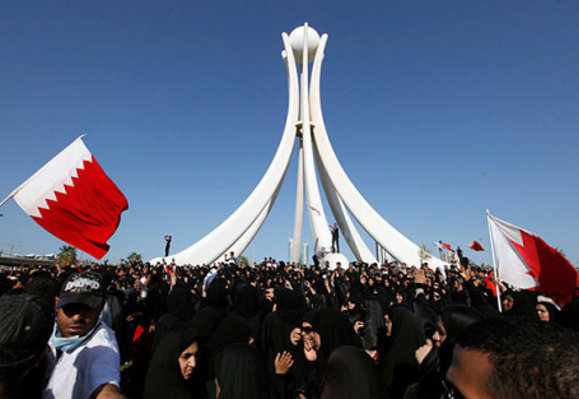
Bahraini police arrested a number of Shias at the weekend for shouting anti-government slogans during a religious festival in the Gulf Arab state, the interior ministry said today.
Police clashed with Shia marchers on Sunday, less than a week after the kingdom, ruled by its Sunni Muslim minority, repealed an emergency law that quashed weeks of protests.
“Some small groups broke the law on Sunday by exploiting the commemoration of the death of the Imam Hadi to stage marches and repeat political slogans that violate [the law],” the official news agency quoted spokesman Tareq bin Dayna as saying.
“A number of those provoking disturbances were arrested … and have been transferred to public prosecution.”
Residents and leading Shia opposition group Wefaq said on Sunday that police used tear gas, rubber bullets, sound grenades and birdshot to break up marches in several Shia villages around the capital Manama.
Marchers in some of the parades shouted “Down, down (King) Hamad” and “The people want the fall of the regime.” Some of the gatherings were purely religious, residents said. …more
June 7, 2011 Add Comments
Readout of the President’s Meeting With His Highness Salman bin Hamad Al Khalifa, Crown Prince of Bahrain
The White House
Office of the Press Secretary
For Immediate Release
June 07, 2011
Readout of the President’s Meeting With His Highness Salman bin Hamad Al Khalifa, Crown Prince of Bahrain
The President met today and had a productive discussion with His Highness Salman bin Hamad Al Khalifa, Crown Prince of Bahrain, following the Crown Prince’s meeting with National Security Advisor Tom Donilon. The President reaffirmed the strong commitment of the United States to Bahrain. He welcomed King Hamad bin Isa Al Khalifa’s decision to end the State of National Safety early and the announcement that the national dialogue on reform would begin in July. He also expressed strong support for the Crown Prince’s ongoing efforts to initiate the national dialogue and said that both the opposition and the government must compromise to forge a just future for all Bahrainis. To create the conditions for a successful dialogue, the President emphasized the importance of following through on the government’s commitment to ensuring that those responsible for human rights abuses will be held accountable. The President noted that, as a long-standing partner of Bahrain, the United States believes that the stability of Bahrain depends upon respect for the universal rights of the people of Bahrain, including the right to free speech and peaceful assembly, and a process of meaningful reform that is responsive to the aspirations of all. …source
June 7, 2011 Add Comments
Obama meeting with Crown Price Hamad green lights, “torture confessions”, military trials, indefinite detentions – after all it’s what Obama’s GITMO is all about
Islamic-World
Bahrain medical staff ‘tortured for confessions’
Tuesday, 7 June 2011
Bahrain, June 07: Doctors and nurses put on trial in Bahrain yesterday told relatives they were beaten with hoses and wooden boards embedded with nails and made to eat faeces. They also had to stand without moving for hours, or even days, and were deprived of sleep in order to force them to sign false confessions.
The Bahraini authorities have put on trial 47 doctors and nurses before a security tribunal, accusing them of trying to overthrow the government, though they say all they did was treat injured pro-democracy protesters. Relatives of the health workers, who were allowed to speak to them for 10 minutes after the hearing, said the accused alleged that they had been psychologically and physically abused during their confinement.
One eyewitness said the health workers said the worst “forms of torture were during the interrogation in the Criminal Investigation Directorate (CID) in Adiya. But at the jail it was mainly humiliation and constant verbal abuse with the occasional beatings, however not as severe and extreme as at the CID.”
The trial is a sign that the end of martial law on 1 June has had no effect on the government’s repression of the majority Shia community. The court trying the health workers, most of whom worked at the Salmaniya Medical Complex, has military prosecutors and military and civilian judges, suggesting the end to martial law may have been a ploy ahead of Formula One’s decision to stage the Bahrain Grand Prix.
Before the hearing yesterday, families of the doctors and nurses had only been able to communicate by phone. Lawyers had not seen their clients at all. Eyewitnesses said the appearance of the doctors confirmed fears of abuse. A witness told The Independent: “They were blindfolded and handcuffed and these were only removed when the [court] session began.” The witness asked for their name to be withheld. …more
June 7, 2011 Add Comments
Mosley, F1 teams express more concern for victims of Bahrain King Hamad’s, Human Rights crackdown, than President Obama
Mosley writes off Bahrain chances
Author: Nigel Brown
Posted on:07 June 2011 – 01:50 PM
Former FIA president Max Mosley has written off the chances of the reinstated Bahrain Grand Prix actually going ahead.
The race had originally been scheduled as the season opener on March 13 but was postponed in February because of civil unrest in Bahrain.
The sport’s governing body unanimously agreed to restore the race to the calendar on October 30, with the inaugural Indian Grand Prix moved back to December 11.
Mosley believes Formula One’s image will be damaged if the race goes ahead, while also adding that there needs to be unanimous agreement from the teams, who have already expressed their dissatisfaction against the season finishing as late as December.
Mosley told BBC Radio 5 live: “I will be astonished if the event goes ahead. I don’t think it will happen.
“One thing that everybody seems to have overlooked is that the teams have to agree a change of calendar.
“You can’t simply move the Indian race from one point to another without asking all the people who have entered.
“You need the written agreement of every team and I don’t believe that is going to be forthcoming.” …source
June 7, 2011 Add Comments
Obama’s pretentious media snub, acknowledgment of fictitious End to Emergency Law and affirmed allegiance to King Hamad, an insult to Democracy and Human Rights Advocates around the World
(AP) WASHINGTON (AP) — President Barack Obama has met with the crown prince of Bahrain at the White House and is welcoming the Gulf kingdom’s decision to end emergency law last week.
In a statement, the White House says Obama told Salman bin Hamad Al Khalifa that stability in Bahrain depends on respect for the universal rights of citizens there, including the right to free speech and peaceful assembly. He also reaffirmed America’s strong commitment to Bahrain.
Bahrain imposed emergency rule in mid-March, giving the military wide powers to suppress demonstrations led by the country’s Shiite majority against the minority Sunni rulers. Bahrain invited 1,500 troops from a Saudi-led Gulf force to help suppress the unrest when emergency rule was imposed. Those troops will remain in Bahrain indefinitely. …source
June 7, 2011 Add Comments
Spain, you are not alone
Spain: Wellsprings of an explosive movement
Sunday, June 5, 2011
By Dick Nichols, Barcelona
Protest camp in Madrid, May 19.
In late April, the progressive Spanish daily Publico asked why there was so little resistance to the economic crisis, despite the country’s 5 million jobless and rising misery.
The union and social movement leaders and left academics interviewed pointed to the numbing impact of mass unemployment, the casualisation of work, the bureaucratisation of organised labour, widespread scepticism that striking could achieve anything, and the economic cushion provided by Spain’s extended families.
They also cited the apparent failure of French and Greek general strikes against austerity.
The consensus was that, given the absence in Europe of even one successful struggle, people in Spain were resigned to battling their way through the crisis as best they could.
No-one sensed the new wave of struggle just over the horizon.
Just over one month later, camps of thousands of los indiganados (“the outraged”) are pitched in the squares of at least 80 Spanish cities and towns.
The eyes of the world are on Mardid’s Puerta del Sol and Barcelona’s Plaza Catalonia, where the occupiers are denouncing pro-corporate austerity, political corruption and demanding a “new system”. …more
June 7, 2011 Add Comments
The Zapatistas, we are all Zapatista, we are all Bahrain, we are all marching toward liberty everywhere
The Return of the Zapatistas? They Never Left
May 2011 – Written by Michael McCaughan
San Cristobal de las Casas
Tuesday, 17 May 2011
Mexico is caught in the grip of an escalating drug war which has cost 40,000 lives in the past five years and has no end in sight. By comparison, the Zapatista uprising in January 1994, with less than 200 casualties, prompted peace rallies, a speedy ceasefire, and a national dialogue. The body count varies from day to day, 29, 41 or 33, numbers and methods varying as decapitation and mutilation complete with asphyxiation and the traditional bullet in the head. This endless war of unimaginable cruelty has numbed most Mexicans who observe from afar and hope the river of blood doesn’t arrive at their doorstep.
Once in a while, however, a single incident can trigger a powerful reaction. The death of Juan Francisco Sicilia, one of seven people gunned down in march, sparked a national mobilisation and a new movement aimed at shifting government policy away from perpetual warfare and toward an integrated political solution to the conflict. Javier Sicilia, poet and father of Juan Francisco, launched ‘The March for Peace with Justice and Dignity’ this month, a three-day event which culminated in a rally in Mexico City. The idea was simple: a silent march and a single slogan, ‘Estamos hasta la madre – no mas sangre’ (‘We’ve had it up to here, no more bloodshed’). This idea captured the popular imagination and on Sunday, May 8, hundreds of thousands of people marched all over Mexico demanding a radical change to government policy.
In Chiapas, the Zapatista Army of National Liberation (EZLN) answered the call and issued a communique in which they announced their plan to march into San Cristobal de las Casas, the town where the Zapatistas first appeared in January 1994. It has been five years since the Zapatistas last mobilised in this manner and for many people the movement has become a fading memory, a noble insurrection which inspired millions but ultimately fizzled out; victims of a sterile and bitter debate over the pitfalls and possibilities of electoral politics. …more
June 7, 2011 Add Comments
Twenty reasons why it’s kicking off in cyberspace
Twenty reasons why it’s kicking off in cyberspace
Posted on June 7, 2011 by deterritorialsupportgroup
In February the Newsnight economics editor Paul Mason very succinctly laid out the radically different nature of recent popular uprisings across North Africa, the Middle East and Europe compared to earlier political movements, and the economic and sociological reasons behind it. This incisive blogpost rang true for many of those involved in those social movements, articulating, as it did, a new sentiment and new political priorities amongst those populations. The short article sketched out a more cohesive image which the media in general was missing, partly through structural failings, but largely because events were unfolding at speed and trying to drag the chaotic events into an understandable analysis was difficult.
Running alongside the (still unfolding) Arab Spring, informing and shaping and being shaped in turn by those events, was a developing online conflict with major similarities; young, optimistic graduates who saw societies in more generalised terms of “power”, highly networked, informal and decentralised decision making processes and a deep cynicism and mistrust of traditional power elites and political ideologies. In the last month especially we’ve seen a series of events and developments that are changing the game of cyber-war (and cyber-class-war).
So what’s going on in cyberspace? What we’re seeing is a significant escalation in serious geo-political combat, and the mainstream press has failed in it’s coverage so far. Perhaps years of rehashing press releases have left many hacks without the critical journalistic capabilities to monitor, study, explain and contextualise the recent events of the cyber-war, leaving the majority of the populace completely in the dark as to what’s happening, and how governments and (unelected) transnational organisations are investing significant resources in an attempt to limit online freedoms.
Make no mistake- this is not a minor struggle between state nerds and rogue geeks- this is the battlefield of the 21st Century, with the terms and conditions of war being configured before our very eyes. Given the significant economic disruption online activism and hacking can cause, and the power online tools have to agitate, plan and execute IRL activism, the current increase in tensions between hackers and the capital/state partnership is every bit as significant as the continuing developments of the Arab Spring, with which the online activist movements are inextricably linked. Below we have laid out a brief overview of recent events. This list is necessarily partial, given the complexity, history and depth of the situation, and we are by no means experts in the field; we would recommend people use it as a jumping off point to help get more educated (we have heavily hyperlinked the text FYI). Get googling.
1. At the heart of it is a newly politicised generation of hackers who have moved from a lulz-based psychic-economy to an engaged, socially-aware and politically active attitude towards world events, primarily as a reaction to the way governments and multinationals dealt with the fallout of Wikileaks. The “politicisation of 4chan” and the birth of Anonymous have set the stage for a practice of socially-engaged hacktivism of a form and scale we’ve not seen before. …more
June 7, 2011 Add Comments
Crown Prince Hamad has un-hosted, non-meeting, no-event, meeting with Obama – Obama Silent
Bahrain protests and Obama’s ‘drop by’ diplomacy
President Obama just happened to ‘drop by’ a White House meeting with Bahrain’s crown prince today even as the government brutally suppresses protests. Why the secrecy?
The small kingdom is home to America’s Fifth Fleet and is of particular concern to Sunni-led Saudi Arabia, which regards the majority-Shiite protests in Bahrain as a proxy battle with Iran. Yet the government crackdown has been particularly brutal, even targeting women for torture.
No wonder then that Mr. Obama had to hide his meeting today with the Bahraini crown prince.
The president didn’t have the meeting on the official White House schedule. Yet he was able to “drop by” the office of National Security Advisor Tom Donilon just about the time a meeting began with Crown Prince Salman bin Hamad bin Isa al-Khalifa.
The crown prince is regarded as the lonely reformer in Bahrain’s ruling family, worthy of consulting but not in a visible way that might confuse people that the US condones the crackdown. His great-uncle, Prime Minister Khalifa bin Salman, is the conservative – and brutal – one, defending the country’s minority Sunni elite against the pro-democracy rabble with an iron fist. He might also have the power to boot out the US Naval base.
“Drop by” meetings are often used by presidents to send or receive messages in situations that need delicate diplomacy. The Dalai Lama, for example, gets such treatment, so as not to offend China by holding an official, cameras-clicking meeting.
Prince Salman is a graduate of American University in Washington, and thus may have an appreciation for the human-rights concerns of the US over Bahrain’s violence. Perhaps he might even take back a tough message from Obama that reform must come quickly and an end to violence even more quickly. …source
June 7, 2011 Add Comments
Emergent pattern on treatment of Journalists
Two more journalists summoned by military court
Published on Monday 6 June 2011.
Printable version PrintSend this article by mail Send français Partager28
Hossam Al-Suwaifi, a reporter for the newspaper Al-Wafd, and Sayyid Abdel Ati, the editor of the newspaper’s weekly edition, were questioned by the military prosecutor’s office on 3 June about a 26 May article referring to a possible pact between the armed forces and the Muslim Brotherhood.
They are the latest in a series of journalists to be summoned for interrogation by military prosecutors. Reporters Without Borders wrote to the Supreme Council of the Armed Forces on 1 June voicing concern that such interrogations were becoming increasingly systematic (see below).
3.06.2011 – Military rulers urged to allow freedom of expression
Reporters Without Borders called today on Egypt’s military regime to stop the “threats, arrests, interrogations and physical violence” it said the country’s journalists and bloggers had been subjected to in the months since the revolution that overthrew President Hosni Mubarak.
The organisation said it feared that a media forum the ruling Supreme Council of the Armed Forces has convened on 5 June with the main political groupings and leading media figures taking part, would be used by the army to “dodge criticism of recent abuses for which it is heavily responsible.” It called on the Council to listen to the demands at the forum for media freedom and show new respect for the work of journalists. The Council says civil society organisations can submit their demands by fax. …source
June 7, 2011 Add Comments
U.S. keen to hijack Arab revolts
Nasrallah: U.S. keen to hijack Arab revolts
June 07, 2011 01:57 AM
By Hussein Dakroub
The Daily Star
BEIRUT: Hezbollah leader Sayyed Hassan Nasrallah accused the United States Monday of seeking to hijack the wave of pro-democracy popular uprisings sweeping the Arab world.
He also praised Palestinians who confronted Israeli troops on the Israeli-occupied Golan Heights despite knowing they would be fired upon.
Damascus said 23 people had been killed Sunday when Israeli troops opened fire on hundreds of Palestinian demonstrators who tried to push through the mined cease-fire line across Syria’s frontier with the Golan Heights. The protesters rallied on the Syrian side of the border with the Golan to mark the Naksa, which refers to the defeat of Arab armies in the June 5, 1967, Middle East war which resulted in Israel capturing Egypt’s Sinai Peninsula, the West Bank, Gaza Strip and East Jerusalem.
Israeli troops killed more than a dozen people along the Lebanese and Syrian borders on May 15 when Palestinian protesters gathered near the border with Israel to commemorate the Nakba, Arabic for catastrophe, marking the 63rd anniversary of the founding of the state of Israel.
In a televised speech addressing the opening session of an intellectual conference on Iran’s Supreme Leader Sayyed Ali Khamenei in Beirut, Nasrallah said: “We hold the Palestinians and those youths who rallied at the border of Syria’s occupied Golan Heights in high esteem and respect for their insistence on confrontation in a clear message of determination in this [Arab] nation.”
“What happened yesterday on the anniversary of the Naksa on the Golan Heights has revealed that the U.S. administration wants to hijack the Arab revolutions,” Nasrallah said.
“This event has confirmed Washington’s absolute commitment to Israel’s security. This is Washington which talks about human rights and freedoms,” he added, referring to U.S. officials’ statements that Israel has the right to defend itself against protesters who attempt to cross its border. …more
June 7, 2011 Add Comments
Bahrain(State) News Agency, BNA – lies, misinformation and disinformation
Spokesperson for the UN High Commissioner for Human Rights: Rupert Colville
Location: Geneva
BAHRAIN
The High Commissioner would like to make clear that a meeting she had last Friday with Bahrain’s Minister of Social Development and acting health minister, Dr Fatima bint Mohammed Al Balooshi and three other Bahrain government officials, has been grossly misrepresented in a report by the Bahrain News Agency. The BNA article was subsequently picked up by a number of newspapers in the region, including the Khaleej Times and the Gulf Daily News, and even by some Sri Lankan government officials and media for their own purposes.
The Bahrain News Agency, which was not present at the meeting, stated that the High Commissioner had “recognized misinformation” about the Kingdom of Bahrain, and quoted her as saying “Certain information which we received about the developments in Bahrain are untrue.”
The High Commissioner would like to stress that she made no such statement, and is disturbed by this blatant distortion of her words. She will formally request the Government officials who attended the meeting to issue a correction.
The discussions at the meeting with the Bahraini Government delegation focused mainly on the proposed OHCHR mission to Bahrain, as well as a number of other issues relating to the recent protests, including the need for transparent independent investigations into the human rights violations that have taken place there. The mission has been accepted in principle by the Bahraini government but no dates have yet been set. …source
June 7, 2011 Add Comments
Obama continues to Pretend Bahrain problem doesn’t exist, will not host non-meeting that he will have with Crown Prince al Khalifa
June 6, 2011, 7:58 PM ET
Obama to Meet Bahrain’s Crown Prince
By Carol E. Lee and Jay Solomon
President Barack Obama will meet with the crown prince of Bahrain at the White House on Tuesday, an administration official said. But in a show of how delicate relations with the U.S. ally have become, the sit-down is not officially on the president’s schedule.
Instead Mr. Obama will “drop by” a meeting that Crown Prince Salman bin Hamad bin Isa al-Khalifa has Tuesday afternoon with National Security Advisor Tom Donilon, the administration official said.

The White House said last week that senior officials would use Prince Salman’s visit to push for political reforms in Bahrain, where the government’s harsh response to uprisings has created a diplomatic challenge for Washington, because of the Khalifa family’s role in helping U.S. efforts to combat terrorism and Iran’s nuclear program.
Last week, a senior administration official said the White House views Prince Salman as “a serious interlocutor” and believes there is “value in engaging with him directly.” The official said the White House sees as a “positive sign” the recent call from Bahrain’s King Hamad bin Isa Al-Khalifa for a national dialogue.
In a speech at the State Department last month, Mr. Obama criticized the crackdown in Bahrain, including the government’s detainment of hundreds of political prisoners.
It is unclear how long the president will spend with the crown prince on Tuesday. The White House does not plan to open any portion of the meeting to media coverage. The administration official said the White House will issue a written statement afterwards. …source
June 6, 2011 Add Comments
Bahrain’s King Hamad decends into paranoid hell as Kingdom slips away, Crown Price to meet Obama in last ditch bid for fascist refromism
Posted on Monday, 06.06.11
Bahrain media charge that U.S. backs regime’s overthrow
By ROY GUTMAN
McClatchy Newspapers
BAGHDAD — As Bahrain’s reformist crown prince headed to Washington on Monday for top-level talks, official news media in the Gulf state stepped up a drumbeat of anti-American attacks, some even accusing of the U.S. administration of colluding with opposition leaders they claim are trying to overthrow the state.
Al Wasat, the onetime opposition paper now under direct control of the Sunni minority government, carried an editorial with possible racial overtones Monday that claimed that “American black fingers are aiming to weaken the Gulf” states so the U.S. can create its own “Greater Middle East.”
Media attacks have also been directed against individuals at the U.S. Embassy, first the human rights officer, who departed early, and now against the acting head of mission, Stephanie Williams, a foreign service officer.
The Akhbar Al Khaleej newspaper on Sunday accused Williams of “collusion” with the moderate opposition group, Al Wefaq, and adopting what it said was the group’s “sectarian Shiite agenda.”
Another paper, Al Ayyam, charged in a column Monday that the U.S. is in an “evil alliance” with the opposition group.
The government ostensibly lifted martial law on June 1, but it’s still rushing highly dubious cases to its military tribunal. On Monday, 47 doctors and nurses were formally charged with a variety of crimes, from the murder of patients to attempting the overthrow of the regime, as well as some lesser offenses, such as taking part in an unauthorized public gathering.
In a May 19 speech on the “Arab Spring,” President Barack Obama called for Bahrain to release political leaders now in jail. “You can’t have a real dialogue when parts of the peaceful opposition are in jail,” he said.
But more than a month after arresting two former members of parliament, the Bahrain government hasn’t allowed them to see their families or consult lawyers, and seems to be preparing to bring them before the military tribunal.
It’s out of this cauldron of shrill rhetoric that Crown Prince Salman bin Hamad bin Isa al Khalifa, 41, a graduate of American University in Washington, is coming to call on members of the Obama administration, which has done its best to avoid public criticism of Bahrain, with the exception of the Obama speech.
The crown prince is the leading advocate of reform, and he encouraged Bahrain’s citizens to voice their dissent and exercise their right to assemble during the monthlong protests that lasted from mid-February to mid-March. Now, many of the people who listened to him find themselves in jail or even charged with a criminal offense.
Reform on the island would open up the political system to far more participation by the Shiite Muslim majority, which has been limited, through gerrymandered districts, to less than half of parliament, and has been kept from most high offices and positions of influence in the security services.
[Read more →]
June 6, 2011 Add Comments
Bahrain, life under State Terrorism
June 6, 2011 Add Comments
Nation Safety Law allows religious processions, reestablishes targets for al Khalifa and Saud
Bahrain: Targeting of religious processions a clear violation of freedom of belief practices
June 6th, 2011
“Freedom of conscience is absolute. The State shall guarantee the inviolability of places of worship and the freedom to perform religious rites and to hold religious processions and meetings in accordance with the customs observed in the country”. (Article 22/ Bahrain Constitution).
On 12 April 2011, Minister of Interior announced that the religious processions- for Shia Community- are not allowed “temporarily” due to the National Safety law (Emergency law). Ref: http://www.alwasatnews.com/3140/news/read/537003/1.html
On 4 June 2011, Bahrain TV announced that the religious processions- for Shia Community- are allowed after the end of the National Safety law (Emergency law).
…source
The riot police attacked the religious processions in several areas (Ma’ameer, Sitra, karzakan, Buri, A’ali, Dair, Kawara, Hamala, Duraz and other). Ref “Ma’ameer village:
The riot police later detained the participants in the religious processions.
The Bahrain Youth Society for Human Rights (BYSHR) expresses deep concern at the targeting of religious processions and emphasizes that freedom of religion in Bahrain is in danger. BYSHR calls for the Special Rapporteur of Religious freedom to take urgent actions. …source
June 6, 2011 Add Comments
No sympathy for the Devil. Empire Builder, Henry Kissinger visionless, sees no future but his grave, the misery of his architecture and vanishing kings and tyrants he calls friends
Democratic change in Bahrain does not serve US interests: Kissinger
Submitted 10 hrs 51 mins ago
Former US secretary of state Henry Kissinger emphasized that a democratic change in Bahrain did not serve the interests of his country, highlighting once again the western double standard towards the Arab revolt, the daily Die Welt reported Monday.
Speaking at a round-table discussion on global affairs in Berlin, Kissinger said it’s ‘not in our interests’ for Shiites to take over power in Bahrain since this could lead to ‘the breakup of Saudi Arabia.’ He conceded the upheaval in Bahrain and other Arab Persian Gulf countries was a ‘strategic and at the same time moral problem’ for America.
The silence of the world, and particularly the US, in the face of the murderous Al-Kalifa repression is galling to ordinary Bahrainis who oppose the crackdown, who watch the world condemn rulers in Libya and Yemen without a mention of Bahrain which is also home to the US Navy’s Fifth Fleet.
While Washington initially urged Bahrain’s government to negotiate with the opposition, it has issued no strong condemnation of Bahrain’s use of violence and intimidation since the middle of March, when Saudi Arabia sent more than 1,000 troops into Bahrain to help the despotic Al-Khalifa regime quell the protest movement that started in February asking for democratic reforms.
The US refusal to condemn massive human rights abuses committed by the Bahraini security forces while condemning such abuses in Libya and Yemen has undermined any credibility it had with Bahrainis.
Human right groups have complained that the White House has been publicly mum amid reports that Bahrain’s Sunni-led government is waging a violent and bloody crackdown — destroying Shiite mosques, illegally detaining and torturing dissidents, attacking medical personnel to prevent them from treating wounded protestors, abusing women and girls, and expelling journalists from the tiny island kingdom. …source
June 6, 2011 Add Comments
F1 leadership tries to duck moral blunder with bull-shit ‘risk assessment’ argument. Time to retire Bernie and the rest of the FIA can follow!
FIA leaves door open for Bahrain GP rethink
Alan Baldwin, Reuters June 7, 2011, 3:39 am
Post Comment
LONDON, June 6 (Reuters) – Formula One’s governing body has left the door open to a possible U-turn on holding a Bahrain Grand Prix this year after announcing last Friday that the postponed race was back on the calendar.
“If we have clear evidence that there is a risky situation this will obviously be taken into consideration,” International Automobile Federation (FIA) president Jean Todt told the BBC on Monday.
The race at Bahrain’s Sakhir circuit would have been the March 13 season-opener but was called off after civil unrest prompted a bloody crackdown in the Gulf kingdom.
It was reinstated, despite the teams making clear that they would rather not go and opposition from human rights campaigners, for Oct. 30 after a fact-finding mission to Bahrain last week by Spanish FIA vice-president Carlos Gracia.
“Our special envoy had meetings with the human rights people responsible in Bahrain,” said Todt. “He met many people before the report was submitted and unanimously agreed.”
Red Bull’s Australian driver Mark Webber said on Saturday that the wrong decision had been taken but did not expect the race to happen anyway despite the FIA announcement.
“As a competitor I do not feel at all comfortable going there to compete in an event when, despite reassurances to the contrary, it seems inevitable that it will cause more tension for the people of that country,” he added.
Police in Bahrain clashed with Shi’ite marchers in a religious festival on Sunday night.
June 6, 2011 Add Comments
Doctors on Trial, Shiite Professionals Dismissed from Employment
Bahrain: Doctors on Trial, Shiite Professionals Dismissed
Today, 23 doctors and 24 nurses who treated injured anti-government protesters at the state-run Salmaniya Medical Complex in Manama during previous months of unrest were charged with attempting to overthrow the monarchy, participating in illegal rallies, denying medical treatment to Sunni patients, and spreading false news that harmed the public. According to a government official, the medics ”cooperated with those protesters to hold political and religious rallies within the hospital grounds and provided misinformation to media outlets.” Their arraignment was in a closed-door hearing of a special security court comprised of military prosecutors and military and civilian judges, and authorized under emergency rule, which was lifted last week. The 47 accused have been detained since March. Authorities have placed a gag order on proceedings against opposition supporters, allowing a few select journalists to cover the trials. An additional hearing is scheduled for June 13.
The government has also dismissed hundreds of state employees and professionals accused of participating in anti-government rallies. Activists claim that the majority of those dismissed have been targeted for being Shiite. …source
June 6, 2011 Add Comments
“Bahraini women are paying dearly for expressing their views.”
Women In The Arab Spring
By William Fisher
The Public Record
Jun 5th, 2011
Since the beginning of the Arab Spring – starting with the unrest in Tunisia in early January – questions have been raised about the role of women in the uprisings across North Africa and the Middle East.
Photography of demonstrations in Egypt’s Tahrir Square reveals the presence of women of all ages. The same appears to be true in other parts of Egypt, and in Tunisia, Syria, and Bahrain.
The Bahrain Center for Human Rights has cataloged the role of women in the demonstrations in that country and the often brutal actions taken by security forces to force them from the streets.
The Center says, “Bahraini women are paying dearly for expressing their views.”
The organization says that dozens of Bahraini women “are being detained in prison facing torture and humiliation for participating in peaceful protests. The government is killing, detaining, physically and verbally abusing and dismissing women from work and education.”
In a statement, the Center says it “strongly condemns the ongoing crackdown against the peaceful protesters in Bahrain, specially the repression and detention of a great number of Bahraini women such as political and social activists, doctors, teachers, housewives as well as school and university students. These women are facing torture as well as physical and verbal abuses that leads to death in some cases; in addition to the dismissal from work and education.”
The Center says it believes the3se actions are “a vengeance against Bahraini women for the key role they played since the beginning of the protests; a way to force them giving up that role and retreat any activity they had in the protesting movement since last February. It is also a way to add pressure on the opposition to retreat their legitimate demands.” …more
June 6, 2011 Add Comments
Maryam Al-Khawaja Oslo Freedom Forum – May 2011
[Editor Note – see more important voices at Oslo Freedom forum Videos]
June 6, 2011 Add Comments
Medics’ trial in Bahrain postponed until next week
Medics’ trial in Bahrain postponed until next week
From Jenifer Fenton, CNN – June 6, 2011 — Updated 1634 GMT (0034 HKT)
(CNN) — Medical workers accused of trying to overthrow Bahrain’s monarchy, among other charges, will get additional time to consult with attorneys before their trial begins, a military court judge ruled Monday.
The judge postponed the trial of the 47 health workers to June 13. It originally was scheduled to begin Monday.
Many of the medics — 24 doctors and 23 nurses and paramedics — worked at Salmaniya Medical Complex, which the government says served as a coordination point for protests against the government where staff neglected their duties.
The justice ministry said the accused are charged with crimes that include incitement to overthrow the regime, deadly assault and refusal to help persons in need.
Activists and human rights groups allege that the medical workers are being prosecuted for treating protesters.
During Monday’s session, lawyers for the medics challenged the court’s legitimacy and asked that workers accused of misdemeanors be released, according to one person who was in court and an opposition figure who spoke with someone who attended the hearing.
The judge denied both motions, the sources said. …more
June 6, 2011 Add Comments
Obama’s ‘John Wayne moment’, ‘circle the wagons boys and prepare to fight, it’s spring time in Arabia’
Embattled Arab Leaders Decide It’s Better to Fight Than Quit
Reuters – By MICHAEL SLACKMAN and MONA EL-NAGGAR
Published: April 27, 2011
CAIRO — Arab leaders facing public revolt have increasingly concluded that it is better to shoot to kill, or at least to arrest and imprison, than to abdicate and flee.
That calculation appears to be based on the short-term results of the Arab Spring. Those who have left, namely Hosni Mubarak of Egypt, face the humiliation of a criminal investigation, a trial and possible imprisonment. Those who have opted to stick with the use of force, like the president of Yemen, Ali Abdullah Saleh, have retained power and appear to have leverage to negotiate immunity should they leave, regional analysts said.
“I don’t think we’re going to see rulers run away, like Mubarak,” said Mustafa Alani, an analyst with the Gulf Research Center in Dubai, in the United Arab Emirates. “We passed this stage. They will not run or abdicate. They will take their chances.”
The wave of Arab uprisings, which began with popular protests that quickly ousted entrenched autocrats, has evolved into deadly confrontations in Libya, Syria, Yemen and elsewhere, with leaders willing to use sustained lethal force against a public convinced that persistence is the key to victory. It is a face-off, a test of wills, which has left thousands dead and opened a dark chapter in what was initially called the Arab Spring. …more
June 6, 2011 Add Comments
House of Saud, existential buy-off of politicals in desperate bid to secure faultering Monarchies, End Times for the House of Saud!
Saudis perched on the Faisaliah Tower in Riyadh. The kingdom is aggressively emphasizing the relative stability of monarchies. – By NEIL MacFARQUHAR – Published: May 27, 2011
RIYADH, Saudi Arabia — Saudi Arabia is flexing its financial and diplomatic might across the Middle East in a wide-ranging bid to contain the tide of change, shield other monarchies from popular discontent and avert the overthrow of any more leaders struggling to calm turbulent nations.
From Egypt, where the Saudis dispensed $4 billion in aid last week to shore up the ruling military council, to Yemen, where it is trying to ease out the president, to the kingdoms of Jordan and Morocco, which it has invited to join a union of Persian Gulf monarchies, Saudi Arabia is scrambling to forestall more radical change and block Iran’s influence.
The kingdom is aggressively emphasizing the relative stability of monarchies, part of an effort to avert any drastic shift from the authoritarian model, which would generate uncomfortable questions about the pace of political and social change at home.
Saudi Arabia’s proposal to include Jordan and Morocco in the six-member Gulf Cooperation Council — which authorized the Saudis to send in troops to quell a largely Shiite Muslim rebellion in the Sunni Muslim monarchy of Bahrain — is intended to create a kind of “Club of Kings.” The idea is to signal to Shiite Iran that the Sunni Arab monarchs will defend their interests, analysts said.
“We’re sending a message that monarchies are not where this is happening,” Prince Waleed bin Talal al-Saud, a businessman and high-profile member of the habitually reticent royal family, told the editorial board of The New York Times last week, referring to the unrest. “We are not trying to get our way by force, but to safeguard our interests.”
The range of the Saudi intervention is extraordinary as the unrest pushes Riyadh’s hand to forge what some commentators, in Egypt and elsewhere, brand a “counterrevolution.” Some Saudi and foreign analysts find the term too sweeping for the steps the Saudis have actually taken, though they appear unparalleled in the region and beyond as the kingdom reaches out to ally with non-Arab Muslim states as well.
“I am sure that the Saudis do not like this revolutionary wave — they were really scared,” said Khalid Dakhil, a Saudi political analyst and columnist. “But they are realistic here.” …more
June 6, 2011 Add Comments
Webber, ….sport isn’t above having a social responsibility and conscience
Webber casts doubt on Bahrain race
5 June 2011
Red Bull Racing driver Mark Webber says he will be ‘highly surprised’ if the reinstated Bahrain Grand Prix goes ahead later this year, despite the FIA’s decision to set a new date for the race. During a World Motor Sport Council meeting in Barcelona on Friday, a 26-strong panel unanimously voted for the event to be staged on the weekend of October 28-30, but Webber believes the wrong choice has been made.
“My opinion is unchanged since I was first asked about this in late February,” the Australian explained on his official website. “Even though a decision has been made, I’ll be highly surprised if the Bahrain Grand Prix goes ahead this year.
“In my personal opinion, the sport should have taken a much firmer stance earlier this year rather than constantly delaying its decision in hope of being able to re-schedule it in 2011. It would have sent a very clear message about F1’s position on something as fundamental as human rights and how it deals with moral issues.
“It’s obvious that the parties involved have struggled to reach a decision but sadly I feel that they still haven’t made the right one. Like it or not, F1 and sport in general isn’t above having a social responsibility and conscience. I hope F1 is able to return to Bahrain eventually but now isn’t the right time.
Webber added that he would not be happy to race at the Sakhir International Circuit in October, arguing that the situation in the country could worsen again as a result.
“As a competitor I do not feel at all comfortable going there to compete in an event when, despite reassurances to the contrary, it seems inevitable that it will cause more tension for the people of that country. I don’t understand why my sport wishes to place itself in a position to be a catalyst for that.” …more
June 6, 2011 Add Comments