A “Papyrus” from Egyptian Human Rights NGOs: The protection of fundamental rights within the new constitution
Egypt
A “Papyrus” from Egyptian Human Rights NGOs: The protection of fundamental rights within the new constitution | 09/07/2011
Press statement
In light of the ongoing debate on the “January 25th” Constitutional process and its core provisions, the Cairo Institute for Human Right Studies (CIHRS) and several Egyptian human rights organizations have submitted a set of basic principles which they believe will guarantee an Egyptian constitution based on the values of the January 25th Revolution and its most prominent slogan, “Freedom, dignity, social justice” These principles, formulated in six detailed articles and signed by more than 25 Egyptian rights organizations, are based on the sovereignty of the people as the source of all governmental authority.
The document containing these principles has been termed a “Papyrus”, in appreciation of ancient Egyptian civilization and the great heritage of cultural, social, ethnic, and religious diversity that has shaped Egyptians’ character and identity. The productive interplay of Pharaonic, Nubian, Coptic, Arabic, and Islamic civilizations constitutes a source of pride and respect for all Egyptians, the origin of Egyptian particularity, and the backbone of their national union.
Article 2 of the Papyrus defends this diversity, emphasizing the need to strengthen and protect the values of pluralism as a fundamental part of humanity and its value, such that no majority should be permitted to suppress and repress any minority by whatever means. Article 1 of the Papyrus stresses the need for the constitution to guarantee cultural rights to every Egyptian, in order to preserve the national heritage and the cultures of various ethnic, religious, and geographic groups throughout Egypt’s history.
Recognizing such diversity and pluralism the Papyrus advocates for the Constitution to take into account numerous sources of legislation as a supra-constitutional principle that reflects Egyptians’ religious, confessional, ethnic, and cultural diversity. Egyptian identity cannot be reduced to one dimension or group without destroying national unity. The Papyrus further upholds the independence of religious institutions and commits them to refrain from engaging in any political partisan activity.
The Papyrus refrains from elaborating in detail the rights to be enshrined in the constitution and legislation, choosing instead to emphasize that international human rights conventions should constitute the fundamental reference point for the elaboration of these rights. The Papyrus proposes to protect the fundamental rights of all Egyptian citizens against any efforts to undermine or weaken these rights within the constitutional formation process. To do so it proposes the formation of a Constitutional Council composed of the heads of the high courts and chaired by the president of the Supreme Judicial Council to oversee the drafting of the Constitution in order to ensure the basic rights of all Egyptians are respected throughout. Additionally, the Papyrus does not propose a particular system of governance (parliamentary, presidential, or mixed), but rather leaves this to the constitution. Instead, it advances a set of fundamental constitutional provisions that must be respected in any democratic system regardless of the specific mode of governance adopted by the constitution.
The Papyrus upholds the independence of the judiciary and limits the jurisdiction of the military judiciary to military crimes committed by military personnel. It also establishes the police as a civilian body, and makes the Interior Ministry and Defense Ministry subject to parliamentary oversight.
Prompted by a belief in the value of dialogue as a basic foundation for democracy, CIHRS has set up an independent email address to receive all comments, suggestions, and questions regarding the Papyrus. Several meetings and discussions will also be organized with various political parties, public figures, youth, and rights advocates in order to further develop this document. …source
Attached the Papyrus.Please direct all comments and inquiries about the document to: albardeya@cihrs.org
July 11, 2011 Add Comments
Footballers marked for torture, detention by al Khalifa’s brutal repression
Football stars tortured for joining protest, say families
Hugh Tomlinson Dubai – July 8 2011 12:01AM
Bahraini footballers, including stars of the national team, were tortured while in custody during a crackdown on anti-government protesters this year, The Times has learnt.
The testimony given to The Times directly contradicts assurances given to Fifa, football’s governing body, by the Bahrain Football Association that no players had been suspended or mistreated.
In fact, friends and relatives said that a number of players were subjected to beatings in prison after they were arrested for taking part in a demonstration against the ruling Al-Khalifa family in March. Other sportsmen have told of long interrogations and ritual humiliation in jail.
The victims included Aala Hubail, a striker, his brother Mohammed and the goalkeeper Ali Saeed, all members of the Bahraini football squad.
Sitting in a community centre in the Shia village of Sitra, near the capital, Manama, they were too afraid to speak about their treatment and would say only that they did not know if they would be allowed to play football again. The Hubail brothers had had their heads shaved. Mohammed had bruises on his feet.
Friends and relatives said that the men had been threatened with further abuse if they spoke out, but gave details of what they knew of the men’s treatment in jail. “The first two weeks after they were arrested were the worst. They were beaten all the time. They still have marks on their bodies,” said one close relative, who did not want to be named.
Bahrainis are obsessed with football and their players are idolised alongside the international stars of the game. Aala Hubail played a vital role in Bahrain’s best showing at an international tournament, when the team came fourth in the 2004 Asian Cup. He was the tournament’s joint top scorer with five goals. …more
July 11, 2011 Add Comments
Bahrain financial woes worsened by relationship with Libya
Special Report – Bahrain financial woes worsened by Libya
Published: July 11, 2011 at 6:21 PM
MANAMA, Bahrain, July 11 (UPI) — Bahrain’s financial problems from political unrest are being made worse by investment links to embattled Libya, a widely known issue in the financial industry that came to the fore as Moody’s downgraded Arab Banking Corp., the kingdom’s banking giant.
Earlier this year Bahrain suffered downgrades of its sovereign debt ratings by in response to the government’s violent crackdown on political activists.
The ABC downgrades could be more far-reaching, however, because of very large Libyan stake in the bank, analysts said.
Moody’s said it downgraded ABC to speculative grade because of the bank’s continued reliance on Libyan deposits and the potential constraints on its franchise given that its 59 percent majority shareholder, the Central Bank of Libya, remains subject to sanctions imposed by United Nations, the United States and the European Union against the Libyan regime.
European authorities froze unspecified Libyan state funds, believed to be tens of billions of dollars, in response to Libyan leader Moammar Gadhafi’s war on dissidents and then armed rebel groups, now grouped together in an interim Transitional National Council and poised to wrest power from Gadhafi.
The Moody’s downgrade had the dual impact of hitting an already nervous Bahraini banking sector harder and raising new questions about the status of Libyan assets abroad. …more
July 11, 2011 Add Comments
HM King Hamad Hails Bahrain-US Military Cooperation – to the United States Shame
HM King Hamad Hails Bahrain-US Military Cooperation
Manama, July 11. (BNA) – His Majesty King Hamad bin Isa Al Khalifa, the Supreme Commander, today lauded the on-going joint military cooperation betwen the two friendly countries and allies – the kingdom of Bahrain and the USA.
This came as HM King Hamad received at Al Safriya Palace today the Commander-in-Chief of the Bahrain Defence Force (BDF) Field Marshal Shaikh Khalifa bin Ahmed Al Khalifa, in the presence of HM’s Personal Representative Shaikh Abdulla bin Hamad Al Khalifa.
During the meeting, HM King Hamad was briefed on the efforts made by the BDF Military Works Directorate and U.S. Army Corps of Engineers to consolidate BDF’s infrastructure, in line with the BDF General Command’s keenness to continuously upgrade BDF’s potentials and competence.
HM the King hailed the on-going cooperation reflecting the solid historical relations bonding the two friendly countries at all levels.
Royal Court Minister, miniters and the Acting US Ambassador to Bahrain were also present. …source
July 11, 2011 Add Comments
Let them eat doughnuts: the US response to Bahrain’s oppression
Let them eat doughnuts: the US response to Bahrain’s oppression
by: Mehdi Hasan – guardian.co.uk, Monday 11 July 2011 20.25 BST
While the west averts its eyes, Bahrain’s people are subjected to brutal suppression
Pity the poor people of Bahrain. They have been shot, beaten, tear-gassed – and patronised. On 7 March, at the height of the pro-democracy protests in the tiny Gulf island kingdom, a crowd gathered outside the US embassy in Manama, the capital, carrying signs that read “Stop supporting dictators” and “Give me liberty or give me death”. A US embassy official emerged from the building with a box of doughnuts for the protesters, prompting a cleric in the crowd to remark: “These sweets are a good gesture, but we hope it is translated into practical actions.”
It hasn’t been. Syria was subjected to sanctions and Libya to air strikes; Bahrain, however, was rewarded with visits from the Pentagon’s two most senior officials – the chairman of the joint chiefs of staff, Mike Mullen, and the then defence secretary, Robert Gates. Disgracefully, at the same time as peaceful protesters were being rounded up and imprisoned, both men offered full-throated endorsements of King Hamad Bin Isa al-Khalifa’s brutal regime.
The Sunni Khalifas have ruled Shia-majority Bahrain – officially a constitutional monarchy – since 1783. Bahrain’s prime minister since 1971, Prince Khalifa bin Salman al-Khalifa – the king’s uncle – has the dubious distinction of being the longest-serving unelected prime minister in the world. Unemployment stands at 15% – the highest in the Gulf – and Shias have long complained of discrimination and disenfranchisement.
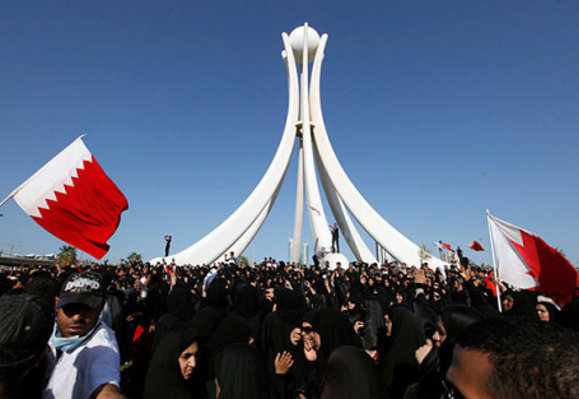
The Arab spring reached Bahrain on Valentine’s Day; protesters – both Sunni and Shia – arrived in Manama’s Pearl Square on 14 February to demand political freedoms, democratic reforms and greater equality for the Shia majority. They were met with rubber bullets and teargas; three days later security forces switched to live ammunition. Within a few weeks some 2,000 Sunni soldiers from Saudi Arabia and the United Arab Emirates had arrived in Bahrain, at the invitation of the Khalifas, to impose martial law – and, in doing so, poured oil on the fire of sectarian tensions. …more
July 11, 2011 Add Comments
Egypt stock markets plunge – unrest hits where it counts, on National Finances – especially impactful in light of imperiled Greece, Italy debts
Egypt shares plunge on unrest
Egypt’s benchmark stock index dropped almost 3 perecnt Monday, dragged down by concerns of mounting unrest in the Arab world’s most populous nation.
By TAREK EL-TABLAWY – AP Business Writer – 11 July, 2011
CAIRO — Egypt’s benchmark stock index dropped almost 3 perecnt Monday, dragged down by concerns of mounting unrest in the Arab world’s most populous nation.
The decline built on the EGX30 index’s nearly 1.7 percent decline a day earlier and reflected the continuing fears in the country five months after the ouster of former President Hosni Mubarak.
Two days after a Friday protest in Cairo’s central Tahrir Square that drew tens of thousands, demonstrators were still camped out there, demanding accountability of former officials and justice for nearly 900 people killed in the mass uprising against Egypt’s leader of nearly 30 years.
Brokers said foreign and institutional investors were dumping their shares in the market, with buyers largely limited to Gulf Arab and some individual investors.
“We haven’t seen events like these since the revolution,” said Khaled Naga, a senior broker at Mega Investments. “These are difficult days.” …more
July 11, 2011 Add Comments
Mexico, another US partner in Human Rights abuse
HR Activists in Mexico Speak of Dangers
July 9, 2011 | Print This Post Print This Post Email to a Friend Email to a Friend
HAVANA TIMES, July 8 (IPS) — Reports of extrajudicial executions, forced disappearances, kidnappings and assaults are some of the heavy baggage that U.N. High Commissioner for Human Rights Navi Pillay is taking home from Mexico.
Pillay, who ended an official visit here Friday, met over the past week with human rights defenders and senior government officials, including conservative President Felipe Calderón, to gather information on the human rights situation in this Latin American country.
“We have no guarantees for carrying out our work,” Gabriela Morales, a lawyer with the Centre for Migrant Human Rights (CDHM), told IPS. “The issue of human rights defenders has to be put on the table.”
In late June, the CDHM closed down its Mexican Northern Border Initiative due to threats and intimidation. The Initiative ran several shelters in border areas, providing assistance to Central American migrants attempting to reach the United States and to Mexicans deported from that country.
What happened to the Initiative, which had shelters in the border cities of Nuevo Laredo, Tijuana, Agua Prieta and Ciudad Juárez, is another illustration of the dangerous nature of the work of human rights defenders, who are threatened and harassed by both organized crime groups and government agents.
Since 2005, 27 activists have been killed, according to the governmental National Human Rights Commission (CNDH). Along with journalists, activists working on behalf of the rights of Central American migrants, who are frequent targets of youth gangs, organized crime groups and corrupt authorities, and the rights of indigenous people, who suffer heavy discrimination and poverty, have been caught up in the spiral of violence in Mexico.
So far this year there have been at least seven cases of assault on migrant rights activists, compared to two cases between October 2009 and October 2010, according to human rights groups.
Since 2000, 73 reporters have been killed, and 12 are still missing, according to the CNDH – making Mexico the most dangerous country in Latin America for journalists. …more
July 11, 2011 Add Comments
Iran Denies Smuggling Weapons To Iraq, Afghanistan
Iran Denies Smuggling Weapons To Iraq, Afghanistan
July 02, 2011
The semi-official Fars news agency quotes Iranian Defense Minister Ahmad Vahidi as saying “the ridiculous and repeated lies of the Americans are aimed at justifying their own errors.”
“The Wall Street Journal” on July 1 quoted unnamed U.S. officials as saying Iran’s elite Revolutionary Guard Corps has supplied allies in Iraq and Afghanistan with rocket-assisted exploding projectiles which have been used to kill American troops.
The newspaper quoted the same officials as saying Iran has also given long-range rockets to the Taliban in Afghanistan, increasing the insurgents’ ability to hit coalition positions from a safer distance. …source
July 11, 2011 Add Comments
Staring down the throat of a beast they call a revoltuion
Egypt: Arab Spring Morphs Into Summer Of Conflict
By William Fisher – The Public Record – Jul 9th, 2011
It should have been expected that the various groups who demonstrated in such a strong, unified position in Tahrir Square and elsewhere in Egypt would begin to show their differences after Mubarak resigned.
After all, they won! So what to do now?
Governing is a lot harder than demonstrating. And, besides, they weren’t the government; the army was.
During the Tahrir Square uprisings, the Army became the darlings of the protesters. They didn’t fire on the protesters. In fact, it was the Army who kept pro-Mubarak forces from physically attacking those who wanted him out.
Now the worm has turned once again. Crowds of full-throated critics of the Army are out in Tahrir Square again in large numbers.
They insist that the demonstrators arrested in previous demonstrations be tried in civilian, rather than military courts. They scream when they learn that the cops who are on trial for mishandling demonstrators have been freed on bail. They insist on an apology from the Ministry of Interior for their mismanagement of the security police during the demonstrations. They’re furious at the supreme military council for abusing prisoners taken into custody during the demonstrations and sentenced to substantial prison terms for what the opposition characterizes as “nothing.” And they’re equally up in arms about the “virginity tests” the military police administered to women taken into custody (the army now says it is discontinuing this practice.) …more
July 11, 2011 Add Comments
Panetta, “US to act unilaterally against Iranian armed extermists”
U.S. may act unilaterally vs Iran-armed Iraq militias
By Phil Stewart – BAGHDAD | Mon Jul 11, 2011 9:13am EDT
BAGHDAD (Reuters) – The United States will take unilateral action when needed to deal with the threat to American troops in Iraq from Shi’ite militias armed by Iran, U.S. Secretary of Defense Leon Panetta said on Monday.
U.S. forces officially ended combat operations in Iraq last August but have come under increasing fire in recent weeks. Fourteen U.S. service members were killed in hostile incidents in June, the highest monthly toll in three years.
U.S. officials blame Shi’ite militias armed by Iraq’s Shi’ite neighbor Iran for most of the recent attacks.
At least three U.S. service members have been killed this month, including one on Sunday, the day Panetta arrived in Baghdad on his first trip to Iraq as defense secretary.
Washington still has about 46,000 troops in Iraq more than eight years after the 2003 invasion overthrew Sunni dictator Saddam Hussein but is scheduled to withdraw its forces by year-end under a security pact between the two countries.
“We are very concerned about Iran and the weapons they are providing to extremists here in Iraq,” Panetta said in an address to U.S. troops in Baghdad. “In June we lost a hell of a lot of Americans as a result of those attacks. And we cannot just simply stand back and allow this to continue to happen …”
Panetta said Washington’s first effort would be to press Iraq to go after Shi’ite groups responsible for the attacks. He was scheduled to meet Shi’ite Prime Minister Nuri al-Maliki later on Monday.
“Secondly, to do what we have to do unilaterally, to be able to go after those threats as well, and we’re doing that,” he said, referring to the right of U.S. forces to defend themselves on Iraqi soil.
General Lloyd Austin, the commander of U.S. forces in Iraq, declined to comment on what specific measures unilateral action might involve.
“I think what the secretary was pointing to was we’ll do what’s necessary to protect ourselves and that could include a host of things … so we’ll just leave it at that,” Austin said.
LETHAL INSURGENCY
U.S. forces in Iraq now operate largely in the background, training and assisting Iraqi police and soldiers against a weakened but still lethal insurgency that launches hundreds of attacks each month. …more
July 11, 2011 Add Comments
The real criminals are ruling the country, operating the courts, staffing the prisons and pulling the triggers
July 10, 2011 Add Comments
dialogue was tyranny fulfilling International obligations and an opportunity to spin media – Revolution is about loosing the chains of tyranny
Bahrain: Pressure mounting for fact-finding mission
Bahrain Freedom Movement – 09/07/2011 – 10:21 am
The political crisis in Bahrain has deepened in the past few days after it became clear that the long-awaited “dialogue” has failed drastically. Instead of dealing with the core issues relating to governance and the future role of the Al Khalifa, the regime turned it into a public meeting arguing about trivial issues that had nothing to do with the underlying causes and demands of the revolution.
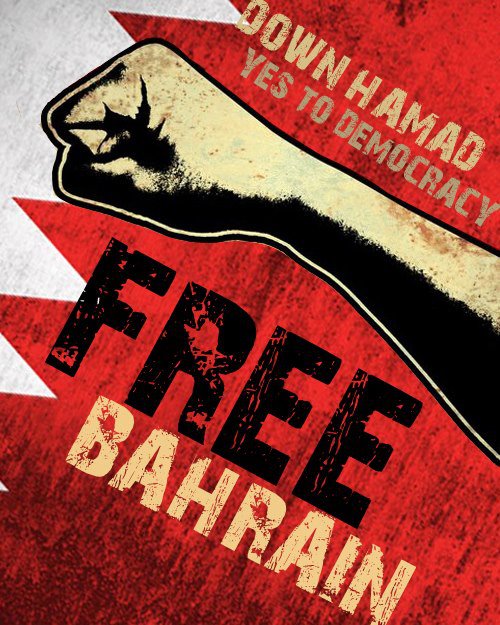
The American Embassy in Manama exerted enormous pressure on the political societies to join the meeting and the Al Khalifa dictatorship blackmailed some of those societies threatening them with severe reprisals if they did not join. The main forces of the revolution have, however, rejected any attempt to undermine the main aims including that of regime change. The first week of this futile attempt to derail the revolution has failed; the youth have returned to the streets and made their presence felt through their demonstrations and slogans like: “The people want regime change” and “Down with Hamad”. Few now believe that it would be possible for the two sides to co-exist following the enormous crimes committed by the Al Khalifa against Bahrain’s people.
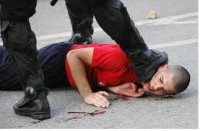
The enormity of the situation has led to international campaigns against the regime. Major news media such as The Times, The Independent, The Guardian have continued coverage of the illegal trials of Bahraini doctors and athletes. The Al Khalifa have been weakened and humiliated to such an extent that as soon as an international body threatens to take action against the Al Khalifa they would cave in without any resistance. When Fifa asked the Al Khalifa to give details of the crimes allegedly committed by the Bahraini athletes such as Alaa Hubail and his brother, Mohammad, the two were released despite their two years prison sentences. On Friday 8th July, both The Independent and Guardian newspapers carried full page adverts against the ongoing summary military trials of doctors and nurses. Almost all international human rights bodies are convinced that senior figures of the Al Khalifa had committed serious crimes against humanity. A recent videos shot secretly on Thursday 7th July depicts clearly members of the Death Squads openly torturing a Bahraini youth after being arrested in the street. There are many similar videos that could be used in any international court as evidence against senior members of the regime. New revelations of the forms of torture being inflicted on the doctors have confirmed that some of the methods may not have been used before. These include stuffing human secretion the mouths of the detainees to force them to sign false confessions. Senior figures of the opposition were given the choice either to utter words of apology to the dictator or being raped.
Meanwhile the 14th February youth have called for more protests to bring about a regime change. While public anger is rising against the American support of the regime, there is mounting pressure on international bodies to take action against the Al Khalifa dictatorship. Although Bahrain’s dictator is trying to avoid international sanctions by forming his own committee to “investigate” the crimes committed in the past few months, there are pressures on the Human Rights Council to send a fact-finding mission to Bahrain. The appointed committee is unlikely to scrutinize the dictator because it has to report to him and is financed by him. The UN Human Rights Council is urged to send her own team to investigate the Al Khalifa crimes against Bahrainis immediately, otherwise the Council will be accused of bias, double standards and failure to do its duties. Up to forty people have been killed by the regime’s machines of terror which is still committing serious crimes against more than 1000 prisoners.
Bahrain Freedom Movement
9th July 2011
…source
July 10, 2011 Add Comments
Bahrain Security Forces engaged in daily pacification of democratic opposition
July 10, 2011 Add Comments
Born a strange in her own land, her hope and strength will previal – end times for kings an tyrants!
July 10, 2011 Add Comments
Western Allies, Egypt, GCC, Bharain, collaborate to repress proDemocracy movement and punish human rights advocates
Egyptian Foreign Minister: “We will have a strong stance against any threat to GCC stability”
Cairo-July 7 (BNA) Egypt today reaffirmed its strong support against any attempts to subvert its security and stability and endanger civil peace.
“The GCC security is an integral part of the collective Arab security and a strategic depth to Egypt’s national security”, Foreign Minister Mohammed Al-Orabi said.
He said that Egypt would strongly oppose any attempt to undermine the GCC security and stability.
In a statement published today in Al-Ahram, he said that relations bonding Bahrain and Egypt would enter a stronger phase, building up on deep-rooted historic ties.
He pointed out that talks between Egyptian Prime Minister Dr. Essam Sharaf and Bahraini officials had revealed an accord in points of view concerning most Arab, regional and international issues.
“The coming period will witness a substantial increase in trade exchanges”, he said, pointing out that his country would encourage Egyptian business to set up a permanent centre for Egyptian products.
In this regard, he extended thanks and appreciation to His Majesty King Hamad bin Isa Al-Khalifa for allocating a land plot to construct the centre. …source
July 10, 2011 Add Comments
Bahrain Security Forces engage in routine destruction of personal property
July 10, 2011 Add Comments
A juristic gap between the Military Court and the Civil Court, and an unknown fate for the detainees
Bahrain: A juristic gap between the Military Court and the Civil Court, and an unknown fate for the detainees from the protests of the 14th of February
July 10th, 2011 – BYSHR
The Bahrain Youth Society for Human Rights (BYSHR) expresses its concern regarding the unknown fate of the detainees from the 16th of March 2011 after the authorities suppressed the protests in Bahrain.
On the 29th of June 2011, the King of Bahrain issued a decision to transfer protestor cases from the Military Court to the regular court.
This decision did not contribute to a fair trial for the following reasons:
1- Transferring the cases from the Military Courts does not mean reinvestigating the cases again by the General Prosecution, where only the files of the detainees will be transferred without a new investigation. The BYSHR has previously questioned the integrity of the evidence that the military prosecution and military court relied on.
2- The convicted in the primary courts and appellants in the Military Courts will be only permitted the Cassation Court, and the Cassation Court in the regular court cannot take the right decision that would contribute to the fairness of the judiciary.
3- The Military Court did not investigate in the torture allegations and did not permit the recording of the claims in the hearings proceedings, and the regular court will not be able to investigate since the marks of torture have disappeared after this long period.
The Bahrain Youth Society for Human Rights (BYSHR) affirms that the Military Prosecution has violated the legal procedures, especially that there are many detainees whom their detention period has exceeded three month, without charging or releasing them.
The Bahrain Youth Society for Human Rights (BYSHR) considers that the duration taken for transferring the cases from the Military Court to the Regular Court is an additional punishment against the detainees that have not been charged, and the international human rights law refuses the punishment of any defendant until being charged guilty by an independent and just court. Based on this, the BYSHR demands the immediate release of all detainees, as well as the instant and independent investigation in the arbitrary arrests, the long detention periods with no charges and the allegations of torture. …source
July 9, 2011 Add Comments
Time running out for reforms, rumors of reform – catastrophic consequences of Western inaction on calling off it’s tyranical allies and friends around the corner – the West can’t have it both ways
New protests rage across Egypt
Demanding faster reforms and prosecution of Mubarak era officials, protesters gather to put pressure on military rulers.
Last Modified: 08 Jul 2011 12:06
Thousands of demonstrators have flooded Cairo’s now-iconic Tahrir Square and other rallying points across the country to demand immediate reforms and swifter prosecution of former officials from the toppled government of Hosni Mubarak.
Friday’s “March of the Million”, as protesters are calling the new uprising, is expected to be the biggest demonstration since the fall of Mubarak on February 11.
Many Egyptians feel that little has changed since the regime was forced out, and the nationwide protests are the latest calls for the country’s interim military rulers to provide a roadmap towards democracy, jobs and infrastructure improvements.
Most of Egypt’s political parties and coalitions, including the Muslim Brotherhood, supported widespread calls for the protest to be staged across Egypt. Hundreds of protesters gathered in Suez and Alexandria, among other locations.
“The main frustration here is over the release of the officers accused of killing protesters during the revolution is the main focus of the people here,” said Al Jazeera correspondent Sherine Tadros from Suez. “What people here are asking for is justice and faster trials of those responsible for the killings of protesters.
Tadros added that the military is trying to maintain control and show a visible presence in Suez.
“However, they are careful not to overshadow the protesters to make it out in many ways that they are here to stop the protest,” Tadros said.
Five months after the revolution, many activists behind Friday’s protest say few of the goals of the original uprising have been achieved. One rallying point is the claim that military rulers have failed to provide justice for the victims of the former regime.
Call for action
“Punishment for the killers of the martyrs,” read one banner in Tahrir Square, the focal point for protests that drove Mubarak out of office after 30 years in power.
In video
Shadi Hamid, the Director of Research at the Brookings Doha Center, discusses the issues behind the protests
Another placard read “Down with the field marshal”, referring to the military commander, Mohamed Hussein Tantawi, who heads the military council which took over after Mubarak.
Tantawi was Mubarak’s defence minister for two decades, and some Egyptians believe he represents the continuation of Mubarak’s lingering power structure that includes the judiciary, police and civil service. …more
July 9, 2011 Add Comments
Bahrain, UAE engaged in creating “firewall of impunity” between Rulers and their Victims brutalized by mercenary “Security Forces” using Erik Prince’ recipe from Iraq
Blackwater Founder Assembling Secret Mercenary Army for UAE
UAE Confirms Hiring Erik Prince, Declines to Offer Details
by Jason Ditz
For the second time this year, Blackwater USA founder Erik Prince has been tapped as the leader of a secret military being formed in the desert. In January he was reportedly at the head of a “anti-piracy milita” in northern Somalia. Now, he is in the United Arab Emirates.
The UAE confirmed Prince’s hiring, saying he was providing “operational, planning and training support” for them, but offering no additional details. Documents leaked regarding the deal with Prince’s new company, Reflex Responses, confirm that he is building up a new mercenary army for the emirates.
The mercenary force is largely composed of Colombians and reportedly also features a number of South African mercs who were involved in the Executive Outcomes corporate army of the 1990′s.
Officially the reason for the new mercenary army is “anti-terrorism” operations, but the force is also confirmed to be created to deal with “internal unrest.” A number of other nations in the region have faced pro-democracy uprisings in recent months, and the United Arab Emirates even provided troops to help Bahrain crush theirs. The UAE itself, however, seems to be taking no chances that its own military won’t be willing to crush similar demonstrations, and is preparing the mercenaries primarily as a force with no local ties which would have no qualms about opening fire on demonstrators to secure the regime’s control. …more
July 9, 2011 Add Comments
Footballers corroborate torture by hired security forces will imprisoned
Bahrain’s soccer stars tortured in custody
The Times – July 09, 2011 12:00AM
BAHRAINI footballers, including stars of the national team, were tortured while in custody during a crackdown on anti-government protesters this year, The Times has learnt.
The testimony given to The Times directly contradicts assurances given to FIFA, football’s governing body, by the Bahrain Football Association that no players had been suspended or mistreated.
In fact, friends and relatives said a number of players were subjected to beatings in prison after they were arrested for taking part in a demonstration against the ruling al-Khalifa family in March.
Other sportsmen have told of long interrogations and ritual humiliation in jail. The victims included A’ala Hubail, a striker, his brother Mohammed and goalkeeper Ali Saeed, all members of the Bahraini football squad.
Sitting in a community centre in the Shia village of Sitra, near the capital, Manama, they were too afraid to speak about their treatment and would say only that they did not know whether they would be allowed to play football again. The Hubail brothers had had their heads shaved. Mohammed had bruises on his feet.
Friends and relatives said the men had been threatened with further abuse if they spoke out, but gave details of what they knew of the men’s treatment in jail.
“The first two weeks after they were arrested were the worst. They were beaten all the time. They still have marks on their bodies,” said one close relative, who did not want to be named.
When the brothers appeared in court, military police officers on duty went up to shake their hands, some asking for autographs.
“But the men who were beating them were not Bahraini. They didn’t care who they were,” said a friend of the players. “These men are loved by the people, Sunni and Shia. You are British: imagine David Beckham gets arrested and tortured. It’s unthinkable.” …more
July 9, 2011 Add Comments
al Khalifa finding it increasingly difficult to hide truth of prisoner torture
Bahrain doctor claims beatings and abuses against ‘Shiite traitors’ by Sunni jailers
By Associated Press, Updated: Saturday, July 9, 6:07 AM
DUBAI, United Arab Emirates — During more than two months in a Bahrain prison, the routine rarely varied: Alleged abuses by day such as beatings with a rubber hose, and then being blindfolded and dragged into a corridor at night to lie on cold tiles with others arrested in the Gulf kingdom’s crackdown on pro-reform protests.
The account — recounted to The Associated Press by a surgeon from Bahrain’s main state-run hospital — is among many claims of rights violations as authorities crushed the Gulf’s main Arab Spring uprising. It also shows the huge challenges for Bahrain’s Western-backed rulers to rebuild their image and lead reconciliation talks that began this month.
The allegations by the surgeon and other medical personnel remain some of the most politically sensitive between Bahrain’s Sunni monarchy and the majority Shiites seeking a greater political voice in the strategic island nation, which is home to the U.S. Navy’s 5th Fleet.
“They insulted us as ‘Shiite traitors,’” said the doctor, who spoke on condition of anonymity because of fear of reprisals and worries about jeopardizing his defense in court. “They kept saying we were ungrateful to the (Sunni) king and what he did for us. ‘You don’t deserve to stay in Bahrain,’ they said.”
The state hospital became contested ground after the uprising began in February as it was flooded with injured protesters — some wounded by live ammunition — and authorities conducted arrest sweeps in the wards. A total of 48 Shiite doctors and nurses, including the surgeon, still face a range of charges from supporting the protests to trying to overthrow the state.
But the claims of abuses while in custody could bring further international scrutiny on Bahrain’s harsh tactics against demonstrators and are among the many bitter and unresolved tensions that could unravel the U.S.-encouraged talks between the leadership and opposition. …more
July 9, 2011 Add Comments
Real-speak about the State of Bahrain and the ” National Dialogue” – moving forward to a new Bahrain
BCHR Statement on the National Dialogue
July 8th, 2011
Middle-East Institute Director Dr Michael Hudson said recently that “The Bahraini authorities have a really serious long-term economic problem on their hands. They don’t have a lot of oil so they are more dependent on the financial center and the tourism sector and the transportation that they have built up over the years, but they have got a lot of repair work to do because the protests and the crackdown has caused a loss of confidence and a distinct loss of legitimacy of the regime.”[1]
The regime wants to be seen to be taking the political crisis seriously, and has made a number of concessions, such as the appointment of a Royal Commission, the release of some of the doctors who were on trial and the moving of the military tribunals to civil courts. The start of a period of National Dialogue (ND) is symptomatic of this policy of superficial concern for the demands of the opposition.
Unfortunately, the constitution of the ND shows the superficial nature of the regime’s concern. Only 35 of the 300 seats at the ND have been allocated to opposition parties[2], and any decision made there can be overturned by the Shura council.
The Bahrain Center for Human Rights (BCHR) agrees with Kristin Diwan, Assistant Professor of Comparative and Regional Studies at the American University School of International Service, who wrote on CNN World that “Ultimately, stability in Bahrain will require social reconciliation and political restructuring. The National Dialogue will not deliver this, and it may in fact work to undermine the prospects for national reconciliation and reform.”[3]
This is a sad state of affairs, and one that is designed to allow the government to claim that it is the opposition’s fault that the talks have failed. These talks are on the government’s terms, which dismiss every concession asked for by opposition groups. The government have not stopped firing teachers and other employees, attacking protesters and torturing political prisoners.
Crucially, these talks do not involve those who are at the center of the political divide – the government and the opposition. These talks are between civil society organisations and businesses and academics, with very few politicians present. BCHR would welcome talks between the main disagreeing parties – the government and opposition.
Nabeel Rajab, Pesident of BCHR, has stated that “We will support a proper National Dialogue that represents the ruling family on one side and the opposition on the other side, but not what is going on now.” …more
July 8, 2011 Add Comments
The only “disputed issues” should be when the al Khalifa’s leave power and how long they will remain in prison for their crimes against the people of Bahrain
Bahrain’s Shiite, Sunni blocs unite to discuss disputed issues
Xinhua | July 08, 2011 10:36
A twelve-member team consisting of Bahraini conservative Sunni and Shiite blocs and some independents was formed Thursday night during the ongoing national dialogue, the dialogue spokesman said.
Spokesman Isa Abdul Rahman announced at a press conference that members from the parliamentary blocs attending the talks reached consensus to form a group that would function separately to study disputed political issues and seek consensus on the solution.
The team would consist of members from Bahrain’s largest opposition group Al Wefaq National Islamic Society, Al Menbar ( Muslim Brotherhood) and Al Asala (Conservative Sunni bloc), and other lawmakers who are taking part in the dialogue, he said.
“We have our reservations with the national dialogue process that represents about five percent of the opposition groups engaged in the talks,” Khalil Al Marzooq, former MP from Al Wefaq, told Xinhua.
Marzooq did not attend the social session Wednesday, saying that it was not important considering there were other key issues that had not yet been discussed.
“We need to get into core issues and want real representation of the people, which would show seriousness and stability,” he said. …more
July 8, 2011 Add Comments
Bahrain Shiite cleric comes down hard on “national dialogue”
Shiite cleric comes down hard on “national dialogue”
MANAMA, Bahrain (AP) — Bahrain’s top Shiite cleric on Friday criticized reconciliation talks between the Shiite-led opposition and the kingdom’s Sunni rulers, accusing the monarchy of using the U.S.-supported dialogue to delay democratic reforms.
The remarks by Sheik Isa Qassim underline the deep tensions in the tiny, but strategically important nation, home to the U.S. Navy’s 5th Fleet, after five months of pro-democracy protests and harsh crackdowns on the Shiite majority pressing for more freedoms and rights.
The cleric delivered a sermon Friday in the opposition stronghold of Diraz, northwest of the capital, Manama.
He said the government-organized talks, which started last week, are meaningless since they don’t take into account the urgency of the people’s demand for change.
“The people sacrifice so much for reform, and they (the rulers) talk about the need for gradual change,” the cleric said. “They want to give reform in small doses while inflicting massive injustice.”
At least 32 people have been killed and hundreds of opposition supporters and activists have been taken into custody since Bahrain imposed martial law in March to quell dissent. Many other perceived protest backers have been purged from jobs and universities.
Bahrain’s Shiites account for about 70 percent of the kingdom’s population, but they claim systematic discrimination including being effectively blocked from top military and political posts. Their revolt in February — inspired by wider Arab uprisings — have been by far the biggest challenge to any Gulf ruler in decades. …more
July 8, 2011 Add Comments
Can al-Wafeq rise to the occasion of Revolutionary leadship?
Bahrainis get set for nationwide rallies
shiapost | July 8, 2011
Bahrain’s military tanks in a street in Manama (FP)
Bahrain’s main opposition group al-Wafeq has called for a new massive nationwide protest despite warnings by the regime’s Interior Ministry against such moves.
The opposition bloc is currently in talks with the ruler of Bahrain in a bid to ease wide-spread tensions in the country.
However, the bloc has announced that it will press for a UN intervention if the dialogue fails. It has also expressed doubts that the so-called ‘national dialogue’ would lead to a resolution of many outstanding issues, such as the persisting suppression, arrest and torture of anti-government protesters as well as the continuing military trials of civilians by the al-Khalifa regime.
Only the leaders from two of the opposition groups, al-Wafeq and al-Waad, are participating in the negotiations as other opposition leaders remain in custody.
According to Bahrain Center for Human Rights, a non-governmental organization, there are currently over 1,000 political detainees, including medical staff, inside the country.
Meanwhile, al-Wafeq called for new protests on Friday across the country. Earlier, however, the Interior Ministry warned that it will quash any kind of protest gathering, a Press TV correspondent reported. …more
July 8, 2011 Add Comments