Proposed Saudi Arabia “Anti-Terror” Law Would Crush Peaceful Dissent and Protest – Model for Bahrain and GCC
Proposed Saudi Arabia “Anti-Terror” Law Would Crush Peaceful Dissent and Protest, Says Amnesty International
Human Rights Organization Obtained Copies of Top Secret Draft Law
This link takes you to the draft law (in Arabic): draft law
Contact: Suzanne Trimel, 212-633-4150, strimel@aiusa.org
Human Rights Watch English Summation HERE
(New York) – Amnesty International has obtained copies of a secret draft Saudi Arabian anti-terrorism law that would allow the authorities to prosecute peaceful dissent with harsh penalties as “terrorist crime.” Under the draft law, the definition of terrorist crimes is so broad that legitimate dissent would, in effect, be criminalized.
The organization obtained copies of the “Draft Penal Law for Terrorism Crimes and Financing of Terrorism,” which would also allow extended detention without charge or trial. Questioning the integrity of the King or the Crown Prince would carry a minimum prison sentence of 10 years.
The leak of the draft comes as ongoing peaceful protests across the Middle East and North Africa are being met with government repression.
“This draft law poses a serious threat to freedom of expression in the Kingdom in the name of preventing terrorism,” said Philip Luther, Amnesty International’s deputy director, Middle East and North Africa program. “If passed it would pave the way for even the smallest acts of peaceful dissent to be branded terrorism and risk massive human rights violations.”
“At a time when people throughout the Middle East and North Africa have been exercising their legitimate right to express dissent and call for change, Saudi Arabian authorities have been seeking to squash this right for its citizens,” said Luther.
A Saudi Arabian government security committee reviewed the draft law in June but it is not known when or if it might be adopted.
The definition of “terrorist crimes” in the draft is so broad that it lends itself to wide interpretation and abuse, and would in effect criminalize legitimate dissent.
Under the draft law, terrorist crimes would include such actions as “endangering…national unity”, “halting the basic law or some of its articles”, or “harming the reputation of the state or its position”.
Violations of the law would carry harsh punishments. The death penalty would be applied to cases of taking up arms against the state or for any “terrorist crimes” that result in death.
A number of other key provisions in the draft law run counter to Saudi Arabia’s international legal obligations, including those under the United Nation Convention against Torture.
The draft law allows for suspects to be held in incommunicado detention for up to 120 days, or for longer periods – potentially indefinitely – if authorized by a specialized court.
Incommunicado detention facilitates torture or other ill-treatment and prolonged detention of that nature can itself amount to torture.
Detainees in incommunicado detention are also, by definition, denied access to a lawyer during their investigation.
The draft law allows for arbitrary detention: it denies detainees the right to be promptly brought before a judge, and to be released or tried within a reasonable time. It gives the specialized court the power to detain without charge or trial for up to a year, and to extend such detention indefinitely. Detainees are not given a means to challenge the lawfulness of their detention in front of a court.
It also fails to include a clear prohibition of torture and other ill-treatment.
The draft law gives wide-ranging powers to the Minister of the Interior “to take the necessary actions to protect internal security from any terrorist threat.” It does not allow for judicial authorization or oversight of these actions.
Amnesty International is a Nobel Peace Prize-winning grassroots activist organization with 3 million supporters, activists and volunteers in more than 150 countries campaigning for human rights worldwide. The organization investigates and exposes abuses, educates and mobilizes the public, and works to protect people wherever justice, freedom, truth and dignity are denied. …more
August 2, 2011 Add Comments
Arab Armies crush protesters – Ramadan Begins
As Ramadan Begins, Arab Militaries Strike Back
Posted by: Geoffrey Mock, August 1, 2011 at 3:43 PM
“While they were hitting me I told them I’m pregnant, they shouted: who’s the father, then hit my stomach with his stick”
– Egyptian woman in Tahrir Square Aug. 1.
This was a weekend Arab armies struck back. In Syria, tanks attacked protesters in Hama, killing at least 100 according to Amnesty International reports. The military was back in action Monday as well.
In Egypt, reports are coming in from Egypt that the military is clearing out activists from Tahrir Square after more than a week of protests calling for a faster pace of reform. All morning reports from Tahrir Square painted a picture of mobs of people picking out protesters, surrounding them, provoking scuffles and then turning the activists over to soldiers nearby.
Unlike in Syria, the violence doesn’t appear to involve shooting, and no deaths have been reported, but there have been reportedly large number of arrests and social media was reporting eyewitness accounts of several injuries.
“Army took someone’s phone and smashed it. ‘by what law are you taking my phone?’ she asked. ‘by my law’ he screamed,” tweeted one Egyptian woman.
All this occurred on the first day of Ramadan, Islam’s holiest month. And it is extremely depressing.
The “But” here may not seem promising, but it’s worth noting: Nothing that occurred this weekend (including strange news about divisions among Libyan rebels) should undermine hope about the direction of the uprisings throughout the Arab and Middle East world. Progress was never going to be linear or quick, and the overreaching arc of the movement still leans toward justice. The fact that thousands are still bravely putting their lives on the lines in the streets of Egypt and Syria point to the fact that the people are not going home anytime soon.
Which means they need our support. Two new Amnesty International actions are meant to show solidarity with the activists as well as take creative steps toward helping real change.
In Syria, an Amnesty International online petition drive is pressing the rising powers of Brazil, India and South Africa to show they will use their new international influence for human rights by pressing the UN Security Council to take action against the violence of the Assad regime. You can add your voice here.
In Egypt, a new action focuses on the key role Egyptian women played in the uprising and concerns that they are now being marginalized. The action calls for specific and concrete steps to ensure women’s full political participation and their guarantees for their economic, social and political rights. You can take the action here. …more
August 2, 2011 Add Comments
German Green Party Sues Government on Saudi Tank Deal
German Party Sues Government on Saudi Tank Deal
AGENCE FRANCE-PRESSE – Published: 1 Aug 2011 08:02
BERLIN – Germany’s opposition Green party is taking the government to court over a reported secret deal to sell hundreds of tanks to Saudi Arabia, a party spokeswoman said Aug. 1.
“A suit brought by the members of parliament Christian Stroebele, Claudia Roth and Katja Keul was filed on Friday” with the Constitutional Court, the spokeswoman added.
The Greens, who oppose the reported deal, have asked the court to rule on whether the government is entitled to grant an export license for the tanks without informing parliament.
Press reports recently suggested that Saudi Arabia would be buying 200 Leopard-2s, Germany’s main battle tank, which is also produced under license in Spain, for a multibillion-euro sum.
Chancellor Angela Merkel and her government have refused to comment on the reports, saying such matters are confidential and decided by the federal security council, a panel that rules on arms exports and is chaired by the chancellor.
“Deliberation and decisions by the federal security council are secret for good reason,” Merkel has told the press.
For decades, Germany has declined to sell such heavy weapons to Saudi Arabia because of concerns over human rights and fears for Israel’s security.
Opposition politicians and even some members of Merkel’s ruling center-right coalition have slammed the reported tank sale, particularly in light of pro-democracy uprisings throughout the Middle East. …source
August 2, 2011 Add Comments
US Policy buy and arm the Middle East one friendly Sunni tyrant at a time
A Saudi beacon for Iraq’s Sunni militias
27 Juyl, 2011 – By Brian M Downing – Asia Times
Iraq is less violent and more stable than it was at the height of the insurgency, but it is still plagued by bombings and sectarian tensions. In recent weeks, Shi’ite militias have been attacking United States troops – perhaps on the direction of Iran, perhaps simply to take claim for their departure scheduled for the end of this year.
Sunni forces have been at work as well, targeting Shi’ite marketplaces and security personnel. Sunni militancy is no longer the diffuse anti-US insurgency it was after the fall of Baghdad, nor is it held in check any longer by benefits that the US surge once bestowed upon it.
Over the past year or two, the Sunni resistance has demonstrated considerable discipline and control in attacking Shi’ite targets and, most remarkably and puzzlingly, in not attacking US personnel. For an answer to this puzzle one might look next door to Saudi Arabia.
The Sunni insurgency, 2003-2007
In the four years between the fall of Baghdad and the success of the surge, various groups fought the Western forces. The Shi’ite militias were led by a handful of indigenous leaders and supported by Iran’s Revolutionary Guard.
Leadership in the Sunni movement, however, was less concentrated. It was based on a confused array of former army officers, tribal chieftains, Ba’ath party figures, religious authorities, local power holders, and al-Qaeda lieutenants.
The rank and file came from former soldiers angered by the US’s demobilization of the army, Salafist faithful who opposed the Western presence, foreign fighters from across the Middle East, and tribal youth seeking pay and adventure when elders lost the revenue and patronage system that Saddam Hussein had given them. All found a cause and steady pay.
Most fighters were undisciplined, and the insurgency showed it. Attacks demonstrated little knowledge of small-unit tactics and US troops often described Sunni fighters as no more than armed gangs. Coordination among rival Sunni groups was limited to sharing bomb-making skills and some supplies, though some tactical coordination emerged.
The Sunni insurgency was funded by Ba’ath party caches secreted about the country, wealthy contractors who had benefited from the old regime, and foreign sources in the Sunni Arab world. The money of the Ba’ath party and the contractors are thought to be long gone.
The Sunni opposition today
Most of the conditions that brought the old insurgency are still in existence. The Sunnis endure loss of privilege and status as the regimes they dominated since the 1920s are gone. Salafism remains strong and indeed it has strengthened as Sunnis turn to austere religion to explain their defeats and offer answers.
Perhaps most significantly, young men from the tribes have lost the jobs that Saddam’s state and later the US surge had given them. The Shi’ite state ended these support systems and many young men are once again available – or they are supported through clandestine revenues from abroad. …more
August 2, 2011 Add Comments
Adding Arms Profits for wrecked economies, Germany and US emmerge as principal arms suppliers for Kings, Tyrants and Human Rights Violators in Middle East, North Africa
Germany Arms Saudis Against Iran
July 26, 2011 |Julio Godoy
HAVANA TIMES, July 26 (IPS) — Germany’s delivery of armored tanks to Saudi Arabia is not aimed at repressing local or regional popular uprisings, but to improve Saudi military capabilities in a likely war against Iran, diplomatic and military experts say.
The German government’s decision to deliver 200 state-of-the-art Leopard 2 armored tanks to the Saudi monarchy – a deal estimated at 1.8 billion Euros – has triggered a wave of criticism by opposition leaders, commentators, the church and human rights groups.
Despite this criticism, the German government has defended the delivery of the tanks to Saudi Arabia, arguing that the Saudi monarchy, albeit a despotic regime, is “a pillar of stability” in the Middle East.
The German government also cites lack of U.S. or Israeli opposition, as justification for the deal with Saudi Arabia.
Contrary to the apprehension expressed by opposition leaders, commentators, and human rights groups, diplomatic and military experts believe that the Saudi regime will not use the German tanks to repress local popular uprisings demanding democratic reforms, but to eventually wage a war against Iran.
“To repress domestic enemies, the Saudis can use better suited equipment, including some 2,000 armored troops transport vehicles,” said Josef Joffe, publisher of the weekly newspaper ‘Die Zeit’.
Joffe is considered one of the most outspoken defenders among German media of the U.S.-Western European military alliance, the North Atlantic Treaty Organization (NATO). He also has links to the U.S. and to the Israeli governments.
By delivering the Leopard 2 tanks to Saudi Arabia, Joffe added, “Germany, together with the U.S.A. and Israel, is sending a message to the region, specifically to Iran: Here is more [military] deterrence. This argument should not be sneezed at.”
Joffe recalled that Germany recently delivered similar military equipment to other Arab governments. “In 2009, Germany delivered 36 Leopard 2 tanks to Qatar,” he said.
Additionally, the German army, the Bundeswehr, has admitted to carrying out military exercises in the United Arab Emirates to test the Leopard 2 tanks capabilities in the desert. The tests were apparently satisfactory.
Other Western governments – especially the U.S., Britain, and France – have for decades helped the Saudis to improve their arsenals.
Avi Primor, former Israeli ambassador to Berlin, and current president of the Israeli Foreign Affairs Association, agreed with Joffe. “Saudi Arabia uses other military equipment better suited to combat domestic popular uprisings,” Primor said.
In their recent intervention in Bahrain to help the repress the popular protests against the al-Khalifa family regime, the Saudis used light AMX armored tanks and not the heavier M1A2 Abrams tanks, of U.S. manufacture, Primor explained.
The Leopard 2 tanks are addressed to Iran specifically, Primor said.
Primor recalled that officially, Saudi Arabia is still at war with Israel. “But Israel and Saudi Arabia have a common enemy, Iran,” he said. “The Saudis consider Iran the most dangerous threat.”
Similarly, he added, “Israel has an urgent interest to strengthen the Saudi military capabilities, as a fortification against the Iranian danger, and as a stable power in the now unsecure Arab world.”
However, Primor said that the critique of human rights groups against the delivery of military equipment to Saudi Arabia is “understandable”. “The Saudi regime is quite archaic,” he said.
Despite such arguments, criticism of the tank exports is not going to end soon. Reinhold Robbe, until last year parliamentary commissioner for the German army, said that Saudi Arabia “is surely not a country that can stand up to the western standards of democracy and human rights.”
Such standards should be the guideline of German foreign policy, including military aid, Robbe said.
The Catholic Church also criticized the deal. “Germany should not deliver weapons in regions in military crisis, or to regimes that violate human rights,” said Bishop Stephan Ackerman, head of the church commission ‘Justitia et Pax’.
Human Rights Watch (HRW) called the Saudi human rights record “dismal”, and emphasized that the regime is one of very few countries in the Arab region whose government has offered no human rights reforms in the wake of the popular uprisings spreading through neighboring countries since the beginning of the year.
“The sight of Saudi tanks rolling into Bahrain signaled the start of Bahrain’s crackdown on peaceful pro-democracy protesters there,” said Christoph Wilcke, senior Saudi Arabia researcher at HRW. “Saudi reformers may well interpret selling tanks to Saudi Arabia at this time as German support for repressive regimes.”
But the German government is turning a deaf ear to such criticism. Instead, it has been offering military equipment to other regimes with similar human rights records.
During a recent trip to Angola in mid-July, German Chancellor Angela Merkel offered the government of Jose Eduardo Dos Santos patrol boats and other military equipment.
It is not clear as yet, whether the boats will be delivered to Angola, but commentators are aghast that Merkel ignored the wave of criticism caused by the delivery of the Leopard 2 tanks to Saudi Arabia and instead acted as “a sales manager for the military industry”, said Claudia Roth, president of the opposition Green party here.
For Thorsten Denkler, foreign policy analyst for the daily newspaper ‘Die Sueddeutsche Zeitung’, “Merkel’s sensors seem to be failing.” Angola, Denkler added, “is one of the most corrupt regimes of the world, where even the constitution cements the one party system.”
Denkler also recalled that Amnesty International repeatedly condemns the human rights violations in the South West African country.
Denkler complained that Merkel’s appeals for a real political understanding of military exports ignores the basic moral prerequisites of foreign policy. “It is not that Germany should not export weapons,” Denkler said. “But such exports should only occur towards states where democracy and the rule of law are guaranteed.” …source
August 2, 2011 Add Comments
Demonstration at Bahrain Ministry of Labor, demonstrators demand return of employment after politically motivated sackings
Fired Bahraini workers demand jobs
shiapost | August 1, 2011
Hundreds of workers in Bahrain have assembled outside the Ministry of Labor, demanding the government reinstate all unlawfully dismissed workers.
The recently-fired workers, who have been sacked for taking part in anti-regime demonstrations, gathered in front of the ministry in the Bahraini capital, Manama, on Monday, Press TV reports.
The Bahraini government and state-linked firms have fired more than two thousand workers since late March, according to Human Rights Watch.
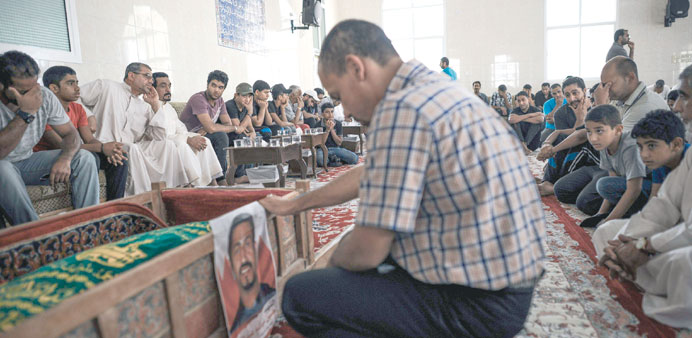
Meanwhile, people in the southern Bahraini city of Sitra held a funeral service for a protester who was killed on Sunday when regime troops fired tear gas to disperse anti-government demonstrators.
On Monday, Saudi-backed security forces in Bahrain abducted a teenager from his home and tortured him for two hours.
Saudi Arabia and the United Arab Emirates deployed military forces to Bahrain in mid-March to assist the Manama government in its brutal crackdown on the popular protests.
Scores of people have been killed and hundreds more arrested in Bahrain since mid-February. Numerous protesters have also been detained and transferred to unknown locations during the brutal onslaught on protesters.
Amnesty International has condemned the brutal crackdown on peaceful protests and detention of Bahraini protesters. …source
August 2, 2011 Add Comments
The Arrest of Ebrahim Sharif – A story of kidnap, detention, torture and humiliation, for no apparent crime other than political leadership – Ebrahim remains in detention with other Bahraini political leaderhsip
Ebrahim Sharif’s account of his arrest, torture, and a visit by the National Institute of Human Rights (translated)
By freeebrahimsharif more on FREE Ebrahim Sharif
The following three articles were written by Ebrahim Sharif (originally in Arabic, translated by his family) from inside Grain Prison, concerning his arrest, torture, and the visit of the National Institute of Human Rights.
The Arrest of Ebrahim Sharif
By Ebrahim Sharif
Arrest:
The arrest took place around 1:45 AM on the morning of Thursday, March 17th, 2011 when the doorbell rang. I went outside with my wife and found a group of masked investigators in addition to armed and masked policemen. They were accompanied by a National Security officer who was unarmed and dressed in civilian clothing. The officer asked me to open the front gate of the garden, and I asked him if he had an arrest warrant. He answered by saying no arrest warrant is required in the case of “National Security”. I opened the door and was arrested and placed in a civilian car where I was handcuffed and blindfolded. My house was not searched. Three people witnessed my arrest: My wife, Farida Ghulam, my neighbour, Mohammed Al Zeera, and his wife, Aisha Ghuloom. The car arrived at a building where I was taken to a room for a medical check up, after which some pictures of me were taken. I was blindfolded during the entire process except during the photographic session.
Next, I was taken out of the building, where my blindfolds were suddenly removed and I found myself surrounded by many masked men that pushed me around and cursed at me with swears such as “Your mother’s pussy”, “bastard”, and other degrading swear words. I was then blindfolded again and put into a van with other people, including Mr. Hassan Mushaima, who I recognized when I heard the security men call his name as they placed him into the van.
We later arrived to “Grein” prison at around 5 AM and were escorted out of the van. We stood in an area blindfolded as authorities and wardens directed threats and profanity at us. I heard them also curse at Mr. Hassan Mushaima, saying phrases such as “To hell with you and your 12 imams”. Afterwards, we were taken to one of the rooms where we were stripped from our clothes and then asked to wear the clothes again after removing our watches, belts, shoes, and eyeglasses. I was then taken to a cell. The treatment was poor and rough the entire time, with no shortage of insults, curses, threats and light beatings.
In prison:
I was put in building No. (4) along with five other prisoners. Sheikh Saeed Al-Nouri was put in cell number (1). Dr. Abdul Jalil Singace was put in cell number (2), Ibrahim Sharif in cell number (3), Sheikh Abdul Hadi Almukhaidher in cell number (4) and Alhurr Youssef Alsumaikh in cell number (5).
After less than an hour I was taken blindfolded to an office where an officer told me that he had met me previously, in the nineties in the State of Kuwait, and asked me if I knew where I was. I told him I do not know, he said, “You are in a place outside Bahrain,” and asked me to cooperate with him and place my hands in the King’s hands and give up my earlier positions. I told him, “My hands are in the king’s hands, but in my own way which is the way of reform,” and I added that the conversation with him could not be sustained without talking face to face by removing my blindfold so that I could explain my point of view and exchange opinions. We did not reach a result and I was taken back to the cell. …more
August 2, 2011 Add Comments
Obama’s promised new beginning
Obama’s promised new beginning
By Shahid Javed Burki
Published: July 31, 2011
The writer is a former vice-president of the World Bank and a former finance minister of Pakistan
In June 2009, less than six months after being sworn in as America’s president, Barack Obama addressed the citizens of the Islamic world. He chose Cairo’s Al Azhar University, the oldest surviving centre of Islamic learning, as the site for his much anticipated address. This was to be one of the most important and remembered speeches the president gave in the early part of his tenure. In it, he promised a new beginning in America’s relations with the world of Islam.
“I have come here to seek a new beginning between the United States and Muslim world, one based upon mutual respect; and one based upon the truth that America and Islam are not exclusive, and need not be in competition,” he told his large audience. “Instead they overlap, and share common principles of justice and progress; tolerance and dignity of all human beings. The people of the world can live together in peace. We know that is a God’s vision. Now that must be our work on Earth.”
President Obama thought that defining a new relationship between Islam and America was expected of him. He was a different kind of American president. “I’m a Christian, but my father came from a Kenyan family that includes generations of Muslims. As a boy I spent several years in Indonesia and heard the azan at the break of dawn and at the fall of dusk. As a young man, I worked in Chicago communities where many found dignity and peace in their Muslim faith.”
That speech was given two years ago. The American president could not have imagined how much would change in the Muslim world since the Cairo address. He must have hoped that democracy, liberty, freedom of expression, respect for the rule of law and rights of all citizens — ideas on which America had built its own society and its own political and social orders — would be adopted by those in the Muslim world where authoritarianism governed. That began to happen in ways that could not have been imagined in June 2009. One single and tragic act of defiance by a frustrated young fruit vendor in a small Tunisian town ignited the Arab world. The Arab street erupted and brought down two long-enduring regimes and threatened several others. The West, including America, surprised by these rapid moving events, stood by and watched as the Arab youth turned out in the streets and in public squares, no longer afraid that they will be mercilessly assaulted by the security forces. They brought down the presidents of Tunisia and Egypt. It was only when the Libyan regime threatened to massacre its own people that the West intervened.
The West began a military operation against the regime of Muammar Qaddafi in Libya that has lasted longer than expected. The Assad family that represents a small non-Sunni minority in a Sunni majority country launched a viscous campaign of repression to beat back those who wanted a more open political system. The opposite happened in Bahrain, where the Sunni establishment and monarch were challenged by the country’s large Shia majority. In Yemen, a society that was still governed by tribalism and tribal loyalties was set on fire, and it rages on even as the country’s long-serving president has gone to Saudi Arabia to recover from the injuries suffered during an attack on his compound by those who had rebelled against his rule. The Arab political revolution is actually work in progress.
There were other developments in the Muslim world. A political party inspired by Islam won the plurality of the vote in a general election and prolonged the rule of the country’s prime minister, Teyyip Erdogan. The Turks demonstrated that Islam was not incompatible with democracy. America and its Nato allies, fearing that they may get stuck in Afghanistan, began the search for a way out of that country that had defied so many other foreign interventions. The Americans found and killed Osama bin Laden in a city deep inside Pakistan’s territory, by carrying out an operation that was deeply resented by many in Pakistan, who considered it an act of aggression committed against a sovereign nation. After relations with Pakistan rapidly deteriorated, Washington indicated that it was holding back part of the aid it had promised the country’s military. A resolution was moved in Congress demanding a cut back in economic aid as well.
The Muslim world’s relations with America, therefore, were moving in directions that were not expected by the country’s new president. To use a favourite Obama expression, it is necessary for Washington to press the reset button. In doing so, it needs to recognise a few things. First, the world of Islam is not homogeneous. The people living in these countries belong to many different cultures and have had different histories. They are making economic, political and social progress at different speeds.
Second, the political systems that are evolving in these countries will be different. This is not surprising since the Christian nations in Europe and America don’t have the same political structures. Third, the strategic interests of countries in the Muslim world will not always be the same as that of America and its European allies. To force countries to follow Washington, Berlin, London and Paris is to generate resentment which is not good for any country inside or outside the Muslim world. Let us take three examples.
A more confident Istanbul has begun to carve out a role for itself in the Middle East, Central and South Asia that may not be in line with what the Americans consider to be their interests. An economically weakened and politically unsettled Islamabad is rightly nervous about what might emerge in its neighbourhood after the United States begins to pull out of Afghanistan. Tehran feels anxious because of the fact that it is the only major Shia country in the middle of a Sunni world. It may be inclined to give up its nuclear ambitions if it feels comfortable about its security situation.
In other words, in resetting the button, President Obama needs to move forward from rhetoric to real politics.
Published in The Express Tribune, August 1st, 2011.
August 2, 2011 Add Comments
US Silience on Bahrain – Obama’s blood money in biggest weapons deal ever to Saudi Arabia – approved months ago delivery in progress Sa
The Express Tribune
US announces massive arms sale to Saudi Arabia
By AFP – Published: October 21, 2010
The plan allows for the sale of 84 F-15 fighter jets, 70 Apache attack helicopters, 72 tactical Black Hawk helicopters and 36 light helicopters. PHOTO: AFP
WASHINGTON: In its biggest arms deal ever, the United States announced Wednesday it will sell up to 60 billion dollars worth of warplanes, helicopters and other weapons to Saudi Arabia, partly to help it counter Iran.
The plan allows for the sale of 84 F-15 fighter jets, 70 Apache attack helicopters, 72 tactical Black Hawk helicopters and 36 light helicopters, assistant secretary for political-military affairs Andrew Shapiro said.
The sale, which also includes the upgrade of 70 used F-15s, is “not to exceed 60 billion” dollars, Shapiro told reporters as President Barack Obama’s administration notified Congress of its plans to make the deal.
Congress has the authority to amend or delay the agreement, according to Shapiro, who said he did not expect Israeli opposition to the sale.
The delivery of the weapons to oil-rich Saudi Arabia would be spread over 15 to 20 years.
“It will send a strong message to countries in the region that we are committed to support the security of our key partners and allies in the Arabian Gulf and broader Middle East,” Shapiro said.
Though he said the deal is “not solely about Iran,” Shapiro admitted it is partly intended to help Saudi Arabia counter the perceived threat from the Islamic republic across the Gulf.
US defense officials said the deal had been in the works for months with the Saudis, who have grown increasingly anxious about Iran’s missile arsenal.
A senior defense official told reporters last month that “if you look at the kingdom, the major threat that they face in the region emanates from Iran.”
The official, who spoke on condition of anonymity, said the arms package “gives them a whole host of defensive capabilities to defend the kingdom and deterrence capabilities.”
The defense package also includes thousands of laser-guided smart bombs, including JDAMS, as well as Hellfire and Sidewinder missiles.
Arms sales to Saudi Arabia in the past have triggered concerns from Israel and its supporters in the United States, but US officials said they did not expect opposition.
“Our assessment is that this (sale) would not diminish Israel’s qualitative military edge, and therefore we felt comfortable in going forward with the sale,” Shapiro said.
Vershbow said US officials consulted Israel as the deal took shape.
“There have been high-level discussions, as well as working-level discussions. And I think it’s fair to say that, based on what we’ve heard at the high levels, Israel does not object to this sale,” he said. …source
August 2, 2011 Add Comments
Saudi Arabia in process of buying Cluster Munitions from US
SOURCE:Flight International
Saudi Arabia requests Sensor Fuzed Weapon buy
By Craig Hoyle – DATE:15/06/11
Textron Defense Systems could be poised to sell its CBU-105 Sensor Fuzed Weapon (SFW) system to Saudi Arabia, with a deal to be worth a possible $355 million.
Revealed by the US Defense Security Cooperation Agency (DSCA) following a 10 June notification to Congress, the potential deal covers the delivery of 404 CBU-105D/B weapons and 28 integration test assets, plus test equipment and personnel training.
The DSCA described Riyadh’s request as being driven by “legitimate security and defence needs”, and said that potential targets for the weapon could include “bunkers, armoured and semi-armoured vehicles, personnel and certain maritime threats”.
Among the terms of a sale would be “an agreement that the cluster munitions and cluster munitions technology will be used only against clearly defined military targets and will not be used where civilians are known to be present or in areas normally inhabited by civilians,” it added.
The CBU-105 weapon has a 99.6% reliability rate, according to its manufacturer. In the event of a failure, each of its 40 individual “skeet” warheads is non-hazardous once on the ground.
No indication was given as to which aircraft type would be equipped with the SFW, but this is most likely to be the Royal Saudi Air Force’s Boeing F-15 fleet.
Textron late last year finalised a $257 million contract to provide 512 CBU-105s to the Indian air force, with these believed to be destined for carriage by its Hindustan Aeronautics-built Sepecat Jaguar ground-attack aircraft. …source
August 2, 2011 Add Comments
Bahrain employs Pakistani mercenaries as Security Force to carry-out “crack-down” orders – mercenaries to work with impunity as do Saudi thugs
The New Bahrain-Pakistan Alliance
Bruce Riedel | August 2, 2011 – 02/08/2011
Bahrain’s Sunni monarchy is hiring hundreds of Baluchi mercenaries in Pakistan to crack down on the Shia majority’s demand for democracy and reform.
Saudi Arabia backs the Khalifa rulers, who are exacerbating sectarian anger and tensions throughout the Gulf. The Arab awakening puts American values and interests in contest with each other throughout the region but especially on this small island in the world’s energy storehouse.
Since the Arab Spring reached Manama, the hard-liners in the Khalifa family have tried to intimidate the Shia majority into accepting something less than their full rights as equal citizens and something less than a constitutional monarchy. The Saudi and Emirati forces that intervened in March back up the Bahraini National Guard, which does the dirty work of smashing demonstrations and arresting the reform leaders. For decades the Khalifas have recruited in Pakistan—especially its western province of Baluchistan—for Sunni soldiers who won’t hesitate to repress Shia.
Now the Khalifa are advertising and hiring by the hundreds in Baluchistan for retired soldiers and police to come urgently to the island and join the National Guard and the Bahrain Defense Force, the regular army. Several thousand have already enlisted. Want ads for more riot police jobs are in Pakistani papers. The ads say “urgent need” for “army and police experience.” Bahrain’s generals and diplomats have been pressing the Pakistani authorities to help them recruit mercenaries on a crash basis. The Saudis have encouraged Islamabad to send troops.
And Pakistan has been more than willing to help. It has been sending soldiers to keep Arab kings on their thrones for a half century. Zia ul Huq, Pakistan’s dictator, who led the anti-Russian jihad in Afghanistan, gained his combat experience in Jordan in the late 1960s fighting the Palestinian fedayeen. The Hashemites still regard him as a key to their survival in Black September 1970 when he helped crush the PLO. The Shia demonstrators in Manama now try to taunt the mercenaries by yelling at them in urdu “the police are crazy” since many speak no Arabic. A Baluchi soldier can get Bahraini citizenship for his duty, a reward that the Shia majority sees as a way to increase their sectarian rivals’ numbers.
The king has promised reform for years. Unrest has been persistent since the British gave the island independence in 1968. I witnessed stone-throwing demonstrations and tear gas in 1994. The Khalifas had many opportunities to open up the system and let them all pass by. Now the Saudis, especially Interior Minister Prince Nayif, who despises Shia, are calling the shots.
The Sauds and the Khalifa are only exacerbating the sectarian hatred on the island, probably sowing seeds that will sprout terror and violence up and down the Gulf. Iran and Iraq have both protested the treatment of the Shia on the island and criticized the royal family for its extreme sectarian policies. The Bahrainis and Saudis have accused Iran of stoking Shia unrest but so far have provided little proof. Bahraini politicians have been accusing Iran of meddling for decades; sooner or later it will be a self-fulfilling prophecy.
For years the United States has pressed the Khalifa to engage in a genuine dialogue to bring about real change and democracy. Now Washington is quietly pushing for more from King Hamad bin Eisa al-Khalifa, but with little to show. The Obama administration thought it was close to a deal when the Saudis intervened. …more
August 2, 2011 Add Comments
Independent Commission begins investigations against backdrop of daily murder, assault and torture by Bahrain Security Forces – the only credible thing Mr. Bassiouni can do is resign commission in protest over al Khalif’s ceaseless violence against oppostion
Bahrain Independent Commission of Inquiry (BICI) begins investigations, Meanwhile Bahraini regime continues violations
2 Aug 2011 – BCHR
In a move supposedly intended to end the crises in Bahrain, King Hamad Al-Khalifa funded a commission to look into crimes committed against the people of Bahrain since February of 2011. The BICI headed by Mr. Bassiouni has just recently started its work and opened their doors for complaints and testimonies. However, they are welcomed with a mixture of skepticism and fear by the people of Bahraini.
One of the reasons people are not more hopeful about this commission is that while the BICI looks into crimes committed in previous month, more crimes are happening on the streets. The most serious of which is the death of Zainab Jummah, caused by excessive tear gas used by riot police to attack not only peaceful protesters but also homes in the villages where protests take place. On the 16th of July, Mrs Jummah a 42 year old mother, who was already ill, died after her house was attacked by tear gas. There are several videos with disturbing footage showing riot police intentionally shooting tear gas into the homes of unsuspecting civilians. There have been other similar cases of suffocation by tear gas in earlier months, what makes this case unique is that it happened during a time the Bahraini regime was preparing for the commission which they claimed would be a transitional move.
On the 23rd of July, the night before BICI’s opening press conference, an 18 year old protester was beaten severely by riot police in the village of AL-Eker. Five riot police kicked and hit him with their guns mostly on his head which resulted in a head injury, then left him on the street. When the protester was found he had a wound in his head and was covered in blood. Fearing that if police identified him he would get arrested, the victim has asked not to be named in this report. …more
August 2, 2011 Add Comments
Findings from Dublin Medical Mission to Bahrain
Bahrain/Dublin: Professor Eoin O’Brien writes in todays Irish Examiner on the findings of the recent humanitarian mission to Bahrain
Posted on 2011/08/02 – Front Line Protection for Human Rights Defenders
Professor Eoin O’Brien writes in todays Irish Examiner on the findings of the recent humanitarian mission to Bahrain to offer support to imprisoned Bahraini doctors and their families.Three of the imprisoned doctors, Dr Ali Al Ekri, Dr Basim Daif and Dr Ghassan Daif studied in the Royal College of Surgeons in Dublin.
The delegation was led by Professor Damian McCormac, who was also joined by Ms Averil Power TD (member of the Irish Parliament). Ms Marion Harken MEP, Mr David Andrews former Irish Minister for Foreign Affairs and Front Line representatives Andrew Anderson and Khalid Ibrahim. The full text of the article is published below.
“I went home from my work as usual following a day of work as an oncologist at the Salymaniya Medical Centre. I was awoken from sleep at 3 a.m. when the door of my apartment was kicked open and I was pulled form my bed by two men who then ransacked the flat, shook and searched my four-year old child, packed my personal papers and computer, and then dragged me from my flat to an a van surrounded by police cars. I protested that my child was alone and young and was told she would be looked after.
I was taken to a room blindfolded and handcuffed with my hands behind my back. After hours of standing against a wall I was verbally insulted and then placed in solitary confinement for 10 days in a small dirty cell, during which time I was tortured, sexually molested by both male and female interrogators and beaten with a hose on the back and neck. I was then moved to a gaol where I could hear other prisoners being tortured and I was interrogated repeatedly. I was filmed signing many papers the content of which no longer mattered to me, but among which was a confession that I had stolen drugs from the Hospital and that I had incited disturbance.
This harrowing account is typical of many similar reports from imprisoned doctors who have been released form prison, and from the spouses and children of doctors who remain in prison that I have heard first-hand during a recent visit to Bahrain as a member of delegation consisting two doctors, Damian McCormack and me; three politicians, Averil Power, Senator of the Irish Parliament, David Andrews, former Minister for Foreign Affairs for Ireland, and Marian Harkin, Member of the European Parliament; two members of Dublin based international human rights organisation Front Line Defenders, the Deputy Director, Andrew Anderson, and Khalid Ibrahim; and a freelance photo journalist, Conor McCabe.
During a two-day visit we met close to 100 people from all sides of Bahraini life. We were brought to the house of a family, which had suffered dearly in the aftermath of the protests, where 27 women and men were gathered representing doctors who had been released from prison to await trial, and the spouses and children of doctors detained in prison. We were brought to a secret suburban location at night to meet ambulance drivers who had been taken from their ambulances, imprisoned and tortured, and medical students, some of whom have been prevented continuing their studies.
At our meeting with the doctors and their relatives their fairness in acknowledging what had been good in the Bahrain health care system, their affection for Salmaniya Hospital where so many of them had served for many years, and their regard for the previous Minister of Health, who had resigned because he had failed to protect doctors, was in contrast to their sense of betrayal by RCSI-Bahrain and the fact that none from the many representatives of both RCSI or RCPI, who had visited the country recently for the conferring of doctors, had made any attempt to contact the families of imprisoned health care workers. …more
August 2, 2011 Add Comments
Oppostion wary to testify before Government Organized “Investigation Panels” as daily detention, sackings, torture and murders by al Khalifa continues against decmocracy seekers
Bahraini politician’s wife tells of fear
Amal Matar tells Al Jazeera that arbitrary arrests have made people scared of testifying before investigating panels. – 02 Aug 2011
The government of Bahrain insists human rights experts are being given unrestricted access to investigate allegations of abuse during protests earlier this year. However, hundreds of protestors remain in prison as stories circulate of torture and arbitrary arrests.
Al Jazeera’s Charles Stratford spoke to Amal Matar, the wife of Matar Ibrahim Matar, a jailed opposition politician.
August 2, 2011 Add Comments
Bloodied but unbowed, Bahrain’s unwarranted state violence against democracy and human rights supporters
[cd editor: important document about the torture and violent crackdown by Bahrain’s Government]
Amnesty International Report March, 2011
Bloodied but Unbowed: Unwarranted State Violence against Bahraini Protesters, the organization [Amnesty International] documents how security forces used live ammunition and extreme force against protesters in February without warning and impeded and assaulted medical staff trying to help the wounded.
The report, which is based on first hand testimonies given to an Amnesty International team in Bahrain, comes as the country is gripped by further violence, after Saudi Arabian and UAE forces entered the small Gulf state three days ago and Bahrain’s King declared a national state of emergency.
“It is alarming to see the Bahraini authorities now again resorting to the same tactics that they used against protesters in February but on an even more intensive scale,” said Malcolm Smart, Amnesty International’s director for the Middle East and North Africa.
“It appears that the government has decided that the way to deal with protests is through violent repression, a totally unsustainable position and one which sets an ominous example in a region where other governments are also facing popular calls for change.” download report here
August 1, 2011 Add Comments
I Am Bahrain
August 1, 2011 Add Comments
Day of Rage
August 1, 2011 Add Comments
Voices do cry out – Freedom for Palestine
August 1, 2011 Add Comments
Saudi Arabia engineers means to massive human rights violations – in times of political unrest, Saud would label opposition terrorists and brutalize them – planned law keeps it legal
Saudi Arabia: Withdraw Draft Counterterrorism Law
Proposal Would Create Legal Veneer for Unlawful Practices
August 2, 2011
“The draft counterterrorism law is trying to enshrine as legal the Saudi Interior Ministry’s unlawful practices. It lumps peaceful political opposition together with violent acts and ensures that the accused won’t get a fair trial. ” Christoph Wilcke, senior Middle East researcher at Human Rights Watch
(Beirut) – Saudi Arabia’s King Abdullah should withdraw a draft counterterrorism law from consideration by the cabinet because it would facilitate serious human rights violations, Human Rights Watch said today in a letter to the king. Human Rights Watch urged the government to consult with international human rights experts to draft a new counterterrorism law that would protect rather than infringe on basic rights.
“The draft counterterrorism law is trying to enshrine as legal the Saudi Interior Ministry’s unlawful practices,” said Christoph Wilcke, senior Middle East researcher at Human Rights Watch. “It lumps peaceful political opposition together with violent acts and ensures that the accused won’t get a fair trial.”
Human Rights Watch received a copy of the draft law, the Penal Law for Crimes of Terrorism and Its Financing, on July 22, 2011, from a source who indicated that it was “in the last stages of discussion.” The Security Committee of Shura Council, Saudi Arabia’s appointed parliament, which exercises limited legislative functions, passed a slightly amended version of the draft law on June 26. Shura Council changes are non-binding recommendations for the Council of Ministers, which drafts, enacts, and enforces the law.
The draft law seriously undermines human rights protections in four key areas, Human Rights Watch said. It contains an extremely vague and overbroad definition of terrorism, places unwarranted restrictions on the rights to free expression and assembly, grants excessive police powers without judicial oversight, and infringes on the rights to due process and a fair trial. …more
August 1, 2011 Add Comments
UN Group – End Gaza blockade now!
End blockade now, says UN group in rare Gaza visit
by: Thalif Deen – The Electronic Intifada – 1 August 2011
UNITED NATIONS (IPS) – When the United Nations General Assembly established a three member special committee to investigate Israeli human rights violations back in December 1968, Israel reacted with obvious anger.
And not surprisingly, the committee was barred from entering any of the territories occupied by Israel — forcing the three members to hold sittings in Cairo, Amman and Damascus where Palestinians from the West Bank and Gaza were given a hearing twice a year.
But geopolitics in the region has changed the political climate — much to the chagrin of the Israelis.
For the first time in 43 years, members of the UN Special Committee to Investigate Israeli Practices in Occupied Territories gained entry into Gaza in July, through Egypt which ousted its Israeli-friendly president Hosni Mubarak following massive public protests earlier this year.
The Egyptian authorities facilitated the visit via the crossing at Rafah, bypassing the longstanding Israeli ban.
The visit further reinforced the continued criticism by the committee of the horrible living conditions in the West Bank and Gaza and the devastating impact of the Israeli economic blockade, as chronicled in several of the committee’s previous reports.
Oppressive restrictions
In a critical report, the committee expressed dismay at Israel’s “continuing disregard of its obligations under international law.”
“Unfortunately, what we found [in Gaza] was that the oppressive restrictions imposed on Gaza by Israel have the effect of collectively punishing the population,” it said.
With around 35 percent of Gaza’s land area excluded from agriculture due to Israel’s vague buffer zone along its boundary line with Gaza and its fishing areas limited to only three nautical miles from the coast, the people of Gaza could hardly feed themselves, much less revive a decimated economy through exports, the committee said.
“We were alarmed by allegations that Israel enforces these policies employing live fire, including in some instances against children and the elderly,” said the committee.
The committee — comprising Palitha TB Kohona, ambassador of Sri Lanka to the UN; Hussein Haniff, ambassador of Malaysia; and Fod Seck, ambassador of Senegal to the UN based in Geneva — is expected to submit a more comprehensive report to the 193-member General Assembly in September.
Kohona said the conditions in Gaza, “to say the least, are very unsatisfactory and the blockade is to be blamed for this.”
“The economic, educational, psychological, health and social conditions are affected by the blockade,” he asserted.
The lifting of the blockade will have an immediate and positive impact on the people of Gaza, both economically and psychologically, and will contribute to confidence building, he added.
Israel’s continuing blockade of Gaza contravened the human rights of the people of Gaza and international humanitarian law and standards, said Kohona, a former chief of the UN Treaty Section.
“It is oppressive and diminishes the lives of the people of Gaza and must be ended now,” he declared.
Urgent need for water
In its report, the committee said it listened to victims, witnesses and UN officials who underlined the dire impact on human rights of the Israeli blockade.
Homes, schools and other infrastructure that were destroyed by Israeli attacks in December 2008 and January 2009 could not be rebuilt due to restrictions on importing building material.
The economy declined significantly and has been sustained by imports through tunnels.
“It would be the occupying power’s responsibility to assist with the reconstruction of Gaza,” noted the committee.
Beyond the homes, schools and businesses that were destroyed, there is an urgent need for water treatment facilities, roads, sewage treatment and the restoration of power, it said.
For many of Gaza’s children, life was difficult and the future hopeless, the committee pointed out, referring to testimony concerning worrying health, psychological and social problems, increasing school dropout rates, and an increasing incidence of child labor.
“We hope the government of Israel will seriously consider the potential consequences of a generation of Gazan children being raised in an environment of near-total deprivation and a lack of opportunities to lead a productive and hopeful life,” it said.
Children jailed at age seven
The practices of the government of Israel which violate the rights of Palestinian children was a constant theme throughout the hearings in Gaza.
Witnesses and officials reported that Palestinian children’s access to education is being impeded through, among other things, restrictions on freedom of movement, constraints on access due to Israel’s wall in the West Bank, a lack of schools especially in East Jerusalem and Gaza, and threats and actual violence by Israeli settlers.
The committee said its attention was drawn to the large number of children held in detention, and cited a range of practices of serious concern, including harsh interrogation techniques, torture and expulsion from their villages.
The committee also underlined its deep concern regarding reports that Israeli security forces were raiding Palestinian homes in the middle of the night to detain children, allegedly as young as seven years old.
The committee’s nine-day investigative visit to the region also included hearings in the Jordanian capital Amman, where it met victims, witnesses and officials working on human rights in the West Bank and the occupied Syrian Golan Heights. …source
August 1, 2011 Add Comments
No USG policy contradiction – USG engaged in fascist coup efforts in Boliva – consistent with Saudi invasion and USG “silence policy” in Bahrain
Bolivia: WikiLeaks expose US conspiracy
Monday, August 1, 2011 – By Federico Fuentes
Recently released United States embassy cables from Bolivia have provided additional insight to the events leading up to the September 2008 coup attempt against the Andean country’s first indigenous president.
On September 9, 2008, President Evo Morales expelled then-US ambassador Philip Goldberg as evidence emerged that Goldberg and embassy officials had been meeting with several key civilian and military figures involved in an unfolding coup plot.
These meetings took place in the midst of “civic strikes” and roadblocks called by the right-wing opposition prefects (governors) of the eastern states. These actions were denounced by the government as an attempted coup.
The prefects announced their intentions to begin implementing “regional autonomy” statutes, which they claimed had been approved by illegal referendums held in the four eastern states between May and July.
These statutes were aimed at securing regional control over natural resources and state security bodies.
Taking over government buildings and cutting off food supplies, the right-wing insurgents carried out a reign of terror on the streets, mobilising paramilitary forces.
Soldiers and police officers were targets of their violence. The hope was to trigger an armed confrontation, banking on important sections of the military refusing to obey government orders.
The secret US cables released by WikiLeaks show how such a scenario was already envisaged months before by the US embassy.
A December 12, 2007 cable assessed the situation within the military. It said that, faced with conflict, the government could “at best” rely on only “sporadic and half-hearted compliance from a minority of commanders”.
Based on intelligence gathered from military officers, the cable concluded: “Although they can be expected to protect government infrastructure and transportation, most commanders are likely to sit out any violent confrontation with opposition forces.”
Field commanders were “prepared to stand down and confine their troops to barracks”, even if a written order was signed by Morales.
Evidence for this was provided by a source that “was on hand when a high-ranking civil defense officer told the commander in Tarija Department to demand a written order from President Morales if asked to take action against opposition leaders or demonstrators”.
“If they received such an order, the officer advised non-compliance and a post lock down to commanders from Cochabamba, Santa Cruz, and Tarija.”
The cable quoted another military official stationed in Santa Cruz as saying that commanders originally from the west were “unlikely” to unseat the same opposition leaders they were working with.
“As for the large minority of officers from the Media Luna [Bolivia’s eastern states],” the official in question noted “there is ‘no way any of us are going to attack our own people.’ Rather, he said, they would side with the opposition if forced to take sides”.
Opposition figures also told the embassy they did not “believe the ‘divided’ military would repress them”.
Cables from the weeks immediately leading up to the coup attempt have yet to be released, but evidence of ongoing communication between the embassy and military commanders, right up until Goldberg’s expulsion, was provided in a report by former parliamentarian Walter Vasquez Michel published in La Epoca on September 28, 2008.
With coup plans well underway, the article reported that US embassy officials met with four retired generals and a security representative from the Santa Cruz prefecture on September 2.
Three days later, the US embassy’s head of military affairs spoke with high ranking active military officials based in Santa Cruz to “plan the handing over of military units to paramilitary groups”.
The aim was to “create the sensation that the government had lost control of the Armed Forces”, a scenario outlined in US embassy cables issued only months prior.
Instead, the plot backfired as government supporters and loyal troops moved into action.
With violence growing in the east, government supporters began marching on Santa Cruz. Residents in poor neighbourhoods of Santa Cruz set up self-defence groups to repel fascist attacks.
After the massacre of dozens of unarmed peasants in the eastern state of Pando on September 11, a wave of revulsion swept through the country. This included middle-class sectors in the east who had, until then, supported the autonomy protests.
This revulsion spread to the armed forces. Soldiers demanded the government send them in to crush the fascist uprising, even if it meant breaking the chain of command.
This allowed the government to overcome internal resistance within the military and to deploy soldiers onto the streets of Pando.
Within 24-hours, the paramilitary forces had been pushed back and calm was restored.
Fearing a similar scenario elsewhere, and with Santa Cruz now encircled by government supporters, the coup plotters were forced to back down.
There may be further evidence to come of US complicity in this violent attempt to bring down the elected Morales government brought to power on the back of an indigenous-led mass movement against neoliberalism.
The cables released so far reveal the US embassy was in communication with forces in the military working against the government. …more
August 1, 2011 Add Comments
Boycotting fascism – trickle down tyrany, economics and working class rebellion
Boycotting fascism?
Policies that have frustrated Palestinians for years are now being applied to middle-class Israelis, too.
Mark LeVine Last Modified: 26 Jul 2011 11:12 – AL Jazeera
During the last week angry young residents of Tel Aviv have been staging a sit-in, or, more accurately, a tent-in, along fashionable Rothschild Boulevard to protest their being priced out of the housing market in Israel’s cultural and economic capital. The protests have drawn the attention of the Israeli and international media, with The Guardian even comparing the protesters to the pro-democracy revolutionaries in Egypt and other Arab countries.
The protests might be new, but the process against which the tent-dwellers are protesting has been going on in Tel Aviv, like other world cities, for at least two decades. But until recently, the main victims of high housing prices weren’t young middle-class Israeli Jews no longer able to afford to live close to the cultural and economic action in Tel Aviv, but poor Palestinian residents of Jaffa who were being pushed out by gentrification and had nowhere else to go.
In the wake of the 1948 war, when Jaffa, like most other Palestinian towns and villages, was emptied of the vast majority of its population, the once-proud city turned poor and decrepit neighbourhood of Tel Aviv underwent a process of Judaisation, with only around 5,000 of the former population of at least 70,000 Palestinians remaining. That population increased several-fold in later decades, but when Jaffa suddenly became a fashionable neighbourhood for Israel’s emerging yuppie Jewish class beginning in the late 1980s, prices began to rise.
By a variety of legal and economic mechanisms the growing Palestinian population was squeezed out of Jaffa’s remaining neighbourhoods like Ajami and Jebaliya, which were quite desirable because of their seaside location. Residents complained of a clear policy of Judaisation through planning and other mechanisms, but were rebuffed when they took their case to the Tel Aviv municipality.
“What can we do; the market is the market,” more than one official would declare. In other words, it wasn’t the explicit policy of the state, but rather natural market forces that were pushing working-class Palestinians, and their Jewish neighbours, out of these neighbourhoods.
Of course, this argument was nonsense. The Israeli state has been deeply involved in the neoliberalisation of the country’s economy, of which Tel Aviv was the natural epicentre. As part of this process it was quite adept at using so-called “market forces” as part of its toolbox for enabling greater Jewish penetration of Palestinian towns and neighbourhoods that were deemed priorities for Judaisation. That Jews were also victims was not relevant, as they were being replaced by even more Jews, and those pushed out always had “somewhere else” to go.
Young Jews could “pioneer” neighbouring towns like Bat Yam – the equivalent of moving from Manhattan to less-desirable but soon-to-be-gentrifying parts of Brooklyn or Queens in the 1980s. Palestinians, however, had literally nowhere to move to except a few Palestinian cities which themselves were experiencing housing shortages.
Resistance was largely futile; more than one Palestinian family set up tents to live in Jaffa’s ill-kept parks after being evicted from their homes, both as a protest against their eviction and because they couldn’t afford to live anywhere else. The tents became part of the landscape after a while, and ultimately disappeared.
In the meantime, gentrification continued apace, whether faux-Ottoman-era monstrosities like the Andromeda Hill development or the even more perverse Peres Centre for Peace, built – tellingly – on land expropriated from Jaffan refugees including the neighbourhood’s cemetery, whose remaining gravestones teeter on the hill along the Centre’s southern border.
Meanwhile, late last year the Israeli Supreme Court okayed the construction of a housing development for a religious Zionist group in the heart of Ajami, on refugee land leased to them by the Municipality and Israeli Lands Administration, despite strong protests by local Palestinian residents and Israeli human rights groups.
And while this process plays out, the remaining Arab parts of Ajami suffer from drugs, violence and government neglect (as illustrated in the 2010 film “Ajami”), while activists who press too hard against the situation can be assured of receiving various grades of the “Shabak education” that Palestinians on both sides of the Green Line have always experienced when they challenged the basic premises of Israeli rule.
From markets to boycotts?
As long as this process was confined to Jaffa, most Israelis, including residents of Tel Aviv, didn’t think too much about it. After all, what was happening in Jaffa was the same thing that happened across the country for decades; it was the modus operandi for how the State of Israel was built.
What’s different today? Today it’s middle-class Israelis who are being pushed out and have nowhere to go; at least not anywhere they want to go. Rich Israeli expats and Diaspora Jews who’ve bought up much of Ajami’s housing stock are now also among the most important buyers of apartments in Tel Aviv, while the young Ashkenazi Jews who are currently living in tents are being told that they should move to the “periphery” and pioneer far less desirable parts of the country than Tel Aviv’s satellite towns.
Gay activists complain that they only feel at home in Tel Aviv, while would-be cultural creatives have little desire to move to development towns populated by working-class Mizrahi Jews or recent immigrants from the former Soviet Union or Ethiopia.
This is a fascinating story, you might be saying to yourself. But what does it have to do with a story about “boycotting fascism,” as this column is titled? Quite a lot, as it turns out. The suffering of young Israelis at the hands of the Tel Aviv housing market illustrates a larger phenomenon which is presently affecting the fabric of Israeli society as a whole: Processes and policies which for years or even decades have been deployed on or affected the Palestinian community, on both sides of the Green Line, are now affecting mainstream Jewish Israelis negatively as well. But hardly anyone understands the genesis of the problem, and so the anger is either misdirected or dissipates because, after all, the market is the market: what can you do?
Another example of this process is the debate surrounding the passing last week by the Knesset of the so-called “Anti-Boycott” bill that has now made it illegal for Israelis to call for or engage in boycotting Israel or even the settlements or settlement-made products, allowing the boycott’s targets to sue boycott supporters for damages without having to prove actual harm from the action.
The new law has caused a firestorm of protest in and outside Israel, with left-wing critics claiming it will lead outsiders to wonder if “there is actually a democracy here”, and, even more damaging, to argue that its
passage heralds the arrival of fascism in Israel, whether “quiet” or “purposeful and palpable”.
Among the arguments that this law reflects such a move is that it restricts freedom of expression, reflects a clear tyranny of the majority within Israeli politics, erases the distinction between Israel and the Occupied Territories, will cripple efforts of various peace groups to help resuscitate the moribund peace process, and is part of a larger process to strip the Supreme Court of its independence. More broadly, in the words of
the usually conservative Maariv columnist Ben Caspit, it represents a right wing that “is running amok” and threatening the supposedly democratic fabric of Israel.
But just as with the housing problem in Tel Aviv, these claims hold true only if one is considering Israeli Jewish society. For Palestinian citizens of Israel, and much more so for Palestinians in the Occupied Territories, Israel has always been – to use the word presently in play – fascist.
Fascism or nationalism the problem?
The basic formula for fascism, that of a highly militarised, corporatist state that manages relations between labour and capital in the name of a mythically defined “people” to the exclusion of all those deemed outside the collective, well defines the kind of ethnonationalism that has long dominated Zionist ideology.
Moreover, the kind of exclusivism that is at the heart of all nationalist identities is ramped up on ideological steroids in the authoritarian nationalist discourses that underlay fascism, as the Italian and German experiences have tragically shown. Ethnonationalisms, and particularly those that emerge in settler colonial settings such as Israel, South Africa, the United States, Australia and French Algeria, are also based on extreme forms of exclusivism and territorial expansionism that must deny basic rights and even humanity to indigenous populations in order to achieve the goal of securing control and/or sovereignty over the “homeland”.
[Read more →]
August 1, 2011 Add Comments
Calls to check the ever expanding USG security state and lift blanket of secrecy
ACLU Report Calls for Radical Reforms to Combat Government Secrecy
July 28, 2011
FOR IMMEDIATE RELEASE
CONTACT: (202) 675-2312; media@dcaclu.org
WASHINGTON – In the years since 9/11 the United States government has spent over a trillion dollars on national security measures that have increased government secrecy exponentially. A new report by the American Civil Liberties Union, “Drastic Measures Required,” illustrates the vast and systemic use of secrecy, including secret agencies, secret committees in Congress, a secret court and even secret laws, to keep government activities away from public scrutiny.
“Our government has reached unparalleled levels of secrecy,” said Laura W. Murphy, director of the ACLU Washington Legislative Office. “Though this administration’s attempts to be transparent are laudable, the reality has been that it is just as secretive as its predecessor. Congress has the tools to curb this excessive secrecy but it must be more aggressive in using them. It’s time to drastically overhaul the way our government classifies information.”
“Drastic Measures Required” highlights the significant powers Congress holds under the Constitution to stem the tide of government secrecy: the authority to regulate the military and national security activities, as well as the tools to investigate executive branch authorities. The report lays out specific recommendations for Congress to help turn the tide of excessive government secrecy –including reforming the misused state secrets privilege, strengthening congressional oversight of national security programs and enacting legislation to limit and regulate the executive branch’s classification power. …more
August 1, 2011 Add Comments
Palestinians Prepare for Massive Uprising – Showdown
Palestinians Prepare for Massive Uprising
by Mel Frykberg, July 30, 2011
BEIT UMMAR, West Bank – Leading members of the Palestinian Popular Committees in the West Bank plan massive civil unrest and disobedience against the Israeli occupation authorities come September when the Palestinians take their case for statehood to the UN.
“We plan to take to the streets en masse,” Musa Abu Maria, a leading member of the Popular Committee in Beit Ummar, a town 11 km north of Hebron in the southern West Bank told IPS. “We will block entire highways leading to and from Israel’s illegal settlements. We will march on settlements. But these will be non-violent and the protestors will be peaceful.
“We have worked out creative strategies to bring the occupation increasingly to the attention of the international community and the world media. We will be coordinating with our international supporters in Europe and America to increase international recognition of the Palestinian predicament as the tide turns in our favor,” added Abu Maria.
The Israeli government, intelligence agencies and security forces have been preparing for an outbreak of Palestinian protests in September as they expect the UN General Assembly to overwhelmingly endorse the Palestinian bid for independence.
The country’s security forces have been holding military drills in preparation for massive clashes. Meanwhile, the political leadership has engaged on a lightning tour of Europe trying to win the support of “quality European countries”, as the Israeli government put it, to vote against Palestinian statehood.
The Israeli government is hoping that the economically and politically stronger members of the UN will side with Israel as approximately 140 UN members from “developing and Third World” countries, amongst others, are expected to vote in favor of Palestine.
So concerned is the Israeli government that on Monday it threatened to revoke the 1993 Oslo Accords in response to the September plan of the Palestinian Authority (PA). According to government sources this is merely one of the alternatives the Israeli government is considering as a counter political move.
The Palestinians are steaming ahead with their strategy. …more
August 1, 2011 Add Comments
Revolution not invented by Iran – Ayatollah Abdullah Javadi Amoli a bit over zealous, arrogant about Iran’s relevance – revoltuion begins, ends and belongs to the people
Islamic Revolution of Iran spread to all over the World
shiapost August 1, 2011
“The Islamic Revolution of Iran has been spread to all over the world and people by selecting Iran as their paradigm, stand against their tyrannical governments,” Iranian jurisprudent, ayatollah Abdullah Javadi Amoli said.
“These days we observe the expanding of the Islamic Awakening around the world especially, in the Middle East,” said the grand Ayatollah.
Ayatollah Javadi Amoli pointed to the recent uprisings in the region and said;” arrogant countries claim that they support human rights but they are after their own interests and spend a gigantic budget for killing innocent people.”
“There stands no system like the system run in Iran,” said the senior cleric stating that this system tries to save the innocent and oppressed people.
The Qom Seminary instructor went on, “The present generation should get more familiar with the lifestyle of prominent people who spend their lives for progress of the country.”
Ayatollah Amoli urged all youths to spend more times with Quran and use its teachings and instructions.
He said that Iran’s 19th International Qur’an Exhibition provides people a good chance for to spend more time with Quran.
The 19th International Qur’an fair will be held under the title ‘Qur’an, Book of Awakening,’ and includes various sections including children, young adults, Islamic Awakening, visual arts, dramatic arts, Islamic attire, digital media, research, education, translation and conceptual arts. …source
August 1, 2011 Add Comments