Al Khalifa regime practice of intimidation and collective punishment continues against Medical Workers
Bahrain to sack 23 health workers over protests
11 Aug 2011
DUBAI, Aug 11 (Reuters) – Bahrain’s health ministry will sack 23 workers and temporarily re-instate 200 who were suspended during a crackdown on anti-government protests early this year, state news agency BNA said on Thursday.
Hundreds of public sector employees, some of them health workers, were fired when the Gulf kingdom crushed the protests led by the majority Shi’ite Muslim population, who were calling for more political freedom and an end to discrimination by the ruling Sunni minority.
Preliminary findings of the committees tasked with looking into “staff violations” indicate 23 health ministry workers will lose their jobs, a spokesman was quoted by BNA as saying. He put the total number facing investigation at 428.
Two hundred employees will return to work next week pending the results of the disciplinary committees’ investigations, on top of 115 who were re-hired in June and July, he said.
Their re-instatement is conditional on their pledging to follow all public sector laws and regulations.
Bahrain, which hosts the U.S. Navy’s Fifth Fleet, has been criticised for its handling of the protests. Fellow Sunni Arab monarchies sent troops to help suppress them in March.
The International Committee of the Red Cross (ICRC) said on Wednesday it was “extremely concerned” about events in Bahrain and mentioned the country in a report on attacks against health care workers and hospitals.
Last month the offices of medical charity Doctors Without Borders were raided by armed security personnel who confiscated medical equipment and supplies. …more
August 12, 2011 Add Comments
Large Protest near Manama – demands for equality and liberty – the flame of revolt will not be quenched
Bahraini’s hold mass anti-regime rally
Fri Aug 12, 2011 – PressTV
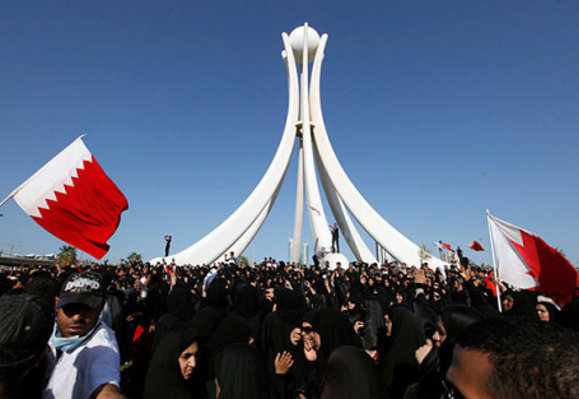
Thousands of Bahraini anti-government protesters have poured into the streets near the capital, Manama, to demand equality and liberty in the country. Demonstrators have also called for an elected government and an end to regime discrimination against the opposition’s overwhelming majority. The mass rally in Abu Quwa, a village west of Manama, is reported to be organized by Bahrain’s influential opposition bloc, al-Wefaq.
Recently released former opposition lawmakers also attended the rally. Jawad Fairooz and Matar Matar, who were detained in May after resigning from parliament in protest at the brutal crackdown on protests, said they had been tortured in prison.
Bahraini protesters have vowed to continue their protests until they achieve their “legal demands.”
Since mid-February, Bahraini protesters have been holding anti-government protests demanding an end to the rule of Al Khalifa dynasty, which they say has instituted despotic governance, discrimination, and the suppression of all dissent.
Manama, backed by Saudi troops, has met the popular protests with a brutal crackdown, killing scores and arresting hundreds.
Amnesty International and Human Rights Watch have harshly criticized Bahrain for its violence against protesters as well as doctors, nurses, lawyers and journalists that expressed support for the protest movement. …source
August 12, 2011 Add Comments
Another Independent Report – ICRC Health Care Situation and Conditions in Bahrain
ICRC: Health care in danger: making the case
10 Aug 2011 – BCHR
The International Committee of the Red Cross (ICRC) said on Wednesday it was “extremely concerned” about events in Bahrain and mentioned the country in a report on attacks against health care workers and hospitals.
“We are extremely concerned about what is going on in Bahrain. We are doing our utmost to ensure we have access not only to hospitals but to detention centres,” ICRC director-general Yves Daccord told a news briefing in Geneva on Wednesday.
The report, which surveyed 16 countries and took more than two years to research, warned that the very foundations of the Geneva Conventions – the right of those wounded in war to receive medical attention, and the right of those treating them to work unimpeded – are under threat.
The report cited several examples as evidence that attacks on health care workers are increasing, from the murder of medical students in Somalia, to the invasion of an Afghan hospital by militia groups, to the shelling of hospitals in Sri Lanka. All of these incidents took place in 2009.
One year later the picture was, if anything, even bleaker, with doctors in Libya attacked, and ambulances fired upon. In Bahrain, patients were reportedly snatched from their beds, and hospital staff intimidated.
The ICRC said the violence is driving thousands of medical professionals from their jobs, and putting millions of lives at risk.
Extracts from the report regarding Bahrain
VIOLENCE AGAINST HEALTH-CARE FACILITIES
Attacks on health-care facilities during armed violence and internal disturbances tend to fall into four main categories.
[..]
The second category of attack is also deliberate, but this time for political, religious or ethnic reasons rather than for military advantage per se. Such assaults against health-care facilities include [..]; the cordoning off and military takeover of Salmaniya referral hospital in Bahrain in early 2011 after it was perceived to support the cause of anti-government protesters;
What the law says:
• Health-care facilities shall be respected and protected at all times and shall not be the object of attack.
• Protective emblems such as the red cross, red crescent and red crystal identifying medical units shall be respected in all circumstances.
• Small arms are permitted in health-care facilities for the purpose of self-defence or defence of the wounded and the sick (against bandits, for example). The presence of all other weapons
compromises the neutral status of a facility.
• Health-care facilities lose their protection if they are used to commit “acts harmful to the enemy.”
• “Acts harmful to the enemy” include the use of health-care facilities to shelter able-bodied combatants, to store arms or ammunition, as military observation posts or as a shield for military action.
VIOLENCE AGAINST THE WOUNDED AND THE SICK
In some contexts, the wounded and the sick face discrimination in access to, and quality of, health care. Although prohibited by international humanitarian law and human rights law, as well as contrary to medical ethics, health-care personnel have refused to treat, or given inferior treatment to patients on the basis of their ethnicity, religion or political affiliation. [..] In recent unrest in Bahrain, Syria and Yemen, protesters have been too afraid to use medical facilities for fear that their wounds will identify them and provoke harsh reprisals.
What the law says:
The four Geneva Conventions of 1949 and their Additional rotocols of 1977 contain the following rules:
• The wounded and the sick, as well as the infirm, and expectant mothers, shall be the object of particular protection and respect.
• The wounded and the sick must be protected against ill-treatment and pillage.
• No one may be left wilfully without medical assistance and care.
• Whenever circumstances permit, and particularly after fighting, each party
to a conflict must, without delay, take all possible measures to search for, collect and evacuate the wounded and the sick without adverse distinction between them.
• The special role of the ICRC is recognized in facilitating the establishment of neutralized zones to protect the wounded, the sick and civilians from the effects of war.
• Parties to a conflict have the first obligation to care for the wounded and the sick. Any care provided by the local population, humanitarian organizations or other third parties does not relieve the parties of their obligations.
VIOLENCE AGAINST HEALTH-CARE PERSONNEL
Health-care personnel face many challenges working in situations of armed conflict and other violence, having to adapt standards of care to the resources available and dealing with large influxes of patients requiring immediate life-saving attention. Beyond these professional challenges often lie grave dangers associated with the nature of their work.
[..]
On occasion, health-care personnel have also been arrested for carrying out their professional responsibilities to treat all in need regardless of who they are and what they have done.
In Bahrain, 47 doctors and nurses who treated protesters have been detained in sweeping arrests of health workers that followed the crackdown on protesters and face trial in a military court on a range of other accusations.
What the Law says:
• Health-care personnel, whether military or civilian, may not be attacked or harmed.
• Health-care personnel shall not be hindered in the performance of their exclusively medical tasks.
• Parties to a conflict shall not harass or punish health-care personnel for performing activities compatible with medical ethics, nor shall they compel them to perform activities contrary to medical ethics or to refrain from performing acts required by medical ethics.
• Medical personnel may not be required to give priority to any person except on medical grounds. Medical personnel decide, in accordance with medical ethics, which patient receives priority.
• The protection of medical personnel ceases when they commit, outside their humanitarian function, acts harmful to the enemy. …source
August 12, 2011 Add Comments
Of Reconciliation, Reform and Revolution
Reconciliation in Bahrain still faces obstacles
National Editorial – Aug 9, 2011
Six months after demonstrations in the Pearl Roundabout degenerated into violence, Bahrain is still troubled by regular street protests. The crackdown on the opposition and subsequent reconciliation efforts have so far failed to restore complete calm, much less heal the deep political divisions.
There have been efforts. In the past week, an international commission investigating the violence has made some progress. Two former MPs from the opposition Al Wefaq party were set free on Sunday, among 41 prisoners who reportedly have been released.
In the worst of the violence, there was wrongdoing on both sides. But there will be no reconciliation possible unless security forces are held to account. The commission, appointed by King Hamad Al Khalifa, has indicated its readiness to investigate regime loyalists, visiting Al Gareen prison to interview prisoners from the opposition and arresting police officers on charges of torturing detainees. This investigation needs to show its evenhandedness if it is to resolve the bloodshed.
But even that is just a starting point. There needs to be a distinction between investigating the crimes of the recent protests and the fundamental process of reform that was at issue in the first place. It remains clear that only a political solution can provide for Bahrain’s future.
For decades, Bahrainis have been negotiating issues including fairness in housing and land allotments, political prisoners, representation in parliament and the constitution. The February protests began as a peaceful, cross-sectarian movement to address these issues. The subsequent violence, encouraged radical elements on both sides and aggravation of the Shiite-Sunni split has only made a resolution more difficult.
The National Blogs
Last month a national dialogue that was supposed to begin the reconciliation process ended in a walk-out by Al Wefaq, the only opposition group that attended. It was a disappointing, predictable conclusion: the forum was inordinately skewed towards regime loyalists, the agenda precluded important issues that needed to be addressed and proceedings were closed to the public.
As much as anything else, it is the lack of debate that is unproductive. A high-profile trial of editors at the opposition newspaper Al Wasat has symbolised the clampdown on discussion; the state-run media is widely distrusted.
Bahrainis across the divide need to be part of any reconciliation process. Everyone lost in the recent unrest. …source
August 12, 2011 Add Comments
The Revolution in Bharain is “not going to be stopped” – “regime in it’s current form is not going to survive”
‘Bahrain allies can’t kill revolution’
Thu Aug 11, 2011 8:10PM GMT
A Bahraini opposition leader says the revolution in Bahrain is “not going to stop,” despite the all-out Saudi and American support for the suppressive regime in Manama. “I can confirm that the revolution is not going to stop, and that this regime, in its present form, is not going to survive for much longer, despite the Saudi and American support to the Al Khalifa dictatorship,” Saeed al-Shahabi from the opposition group of Bahrain Freedom Movement told Press TV on Thursday.
Anti-government protesters have been holding peaceful demonstrations across the Persian Gulf sheikdom since mid-February, calling for an end to the Al Khalifa family’s over-40-year-long rule over the country.
Shahabi predicted that the island would witness ‘more protests’ along with ‘more crackdowns’ and human right violations committed by the regime.
On March 14, Saudi Arabia and the United Arab Emirates deployed police and military forces in the country following a plea by the Bahraini regime to help it crush the nationwide protests there.
The Bahraini activist described the Saudi mercenaries involved in the attacks on the Bahraini people as ‘the source of all evil in the world today,’ saying they were responsible for the global terrorism, fanaticism, and extremism among other instances of criminality.
The Bahraini government is, meanwhile, being constantly backed by the United States, which has its Navy’s Fifth Fleet deployed in the country.
The support comes despite Manama’s record of human rights abuses and the numerous complaints lodged against it with the International Court of Justice at The Hague.
“The Bahraini people have no aim other than having the right to determine their own destiny, and establish their representative system in their own country,” Shahabi said.
New footage recently surfaced from the country, showing the Saudi-backed Bahraini forces’ violently dispersing the demonstrators.
According to local sources, scores of people have been killed so far during the government’s clampdown, with foreign troops contributing to intensification of violence.
According to the Bahrain Center for Human Rights, over 1,000 political detainees are currently being held in Bahrain’s prisons.
Amnesty International and Human Rights Watch have also severely criticized Manama for its brutality against the civilians and violent treatment of the doctors, nurses, lawyers, and journalists, who have voiced support for the revolution. …more w/video
August 11, 2011 Add Comments
Bahrain forces block roads to Pearl Square – Calls for Freedom will not be Silenced!
Bahrain forces block roads to former protest hub
By BRIAN MURPHY, Associated Press – 1:08 p.m., Aug. 11, 2011
DUBAI, United Arab Emirates — Witnesses say security forces in Bahrain’s capital are blocking roads around a former protest hub after clashes with anti-government demonstrators in the Gulf island kingdom.
Witnesses say tanks and police vehicles surrounded Pearl Square, which had been the centerpiece for Shiite-led protests calling for greater rights from Sunni rulers in the strategic nation, which is home to the U.S. Navy’s 5th Fleet. The witnesses spoke on a condition of anonymity because they fear reprisals.
The blockades Thursday came after protesters in a Manama neighborhood called for a march back to Pearl Square, which was stormed by security forces several weeks after pro-reform demonstrations began in February.
Major protests have been crushed, but small-scale clashes have occurred nearly nightly for weeks.
The Associated Press …source
August 11, 2011 Add Comments
Pressure mounting on Gulf to depeg from US dollar – how far will friends go?
Pressure mounting on Gulf to depeg
By Waheed Abbas – Zawya
Study says falling dollar is putting inflationary stress on GCC economies. Pressure is mounting on the Gulf central banks to depeg their currencies in order to contain rising inflationary stress, according to a study released on Wednesday.
Kuwait-based Global Investment House said “the weakness in the US dollar will potentially aggravate GCC inflation by pushing up cost of importing goods to the region as it is heavily reliant on imports.
“Gulf will not only be exposed to its currency dropping against other currencies it will also be exposed to cost push inflation as well. The downgrade will undoubtedly increase pressure to de-peg the GCC currencies so as to contain inflationary pressures in the region however it a difficult decision to be made and one which involves other important factors that need consideration,” said Faisal Hasan, Head of Research at Global.
Despite the downgrade and its obvious effect on the dollar and its potential risk to Gulf currencies, UAE and Bahrain have already announced that they will maintain the dollar peg.
Hasan predicted that WTI crude oil price will range between $70 to $75 per barrel this year which is in the comfortable zone for the oil-producing Gulf state to maintain fiscal spending.
[Read more →]
August 11, 2011 Add Comments
Al-Jazeera in defense of “Shouting in the Dark” – “We were not given free access. We were denied comment by the Bahraini authorities”.
Al-Jazeera defends Bahrain documentary
(AFP) – August 11, 2011
DUBAI — The head of the Qatar-based satellite news channel Al-Jazeera English defended a documentary about this year’s unrest in Bahrain, in comments published Thursday, after an angry response by Bahraini authorities.
Al Anstey said in an interview with Qatar’s Peninsula daily that the documentary, “Shouting in the Dark,” did not include comment from Bahraini authorities because they refused to speak to the channel.
“We were not given free access. We were denied comment by the Bahraini authorities. Our producer was unable to access certain areas. Some sections of society also refused to comment,” Anstey told the newspaper.
He said the channel had waited in vain for a comment from Manama, and in the end, “the documentary was aired when it was complete.”
The documentary deals with the harsh government crackdown on popular protests in mid-March, in which authorities say 24 people were killed. It provoked an angry response by Bahrain, where the media have harshly criticised Al-Jazeera, which is financed by Qatar’s government.
“The Qatari media are carrying out disinformation and incitement to sedition in Bahrain,” the kingdom’s Al-Watan daily wrote on Monday.
Al-Jazeera’s Arabic channel, which had given extensive coverage to the uprisings in Tunisia and Egypt, had been widely criticized by activists for its perceived timid coverage of the unrest in Bahrain, a fellow member with Qatar of the six-nation Gulf Cooperation Council.
The GCC, which also includes Saudi Arabia, the United Arab Emirates, Kuwait and Oman, had dispatched forces to Bahrain to back the small kingdom’s Sunni-led dynasty against protests organised by the country’s Shiite majority. …source
August 11, 2011 Add Comments
Bird Shot in Bahrain – Not Human Rights Abuse is standard mode of operation for Bahrain Security Forces

August 11, 2011 Add Comments
U.S. Hires Shady Mercenary for Somali Proxy War
U.S. Hires Shady Mercenary for Somali Proxy War
By David Axe Email Author – August 11, 2011 – Wired Danger Room
A French-born mercenary with a criminal record and possible ties to several African coups and at least one murder is the latest agent of the U.S. government’s out-sourced war in Somalia, according to The New York Times‘ ace Africa reporter Jeffrey Gettleman and others.
Richard Rouget, alias “Colonel Sanders,” works for Bancroft Global Development, a Washington, D.C.-based “private security company” that maintains an approximately 40-man team of self-described “mentors” in Mogadishu, Somalia’s embattled capital city.
Rouget and the other mentors — a mix of former French, Scandinavian and South African soldiers — help train the 9,000-strong, U.S.-funded Ugandan and Burundian peacekeeping force that doubles as the heavy army of the Somali Transitional Federal Government in its long war with the al-Shabab Islamic terror group.
Al-Shabab, the latest in a long chain of Somali insurgent groups, has allied itself with al-Qaida and last year pulled off a bloody twin bombing in Uganda. Al-Shabab actively recruits disaffected Somali-American teenagers to sneak into Somalia to fight. In 2008, one of these young recruits became the first known American-born suicide bomber when he blew himself up outside a Somali government building.
Uganda and Burundi have paid Bancroft $7 million since 2010 for counter-insurgency training, according to Gettleman and his co-writers. Washington refunds the two African countries for their training expenses. The D.C. company’s assistance has helped “turn a bush army into an urban fighting force,” one adviser told Gettleman — and is partly responsible for the transitional government’s big advances in Mogadishu and across Somalia in recent weeks. The Associated Press credits Rouget’s bomb disposal experts for the drastic reduction in African Union troops lost to roadside explosives.
But the battlefield success comes at the cost of American moral credibility. First, there were reports that the U.S.-backed transitional Somali government employs child soldiers as young as 12. And now America has endorsed, however indirectly, a man who for years has allegedly fought against stability, justice and self-governance in Africa.
The photos accompanying Gettleman’s piece depict the “husky,” 51-year-old Rouget accompanying Ugandan soldiers onto a Mogadishu rooftop to observe a gunfight between peacekeepers and al-Shabab troops. ”Give me some ‘technicals’ and some savages and I’m happy,” Rouget joked, using the slang term for pickup trucks fitted with heavy machine guns. The Associated Press calls Rouget “a cigar-smoking, poetry-quoting, whiskey-drinking former big game hunter” with “a long scar on his thigh from getting shot in Somalia last year.” …more
August 11, 2011 Add Comments
Forensic experts to see Bahrain ‘torture’ victims – tainted ointment – questions remain, to what end, to who’s benefit?
Forensic experts to see Bahrain ‘torture’ victims
shiapost | August 11, 2011
Cherif Bassiouni, Chairman of the Bahrain Independent Commission of Inquiry addressing a news conference in Manama (File Photo)
MANAMA — The international probe panel assigned to investigate recent unrest in Bahrain will have a team of forensic medical experts from outside the country come in to look at all individuals who have complained of physical mistreatment and torture.
Chairman of the Bahrain Independent Commission of Inquiry (BICI), Mahmoud Cherif Bassiouni, told the Press on Tuesday such plan to ensure better investigation. He said that individuals complaining of tortures will be visited at hospitals and detention facilities, as well as be welcomed at BICI offices.
He said that the panel has helped in the release 137 detainees. Two of the released detainees are former MPs, Mattar Mattar and Jawad Fairuz, members of the Al Wefaq National Islamic Society. “‘The investigative team has made a number of visits to prisons, detention centres and police stations, and hospitals, many of which have been unannounced. They have recorded and collected the testimonies of all the prisoners with whom they’ve met, as well as their families, including documenting reports of cases of mistreatment and torture,” he said.
The commission has interviewed over 300 people at its offices, in addition to an undisclosed number of persons interviewed in Bahrain hospitals, prisons and detention centres, and has received statements from 209 witnesses and victims. …source
August 11, 2011 Add Comments
Bahrain detainees freed other freed with trumped up charges pending prosecution
Some freed Bahrain detainees to be tried – former MP
Wed Aug 10, 2011 2:00pm GMTBy Isabel Coles prosecution
DUBAI (Reuters) – Bahrain has released more than 100 detainees who had been facing military trials over their roles in anti-government protests earlier this year, but some of them will still be prosecuted in civilian courts, one of those set free said on Wednesday.
A panel of international lawyers which Bahrain’s Sunni Muslim monarchy invited to investigate the protests that mainly involved the Gulf state’s Shi’ite Muslim majority, said on Tuesday that a total of 137 people had been released.
Among the detainees, who walked free on Sunday, were Jawad Fairouz and Matar Ibrahim Matar, former members of parliament in the largest Shi’ite political bloc, al Wefaq.
Fairouz, who expects proceedings against him to be dropped, said some other detainees had been told they could not leave the country pending prosecutions in a civilian court.
“I heard they took some photos of them to show that they are in good health, so that later on when they re-appear in court there shouldn’t be any kind of claim they’re going to be tortured,” said Fairouz, who had been charged with spreading false news and taking part in illegal gatherings.
“When they released us they didn’t take any signature or any commitment from us that we were going to be referred to the civil court,” he said.
Among those likely to face trial in a civilian court is lawyer Mohammed al-Tajer, who was detained in April after defending people arrested during the protests, Fairouz added.
More than 1,000 people were detained after Bahrain crushed demonstrations in March for greater political freedom and an end to sectarian discrimination that Shi’ites say they face in access to land, housing and state employment. …more
August 11, 2011 Add Comments
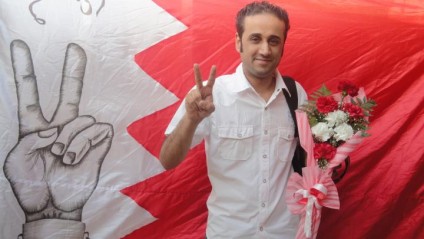
Bahrain viva y puede que el pueblo se levantan victoriosos
August 11, 2011 Add Comments
al Khalifa youth outreach program in Albilad Alqadeem village – 6-Aug.,2011
August 10, 2011 Add Comments
Aldair village protests on Aug10,2011
August 10, 2011 Add Comments
London riots used by Iran, Bahrain to justify government crackdowns – striking difference in Bahrain is the government as actor of violence
London riots used by Iran, Bahrain to justify government crackdowns
By Elizabeth Flock – Posted at 09:35 AM ET, 08/10/2011
A pro-regime Bahraini newspaper contends that British Prime Minister David Cameron, right, and the King of Bahrain, Hamad ibn Isa Al Khalifa, left, have a few things in common. (ANDY RAIN – ASSOCIATED PRESS) It was only a matter of time before connections were drawn between London’s ongoing riots and the wave of demonstrations that has swept more than a dozen Arab countries over the past year.
But the connections aren’t being drawn by British protesters, seeking to connect themselves to a wider cause.
Instead, they’re claimed by government supporters in Iran and Bahrain, as a means of legitimizing the violent crackdowns on uprisings in their own countries.
After a cabinet meeting Wednesday, Iranian president Mahmoud Ahmadinejad went on state radio to urge the U.N. Security Council to take action over the British riots, saying that it was hypocritical in its reactions to such events.
“If one percent of this happens in countries that oppose the West, they scream until they are hoarse,” Ahmadinejad said.
By criticizing the actions of the British government against protesters, Ahmadinejad was seemingly trying to legitimize his own.
Ahmadinejad also called on British officials to listen to the demands of their people, a move that prompted Guardian reporter Haroon Siddique to call Ahmadinejad a “funnyman.” Many others picked up on the irony of the call from Ahmadinejad, whose government has been condemned internationally for its handling of protests and dissent:
Ahmadinejad: “No, no, no Britain! You’re supposed to wait until protesters go home, then kidnap them at night.” http://bit.ly/okPnAmless than a minute ago via TweetDeck Favorite Retweet ReplyMatt Duss
mattduss
In Syria, a country whose president has been under increasing fire from the international community to step down after killing demonstrators, state-run television also ran stories about the chaos in Britain.
Footage that showed a British policeman chasing and knocking a man down was accompanied by a caption that read: “Cameron: ‘We face a problem confronting the gangs in Britain.’” …more
August 10, 2011 Add Comments
Bahraini detainees freed with threat of trials and rearrest on trumped up charges
Freed Bahraini detainees still to face trial
August 11, 2011 01:49 AM – By Isabel Coles – Reuters
DUBAI: Bahrain has released more than 100 detainees who had been facing military trials over their roles in anti-government protests earlier this year, but some of them will still be prosecuted in civilian courts, one of those set free said Wednesday. A panel of international lawyers which Bahrain’s Sunni Muslim monarchy invited to investigate the protests that mainly involved the Gulf state’s Shiite Muslim majority, said Tuesday that a total of 137 people had been released.
Among the detainees, who walked free Sunday, were Jawad Fairouz and Matar Ibrahim Matar, former members of parliament in the largest Shiite political bloc, Al-Wefaq.
Fairouz, who expects proceedings against him to be dropped, said some other detainees had been told they could not leave the country pending prosecutions in a civilian court.
“I heard they took some photos of them to show that they are in good health, so that later on when they re-appear in court [they] shouldn’t [make] any claims [that they had been] tortured,” said Fairouz, who had been charged with spreading false news and taking part in illegal gatherings.
“When they released us they didn’t take any signature or any commitment from us [that would require us to be] referred to the civil court,” he said.
Among those likely to face trial in a civilian court is lawyer Mohammad al-Tajer, who was detained in April after defending people arrested during the protests, Fairouz added.
More than 1,000 people were detained after Bahrain crushed demonstrations in March for greater political freedom and an end to sectarian discrimination that Shiites say they face in access to land, housing and state employment.
The kingdom attributed the unrest to manipulation by Iran of its Shiite co-religionists in Bahrain and denied persistent allegations of torture during and after the wave of detentions.
It has responded to international criticism of the crackdown by funding an international legal commission to investigate the events, but activists and rights groups say the panel is cut off from people who fear reprisal for testifying.
Bahraini opposition activists have also faulted the panel’s head, Cherif Bassiouni, for praising the authorities for cooperating with the investigation, and suggesting that abuses were individual acts, not official policy.
…source
August 10, 2011 Add Comments
BICI issues statement in attempt to reestablish “legitimacy” in light of it’s arrogant and prejudical statements to the press
[cb editoral note: BICI has issued the following statement in attempt to reestablish “legitimacy” in light of it’s arrogant and prejudicial statements in previous dialogue with the press – regardless, any Investigating body organized by a criminal party it is to investigate; I.e., a regime that as a daily practice demonstrates it’s armed and violent aggression toward those who oppose it, will never have credibility even if its leadership could be seen as sincere.
Furthermore even if the investigation could yield a significant degree of credible reporting and it may, a dichotomous finding and conclusion seems inevitable. This investigation is designed to be manipulated and to satisfy the pressures for “proper conduct” from al Khalifa by the West. It is the price of atonement the West demands in order to keep al Khalifa in it’s good graces and to “save face”. It is purely a political arrangement and a product of failed Western interventionist practice that blinds it from truth and justice that it is not prepared to demand.
In the end the investigation will arrive at a conclusion, there will be blame and conjecture from all sides that leaves an ambiguity void of any means to satisfy the demand for justice except that which a violent and tyrannical King chooses. This entire process seems designed by al Khalifa to leave his victims even more estranged from access to power and to preserve his reign with approval from the West as an important pillar of Western military strategy against a demonized Iran. ]
The Bahrain Independent Commission of Inquiry Statement
In view of the fact that certain statements made by chairman of the Bahrain Independent Commission of Inquiry (“BICI”) have been interpreted as prejudging the outcome of the Inquiry, the BICI has decided to issue the following statement on how it has worked, will continue to work, and determine the contents of its report.
1. The BICI is still at the beginning of its investigations. It has not reached any final conclusions. Its work continues to be independent and free from any interference, either by the government of Bahrain, any other government, or any interest group, either within or outside of Bahrain. The BICI hires its own staff, conducts its own investigations, has its own budget, and acts in every respect as an independent commission.
2. In carrying out its responsibilities, the BICI has so far met with a number of government officials, as well as opposition leaders, representatives of civic organizations, and individual victims and witnesses. It has conducted unscheduled visits to several detention and prison facilities, as well as police stations, and its investigators have spoken to detained individuals outside the presence of any public official. It has also reviewed arrest and conviction records.
In the short period since July 24, the BICI has:
* Met with over 200 persons in prisons and detention facilities and injured persons in hospitals; 50 senior government officials, including several members of cabinet; 18 opposition parties and civil society organizations; 90 students who have been suspended from their studies; and 105 persons who have been arbitrarily dismissed from their work positions.
* Received 300 complaints from dismissed employees.
* Recorded 140 allegations of physical abuse and torture in prisons and police stations.
* Secured the release of 151 persons from prisons or detention facilities. This number includes 137 persons who were charged with misdemeanors and were pending trial. These cases were transferred from the military court system to the civilian court system by a Royal Order at the request of the BICI chairman.
* Instigated an investigation by the Ministry of Interior into 2 police officers and 10 police personnel charged with physical abuse and torture.
* Received statements from 348 witnesses and victims of alleged arbitrary arrest and detention, physical abuse, and torture.
* Received over 900 emails, many of them containing information about events, and alleged victimization, either by the sender or claimed to be known by the sender.
3. All of the above has been done in cooperation with individual witnesses and victims, representatives of political opposition groups and civil society organizations, and the government. The BICI wishes to acknowledge with appreciation the hundreds of victims and witnesses who have come forward with their information. In addition, the BICI wishes to reassure them and others of the safety and privacy of these communications. We have taken and will continue to take all possible measures to safeguard the confidentiality of all information received, and we sincerely believe that there is no reason for anyone to believe otherwise.
4. It is important for anyone following the work of the BICI to know that while all of what is described above is taking place, there can be no final conclusions that can be derived therefrom. Conclusions and recommendations will occur after investigations are complete, and a more complete record is established. As of now, it can be stated that the BICI has had the cooperation of witnesses and victims, civil society organizations, opposition groups, and the government. The chairman of the BICI has publicly credited the Ministry of Interior, National Security Agency, the Attorney General, and the Military Prosecutor General for their cooperation, and it is only fair to do so. This should not be interpreted by anyone as covering up or overlooking the responsibility of any organization or any person for any illegal act. The BICI will continue to gather evidence and the conclusions in its report will be based on that evidence, in whatever direction it may lead and at any and all levels of responsibility.
5. We look forward to the continued cooperation of all parties concerned, and we hope that the heightened level of anxiety that exists in Bahrain society, and particularly with respect to the victims and families of victims of those who have been arrested, detained, tried and convicted, physically mistreated and tortured, does not carry them to any unfounded conclusions or judgments on the BICI and its work. We remain committed to the truth, and to continuing our work on the basis of impartiality, fairness, and neutrality. …source
August 10, 2011 Add Comments
RIM Offices burn in London as deal with Middle East fascists comes together
STC, RIM sign partnership deal
10 Aug 2011 – Arab News
RIYADH: The Saudi Telecom Company and the Canadian Research in Motion Company (RIM) on Monday signed a partnership that aims to provide a wide range of content, applications and smart solutions for Blackberry users across the Kingdom.
The agreement, signed in Riyadh by Ibrahim Al-Omar, STC’s retail sector vice president, and Sandeep Sahgal, RIM’s Middle East managing director, focuses on exchanging expertise between the two companies in a manner that serves mutual interests and enables customers to enjoy up-to-date services and technologies.
As a result of the new partnership, STC announced the launch of BlackBerry bold 9900 device with its exceptional design, touch screen and the Blackberry 7 system, thus demonstrating the elegance and practicality in one device.
Al-Omar said: “The strategic partnership between STC and RIM is based on launching the level of coordination between the two companies in order to serve their common interests and fulfill customers’ need for technologies and unique services. STC’s interest in this partnership confirms its major role in launching and providing current and new smart devices to its customers, which is based on STC’s strategy that revolves around the customer. STC was the first to bring the blackberry services into the Kingdom giving it a leading market position there, and resulted in doubling the number of customers in the BlackBerry service, which prompted us to meet their expectations by providing services and products that suit various tastes.”
Sahgal said: “We are pleased with our partnership with STC and the opportunity to introduce our new collection of Blackberry smart devices to our customers in the Kingdom.” He added: “According to a GFK report, the Blackberry Curve 8520 is the bestseller between July 2010 and July 2011. A report issued by CANALYS Company about the smart devices’ shipments in the second quarter 2011 proved that the Blackberry device is the bestseller in the market. In addition to that the Blackberry community in the Kingdom registered one of the highest levels of using the BBM application in the world (99 percent). …source
August 10, 2011 Add Comments
Quashing the truth – media politics and the suppression of documented Crimes Against Humanity by al Khalifa and Saud
[cb editorial note: a bit bothersome but no real surprise as AlJazeera moves into it’s “new community” in NYC.]
Al Jazeera Changes Plan to Rerun Documentary
Tuesday, August 9, 2011 – The New York Times
By Brian Stelter
Al Jazeera English has quashed several planned rebroadcasts of “Shouting in the Dark,” an hourlong documentary about Bahrain’s crackdown on pro-democracy protesters that had its debut last week and brought complaints from Bahraini authorities.
The decision this week to halt the repeats raised concerns among Al Jazeera’s staff members that the channel was succumbing to political or diplomatic pressure from Bahrain and its ally Saudi Arabia.
In response to inquiries by The New York Times, a spokesman for Al Jazeera said Tuesday that the documentary would be rebroadcast on Thursday and would be paired with a round-table discussion.
The episode illustrates the thorny issue of independence for Al Jazeera, one of the world’s biggest satellite news organizations, which is financed by the emir of Qatar and is perceived by some people to be a diplomatic tool of the country. Al Jazeera insists that the Qatari government does not interfere in the network’s editorial operations.
Al Jazeera’s Arabic and English language channels both came under scrutiny in February and March for their coverage of Bahrain, an island kingdom just north of Qatar in the Persian Gulf. Viewers perceived that the Arabic channel, in particular, paid less attention to the Bahraini protests than it did to the earlier protests in Tunisia and Egypt. Qatar joined Saudi Arabia in sending troops into Bahrain to violently quell the protests in March.
Bahraini authorities helped to limit news coverage of the crackdown by blocking journalists from entering the country and expelling some who were already there. …more
August 10, 2011 Add Comments
Please – let’s not call these the ‘BlackBerry riots’
Please — let’s not call these the ‘BlackBerry riots’
Aug 9, 2011 14:30 EDT – REUTERS – by: Jon Boyle
[cb editor note: the author of the article states, “there is another thing: BBM messages are largely untraceable. ” due to encryption features on the BlackBerry. This isn’t correct there are BlackBerry encryption “crack codes” that can be used to make “encrypted communication” visible to government or spies – see HERE] and HERE]
Please — let’s not call these the ‘BlackBerry riots’
Aug 9, 2011 14:30 EDT – REUTERS – by: Jon Boyle
Here we go again: Young people, rioting in the streets, railing against leadership, using their mobile phones to outsmart law enforcement caught off guard by the nimbleness of cool kids in what would be a B-movie script if it wasn’t unfolding in real time.
But this time it isn’t happening in some far off, ambiguously backward Middle Eastern place. No, this is happening in the homeland of Sir Thomas Moore, Winston Churchill and Kate Middleton.
[Read more →]
August 10, 2011 Add Comments
Bahrain Torn apart by the Injustices of Wahabi Al Khalifa & Saudi Rulers
Bahrain Torn apart by the Injustices of Wahabi Al Khalifa & Saudi Rulers
August 10, 2011 – Jafria News
JNN 10 Aug 2011 Manama : Brutal crackdowns on Bahraini protesters have revealed a bloody rift between the country’s Wahabi rulers and the Shia majority. Sectarian violence have torn the nation apart – as it has done elsewhere around the world.
This is an Article written by Patrick Cockburn, who is a Independent Journalist , and have tried to give a factual condition of the Bahraini Kingdom. So we are publishing this article for our readers .
Is there a fatal connection between the initial letter “B” and places torn apart by struggles for power between different religious communities? I started as a journalist in Belfast in the early 1970s when the city was convulsed by sectarian warfare between Catholics and Protestants. In later years, I moved to Beirut to cover the many-sided civil war, at the heart of which was the conflict between Muslims and Maronites. After 2003, I spent long months in Baghdad, writing about the fighting between Shia and Sunni which culminated in the slaughter of 2006-7.
Even so, it is surprising to find Bahrain added to the list of places polarised and traumatised by sectarian differences, in this case between Shia and Sunni. The confrontation between the ruling Sunni minority led by the al-Khalifa royal family and the Shia majority is not entirely new. There have been crises in relations between the two in the past. But the ferocity and cruelty of what has transpired on this small island in the Gulf over the last five months has shocked and surprised its 1.2 million people, half of whom are Arabs.
Among those puzzled is Cherif Bassiouni, the highly distinguished Egyptian-American legal scholar, who has been asked by King Hamad bin Isa al-Khalifa to lead an inquiry into the events which followed the start of the Arab Awakening on 14 February. Compared to Iraq or Libya, Bassiouni notes that the casualties were light – about 33 dead – “but this relatively small number has had a traumatic effect on society”. He describes the two sides as producing wholly different accounts of what happened. He says “it is like a murder scene where you have the dead body, but nobody can agree if the bullet came from the right or the left”.
He is convinced he has the backing of the King and the Crown Prince for an inquiry which will be somewhere between a fact-finding investigation and a truth commission. He suspects that in order to reverse sectarian polarisation, a cleansing of the security forces may be needed as well as a government-backed programme for reconciliation.
Many Shia believe that the King will be unable or unwilling to deliver on his commitments to Bassiouni. Alaa Shehabi, the wife of a jailed Shia businessman, says: “It is a big problem if the King didn’t know what was happening, and a bigger problem if he did know and is Pretending ignorance.
One does not have to go far in Bahrain to find out why the Shia are so angry. In Graham Greene’s Our Man in Havana, his fictional Cuban police chief Captain Segura distinguishes between two classes of people, the torturable and the untorturable. It is not a distinction that has made much impression on the Bahraini security forces, going by the wholesale repression that began on 15 March, which followed the arrival of a Saudi-led military contingent. Protesters in Pearl Square were beaten and the 300-foot monument in the square was dismantled. Every part of Shia society was targeted – mosques and religious meeting places were bulldozed. Frantic families searched for relatives who had disappeared into police and army custody and were not heard of for weeks.
Some human-rights activists were expecting to be arrested, but were amazed and shocked by the brutality with which they were treated. Zainab Abdul-Hadi al-Khawaja had suspected that her father, Abdul-Hadi al-Khawaja, a human-rights activist, would be detained and he had told his family he was willing to go voluntarily. Instead, a band of masked police broke into his house at 3am and dragged him downstairs, breaking his jaw as they did so. His interrogators continued to beat him on his fractured jaw and threatened him with rape unless he confessed. When Zainab saw him weeks later in military court, where he was sentenced to life imprisonment, his face was so badly swollen that he told his family: “I cannot even smile at you anymore.”
Zainab and her father are among the few of those mistreated who are willing to say what happened on the record. Others gave me appalling accounts before saying anxiously: “Please don’t give my name or any detail which would let the police know that I talked to you.”
Any expression of sympathy for the protesters invited punishment. As Zainab was speaking to me in a coffee shop in Manama, the capital of Bahrain, a woman and child came to sit opposite us. The woman said she had worked for years in a government ministry dealing with the special needs of the disabled, but she had just been suspended. One count against her was that she had cried on the phone when talking to a senior official, saying: “It is wrong what is happening to the Shia in Bahrain.”
Government officials and members of the Minority Wahabi community have a strikingly different picture of what happened in Bahrain. “There are almost totally different narratives,” Bassiouni told me. Mariam Ahmed al-Jalahra, assistant under-secretary at the Ministry of Health, tries to change the complete picture falsely, by narrating a completely fabricated story about how the Salmaniya Medical Complex was taken over by doctors sympathetic to the protesters. Where she twist[s] the story 180’ Degree[s], as [to] what is not possible as per the prevailing conditions there, as the sympathizer can not let harm to her her or his supporter , but as she in her own words twist[s] as “What happened was beyond disaster,” she says, adding that patients were put in danger and had to be moved to other hospitals. She herself was stopped at the hospital gates by protesters, though she was allowed to proceed when her driver identified her as a doctor. “This was something scary,” she says. She denies that any doctor is being punished for treating injured protesters, but says that those who broke rules should suffer sanctions. While to get the complete story what happened at the Sulamaniya Medical complex , please follow the link and get the details. [see link HERE for Sulamaniya Medical Story]
What comes across in talking with Jalahra and other Wahabi is an exaggerated sense of victimhood in the face of mostly minor infringements of the law by the protesters. Two Sunni consultants from the 1,000-bed Salmaniya Medical Complex separately told me that they were very worried that they had been put on a “shame list” because they disagreed with fellow doctors, almost all Shia. Again there is a lack of a sense of proportion.
When I asked Sunni doctors what they thought of allegations, for which there is strong evidence, that their Shia colleagues have been tortured, they replied blandly that the matter was under investigation and, in any case, they doubt that mistreatment in prisons is as bad as was reported.
[Read more →]
August 10, 2011 Add Comments
London Calling
British riots: a crisis of ideology and political leadership
Tuesday, August 9, 2011
By Richard Seymour, London
You’ve probably heard it said a dozen times today: “It’s like 28 Days Later out there.”
Every thirty seconds, there’s a new riot zone.
I’ve rarely known the capital to be this wound up. It’s kicked off in East Ham, then Whitechapel, then Ealing Broadway (really?), then Waltham Forest… It’s kicked off in Croydon, then Birmingham, then (just a rumour so far) Bradford…
The banlieues (outer-suburbs) of Britain are erupting in mass civil unrest.
Until now, the claim has been that this is merely a criminal enterprise. At a stretch, it was orchestrated criminality, using Twitter and Blackberry messenger.
If you’re following what’s happening in Britain, that’s an impossible position to sustain. A few looters here and there might be evidence of little more than opportunism.
But clashes with police in several major cities, including the two largest cities, doesn’t look like mere entrepreneurialism to me.
And as it spreads to hitherto unexpected places, it certainly doesn’t look orchestrated.
Part of the reason for the spread is probably that the aura of invincibility on the part of British riot police has been seriously damaged by these riots.
Protesters in Britain are used to being contained and out-manouevered by police. That makes it seem as if the police are omnipotent.
This situation has underlined very clearly that law and order is generally maintained by consent, not coercion. The police are not all powerful, despite their technological and organisational advantages, which is why they rely on good “community relations”.
In those areas where there are long-standing grievances and sources of resentment, it seems, that consent has been withdrawn. As a result of the unpredictable way in which this unrest has unfolded, the police have ended up being out-played, and sometimes out-numbered.
Yet, as important, there is also an underlying crisis of ideology and political leadership for the police.
Amid the Hackgate scandal, which has shattered their credibility, and following the killing of a suspect under circumstances that were only ineffectually and temporarily concealed, they are (potentially) facing a complete collapse in relations with black British communities.
British Prime Minister David Cameron and the police leadership will be evacuating themselves over this prospect. The painstaking attempts to overcome the complete mutual hatred and distrust that characterised such relations in the 1980s made some headway.
Of course, police harrassment, brutality, killing in custody, and so on, did not come to an end. Institutional racism proved durable.
But there was definitely an amelioration between Broadwater Farm and the Lawrence Inquiry. And that is one advance which, I believe, they don’t want to put through the historical shredder.
So, despite politicians such as the Liberal Simon Hughes ranting and demanding that the police use the water cannon, and despite the ritual denunciations and tough talk about the law from (another Liberal) Lynne Featherstone, I suspect the police are quite unsure as to how they’re supposed to be handling this. …more
August 9, 2011 Add Comments
Release on bail, ongoing judicial harassment faced by Mr. Mohamed Issa Al Tajer
Release on bail and ongoing judicial harassment faced by Mr. Mohamed Issa Al Tajer
9 August 2011
The Observatory has been informed by reliable sources about the release on bail and ongoing judicial harassment faced by Mr. Mohamed Issa Al Tajer, a prominent human rights lawyer.
The Observatory for the Protection of Human Rights Defenders, a joint programme of the International Federation for Human Rights (FIDH) and the World Organisation Against Torture (OMCT), has received new information and requests your urgent intervention in the following situation in Bahrain.
New Information:
According to the information received, on August 6, 2011, Mr. Mohamed Issa Al Tajer was released on bail. Before his release, he was forced to sign documents stating that he would appear before courts and be available for interrogation at any time if summoned. He was also required to declare that he would not carry out “activities against the country”.
The Observatory firmly denounces the continued judicial harassment faced by Mr. Mohamed Issa Al Tajer, which seems to merely aim at sanctioning his peaceful and legitimate human rights activities as a defence lawyer, and moreover condemns the lack of due process in the trial held against him over the past months before the Lower National Safety Court (see background information).
The Observatory also condemns the ill-treatments suffered by Mr. Al Tajer while in detention: he was reportedly beaten on his head, forced to stand up with his hands against the wall. He also suffered from deprivation of sleep and was forbidden to go to the toilet. He also reportedly heard other prisoners being tortured.
The Observatory recalls the judicial proceedings launched against Mr. Al Tajer took place within the context of an intensified crackdown against activists, including human rights defenders, who have supported or are alleged to have supported the protest movement which started in Bahrain in February 2011. Hundreds of individuals are still arbitrarily detained, and access to the majority of these detainees, including by their lawyers, is not guaranteed. Concern about the physical integrity and life of those arrested are consequently high.
Background Information:
At around 11 pm on April 15, 2011, a group of more than 20 masked and armed plain-clothes men, belonging to security forces, entered without any warrant the house where Mr. Al Tajer was present with his wife and young children. At 00.30 am, after thoroughly searching the house and confiscating computers and mobile phones, the men arrested Mr. Al Tajer and took him to an unknown destination. After his arrest, Mr. Al Tajer was detained incommunicado for five weeks and was then allegedly transferred to the Gurain military prison.
In addition, Mr. Al Tajer appeared before the Lower National Safety Court on June 12, 16 and 23, 2011 and could only meet with his family and lawyer on these occasions.
On June 23, 2011, Mr. Mohamed Issa Al Tajer appeared before the Lower National Safety Court in Manama on four charges: “inciting others to develop hatred or hostility towards the system of Government” pursuant to Article 165 of the Bahraini Criminal Code; “deliberately releasing malicious news or rumours about (…) the State” pursuant to Article 168; “inciting others (…) to hate or show contempt for a certain faction (…) undermining the public peace” pursuant to Article 172; and “taking part in a demonstration (…) with the aim of committing crimes (…) aimed at undermining public security” pursuant to Article 178 punishable by a prison sentence of up to three years. Mr. Al Tajer was blamed for committing all those crimes because he reportedly made a speech in which he addressed the public in the Pearl Roundabout’s last March to denounce Bahrain’s human rights record. In the charge sheet against him, it was stated by the prosecution that by making such speech he jeopardised the country stability and security and caused the public to reject the National Dialogue, which was then called for by the Government.
The verdict in this trial was to be issued on July 5, 2011, but shortly before that date, on June 26, the authorities announced that all remaining court cases will be transferred from the special military courts to civilian courts. Thus, Mr. Al Tajer’s trial was suspended and transferred to civil courts. …more
August 9, 2011 Add Comments
On working for Scoungrels, Scum-bags and al Khalifa
Lobbyists Jump Ship In Wake Of Mideast Unrest
Bahrain Qorvis – First Posted: 03/25/11
NEW YORK — One of Washington’s best-known lobbying and public relations firms has been upended in the wake of the turmoil in the Middle East due in part to its representation of some of the region’s autocratic governments.
In the last two months, more than a third of the partners at Qorvis have left the firm to start their own lobby shops, partly because of the firm’s work on behalf of such clients as Yemen, Bahrain, Saudi Arabia and the Central African nation of Equatorial Guinea, say former employees.
“I just have trouble working with despotic dictators killing their own people,” a former Qorvis insider tells The Huffington Post. “People don’t want to be seen representing all these countries — you take a look at the State Department’s list of human rights violators and some of our clients were on there.”
The governments of Bahrain and Yemen, which have been condemned by the United Nations for their brutal crackdowns that resulted in dozens of protesters killed and hundreds injured, are both represented by Qorvis through a subcontract to British public relations giant Bell Pottinger. Saudi Arabia, which last week sent troops to assist in riot control in Bahrain and has long been cited for its poor human rights record, is a longtime client of the firm. And Equatorial Guinea, an oil-rich dictatorship considered one of the most corrupt and undemocratic regimes in the world, likewise pays Qorvis to burnish its reputation.
Several former Qorvis staffers blamed the firm’s current management for cultivating such “black hat” clients, noting that much of that business came about through the firm’s partnership with Bell Pottinger, the United Kingdom’s largest public relations firm, which took heat for representing Sri Lanka during that South Asian country’s brutal crackdown on rebel groups during the last two years. “They have zero conscience in what they do,” says the first former insider, referring to Bell Pottinger. A spokesperson for Bell Pottinger did not return calls for comment.
Such “black hat” countries pay well — Equatorial Guinea pays Qorvis $55,000 per month and Saudi Arabian initially paid Qorvis $14 million per year back in 2002 to polish its reputation in the wake of the Sept. 11, 2001, attacks, though in recent years the latter contract has been much less lucrative. “These scumbags will pay whatever you want,” says the former insider. “You can charge retainers that are huge.” …more
August 9, 2011 Add Comments