US-supported Al Khalifa ruling family is trying to subvert democracy with the help of foreign forces and US based “private” advisors, consultants, mercenaries
Human rights violations continue in Bahrain
November 2, 2011 – PressTV
Bahrain may not be in the international media spotlight like it once was, but according to activists speaking at the House of Lords in London, human rights violations are taking place there every day.
And these violations, they say, have convinced most Bahraini people that regime change can be the only long-term solution. Speakers at the conference said that crimes committed in Bahrain had been referred to the International Criminal Court in The Hague. These include murder, torture, unlawful detention and sham trials.
The activists said the US-supported Al Khalifa ruling family is trying to subvert democracy with the help of foreign forces.
Delegates at the House of Lords also called for the immediate withdrawal of Saudi forces from Bahrain who were instrumental in crushing the pro-democracy uprising. The Bahraini authorities deny human rights abuses and say they are simply ensuring the national security and stability of the nation. According to the al Khalifas, so-called foreign forces are instigating riots in the county with the aim of fomenting sectarian warfare.
Many members of the Bahraini opposition are based here in London and face arrest or worse if they go back home. And most of them feel that the British government’s response to the Bahraini crisis has been woeful, effectively giving support to a despotic dictatorship against the will of the people.
Conference delegates urged the international community to condemn the Khalifas, to stop selling arms to them and to withdraw all support from their regime. But they rejected all foreign military intervention in Bahrain, saying that ultimately it’s up to the Bahraini people to liberate themselves. …source
November 2, 2011 Add Comments
BBC makes major strides in effort to master “shit journalism”
Why the BBC ‘has let down Bahrain’s people’
World News — 02 November 2011 – Manama Press
MANAMA: The British Broadcasting Corporation moved from being a globally respected news organisation to joining the ranks of the yellow press during the unrest in Bahrain.
That is the view of Akhbar Al Khaleej Editor-in-Chief Anwar Abdulrahman.
Speaking on the sidelines of the Bahrain Chapter of the International Advertising Association meeting yesterday at the InterContinental Regency Bahrain, in Manama, Mr Abdulrahman said that the BBC had let down the people of Bahrain with its coverage.
“I have respected the BBC in the past but they seem to have had a mental change,” he said.
“What they said over the unrest turned them into yellow journalism. I suppose they were in competition with the Sun at that level of coverage and now we have a BBC that we can no longer trust.
“I hope we, as human beings, learn and repair our standards because the coverage of the BBC was damaging to Bahrain in the eyes of the world.”
He added: “The BBC broadcasts its news bulletins in every language. If only a few Bahraini teenagers burn tyres in the streets to hinder traffic, for the BBC this is big news.
“However, when the house of the most distinguished Bahraini woman journalist Sameera Rajab was attacked with Molotov cocktails last week, the BBC did not utter a word.
“I seriously question its integrity.”
To illustrate the differences in perception between the Arab world and the West, Mr Abdulrahman related the incident of a Bahraini student staying in the UK who one day found that the lady serving them in the cafeteria had disappeared.
On enquiring, he was told that she was facing some family problems. So he decided to visit her.
“Thank you for coming to visit me,” she said. “I am facing enormous problems. My husband has run away with another woman and, secondly, my 18-year-old unmarried daughter is pregnant. These are facts of life I have to face.”
Suddenly she started crying and said: “But what is really tragic is that my dog has died.” …source
November 2, 2011 Add Comments
al Khalifa regimes continues stand off holding students and many other hostage
#Bahrain | 14 UOB student R Deprived of the right to education, ARBŊ(via @H_Alsankis)#UOB #FreeUOBstudents
Deprived of the right to education .. 14 students from the University of Bahrain are being held behind bars
1. Shawqi Radhi [22 years] College of Business Administration – were sentenced to prison for 15 years | #Bahrain #UOB #FreeUOBstudents
2. Jawad Almahari [24 years] College of Law – were sentenced to prison for 15 years | #Bahrain #UOB #FreeUOBstudents
3. Jassim Almukhodar [20 years] Bahrain Teachers College – were sentenced to prison for 15 years | #Bahrain #UOB #FreeUOBstudents
4. Jassim Alhulaibi [19 years] Bahrain Teachers College – were sentenced to prison for 15 years | #Bahrain #UOB #FreeUOBstudents
5. Yousif Ahmed [20 years] College of Business Administration – were sentenced to prison for 15 years | #Bahrain #UOB #FreeUOBstudents
Was sentenced in the case of the events of the #UOB “13/3” as well as to pay a penalty of 349,300 BD | #Bahrain #UOB #FreeUOBstudents
6. Jassim Ali Yahya [20 years] College of Business Administration – were sentenced to prison for 20 years | #Bahrain #UOB #FreeUOBstudents
Jassim Ali Yahya is accused in the abduction of a security man in the North Sehla, was arrested on 16 March | #Bahrain #UOB #FreeUOBstudents
7. Ali Almolani [20 years] College of Engineering – were sentenced to prison for 3 years | #Bahrain #UOB #FreeUOBstudents
Ali Almolani was arrested at a checkpoint and was sentenced in the case of an illegal gathering and rioting crowds | #Bahrain #UOB #FreeUOBs
8.Mohammed Ali Alsheikh [College of Business Administration] suspended for 45 days on pending investigation | #Bahrain #UOB #FreeUOBstudents
Mohammed Ali Alsheikh was arrested after the suppression of self-determination in the Aali Village | #Bahrain #UOB #FreeUOBstudents
9. Mohammed Nusaif [College of Engineering] suspended for 45 days on pending investigation | #Bahrain #UOB #FreeUOBstudents
Mohammed Nusaif was arrested after the suppression of self-determination in the Aali Village | #Bahrain #UOB #FreeUOBstudents
10. Abbas Mahdi [College of Applied] suspended for 45 days on pending investigation – arrested in Sanad on 3/10 | #Bahrain #FreeUOBstudents
11. Yasser Mansour Madan [College of Information Technology] suspended for 45 days on pending investigation | #Bahrain #FreeUOBstudents #UOB
Yasser Mansour Madan was arrested in Sanabis Village on 23/9 | #Bahrain #UOB #FreeUOBstudents
12. Fadel Abbas Majeed [College of Business Administration] was arrested on 7/10 | #Bahrain #UOB #FreeUOBstudents
13. Hussain Ali [College of Engineering] was arrested on 11/9 | #Bahrain #UOB #FreeUOBstudents
14. S.Wael S.Hashim [College of Engineering] was arrested this morning 2 / 11 | #Bahrain #UOB #FreeUOBstudents
S.Wael was arrested after breaking into his house and broken down in the Aldair village | #Bahrain #UOB #FreeUOBstudents
These 14 students from the #UOB, who are still detained – we demand 2 release them, their place in the uni, not behind bars | #Bahrain
November 2, 2011 Add Comments
al Khalifa regime continues hostage stand-off with the West
HRF: Jaleela Al Salman Released, Countless Others Remain Jailed
November 1, 2011 – B CHR
Washington, DC— Human Rights First today expressed relief at reports that Jaleela Al Salman, Vice President of the Bahraini Teachers Association, has been released from jail. On October 18, Al Salman was rearrested in a night raid and seized by masked men who entered her home without showing a warrant for her arrest.
“Jaleela’s release is welcome news, but her case and the high profile cases of the Bahraini medics are just the tip of the iceberg. There are countless less famous people who have been tortured and sentenced and who remain jailed after unfair trials,” said Human Rights First’s Brian Dooley, who spoke to Al Salman via Skype just days before her most recent arrest.
On September 25, Al Salman was sentenced to three years in prison. She was convicted following an unfair military court trial and was at home while she waited for her appeal, currently scheduled for December 11. Al Salman was originally in prison between March 29 and August 21. Her colleague, Mahdi Abu Deeb, President of Bahrain Teachers Association, was recently sentenced to 10 years imprisonment. Hear directly from Al Salman as she talks in her own words about the abuse she suffered in custody here.
The United States has notified Congress of its intention to sell $53 million in arms to the Bahraini government. A resolution of disapproval has been introduced in both chambers of the U.S. Congress and several members are objecting to the sale. Human Rights First said it’s likely not a coincidence that the Bahraini Government has released Al-Salman as the U.S. Government continues to considers the sale. …source
November 2, 2011 Add Comments
Bahrain Teachers’ Union Leader Released
Bahrain Teachers’ Union Leader Released
Nov 2nd, 2011 – By shiapost
The Vice-President of the Bahrain Teachers’ Association (BTA) Mrs. Jaleela Al Salman have been released yesterday Tuesday November 1, 2011. She received the warm welcome at Headquarter Jamiat Al-Wifaq (the Islamic National Accord Association).
According to the Shia Post, the release of Mrs. Jaleela Al Salman came in to order after she was re-arrested on October 18 at 3:00am, following a home raid by security forces without an official notice or warrant for her arrest.
On 25 September 2011, Mrs. Jaleela Al Salman was senteced to 3 years imprisonment by a Military court with charges of inciting hatred towards the regime, calling for a teachers strike and attempting to overthrow the ruling system by force.
This comes among other charges alongside her colleague, Mahdi Abu Deeb, President of Bahrain Teachers Association, who was sentenced to 10 years imprisonment. Mrs. Jaleela was also detained since 29 March 2011, only to be released on August 21 2011 with Head of the Nurses’ Society, Rula Al Saffar, after her health deteriorated for going on a hunger strike in protest of her illegitimate detention.
Masked security forces in civilian clothing broke in to Mrs. Jaleela’s house at 3:00am today for the second time this year, despite her father’s willingness to open the door after hearing noises. They claimed to be executing court order but lacked an arrest warrant.
It should be mentioned that after her release on August 21 2011, Mrs. Al Salman had to be treated for disc disorder and high blood pressure, as well as for having unstable heartbeats which she had developed during her 149 days in detention when she was on hunger strike.
Hundreds of people across Bahraini society have been detained since mid-March, when authorities cracked down on pro-reform protests. Scores of detainees, including medical professionals and prominent opposition activists, were brought before military courts for leading the protests and in some cases calling for a change of government. …source
November 1, 2011 Add Comments
Bahrain’s Young People, their Season of Discontent and Visions of Democracy
Meanwhile, the Bahraini government has ratified without reservation both the International Covenant on Civil and Political Rights (ICCPR) and the International Covenant on Economic, Social and Cultural Rights (ICESCR). That’s a problem because Bahrain Polytechnic’s code — and others like it — directly inhibits students’ freedom of opinion and expression by preventing those who are involved with political activities…
Bahrain’s Youth Crackdown: Hard Lessons in Democracy Building
November 1, 2011 – by Brian Dooley – Huff Post
The Bahraini government has some key lessons for young people participating in the nation’s Arab Spring-inspired uprising — codes of silence, promises to not participate in political freedom efforts, and limits on free speech. It’s this sort of clumsy repression that exposes the reality behind the Bahrain regime’s attempts to present things as returning to normal. For Bahraini students, things are far from normal.
The Bahraini government’s inept handling of its students is a great example of why the kingdom is increasingly seen as a pariah state. Dozens of students were arrested and hundreds more were expelled earlier this year following large-scale peaceful protests calling for democratic reform in the Bahrain. These students faced aggressive interrogations about their possible participation in political protests and some were even asked to identify classmates in demonstration photos that appeared on social networking sites such as Facebook.
In August, in a much vaunted gesture of reconciliation, Bahraini King Hamad publicly ordered all students to be reinstated. Around that same time, he also ordered that all dismissed workers should be reinstated and he abolished military trials for civilians. Clearly he did not get the memo that these steps will only gain favorable publicity if they are actually carried out. Hundreds of workers are yet to be reinstated and dozens of students at the Bahrain Polytechnic are still dismissed.
The students of Bahrain Polytechnic remain caught up in the king’s doublespeak. Bahrain Polytechnic presents itself as the modern, progressive face of Bahrain. Its faculty is largely comprised of international teachers and its website claims that the university’s students will:
[Read more →]
November 1, 2011 Add Comments
Bassiouni minimizes torture reports to name calling and a small systemic incident – “despite the small number of cases, it is clear there was a systematic policy” and one person was even called a “Shia pig”
Bahrain Probe Finds Torture Was Systematic
The commission has investigated thousands of individual cases of abuse and will fully release the findings later this month
by John Glaser – November 01, 2011 – Antiwar.com
Torture of Bahraini detainees was systematic, according to the independent human rights probe tasked with investigating widespread abuse since the outbreak of Arab Spring protests in Bahrain.
“It is not possible to justify torture in any way, and despite the small number of cases, it is clear there was a systematic policy,” Bassiouni said in an interview with Egyptian daily Almasry Alyoum on Monday.
“I investigated and I found 300 cases of torture and I was helped in that by legal experts from Egypt and America.”
The commission announced in August that more than 5,200 complaints had been examined, but the latest complaint it took into consideration for the report – scheduled for release on November 23 – was on October 31. The commission says it has “investigated every death and torture case.”
The revelations about widespread and systematic torture conforms with previous reports that some of the medical professionals who had been detained claimed they had been beaten with sticks and rubber hoses, given electric shocks to the face with cables, sexually abused, etc. All of the abuse was on the discriminated Shia majority and often explicitly racist[sectarian], as one nurse recalled being screamed at with “Shia pig!”
Bahrain has long engaged in torture in its time as a US ally. One year before the Arab Spring protests broke out, Human Rights Watch released a report noting torture on the rise despite a decade of promises from the regime for reform.
The torture included “electro-shock devices, suspension in painful positions, and beatings” while many detainees reported being threatened with rape or murder in order to elicit confessions.
After months of pressure, the Obama administration has decided to tie the latest arms deal with the Bahraini regime to the results of the probe, to be released later this month. …source
November 1, 2011 Add Comments
Free Bahrain!

November 1, 2011 Add Comments
Even so Paul Murphy MEP, let us do so and quickly – Hats off to you Sir
November 1, 2011 Add Comments
Outsourcing Afghanistan’s “Abu Ghraib” leaves US “blameless”
Denial of Ignoring Torture in Afghan Prisons Not Credible–They Trained Afghan Military Police
Posted on October 31, 2011 by Jim White
Brig. Gen. Saffiullah, Afghan National Army Military Police Brigade commander, proudly displays his certificate from Robert Harward, left, on April 5, 2010. (Air Force photo)
Yesterday, the Washington Post finally caught up to where Marcy was over two weeks ago and discussed the UN report “Treatment of Conflict-Related Detainees in Afghan Custody” (pdf). I’d like to move beyond the primary findings of the report, that torture is widespread in Afghan detention facilities and that the US continued bringing prisoners to these facilities long after other nations discontinued the practice due to concerns over reports of torture, and to examine US denials of knowledge regarding the torture.
First, to set the stage from the Post article:
Department 124 was long sealed off from the outside world; the ICRC, the United Nations and other organizations concerned with human rights were barred by Afghan officials from monitoring conditions there.
But American officials frequently went inside, according to Afghan officials and others familiar with the site. U.S. Special Operations troops brought detainees there, and CIA officials met with Department 124’s leadership on a weekly basis, reviewed their interrogation reports and used the intelligence gleaned from interrogations to inform their operations, the officials said.
And now the denial I’m most interested in:
One U.S. official in Kabul said the CIA officers and Special Operations troops would not have ignored torture. “Not in the post-Abu Ghraib era,” the official said. “All American entities out there are hyper-aware of these allegations and would report them up the chain.”
We will dismiss the CIA denial out of hand: documentation of CIA torture practices and the CIA’s attempts to have DOJ provide legal cover for them now fills many books. However, JSOC involvement in torture is less well-documented despite the fact that JSOC torture played a central, but under-reported, role in David Petraeus’ COIN strategy as implemented in both Iraq and Afghanistan. Petraeus’ primary operative in implementing the torture strategy in both countries was Stanley McChrystal. …more
November 1, 2011 Add Comments
Obama Makes UNESCO Pay for letting Palestinians ride in front of the bus
U.S. Makes UNESCO Pay for Admitting Palestinians
Oct 31, 2011 – Peter Z. Scheer
Israeli Ambassador Nimrod Barkan huffed and puffed after his country’s Palestinian colony was admitted into the United Nations Educational, Scientific and Cultural Organization (UNESCO) on Monday. Washington, bound by law, promised to cut off all U.S. funding for the organization, whose mission “is to contribute to the building of peace.”
(More on UNESCO and its mission HERE.)
This decision is quite separate from the issue of whether Palestine will be recognized as an independent member state by the United Nations, an issue that is yet to be decided. President Barack Obama and the conservative government of Israel are vehemently opposed to any international recognition.
Part of UNESCO’s work is to identify and protect World Heritage Sites, of which there ought to be many in the occupied territories, which include the birthplace of Jesus Christ.
UNESCO will lose $60 million, or nearly a quarter of its funding, because U.S. legislation from the 1990s “mandates a complete cutoff of American financing to any United Nations agency that accepts the Palestinians as a full member,” reports The New York Times.
President Obama had this to say at his Sept. 21 address to the General Assembly:
Peace will not come through statements and resolutions at the United Nations—if it were that easy, it would have been accomplished by now. Ultimately, it is the Israelis and the Palestinians who must live side by side. Ultimately, it is the Israelis and the Palestinians—not us—who must reach agreement on the issues that divide them: on borders and on security, on refugees and Jerusalem.
Even if you take that argument for granted—that peace will not be found in the global center of diplomacy, but through the direct negotiations that have gone nowhere for decades—it’s an argument that the Palestinians would not find peace in the United Nations, not an argument that joining the U.N. would leave the Palestinians any worse off than they are now. And for now, they have UNESCO.
November 1, 2011 Add Comments
The Weapons Sale must go on – Bharain sale frustrated, no bother – King Hamad we’ll leave the keys under the seat
Saudi Arabia to Buy Up-armored Humvees
By US Defense Security Cooperation Agency – October 31st, 2011
The Defense Security Cooperation Agency notified Congress Oct. 26 of a possible Foreign Military Sale to the Kingdom of Saudi Arabia for 124 M1151A1-B1 Up-Armored High Mobility Multi-Purpose Wheeled Vehicles (HMMWVs), 99 M1152A1-B2 Up-Armored HMMWVs and associated equipment, parts, training and logistical support for an estimated cost of $33 million.
The Kingdom of Saudi Arabia has requested a possible sale of 124 M1151A1-B1 Up-Armored High Mobility Multi-Purpose Wheeled Vehicles (HMMWVs) and 99 M1152A1-B2 Up-Armored HMMWVs, with supplemental armor kits, spare and repair parts, support and test equipment, publications and technical documentation, personnel training and training equipment, U.S. Government and contractor engineering, technical and logistics support services, and other related elements of logistical and program support.
The estimated cost is $33 million.
This proposed sale will contribute to the foreign policy and national security of the United States by helping to improve the security of a friendly country that has been, and continues to be, an important force for political stability and economic progress in the Middle East.
The proposed sale will provide a highly mobile and light combat vehicle capability enabling the Royal Saudi Land Forces (RSLF) to rapidly engage and defeat perimeter security threats and readily employ counter and anti-terrorism measures. The RSLF already has HMMWVs in its inventory and will have no difficulty absorbing these vehicles.
The proposed sale of this equipment and support will not alter the basic military balance in the region.
The prime contractor will be AM General of South Bend, Indiana. There are no known offset agreements proposed in connection with this potential sale.
Implementation of this proposed sale will not require the assignment of any additional U.S. Government or contractor representatives to Saudi Arabia.
There will be no adverse impact on U.S. defense readiness as a result of this proposed sale.
This notice of a potential sale is required by law and does not mean the sale has been concluded.
…more
November 1, 2011 Add Comments
Israel and the slippery slope to War
by Local Editor – moqawama.org – Novemebr 1, 2011
As western pressure and particularly US one is escalating towards the Islamic Republic of Iran, “Israeli” media is busy in the amplification of the campaign.
“Israeli” “Ynet” paper reported that as War Minister Ehud Barak failed in handling the Hamas rule in Gaza, he seeks to engage in bigger issues. The Gaza Strip is a minor issue for him.
“He has his sights set on Iran and the nuclear bomb threat, and Prime Minister Netanyahu is there with him. The situation reached the point where former Mossad Director Meir Dagan felt the need to openly warn against this dangerous move,” the paper revealed.
Advising that “Israel” must not carry out an overt strike against Iran, “Israeli” analyst Daniel Friedmann considered that “the issue is complex and the risks are so great that “Israel” cannot assume them.”
“Even if a certain element of surprise can be achieved in an expected strike, the risk to the striking force is clearly much greater than what it was in Iraq and in Syria,” the military analyst mentioned warning that “the extent of the disaster inherent in the possibility of “Israeli” soldiers dying on Iranian soil requires no elaboration.”
Fearing a high probability that Iran would respond by directing missile barrages at “Israeli” cities and at vital facilities, “Y net” considered that “such attacks could be supplemented by missiles from the Gaza Strip and from Lebanon.”
“Iran borders the Strait of Hormuz, which is used when transporting the oil of many states, including Saudi Arabia, Kuwait, Bahrain an Iraq. Overall, a significant portion of the global oil consumption goes through there,” the paper threatened.
“One thing is clear. “Israel” cannot afford to assume all the risks inherent in a direct military operation against Iran. The decision on this matter must remain in the hands of Western powers,” it concluded. …source
November 1, 2011 Add Comments
U.S. Gulf buildup would be imprudent
U.S. Gulf buildup would be imprudent
Oct 31st, 2011 – By shiapost
BAGHDAD: Any buildup of U.S. forces in the Gulf after their withdrawal from Iraq would be imprudent, Iran’s foreign minister said on Monday, urging all nations to tread cautiously in a troubled region.
Foreign Minister Ali Akbar Salehi made the comments in Baghdad days after U.S Secretary of State Hillary Clinton warned Iran not to try to exploit the U.S. withdrawal at the year-end.
“Now, about the U.S. planning to build up their forces in the region … they are not following a rational and prudent approach,” Salehi told a joint news conference with Iraqi Foreign Minister Hoshiyar Zebari.
“The Americans always have a deficit, unfortunately, in rationality and prudence. So what I expect is that it’s about time for the Americans to be … more prudent and wise in their approach,” he said.
Washington is planning to bolster its military presence in the Gulf after it pulls out of Iraq, including negotiating to maintain a combat presence in Kuwait, and is considering deploying more warships in the area, the New York Times reported on Sunday.
Salehi said the region was entering a troubled period. “The consequences of these developments are not yet known to anybody, so one has to be cautious. Everybody has to be cautious, including the U.S.,” he said.
Iraq and the United States failed after months of talks to agree on keeping U.S troops in Iraq past the end of this year.
U.S President Barack Obama announced he would stick to plans to pull out the remaining force, about 39,000 now, by the year-end, nearly nine years after the invasion that ousted Saddam Hussein. .
U.S. officials have accused Iran of interfering in Iraqi affairs by supporting Shi’ite militias in Iraq.
On Sunday Iran’s supreme leader Ayatollah Ali Khamenei hailed the coming withdrawal of U.S. troops from neighbouring Iraq as a “golden page in that country’s history”.
“Iraq does not need anybody to meddle in its internal affairs. Iraq is an independent country,” Salehi said.
Asked if Iran was ready to make a deal with Iraq to train its forces and exchange intelligence information, Salehi said:
“Sure. (There is) no problem in such a suggestion, to make a thorough pact that includes all these (ideas),” he said. …source
November 1, 2011 Add Comments
Western meddeling to topple Syrian Government , bad idea
Western Conspiracies to topple Syrian Government , Will Bring a Regional Turmoil
November 1, 2011 – by jafrianews
JNN Nov. 1st.2011:There is a conspiracy involving regional powers that is aimed at overthrowing the Assad regime in Syria, warned Beirut-based political analyst Kamel Al Wazne.
He argued that Syria’s neighbors are getting involved in the country’s political process out of a personal vendetta again President Bashar al-Assad. “As you can see, the regional powers haven’t been neutral with the situation that is taking place inside Syria,” Al Wazne told RT. ”Actually, some of these countries have been fueling weapons and money and a certain ideology to topple Assad’s regime.
The reason, Al Wazne says, is simple. “President Assad has taken a very strong position in the past, supporting the resistance in Lebanon, Iraq and Iran and the idea of a regional alliance against Israel,” he stated. “Certain regional powers – namely Turkey, Saudi Arabia and Qatar – don’t like that.”
Still, Al Wazne sees Assad’s position as a strong one. “The president still has the biggest support in Syria, we have seen millions turning up to support him,” he said. “And he acknowledges that there is opposition in the country asking him for change. That’s why we are having constitutional reform. But there are also external powers – the so-called opposition in exile. Those are backed by the West and some Persian Gulf countries.”
Direct NATO involvement, he warned, would be unwise. “I think any attempt by the US or a Western power may backfire, as the situation in Syria is much different from the one in Libya,” he said. “We have to remember Muammar Gaddafi had a peace deal with the West, he had given everything he has to the US, setting up cooperation with the US intelligence and putting his money with the US, and they turned against him. The Syrian are more capable, unified and determined, they have the capability and the means to defend their country. The West knows that Syria will not be left alone in any confrontation.”
Canadian war correspondent Scott Taylor agrees with Al Wazne. “Syria is a little different in terms of geographic fault lines [from Libya],” Taylor told RT. “Any external involvement would have the potential to reverberate in the entire region. Iraq is not stable. The US is pulling out its troops, they are looking to relocating forces to Kuwait so they can still maintain some control over the area. Turkey has launched an incursion into northern Iraq [to] hunt the Kurds, and there is a Kurdish minority in Syria as well. Israel is on the border. You have got all kinds of things which would make it very hard to go in there and make a less-than-volatile situation.
“ Russian lawmakers, who went on a fact-finding mission to Syria recently, concluded that Damascus is indeed carrying out the democratic reforms it promised, and Al Wazne hopes the country can solve its problems without Western interference.
“The president will try his best to [unite] the country around him,” he said. “But the West have a vendetta against Assad, and thus we have to wait and see. There is a determination in the president and the Syrian people to find closure. But the conspiracy in my estimate will continue to act against the Assad regime.”
According to UN estimates, over 3,000 people – from both the opposition and Syrian law enforcement – have died since the violence broke out in March. Damascus says soldiers and police account for 1,100 of the dead. …more
November 1, 2011 Add Comments
U.S. Planning Troop Buildup in Gulf After Exit From Iraq
U.S. Planning Troop Buildup in Gulf After Exit From Iraq
by Andrea Bruce – The New York Times – October 29, 2011
MacDILL AIR FORCE BASE, Fla. — The Obama administration plans to bolster the American military presence in the Persian Gulf after it withdraws the remaining troops from Iraq this year, according to officials and diplomats. That repositioning could include new combat forces in Kuwait able to respond to a collapse of security in Iraq or a military confrontation with Iran.
Related
The plans, under discussion for months, gained new urgency after President Obama’s announcement this month that the last American soldiers would be brought home from Iraq by the end of December. Ending the eight-year war was a central pledge of his presidential campaign, but American military officers and diplomats, as well as officials of several countries in the region, worry that the withdrawal could leave instability or worse in its wake.
After unsuccessfully pressing both the Obama administration and the Iraqi government to permit as many as 20,000 American troops to remain in Iraq beyond 2011, the Pentagon is now drawing up an alternative.
In addition to negotiations over maintaining a ground combat presence in Kuwait, the United States is considering sending more naval warships through international waters in the region.
With an eye on the threat of a belligerent Iran, the administration is also seeking to expand military ties with the six nations in the Gulf Cooperation Council — Saudi Arabia, Kuwait, Bahrain, Qatar, the United Arab Emirates and Oman. While the United States has close bilateral military relationships with each, the administration and the military are trying to foster a new “security architecture” for the Persian Gulf that would integrate air and naval patrols and missile defense. …more
November 1, 2011 Add Comments
Obama just stupid, inept or great manipulator?
Iran Assassination Plot Has Earmarks of FBI Care and Feeding
By Ian Williams – October 19, 2011 – FPIP
ObamaMLKLast weekend the Martin Luther King memorial was unveiled in Washington, evoking his speech “I have a dream.” I was having a dream too, but mine wandered between nightmare and “déjà vu all over again.” Unlike many on the left in the USA, when I see President Obama I see a fundamentally decent person reading a script written by others — which in this dream is like Colin Powell reciting his fundamentally flawed brief at the UN about Iraqi weapons.
The taurine faecal evidence of an Iranian plot to kill a Saudi envoy in the US has all the conviction of Hitler describing Polish infiltration into German territory in 1939 — and all the humiliation of seeing a decent person’s integrity being abused.
The “plot” recalls how much of American governmental behavior evokes the unreformed eighteenth century British polity on which it is based. Apart from the overtly corrupt electoral system gerrymandered into an American version of rotten boroughs and the Gradgrindish attitudes to public welfare, that is no more apparent than in the legal system.
Maybe they no longer hang people for pickpocketing any item worth more than a shilling, but they do execute quite a few on dubiously assembled evidence that relies on paid informants and, especially in the case of the FBI, on paid instigators.
So one does not have to join the Iranian Ayatollah Fan Club to be skeptical of the latest allegations. It is a sad fact that almost every terrorist plot the FBI has unearthed for many years — even before 9-11 — has also been planted and nurtured by the FBI. Even in the long-forgotten first World Trade Center bombing in 1993 it was an Egyptian officer who was also a paid FBI informant who seems to have instigated the completely inept plot, for which arch-enemy of the Mubarak regime Sheik Omar Abdul-Rahman is still serving a life sentence — or not, since the actual charges of conspiracy and sedition are reminiscent of days of repression in Britain around the time of the Peterloo massacre that moved Shelley to stirring verses, rarely taught in English Lit classes.
[Read more →]
November 1, 2011 Add Comments
UN passes Iran’s bid for Nuclear Disarmament
UN passes Iran’s bid for N disarmament
1 November, 2011 – Shia Post
The UN General Assembly’s First Committee has endorsed an Iran-sponsored resolution on nuclear disarmament despite attempts by the US and the Israeli regime to kill the bid.
The committee, which focuses on disarmament and international security issues, approved the resolution with 107 votes on October 31, despite strong opposition and negative campaigning by the US, the Tel Aviv regime as well as some European governments, IRNA reported.
The resolution calls for the implementation of pledges made at the three most recent Nuclear Non-Proliferation Treaty review conferences.
It also reiterates the urgency for a nuclear-free Middle East and demands that the Israeli regime must sign the Nuclear Non-proliferation Treaty (NPT).
Israel, widely believed to be the sole possessor of a nuclear arsenal in the Middle East with over 200 undeclared nuclear warheads, pursues the policy of “deliberate ambiguity” for its nuclear program.
Tel Aviv has so far rejected all global demands to join the NPT and does not allow the International Atomic Energy Agency (IAEA) inspectors to inspect and monitor its controversial nuclear program.
The Israeli regime has never denied or confirmed the existence of its nuclear arsenal as part of its long-held ‘nuclear ambiguity’ policy. Despite international objections to such dubious policy, the UN and its nuclear regulatory agencies have never taken serious steps to censure or impose sanctions on the defiant regime.
Tehran has also proposed a draft resolution on missiles, which is to be discussed in the committee’s next session. …source
November 1, 2011 Add Comments
Canadian to begin Sentence in Bahrain
Canadian fears death in Bahrain prison
CBC News – Nov 1, 2011 – CBC
A Canadian who says he was tortured while detained in a Bahrain prison fears he will die in custody when he returns there this week to begin serving a five-year sentence.
“To be honest it means death,” Naser al-Raas said in an interview with CBC Radio’s The Current from Bahrain. “I cannot survive this conditions. No. No way.”
Al-Raas said he expects to be tortured again and will also be deprived of medication he needs for a heart and lung condition.
Canadian Naser al-Raas is set to begin serving a five-year sentence this week in a Bahrain prison. Canadian Naser al-Raas is set to begin serving a five-year sentence this week in a Bahrain prison. (Family photo)
“I’m just afraid of going the same [route] again. The same torturing process that I was in. And nothing is sure in the future.”
Al-Raas has already spent 31 days in a Bahrain prison. Upon his release, he was tried and found guilty for participating in anti-government demonstrations and sentenced to five years in prison.
He has been ordered to turn himself in to Bahrain authorities by the end of the week to begin the sentence.
Al-Raas has denied he was involved in the protests, and says he was just observing the situation.
Al-Raas, 28, lived in Ottawa from 1996 to 2000, where his mother and brother still live, according to the Toronto Star. He had been living and working in Kuwait but went to Bahrain in April to visit his sisters and fiancée.
He said he was arrested when he was about to board a plane to return to Kuwait at the Bahrain International Airport. His passport was confiscated and he was taken to Al Qala prison.
He said he was taken underground for a month and that no one, including his family or the Canadian government, knew about his whereabouts.
“First 11 days were the worst days of my life actually. [They] hit me a with rubber hose and wooden sticks. They tied me to a chair, they started to beat me and sometimes they electrified me,” he said.
He said he was taken to the hospital four times while in prison.
“They were torturing. me and everyone else for satisfaction. Not for getting information.”
A few hours before his release, he said he was forced to sign a confession. He was later convicted in a civil court of gathering and spreading false news.
He said Canadian government officials observed his trial but have not done enough to help him. …more
November 1, 2011 Add Comments
Egypt, The Unfinished Revolution
Egypt: the unfinished revolution
By Roula Khalaf – October 28, 2011 – Financial Times
In February, the fall of Hosni Mubarak unleashed euphoria in Cairo: now, frustration is rife and unrest troubles the streets as the country faces an uncertain future. Ahead of next month’s elections, the nation’s people talk about revolution – and finding the way forward.
A few hours after Hosni Mubarak’s vice-president appeared on state television to announce Egypt’s leader of 30 years was stepping down, I took a walk down the banks of the Nile. On that mild February night, a wild party of liberation had broken out in Cairo’s Tahrir Square. The scenes along the way were breathtaking. They belonged to an Arab world I had never known. Dragging their children out of bed, Egyptian families swarmed the streets, from the Kasr al-Nile bridge to the state television building, hugging each other in congratulations, lifting the children up on the army tanks and posing for pictures with soldiers. The army officers, who had placed the future of Egypt above their loyalty for Mubarak, were giddy with the hero status bestowed on them and the chants of “the army and the people in one hand”.
Down in Tahrir Square, where young Egyptians had camped out for nearly three weeks, new banners were already drafted to mark Mubarak’s departure, some held by old men who stood still amid the moving crowds. The voice of Umm Kalthum, the Arab world’s most famous singer, rang out, “ana al shaab, ana al shaab” (I am the people), and to this old revolutionary tune, the people hummed their own new slogan: “Lift your head high, you are Egyptian.”
Seized by a swell of patriotism and a longing for dignity, a population dismissed for decades as too hopeless and subdued to change its destiny was shocked by its own sudden empowerment. Tunisians had brought down their own dictator a few weeks before, sparking the Arab spring winds that blew through Cairo. But in Tahrir Square the real Arab revolution had triumphed. Egypt is not just another Arab country: it is the heart of the Arab world, its biggest nation, with more than 80m people. It determined whether Arab armies fought wars or made peace, and it gave the region its most illustrious leaders and most celebrated artists and authors. On the morning after, on February 12, the celebrations were still ongoing in Tahrir but they had taken on another startling face. As young people discovered Egypt was theirs, rather than Mubarak’s, they carried their brooms and descended on the square to pick up the rubbish and scrub the nearby monuments on the bridge. …more
October 31, 2011 Add Comments
The Arab Spring and Bahrain
POMED Notes: “The Arab Spring and Bahrain”
30 October, 2011 – POMED Wire
On Thursday, the Universal Muslim Association of America (UMAA) hosted a panel discussion entitled “The Arab Spring and Bahrain,” part of UMAA’s National Advocacy Day on Capitol Hill. Speakers included Husain Abdulla, Director of Americans for Democracy and Human Rights in Bahrain; lawyer and activist Dr. Abdulhameed Dashti; exiled Bahraini dissident Al-Sayid Qasem Al-Hashemi; and Human Rights Watch’s Washington Director Tom Malinowski. Mowahid Shah moderated the event.
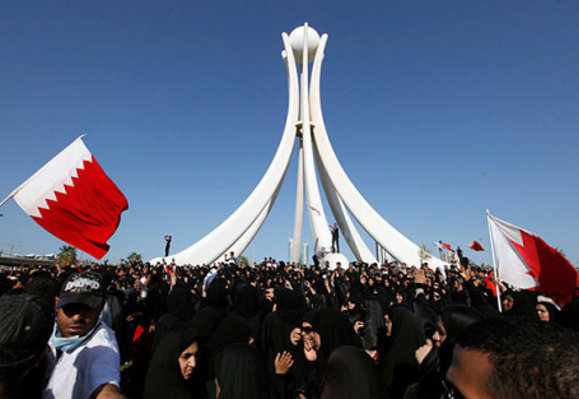
For full event notes, continue reading. Or, click here for the PDF. Abdulla began by noting that while the Bahraini uprising began with simple demands, the government crackdown intensified these desired reforms to calls for regime change. The U.S. administration’s initial reaction urged the Government of Bahrain to not attack peaceful protesters, and the al-Khalifa regime responded by “backing off,” allowing protesters to camp in Pearl Roundabout and announcing a National Dialogue. Then, Abdulla argued, the White House policy changed from one of support for protesters to regime stabilization. The onus for the shift, he added, was the presence of the U.S. naval base in Bahrain. Now, Abdulla said, the U.S. administration has pursued a policy of “strongly taking the side of the Bahraini government.” Furthermore, the coverage of the Bahraini revolution differed from that of its regional neighbors because of the close relationship between the U.S. and Bahrain.
Abdulla asserted that the movement in Congress against the proposed arms sale to Bahrain was sparked by the activism of human rights groups. Support for the joint House and Senate resolutions has been bi-partisan, he added. He also cited the arrival of 29 Bahrainis seeking political asylum in the U.S. over the last two months as testimony that “there is a serious problem” in Bahrain, and that the U.S. administration must “talk to our ally.” He suggested allowing peaceful protests as a “good gesture” from the al-Khalifa government, and concluded by saying that Bahraini oppositionists are facing “mercenaries in Bahrain” as well as “mercenaries in Washington,” referencing the Bahraini government’s contracts with nine lobbying firms. “The movement in Bahrain is indigenous, and its demands are fair,” he said.
Dashti then discussed the “double standard” the Bahraini uprising faces. Opposition members expected the same level of U.S. support that Egypt and Tunisia enjoyed, but have recieved an unbalanced approach that obscures the “legitimate demands of the Bahraini revolution.” He argued that the government of Bahrain has violated international human rights standards, including the conventions against genocide. The regime’s targeting of the Shia community constitutes genocide, he asserted. International organizations have failed to act. This inaction is caused by U.S. interests in the Gulf as well as the power of Saudi Arabia. He also said that the Bahraini government is “importing a new population to change the demography” of the country. The U.S., he said, controls the Gulf and Bahrain; thus, he asked Americans to “put pressure on Congress to help the Bahraini people.” …more
October 31, 2011 Add Comments
US Congress Cut Weapons Off to GCC and we might start thinking your awake
The US responds to “the Arab spring”: here is a “security architecture”
30 October, 2011 Angry Arab News
“With an eye on the threat of a belligerent Iran, the administration is also seeking to expand military ties with the six nations in the Gulf Cooperation Council — Saudi Arabia, Kuwait, Bahrain, Qatar, the United Arab Emirates and Oman. While the United States has close bilateral military relationships with each, the administration and the military are trying to foster a new “security architecture” for the Persian Gulf that would integrate air and naval patrols and missile defense.
“Back to the future” is how Maj. Gen. Karl R. Horst, Central Command’s chief of staff, described planning for a new posture in the Gulf. He said the command was focusing on smaller but highly capable deployments and training partnerships with regional militaries. “We are kind of thinking of going back to the way it was before we had a big ‘boots on the ground’ presence,” General Horst said. “I think it is healthy. I think it is efficient. I think it is practical.” (thanks Amer) …source
October 31, 2011 Add Comments
Clinton comes down hard on Saudi Arabia Womens Right to Drive – as long as they are not Witches
Clinton Finally Expresses ‘Support’ for Saudi Women Drivers
By Patrick Goodenough – June 22, 2011 – CNS News
(CNSNews.com) – Although Secretary of State Hillary Clinton has championed women’s rights from Azerbaijan to Zambia, it took her weeks to respond to an appeal to publicly support a campaign by Saudi women to be permitted to drive.
Even then, her comments on Tuesday came not of her own initiative, but in response to a question at a press availability – and after Saudi women activists and journalists had questioned her public silence on the subject.
In her answer, Clinton signaled once again the Obama administration’s sensitivity about the U.S. being seen to be preaching change to a non-Western culture – and to an important U.S. ally. She repeatedly stressed that the driving campaign was coming from Saudi women themselves. …more
October 31, 2011 Add Comments
Saudi Arabia, US Security Partner in the Middle East – reminiscent of US 1690s Salem Witch Hunts
October 31, 2011 Add Comments
Western oriented Broadcast Media Blitz in MENA
Arab Spring Reshapes Market for TV News
By ERIC PFANNER – October 30, 2011 – NYT
PARIS — As revolutions upend the political landscape across the Arab world, the news media landscape is shifting, too.
The market for Arabic-language television news, dominated for years by two satellite channels with close links to Arab rulers, is poised for a shot of new competition with the pending introduction of two 24-hour news channels backed by Western media conglomerates.
Prince Walid bin Talal, the Saudi billionaire who controls the media company Rotana, provided details last month of one of the channels, which will be named Alarab and will operate in partnership with Bloomberg, the business news and information company.
Meanwhile, British Sky Broadcasting, the pay-television provider, is moving ahead with plans for the introduction of another new channel, called Sky Arabia, in partnership with Abu Dhabi Media Investment, which is controlled by Sheik Mansour bin Zayed al-Nahyan, a member of the ruling family of the Gulf emirate.
Analysts say the new channels, which are set to start broadcasting next year, could provide the first serious challenge in years to Al Jazeera and Al Arabiya, which have enjoyed a viewership duopoly for much of the past decade.
Joe Khalil, co-author of the book “Arab Television Industries,” said he did not think the newcomers would replace Al Jazeera, which is owned by the royal family of Qatar, or Al Arabiya, which is based in Dubai and owned by Saudi investors with royal connections. Those broadcasters have long faced competition from several other regional news channels, including BBC Arabic Television and Al Hurra, which is financed by the U.S. government.
But the new channels “are high-profile projects, and the increased diversity will put pressure on the market leaders to distinguish themselves,” Mr. Khalil said.
While the new channels missed out on the revolutions in Tunisia, Egypt and Libya, as well as uprisings in other Arab countries, executives say they are confident that demand for news will continue to grow. …more
October 31, 2011 Add Comments