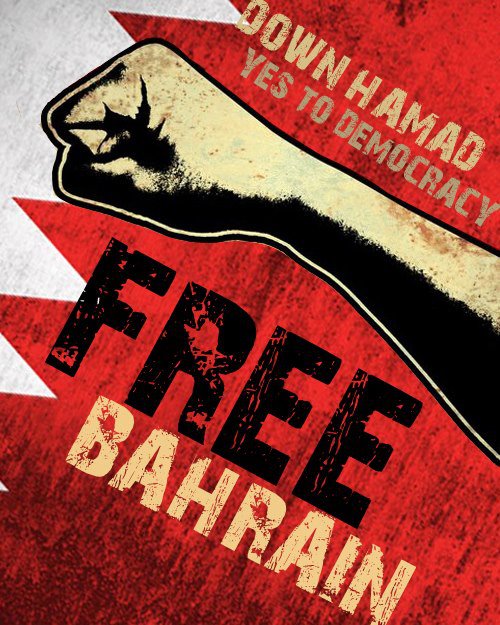
Protest it’s Your Right
January 12, 2012 Add Comments
Bahrain’s newly trained, Human Rights, ISO complaint, Multi-ethnic, Multi-national Security Force, hone skills on Protesters
A spokesperson for the Bahrain International Circuit (BIC) on Monday said the government, which had an independent report carried out last year, has moved to ensure no further human rights violations will take place. “Last year, the King of Bahrain commissioned an independent report into alleged human rights abuses, the findings of which were published in November”. “The report found evidence of human rights violations and made certain general and specific recommendations. “The government has fully acknowledged the findings of the report and is acting swiftly and convincingly on the recommendations.” the spokesman said.

January 12, 2012 Add Comments
blood diamonds, blood money, bloody royality, bloody Bahrain, bloody hell!
Business as usual in bloody Bahrain
by Ala’a Shehabi and Kristian Ulrichsen – guardian.co.uk – 11 January 2012
It’s no surprise the Countess of Wessex accepted jewellery from the Bahraini royal family: Britain has been its backbone for years
News that the Countess of Wessex accepted gifts of jewellery from Bahrain’s royal family is not surprising. After almost 200 years of British-supported rule by the House of Khalifa, Bahrainis are no closer to human rights or democracy. Meanwhile, British firms continue to profit from the ongoing crackdown, as the British government seemingly turns a blind eye to continuing abuses.
Prince Charles rolled out the red carpet for the Sandhurst-trained king of Bahrain in December, soon followed by Prince Edward’s visit to Bahrain with his wife, the Countess of Wessex.
British officials maintain there is nothing the British government can do to pressure the Bahraini government to stop its human rights atrocities. In reality, there isn’t much that they want to do. But the UK arguably has more leverage over Bahrain’s ruling family than any other Arab autocracy, because of its long historical connections.
Britain has provided legitimacy for the Al Khalifa regime ever since it labelled them the “rulers of Bahrain” in an 1820 treaty. This arrangement assigned all power relating to foreign affairs to the British, who intervened twice to remove rulers they didn’t want, most recently in 1923.
A long line of British “advisers” stiffened the backbone of the Al Khalifa’s security services. Charles Belgrave lasted 30 years until being forced out by anti-Suez protests in 1956. Ian Henderson lasted 32 years, and became known as the “Butcher of Bahrain” for his alleged role in torturing opponents of the regime. John Yates is the latest incarnation of Britain’s advisory role in Bahrain’s security services.
The British eventually left Bahrain in 1971, much to the delight of the local population at gaining independence, and to the disappointment of the Al Khalifa. To this day, any celebration of 15 August, the date marking British departure, is forbidden.
Bahrain’s foreign minister (himself a member of the ruling family) has said that it would be wrong to use the word colonialism to describe Britain’s role in Bahrain. In reality, Britain was the ruling family’s backbone, and their protector in maintaining the status quo against the democratic aspirations of ordinary Bahrainis.
From providing the intelligence-gathering software to monitor social media and spy on activists, to arranging canine security for the interior ministry, tender records show how British companies, consultants and special advisers are raking in the cash from the security crackdown. …more
January 12, 2012 Add Comments
Can you identify the Israeli Rabbi, Saudi Minister and Bahraini King talking about “the Iranian threat” in the photo below?

January 11, 2012 Add Comments
King Hamad feeds his Pakistani Security Corp to the dogs for following orders
Bahrain tries police for beating detainees to death
11 January, Agence France Presse
DUBAI: A Bahraini court on Wednesday began the trial of two policemen accused of torturing to death two Shiites detained in the wake of the mid-March crackdown on pro-democracy protests, a lawyer said.
The two policemen are accused of “beating to death” Ali al-Saqer and Zakeriya al-Asheeri, said lawyer Mohammed al-Tajer, who is the representing the plaintiff families of the dead men.
Three other policemen are also facing charges of “concealing information about the crime,” he told AFP by telephone. The charges were filed by the public prosecution.
The trial of the five Pakistani policemen follows a government pledge to punish those behind torturing detainees, following a damning probe which accused police of using excessive force against protesters.
But Tajer, and the opposition, raised concerns that low-ranking officers were apparently being used as scapegoats to cover up what they claim to be the systematic torture of detainees after the clampdown.
“We want… to bring to trial the security bodies that those policemen worked for, whether that is the national security or the interior ministry,” said Tajer.
Al-Wefaq, Bahrain’s main Shiite opposition formation, accused the judicial system of helping in “protecting those really responsible for crimes against humanity in Bahrain,” dismissing the trial as being a “mock” one.
“Torture is not just systematic. It is now a policy of the state,” it said in a statement.
The interior ministry has accused around 20 policemen of using torture against detainees, Tajer said.
The report by the Bahrain Independent Commission of Inquiry, commissioned by King Hamad, found 35 people were killed in the unrest, including five security personnel and five detainees tortured to death in custody. Hundreds were injured.
…more
January 11, 2012 Add Comments
US DEA and ICE sell weapons to cartels and launder money for cartels as “part of US effort to fight crime” – WTF?
U.S. Agents Aided Mexican Drug Trafficker to Infiltrate His Criminal Ring
By Randal C. Archibold – 09 January, 2012 – NYT
The documents, part of an extradition order by the Mexican Foreign Ministry against the Colombian supplier, describe American counternarcotics agents, Mexican law enforcement officials and a Colombian informant working undercover together over several months in 2007. Together, they conducted numerous wire transfers of tens of thousands of dollars at a time, smuggled millions of dollars in bulk cash — and escorted at least one large shipment of cocaine from Ecuador to Dallas to Madrid.
The extradition order — obtained by the Mexican magazine emeequis and shared with The New York Times — includes testimony by a Drug Enforcement Administration special agent who oversaw a covert money laundering investigation against a Colombian trafficker named Harold Mauricio Poveda-Ortega, also known as “The Rabbit.” He is accused of having sent some 150 tons of cocaine to Mexico between 2000 and 2010. Much of that cocaine, the authorities said, was destined for the United States.
Last month, The Times reported that these kinds of operations had begun in Mexico as part of the drug agency’s expanding role in that country’s fight against organized crime. The newly obtained documents provide rare details of the extent of that cooperation and the ways that it blurs the lines between fighting and facilitating crime.
January 11, 2012 Add Comments
Secretary Clinton unaware of realities in Iran as foreign powers assassinate leading Nuclear Scientist
Remarkably, Clinton also called for Iran to return to the “P5+1″ talks, apparently having missed Iran’s Foreign Minister stating last week that Iran is ready to return to these critical talks aimed at diffusing the tension over Iran’s nuclear technology.
Iran Begins Uranium Enrichment at Qom Tuesday, Enrichment Scientist at Natanz Assassinated Wednesday
11 January, 2012 – by Jim White – Empty Wheel
US Secretary of State Hillary Clinton railed Tuesday against Iran’s beginning of operations at its Qom uranium enrichment facility, which is buried deep within a mountain to protect it from bunker-buster bombs. Less than 24 hours later, the Deputy Director of the Natanz enrichment facility was assassinated when a bomb attached to his car exploded in northern Tehran. Iran is blaming Israel,citing similarities of this attack with two previous attacks on Iranian nuclear scientists, attacks in which Iran says the US also was complicit.
Despite the fact that Iran’s new uranium enrichment plant at Qom is designed to enrich uranium to only 20%, well short of the 90%+ that is needed for nuclear weapons, the US response to the start of operations there paints it as a highly provocative act:
“This step once again demonstrates the Iranian regime’s blatant disregard for its responsibilities and that the country’s growing isolation is self-inflicted,” Clinton said in a statement. “The circumstances surrounding this latest action are especially troubling,” Clinton said. “There is no plausible justification for this production. Such enrichment brings Iran a significant step closer to having the capability to produce weapons-grade highly enriched uranium.”
Clinton rejected Iran’s assertion that it needed to enrich uranium to produce fuel for a medical research reactor, saying Western powers had offered alternatives means of obtaining such fuel but their offers had been rejected by Tehran.
Remarkably, Clinton also called for Iran to return to the “P5+1″ talks, apparently having missed Iran’s Foreign Minister stating last week that Iran is ready to return to these critical talks aimed at diffusing the tension over Iran’s nuclear technology.
It appears that the US is having a bit of trouble with message management over its actions in relation to Iran. Over at Moon of Alabama, b reports on an embarrassing incident yesterday in which transcription from a “senior administration official” in the Washington Post got a bit too candid and had to be revised. The initial version of the story stated that “The goal of U.S. and other sanctions against Iran is regime collapse“, but the story has been changed to “The Obama administration sees economic sanctions against Iran as building public discontent that will help compel the government to abandon an alleged nuclear weapons program”. Oops! …more
January 11, 2012 Add Comments
King Hamad shuts down F1 with attack on Drivers
Bahrain paving the way for Formula One Race by imprisoning Car Racing Champion Mohamed AlKhunaizi
11 January 2012 – BCHR
Athletes are still taken to prison for exercising legitimate rights
The Bahrain Center for Human Rights condemns the continuing arrests and unfair trials against hundreds of pro-democracy protesters in Bahrain due to their exercise of legitimate rights like freedom of expression and peaceful assembly. This includes Bahraini car racing champion Mohammed AlKhunaizi, who was sentenced to two years imprisonment just a few days after the confirmation of the placement of Bahrain in the Formula One race calendar for 2012.
On December 13, 2011, the Criminal Court in Bahrain ruled against 40 year old car racing champion Mohamed AlKhunaizi with two years imprisonment on charges of illegal gathering and inciting hatred against the regime. These charges are ones which the military prosecutor and later the public prosecution did not stop pressing against the majority, if not all, of the hundreds of pro-democracy detainees. This goes in conflict with the essence of freedom of expression and peaceful assembly.
Mohammed AlKhunaizi is a professional speed car racer since 1998, and also the founder and team leader of “Khunaizi Racing Team”. Heis winner of several local and international tournaments and has achieved unique records in the Middle East. He also runs a special garage for race car maintenance, and he is one of founders of the Bahrain Automobile Club. Furthermore, he is a father of two children. …more
January 11, 2012 Add Comments
King Hamad committed to violence, pain and ruination of lives, conducts media show of reform to facilitate weapons purchase from the West
Urgent Appeal: The child being named locally “the next martyr”
10 January, 2012 – BCHR
Ameer AbdulSamad Fathi a political prisoner with life threatening illness
The BCHR is alarmed and greatly concerned for the well being of Ameer AbdulSamad Fathi (15 years old). Ameer was arrested at 5 in the morning on the 2nd of January from his home despite the fact that he suffers from a chronic and life threatening illness. Before his arrest Ameer was on continuous medication and because of risk of suffocation he had to be monitored while sleeping. Because of the seriousness of his condition bloggers have named this child “the next martyr.”
After reading Ameer’s medical file a doctor told the BCHR “Amongst other things, Ameer suffers from severe obstructive sleep apnea which is a condition that causes the person to suffocate suddenly while sleeping or lying down and requires urgent oxygen support using breathing machines only found in specialized and fully equipped hospitals. The seriousness of his condition is found in that deterioration can happen suddenly and without any warning. Ameer also suffers from a dysfunctional bladder and difficulty in breathing. The presence of Ameer at prison puts his life in danger.”
Ameer’s arrest was part of mass arrests that happened in the same night and targeted many children less than 18 years old, in Muharraq. They were arrested without warrants and accused of illegal gathering and incitement. According to BCHR information there were no demonstrations in the previous period in that area. …more
January 11, 2012 Add Comments
King Hamad reform noise falls on ears deafened by decades fo lies, deceit and brutal abuse
see next article for a grounding in King Hamad’s lies and deceit.
Bahrain eyes reforms to boost parliament’s powers
08 January, 2012 – Reuters – by Firouz Sedarat
(Reuters) – Bahrain’s cabinet proposed on Sunday giving more powers to the elected chamber and allowing it to question ministers, as part of constitutional reforms in the wake of pro-democracy protests last year.
The cabinet proposed amendments to “achieve greater balance between the executive and the legislative, to strengthen the role of the legislative and regulate the questioning of ministers,” the state news agency BNA said.
The cabinet also approved a 5.35 million dinar ($14.2 million) program to help 211,000 private sector workers making less than 250 dinars a month in the Gulf island country, a regional banking center, the agency said.
The cabinet said the proposed reforms were the result of talks between Bahrain’s opposition and pro-government groups which began in July, aimed at healing deep rifts opened when the Western-allied state’s Sunni rulers crushed protests led by majority Shi’ites early last year.
Bahrain’s largest Shi’ite opposition group Wefaq withdrew from the “national dialogue,” complaining with other opposition groups they would never get their proposed reforms approved, as the opposition was allocated only 35 of 300 seats in the discussions. Some other opposition representatives remained in the talks.
There was no immediate opposition reaction Sunday to the proposed reforms, but opposition figures have cast doubt on the ruling monarchy’s willingness to offer significant concessions.
RIGHTS ACTIVIST DENIED ENTRY
The Gulf Arab state denied entry Sunday to an official of U.S.-based Physicians for Human Rights (PHR) who wanted to attend the trial of a group of medics detained during the protests, the group and a Bahraini activist said. …more
January 10, 2012 Add Comments
Bahrain’s Mythical Democratic Reform and Human Rights Charade
Bahrain had a longstanding consensus in favor of moderate reform, including reinstating a constitutional monarchy that has never really been. Last February’s State inflicted violence on peaceful protests has likely closed the window on a long history of the al Khalifa regime’s promises, offers and actions that have never materialized. King Hamad has been out maneuvered by a Well Educated, Techno-Savvy Opposition that has brought new light to his unceasing deceptions and the violent complicity in his misdeeds by the West. To contrast the present conundrum and extent of lies, manipulation and deceit from the al Khalifa regime, here is a revisit of recent history with this 2002 article from Middle East Intelligence Bulletin…
Political Reform in Bahrain: The Price of Stability
September 2002 – by Nadeya Sayed Ali Mohammed – MEIB
Nadeya Sayed Ali Mohammed is a post-doctoral research fellow at York University in Canada, a contributing writer for Oxford Analytica.
King Hamad bin Isa al-Khalifa’s August 21 decree establishing the district boundaries for Bahrain’s parliamentary elections in October was emblematic of the entire political reform process that has been underway for the past year and a half. Although it was greeted with much fanfare by supporters of the monarchy, Shi’ite Muslim opposition leaders complained that the single-member districts did not take into account the country’s “demographics” – a polite way of pointing out that it dilutes the votes of Shi’ites, who constitute 65% of the population. The gerrymandering was so blatant that some districts contain as many as 12,000 registered voters, while others have as few as 500.
While Hamad’s decree highlights that there is a limit to Bahrain’s political liberalization drive, the opposition’s relatively muted reaction illustrates its primary objective – stability. The king’s strategy is intended not so much to satisfy the political demands of his constituents, but to ensure that they are expressed within the system, rather than in the streets.
The National Charter
Hamad’s ascension in 1999 originally met with considerable Shi’ite apprehension. He had served as crown prince and defense minister during the 38-year reign of his father and played a key role in the brutal suppression of Shi’ite protests from 1994 to 1998. He also faced a potential challenge from his uncle, a staunch opponent of reform who had once supported the ascension of his own son. In an effort to secure his position, Hamad sought to ease tensions and promote reconciliation by gradually releasing political prisoners during the first two years.
Preserving internal stability required additional measures – the restoration of parliament, which was dissolved in 1975, had long been a key political demand of Shi’ite opposition leaders. Political reforms were also seen as a way to bolster the country’s standing internationally. With its small population and meager resources, Bahrain’s influence within the Gulf Cooperation Council (GCC) was limited, and its only strategic importance derived from its location as the home of the US Fifth Fleet. Moreover, Qatar had scored points internationally by holding municipal elections in March 1999. Hamad clearly wanted to put Bahrain on equal footing with its centuries’ old rival, perhaps with an eye toward influencing the ruling of the International Court of Justice on the two countries’ dispute over the Hawar Islands (which were awarded to Bahrain in March 2001). Improving relations with Iran, a predominantly Shi’ite country, was also an important consideration.
[Read more →]
January 10, 2012 Add Comments
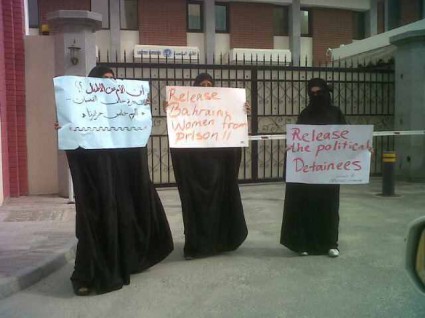
Free Bahrain’s Political Prisoners Now!
January 10, 2012 Add Comments
State Department won’t move to reign in the al Khalifas, but they will help shakedown Haitians for cheaper labor
Washington Backed Famous Brand-Name Contractors in Fight Against Haiti’s Minimum Wage Increase
by Dan Coughlin and Kim Ives
The U.S. Embassy in Haiti worked closely with factory owners contracted by Levi’s, Hanes, and Fruit of the Loom to aggressively block a paltry minimum wage increase for Haitian assembly zone workers, the lowest paid in the hemisphere, according to secret State Department cables.
The factory owners refused to pay 62 cents an hour, or $5 per eight-hour day, as a measure unanimously passed by the Haitian parliament in June 2009 would have mandated. Behind the scenes, the factory owners had the vigorous backing of the U.S. Agency for International Development (USAID) and the U.S. Embassy, show secret U.S. Embassy cables provided to Haïti Liberté by the transparency-advocacy group WikiLeaks.
The minimum daily wage had been 70 gourdes or $1.75 a day.
The factory owners told the Haitian parliament that they were willing to give workers a mere 9 cents an hour pay increase to 31 cents an hour – 100 gourdes daily – to make T-shirts, bras and underwear for U.S. clothing giants like Dockers and Nautica.
To resolve the impasse between the factory owners and parliament, the State Department urged then Haitian President René Préval to intervene.
“A more visible and active engagement by Préval may be critical to resolving the issue of the minimum wage and its protest ‘spin-off’ — or risk the political environment spiraling out of control,” warned U.S. Ambassador Janet Sanderson in a June 10, 2009 cable to Washington.
Two months later, Préval negotiated a deal with Parliament to create a two-tiered minimum wage increase – one for the textile industry at $3.13 (125 gourdes) per day and one for all other industrial and commercial sectors at $5 (200 gourdes) per day.
Still, the U.S. Embassy was not pleased. Deputy Chief of Mission David E. Lindwall said the $5 a day minimum “did not take economic reality into account” but was a populist measure aimed at appealing to “the unemployed and underpaid masses.” …more
January 10, 2012 Add Comments
War with Iran is already here, Syria was supposed to be first to fall
A mistaken case for Syrian regime change
By Aisling Byrne – 05 January, 2012
“War with Iran is already here,” wrote a leading Israeli commentator recently, describing “the combination of covert warfare and international pressure” being applied to Iran.
Although not mentioned, the “strategic prize” of the first stage of this war on Iran is Syria; the first campaign in a much wider sectarian power-bid. “Other than the collapse of the Islamic Republic itself,” Saudi King Abdullah was reported to have said last summer, “nothing would weaken Iran more than losing Syria.” [1]
By December, senior United States officials were explicit about their regime change agenda for Syria: Tom Donilon, the US National Security Adviser, explained that the “end of the [President Bashar al-]Assad regime would constitute Iran’s greatest setback in the region yet – a strategic blow that will further shift the balance of power in the region against Iran.”
Shortly before, a key official in terms of operationalizing this policy, Under Secretary of State for the Near East Jeffrey Feltman, had stated at a congressional hearing that the US would “relentlessly pursue our two-track strategy of supporting the opposition and diplomatically and financially strangling the [Syrian] regime until that outcome is achieved”. [2]
What we are seeing in Syria is a deliberate and calculated campaign to bring down the Assad government so as to replace it with a regime “more compatible” with US interests in the region.
The blueprint for this project is essentially a report produced by the neo-conservative Brookings Institute for regime change in Iran in 2009. The report – “Which Path to Persia?” [3] – continues to be the generic strategic approach for US-led regime change in the region.
A rereading of it, together with the more recent “Towards a Post-Assad Syria” [4] (which adopts the same language and perspective, but focuses on Syria, and was recently produced by two US neo-conservative think-tanks) illustrates how developments in Syria have been shaped according to the step-by-step approach detailed in the “Paths to Persia” report with the same key objective: regime change.
The authors of these reports include, among others, John Hannah and Martin Indyk, both former senior neo-conservative officials from the George W Bush/Dick Cheney administration, and both advocates for regime change in Syria. [5] Not for the first time are we seeing a close alliance between US/British neo-cons with Islamists (including, reports show [6], some with links to al-Qaeda) working together to bring about regime change in an “enemy” state.
Arguably, the most important component in this struggle for the “strategic prize” has been the deliberate construction of a largely false narrative that pits unarmed democracy demonstrators being killed in their hundreds and thousands as they protest peacefully against an oppressive, violent regime, a “killing machine” [7] led by the “monster” [8] Assad.
…more
January 10, 2012 Add Comments
US backs regime harboring and training Terrorists
Saudi Arabia to harbor MKO terrorists
06 January, 2012 – PressTV
Saudi Arabia has reportedly accepted to give refuge to at least 70 members of the terrorist Mujahedin-e Khalq Organization (MKO) following the group’s planned expulsion from Iraq.
According to the reports coming from Baghdad, the US has asked its allies in the region, including Saudi Arabia, Azerbaijan, Jordan, Qatar and Pakistan, to give refuge to MKO members for conducting espionage activities on their soil.
The move came after the Iraqi government expressed determination to close Camp Ashraf, the base of the terrorist group located in the eastern province of Diyala and to expel all MKO members from the country. Iraqi Prime Minister Nouri al-Maliki has repeatedly said that the Iraqi government cannot permit a criminal gang to remain in the country.
Meanwhile, the terrorist group has also announced that it is ready for a gradual pullout from Camp Ashraf.
The Ashraf Camp, about 120 kilometers (74.5 miles) west of the Iranian border, currently houses more than 3,400 MKO members. The notorious camp was scheduled to be closed by the end of 2011, but a few days before the planned expulsion, the Iraqi government, under US pressure, agreed to a UN plea to extend by six months a year-end deadline to shut down the headquarters of the anti-Iran terrorist group on its soil.
Mujahedin-e Khalq Organization, which has carried out numerous acts of terror and violence against Iranian civilians and government officials, fled to Iraq in 1986, where it enjoyed the support of Iraq’s executed dictator Saddam Hussein and fought alongside Iraqi troops during the Iran-Iraq war.
The terrorist group is also known to have collaborated with Saddam in the bloody repression of the 1991 Shia Muslims in southern Iraq and the massacre of Iraqi Kurds in the country’s north. …more
January 10, 2012 Add Comments
Sacrificing Principle to Expediency – The Arms Merchants
Sacrificing Principle to Expediency – The Arms Merchants
by CHRISTOPHER BRAUCHLI – 08 January, 2012
Arms sales are not as straightforward as one might think. For one thing, Russia and the United States are both eager to maintain their respective positions as the most successful merchants of death dealing devices. That causes them to sacrifice principle to expediency. And there’s a good reason why they are eager to sell lots of arms. It boosts their respective economies. And times were bad in 2010 and needed a boost in 2011.
In 2010 worldwide arms sales dropped by 38 percent from their 2009 levels to the lowest levels since 2003. In 2009 $65.2 billion in worldwide arms sales agreements were signed compared with $40.4 billion in 2010. Of those amounts the U.S. had $21.3 billion in arms sales whereas Russia had only $7.8 billion. Happily, 2011 turns out to have been a much better year. Projections for Russian arms sales for 2011 were more than $9 billion and by year’s end it had contracts to sell approximately $3.8 billion in arms to Syria.
The United States is not happy that Russia is supplying arms to Syria, a country of whose leader, Bashar al-Assad, the United States and other Western leaders strongly disapprove. Commenting on Russia’s selling arms to Syria, Secretary of State Clinton said in August 2011: “We want to see Russia cease selling arms to the Assad regime.” Russia is unaffected by her comments. It knows that to remain competitive with the United States in the arms sale competition it needs to sell arms wherever there’s a market. Since the United States is more principled than Russia, it does not sell arms to Syria. Instead it sells them to countries that it thinks are in tune with its goals on the international stage-like Iraq.
Iraq is the country the United States devastated in order to help it out. Nuri Kamal al-Maliki is its Prime Minister and we are happy to sell him arms. At the end of December 2011 it was disclosed that we were selling the Iraqi military about $11 billion worth of arms and training. We sell to Iraq because it is our friend. We refuse to sell to Mr. Assad because he is not our friend. Mr. Maliki, has let it be known that he supports President Assad even though Mr. Assad is busy slaughtering his citizens in order to keep them in line. Mr. Maliki supports Mr. Assad because Iran, a country to which the United States has not sold arms since Mr. Reagan was president, encouraged Mr. Maliki to befriend Syria. So now the United States is arming Iraq which is allying itself with Iran and supports Syria whom the U.S. thinks Russia should not arm.
A few weeks ago it was disclosed that that United States had put on hold a planned sale of $53 million of arms to the Kingdom of Bahrain. Bahrain has proved itself a good friend of the United States since it is home to the U.S. Navy’s 5th Fleet. Bahrain’s ruthless ruler is King Hamad bin Isa Al Khalifa. He brutally put down an Arab spring uprising that took place in Bahrain beginning on Valentine’s Day in 2011. More than 40 of those participating in the uprising were killed by the King’s forces. Thousands more were imprisoned and brutalized. When news of the proposed arms sale reached members of the United States Congress, they demanded that the sale be put on hold pending a detailed report of what went on during the uprising to determine whether an arms sale to Bahrain was appropriate. As a result, the arms sale has not yet taken place.
King Hamad was aided by Saudi Arabia in putting down the uprising. According to a March 15, 2011 report in the Los Angeles Times, one month after the revolt began, “hundreds of troops from Saudi Arabia and police officers from the nearby United Arab Emirates. . . entered Bahrain at the request of the ruling family. . . .” to help put down the uprising.
On Christmas Eve it was announced that the administration would sell $30 billion in fighter jets and other arms to Saudi Arabia. This was part of a $60 billion arms sale that was approved by Congress in October 2010. Although the sale to Bahrain was put on hold, there was no need to put the sale to Saudi Arabia on hold since it is a REALLY good friend to the U.S. even though it helped King Hamad put down the uprising in his country. …more
January 10, 2012 Add Comments
Obama secures electoral success, lines the pockets of US Military Industrial Profiteers, affirms “friendly” tyrants and human rights abusers
Arms dealer Obama will win by default
07 January, 2012 – by Robert Scheer – paragould daily press
Barack Obama will be re-elected not as a vindication of his policies but because the Republicans are incapable of providing a reasonable challenge to his flawed performance. On the central issue of our time — reining in the greed of the multinational corporations, led by the financial sector and the defense industry — a Republican presidential victor, with the possible exception of the now-sidelined Ron Paul, would do far less to challenge the kleptocracy of corporate-dominated governance.
As compared to front-runner Mitt Romney, who wants to derail even Obama’s tepid efforts at regulating Wall Street and who seeks ever more wasteful increases in military spending, the incumbent president appears relatively enlightened. But that is cold comfort.
Not only has Obama been a savior of the banking conglomerates that so generously financed his campaign, but he also has proved to be equally as solicitous of the needs of the military-industrial complex. He entered his re-election year by signing a $662 billion defense authorization bill that strips away some of our most fundamental liberties and keeps military spending at Cold War levels and by approving a $60 billion arms deal with Saudi Arabia.
Those two actions represent an obvious contradiction, since the attack on American soil that kept defense spending so high in the post-9/11 decade was carried out by 15 Saudis and four other men directed by Osama bin Laden, a wealthy Saudi primarily using funding from his native land. Now Saudi Arabia is to be protected as a holdout against the democratic impulse of the Arab Spring because it is our ally against Iran, a nation that had nothing to do with 9/11. Saudi Arabia, it should be recalled, was one of only three nations, along with the United Arab Emirates and Pakistan, to recognize the Taliban government that harbored bin Laden before 9/11.
This is the same Saudi monarchy that rushed its forces into Bahrain last March to crush a popular uprising. But that doesn’t trouble the Obama administration; for two years it has been aggressively pushing the Saudi arms deal, which includes $30 billion in fighter jets built by Boeing. Forget human rights or the other good stuff Democrats love to prattle on about. As White House spokesman Josh Earnest put it, “This agreement reinforces the strong and enduring relationship between the United States and Saudi Arabia and demonstrates the U.S. commitment to a strong Saudi defense capability as a key component to regional security.”
The rationale for the first big arms deal since 1992 with the tyrannical Saudi monarchy is that a better-armed Sunni theocracy is needed to counter the threat from the Shiite theocracy in Iran. Once again, the U.S. is stoking religious-based fratricide, just as we did in Iraq. Only this time, we’re on the side of Saudi Sunnis oppressing Shiites both at home and in neighboring Bahrain. That oppression — along with a U.S. invasion that replaced Tehran’s sworn enemy in Sunni-led Baghdad with a Shiite leadership that had long been nurtured by Iran’s ayatollahs — is what enhances the regional influence of Iran. …more
January 10, 2012 Add Comments
Saudi beheadings continue as silent US readies delivery of 60b in weapons
Saudi Arabia beheads man for murder
08 January, 2012 – Agence France Presse
RIYADH: Saudi Arabia beheaded a man convicted of murder Sunday, the interior minister said in a statement, just two days after the UN expressed alarm at the scale of executions in the kingdom.
Jahaz al-Baqmi, who was executed in the southern Saudi city of Taif, was convicted of stabbing a man to death, according to a ministry statement released by the official SPA news agency, bringing the number of executions carried out in 2012 to four.
On Friday, the United Nations High Commissioner for Human Rights voiced alarm at the almost threefold increase in executions in Saudi Arabia last year.
“We are alarmed at the significant increase in the use of the death penalty in Saudi Arabia in 2011,” said spokesman Rupert Colville at a regular press briefing.
“What is even more worrying is that court proceedings often reportedly fall far short of international fair trial standards, and the use of torture as a means to obtain confessions appears to be rampant,” he added.
Saudi Arabia, which enforces a strict interpretation of Islamic Sharia law, applies the death penalty for a wide range of offences, including rape, murder, apostasy, armed robbery and drug trafficking.
At least 76 death row inmates were executed in 2011, according to an AFP count, while Amnesty International has said the kingdom executed 79 people last year.
January 10, 2012 Add Comments
Obama’s Legacy Guantánamo Bay and empowering Human Rights abuse in Bahrain
January 10, 2012 Add Comments
History of Oil – Robert Newman – The Dollar and the War on Iraq
January 10, 2012 Add Comments
Desert Venture
January 10, 2012 Add Comments
UN Office Protests in Bahrain
Bahrain protests draw thousands to UN office in Manama
10 January 2012 – BBC
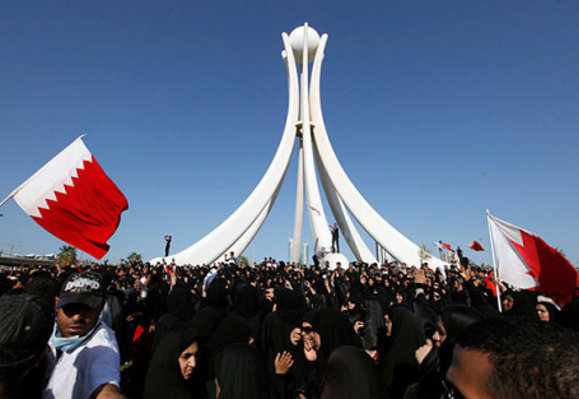
Several thousand people have held a protest outside the United Nations’ offices in Bahrain’s capital, Manama.
The demonstrators chanted “Down, Down, Khalifa” – a reference to long-serving Prime Minister Sheikh Khalifa Bin Salman al-Khalifa, activists said.
They also carried banners urging the UN to “intervene to protect civilians”.
Witnesses said that police allowed the peaceful demonstration to proceed without interference, while a police helicopter hovered overhead.
One activist told the BBC: “Today the police were good. They didn’t close off roads, they didn’t attack us as they usually do with tear gas and stun grenades.”
Observers say the police might have behaved with restraint because of a rare public rebuke by the United States last week over police tactics and the beating of a well-known human rights activist, Nabeel Rajab.
The US state department said the facts of the case were in dispute, but that it was very concerned “about frequent reports of excessive force”.
Restraint
Bahrain’s ruling Al Khalifa family are Sunni Muslim, while the majority of the Gulf state’s population – and those attending anti-government protests – are Shia Muslim.
The prime minister has held his position for more than 40 years. He is the uncle of the king, Sheikh Hamad Bin Isa al-Khalifa, and is widely considered to be a hardliner.
Longstanding Shia resentment over discrimination in the kingdom helped trigger months of unrest last year.
Tuesday’s rally outside the UN’s offices was organised by several opposition political parties, including the main Shia movement, al-Wefaq, and the secular Waad party, which is headed by a Sunni, Ibrahim Sharif.
Mr Sharif is currently serving a five-year prison sentence for plotting to overthrow the state, a charge which independent observers have said is without any merit.
Al-Wefaq and Waad have refused to take part in national reconciliation discussions ordered by King Hamad in the wake of a damning report by a panel of international human rights experts in November.
The report, commissioned by the king, is seen as an attempt to defuse tensions between the government and predominantly Shia protesters that saw at least 35 people die.
The committee was chaired by a distinguished Egyptian human rights lawyer, Professor Cherif Bassiouni.
His report documented numerous and systematic human rights abuses by the government against its citizens, including excessive use of force by police and torture in custody.
…more
January 10, 2012 Add Comments
Al Qaeda Financial Officer arrested in training site in Iraq
Al Qaeda Financial Officer arrested in training site in Iraq
January 06, 2012- Alsumaria
Kirkuk Police Command announced, on Thursday, that it arrested Al Qaeda’s Financial Officer with a group of his assistants when they were training to attack southwestern regions in Kirkuk.
“In an extensive security operation in Al Huwaija District, southwestern Kirkuk, a police force managed today to arrest the Financial Officer of Islamic State of Iraq (Dawlat Al Iraq
Al Islamiya) with a group of his assistants when they were preparing attacks and raids over governmental buildings southwestern Kirkuk,” Kirkuk Police Force Commander Brigadier General Jamal Taher Baker told Alsumarianews.
“The arrest operation was based on accurate intelligence information and was carried out by a police force coordinating with division 12 of Iraqi Military,” Baker added noting that investigations with detainees took place in a security station.
“Detainees were training in Hamrin Mountains southwestern Kirkuk in preparation for a series of terrorist attacks in Huwaija and Kirkuk,” Head of Kirkuk Police, General Sarhad Qader told Alsumaria news considering the arrest of Financial Officer of Islamic State of Iraq as a deathblow to the organization in Kirkuk.
Kirkuk witnessed, on Thursday, the arrest of 5 Al Qaeda members for performing explosive attacks during an operation southwestern the province.
Kirkuk Province, situated 250 km northern Baghdad, is one of Iraqi disputed areas which witnesses constant violence targeting security forces members as well as civilians. Kirkuk is also facing murders due to tribal or personal conflicts. …more
January 10, 2012 Add Comments
The Saudi response to the ‘Arab spring’: containment and co-option
Saudi Arabia’s response to the ‘Arab spring’ has been an attempt to co-opt movements for change in a bid to maintain the status quo. Madawi Al-Rasheed talks to Deniz Kandiyoti about the contradictions of a ruling elite that promotes a conservative Islam, that threatens women’s existing rights abroad – as in Tunisia and Egypt – while it poses as the emancipator of women at home.
The Saudi response to the ‘Arab spring’: containment and co-option
by Madawi Al-Rasheed, 10 January 2012 – Open Democracy
About the author – Madawi Al-Rasheed is professor of the anthropology of religion at Kings College, London. Her books include Contesting the Saudi State: Islamic Voices from a New Generation (Cambridge University Press, 2006); Kingdom Without Borders: Saudi Arabia’s Political, Religious and Media Frontiers (C Hurst, 2008); and A History of Saudi Arabia (Cambridge University Press, 2nd edition, 2011).
Deniz Kandiyoti: You have written eloquently about the battle for the soul of the “Arab spring”. I would like us to explore a critical question with significant implications for the future of pluralism and gender equality in the Middle East and North Africa, namely the policies of Saudi Arabia. How do you evaluate Saudi reactions to the events of the “Arab spring”?
Madawi Al-Rasheed: In January 2011 the Saudi regime was very apprehensive about the fall of Mubarak in Egypt and feared his abandonment by their major ally – the United States. The Saudis supported Mubarak and provided financial backing to make up for the loss of American aid in order to weather the storm. In Tunisia, they had close security and intelligence links with the Ben Ali regime- links that were exposed during his fall. Ben Ali was offered refuge in Saudi Arabia. In Bahrain, which is much closer to home and has a Shiite majority linked to their Saudi counterparts in the Eastern province, the idea of democracy or majority rule could not be tolerated. With the support of the Gulf Cooperation Council, the Saudis sent troops to help the al-Khalifa rulers against the pro-democracy movement, consolidating Sunni rule and rolling back what they saw as Iranian influence. The Bahraini regime was also propped up financially. This triggered a reaction across the border in Saudi Arabia. Playing up sectarianism became a Saudi pre-emptive counter-revolutionary strategy that exaggerates religious difference and hatred and prevents the development of national non-sectarian politics.
Protests at Sadi and Bahrain Embassies in london Russell Pollard/Demotix. All Rights Reserved
This put Saudi Arabia firmly in the counter-revolutionary camp. However, as they realised that they could not stop the change they attempted to co-opt it. The irony is that they backed change in Libya, under the umbrella of the Arab League and supported military intervention, whilst in Yemen they supported Al Saleh and attempted, at the same time, to develop an alternative leadership with patronage ties to the Saudi regime. In short, the Saudis worked on the maintenance of the status quo over democratic change in every way, except when change was in line with their perceived interests. The protests in Syria were seen as an opportunity to win Syria back to the Arab fold, after President Bashar Assad increasingly drifted towards Iran. …more
January 10, 2012 Add Comments
Raytheon and Lockheed Martin Weapons System Sales are real threat to Gulf instability not Iran
U.S. companies key to gulf missile shield
by Staff Writers – Saudi Arabia- 9 January, 2012
Raytheon and Lockheed Martin have become key elements in an accelerating drive by Saudi Arabia and its Persian Gulf partners to build an integrated missile defense shield to protect the energy producers against Iran’s growing missile arsenal.
On Jan. 2, the Raytheon Co. of Massachusetts announced a $582.5 million contract to supply the United Arab Emirates, a regional military heavyweight, with AN/TPY-2 radars for the Terminal High Altitude Area Defense missile defense system, or THAAD.
The seven-emirate federation is the first foreign buyer of THAAD, for which Lockheed Martin is the prime contractor.
Under a $3.48 billion deal announced in Washington Dec. 25, the emirates acquired two units with 96 interceptor missiles.
The missiles are produced at its Troy, Ala., facility. The AN/TPY-2 X-band radars will be manufactured at Raytheon’s plant in Massachusetts.
Two years ago, the Americans deployed one of their AN-TPY-2 units in Israel’s Negev desert south of Tel Aviv to bolster Israeli missile defenses with the capability to detect Iranian ballistic missiles at long range. But the unit remains under U.S. control.
Discussions are under way for a THAAD sale to Saudi Arabia. Washington is also urging the kingdom to upgrade its 16 Patriot Advanced Capability-2 batteries, which have 96 missiles, to PAC-3 standard.
Raytheon announced Jan. 4 that it had completed its first Configuration-3 Patriot radar upgrade for Kuwait’s military, the first of six such upgrades for the northern gulf emirate which has 40 PAC-2 Patriots.
The Saudis are also contemplating the purchase of DDG- 51 Arleigh Burke-class Aegis destroyers that could be armed with ballistic missile defense capability.
These would be the most powerful vessels in the Saudi navy, whose main surface combatants are currently French destroyers and frigates.
The U.S. Navy’s 9,100-ton DDG 51s form the backbone of its BMD force and one of these vessels is always deployed in the gulf.
The kingdom is reported to be considering the purchase of up to a dozen new warships worth between $20 billion-$23 billion under Naval Expansion Program II.
Apart from U.S. moves to maintain cutting-edge defenses against Iran in the region, Washington has long pressed the gulf monarchies to upgrade and strengthen their missiles defenses. …more
January 10, 2012 Add Comments