Bahrain’s slow bleed of reckless, abusive governance
Unrest weighs on Bahrain economy’s recovery
By Praveen Menon – 1 February, 2012 – Reuters
MANAMA (Reuters) – Bahrain’s economy is rebounding on the back of heavy government spending and support from its neighbors, but a full recovery may be out of reach if anti-government protests continue.
A year after mostly Shi’ite demonstrators launched protests against Bahrain’s Sunni Muslim rulers, demanding an end to sectarian discrimination and more say in government, authorities are seeking to quell discontent by doling out benefits to citizens: higher salaries, housing and better infrastructure.
But the spending has had only limited success in reviving the island kingdom’s reputation as a regional banking, trading and Islamic finance hub, as unrest continues on the outskirts of the capital Manama.
“The damage to the economy is somewhat permanent,” said Michael Stephens, researcher at the Doha-based Royal United Services Institute for Defence and Security Studies.
“Bahrain has been a financial hub and has all legislations in place for businesses. However, political instability continues and this is unlikely to change anytime soon. I don’t think the government can encourage business in Manama without solving the political situation.”
Economic conditions in Bahrain have improved considerably since the first quarter of 2011, when gross domestic product shrank 1.3 percent because of street violence that temporarily closed businesses and prompted the evacuation of foreigners. GDP grew 2.2 percent quarter-on-quarter between July and September, the most recent period for which data is available.
But politics continue to overhang the economy of 1.3 million people. The Bahrain Air Show in January, the first big international event since the unrest, was marred by protesters who tried to disrupt it by burning tires and organizing rallies.
More protests are expected before the Bahrain Formula One Championship in April, which the government hopes will show a climate of normalcy. Another possible focus of opposition activity is February 14, the first anniversary of the uprising.
The latest GDP data underlined how political uncertainty is distorting the economy. The output of the oil and gas sector climbed an inflation-adjusted 3.5 percent from a year earlier in the third quarter on the back of high oil prices. But the real estate sector was down 5.6 percent, as investors stayed cautious, and the hotel and restaurant sector fell 8.7 percent, suggesting business travel and tourism continued to suffer.
“Most of the real economy was still in contraction by the third quarter of 2011,” said Nancy Fahim, a Standard Chartered economist. “While recovery is taking place, sporadic political events in 2012 are possible and would present downside risks to growth.”
The government says Bahrain continues to attract new foreign investment; in December the central bank said it had granted in-principle approvals for two Geneva-based investment houses and a foreign reinsurance company to set up offices in the country. …more
February 1, 2012 Add Comments
Human Rights Concerns Linger as Facebook IPO Approaches
Human Rights Concerns Linger as Facebook IPO Approaches
31 January 31, 2012 – Human Rights First
Washington, DC – As Facebook prepares to launch the process for establishing its much-anticipated initial public offering (IPO) this week, Human Rights First is urging the company to make clear how it will address lingering human rights concerns to potential investors. The group is also calling on Congress to close a major loophole that permits insider trading by members of Congress – a topic that will come to the forefront as Facebook’s IPO launches.
Among the human rights concerns potential investors should consider are unanswered questions about how Facebook will approach user privacy in countries where the internet is a tool of repression rather than expression. According to Human Rights First, Facebook should explain how it would respond to government requests for user information or for censorship.
“Facebook is the industry leader in social networking. Their privacy and human rights policies will become the standard for all services. Likewise, their failure to adequately anticipate and address human rights concerns will have grave consequences,” said Human Rights First’s Meg Roggensack. “Facebook has a responsibility to future investors to answer these questions before they launch their IPO this spring.
Currently, Facebook does not explicitly lay out its strategy to protect freedom of expression and other human rights. In addition, its privacy policy varies from country to country, making it difficult for users to understand which of their personal information is private.
The Federal Trade Commission (FTC) recently reached a settlement that requires Facebook to revise its privacy policies and subject them to periodic independent review. The settlement agreement – which explicitly covers user generated registration and data posts – doesn’t clearly indicate how Facebook would handle information gathered about its users while on the site. …more
February 1, 2012 Add Comments
Bahrain Opposition Fears Effects of Iran-West Tensions
Bahrain Opposition Fears Effects of Iran-West Tensions
31 January, 2012 – Bahrain Freedom Movement
Bahraini opposition leaders Hamza al-Dairi, second left raising his fist, and Jalal Fairooz, right, holding a candle and Bahraini flag, both former opposition lawmakers from al-Wefaq society, participate in a rally in the eastern village of Sitra, January
Opposition supporters in Bahrain have expressed concern that escalating tensions between Iran and the West may further stifle their calls for democratic reform in the Persian Gulf kingdom.
Bahrain’s majority Shi’ite Muslims took to the streets nearly a year ago demanding a new government and more rights from their Sunni leaders.
The country continues to crack down on pro-democracy demonstrations and blames Shi’ite-ruled Iran for inciting the civil unrest.
Last month, King Hamad bin Isa al-Khalifa alleged that Syria, which is also ruled by Shi’ites, was training young Bahrainis to overthrow the ruling family.
Bahrain’s main opposition party, al-Wefaq disputes the claims.
“We would like to be isolated from the international conflicts,” said Matar Matar,a spokesperson for the group. “We are worried about those conflicts and their impact on our country.”
Western nations have agreed on sanctions targeting Iran’s lucrative oil industry, hoping they will force the country to abandon its uranium enrichment program.
Tehran insists its nuclear work is for peaceful purposes and has threatened to block the Strait of Hormuz, a major route for world oil traffic, in response to the sanctions.
The United States says it will use force if necessary to keep the strategic waterway open, sparking fears of a confrontation in the Persian Gulf.
Al-Wefaq spokesman Matar says these tensions may provide an advantage for Bahraini authorities. “It is easy for the regime here to utilize this conflict and blame Iran for everything happening here in Bahrain and such tone can be accepted in the United States,” he said.
Bahrain’s opposition has criticized America and its allies for what it sees as a failure to press the Bahraini government to end its deadly assault on civilian demonstrators.
The U.S. Navy’s Fifth Fleet is based in Bahrain, adding to the complexity of the situation.
Theodore Karasik is director of research at the Dubai-based Institute for Near East and Gulf Military Analysis.
“Within the U.S. foreign policy establishment there’s a split between those who believe that Iran is behind what’s ongoing in Bahrain and those that do not. Because of the U.S.’s relationship with the GCC (Gulf Cooperation Council), however, public officials have to go on-record saying that this looks like an Iranian plot,” said Karasik. …more
February 1, 2012 Add Comments
IAEA, Iran, upbeat about Nuclear Program talks
Positive response to IAEA-Iran talks
by Al-Akhbar – 1 February 1, 2012 –
Both Iran and the UN’s atomic watchdog gave a positive response to talks held in the Islamic republic aimed at clarifying Tehran’s nuclear program, and defusing tension with the West.
Officials from the International Atomic Energy Agency (IAEA) visited Tehran on Saturday for talks with Iranian officials to try to advance efforts to resolve the nuclear row.
“We are committed to resolving all the outstanding issues and the Iranians certainly are committed too. But of course there is still a lot of work to be done and so we have planned another trip in the very near future,” Herman Nackaerts, deputy director general of the International Atomic Energy Agency (IAEA), told reporters after returning from Tehran.
Asked if he was satisfied with the talks, Nackaerts, who headed the six-member IAEA mission, said “Yeah, we had a good trip.”
He described the three days of talks as “intensive discussions,” but did not elaborate on the details of the talks.
Iran earlier described the talks as “constructive” and said further meetings were planned.
“Talks between Iran and the visiting team of inspectors from the International Atomic Energy Agency were constructive and … the two sides agreed to continue the talks,” the semi-official Fars news agency quoted an unnamed source as saying on Tuesday.
The Fars report said the date of future talks between Iran and IAEA had been set, but did not give details.
An explosive IAEA report released in November just fell short of explicitly accusing Iran of developing nuclear weapons.
Iran slammed the report as “lousy intelligence,” but the findings gave the West ammunition to up its pressure against Tehran.
Since the report’s release, the United States and European Union have imposed their most severe sanctions on Iran yet, targeting its oil industry – the second largest OPEC exporter. …more
February 1, 2012 Add Comments
Bahrainis on hunger strike, official favours release
Bahrainis on hunger strike, official favours release
by Andrew Hammond – 31 January, 2012 – Reuters
MANAMA, Jan 31 (Reuters) – Fourteen jailed opposition figures in Bahrain have gone on hunger strike ahead of the Feb. 14 anniversary of a failed pro-democracy uprising, activists said on Tuesday, and a government official said he favoured releasing some of the men.
“They demand an end to the political crackdown. They are protesting against the unfair trial they faced and they want the release of all prisoners of conscience,” said Mohammed al-Mascati, head of the Bahrain Youth Society for Human Rights.
Mascati and several dozen other activists gathered at the opposition Waad party building in Manama to stage their own hunger strike in sympathy with the opposition leaders, who were prominent during four weeks of protests inspired by revolts against rulers in Tunisia and Egypt.
Bahrain imposed martial law in March last year and invited in troops from Saudi Arabia and the United Arab Emirates to help crush the month-old uprising.
The government said the island’s majority Shi’ite Muslims had coordinated the protests with Iran for sectarian reasons, an accusation the opposition denied.
The 14, who activists said began their hunger strike on Sunday, were among 21 politicians, rights activists and bloggers tried in a military court on charges including “forming a terrorist group to change the constitution and its monarchical system” and organising protests. Eight were sentenced to life imprisonment. Seven are abroad or in hiding.
Activists said the hunger strikers included rights activist Abdulhadi al-Khawaja, Al-Haq opposition party leader Hassan Mushaimaa and Ibrahim Sharif, a Sunni Muslim opposition leader.
Sharif’s wife Farida Ismail said prison authorities had removed privileges such as access to television to try to force the men to end the hunger strike in Jau prison. She said they were being force fed.
“These trials were political, they were just revenge by the government,” she said at Waad headquarters.
An interior ministry statement said the hunger strikers were being properly cared for. “While it is regrettable that this action may cause additional hardship for the detainees or put their health at risk, they do have the right to refuse food,” it said, citing general inspector Ibrahim Habib.
“All of the inmates have been provided with regular medical care that is available to them 24 hours a day.”
CONFESSIONS UNDER TORTURE
A rights commission on the unrest reported in November that detainees had been tortured. It criticised military trials and advised the authorities to have jail sentences reviewed.
The government, under outside pressure to implement the recommendations, has said a judicial panel will review some sentences. But they have not questioned the military verdict against the 21 protest leaders, who have the right to take the case to the cassation court, the highest appeal court.
A government official expressed hope some of the jailed protest leaders would be freed but said others had planned an Islamist coup.
“I am hopeful that a lot of the cases will be reviewed, but there are some cases to go through and cases have been transferred to the civilian courts,” said Sheikh Abdul-Aziz bin Mubarak al-Khalifa, a senior adviser at the Information Affairs Authority and former ambassador to London.
“I’m hopeful for not necessarily all of them, but at least some of them … There are those in prison who called for a restructuring of the country’s institutions, for a full-blown revolution and who called for an Islamic republic using non-peaceful methods,” he said.
Al-Haq and two other parties, Wafa and the Freedom Movement, formed a “Coalition for a Republic” during the protests that called for the creation of a democratic republic.
Bahrain remains in turmoil with daily clashes in Shi’ite towns and villages between protesters and riot police that have become more violent in recent weeks. The economy of Bahrain, a banking and tourism hub, has been shaken by the unrest.
The daily al-Ayyam – owned by a media adviser to the king – reported on Tuesday that contacts had begun with unnamed political forces for a new national dialogue “to bring Bahrainis together and strengthen national unity”.
Opposition politicians said no one had contacted them and the report was window-dressing ahead of the Feb. 14 anniversary.
Since the uprising, the government has strengthened parliament’s power to monitor the cabinet, but has not reacted to opposition demands for a fully empowered elected parliament able to form a government. …source
February 1, 2012 Add Comments
“Syrian conflict being transformed into something much more cynical” – Bassam Haddad
January 31, 2012 Add Comments
International Community Aids Bahrain Regime in Gassing Murders, Provides Gas and Looks Away – Reminiscent of Nazi Attitudes toward the Jewish
Bahraini Government’s Use of Tear Gas Claims Several Lives
by Abdulrazzaq al-Saiedi on January 27, 2012
Over the last month, the Bahraini police have been using tear gas almost every night against protesters in residential areas. Specifically, the police have been targeting the Shi’a neighborhoods of Iker, Sitra, Nuwadrat, and Ma’ameer. While there are international guidelines for the proper use of tear gas, victims of such attacks describe the police using tear gas inappropriately – including firing into homes and other closed spaces. Such inappropriate use can have disastrous consequences. Since the start of the unrest in February 2011, at least 13 civilians have died from exposure to the tear gas, according to Bahraini civil society groups. They note that those who die from tear gas inhalation are usually people who are already vulnerable due to old age or disease, which make the gas’s effects more deadly.
One of these victims was a newborn baby who was in her own home when she was exposed to the gas. She died on December 11th when she was just 6 days old. 14-year-old Yasseen Al Asfoor was the most recent victim of government misuse of tear gas against protestors; he suffered from respiratory problems and tear gas killed him on January 22nd.
A Bahraini doctor told Physicians for Human Rights (PHR) that she believes that the government is using a new kind of tear gas that is more dangerous. But without knowing the active ingredient, she has been struggling to treat patients:
“I was exposed to different types of gas when I went to (the village of) Sitra—a white gas and a yellow one, but I also saw a third gas of a blue color from a distance. The gas felt like a poison, like a thousand knives and needles all over your body; what kind of tear gas is supposed to affect people this way? I have seen tear gas patients who are in a state of convulsion that never ends, like a prolonged seizure… Before the tear gas that was being used had ‘Pennsylvania, USA’ written on it, now the canisters are just blank with no labels. It is impossible to know what the contents are.”
Other Bahraini doctors also noted that the symptoms of the tear gas were unusual. When they asked the Ministry of Health to run tests on the gas canisters, their requests were denied. Since the long-term effects of prolonged and repeated exposure to tear gas has never been studied, physicians in Bahrain have begun to worry about the impact that repeated exposure to these chemicals may have on the general population. …more
January 31, 2012 Add Comments
Even US Hawks say “not so fast” on Syrian Abyss
Top US senator wary of aiding Syrian opposition
31 January, 2012 – Agence France Presse
WASHINGTON: Republican US Senator Dick Lugar, one of his party’s elder statesmen on foreign policy, cautioned Tuesday against providing US aid to Syria’s opposition “at this point.”
“I think for the time being we should back our ambassador, who I think is doing a great job of witnessing what is occurring, informing us and European countries or others who are interested,” Lugar told reporters.
“But I would not advocate action beyond that at this point,” said the senator, who had been asked what help Washington could provide to the opposition to President Bashar al-Assad amid a bloody months-long crackdown.
Lugar, the top Republican on the Senate Foreign Relations Committee, warned that it would be “very difficult” to identify potential recipients of US help among the “tribes, regional groups of all sorts” and other foes of the regime.
“We’re not really prepared to pick and choose winners and losers in that situation,” said the lawmaker.
His comments came as Syria’s opposition urged the global community to act, deploring its failure to stop “massacres,” ahead of a showdown at the UN Security Council over a resolution aimed at halting the violence. …source
January 31, 2012 Add Comments
In humane and arbitrary detentions in the name of anti-terrorism must stop!
A Prisoner Swap in Saudi Arabia
by Geoffrey Mock – 31 January 31, 2012 – Amnesty
‘If you don’t, we won’t either.’
That’s the agreement the Saudi and Iraqi government found on the matter of executing prisoners each is holding from the other country.
Arab News reported Friday that government officials of both countries came to a consent, at least in principle, to put executions of Saudi and Iraqi prisoners on death row on hold. This ‘in principle’ agreement reportedly will last two months until a final agreement to swap prisoners is reached. Currently, there are 138 Iraqi nationals imprisoned in the Saudi Kingdom, most of whom were charged with involvement in terrorist operations. Eleven Iraqis were sentenced to death.
The news of Friday’s ‘in principle’ agreement to put executions on hold until any further consent has been reached to swap prisoners, may appear as a step forward toward decreasing the shockingly accumulating numbers of executions posed on prisoners in the Kingdom. However, in reality it’s only a band-aid solution to a larger problem: Since March 2011, the Saudi Arabian authorities have launched a new wave of repression in the name of security, including attacks on political opponents, religious minorities and even foreign nationals.
Sentences based upon alleged terrorist affiliation are common in Saudi Arabia. The country is in the process of passing a new anti-terror law that provides for the prosecution of acts of peaceful dissent as ‘terrorist crimes’ such as ‘harming the reputation of the state or its position.’ If the law is passed as written, questioning the integrity of the king or the crown prince would be punishable by a minimum of 10 years in prison.
The human rights threats of the new anti-terror law are vast according to the Amnesty International report, ‘Saudi Arabia: Repression in the name of security’, published last month. The vague and broad definition of terrorism offenses, the unlawful restrictions of freedom of expression, as well as the violations of rights of detainees are just a few of many key parts of the new law that pose tremendous threats to human rights in Saudi Arabia. …more
January 31, 2012 Add Comments
U.S. Ranks 47th in Press Freedom
U.S. 47th in Press Freedom After Attacks on OWS
By DAVE LINDORFF – 27 January 27, 2012 – Counterpunch
Say it loud and say it proud: We’re Number 47! We’re Number 47! Boo-yah!
If you want to know why the US — beacon of freedom, land of the First Amendment – is now ranked number 47th (out of 179) in terms of freedom of the press in the annual ranking put out by Reporters Without Borders, below South Africa, Botswana, South Korea and Comoros, and just above Argentina, Romania and Latvia, you could ask Mike Bloomberg, the billionaire mayor of New York and himself owner of a huge news organization, or his Chief of Police Raymond Kelly.
For that matter you could ask the mayors and police chiefs of Chicago, Los Angeles, Seattle, Portland, Boston, Philadelphia, or a host of other cities.
Better yet, ask the mayor of Oakland and her police department’s latest gestapo chief, Howard Jordan.
According to Reporters Without Borders, what caused the US to plunge from 20th place last year, up there with the likes of Ireland, Germany, Belgium and Japan, down to 47th this year, was the way reporters were treated by police as they tried to cover the Occupy Movement that began last September.
Across the country, police maneuvered to block reporters from covering their brutal crackdown on the Occupy Movement. They swept into encampments from Los Angeles to New York wearing black military-style riot gear in the dead of night to avoid cameras and video-cams, waiting until most journalists had gone home to bed before tearing up the tents and firing the tear gas grenades, the rubber bullets and the pepper spray at unarmed, unresisting protesters. Or, when reporters did show up and tried to cover the assaults on peaceful demonstrators, the cops sometimes, as in New York, smashed them and their cameras, or just arrested them.
“Who here has a press card?” asked the officer in charge in New York before the final assault on Zuccotti Square’s occupiers. When reporters dutifully raised their hands or held up their press passes, New York’s not-so-finest grabbed them, cuffed them and hauled them away. “Only for their safety,” was the explanation given later by the cops and the mayor after that particularly noxious display of police-state tactics against the media. ….more
January 31, 2012 Add Comments
US Main Stream Media bangs the “war drum” against Iran
Israeli policy underscores the utterly criminal character of the war being prepared against Iran. Israel, a non-signatory to the Nuclear Non-Proliferation Treaty, which illegally maintains a large stockpile of nuclear weapons, declares its right to destroy the nuclear program of Iran, a signatory to the treaty…
The New York Times and the drive to war against Iran
By Barry Grey – 31 January, 2012 – WSWS
The New York Times on Sunday published a lengthy article in its weekly magazine that sympathetically and clinically lays out the arguments of Israeli policy makers in favor of a military attack on Iran sometime this year. The article, written by Ronen Bergman, a prominent Israeli journalist who specializes in intelligence matters, features interviews with top current and former Israeli officials, including Defense Minister Ehud Barak, Vice Prime Minister Moshe Ya’alon and former Mossad chief Meir Dagan.
Bergman discusses the extensive military preparations made by Israel for an attack on Iranian nuclear facilities and reviews the covert war being waged by Israel, with US support, which has included deadly explosions at military and nuclear facilities, cyber warfare, and the assassination of five Iranian nuclear scientists since 2007, the latest occurring January 11 in the center of Tehran.
The author concludes the article by stating, “I have come to believe that Israel will indeed strike Iran in 2012.”
Appearing in the context of newly announced US and European sanctions against Iranian oil exports and a buildup of US naval forces in the Persian Gulf, the article serves a definite and sinister purpose: to provide the pretexts and condition public opinion for a preemptive and unprovoked war of aggression that will have catastrophic consequences for the people of Iran and the Middle East and ultimately for the entire world.
It appeared only days after President Obama’s belligerent State of the Union address, in which he boasted of isolating and economically crippling Iran and reiterated that he would “take no options off the table” to prevent Iran from getting a nuclear weapon. The same day the article was published, US Defense Secretary Leon Panetta appeared on CBS Television’s “60 Minutes” program and baldly asserted that Iran would have a nuclear weapon within a year.
The Times article cites both supporters and opponents within the Israeli establishment of a near-term attack on Iran, giving greater weight to the former than the latter. It accepts uncritically the common premise advanced by Israel, the US and the European powers that Iran is embarked on a program to build nuclear weapons and must be prevented from doing so, if necessary by military means. It quotes Moshe Ya’alon, Israel’s vice prime minister and minister of strategic affairs, as saying, “Our policy is that in one way or another, Iran’s nuclear program must be stopped.”
This statement of Israeli policy underscores the utterly criminal character of the war being prepared against Iran. Israel, a non-signatory to the Nuclear Non-Proliferation Treaty, which illegally maintains a large stockpile of nuclear weapons, declares its right to destroy the nuclear program of Iran, a signatory to the treaty, which insists that its nuclear program is civilian and therefore permitted under international law. Despite the best efforts of the US, Israel and their imperialist allies, the International Atomic Energy Agency has been unable to substantiate their claims that Iran is, in fact, seeking to build nuclear weapons. …more
January 31, 2012 Add Comments
Great Depressions, Greed, Weapons and Jobs – And a President up for Reelection
Amazingly, the Nye Committee in the U.S. Senate devoted 93 hearings from 1934 to 1936 to exposing America’s own “greedy munitions interests.” Even in those desperate depression days, a desire for profit and jobs was balanced by a strong sense of unease at this deadly trade, an unease reinforced by the horrors of and hecatombs of dead from the First World War.
Weapons ‘R’ Us
Making Warbirds instead of Thunderbirds
31 January, 2012 – by William J Astore – Le Monde diplomatique
Perhaps you’ve heard of “Makin’ Thunderbirds,” a hard-bitten rock & roll song by Bob Seger that I listened to 30 years ago while in college. It’s about auto workers back in 1955 who were “young and proud” to be making Ford Thunderbirds. But in the early 1980s, Seger sings, “the plants have changed and you’re lucky if you work.” Seger caught the reality of an American manufacturing infrastructure that was seriously eroding as skilled and good-paying union jobs were cut or sent overseas, rarely to be seen again in these parts.
If the U.S. auto industry has recently shown sparks of new life (though we’re not making T-Birds or Mercuries or Oldsmobiles or Pontiacs or Saturns anymore), there is one form of manufacturing in which America is still dominant. When it comes to weaponry, to paraphrase Seger, we’re still young and proud and makin’ Predators and Reapers (as in unmanned aerial vehicles, or drones) and Eagles and Fighting Falcons (as in F-15 and F-16 combat jets), and outfitting them with the deadliest of weapons. In this market niche, we’re still the envy of the world.
Yes, we’re the world’s foremost “merchants of death,” the title of a best-selling exposé of the international arms trade published to acclaim in the U.S. in 1934. Back then, most Americans saw themselves as war-avoiders rather than as war-profiteers. The evil war-profiteers were mainly European arms makers like Germany’s Krupp, France’s Schneider, or Britain’s Vickers.
Not that America didn’t have its own arms merchants. As the authors of Merchants of Death noted, early on our country demonstrated a “Yankee propensity for extracting novel death-dealing knickknacks from [our] peddler’s pack.” Amazingly, the Nye Committee in the U.S. Senate devoted 93 hearings from 1934 to 1936 to exposing America’s own “greedy munitions interests.” Even in those desperate depression days, a desire for profit and jobs was balanced by a strong sense of unease at this deadly trade, an unease reinforced by the horrors of and hecatombs of dead from the First World War. …more
January 31, 2012 Add Comments
“Security Consultants” write narrative and analysis of events in Bahrain
Bloodshed in Bahrain
By DANIEL NISMAN – 30 January, 2012 – Jerusalem Post
A year after Arab Spring and the island nation’s sectarian conflict is worse than ever.
As Bahrain braces for the year anniversary of the outbreak of its protest movement, worrying trends are beginning to emerge in the activity of its Shi’ite-led activist groups. Since February 14 2011, the opposition’s modus operandi consisted of mostly civil disobedience acts aimed at drawing the world’s attention to the inequality facing the Shi’ite majority. In past months however, activists have stepped up acts of violence, mainly aimed at security forces, whose alleged brutality has come to symbolize their oppression at the hands of the Sunni monarchy.
On January 24, opposition groups launched a campaign dubbed “the Rebel’s grip,” aimed at expelling the regime’s security forces from Shi’ite villages in the central and northern parts of the island. The campaign comes days after a prominent Shi’ite cleric issued a particularly scathing sermon, calling for supporters to assault any security personnel suspected of attacking female protesters. The opposition’s rage towards security forces comes after a year of high profile incidents involving protesters’ deaths as a result of police brutality. Many of these incidents were caught on video, spread through social media and ingrained in the minds of activists.
Regardless of whether their motives are justified or not, the opposition’s shift toward violence presents a real threat to the prosperity of a nation which seeks to shift from natural resources to international trade and commerce as its future source of revenue. In an effort to quell this discontent, the regime launched the Bahrain Independent Commission of Inquiry (BICI) which recommended reforming the police force as a primary step towards reconciliation. In early January 2012, public security chief Tariq Al Hassan announced the implementation of “community policing” programs in which 500 officers would be recruited in order to police their own communities.
These programs are likely the result of consultations with recently enlisted Western experts, who have themselves been part of the trend of community policing which has swept forces from Los Angeles to London in recent decades. This policy was born out of the realization that trust and coordination between the police and the communities they serve is a critical factor in preserving order. It remains clear that such reforms are crucial to restoring stability in Bahrain, given the ever-widening gap of trust between police and Shi’ite residents.
Unfortunately for the Bahraini government however, community policing is not a quick fix for the Island’s problems and therefore must be implemented holistically and patiently in order to achieve real results. Ground level reforms already proposed will not be successful in winning hearts and minds unless the police leadership makes it clear to the people that their perceptions of the police are indeed important. Performance surveys gauging the impact of new programs, meetings with community leaders, and increased transparency regarding officer misconduct are all proven methods which have helped improve public opinion of police forces in Europe and elsewhere.
In addition, Bahraini security forces must place special emphasis on appealing to the new generation of Shi’ite youth and garnering their trust. Police must learn about quality of life issues in Shi’ite villages, penetrating schools and setting up programs aimed at cooperatively solving these problems.
Lastly, the Bahraini police must accept and compensate for the factors that are currently tarnishing their image and effectively preventing them from fulfilling their role in preserving order. As seen in the past year, the primary factor is the issue of police brutality – a trend particularly difficult to stem while persistent riots require a forceful response in order to be dispersed. As such, a two-pronged effort is required to nip the bud of what has become a central issue in the Bahraini discourse: Firstly, a dependable and transparent internal affairs division must be established within the force. Second, the Public Security Ministry must work to coordinate and approve peaceful demonstrations, even those taking place in high profile areas of the capital.
It is at this point that the success of community policing in Bahrain is dependent upon the government’s overall willingness to commit to reconciliation with willing opposition groups, including the staunchly opposed Al Wefaq organization. In a nation where mistrust between the government and the people is deeply entrenched along sectarian lines, the former’s choice in allowing the latter to demonstrate is truly the hardest step. Indeed, the concept of a liberal policing policy in a region known for absolutist rule may seem laughable to many skeptics. However, it was likely those same skeptics who laughed at the possibility of free elections in former dictatorships like Tunisia, or the power of the common man in Egypt.
As such, community policing indeed provides the opportunity for the Bahraini government to engage in its own revolutionary act, by proactively ensuring stability by restoring trust between the people and the police. As exhibited elsewhere in the region, they may not have a choice.
The writer works for Max Security Solutions, a risk consulting firm based in the Middle East. He is an expert on community policing and author several policy papers on its implementation in the region. …source
January 31, 2012 Add Comments
Bahrain’s Jaw Prison Hunger Strike Spreads, Hunger Strikers under attack
Around 250 political prisoners started a widespread national hunger strike in the central Jaw prison on the 29th of January after the 14 political and human rights leaders in prison announced they would commence a hunger strike to protest their continued detention as well as the deteriorating human rights situation in the country. I sent out a SOS call yesterday from one of the detainees yesterday, and since then the situation has deteriorated.
According to the information we’ve received, part of the prison (number 4) was teargassed as punishment to the detainees on strike, and a number were severely beaten. Another number of detainees were also put in solitary confinement as punishment for going on hunger strike.
The detainees are also not being allowed to make any phone calls, and are being denied any time outside as they were before.
The 14 political and human rights leaders reportedly were paid a visit by the same judge who had presided over their case, who threatened that they will not be allowed to call their families and put in solitary confinement if they do not stop their hunger strike immediately. The detainees responded that they would continue with their planned one week strike, but if they are punished they will announce it as an open ended strike.
In other updates, after detainees at the Dry Docks prison announced they would join the hunger strike, a number of detainees from different areas in Bahrain were reportedly taken and were reportedly told that they would be released if they plead for the king’s forgiveness, and said they are against the strike and the protests. A number of those who refused to abide were reportedly beaten so severely that they had to be moved to the hospital after. Some of the detainees called their families after upset, saying they had been forced to make video taped apologies.
Two prisoners in AlWesta prison fainted due to the hunger strike and were moved to the MOI hospital.
A number of activists who are not detainees have joined the hunger strike, amongst them Mohammed AlMasqati, president of the Bahrain Youth Society for Human Rights and Zainab Alkhawaja.
confirmed undisclosed source
January 31, 2012 Add Comments
In the flames they seek to claim a future the Foreign Mercenaries were hired to steal
January 31, 2012 Add Comments
ABC News and Bahrain Regime collaborate on Iran, Syria disinformation campaign
Officials: Iran, Syria Aided Bomb, Assassination Plot in Bahrain
By RYM MOMTAZ – 31 January, 2012 – ABC News
Five men arrested in November in connection with a plot to blow up the only bridge connecting the island of Bahrain with Saudi Arabia and to assassinate Bahraini politicians are allegedly tied to Iran’s Revolutionary Guard and reportedly received military training in Syria, according to information leaked to the media by authorities.
The charges are the latest salvo in a regional struggle for power between Iran and the Arab Gulf states, including Saudi Arabia, and come just after the U.S. revealed an alleged plot by Iran’s Revolutionary Guard to assassinate the Saudi ambassador to the U.S. in Washington, D.C.
…source
January 31, 2012 Add Comments
Protect the victims not the abusers – al Khalifa regime and its Police are shameless in trampling of human rights and dignity
Bahrain must release woman activist convicted for listening to ‘revolutionary’ music
30 January, 2012 – Amnesty
The Bahraini authorities must release the first woman activist to be convicted over her involvement in last year’s pro-reform demonstrations, Amnesty International said today after a court rejected her appeal and upheld her prison sentence.
Fadhila Mubarak’s 18-month prison sentence for protesting and listening to “revolutionary” music was today upheld by the Court of Cassation in the capital, Manama.
“Fadhila Mubarak is a prisoner of conscience who was reportedly beaten and tortured in detention and then sentenced in an unfair trial before a military court on spurious charges for standing up for her rights,” said Hassiba Hadj-Sahraoui Deputy Director of Amnesty International’s Middle East and North Africa Progamme.
“The Bahraini authorities must release her immediately and unconditionally. Fadhila Mubarak’s sentence only serves to demonstrate the intolerance of the authorities and the failures of the justice system. They must also launch an independent investigation into allegations of torture against her and bring those responsible to justice.”
Fadhila Mubarak was arrested on 20 March 2011 when her car, which was also carrying her eight-year-old son and two other children, was stopped at a checkpoint close to Rifaa, south-west of Manama.
She was told she had been stopped for playing music calling for the overthrow of the regime, and was asked to turn the sound down.
She refused and asked the police officer for identification, before being forced out of the car, beaten on the head and arrested.
Fadhila Mubarak was taken to Rifaa police station. During interrogation she is said to have been repeatedly beaten all over her body by female policewomen. She was then taken to ‘Issa Town police station and beaten again.
The National Safety Court of First Instance, a military court, found Fadhila Mubarak guilty of several charges on 17 May 2011 and she was sentenced to four years in jail.
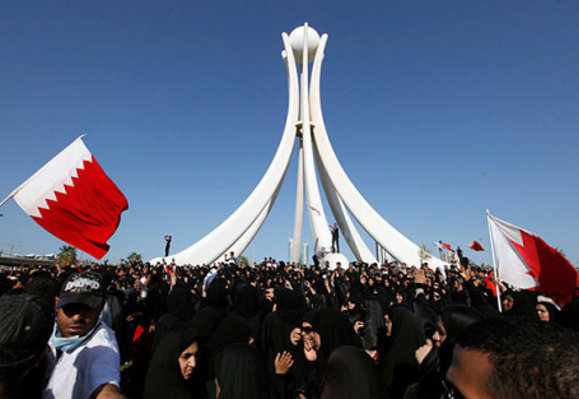
She faced spurious charges of taking part in an illegal gathering of more than five people; taking part in illegal protests at the GCC (Pearl) Roundabout in central Manama; possessing CDs and leaflets inciting hatred towards the regime and assaulting a policeman by pulling his shirt.
January 31, 2012 Add Comments
Bahrain’s Police need to be jailed not protected – MOI should enforce laws against lawless Police
January 31, 2012 Add Comments
Outcry over the idiocy of Obama’s weapons greed in Bahrain
Rights Groups Oppose Smaller Arms Transfer
By Jim Lobe -30 January, 2012 – IPS
WASHINGTON, Jan 30, 2012 (IPS) – The decision by the administration of President Barack Obama to approve limited transfers of military equipment to Bahrain is coming under renewed fire by human rights and pro-democracy groups here.
The groups, as well as a number of lawmakers who have opposed renewed arms transfers to Bahrain, are demanding that the administration publicly disclose precisely what it intends to provide the Gulf kingdom.
And they are warning that any military transfers at this time will almost certainly be seen by pro-democracy opposition forces as support for a repressive regime.
“Even a limited sale of military items to the Bahraini government sends the wrong message,” said David Kramer, the president of Freedom House, a pro-democracy group that receives support from the Congressionally funded National Endowment for Democracy (NED).
“Until the Bahraini government ends systemic human rights abuses, allows unfettered access to media and international organisations, and begins implementing meaningful political reform, the United States should not consider the sale of any military items,” Kramer said Monday.
Other groups were slightly more circumspect. “Because the details (of the sale) are secret, it is difficult to independent determine whether the U.S. government is providing the kinds of weapons and ammunition, and/or equipment that Bahraini security forces could use in the commission of further human rights violations,” according to Sanjeev Bery, advocacy director for the Middle East at Amnesty International’s office here.
“At a time when Bahrainis are experiencing human rights violations at home, it doesn’t look good to be handing their government additional military equipment,” he added, noting the deaths in January of as many as nine Bahrainis from tear-gas inhalation or being struck by tear-gas canisters at close range.
Longstanding relationships between Washington and the militaries of friendly but repressive governments during the so-called “Arab Spring” over the past year have become increasingly problematic. …more
January 31, 2012 Add Comments
Mr. Interior Minister, Where are your laws that protect people driving, from CS gas shot by your MOI thugs?
January 31, 2012 Add Comments
Who needs protection from Whom Mr. Interior Minister?
Interior Minister Sheikh Rashed bin Abdullah Al-Khalifa said on Sunday 29 January 2012, recent clashes have seen an “increase in violence and attacks on security personnel.” He also stated his intention to urge parliament to pass laws to punish “assailants and the instigators” of attacks that target security forces with jail sentences lasting up to 15 years. “My responsibility is to call for the strengthening of law protecting police as there are no deterrent laws so far.”

Ali Jawad, 14 years old, murdered with tear gas canister shot point blank to head by MOI Security Forces
January 30, 2012 Add Comments
The Death and Forbidden Rebirth of the Oakland Occupy Commune
A report on the J28 “move-in day” in Oakland, first published at Viewpoint.
Building the Red Army: The Death and Forbidden Rebirth of the Oakland Commune
Submitted by maxrenn – 30 January, 2012 – libcom.org
“Don’t fuck with the Oakland Commune.” Words which will live forever in history, to be remembered and repeated at every glorious defeat inflicted upon the heroes of the future by mayors, police officers, unions, churches, and children. A letter, signed by the Occupy Oakland Move-In Assembly, promised to respond to the inevitable eviction of an illegal building occupation by “blockading the airport indefinitely.” Tactics only dreamed of by al-Qaeda, within the reach of Occupy Oakland after just four months.
Yesterday these words were at the center of a material practice which brought our movement up against its limits. It’s not a bad thing to meet your limits. It means confronting the possibility and necessity of radical transformation. And this confrontation should be approached with all the courage and resolve on display when a young militant throws a tear gas canister back at a line of police.
Occupy Oakland Move-In Day was to be a historic event, an occupation of a privately owned building by a mass of people, announced well in advance. The literature indicated that “multiple targets” had been identified, and that the site would be “a vacant building owned either by a bank, a large corporation of the 1% or already public.” The goal was familiar: to establish a social center in the building for community use. And in fact a remarkable schedule of events had been planned, a “festival” which could surely have drawn in attention and support.
Every action in Oakland begins with a deceptive innocence, a rally at Oscar Grant Plaza. The numbers were impressive – the mainstream media reports 1,000-2000 throughout the day – and a sign that a remarkable cross-section of the city had been waiting for this. But at the same time police were walking through the crowd with a photo album of prominent organizers, along with warrants for their arrest.
Apparently some of those arrested were returned to the rally, and the march set off in good spirits. From time to time you could look across the street and see lines of police on the next block. You could also look up and see their helicopters.
At a certain crucial intersection it became clear that police, who had a bird’s-eye view of our trajectory, were blocking the planned route. In front of us was quagmire known as Laney College. This was the first moment in which a desperately-needed contingency plan was unavailable. Though the truck with the sound system and furniture was at an impasse, the crowd spontaneously surged onto the unfamiliar campus and had no idea where to go. It wasn’t hard for the police to block the most apparent exits. …more
January 30, 2012 Add Comments
Sanctions were Aimed at Averting Wider Conflict
New Sanctions Aimed at Averting Wider Conflict
By Barbara Slavin – IPS – 25 January, 2012
British Foreign Secretary William Hague said the sanctions are designed to “increase(e) the pressure for a peaceful settlement of these disputes.”
WASHINGTON, Jan 25, 2012 (IPS) – European countries are imposing unprecedented sanctions against Iran in part in hopes of preventing an Israeli attack on Iranian nuclear installations that could further destabilise the Middle East and wreak havoc on the global economy.
The decision Monday by the European Union to phase out purchases of Iranian oil by Jul. 1 is timed to U.S. legislation that has the same deadline for sanctions against foreign banks that continue to do business with the Iranian central bank. However, European and U.S. experts on Iran cite the fear of a new war as a key reason for the EU decision.
“The French administration is worried about Israel attacking Iran this year,” a French researcher, speaking on condition of anonymity because he advises the French government, told IPS Wednesday.
British Foreign Secretary William Hague, answering questions Tuesday in the House of Commons, said the new sanctions are designed to “to lead us away from any conflict by increasing the pressure for a peaceful settlement of these disputes.”
The EU decision reflects Israeli success in pressuring both the United States and Europe. Israeli officials have repeatedly called for “crippling” sanctions against Iran, suggesting that might forestall their use of military force against Iran’s nuclear facilities – and collateral damage in terms of sharply higher oil prices and increased regional instability.
There is particular concern that Israel might act in 2012 out of concern that Iran is nearing nuclear weapons capability and in the belief that the Barack Obama administration would be obliged to support Israel in a U.S. presidential election year.
Stuart Eizenstat, who negotiated with Europeans a decade ago after the U.S. Congress first enacted sanctions that sought to penalise foreign oil companies doing business with Iran, told IPS Wednesday that the EU turnaround was “remarkable and stunning…given where they were on sanctions in general and Iran in particular.” …more
January 30, 2012 Add Comments
The escalating stakes over Iran’s Soverign Rights, including the Right to Self Defense
Playing Poker in the Strait
By James R. Holmes – 30 January, 2012 – The Diplomat
Does Iran boast the capacity to bar the Strait of Hormuz to commercial and naval shipping, as influential officials and lawmakers have repeatedly vowed to do? Doubtful – but Tehran can make serious trouble for the United States, the West, and its Middle East neighbors short of putting a stopper in the bottle of the Persian Gulf.
Just after the New Year, Iranian army chief Ataollah Salehi cautioned the nuclear-powered aircraft carrier USS John C. Stennis to stay clear of the Persian Gulf. “I advise, recommend and warn them over their return of this carrier to the Persian Gulf,” intoned Salehi, “because we are not in the habit of warning more than once.” The U.S. Navy paid these words little if any heed. Stennis remained in the area and was joined by its sister ship, USS Carl Vinson, in the Indian Ocean theater a few days later. Last week, after the European Union levied new economic sanctions to dissuade Iran from pressing ahead with its nuclear-weapons program, Muhammad Ismail Kowsari, deputy head of the Islamic Republic’s committee on national security, warned that the strategic waterway would “definitely be closed if the sale of Iranian oil is violated in any way.” Kowsari proclaimed that regional and Western navies would be unable to force the Strait should Iranian forces close it.
We have to allow for the bluster quotient in any pronouncement issuing forth from Tehran. Still, the Iranian armed forces possess sufficient seaward reach – in the form of anti-ship cruise missiles, speedboats and other small craft, sea mines, and so forth – to give Western capitals pause. The logic of “access denial” and “area denial,” two terms much in vogue among American commentators, involves manipulating perceptions among antagonists as much as it does girding oneself to actually fight battles on the high seas. Amassing and displaying the capacity to do significant damage sends a message. Tehran may believe it can convince Washington and its partners that persevering with sanctions will exact costs that vastly outstrip any gains the coalition can hope to extract from economic coercion. In effect, the Iranian leadership has threatened to hold hostage the 17 million barrels of oil that passes through the Strait every day, and the prosperity of oil-dependent economies with it. …more
January 30, 2012 Add Comments
Pushing for War with Iran
Putting Israel First
The War Party’s Achilles’ heel
by Justin Raimondo – 30 January, 2012 – Antiwar Forum
The campaign to lure the US into attacking Iran has one big problem to overcome before the War Party can taste success: the rather obvious fact that such a war would benefit Israel, and not the United States. This is why Israel’s partisans in the US constitute the spearhead of the pro-war agitation, why AIPAC has made this a consistent theme for the past few years, and why the billionaire Sheldon Adelson, aside from funding the Newtster, has poured untold millions into the same project. Hardly a day goes by without some Israeli government official reiterating, once again, that Iran represents an “existential threat” to the Jewish state, and threatening to strike the first blow if Uncle Sam fails to wake up in time, while Israel’s amen corner dutifully echoes the same line.
Israel and its more vehement partisans in this country have demanded the US attack Iran, even going so far as to raise the specter of another Holocaust if America fails to act. However, one argument they have failed to make is significant by its absence – they have failed to show how it is in America’s interest to launch a military strike. Indeed, they have neglected this part of the equation rather ostentatiously, and yet one can hardly blame them for this oversight for the simple reason that such a case would be impossible to make. An attack on Iran would deprive the world economy of a significant portion of its energy needs, and would likely result in an economic catastrophe in this country – to say nothing of the costs of the war, in blood and treasure. War-weary Americans are not in the mood for another invasion and occupation in search of nonexistent “weapons of mass destruction.” This is the War Party’s Achilles’ heel.
How to get around this is the problem at the heart of the War Party’s current project, and in order to do so they are employing the deadliest weapon in their well-stocked arsenal: the accusation of “racism,” the most toxic accusation anyone can make about someone in the current political climate. Specifically, they are accusing war opponents of “anti-Semitism.” After all, if Israel is the Jewish state, and that state’s very existence is threatened by the specter of Iran’s alleged nuclear weapons program (which US intelligence has stubbornly failed to detect), then opposition to US military action is “anti-Semitism,” pure and simple. …more
January 30, 2012 Add Comments