Zainab al Khawaja Arrested Near Pearl Roundabout
Zainab al Khawaja Arrested Near Pearl Roundabout
12 February, 2012 – Witness Bahrain
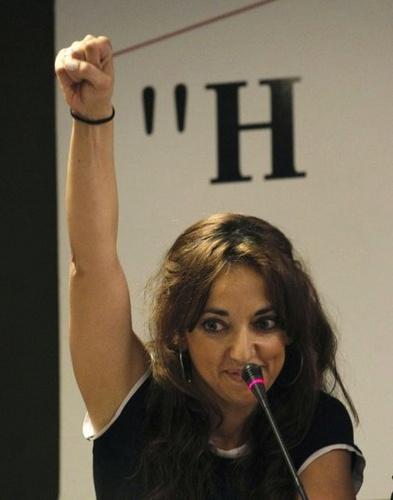
Prominent activist Zainab al-Khawaja was arrested today during an attempt to walk to Pearl (Lulu) Roundabout initiated by human rights leader Nabeel Rajab. A few meters from the blocked entrance to the site of last year’s encampment, police fired tear gas directly at the group of ten people, including two children. A ten-year-old girl, Malak Rajab, was overwhelmed by tear gas.
Zainab al-Kahawjah continued running toward the entrance and was surrounded by police. When she did not tweet for forty minutes, word went around that she had been disappeared. She is being held at Nuaim Police Station.
Zainab is the daughter of Abdulhadi al-Khawaja, who is serving a life sentence for his human rights activism. Abdulhadi al-Khawaja, who began an open-ended hunger strike on Wednesday in the lead-up to the February 14 anniversary of the ongoing revolution, was taken to the hospital last night.
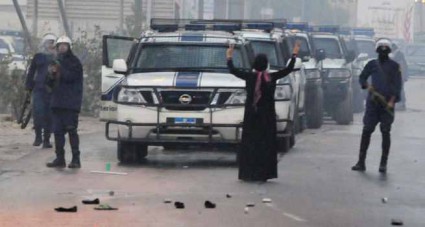 Zainab Courageously Stopping Security Forces in Previous Protest
Zainab came to prominence last April after staging a 10-day hunger strike to demand the release of her father, uncle, husband and brother-in-law, who were all being held for their political activities. She tweets as @angryarabiya, and has over 33,000 followers.
A brief interview with Zainab al Khawaja is included in the video clip [above] shot by a Witness Bahrain team member two nights ago in Sitra.
February 12, 2012 Add Comments
Inhuman Assault by Security Forces
February 12, 2012 Add Comments
Mic Check – Witness Huwaida Arraf Arrest by King Hamad’s Barney Boys of Idiocy, can you hear us now Mr. Posner?
11 February, 2012
“Witness Bahrain” Launched as Ongoing Revolution Marks First Year
International Observers Arrive in Bahrain
Manama – Today, human rights defenders launched the “Witness Bahrain” initiative to monitor and report on the repression of Arab Spring democracy activists in the Kingdom of Bahrain. “Witness Bahrain” is a group of international observers, primarily from the United States, who have responded to the call of Bahraini human rights activists to witness their revolution, stand with them at protests, in hospitals and in villages, and to tell the world what they see. The government of Bahrain has denied entry to a number of prominent journalists and human rights workers in the lead-up to the one-year anniversary of the massive and ongoing pro-democracy movement. …more
Huwaida Arraf – Palestinian American human rights activist & lawyer. Co-founder of the International Solidarity Movement; Chairwoman of the Free Gaza Movement – Stopped in Bahrain to Witness for Human Rights on behalf of freedom loving people everywhere
recent tweets up until arrest
2h Huwaida Arraf Huwaida Arraf @huwaidaarraf
Police have me barricaded. #Bahrain #witnessbahrain
3h Huwaida Arraf Huwaida Arraf @huwaidaarraf
Peaceful demo attacked with tear gas. Police chasing people down alleyways. #Bahrain #witnessbahrain #Manama
3h Huwaida Arraf Huwaida Arraf @huwaidaarraf
Police grabbed young boy. Will not say why or let us get his name. #Bahrain #Manama #witnessbahrain
3h Huwaida Arraf Huwaida Arraf @huwaidaarraf
Riot police already starting to chase after young men. Why? #Bahrain #witnessbahrain #ArabSpring
3h Huwaida Arraf Huwaida Arraf @huwaidaarraf
Walking in #Manama with @angryarabiya people joining. #Bahrain #witnessbahrain #ArabSpring
4h Huwaida Arraf Huwaida Arraf @huwaidaarraf
I and #witnessbahrain team will report what we see. Sadly some people refuse to see. #Bahrain #ArabSpring
5h Huwaida Arraf Huwaida Arraf @huwaidaarraf
Kate @katrap40 preparing her gas mask for demo in #Manama. #Bahrain #witnessbahrain #Feb14 yfrog.com/h29fejcfj
20h Huwaida Arraf Huwaida Arraf @huwaidaarraf
Riot police storm Sehla village firing teargas & sound bombs. Shotguns drawn and lasers pointed. #Bahrain #WitnessBahrain
20h Huwaida Arraf Huwaida Arraf @huwaidaarraf
@fqadi No thanks needed! We must stand united against all forms of injustice
In reply to Fadi Al-Qadi
20h Huwaida Arraf Huwaida Arraf @huwaidaarraf
@MARYAMALKHAWAJA Least we can do! Keep strong.
In reply to Maryam Alkhawaja
February 11, 2012 Add Comments
King Hamad you miss the point, the harder you try to knock her down the bolder she stands against you
February 11, 2012 Add Comments
U.S. Rep. Jim McGovern: Statement on Bahrain
U.S. Rep. Jim McGovern: Statement on Bahrain
10 February, 2012 – Office of Congressman McGovern
Washington—Congressman James P. McGovern (D-MA) today urged the Bahraini government to allow Bahrainis to assemble and express their political views on February 14 in commemoration of the one-year anniversary of the outbreak of major demonstrations in Bahrain.
Congressman McGovern also urged the Bahraini security forces and Bahraini protesters to refrain from the use of violence on the anniversary. Violence by either side only serves to strengthen those opposed to genuine peace and reconciliation.
“The rights to assemble peaceably and express political views are fundamental human rights,” said Congressman McGovern. “The Bahraini government should respect these critical rights, and all Bahrainis should reject the use of violence.”
Congressman McGovern is Co-Chairman of the Tom Lantos Human Rights Commission. …source
February 10, 2012 Add Comments
Abdulhadi Al-Khawaja says from Jaw prison in Bahrain: Freedom or Death
Courageous defender of human rights Abdulhadi Al-Khawaja says from Jaw prison in Bahrain: Freedom or Death
9 February, 2012 – Gulf Center for Human Rights
Beirut, 09 February, 2012 — Courageous defender of human rights and the main founder of the Gulf Centre for Human Rights, Abdulhadi al-Khawaja, announced from jaw prison, on Wednesday, 8 February, 2012, that he begins an indefinite hunger strike. The distinguished human rights defender told his family in a telephone call, that he is starting a hunger strike to “freedom or death.”
On 22, June, 2011, Human rights defender Abdulhadi Al-Khawaja has been sentenced by the National Safety Court -a militarry court- to a life imprisonment . On 29 January 2012, human rights defender Abdulhadi Al- Khawaja and 13 other prisoners, including human rights defender Abduljalil Al- Singace and prominent activists, started a hunger strike to protest against their imprisonment and demanding respect for people’s human and civil rights in Bahrain.
The Gulf Centre for Human Rights urges the authorities in Bahrain to:
1. Immediately and unconditionally free human rights defender Abdulhadi Al-Khawaja, and the other 13 activists, and drop all the charges against them.
2. Carry out an independent, thorough and impartial investigation into the reported torture and ill-treatment of defender Abdulhadi Al-Khawaja, with a view to identifying those who are responsible, and bringing them to justice;
3. Ensure that all human rights defenders in Bahrain, carrying out their legitimate work in the defence work of human rights, are able to operate free of restrictions and reprisals.
For more information, please contact:
The Gulf Centre for Human Rights is an independent centre and has been registered in Ireland. The Centre works to strengthen support for human rights defenders and independent journalists in Bahrain, Iraq, Kuwait, Oman, Qatar, Saudi Arabia, United Arab Emirates and Yemen. …source
February 10, 2012 Add Comments
Veteran US Diplomat Questions Syria Storyline
Veteran US Diplomat Questions Syria Storyline
By Sharmine Narwani -Al Akhbar – 9 February
The problem with US policy in the Middle East is that it now operates almost entirely at the political level: gone are the days when area experts were the heavyweights in the command center, weaving historical context, relationships and nuance into vital policy decisions.
Today you are more likely to have single-issue interest groups, commercial projects and election cycles impact key deliberations. It’s a short-term view: tactical more than strategic and black and white in its approach. Like a high-octane marketing campaign, it is heavily focused on key phrases, scene-setting, and narrative building.
The spotlight on Syria in recent weeks has been intense and the propaganda has been incessant: Regime massacres in Homs, evil Russia and China, a benevolent UN Security Council trying to save Syria, 1982’s Hama slaughter resuscitated, and an American ambassador left “disgusted” at the gall of others using veto power.
But take the hysteria down a notch or two, bring the debate back into the hands of measured, experienced observers, and the storyline may be tangibly different. Over the weekend, I had the privilege of receiving an email that reminded me of a time when area experts at the US State Department delivered honest assessments of events so that wiser decisions could be taken.
The missive was from a former US diplomat with service experience in Syria who has asked to remain unnamed. I am publishing the email below in its entirety for the benefit of readers:
I have serious problems with all the talk about military intervention in Syria. Everyone, especially the media, seems to be relying solely on anti-regime activists for their information. How do we know 260 people were killed by the regime in Homs yesterday? That number seems based solely on claims by anti-regime figures and I seriously doubt its accuracy.
I served over three years in Damascus at the US Embassy and I know how difficult it is to sort fact from rumor in that closed political society. We were constantly trying to verify rumors that we had heard about assassinations, regime arrests, etc., and that included the Agency, which was just as much in the dark as everyone else. Today, we have a skeleton embassy which I am sure is under constant surveillance and with very few personnel to go out and report on what is happening. When I was in Damascus over two years ago, I was less than impressed with the Embassy’s sources and with its understanding of the dynamics of what was going on Syria. And the same is true when I talk to officials at the State Department.
The media, and to an extent the Administration, have personalized the conflict in Syria as being about Bashar Assad and his family. They have consistently underestimated the sectarian nature of the conflict there. It is not just Bashar Assad and his family that are hanging onto power at all costs, it is the entire Alawi system of control of the country, including the military, the security services and the Baath Party. I believe that Alawites firmly think that if they lose power, the Sunnis will slaughter them, That was one reason Hafez and his brother Rifaat were so ruthless in Hama thirty years ago. And everyone in the West conveniently forgets the campaign of assassinations and suicide bombings carried out in the three or four years before Hama by the Muslim Brotherhood throughout the country. I personally witnessed the aftermath of such bombings in which several hundred people were killed. While the State Department, the CIA and other organs of government may have short historical memories, the people in Syria do not.
February 10, 2012 Add Comments
King Hamad organizes press blackout
Bahrain should grant entry to journalists
9 February, 2012 – Committee to Protect Journalists
New York, February 9, 2012–Bahrain has rejected at least six journalists’ applications for entry visas ahead of the anniversary of antigovernment protests that swept the country in February 2011, according to news reports. The Committee to Protect Journalists calls on authorities to allow journalists into the country to carry out their work freely.
Several international journalists wrote on Twitter over the past two days that their visa applications had been denied. They were told the rejections are due to a “high volume of requests,” but that they are welcome to reapply after February. The journalists had wished to cover the February 14 protest anniversary.
Among the journalists who were denied visas are: The New York Times’ Nicholas Kristof and Adam B. Ellick; Kristen Chick of the Christian Science Monitor; the BBC’s Cara Swift; Alex Delmar-Morgan of The Wall Street Journal; and Gregg Carlstrom from Al-Jazeera.
“Bahraini authorities act as if they have something to hide by engaging in this crude form of censorship,” said Mohamed Abdel Dayem, CPJ’s Middle East and North Africa Program Coordinator. “The government should immediately reverse its decision and allow international news media to observe and report on the anniversary.”
In 2011, local independent and foreign journalists in Bahrain endured the worst conditions since King Hamad bin Khalifa assumed the throne in 1999. CPJ has documented two journalist deaths in government custody, dozens of detentions, physical assaults, arbitrary deportations, and government-sponsored smearing of journalists, among other violations. …source
February 10, 2012 Add Comments
Witness Bahrain, Protecting against a Violent Regime
February 10, 2012 Add Comments
King Hamad look closely, this is what the end of you looks like
February 10, 2012 Add Comments
Peaceful Protests on the First Anniversary of the Revolution in Bahrain
Urgent Appeal: Peaceful Protests on the First Anniversary of the Revolution in Bahrain
February 10th, 2012
Ladies and gentlemen, members of international NGOs, authorities, and Media.
Best regards from Bahrain.
The Bahrain Youth Society for Human Rights (BYSHR) would like to inform you to monitor the protests on the first anniversary of the revolution.
Ladies and gentlemen,
We would like to inform you that a group of activists, patriotic figures and youth are planning to launch a rally against the government in protest on violations of human rights in Bahrain. The rally will start at Manama district on February 11-14, 2012.
BYSHR believes that Riot police, National Guard and Army will target participants by using rubber bullets and tear-gas. They use such weapons intensively against children, women, youth, and seniors.
The Riot police, National Guard and Army have committed similar violations against participants in previous peaceful events calling for democracy, freedom, and justice in Bahrain.
Ladies and gentlemen,
BYSHR looks forward to your interest in following up the consequences of the rally on Sunday, Monday and Tuesday. BYSHR calls upon you to move urgently to stop the expected acts of Riot police, National Guard and Army, including detention and torture.
Sincerely,
Mr. Mohammed Al-Maskati – President of the Bahrain Youth Society for Human Rights
E-mail: info@byshr.org
Mobile: (+973)36437088
February 10, 2012 Add Comments
“Witness Bahrain” Launched as Ongoing Revolution Marks First Year
“Witness Bahrain” Launched as Ongoing Revolution Marks First Year
February 10, 2012 – February 10. 2012
International Observers Arrive in Bahrain
Manama – Human rights defenders launched the “Witness Bahrain” initiative to monitor and report on the repression of Arab Spring democracy activists in the Kingdom of Bahrain.
“Witness Bahrain” is a group of international observers, primarily from the United States, who have responded to the call of Bahraini human rights activists to witness their revolution, stand with them at protests, in hospitals and in villages, and to tell the world what they see. The government of Bahrain has denied entry to a number of prominent journalists and human rights workers in the lead-up to the one-year anniversary of the massive and ongoing pro-democracy movement.
“People here fear that the government of Bahrain’s attempt to keep out foreign observers signals an impending escalation of violence,” said Radhika Sainath, a civil rights attorney from New York. “As such, our presence here is all the more crucial.”
In the coming days and weeks, Witness Bahrain will stand with people taking to the streets to demand democracy, equality and respect for human rights. Witness Bahrain will also maintain a presence in villages active in pro-democracy protests which are being subjected to night raids, tear-gassing and other attacks by the police.
“We call on the Bahraini government to refrain from attacking peaceful protesters; however, should the government choose to continue using violence, we will be present to witness,” the group said.
Follow Witness Bahrain: follow Witness Bahrain HERE
Twitter: @WitnessBahrain Email: info@WitnessBahrain.org
February 10, 2012 Add Comments
Hearts in one Accord, Hamad must Go
February 10, 2012 Add Comments
The US government insists that none of the weapons in the deal can be used against protesters
US pushes Bahrain arms deal despite abuses
Obama administration using legal loophole to sell arms to Bahrain despite ongoing abuses and crackdown on NGOs.
Gregg Carlstrom – 02 February, 2012 – Al Jazeera
The Obama administration is pushing to close an arms deal with Bahrain, despite the government’s nearly year-long crackdown against protesters and recent steps to block American NGOs from operating in the island kingdom.
A previous arms sale was suspended late last year after fierce opposition from human rights groups and members of Congress. But the White House is now taking advantage of a legal loophole to push forward a separate deal without congressional approval.
The deal is also advancing despite the Bahraini government’s recent crackdown on several US-based NGOs, including the National Democratic Institute and Physicians for Human Rights. Staffers with valid Bahraini visas have been barred from entering the country.
Some of the organisations received letters informing them that their work was temporarily suspended, ostensibly until a national commission finishes reviewing the recommendations of the official commission which studied last year’s unrest.
“The commission’s deadline to complete this work is by the end of February,” said the letters, which were signed by Houda Nonoo, Bahrain’s ambassador to the United States. “We therefore feel that it would be more beneficial for a visit from your esteemed organisation to take place after this date.”
Several of the organisations had issued critical reports on human rights abuses and restrictions on political freedom in Bahrain, where more than 40 people have been killed and thousands arrested during nearly a year of unrest.
“It’s ironic that there’s not much discussion of this, considering what’s happening in Egypt right now,” said Stephen McInerney, the director of the Project on Middle East Democracy, referring to a similar (though harsher) crackdown on American NGOs in Cairo.
No ‘internal security items’
The new arms sale, which was first reported by Josh Rogin in Foreign Policy, takes advantage of a legal loophole which allows the administration to make small sales – less than $1mn – without congressional approval. So a larger package could be broken into individual sales, each below the million-dollar threshold, to avoid notifying Congress.
The package will include patrol boats, communications equipment, and spare parts for helicopters and fighter jets, according to the US State Department, which insisted that “none of these items can be used against protesters.”
Full statement on arms deal
“Examples of what we are providing include spare parts and contractor maintenance support for existing F-16s, helicopters, and communications equipment. It includes items such as patrol boats for maritime security and support services for training Bahraini troops who are supporting coalition operations in Afghanistan. It does not include any new capabilities, nor would it include internal security items, such as small arms or tear gas.”
— State Department
“It does not include any new capabilities, nor would it include internal security items, such as small arms or tear gas,” a department spokesman said in a statement to Al Jazeera.
But some of the items in the proposed sale have indeed been used against protesters. Bahraini security forces routinely use helicopters to monitor demonstrations, for example, and activists say footage from those helicopters is sometimes used to identify and arrest participants.
The official report of the Bahrain Independent Commission of Inquiry (BICI) mentions at least three occasions on which military helicopters were deployed to monitor protests.
This latest deal is separate from an earlier proposal to sell Bahrain more than $50mn worth of weapons, including 44 Humvees. Those armoured vehicles have also been used against protesters on numerous occasions.
The administration has temporarily suspended that deal, though it can finish the sale at any time, because members of Congress did not file formal objections during the 90-day “notification period.” Congress could have blocked the deal during that period by passing a resolution of disapproval. …more
February 9, 2012 Add Comments
Saudi Arabia defense forces use of US Weapons to defend against external threats
February 9, 2012 Add Comments
Another tear gas death from your Weapon Sales to “friends” President Obama

February 9, 2012 Add Comments
Saudi citizen gunned down by al-Saud Troops – President Obama you must Stop Transfer and Sales of Weapons to Saudi King Abdullah immediately!
February 9, 2012 Add Comments
Is this protester one of the “external threats” US weapons are supposed to stop US President Obama?
February 9, 2012 Add Comments
Saudi Protesters murdered by Saudi troops as they shout out against King Hamad of Bahrain
February 9, 2012 Add Comments
…do not allow the word “democracy” to be utilized apologetically to represent the dictatorship of the exploiting classes
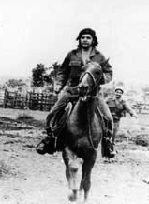
“Barefaced violation of all legislation or of laws specifically instituted to sanction ruling class deeds only increases the pressure from the people’s forces. The oligarchical dictatorships then attempt to use the old legal order to alter constitutionality and further oppress the proletariat without a frontal clash. At this point a contradiction arises. The people no longer support the old, and much less the new, coercive measures established by the dictatorship and try to smash them. We should never forget the class character, authoritarian and restrictive, that typifies the bourgeois state. Lenin refers to it in the following manner [in State and Revolution ]: “The state is the product and the manifestation of the irreconcilability of class antagonisms. The state arises when, where, and to the extent that class antagonisms objectively cannot be reconciled. And, conversely, the existence of the state proves that class antagonisms are irreconcilable.” In other words, we should not allow the word “democracy” to be utilized apologetically to represent the dictatorship of the exploiting classes; to lose its deeper meaning and acquire that of granting the people certain liberties, more or less adequate. To struggle only to restore a certain degree of bourgeois legality without considering the question of revolutionary power is to struggle for the return of a dictatorial order established by the dominant social classes. In other words, it is to struggle for a lighter iron ball to be fixed to the prisoner’s chain.” – Che Guevara
Guerrilla warfare: a Method …more
February 9, 2012 Add Comments
Theft of property is another sign of the terminal illness of dictators and their greed
February 9, 2012 Add Comments
King Hamad’s murderous apartheid takes another young persons life in State directed violence
Bahrain Teenager’s Death Shows Tensions Persist Year After Popular Revolt
By Donna Abu-Nasr – 9 February, 2012 – Bloomberg
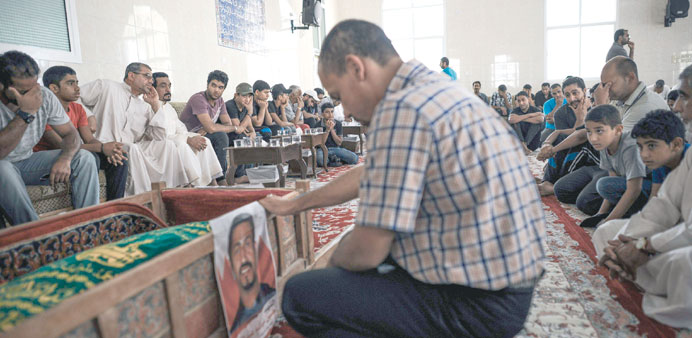
Mohammed Ibrahim Yacoub had a haircut, took a shower and left home with a friend as police clashed with Shiite Muslim protesters near his home in Sitra, Bahrain on Jan. 25. That was the last time his family saw their 18-year-old son alive.
There are competing narratives of what happened to Yacoub. His family, who are Shiites, say he was hit by two police cars that were chasing him, then detained, tortured and taken to hospital where he passed away. The government says he died as a result of complications from sickle-cell anemia following his arrest for vandalism.
Yacoub’s is one of several contested deaths in the run-up to the Feb. 14 anniversary of last year’s mass anti-government rallies. They were suppressed at a cost of at least 35 dead, exacerbating divisions between Bahrain’s Shiite majority and Sunni royals that may flare again as activists call for renewed protests. Violence has hurt the economy and fueled the rivalry between Saudi Arabia, which sent troops to help the crackdown, and Shiite-ruled Iran, accused by Bahrain’s authorities of encouraging the unrest.
There are “tensions in Bahrain that do have the potential of boiling over and creating economic instability,” Farouk Soussa, chief economist for the Middle East at Citigroup Inc. in Dubai, said in a phone interview. “There are no illusions that what happened over the past year was a one-off.”
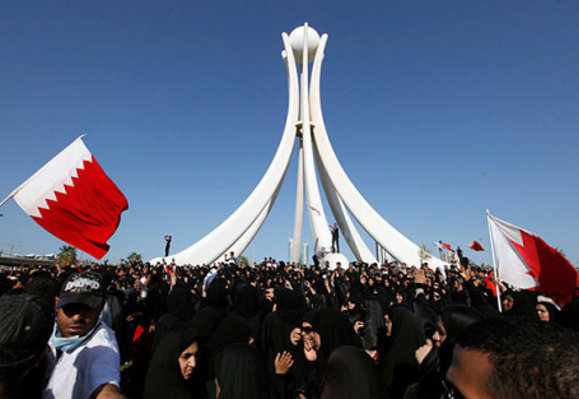
Pearl Roundabout Demolished
Protesters say they will attempt to march to the former Pearl Roundabout, the center of last year’s rallies. The roundabout has been demolished by the government and the surrounding area turned into a restricted military zone. Demonstrators attempting to reach it in December were met with tear gas, stun grenades and rubber bullets, according to the Bahrain Youth Society for Human Rights.
The opposition says several people have died after torture, like Yacoub, or tear gas inhalation, allegations the government denies.
Shiites represent about two thirds of the nation’s population of 1.2 million, according to the U.S. State Department. In demonstrations in February and March, they demanded democratic representation and equal economic opportunities, saying that they faced discrimination in jobs and housing and that the elected parliament lacks power. …more
February 9, 2012 Add Comments
‘Freedom or Death’, al-Khawaja leads hunger strike ahead of US State Department calls for release of all held for their ‘political expression’
Bahraini activist goes on hunger strike before anniversary of uprising
9 February 2012 – The Guardian
Abdulhadi al-Khawaja, convicted of leading last year’s protests, restarts hunger strike calling for his release
A jailed rights activist in Bahrain has gone back on hunger strike before the anniversary of the country’s pro-democracy uprising on 14 February, the Bahrain Youth Society for Human Rights has said.
Abdulhadi al-Khawaja was one of 14 prominent figures convicted of leading the protests who took part in an eight-day hunger strike to demand their release. Bahraini authorities said that hunger strike ended last week.
“Al-Khawaja said in a telephone call to his family: ‘Freedom or death,’ which means he started an open hunger strike until his release,” said the Bahrain Youth Society for Human Rights on its website.
The opposition is trying to put pressure on the government, dominated by the Sunni Muslim al-Khalifa family, before the anniversary of the uprising. The reforms they want include an elected government – the first in the Gulf – and reduced powers for the al-Khalifas.
Bahrain imposed martial law in March last year and asked troops from Saudi Arabia and the United Arab Emirates to help crush the month-old uprising.
The government said the island’s majority Shia Muslims had co-ordinated the protests with Iran for sectarian reasons, an accusation the opposition has denied.
…more
February 9, 2012 Add Comments
Bahrain Women Protesters ‘Tortured by Regime’
Bahrain Women Protesters ‘Tortured by Regime’
9 February, 2012 – By Anissa Haddadi – International Business Times
The Bahraini government has been accused of increasing the use of torture of women activists in prison as it hardens its stand against pro-democracy protesters.
With the first anniversary of protests approaching on 14 February, fresh accusations have surfaced about the government’s treatment of opponents in the small island state. Activists said that the government has failed to implement most of the recommendations set be the Bahrain Independent Commission of Inquiry (BCIC) into alleged human rights abuses.
Teachers, doctors, athletes and others seens as enemies of the regime continue to be arrested or are banned from work. A media blackout has been enforced ahead of the anniversary with numerous journalists refused visas.
More than 1,000 Bahrainis have been detained – 11 percent of them women – since a state of emergency was declared in March 2011 in response to the protests and stories of the torture of female prisoners continue to emerge.
“The use of torture is ongoing; we are still receiving reports of torture from detainees that are in prison,” Maryam al-Khawaja, a Human right activist working for the BCHR told the IBTimes.
Among the victims are:
Bahiya Abdulrasool al-Aradi, a 51-year-old woman who went missing in March 2011. She was last seen driving her car and was on the phone with her sister when she heard gunshots. Aradi disappeared and her family were called by the authorities a few days later. and told that she was in a Bahrain military hospital on life support. The authorities said she died of “brain injury” but the BCIC said she had been shot from behind.
…more
February 9, 2012 Add Comments
DOS Posner Public Statement in Bahrian, 09 February, 2012
February 9, 2012 Add Comments