Villages Attacked Chemical Gas kills villager in his home
Several villages attacked; Bahraini dies after inhaling toxic gas
11 April, 2012 – Shia Post
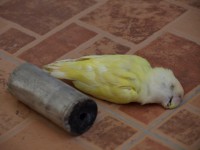
Pro-government thugs in Bahrain have attacked several villages near the capital, Manama, and Bahraini has died due to asphyxia after inhaling poisonous tear gas fired by Saudi-backed regime forces as Manama’s brutal crackdown on protests continue.
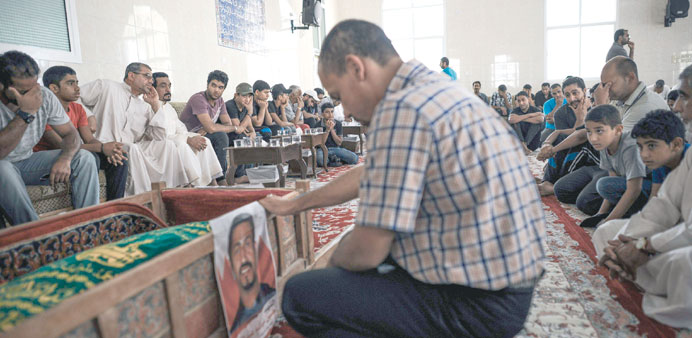
The victim, identified as Abdul Rasoul Hassan Ismail, died after inhaling toxic gas fired on his house in the village of Karbabad last week.
Several Bahraini civilians, mostly senior citizens and kids, have died due to the misuse of tear gas against protesters by regime forces.
Meanwhile, Bahraini authorities continue to defy national and international calls to release prominent rights activist Abdulhadi al-Khawaja, who has been on hunger strike for over two months and is feared to be on the verge of death.
Witnesses said on Wednesday that hundreds of regime thugs wielding knives and sticks attacked a number of Shia villages overnight, beating residents and damaging their properties.
Some reports suggest that the attackers were responding to messages posted online to avenge a bomb attack that injured seven policemen in the area two days earlier.
Activists, however, say the bombing was orchestrated by the regime itself to justify its brutality against protest areas.
Bahrain’s largest opposition group al-Wefaq says security forces did nothing to stop the attackers, who were in civilian clothes.
“The security forces did not carry out their duty, they did not disperse the (assailants) or prevent them from attacking citizens,” al-Wefaq statement said, adding that authorities must “deal with these militias.”
The latest development comes amid escalating tensions in the Persian Gulf country over the deteriorating health of jailed prominent human rights activist Abdulhadi al-Khawaja, who is on hunger strike to protest against the life sentence handed to him and Manama’s ongoing crackdown on protests.
Bahrainis have held several demonstrations in support of Khawaja after he started his strike in February, urging the government to release him.
Amnesty International has also called for the ‘immediate and unconditional release’ of al-Khawaja, considering him a ‘prisoner of conscience, detained solely for exercising his right to freedom of expression’. …source
April 11, 2012 Add Comments
Iranian Scientist Produces Smart Anti-Cancer Medicine
Iranian Scientist Produces Smart Anti-Cancer Medicine
Jafria News – 11 April, 2012
JNN: Iranian researcher Dr. Omid Farrokhzad of Harvard Medical School has produced a smart cancer drug that is capable of targeting cancer cells in animals.
Farrokhzad and his colleagues made the drug in nano scale which enables it to distinguish and target cancer cells without causing common side effects of chemotherapy.
In popular cancer treatment with chemotherapy, both cancer cells and healthy ones are damaged.
“The method does not include chemotherapy side effects and the animal tests show that it can reach cancer cells 500-1000 percent more than chemotherapy,” Farrokhzad explained.
He also noted that the medicine will be ready to be used after the clinical studies are finished within the next five years.
Harvard has called the drug a ‘paradigm shift’ in cancer treatment. …source
April 11, 2012 Add Comments
The Impact of Police Brutality: OWS and the Arab Spring
The Impact of Police Brutality: OWS and the Arab Spring
10 April, 2012 by llaurenfrank – OWS Analysis
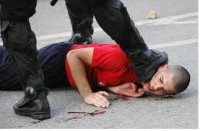
Police brutality has occurred in both the OWS movement and in response to each Arab Spring Revolution. Though the response to the Arab Spring Revolutions has generally been more brutal than the response to OWS demonstrations, the brutality indicates a similar state attitude toward these revolutionary demonstrations: that they will not be tolerated. If the actions of police are any indication, it seems that democracies (as evidenced by the US) are no more thrilled with such revolutionary demonstrations than were the dictatorships which responded to protests in Bahrain, Egypt, and Libya.
One protester described the actions of the police as reminiscent of what one might expect in a fascist state, saying, “I’m here because I’m incredibly sad and incredibly angry; I’m hoping our city government comes to their senses and stops dealing with us like a fascist state” (The Guardian). That particular protestor was referring to the brutal force used by police to break up protests in Oakland. The methods employed included teargas, stun grenades, and blows with batons.
In contrast, police in Egypt have shown considerably less regard for the lives of those protesting. Reports of just exactly what police are doing vary widely, but reported death tolls are staggering. One March in protest of the government consisted of the relatives of approximately 850 people who had been killed while participating in sit-ins (The Daily Beast). Similar to protesters in the US, those marching were met with teargas and blows from police, but the damage done was far more extensive. Nearly 1,000 people were reported to have been injured, due to police action in that one incident alone. Police also employed verbal assaults and threatening family members of protesters. …more
April 11, 2012 Add Comments
Abdul Rasoul Hassan Ismail of Karbabad killed in Chemical Gas attack turning his home into Gas Chamber
editor: The methods used by MOI Police has demonstrated a “skillful” and deliberate use of chemical aerosols to transform Bahrain homes into lethal “gas chambers”. There should be no confusion, these are not harmless “tear gas” these are lethal chemical aerosols designed and used for combat scenarios. The regime is engaged in Chemical Warfare against its citizens. Phlipn.
Another Bahraini killed by poisonous tear gas
11 April, 2012 – PressTV
Another Bahraini has died due to asphyxia after inhaling poisonous tear gas fired by Saudi-backed regime forces as Manama’s brutal crackdown on protests continue.
The victim, identified as Abdul Rasoul Hassan Ismail, died after inhaling toxic gas fired on his house in the village of Karbabad last week.
Several Bahraini civilians, mostly senior citizens and kids, have died due to the misuse of tear gas against protesters by regime forces.
Meanwhile, Bahraini authorities continue to defy national and international calls to release prominent rights activist Abdulhadi al-Khawaja, who has been on hunger strike for over two months and is feared to be on the verge of death.
Khawaja, the co-founder and former president of the Bahrain Center for Human Right, began a hunger strike in early February to protest against the life sentence he received last year and Manama’s ongoing crackdown on peaceful protests.
Bahrainis have held several demonstrations in support of him after his refused to eat, urging the government to release him.
Amnesty International has also called for the ‘immediate and unconditional release’ of al-Khawaja, considering him a ‘prisoner of conscience, detained solely for exercising his right to freedom of expression’. …source
April 11, 2012 Add Comments
Letter to President Barack Obama calling for release of Abdulhadi al-Khawaja
Letter to President Barack Obama calling for release of Abdulhadi al-Khawaja
9 April, 2012
Barack Obama
President of the United States of America
The White House
1600 Pennsylvania Avenue NW
Washington, DC 20500
Dear President Obama,
We write to urge you to publicly call on the Government of Bahrain to immediately and unconditionally release from prison Abdulhadi al-Khawaja. Al-Khawaja is a Bahraini human rights defender and democracy activist who may soon die, as he has been on a hunger strike for more than two months.
Al-Khawaja was arrested one year ago in the wake of popular protests against the Bahraini government, and sentenced to life in prison. While in detention, al-Khawaja suffered from torture and severe ill-treatment. As a result, he was admitted to the Bahrain Defence Force Hospital in April last year with a cracked jaw and skull requiring several operations on his head and face.
To protest his ongoing detention and mistreatment, al-Khawaja began a hunger strike on February 8. In an open letter to the King of Bahrain, al-Khawaja pledged to stay on hunger strike until “freedom or death.”
After being arrested in April 2011, al-Khawaja was sentenced to life in prison in June 2011 as part of a group trial of 21 activists and human rights defenders. This group was charged with a range of offenses related to their role in peaceful demonstrations in Bahrain in February and March 2011. International human rights organizations and the Bahrain Independent Commission of Inquiry (BICI) have stated that the trials did not comply with international standards of due process,
nor even Bahrain’s own criminal code, because the 21 civilians were tried before National Safety Courts, which are military courts.
The evidence is clear that al-Khawaja and others were sentenced in violation of their rights to freedom of expression, assembly and association, which are protected under international law. We are deeply concerned about the health of human rights defender Abdulhadi al-Khawaja, and respectfully request that the United States urge the Government of Bahrain to release al-Khawaja immediately and allow him to travel abroad, including for medical treatment, if he wishes to do so.
Thank you for your consideration.
Sincerely,
3P Human Security
AFL-CIO
AFL-CIO Solidarity Center
Open Society Foundations
Physicians for Human Rights
Project on Middle East Democracy
Universal Muslim Association of America
Freedom House
Human Rights First
Human Rights Watch
Just Foreign Policy
Amnesty International
Citizens for Global Solutions
Foreign Policy Initiative
Americans for Democracy and Human Rights in Bahrain
April 11, 2012 Add Comments
State organized Milita groups pickup where MOI Police leave-off with murders, violence, ransacking of Shiite Villages and Businesses
Bahrain violence grows with mob attacks
REEM KHALIFA – Associated Press – 11 April, 2012
MANAMA, Bahrain (AP) — Mobs with iron rods and sticks ransacked a supermarket belonging to a major Shiite-owned business group Wednesday, a company official said, as part of a spike in violence in the Gulf nation in retaliation for a bomb attack on police.
The attack appeared linked to a wave of reprisals and intimidation by suspected Sunni groups angered by the 14-month-old uprising by Bahrain’s Shiite majority seeking to weaken the powers of the kingdom’s Sunni monarchy.
The growing unrest, which has included vigilante-style attacks in some Shiite areas, also could escalate worries by Formula One teams about whether to participate in the April 22 Bahrain Grand Prix. The race was called off last year amid security fears and Bahrain’s leaders are pushing hard to bring back the event as a sign of stability in the island nation.
Amir Jawad, a board member for the Jawad Business Group, said the mob smashed windows and caused other damage to the supermarket in what he called a “systematic” series of attacks. The crowds also roamed outside the headquarters of the company, which owns supermarkets, cafes and fast-food outlets.
Jawad said company security guards detained at least two suspected attackers. There were no immediate reports of injuries.
“The vigilantes used iron, steel and wood sticks,” he said.
Jawad sites have faced sporadic vandalism since the uprising began in February 2011 in the strategic Gulf nation, which is home to the U.S. Navy’s 5th Fleet. Bahrain’s Shiites account for about 70 percent of the population, but they claim they face widespread discrimination and are kept from top government or military posts.
Nearly 50 people have died in the Arab Spring’s longest-running street battles. Apparent Sunni mobs have stepped up reprisals following a blast Monday that injured seven policemen. On Tuesday, Bahrain said four suspects had been arrested in connection with the blast.
In some Shiite areas, apparent Sunni hard-liners carrying knives and sticks staged hit-and-run attacks late Tuesday and set up roadblocks, said witnesses, who spoke on condition of anonymity in fear of receiving pressures from authorities.
The largest Shiite political group, Al Wefaq, claimed that security forces failed to confront the “militias.”
…more
April 11, 2012 Add Comments
Bahrain F1 about Moral Choice not about “scaremongering”
Bahrain condemns ‘scaremongering’ over F1 race
10 April, 2012 – Al-Akhbar – Reuters
Bahrain Grand Prix organizers summoned support for their troubled Formula One race on Tuesday and said a campaign for it to be cancelled was being driven by “armchair observers” and “extremist groups.”
The Bahrain International Circuit produced witness statements from foreign observers, including two members of the Lotus team, and the British ambassador to the Gulf kingdom in defense of the April 22 race.
It said a briefing by the Lotus representatives had been sent to all 12 team principals on April 5 and ahead of this weekend’s Chinese Grand Prix in Shanghai, where a final decision is expected.
Bahrain, which has endured almost daily pro-democracy protests since an uprising against the government in February last year was bloodily suppressed, is due to follow on immediately after China.
There have been increasingly vocal calls for it to be cancelled however, with one unnamed team principal telling Britain’s The Guardian newspaper that all the teams were hoping the governing FIA would call off the race.
…source
April 10, 2012 Add Comments
MOI “Pinkertons” raid village of Akr, walk away with prisoners – of course they did, guitly or not
Bahrain arrests four after “terrorist attack” on policemen
10 April, 2012 – Lebanon Now
Bahraini authorities arrested four people Tuesday in a dawn raid on a Shia village, the opposition said, after seven policemen were wounded there in what officials claimed was a “terrorist attack.”
Al-Wefaq, the main opposition bloc, said that security forces arrested four people in the village of Akr, south of Manama, and “brutally” beat up relatives of those wanted by authorities in a crackdown which also left several wounded.
The arrests came hours after state news agency BNA quoted public security chief, General Tareq al-Hassan, as saying that an improvised bomb exploded late Monday near a police checkpoint at the entrance to Akr “wounding seven policemen, three of them critically.”
Hassan added that the initial investigation “revealed that the explosion was caused by a pipe bomb attached to a container full of gasoline.”
In a late Monday statement, Al-Wefaq said that it was closely “following the developments in Akr… but we have no independent information” about the incident, adding that the village was “entirely surrounded by security forces who are imposing collective punishment.”
“We have received calls for help from village residents,” it said, adding that security forces are “using pellet guns” against the villagers.
…source
April 10, 2012 Add Comments
EU High Representative, Catherine Ashton, on Abdulhadi al-Khawaja
FOR FURTHER DETAILS:
Michael Mann +32 498 999 780 – +32 2 299 97 80 – Michael.Mann@eeas.europa.eu
Maja Kocijancic +32 498 984 425 – +32 2 298 65 70 – Maja.Kocijancic@ec.europa.eu
Sebastien Brabant +32 460 75 09 98- Sebastien.Brabant@ec.europa.eu
COMM-SPP-HRVP-ASHTON@ec.europa.eu
www.eeas.europa.eu
EN
EUROPEAN UNION Brussels, 10 April 2012
A 162/12
Statement by the spokesperson of EU High Representative, Catherine Ashton, on the situation of Mr Abdulhadi al-Khawaja in Bahrain
The spokesperson of the High Representative of the Union for Foreign Affairs and Security Policy/Vice President of the Commission Catherine Ashton issued the following statement today:
“After more than 60 days of hunger strike, the health situation of Mr Abdulhadi al-Khawaja demands urgent attention. The High Representative is very worried by the latest reports. She and her services have been following the issue in close contact with Denmark, both in Europe and in Bahrain, and have spoken to various Bahraini representatives over the past weeks.
She urges the Bahraini authorities to take all appropriate measures to find a humanitarian solution to Mr. al-Khawaja’s deteriorating health situation, as a matter of absolute urgency.
She also urges the Bahraini authorities to immediately reinstate consular access to Mr. al-Khawaja, access which has been denied for the last two days.”
April 10, 2012 Add Comments
Ecclestone resorts to “blackmail” to force teams to Bahrain Grand Prix
Bernie Ecclestone tells F1 teams to pay up or shut up over Bahrain
10 April, 2102 – The Guardian
Bernie Ecclestone made the 12 Formula One teams an offer they must refuse on Tuesday when he indicated that they could decide whether or not to compete at next week’s Bahrain Grand Prix. The words he left unspoken were that, should the teams take him up on the offer, it would cost each of them millions for breaking contracts.
“We’ve no way we can force people to go there,” Ecclestone had said in response to a Guardian story in which a leading member of one team said everyone hoped the FIA would call the race off. “We can’t say: ‘You’ve got to go’ – although they would be in breach of their agreement with us if they didn’t go – but it doesn’t help.
“Commercially they have to go, but whether they decide to or not is up to them. I’ve had no one say anything other than: ‘We’re going to be racing in Bahrain.'”
Two triple world champions who later became team chiefs – Sir Jackie Stewart and Niki Lauda – explained why the teams would have to go to Bahrain, provided the race continues to be endorsed by Ecclestone and the FIA, the sport’s governing body. Lauda, who was in charge of the Jaguar team for two years, said: “The consequences are that if you don’t go you have to pay, so you have to be very careful. Teams can’t just say they’re not going. We’re all together in one world championship for Formula One.
“One team can’t just say they’re not going. If they say that they’re not part of the sport. They have a Concorde agreement. If teams can just do whatever they want we could not have races all over the world.”
Ecclestone and Formula One have the dozen constructors over a barrel. Because if any team – particularly a smaller operation – decides to break their contract with the sport’s commercial rights holder the consequences could be financially ruinous. The difficulties the teams face are not even purely financial. Stewart said: “I wouldn’t put it down to a financial figure. It’s more of a responsibility and a contractural commitment, not only to Bernie Ecclestone but to all the sponsors. …more
April 10, 2012 Add Comments
The Torture of Al Khawaja and Obama’s Powerlessness over a “Piss Ant” Tyrant
The Torture of Al Khawaja by American-Backed King of Bahrain
By: Siun – 9 April 9, 2012 – FireDog Lake
Update: Zeinab AlKhawaja (@angryarabiya) reports that her father has been moved to the hospital where the abuse described below took place last summer. His attorney and family have not been allowed to visit or speak to him for more than two days leading his attorney ‘to fear the worst.” Additional reports suggest he is on some type of IV fluids and the possibility of forced feeding but details are unclear. Zeinab is “on her way” to a further interrogation by the public prosecutor. This new questioning follows an additional arrest and release when she went to the hospital and asked to see her father.
Last summer, the King of Bahrain funded the “independent” Bahrain Independent Commission of Inquiry to review human rights issues in the country. The report was praised by the King’s American friends – and presented as justification for continued American support of the monarchy.
This past November the BICI commission’s final report included the following description of Abdulhadi Al Khawaja’s arrest and detention as one of 60 case studies of “alleged victims of torture or mistreatment.” (see page 430 and following of the full report, available for download at the commission site here )
As readers here know, Al Khawaja, is close to death this weekend as he continues a hunger strike as his only remaining way to protest the monarchy’s abuses. …more
April 10, 2012 Add Comments
The “Suicidal State” and the War on Youth
The “Suicidal State” and the War on Youth
10 April, 2012 – By Henry A Giroux – Truthout
In spite of being discredited by the economic recession of 2008, market fundamentalism has once again assumed primacy as a dominant force for producing unprecedented inequalities in wealth and income, runaway environmental devastation, egregious amounts of human suffering and what Alex Honneth has called an “abyss of failed sociality.”(1) The Gilded Age is back with big profits for the ultra-rich and large financial institutions and increasing impoverishment and misery for the middle and working class. Political illiteracy and religious fundamentalism have cornered the market on populist rage providing support for a country in which, as Robert Reich points out, “the very richest people get all the economic gains [and] routinely bribe politicians” to cut their taxes and establish policies that eliminate public goods such as schools, social protections, health care and important infrastructures.(2)
It gets worse. Everywhere we look, the power of the rich and powerful operates to create a “suicidal state”(3) in which regulations meant to restrict their corrupting power are shredded; shamelessly and without apology, they use their unchecked power to lay off millions of workers while simultaneously cutting the benefits and rights of those on the job in order to dramatically increase corporate profits. As social protections are dismantled, public servants denigrated and public goods such as schools, bridges, health care services and public transportation deteriorate, the current neoliberal social order embraces the ruthless and punishing values of economic Darwinism and a survival-of-the-fittest ethic. In doing so, the major political parties now reward as its chief beneficiaries the mega banks, ultralarge financial industries, the defense establishment and big business.
Reinvigorated by the passing of tax cuts for the superrich, the right-wing dominated House of Representatives along with number of right-wing state governorships have launched an ongoing war on women’s rights, the welfare state, workers, students, and anyone who has the temerity to speak out against such attacks. The corporate-controlled media, especially Fox News and Clear Channel Communications, emulate the former Soviet Union’s version of Pravda, its once laughable propaganda rag. At the same time, the liberal media is as spineless as it is complicit with existing relations of power – more willing to compromise with right-wing ideology than exercising civic courage in searching for the truth and exposing the lies of normalizing power.
Hiding behind the mantle of balance and objectivism, the liberal media is incapable of a discriminating judgment and moral position and, increasingly, resembles a game show nervously repeating bad jokes, promoting sensationalist stories, emulating celebrity culture and garnering elevated ratings in order to lure in big money from advertisers. …more
April 10, 2012 Add Comments
Bloodshed in Bahrain A year of ceaseless Human Rights Abuse
One year after the uprising, Bahraini civilians continue to be violently punished in their pursuit of democracy. The Journal speaks to human rights activists about the abuse inflicted on the nation’s citizens and the lengths that campaigners will go to prevent it
Bloodshed in Bahrain
10 April 2012 – journal-online.co.uk – Rachael Fulton
11 February in Budiyia, Bahrain. Thousands of people are taking to the streets for a peaceful political rally. An aura of collective hope reverberates through the crowd as men march ahead, women walking behind them clothed in burkas. Flags and banners trail in the air above the masses as they chant in unison, demanding democracy, the restoration of their rights and an end to the Al Khalifia government’s brutality.
As the excitement builds to crescendo, the crowd is confronted by a wall of armed Bahraini police in riot helmets and shields. Tear gas missiles are launched into the throng, spewing toxic fumes into demonstrators’ faces. The sky is shredded by rubber bullets. Sound bombs deafen them as they scatter, running blindly to avoid police gunfire. One woman refuses to run. She stands in the firing line, her hand raised in a defiant victory sign, allowing the clouds of stinging tear gas to engulf her. She will not surrender her beliefs under threat of violence. She will not stop fighting.
This is one of many harrowing images that haunts Elaine Murtagh, an Irish national deported from Bahrain in February for participating in anti-government protests. This rally would be the first of several public events Elaine witnessed during her week in the country, most of which descended into chaos at the hands of government authorities. While most Western women may have spent Valentines’ Day at home being treated by their partners, Elaine spent it escaping tear gas attacks and attending the wounded civilians littering Bahrain.
“I got shot at with tear gas and my eyes went blind – like getting a bottle of perfume poured in them,” recalls the 40 year old of her first protest. “My skin was on fire and I couldn’t breathe – I started to cry and shout. I will never forget how I felt. When I reached safety I wanted to ring my husband, but with the shock I could not even remember his name, or his number.”
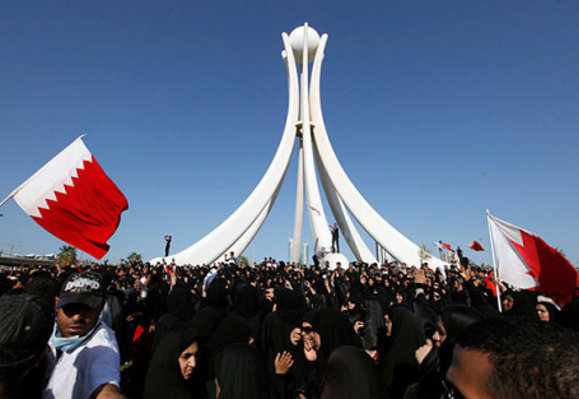
The February 14 protests marked the first anniversary of the Bahrain uprising, a revolutionary movement triggered by the Arab Spring. In this initial revolt, protesters set up camp in Lulu Square to demonstrate against the Al Khalifia government. They occupied the square until March 16, peacefully protesting for democracy, before a 1500-strong collective of troops from Saudi Arabia, the United Arab Emirates and Bahraini police mercenaries stormed the camp and tore down the Lulu Square monument. Protestors were rewarded for their uprising with tear gas bombs and rubber bullets. Hundreds were wounded and four killed. …more
April 10, 2012 Add Comments
Protester Attacked in March on US Embassy in Bahrain – Ambassador Krajeski fails Bahrainis Seeking Democracy
April 10, 2012 Add Comments
Eccelstone puts Moral Choice Squarely on FIA Teams Shoulders
Protest over the 2012 Bahrain Grand Prix
10 April, 2012 – Business and Human Rights Resource Center
Human rights groups have urged Formula One teams to consider boycotting the Bahrain Grand Prix in April 2012. Nabeel Rajab, Vice president for Bahrain Center for Human Rights has said: “We would prefer it if they [the teams] didn’t take part. I am sure the drivers and teams respect human rights.” Human Rights Watch has said: “[The Fédération Internationale de l’Automobile] should consider the serious abuse of human rights in Bahrain and the fact that to this day authorities continue to suppress pro-democracy protests.”
On 10 April 2012, Formula 1 CEO Bernie Ecclestone said that the decision on whether to take part is now up to each team: “Commercially they have to go, but whether they decide to or not is up to them”.
Business & Human Rights Resource Centre is inviting each team to respond to these concerns about the race. Below are the names of the teams followed by the items we are asking them to respond to. We will indicate next to each company at the latest by Wednesday 18 April whether or not each responded, and how it responded.
McLaren-Mercedes
Red Bull Racing-Renault
Ferrari
Sauber-Ferrari
Lotus-Renault
Force India-Mercedes
Williams-Renault
STR-Ferrari
Mercedes
Marussia-Cosworth
Caterham-Renault
HRT-Cosworth
We are also inviting the Formula One Group and its owners to respond:
Formula One Group of Companies
CVC Capital Partners
JP Morgan
…source
April 10, 2012 Add Comments
Bahraini authorities’ single-minded determination to persecute Abdulhadi Al-Khawaja override justice or humanity
Jailed Bahraini activist Abdulhadi Al-Khawaja’s life in danger
10 April, 2012 – Hassiba Hadj Sahraoui – Amnesty International
Bahraini prisoner of conscience Abdulhadi al-Khawaja’s health has seriously deteriorated due to a hunger strike.
“The Bahraini authorities’ single-minded determination to persecute Abdulhadi Al-Khawaja seems to override any consideration for justice or humanity.”
The Bahraini authorities must immediately and unconditionally release a prominent human rights activist whose health is rapidly deteriorating as he passes his 60th day of hunger strike, Amnesty International said today.
Abdulhadi Al-Khawaja, 52, who is serving a life sentence for his role in anti-government protests last year, has been denied visits by his family and lawyer in the past four days. He has been on hunger strike for 62 days in protest at his unfair imprisonment.
Amnesty International considers Al-Khawaja and 13 other prominent opposition activists held with him to be prisoners of conscience, held solely for peacefully exercising their rights to freedom of expression and assembly, and who have not advocated violence.
“These 14 men should all be immediately and unconditionally released – but instead the Court of Cassation has adjourned their appeal and denied them bail,” said Hassiba Hadj Sahraoui, Deputy Middle East and North Africa Programme Director at Amnesty International.
“In the case of Abdulhadi Al-Khawaja, this delay will have potentially disastrous consequences for his health, which continues to deteriorate as a result of his hunger strike. We hold the Bahraini authorities responsible for his situation.”
“Their single-minded determination to persecute him seems to override any consideration for justice or humanity.”
“At the very least, the authorities must immediately allow Abdulhadi Al-Khawaja’s family and lawyer to visit him.”
Abdulhadi Al-Khawaja’s wife told Amnesty International that he had been barred from receiving visits for the past four days.
They had last spoken on Friday evening, when he phoned her from the Bahrain Defence Force Hospital, saying he had asked to be transferred back to Jaw Prison after having difficulty breathing. He claimed that the nurses and guards at the hospital were not treating him well.
On Sunday, his family were turned away from Jaw Prison when they attempted to visit him, and his lawyer today had a visitation application denied.
On 2 April, the Court of Cassation started to review the verdicts against the14 men, but adjourned the hearing until 23 April, when it is expected to rule. The Court rejected a request to release the prisoners on bail.
Last week, Abdulhadi Al-Khawaja was transferred from Jaw Prison – first to the Ministry of Interior’s hospital in al-Qala’a, in the capital Manama, before being admitted to the Bahrain Defence Force Hospital.
Al-Khawaja, a former protection co-ordinator with Irish human rights NGO Front Line Defenders, was arrested in April 2011 and accused of being one of the leaders of anti-government protests. He was tortured in custody and sentenced to life imprisonment by a military court in a grossly unfair trial last June.
Bahraini authorities did not allow two Front Line officials to visit him in hospital during their mission to Bahrain last week. Large demonstrations were organized in Bahrain last Friday to demand Abdulhadi Al-Khawaja’s release. …
April 10, 2012 Add Comments
Bahrain risks instigating a collapse of its civic society if it does not release Abdulhadi al-Khawaja
Bahrain risks instigating a collapse of its civic society if it fails to release this respected human rights activist and hunger striker
Abdulhadi al-Khawaja’s death would be a stain on Bahrain
guardian.co.uk – 9 April, 2012
Your Majesty, King Hamad bin Isa bin Salman Al Khalifa,
We, the undersigned, call on the government of Bahrain to immediately and unconditionally release leading human rights activist Abdulhadi al-Khawaja, whose life is now in grave danger as he enters the 61st day of his hunger strike, begun in protest at his detention and treatment.
We call for his urgent release on humanitarian grounds, and in conformity to the findings and recommendations of the Bahrain Independent Commission of Inquiry (BICI).
If Abdulhadi al-Khawaja is not released and dies in prison, the Bahrain government will signal a total failure of political will in addressing the human rights violations that occurred in 2011. This would further alienate the already fragile trust of opposition groups and instigate a dangerous collapse of civil society. Mr al-Khawaja is deeply revered and respected by much of the population of Bahrain, as well as the wider region and world. His death could dangerously inflame national tensions which are already escalating.
Mr al-Khawaja was arrested on 8 April 2011 and subjected to cruel and abusive treatment by government employees. A forensic team working for the BICI team investigated his case.
The BICI team found that his jaw was broken “immediately after the arrest” which required “major surgery” to heal. In hospital he was “blindfolded the whole time and handcuffed to the bed with tight cuffs”. He was discharged from hospital, against the recommendations of his doctor, and placed in “solitary confinement in a small cell” where “there was no fresh air”. He experienced “regular beatings at night”, sexual assault and other torture.
Mr Al-Khawaja was tried before a military tribunal and given a life sentence for allegedly conspiring to overthrow the Bahrain government. Both his trial and subsequent appeal, which was also heard before a military tribunal, have been heavily criticised by major human rights and legal organisations. The BICI further found that after he was sentenced, he was “beaten by guards”. The findings of the BICI report were also very critical of the quality of the justice Mr al-Khawaja and other political leaders received.
Recommendation 1,720 of the BICI report calls for all such military trials to be reviewed before a civilian court. Mr Al-Khawaja’s life sentence was due to be reviewed before a civilian court on 2 April 2012. However, on that day a judge postponed the review until 23 April. Mr Al-Khawaja has now been on hunger strike for 61 days. The consequent deterioration of his health means that he will likely be dead or comatose before that date.
Mr al-Khawaja began his hunger strike on 8 February 2012. He has stated that he will continue this strike until “freedom or death”. There is no question of his commitment to this stance.
If your government allows Mr al-Khawaja to die in prison, it will send a stark message that it means to ignore the most important recommendations of the BICI report. The message will spread not just across Bahrain, but internationally, to citizens and governments who have relied upon your assurances that you are committed to reform.
You have the power to release Mr al-Khawaja. It will be a stain on Bahrain if his death comes before his freedom.
In the interests of justice and reconciliation in your country, we urgently and respectfully ask you to release Mr al-Khawaja immediately and unconditionally,
Signed:
The Right Honourable Lord Avebury
Jeremy Corbyn MP
Richard Burden MP
Front Line Defenders
PEN International
Doctors in Chains
Professor Sajjad Rizvi (University of Exeter)
Professor Scott Lucas (University of Birmingham)
Professor F Gregory Gause III (University of Vermont)
Professor Craig Toby Jones (Rutgers University)
Professor Khaleel Mohammed (San Diego State University)
Dr Christopher Davidson (Durham University)
Dr Mike Diboll (formerly of University of Bahrain)
• This letter will be delivered to the Bahrain Embassy in London at close of business Tuesday. Anyone wishing to add a signature can do so by sending an email to: releasealkhawaja@gmail.com
…source
April 10, 2012 Add Comments
The Revolution is Not Over – Formula One Don’t Come
April 10, 2012 Add Comments
Bahraini Terrorists Storm US Embassy – Quit paying Joe Trippi to Spin this Shit!
US Spins bloody tryrant as a patient King. Democratic Political Movement as Terrorists Uprising
10 APril, 2012 – Phlipn Pagee
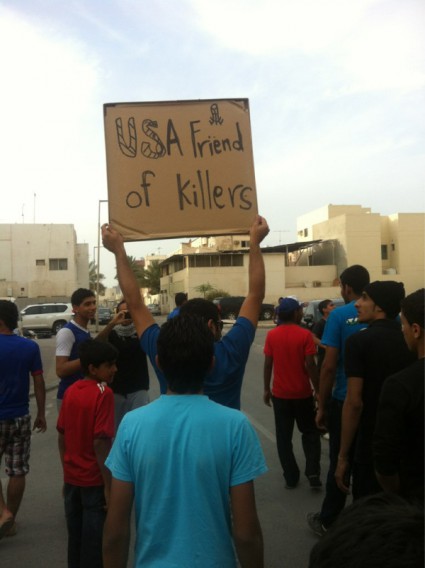
A year ago, Bahrain’s Youth Movement and the rest of Bahrain’s Democracy Movement were looking to President Obama for support after a dumbfounding display of violence by Bahrain’s King Hamad as he slaughtered protesters in what was solidly one of the largest nonviolent political movements to be maintained during the “Arab Spring”. Their demands we nothing more than implementation of democratic reforms promised by King Hamad a decade earlier. In what now seems an over reaction caused by fear of contagion to their Eastern provinces, the Saudis were so alarmed by the prospects of democracy in Bahrain, they invaded and took charge of the now year long reign of brutality, which includes well documented murders, rapes, tortures and collective punishment and detention of hundreds of political dissidents.
President Obama in the meantime took on a subservient role to the Saudis who held oil prices and 300B dollars of weapons deals and 50,000 US jobs in the offing. Secretary Clinton offered al Saud and their lackeys the al Khalifas the comforts only afforded “friends”. The al Khalifa regime was quick to pick up on exploiting their role as “vertically integrated trading partner”. The “friends of the DNC” hopped on the gravy train of security and public relation services, in order to salvage the reputation of the wayward King King Hamad, in a fashion reminiscent of former Secretary of State Albright’s billion dollar cell phone concession in Kosov and the USG deals wed by Chenney and Clinton(Bill) for KBR-Haliburton as one of the greatest war profiteering rackets ever imagined there. In a systematic fashion, Bahrain’s Democracy Movement is increasingly portrayed in Western media as a “terrorist uprising”. Google searches on Bahrain that used to yield scores of top hits showing the gross human rights violations by the regime, now pop up weather reports, travel information and articles about terrorism in Bahrain.
In the past year a nonviolent political movement for democracy is being media made into a violent antagonist of a pro-US regime. A regime that conducts daily raids using chemical gas attacks on villages transforming homes into lethal gas chambers. The police force of foreign nationals, which few speak Arabic, ransack villages, rape children, beat and torture the village residents continue to do so with impunity. In response the youth movement has been transformed into a “self defense” force for the villages. Yes, they do deploy Molotovs and without a coherent and responsible response from President Obama and Secretary Clinton that effectively corrals their murderous friends of the al Khalifa regime, the violence is sure to escalate. Without direct and meaningful intervention to stop their reckless and destructive “friend”, visions of a regime wrecked by the fruit of its own violence grow increasingly clear. And all the spin in the world won’t change the reality of situation where democracy will prevail even if it has to find its footing among the ashes.
President Obama is this is the fruit of your “quite diplomacy”, Hello! it isn’t working!!!! The streets grow louder and more unstable by the hour. Frankly you need to wake-up and realize King Hamad is no “friend”, he is a liability and as instability spreads throughout the region, the beast they call a revolution is going to rear it ugly head it the most in opportune time. And while your adjusting your policy lets see if we can come up with a recipe to make Ambassador Krajeski effective for all Bahrainis or get him the hell out. Bahrain needs someone who is interested in helping all of its people, not another career builder or incompetent CIA field agent, which ever the case maybe. President Obama, make that damn Nobel Peace Prize mean something for once. Somehow in all the war and violence your “quite diplomacy” seems to breed it make the Nobel look a bit like a “cracker jack” prize.
Phlipn, out.
April 10, 2012 Add Comments
How Bahrain Spends Millions To Spin The Press
How Bahrain Spends Millions To Spin The Press
9 April, 2012 – By Matt Hardigree -Jalopnik
The press reports “saboteur” — not a pro-democracy protester.
And those fiery armored vehicles bearing down on him are “enlightened peace keepers” being trained to become a “highly modern and sensitive public security force” — not part of the brutal Bahraini security forces who killed at least 13 people in an uprising last year and a 14th protestor less than two weeks ago.
That is, at least if you’re to believe emails sent to me by a former leading political editor from the United Kingdom whose job it is now to front for the Kingdom of Bahrain in their pursuit of better press from western outlets.
It was part of an orchestrated campaign by Bahrain’s ruling elite who want the return of the Formula One race later this month that was cancelled last year when the country was one of many states involved in what the west has dubbed the “Arab Spring.”
The race is back on — as of now — thanks to this effort to convince the press that all is well in the tiny Arab kingdom.
Perfect conditions for a race if you don’t mind the occasional tear gas or dead protestor. Excuse me, “saboteur.”
Bahrain And The “Arab Spring”
Bahrain is an Island kingdom in the Persian Gulf of about 300 square miles with a population of only 1.23 million. It’s nominally a constitutional monarchy, although all real power lies within the hands of the royal family, led by King Hamad bin isa Al Khalifa. The unelected prime minster — the longest serving prime minister in the world — is the King’s uncle.
As with many of the countries in the region, there are religious differences. The ruling elite are Sunni. The majority of the country is Shiite. Despite previous attempts at weak political reform the Shiite majority is mainly poor with little political power.
Pro-Democracy groups representing the marginalized portions of the population called for a day of action and took to the streets on February14th, 2011 in the midst of the “Arab Spring.” First a few thousand individuals appeared and then, eventually, hundreds of thousands. Nearly a quarter of the population may have protested at one point or another. They gathered around the Pearl Monument in Pearl Square in the capital city of Manama — a 300-foot sculpture that became a symbol of the protests. Their version of Egypt’s Tahrir Square. …more
April 10, 2012 Add Comments
FIA and fascist sympathizer Eccelstone should part ways to restore Moral Integrity to Sport
Bernie Ecclestone may have to bow to public opinion and call off this month’s grand prix
Bahrain shines uncomfortable light on F1’s moral credentials
11 April, 2012 – Guardian
Dictatorial, undemocratic, feudal in structure and intolerant of dissenting opinion – there have always been fundamental concerns surrounding Formula One. Bahrain has got problems, too.
The Bahrain International Circuit is one of 20 venues for F1’s travelling and very noisy circus in 2012. There are worries about a number of the other countries included in the sport’s calendar as well.
Human rights in China, the home of this Sunday’s race in Shanghai, has long been a topic of heated debate, as have conditions in oil-rich Abu Dhabi, which will host the 18th event in November.
Then there is the next race in Texas two weeks later, the state with the worst record on capital punishment in the United States, while the areas that stage the Indian and South Korean races are infamous for their poverty and have attracted allegations of corruption.
Formula One can argue rather convincingly it is not the planet’s moral guardian. The Bahrain Grand Prix, however, is different. For this is the race that galvanised public opinion last year and it is doing so again. Forget the decibel-fest in Shanghai on Sunday, it is Bahrain the following week that everyone is talking about.
This race was cancelled last year and, unless there has been a fundamental improvement in the political situation, it seems likely that it will be called off again, albeit for safety rather than moral reasons.
But no one is openly talking about it. That is because those who govern the sport want to go to Bahrain with a sense of unity. Without that the whole enterprise is hopeless.
And even now teams are afraid of falling out with the FIA, the sport’s governing body, or Bernie Ecclestone, the commercial rights holder who will be 82 this year but who still holds the sport in his gnarled grip. It has been that way for almost four decades. Ecclestone may be out of date but he remains, even in old age, one of the most remarkable negotiators in all sport and there is probably not a single team in the paddock which is not indebted to him, both personally and collectively.
In recent years some team principals have muttered, privately, that it is time to move on. They concede that while Ecclestone did a great job is positioning the sport where it is now, through the 1980s and 1990s, he knows little of the modern world or perhaps how best to market the beast that he created. …more
April 10, 2012 Add Comments
The evidence is clear that al-Khawaja and others were sentenced in violation of their rights
Bahrain denies man on hunger strike is critically ill
10 April, 2012 – CNN
(CNN) — Bahrain on Tuesday denied reports that a detained activist on a hunger strike has serious medical problems, saying he is taking fluids orally and intravenously.
Abdulhadi al-Khawaja, 52, was arrested a year ago and is serving a life sentence for his role in anti-government protests that continue to roil Bahrain.
He has been on a hunger strike for about two months.
The United Nations has urged Bahrain to consider transferring the detainee, who holds Danish citizenship, to Denmark on humanitarian grounds.
“In cases where there is a hunger strike, the health and well-being of the person should be the foremost concern,” United Nations spokesman Martin Nesirky said Monday.
Relatives are concerned about his health. His daughter said Al-Khawaja is having trouble breathing and is harassed by hospital staff and security guards.
“There were very long pauses,” Zainab al-Khawaja said Sunday after speaking with her father. “He was trying to breathe between every word.”
“His tone and the way he was speaking was like he was saying goodbye,” she said. “We’re not sure if we’ll ever see him again.”
Bahraini government officials said Tuesday that a medical checkup by two independent experts revealed al-Khawaja is not critically ill.
He is taking fluids orally and intravenously, and is in good condition, said Abdulaziz Al Khalifa, a spokesman for the internal affairs authority.
Rights groups such as Amnesty International have called on Bahrain to free him.
In a letter to U.S. President Barack Obama on Monday, the group and 14 others rights organizations urged Obama to demand Bahrain release him.
“The evidence is clear that al-Khawaja and others were sentenced in violation of their rights to freedom of expression, assembly and association, which are protected under international law,” the groups wrote.
A judicial panel has said he does not meet the conditions to be transferred into the custody of Denmark, according to the Bahrain News Agency.
Al-Khawaja was arrested in April 2011 for his role in anti-government protests that began a month earlier with demands for political reform and greater freedoms in the Sunni-ruled, Shiite-majority nation.
In June, Bahrain found him and seven other Shiite opposition activists guilty of plotting to overthrow the country’s Sunni royal family.
He can appeal his life sentence during a hearing April 23, the government said.
April 10, 2012 Add Comments
Iran, Another War for the One Percent
Surrender now or we’ll bomb you later
THE ROVING EYE By Pepe Escobar – 11 April, 2012 – Asia Times
Former United States president George W Bush issued an ultimatum to Saddam Hussein before bombing and invading Iraq.
Nine years later, US President Barack Obama has issued an ultimatum to the leadership in Tehran before … setting optimal conditions for an “all options on the table” exercise.
Obama has made an offer to Tehran to “negotiate” its nuclear program – ahead of long-delayed talks between the “Iran Six” (P5+1 – the five permanent members of the UN Security Council – the US, the United Kingdom, China, Russia and France – plus Germany) and Iran scheduled for Istanbul on Saturday.
For starters, it’s not an offer; it’s a list of demands – even before any negotiation takes place. And these “near term” concessions are packaged – according to the president’s own rhetoric – as a “last chance”.
In modern times, this used to be known as an ultimatum. In the post-everything era, it passes for “international diplomacy”.
Obama wants Tehran to shut down and in fact destroy the Fordow enrichment plant, built under a mountain outside the holy city of Qom; he wants Tehran to definitely renounce and “surrender” its entire stockpile of uranium enriched to 20%; to stop any sort of enrichment, even to harmless 5% (which means Iran renouncing its whole civilian nuclear program, to which it has a right according to the nuclear Non-Proliferation Treaty ); to allow International Atomic Energy Agency (IAEA) inspectors full access to all Iranian nuclear sites (they already have it); and to let the inspectors talk to all top Iranian nuclear scientists (that’s not exactly possible; quite a few have been assassinated by Israel’s Mossad).
So welcome to the “roll over and die” school of diplomacy – as perfected by the Obama administration, with vital input from the Israel lobby in Washington. It’s our way of the highway. And the highway is to hell – to the sound of “Bomb Bomb Iran”.
Another war for the 1%
No wonder the proverbial “Israeli officials” are delighted that Iran – via its Foreign Ministry – has rejected all these demands as “irrational”; for Tel Aviv, the Iranian response is “good”.
“Good” means the list of demands spells out the inevitable failure of the talks – which is the core of the Israeli strategy. Afterwards Obama may (will) use the failure as the perfect excuse to apply even harsher sanctions – and who knows what else.
The whole Israeli official apparatus for months have been brainwashing Israeli, American and European public opinion for war on Iran by all means necessary – manipulating everything from a nonsensical “existential threat” to the coming of a “second Holocaust”.
Now the whole Fordow controversy is linked to the Israeli spin of another shady concept – known as “sphere of immunity”. Tel Aviv insists Fordow will allow Tehran to protect the more sensitive elements of its nuclear program literally inside a mountain – immune from the most powerful GBU-28 bunker buster bombs (which Obama, by the way, agreed to sell to Israel). …more
April 10, 2012 Add Comments
Friends of Syria, “fools for war?”
We want war, and we want it now
THE ROVING EYE By Pepe Escobar – Asia times – 6 April, 2012
It was deep into the night, somewhere over Siberia, in a Moscow to Beijing flight (BRIC to BRIC?) when the thought, like a lightning bolt, began to take hold.
What the hell is wrong with those Arabs?
Maybe it was the narcotic effect of that perennially dreadful Terminal F at Sheremetyevo airport – straight out of a Brejnev gulag. Maybe it was the anticipation of finding more about the Russia-China joint naval exercise scheduled for late April.
Or it was simply another case of “you can take the boy out of the Middle East, but you can’t take the Middle East out of the boy”.
With friends like these … It all had to do with that Friends of Syria (fools for war?) meeting in Istanbul. Picture Saudi Foreign
Minister Saud al-Faisal – who seems to have a knack for sending US Secretary of State Hillary Clinton into rapture – feverishly arguing that the House of Saud, those paragons of democracy, had “a duty” to weaponize the Syrian “revolutionary” opposition.
And picture al-Faisal ordering an immediate ceasefire by the Bashar al-Assad government, guilty – according to the House of Saud – not only of cruel repression but crimes against humanity.
No; this was not a Monty Python sketch.
To make sure he was milking the right cow, al-Faisal also said that the Gulf Counter-revolution Club (GCC), also known as Gulf Cooperation Council, wanted to get further into bed with the United States. Translation, if any was needed; the US-GCC tag team, as expressed by the weaponization of the Syrian “rebels”, is meant to body slam Iran.
For both the House of Saud and Qatar (the other GCCs are just extras), what’s goin’ on in Syria is not about Syria; it’s always been about Iran.
This especially applies to the Saudi pledge to flood the global oil market with a spare oil production capacity that any self-respecting oil analyst knows they don’t have – or rather wouldn’t use; after all, the House of Saud badly needs high oil prices to bribe its restive eastern province population into not even thinking about that Arab Spring nonsense. …more
April 10, 2012 Add Comments
BAHRAIN: How the US Mainstream Media Turn a Blind Eye To Washington’s Despotic Arab Ally
Study Reveals Corporate News Blackout On Democracy Uprising in Persian Gulf Kingdom
BAHRAIN: How the US Mainstream Media Turn a Blind Eye To Washington’s Despotic Arab Ally
by Colin S. Cavell – 9 April, 2012 – Global Research.ca
In her year-end summary of the Arab Spring revolts of 2011, Christiane Amanpour, the Global Affairs Anchor of ABC News as well as an anchor and Chief International Correspondent at CNN, highlights the rebellions in Tunisia, Egypt, Libya, and Syria but never mentions the uprising in Bahrain (“This Week,” December 25, 2011). Apparently, Bahrain falls off the global map with Amanpour and ABC News [1].
In its year-end edition, the world’s largest weekly news magazine with headquarters in New York City, Time, awarded its “Person of the Year” award to ‘The Protester’ heralding the millions who voiced their opposition to dictators and corruption in 2011 starting with the protests in Tunisia which spread throughout the Arab world on into Europe and across the Atlantic to the Occupy Wall Street Movement in the USA. In his cover story on “The Protester,” Time magazine reporter Kurt Andersen praises activists in cities in Tunisia, Egypt, Spain, Greece, Britain, Israel, Mexico, India, Chile, the USA, Russia, Syria, Germany, Italy, Hungary, Jordan, Yemen, Libya, Algeria, and Morocco. Is Bahrain mentioned at all, our dear reader may inquire? Only once: to indicate that the “days of rage” had reached to the “softer monarchical dictatorships—Jordan, Bahrain, Morocco…” (Andersen, p. 72) [2]. Yes, that is it—one mention. In a 21-page article, one would think that a seasoned journalist would care to write a little more about the massive demonstrations and subsequent onslaught by regime forces against the pro-democracy protesters which occurred in Bahrain in 2011. Is this careless journalism or deliberate policy to exclude reporting on Bahrain?
Dr. James J. Zogby, founder and president of the Washington DC-based Arab American Institute, in his article “The ‘Arab Spring’ Effect,” conducted a year-end public opinion survey in Tunisia, Egypt, Lebanon, Jordan, Iraq, Saudi Arabia, UAE, and Iran regarding the effect of the 2011 Arab Spring and the publics’ satisfaction with the pace of political change, and there is not one mention of Bahrain and no reporting on how Bahrainis feel about the pace of political change in their country (January 1, 2012). Is Bahrain just too small or too insignificant one may begin to ponder?
Noted commentator on Middle Eastern affairs, Professor Juan Cole from the University of Michigan, in his November 10, 2011 article entitled “Protest Planet: How a Neoliberal Shell Game Created an Age of Activism,” writes of the factors that have motivated the Arab Spring rebellions including “the resulting corruption, the way politicians can be bought and sold, and the impunity of the white-collar criminals who have run riot in societies everywhere…high rates of unemployment, reduced social services, blighted futures, and above all the substitution of the market for all other values as the matrix of human ethics and life.”
Though able to pinpoint many of the causes of the revolts, Dr. Cole—like others in the American mainstream—fails to mention Bahrain even once when he traces the path of the Arab rebellions thusly: “The success of the Tunisian revolution in removing the octopus-like Ben Ali plutocracy inspired the dramatic events in Egypt, Libya, Yemen, Syria, and even Israel that are redrawing the political map of the Middle East” (Cole, November 10, 2011). Excuse me, Professor Cole, but what about Bahrain?!
“Just like nothing ever happened”
In a rare exception to the near-national blackout of reporting on Bahrain by the USA’s top media outlets [3], National Public Radio reporter Kelly McEvers, in early 2012, tells, after several trips to Bahrain in 2011, of “Bahrain: The Revolution That Wasn’t” (McEvers, January 5, 2012). “Bahrain’s uprising didn’t get quite as much attention as some of the others in the Arab world last year,” she reports. “But it was one of the first, beginning on Feb. 14.” McEvers continues, “Bahrainis had protested before, mainly about the fact that the country’s majority Shiites remain poor [4] and disenfranchised by the Sunni monarchy. But they’d never protested like this.
“At first the protesters asked for things like an elected Parliament, a new constitution. But then when demonstrators started getting killed, tens of thousands of Bahrainis converged on a place called the Pearl Roundabout to call for the fall of the ruling Al Khalifa family.”
“Bahrain State TV called protesters traitors and agents of Iran, which is nearby and also has a Shiite majority.”
“In Bahrain, pro-government thugs attacked protesters, and protesters fought back. Just one month into the uprising, Bahrain’s ruling family authorized some 1,500 troops from Saudi Arabia and the United Arab Emirates to enter the country.”
“Apache helicopters circled overhead as authorities cleared the Pearl Roundabout of all protesters. They never made it back” (McEvers, January 5, 2012).
McEvers further notes that Bahrain is the one Arab country where the government was able to definitively suppress a major uprising. She quotes Dr. Toby Jones, a professor of Middle East history at Rutgers University, who concluded this is because “the United States and its allies wanted it that way.” Bahrain definitely stands apart from the other Arab regimes implies Jones. …more
April 9, 2012 Add Comments